American Guerrilla Marketing
Nationwide Service
Media planning, media buying, billboard advertising, & guerrilla marketing
Flyposting Services in London, Planned Around Your Campaign

A London flyposting campaign needs a clear area plan, artwork built for the chosen format and a confirmed route to authorized poster locations. Shoreditch, Soho, Camden, Brixton and the South Bank can all suit different briefs, but they are not one continuous posting area. The best plan concentrates coverage where your audience already moves and confirms each proposed surface before production.
AGM coordinates London flyposting campaigns with UK production support, from campaign planning and print specifications to installation and post-campaign documentation. We start with your objective, dates, artwork orientation and target areas, then confirm what can be delivered through the available authorized inventory. That distinction matters in the UK: an available-looking wall does not automatically have the owner’s permission or the required advertising consent.
Plan a London flyposting campaign
Send your campaign objective, dates, artwork orientation, approximate sheet count and priority areas. We will assess the authorized placement options, recommend a suitable format and return a defined London plan for review.
Build Coverage Around A Focused London Route
London is spread across distinct neighbourhoods, and the distances between them affect crew routing and campaign frequency. Rather than distribute a modest poster run thinly across the capital, we assess a compact group of areas against the audience, campaign dates and authorized location options.
- Shoreditch and Brick Lane: Assess for music, fashion, entertainment and creative campaigns when appropriate poster inventory is available.
- Soho and Covent Garden: Consider for central entertainment, retail and cultural briefs. Visibility and availability vary by street and property.
- Camden: A possible fit for music, venue and event campaigns, subject to the route and permissions.
- Brixton and Peckham: Consider for South London coverage where local relevance and authorized surfaces align with the brief.
- South Bank: Evaluate for arts and visitor-facing campaigns, while checking the specific estate, property and advertising rules.
These are examples of areas to assess, not promises of inventory, audience demographics or campaign reach. A proposed route should name the areas and placement type that can actually be secured.
Choose The Poster Format Before Approving Artwork
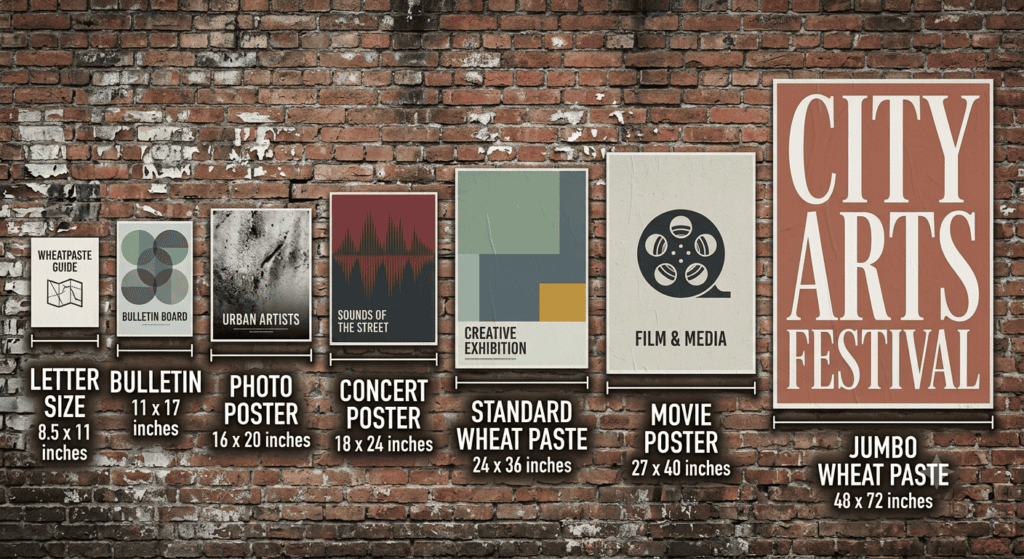
London street advertising uses its own established poster formats, ranging from high-volume street-level placements to oversized wall takeovers. Artwork should be designed directly to the selected format so the proportions, typography and visual hierarchy remain consistent through printing and installation.
| Format | Millimeters | Inches | Where It Goes |
|---|---|---|---|
| B2 Poster | 500 × 700 | 19.7 × 27.6 | Street-level placements throughout urban neighborhoods, pedestrian corridors and high-foot-traffic areas. Ideal for high-volume campaigns. |
| 4 Sheet (40 × 60) | 1010 × 1520 | 47 × 71 | Large portrait posters installed on street-level walls, construction hoardings and prominent urban surfaces. |
| Paste Up | 1010 × 1520 | 78.7 × 78.7 | Large-format installations designed to establish a dominant visual presence across prominent street-level surfaces. |
| Blockbuster | 2200 × 4000 | 86.6 × 157.5 | Oversized landscape installations designed for maximum visibility, large wall takeovers and high-impact brand awareness campaigns. |
B2 posters work well when the objective is frequency and repeated visibility throughout targeted London neighborhoods. The larger 4 Sheet format creates a more substantial individual presence on walls and hoardings, while Paste Ups allow multiple creative elements to establish a larger street-level footprint.
At the top end, Blockbusters provide a dramatically larger landscape execution designed for major wall takeovers and hero placements. Because these installations require significantly more uninterrupted surface area, they should be planned around the available wall inventory and the proportions of the final creative.
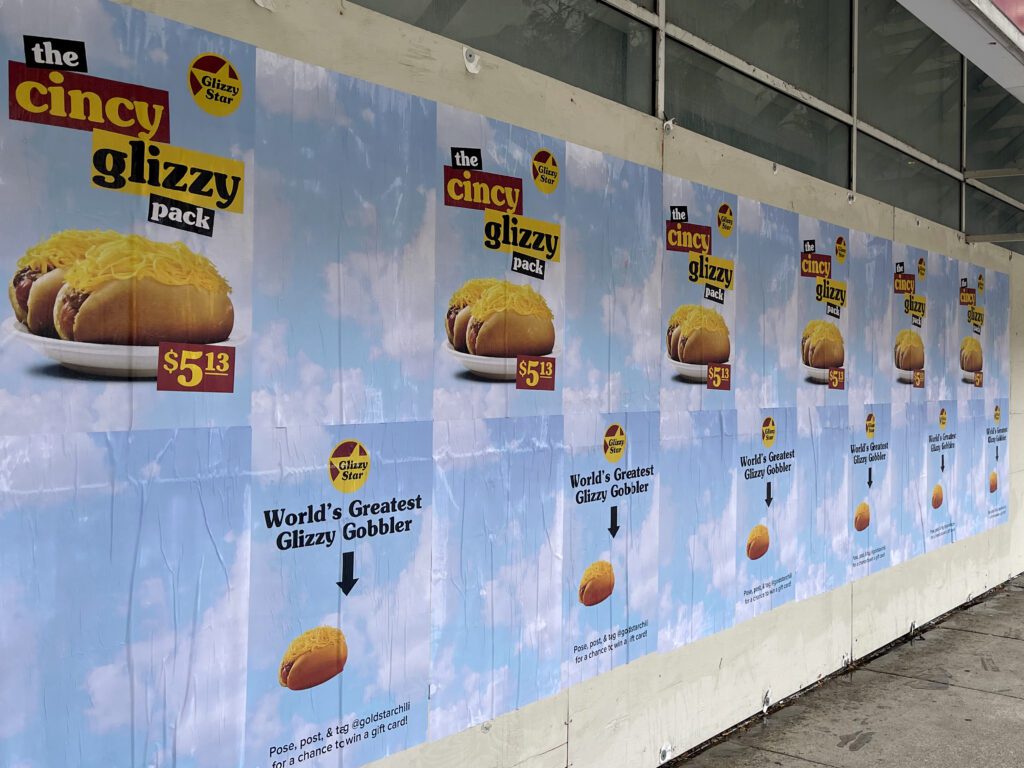
For larger installations and poster grids, artwork should be planned with seams, spacing and installation order in mind. Important typography, faces, logos and calls to action should be positioned so the composition remains visually strong once installed.
Final format, orientation, bleed and production specifications should be confirmed against the selected London inventory before artwork is released for printing.
Confirm Owner Permission And Advertising Consent
Flyposting in the strict sense can mean displaying posters without authorization. AGM plans campaigns around locations where the placement is approved and the property owner or relevant authority has given permission. Depending on the site and advertisement, planning consent may also be required. The UK government’s advertising guidance states that site-owner permission is required even where an advertisement has deemed consent; displaying an advert without the necessary consent can be an offence.
London is not governed by one single local enforcement office. The relevant borough or land manager may differ by location, and transport, estate or privately owned sites can have their own approval process. Before printing, the proposal should identify the type of inventory, responsible owner or media operator, permission basis and any consent assumptions. Never treat construction hoarding, a railway arch, street furniture or an empty wall as available merely because it is visible from the pavement.
Read the UK government guidance on advertisements and the relevant Town and Country Planning (Control of Advertisements) Regulations 2007. This page is marketing information, not legal advice.
Plan production around the surface and orientation
Poster orientation affects which locations can work. A portrait sheet may fit a narrow return or column-shaped display, while landscape artwork needs more continuous width. For a tiled wall or hoarding display, keep faces, logos and important copy away from panel joins, pipes, bolts and other breaks in the surface. Scouting should follow the approved creative direction rather than forcing the design onto an unsuitable wall after printing.
Paper, adhesive and surface condition should be selected for the specific placement and weather window. Rough brick, smooth render, coated paper and wet or cold surfaces behave differently. We confirm production specifications with the local team and avoid promising a fixed outdoor lifespan: cleaning schedules, competing posters, exposure and surface treatment can change how long an installation remains visible.
What A London Flyposting Campaign Includes
- Campaign planning: Align the objective, audience, timing, orientation and priority areas.
- Placement checks: Review current availability and the authorization basis for proposed locations.
- Artwork and format review: Match the creative to the printer or media owner’s exact template and identify joins or safe areas.
- Local production coordination: Coordinate print and installation with the UK production partner.
- Campaign documentation: Provide location and installation photos in the reporting format agreed in the proposal.
AGM manages campaign strategy and client coordination, while local production partners handle on-the-ground installation. Your proposal will state what is included—such as print, placement type, areas, quantity, schedule and reporting—before work begins.
London campaign example: Daddy Yankee’s La Postal
AGM coordinated London as one of seven cities in the two-round wheatpasting campaign for Daddy Yankee’s La Postal. The published case study describes production, scouting, installation and reporting across the campaign, and notes that the London and Madrid partner teams were upgraded between rounds to improve European reporting and photography. It is a useful example of why local execution and consistent documentation need to be planned together. Read the La Postal campaign case study.
How The London Campaign Process Works
- Share your brief. Tell us the objective, launch dates, audience, preferred neighbourhoods, poster count and artwork status.
- Check feasibility. We review route options, placement permissions, format needs, production and timing with the UK team.
- Approve the plan. Review the proposed areas, inventory type, deliverables, quote and assumptions.
- Produce and install. After approvals and artwork sign-off, the local team coordinates printing and installation.
- Review documentation. Receive the placement report and photos specified in the proposal.
London flyposting FAQs
Unauthorized flyposting can be unlawful. Each placement needs the relevant site-owner permission and may also need advertising consent. Requirements can vary by borough, transport operator, estate or property owner, so confirm the route for each location before installation.
Flyposting usually refers to individual paper posters or poster grids placed on approved surfaces. A 6-sheet is a separately booked outdoor-media panel with its own display area and artwork template. One should not be quoted or described as the other.
Shoreditch, Soho, Camden, Brixton, Peckham and the South Bank are examples of areas that may be assessed. Actual coverage depends on the brief, authorized inventory, dates and available local routes.
It depends on the placement. B2, ISO B1, A0 and A1 are sheet-size references, while UK trade “B1/Quad,” 4-sheet and 6-sheet can describe booked poster media formats. The table above separates them. Always use the final supplier template before preparing print files.
Not without checking. A 24 × 36 inch file may suit a particular campaign, but it does not automatically match a UK printer’s sheet or a booked outdoor panel. Confirm the finished size, orientation, bleed and safe area with the production partner before approval.
Share dates early, especially for multi-market campaigns, booked media or any placement that needs additional consent. Production and local availability affect the schedule. AGM’s London agency guidance recommends four to six weeks for larger cross-territory activations; the timing for a single-market campaign should be confirmed against its actual scope.
The proposal will define the documentation, such as location records and installation photos, and when they will be delivered. Coverage and photo detail should be confirmed before the campaign begins.
Our Campaign Locations
Browse All States
Explore Fly Posting Advertising opportunities across the United States.
49 States • 192 Cities