American Guerrilla Marketing
Nationwide Service
Media planning, media buying, billboard advertising, & guerrilla marketing
Full-service fly posting and wheatpaste campaigns across the Old Line State — Baltimore’s arts districts, Montgomery County’s professional corridors, and every market in between.
Maryland occupies a genuinely unusual position in American marketing geography. Wedged between the federal capital and the mid-Atlantic coast, the state contains some of the most educated, policy-aware, and media-literate consumer audiences in the country — audiences that are precisely the ones that respond to fly posting. These are people who walk neighborhoods, support independent businesses, attend arts events, and actually look at what’s on the walls around them.
American Guerrilla Marketing has executed fly posting and wheatpaste campaigns across Maryland’s most active markets — from Baltimore’s Station North Arts District to the pedestrian corridors of downtown Frederick, from Gaithersburg’s Rio Lakefront to Rockville’s Pike & Rose mixed-use hub. We operate with direct in-house installation crews — no subcontractors, ever — so every campaign gets executed with the same attention to placement strategy and surface quality that built our reputation.
Maryland’s geography is one of its defining marketing characteristics. The I-95 corridor compresses a large share of the state’s population into a tight band running from Baltimore south through the DC suburbs. That concentration means a well-designed statewide fly posting campaign doesn’t require covering sprawling rural distances — it requires surgical placement across a relatively contained but densely populated zone. That’s exactly the kind of campaign we’re built for.
From Baltimore's arts districts to Montgomery County's professional corridors, we'll put your brand exactly where Maryland's most engaged audiences walk every day.
Select a city to explore Fly Posting Advertising opportunities.
No other state shares Maryland’s specific relationship to the federal government and its attendant media ecosystem. The DC metro corridor — which draws in a substantial portion of Maryland’s suburban population in Prince George’s, Montgomery, and even Charles Counties — is shaped by a constant flow of policy conversation, advocacy communications, media relationships, and government-adjacent professional networks. That shapes the audience’s sophistication and the competitive landscape for getting noticed.
Street-level advertising thrives in this environment precisely because it’s not a digital banner or a cable TV spot. Fly posting and wheatpaste advertising are physical, tangible, and present in the actual spaces where people move through their days. For brands in the political communication, advocacy, entertainment, media, health sciences, or consumer sectors, Maryland offers an audience that responds to visual storytelling in a way that digital-saturated markets increasingly don’t.
The parallel to our work with The Onion — which ran a campaign spanning Manhattan and DC — is instructive here. That campaign succeeded in DC not because it blanketed mass-market surfaces, but because it placed street posters in the exact corridors where the target audience actually walked: the neighborhoods, the commuter routes, the arts-adjacent blocks where politically and culturally engaged people actually live their lives. Maryland’s federal-adjacent corridors operate on the same logic.
Baltimore is the anchor market for any serious Maryland fly posting campaign, and for good reason. The city contains more arts organizations per capita than most American metros, a warehouse district surface inventory in neighborhoods like Station North and Remington that genuinely rivals Brooklyn, and a culture of hyper-engaged neighborhood identity that makes street-level advertising feel native rather than intrusive.
Station North is Baltimore’s officially designated Arts and Entertainment District — a recognition that codifies what anyone who’s spent time there already knows: this is a neighborhood built around creative expression, and blank walls are part of that visual culture. The same goes for Charles Village near Johns Hopkins University, Fells Point’s historic cobblestone corridors, the Hampden neighborhood’s walkable stretch on 36th Street, and the rapidly evolving Remington blocks around R. House.
For entertainment brands, music releases, arts events, film campaigns, and consumer products targeting a culturally engaged urban audience, Baltimore is the kind of market where fly posting doesn’t just reach people — it speaks their language. Oriole Park at Camden Yards and M&T Bank Stadium generate enormous seasonal sports foot traffic in the southern downtown, adding a mass-audience layer to the city’s more arts-focused north.
Station North is Baltimore’s designated arts district — warehouse walls, gallery adjacency, and a creative audience that genuinely engages with street-level imagery. Charles Village adds the Johns Hopkins academic corridor: educated, culturally forward, high media awareness. Between them, these two zones cover a swath of North Baltimore that’s among the highest-performing fly posting territory in the mid-Atlantic.
Frederick’s Market Street corridor and Carroll Creek Linear Park form the core of a mid-size Maryland city with surprising cultural depth. Civil War heritage tourism brings out-of-town visitors who move through downtown storefronts. Hood College adds an academic layer. The Shab Row independent retail corridor is highly walkable and locally beloved. Fly posting in Frederick reaches a demographic that’s both locally rooted and DC-commuter-connected.
Gaithersburg’s Rio Lakefront development is one of Montgomery County’s most active public gathering spaces — a pedestrian lake loop with consistent cross-demographic foot traffic. The Kentlands neighborhood adds a walkable New Urbanist retail core that’s unusual for the suburban format. Montgomery County’s biotech and federal contractor employment base means the audience skews toward high-income, educated professionals — and that the market has exceptional demographic diversity across South Asian, East Asian, Latino, and other communities.
Rockville’s Pike & Rose is one of Maryland’s most successful mixed-use pedestrian developments, generating consistent cross-demographic traffic in a walkable format. The NIH and NIST research campuses anchor a professional community with above-average household incomes and brand awareness. Rockville Town Square hosts regular civic programming, and Metro access via the Red Line makes this a transit-connected suburban market with atypically high pedestrian foot traffic for its density.
Award Winning Personalized Service
You will get thoughtful, devoted, and individualized attention from our experienced, qualified, and professional personnel. Being one of the most illustrious agencies in Brooklyn, New York, American Guerrilla Marketing has been awarded the Best of Brooklyn title.
Nationwide
Industry City, Brooklyn, New York 11232
American Guerrilla Marketing
Hours
Mon - Fri: 9 AM - 5 PM
Sat & Sun: Closed
Automate your campaign with AGM’s Request for Proposal Builder. Simply answer a few quick questions about your campaign goals, markets, and timeline, and the system will generate a tailored presentation with recommended strategies, quantities, and pricing. Click the RFP Builder to instantly receive your customized proposal.
Montgomery County is one of the wealthiest counties in the United States and contains some of Maryland’s most distinctive audience segments. The biotech and government-adjacent professional communities centered around NIH, NIST, and a dense cluster of federal contractor operations create a residential community with high household incomes, brand sophistication, and media awareness. This is an audience that notices quality and responds to it.
Just as importantly, Montgomery County has exceptional demographic diversity. Gaithersburg and Rockville both feature major South Asian, East Asian, and Latino community concentrations alongside Anglo professional residents. For brands with multicultural targeting objectives, this geographic concentration of diverse, high-income consumers is rare outside of major global metros. Fly posting reaches these audiences where they actually spend their discretionary time — at the Rio Lakefront, in Kentlands, along Rockville Pike’s evolving streetscape.
The absence of heavy traditional outdoor advertising saturation in these markets is another structural advantage for fly posting. In markets that are billboarded to death, another outdoor ad is ignored. In Gaithersburg and Rockville, where OOH saturation is comparatively low, street-level fly posting stands out sharply and captures attention it wouldn’t command in a more cluttered environment.
Prince George’s County carries the University of Maryland — one of the largest universities in the Mid-Atlantic — along with a substantial federal workforce, proximity to the Capital Beltway, and communities that have seen significant investment and demographic evolution over the past decade. College Park’s campus-adjacent corridors and Hyattsville’s arts district are among the most underrated fly posting surfaces in the broader Maryland market.
Campaigns targeting Gen Z or Millennial audiences with strong academic or creative identities can reach a concentrated, engaged population in Prince George’s corridors that larger Maryland campaigns sometimes overlook in favor of better-known markets to the north and west. We know these surfaces and can route campaigns through them as part of broader Maryland builds.
Maryland’s relationship to the Chesapeake Bay is more than geography — it’s a cultural identity that shapes how residents relate to brands, community, and quality of life. The maritime heritage, seafood economy, and outdoor recreation orientation that define much of Maryland’s self-image create a consumer culture that values authenticity, locality, and character. Brands that communicate those values through fly posting are speaking directly to what Maryland residents respond to.
This extends to the Eastern Shore communities, Annapolis’s sailing culture, and the waterman communities that have shaped Maryland’s coastal economy for centuries. While the most active fly posting markets are concentrated in the I-95 corridor, campaign builds for brands with an outdoor, coastal, or lifestyle angle can incorporate Annapolis and Eastern Shore corridors where event density and seasonal foot traffic justify it.
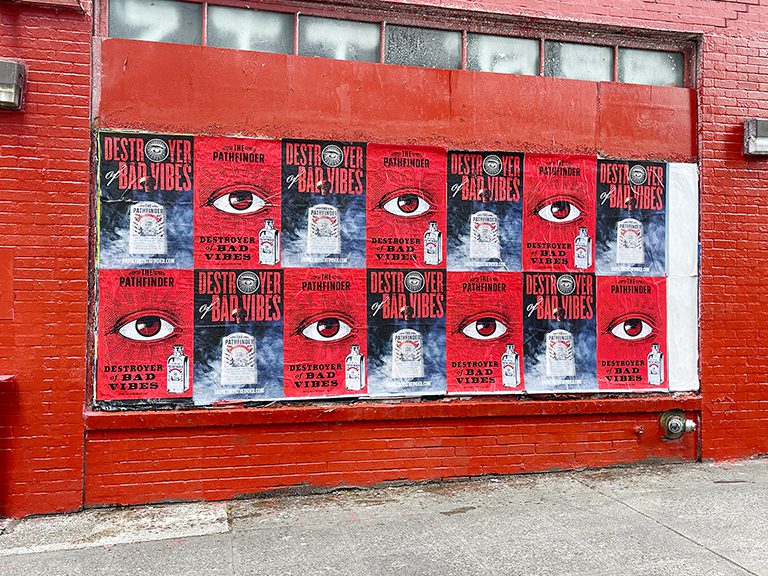
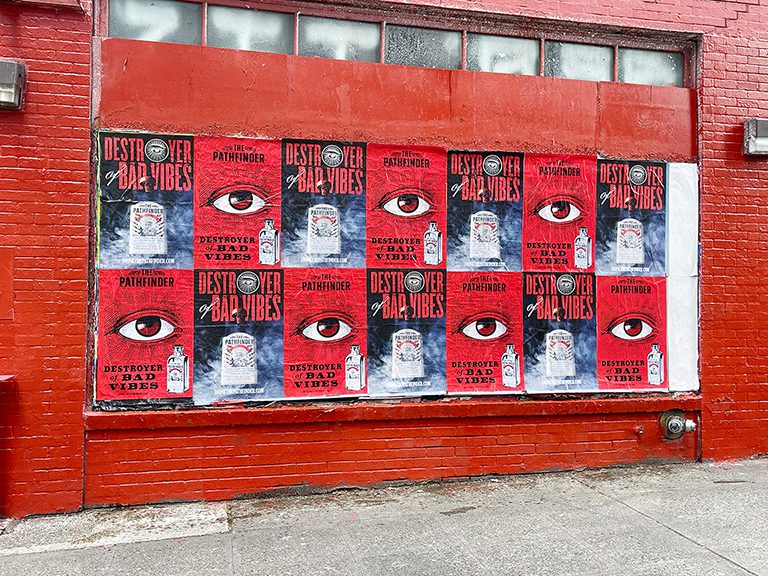
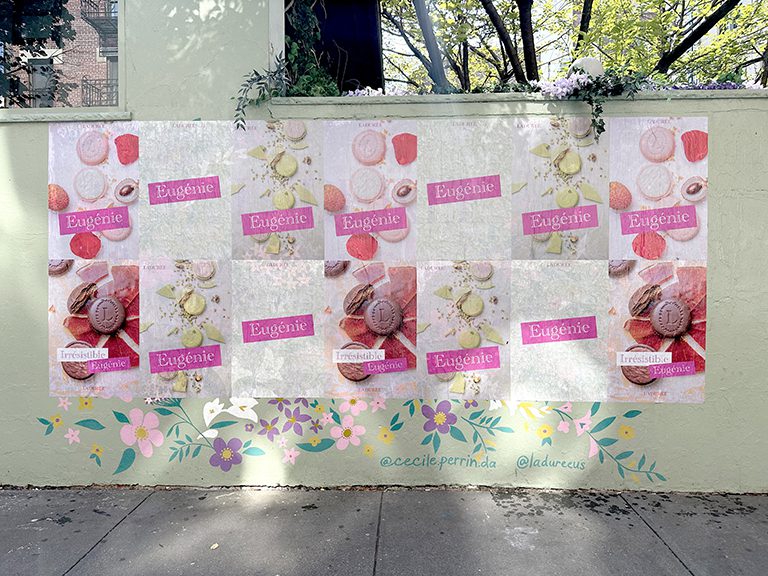
The standard fly posting format — dense coverage across multiple blocks and neighborhoods. Ideal for building presence across a market, creating frequency of impression, and owning a corridor. Best on smooth plywood construction barriers and blank commercial building sides.
Statement-scale wheat paste posters for key locations. Maximum visual impact at high-traffic intersections, construction hoarding, and blank warehouse walls. The 48×72 commands attention even at a distance and makes a dominant impression at the locations that matter most.
Our Maryland client mix reflects the state’s unique blend of markets. Entertainment companies use Baltimore’s arts district corridors to reach culturally engaged audiences for film, music, and event campaigns. Tech and health-science brands use the Montgomery County professional corridors to reach an educated, brand-aware residential audience. Advocacy organizations and political communications teams use the federal-adjacent suburban ring to reach audiences who are more tuned into policy and media conversation than almost anywhere in the country.
Consumer product brands use the statewide I-95 concentration to run efficient multi-city builds that reach Baltimore, the DC suburbs, and the corridors in between without the geographic sprawl that makes statewide campaigns expensive in larger states. And local businesses use neighborhood-targeted installations to create the kind of street-level presence that no digital campaign can replicate.
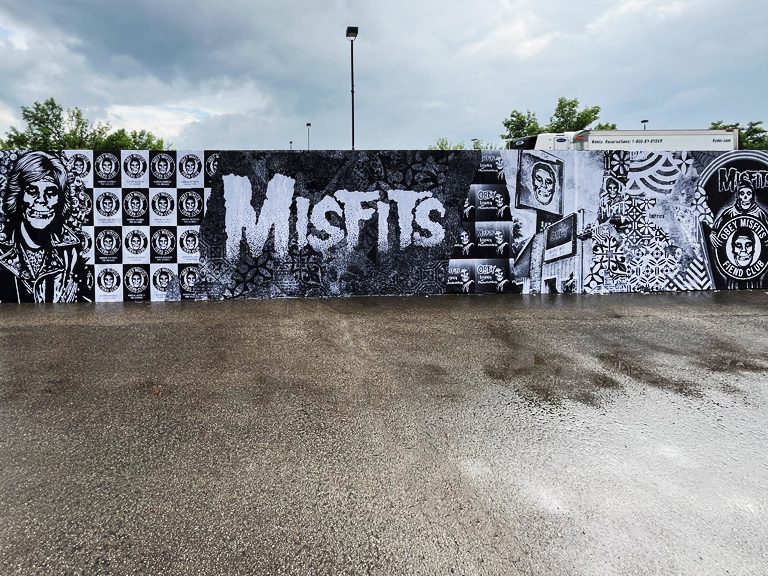
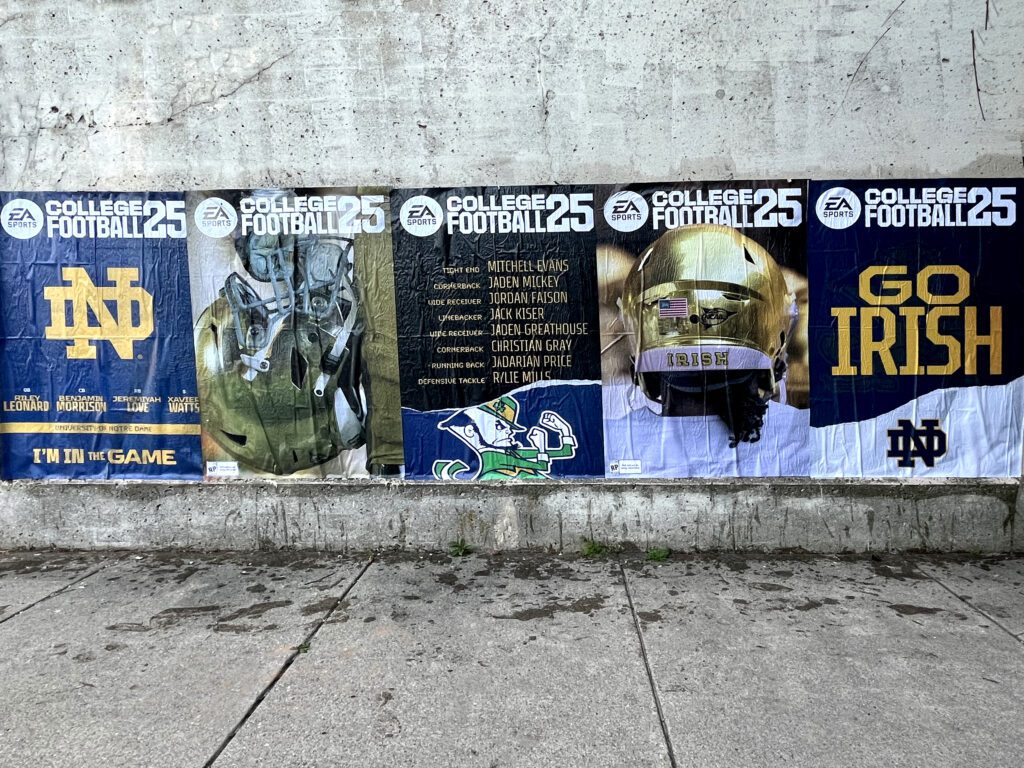
Our client history spans Netflix, The Onion, EA Sports, Biossance, and Shepard Fairey — alongside countless emerging brands and independent campaigns. We’ve won Best of Brooklyn recognition and built a reputation on delivering campaigns that actually look right and hold up. That standard travels with every crew we send into a Maryland market.
Effective fly posting starts with surface selection, and Maryland offers a range of surface types across its diverse markets. In Baltimore, blank warehouse walls and construction plywood in Station North, Remington, and Fells Point provide smooth, large-format surfaces that hold paste well and anchor the visual presence of a campaign. In the suburban corridors of Montgomery County, active construction along Rockville Pike and the White Flint redevelopment zone is generating fresh plywood hoarding inventory that’s among the best new surface stock in the mid-Atlantic.
Smooth-surface commercial building sides in downtown Frederick and the Carroll Creek zone hold 24×36 posters beautifully and are visible from the pedestrian routes that locals and tourists walk daily. Utility structures and blank building exterior sides in academic corridors near MICA, Johns Hopkins, and the University of Maryland add density in high-traffic student and faculty zones. The general principle across all Maryland markets: smooth surfaces hold paste longest, visible corridors maximize impressions, and placement strategy matters as much as quantity.
We’re capable of building campaigns across Maryland’s full geography, including smaller markets like Annapolis, Towson, College Park, Hyattsville, and Silver Spring alongside the major hubs. The practical concentration of active campaigns is in the I-95 corridor from Baltimore south through the DC suburbs, but we route campaigns based on where your audience actually is, not where it’s easiest for us to operate.
Maryland’s markets tend to have lower traditional OOH saturation than primary metros, which means street-level fly posting stands out more sharply against the competitive landscape. The audience in Maryland’s suburban corridors is also disproportionately educated and high-income relative to the market’s size, and the federal-adjacent layer creates a uniquely policy-literate and media-aware consumer segment you won’t find in most comparable metros.
Yes. The geographic proximity of Baltimore and the Montgomery County/Prince George’s County suburban corridor makes multi-market Maryland builds very efficient. We can route a single campaign through Baltimore arts districts and suburban Rockville or Gaithersburg in the same installation window, giving you I-95 corridor coverage with a single coordinated effort.
Fly posting is the practice of installing wheat paste printed posters — typically in formats like 24×36 or 48×72 inches — on exterior surfaces like construction barriers, blank building walls, and commercial building sides. It’s also called wheatpasting or street poster advertising. The result is street-level, high-visibility advertising that appears where people actually walk, creating an impression that digital advertising simply cannot replicate.
Typical campaign duration is one to two weeks, depending on weather conditions, surface type, and the specific locations used. Smooth surfaces in covered or sheltered areas hold paste the longest. Maryland’s weather patterns — including seasonal rain and humidity from the Chesapeake Bay — are factored into our surface selection and installation approach to maximize campaign life.
Never. Every Maryland installation is handled by our direct in-house crews. We don’t farm out work to third parties, which means every campaign gets the same training, the same standards, and the same quality control regardless of the market. This is a core operating principle we don’t compromise on.
The post-campaign GPS photo report includes geotagged photographs of every poster location, showing the poster installed in context. You can verify that coverage matches the agreed territory, use the photos for social media content, and document the campaign for internal reporting. It’s a complete visual record of where every poster landed.
Our smallest standard Maryland campaign is 100 posters in the 24×36 format at contact us for pricing or 100 posters in the 48×72 format at contact us for pricing. We can advise on the right mix based on your geography and objectives — sometimes a tighter concentration of larger-format posters outperforms a broader spread of standard-sized ones, and vice versa.
Yes. For 24×36 campaigns, we offer 72-hour rush turnaround for quantities up to 500 posters. This is designed for time-sensitive events, album drops, film releases, and product launches where getting up fast matters more than lead time optimization. Rush availability is subject to scheduling — contact us early if you’re working against a hard launch date.
Maryland’s market mix makes it attractive to an unusually wide range of brand categories. Entertainment clients use Baltimore’s arts and music corridors. Health and science brands use the NIH and biotech corridors in Montgomery County. Advocacy organizations use the federal-adjacent suburban ring. Consumer products use the I-95 concentration for efficient statewide reach. Fashion and lifestyle brands use Baltimore’s creative districts. We’ve run campaigns for all of these categories and can advise on the right territory and format for your specific objectives.
We accept high-resolution digital files — PDF, AI, or high-resolution PNG/TIFF — sized and formatted for the poster dimensions you’re running. We’ll review your artwork for print readiness when you submit your brief and let you know if any adjustments are needed before we go to print. The goal is to make sure what ends up on the wall looks as good as what you designed.
Fly posting regulations vary by municipality across Maryland, and campaigns are executed on surfaces where posting is permitted or on private property with appropriate authorization. We navigate this as part of campaign planning and do not install in locations that would expose your brand to compliance problems. Our experience across Maryland’s markets means we know where campaigns can be run effectively and legally.