
November 25, 2026
MKG Experiential Marketing: How It Actually Works
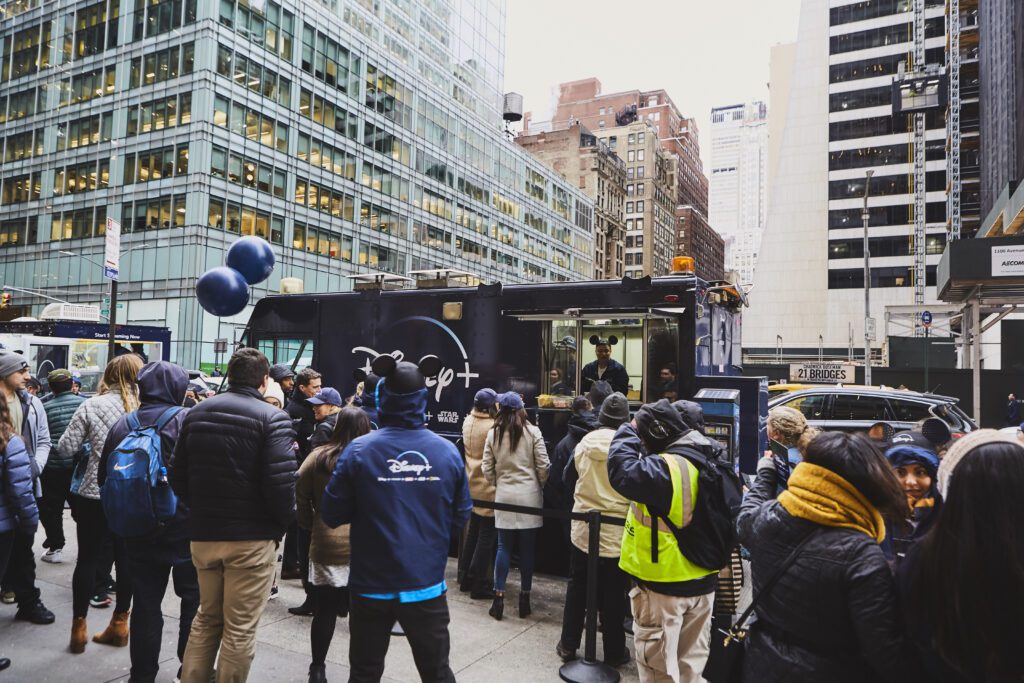
People searching MKG experiential marketing are usually doing one of two things.
Some are looking for a specific shop by name. I am not going to discuss other operators, so if that is you, this page will not answer that question.
The rest are doing something more useful. They have a budget, a product or a moment, and a vague sense that “experiential” is what they are supposed to buy. They are searching agency names because they do not yet know what questions to ask, and every page they land on is either a portfolio reel or a definition.
This page is for the second group. It is the operator’s version of how experiential marketing actually runs. Crew, hours, footprint, permission, weather, the stuff that breaks, and the ideas I talk clients out of before they spend a season building something that will not work on a sidewalk.
I run street-level campaigns. We paste, snipe, stencil, project and drive, and we staff Street Teams and activations. I have stood in a lot of footprints at six in the morning watching a truck fail to arrive. That shapes how I talk about this.
What experiential actually is, stripped of the reel
Experiential marketing is advertising that requires a person to be somewhere.
That is the whole definition and it is also the whole constraint. Everything that makes the format powerful and everything that makes it fragile comes from that one fact. You are not buying impressions on a surface. You are buying an event in physical space that depends on staff showing up, weather cooperating, a location being available, and strangers choosing to engage.
Three broad shapes:
Street teams. Trained staff in a defined footprint, handing something out, talking, directing people. Smallest footprint, fastest to deploy, most flexible.
Activations and installations. A built presence. A structure, a vehicle, a stage, a sampling setup, a photo moment. Needs a site, a build, power in most cases, and a teardown.
Event presence. Showing up inside someone else’s event, at a festival, a conference, a game, where the crowd is already assembled and the organiser controls the rules.
Those three differ enormously in lead time, cost drivers and risk. Most briefs that arrive describing one would be better served by another.
The honest trade: depth versus reach
Experiential buys the deepest engagement available in marketing and the smallest audience.
A good street team interaction lasts thirty seconds to two minutes. The person leaves holding something, having talked to a human, with a specific memory. Nothing else in out of home gets near that. Not a billboard, not a screen, not a poster.
And the total number of people who get that experience in a day is small. Genuinely small. Clients routinely underestimate this by an order of magnitude when they imagine the day.
This is the single most important thing to understand before you commission anything. If your objective is “lots of people should know we exist,” experiential is the wrong primary tool and you should be buying surfaces. If your objective is “the right few hundred people should have a real encounter with this,” experiential is unmatched.
The campaigns that work use experiential for depth and something else for reach. Usually that something else is paper on walls, which I will come back to.
Crew is the product
In street-level experiential, the staff are not delivering the campaign. They are the campaign.
How a team is built. A field lead who does not do the handing, because they are managing position, supply, breaks and problems. Then ambassadors in pairs, because a pair approaches people far better than a lone person does and because a lone person on a corner gets lonely and stops trying by hour three. For anything with a vehicle or a build, add someone whose job is the asset rather than the crowd.
How long a shift really works. Energy, not hours, is the limit. Genuine outbound engagement with strangers degrades noticeably after a few hours. We build in real breaks and we would rather run two sharp windows than one long one where the back half is people standing near a box.
Timing. Built around when the crowd exists, not around office hours. Lunch windows in business districts. Late afternoon and evening on commercial strips. Egress after an event. The morning peak at a transit interchange. A ten to four shift in a district that fills at seven is a day spent talking to nobody.
Briefing. The thing clients skip and the thing that decides quality. Ambassadors need to know what the product actually is, what the three most common questions will be, what they are not allowed to claim, and what to do when someone is rude. A team briefed for twenty minutes performs visibly worse than a team briefed properly.
Supply. Whatever is being handed out needs a plan for storage, resupply and weather. Paper goods in humidity are a problem. Anything perishable multiplies the complexity. Running out at hour two in front of a queue is worse than never having been there.
Footprint and permission, the grey area
Where you can stand is the question that decides most activations, and it is less settled than people expect.
Rules on sidewalk activity, distribution, structures and amplified sound vary by municipality. They vary again depending on whether you are on public right of way or private property, and on whether the property owner has given permission. Event grounds have their own rules set by the organiser, which are usually stricter than the city’s. Enforcement is inconsistent between cities and sometimes between districts inside one city. It is a grey area and anyone promising a single national answer is wrong.
What we do about it is practical:
We do not give legal advice and will not pretend to. We describe what we do to reduce exposure and we are honest about where uncertainty sits.
Weather is the whole risk register
Experiential is the only format in our mix that can be entirely destroyed by a forecast.
Rain. Crowds do not exist. A street team on a wet Tuesday in a commercial district reaches almost nobody, because the people who would have strolled are now walking fast with their heads down. Anything handed out in rain gets ruined immediately.
Cold. Engagement collapses. People do not stop to talk in freezing weather, outdoor dwell windows compress sharply, and staff performance drops fast however well dressed they are.
Heat. Staff rotation becomes a real operational requirement. Anything meltable is out. Midday footprints in Southern summer need shade or they are not footprints.
Wind. Kills anything lightweight. Tents, banners, flags, signage, printed handouts. A gust takes a setup apart and it looks bad while it happens.
So we build contingency into the plan rather than hoping. A covered fallback position, a reschedule clause, or a decision point the day before. The worst outcome is a full crew deployed into conditions where nobody is outside, and that outcome is entirely avoidable by planning for it.
What we talk clients out of
Building something elaborate before testing whether anyone stops. The most expensive mistake in this category. A big build that assumes engagement is a bet on strangers behaving the way a deck imagined. A smaller footprint tested first will tell you in one afternoon what a build will tell you after months.
Choosing a location by how it looks rather than by foot traffic at the actual hour. Photogenic plazas are frequently empty. Walk the site at the hour you intend to run. Count people. It is a dull exercise and it changes plans constantly.
Expecting reach numbers that the format cannot produce. If a client needs a large audience figure for an internal report, experiential will disappoint them. I would rather say that at the start than defend a small number afterwards.
Giveaways nobody wants. Branded items that go straight in a bin cost goodwill as well as money. The best handouts are either genuinely useful in that moment, in that weather, in that place, or they are the actual product.
Activations with no reason to be there. If the thing could happen anywhere, it will feel like it happened nowhere. The strongest activations are tied to a specific place, a specific event or a specific moment.
A single day with no surrounding presence. One day of staff in a district where nothing else exists is a day that evaporates. Which brings me to the part most experiential conversations skip.
Amplified sound as a default. Clients love the idea. It is the element most likely to generate a complaint, it varies most by municipality, and it rarely improves engagement.
Scripting ambassadors word for word. A script delivered verbatim sounds like a script, and people disengage within about four words of hearing one. What works is a briefing deep enough that staff can answer honestly in their own language, plus a short list of things they must not claim. Trust the people you hired and brief them properly, or hire different people.
Running the footprint for a full day because the day was booked. Crowds are not evenly distributed across hours, and neither is staff energy. Two sharp windows positioned where the foot traffic genuinely peaks will out-deliver eight continuous hours, and the team will still be approaching people properly at the end of the second one.
The layer that makes experiential land
Here is the thing I believe most strongly about this format, after watching a lot of activations work and a lot of them not.
An activation that arrives cold is an interruption. An activation that arrives after the neighbourhood has already seen the campaign three times is confirmation.
So we put paper up first.
Two weeks ahead, Wheatpasting & Poster Campaigns go into the corridors feeding the footprint. Night work, usual window roughly eleven at night to five in the morning, chosen for low pedestrian traffic, available kerb space and fewer interruptions. Crews work in pairs, one pasting while the other carries and spots, with several pairs working outward from a drop point on a longer corridor. Placement is a repeated grid rather than scattered singles, because repetition inside a walking distance is the entire mechanism.
Surface decides whether it holds. Smooth plywood hoarding is the best surface in this business, because paste wets it evenly and the paper lies flat with the edges staying down. Painted concrete and smooth block are close behind. Raw brick is porous and uneven, so paper bridges the mortar lines, sits proud and lifts at the corners. Rolling steel shutters move every morning when the business opens and chew paper quickly. Fresh sealant, silicone and anti-graffiti film reject paste outright.
Weather decides the rest. Paste needs a dry setting window and the first hours matter most. Humidity slows the set. Rain inside that window takes a run down to the pavement. Below freezing the paste will not bond before it freezes and you come back to paper on the ground. In Southern summer we work the back of the night because paper dries faster than a crew can lay it. We move nights for weather, routinely.
How long it holds is honestly variable. Days to several weeks, with sheltered surfaces at the long end and exposed corners and heavy foot traffic at the short end. Removal is planned and documented, because it is what keeps property relationships usable next time.
Closer in, Snipe Advertising saturates the walking routes at eye level. On the day, Sidewalk Decals & Stencils sit on the approach where people queue, on smooth poured concrete, since rough aggregate and brick pavers will not hold an edge.
Then the team arrives, and the people they approach have a flicker of recognition before anyone opens their mouth. That flicker is worth more than any amount of build budget.
Measuring experiential without fooling yourself
Nobody has clean attribution here, and the numbers people present are frequently softer than they sound.
What is honest and usable:
Interaction counts, recorded by the team. Actual conversations, not people who walked past. This is the real number and it will be smaller than the deck predicted. Record it anyway, because it is the only direct measure you have.
Redemption or sign-up counts. If something is handed out with a code or a link, track it. Response rates are modest and that is normal. Treat them as directional.
Documentation. Timestamped photographs of the footprint, the crowd and the setup. Proof of delivery rather than performance, and the thing clients most often forget to request.
Geo-held comparison. If you run in several markets, hold comparable ones unexposed and compare branded search or direct traffic. Blunt and slow, but the most honest instrument available.
Qualitative notes from the field lead. The most undervalued output of any activation. What people asked, what confused them, what objection came up repeatedly. That is genuine product and messaging insight and it costs nothing extra to collect.
What is not measurement: estimated reach figures built by multiplying footfall by a factor someone chose. Use them for comparison if you must. Do not report them internally as encounters.
Choosing the right shape for the brief
Quick practical guidance.
You need a lot of people to encounter the brand. Surfaces first, experiential second. Posters, snipes, decals for reach, a street team for depth at the points that matter most.
You need people to try the product. Street team or sampling activation, positioned where your target is already standing still rather than where it is convenient to park.
You need a moment with scale and spectacle. An activation or installation, on permissioned private ground, tied to a specific place and time. Add Projection Advertising if there is a building face and genuine darkness, since it reaches a size no built structure will.
You need to reach people at an event you do not control. Event presence, negotiated with the organiser, plus a street layer in the surrounding corridors where the organiser’s rules do not apply.
You need to own a district over weeks. Paper, mostly. Experiential cannot sustain that, because it exists only while people are standing there.
Frequently asked questions
What does experiential marketing actually involve on the day?
Staff, a footprint and a crowd. A field lead manages position, supply and breaks while ambassadors work in pairs, approaching people, handing something out and answering questions. Shifts are built around when the crowd exists rather than office hours. Weather, permission and footfall at the actual hour decide most of the outcome.
How many people will an activation reach?
Far fewer than most clients expect, and that is the honest trade. Interactions run roughly thirty seconds to two minutes each, which produces the deepest engagement available in marketing and the smallest audience. If reach is the objective, buy surfaces and use experiential for depth at the points that matter most.
Do I need permission to run a street team?
It depends on where you stand. Rules on sidewalk activity, distribution, structures and sound vary by municipality and by whether the ground is public right of way or private, and enforcement is inconsistent. It is a grey area. We build footprints on permissioned private property wherever possible, keep them compact and unobstructive, and document the setup.
What happens if it rains?
Crowds disappear, handouts get ruined and engagement collapses, so we plan for it rather than hope. That means a covered fallback position, a reschedule clause or a decision point the day before. Deploying a full crew into conditions where nobody is outside is the single most avoidable failure in this format.
Should the activation come first or the advertising?
Advertising first. An activation that arrives cold is an interruption, while one that arrives after a neighbourhood has already seen the campaign several times reads as confirmation. We typically paste posters in the feeding corridors a couple of weeks ahead, add snipes closer in, then place decals on the approach on the day.
What should we hand out?
Something genuinely useful in that moment, in that weather, in that place, or the actual product. Branded items that go straight into a bin cost goodwill as well as budget. Plan storage, resupply and weather exposure before committing, because running out at hour two in front of a queue is worse than not being there.
Request a campaign quote
If you are researching experiential agencies and want an operator’s read on what your brief actually needs, send us the market, the moment and the objective. We will tell you honestly what a footprint can deliver, what it cannot, and what a street layer around it would add.
We run Wheatpasting & Poster Campaigns, Snipe Advertising, Sidewalk Decals & Stencils, Projection Advertising, LED Trucks & Mobile Billboards and Street Teams & Experiential nationwide.
Request a campaign quote.

Ready to Run Your Campaign?
Call us or email us. We’ll tell you exactly what we can do in your market and what it costs.
Related Services
Explore similar advertising solutions offered by American Guerrilla Marketing.
American Guerrilla Marketing — Los Angeles
Street-level campaigns in Los Angeles and nationwide. Wheatpasting, LED trucks, street teams, and more.
(646) 776-2770
Related Articles
-
Cambridge Projection Advertising: Permissions, Corridors
November 25, 2026
-
Cincinnati Projection Advertising: Permits and Corridors
November 25, 2026
-
Projection Advertising in Long Beach, California
November 25, 2026
-
Experiential Marketing Agency Jobs vs the Alternatives
November 25, 2026
-
Richmond Projection Advertising: Permits and Corridors
November 25, 2026