American Guerrilla Marketing
Nationwide Service
Media planning, media buying, billboard advertising, & guerrilla marketing
Colorado’s Front Range concentrates one of the most brand-active young professional populations in the country. AGM executes wheat paste campaigns in Denver, Fort Collins, Colorado Springs, and Aurora — from RiNo gallery walls to the seasonal windows of Vail and Breckenridge.
Colorado’s Front Range is one of the highest-concentration markets in the country for brands targeting educated, active young adults who self-identify through their outdoor pursuits, their music preferences, and their relationship with brands that reflect who they are. From Denver’s River North arts district to Fort Collins’ pedestrian-core Old Town Square, from Colorado Springs’ independent arts corridor on Colorado Avenue to Aurora’s multicultural East Colfax Avenue, fly posting in Colorado reaches a demographic that treats street-level advertising as part of the visual culture they already engage with — not an interruption to scroll past.
The I-25 corridor that stitches the Front Range cities together creates a unique media geography: a dense population ribbon running from Pueblo in the south through Colorado Springs, Denver, Boulder, and Fort Collins toward the Wyoming border. Denver anchors the corridor with more than 715,000 residents in the city proper and a metro population approaching three million. Fort Collins, 65 miles north, combines 34,000 CSU students with a robust craft and creative economy that punches far above its population size. Colorado Springs, 70 miles south of Denver, blends military-adjacent young adult demographics from Peterson Space Force Base and Fort Carson with a genuine arts ecosystem that operates completely independently from Denver’s influence. Aurora, immediately east of Denver, is the metro’s most demographically diverse city — and home to East Colfax Avenue, one of the most consistently dense pedestrian corridors in the entire region.
Unlike most major American metros, Colorado’s consumer psychology is organized in part around outdoor identity. A significant percentage of Denver and Fort Collins residents moved to Colorado specifically for access to skiing, climbing, cycling, and trail running — and they carry that identity into their purchasing decisions in ways that brands can reliably reach. Outdoor apparel brands, gear companies, winter sports equipment makers, and lifestyle brands built around active living find Colorado’s wheat paste market unusually receptive because the demographic actively seeks out brands that reinforce their self-image. Fly posting in Denver’s RiNo neighborhood hits this market when it’s most engaged: during post-work brewery walks, First Friday routes on Brighton Boulevard, and morning commutes through a neighborhood where street art is treated as a community visual amenity rather than noise.
Colorado also draws brands that find its demographic valuable precisely because it’s difficult to reach through conventional channels. Craft beer labels entering a competitive state market, outdoor lifestyle companies seeking authenticity over impressions, cannabis brands constrained by digital advertising platform restrictions, and entertainment brands targeting mountain west audiences all find that wheatpasting in Colorado’s pedestrian-active districts delivers the contextual alignment that digital targeting claims to offer but rarely achieves. When an outdoor apparel brand’s poster appears on a Brighton Boulevard warehouse wall in RiNo in early October, it’s not reaching someone who was algorithmically bucketed into an audience segment — it’s reaching someone who climbed on the weekend, is now grabbing a beer at Crooked Stave, and is already thinking about their winter season.
AGM executes wheat paste campaigns across Denver, Fort Collins, Colorado Springs, and Aurora with in-house installation crews, GPS-documented photo reporting, and direct client service from creative brief to final install. No subcontractors. No guesswork. Just posters on walls in the right neighborhoods.
Select a city to explore Fly Posting Advertising opportunities.
Breckenridge Ski Resort, Vail Mountain, Keystone, and Arapahoe Basin typically begin opening terrain in late October and early November, kicking off a resort season that transforms consumer behavior along Colorado’s entire Front Range. Ski and snowboard brands, outdoor outfitters, mountain lodge operators, après-ski lifestyle labels, and winter apparel companies have a finite window to reach Denver and Fort Collins consumers before that first lift opens — and fly posting campaigns placed in that pre-season window land at exactly the moment when intent meets purchase readiness in a way that no other timing achieves.
Posters on Brighton Boulevard in RiNo and Mountain Avenue in Fort Collins installed in late September and October reach the same consumers who are simultaneously browsing gear reviews, comparing Ikon and Epic pass prices, and evaluating layering systems before the snow arrives. No other advertising format occupies the same street-level position in these neighborhoods at that specific moment. A digital ad on Instagram can reach someone scrolling at home; a wheat paste poster on the wall outside a RiNo brewery reaches them when they’re already in the physical environment where outdoor lifestyle brand decisions get reinforced — surrounded by their community, in the neighborhood they chose because it reflects who they are.
The resort season window creates a campaign calendar anchor that most other states simply cannot replicate. A brand that times its wheatpasting in Colorado to land three to four weeks before Vail or Breckenridge’s opening day is speaking directly to consumers who are already in active planning mode. It’s not aspirational advertising — it’s advertising that intersects a real purchasing decision already in motion. AGM has executed this timing strategy for outdoor lifestyle brands seeking Denver and Fort Collins street presence before mountain season opens, and the contextual relevance of those campaigns consistently outperformed equivalent placements made in warmer months when the ski-consumer mindset wasn’t yet activated.
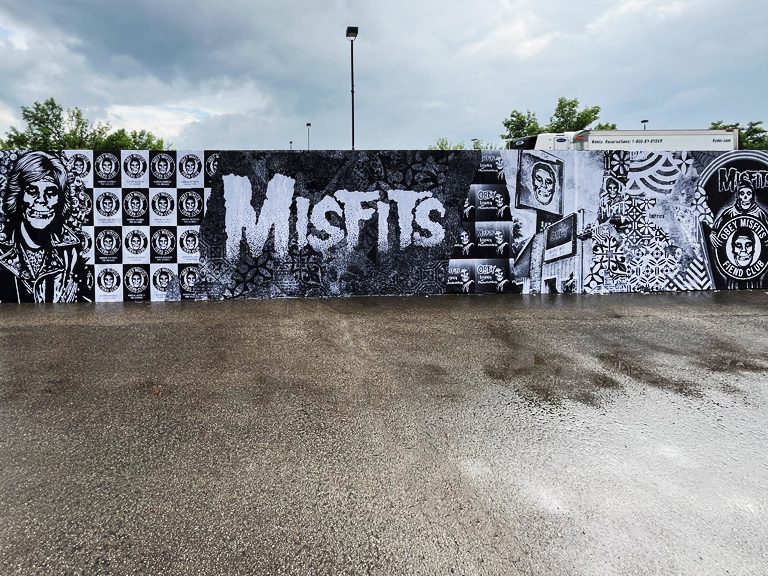
AGM’s installation work for Shepard Fairey’s Sonic Temple Festival 2024 activation in Columbus, Ohio demonstrated exactly the kind of large-scale arts district wheat paste execution that defines how music and visual arts brands should operate in markets with strong mural and street art cultures. The Columbus installations covered multi-story wall positions and high-pedestrian arts corridor placements, using the Short North district’s existing visual culture as context rather than trying to override it. The campaign felt endemic to the arts district — indigenous to the neighborhood’s identity rather than imposed on top of it — which is precisely the distinction that separates effective wheatpasting from generic outdoor advertising applied to available surfaces.
Denver’s RiNo arts district has more in common with Columbus’ Short North than with any other arts neighborhood in the Mountain West. Brighton Boulevard and Larimer Street are lined with commissioned murals from internationally recognized artists, and RiNo’s visual identity is built entirely around the premise that blank walls are creative opportunities. When AGM installs wheat paste in RiNo, the campaign doesn’t compete with the neighborhood’s visual environment — it participates in it. The same credibility that made the Shepard Fairey Sonic Temple campaign compelling in Columbus’ arts district translates directly to RiNo, where First Friday art walks pull thousands of creative professionals and arts-adjacent residents past the same corridors where posters go up.
Colorado’s broader concert ecosystem reinforces this connection. Red Rocks Amphitheatre in Morrison — arguably the most iconic outdoor concert venue in the United States — draws hundreds of thousands of visitors between May and October. The Mission Ballroom in Denver’s Cole neighborhood handles sold-out arena-level shows throughout the year. Ogden Theatre, Bluebird Theater, and Fillmore Auditorium all sit on or near Colfax Avenue, creating a dense live music strip that generates enormous pedestrian traffic on show nights. Music brands, streaming services, entertainment companies, and tour promoters use fly posting in Denver to reach the live music audience in exactly the neighborhoods where that audience eats, drinks, and moves before and after concerts — the same contextual logic that made the Sonic Temple installation effective in Columbus’ arts and music corridors.
Award Winning Personalized Service
You will get thoughtful, devoted, and individualized attention from our experienced, qualified, and professional personnel. Being one of the most illustrious agencies in Brooklyn, New York, American Guerrilla Marketing has been awarded the Best of Brooklyn title.
Nationwide
Industry City, Brooklyn, New York 11232
American Guerrilla Marketing
Hours
Mon - Fri: 9 AM - 5 PM
Sat & Sun: Closed
Automate your campaign with AGM’s Request for Proposal Builder. Simply answer a few quick questions about your campaign goals, markets, and timeline, and the system will generate a tailored presentation with recommended strategies, quantities, and pricing. Click the RFP Builder to instantly receive your customized proposal.
Denver’s RiNo Arts District functions as the epicenter of street-level brand culture in the Mountain West. Brighton Boulevard and Larimer Street anchor a neighborhood where warehouse walls covered in commissioned murals create the ideal environment for wheat paste campaigns — posters don’t interrupt RiNo’s aesthetic, they extend it. Denver’s fly posting market radiates outward from RiNo through Colfax Avenue’s live music venue corridor (Ogden Theatre at 935 E Colfax, Bluebird Theater at 3317 E Colfax, Fillmore Auditorium at 1510 Clarkson Street), into Five Points’ active revival on Welton Street near Mission Ballroom at 4242 Wynkoop, and through Capitol Hill and South Broadway’s combined residential and nightlife density. The city’s creative professional population, outdoor industry presence, cannabis economy, and music ecosystem make Denver one of the most active fly posting markets west of Chicago.
Fort Collins’ pedestrian-only Old Town Square concentrates foot traffic in a way that few cities of its size anywhere in the country can match — the car-free commercial core on College Avenue and Mountain Avenue functions as a naturally bounded impression zone where a well-placed campaign achieves extraordinary saturation with fewer positions than sprawling metro markets require. College Avenue running south from Old Town toward Colorado State University carries 34,000-plus enrolled students through daily pedestrian patterns, and the cross streets of Elizabeth and Laurel provide secondary density through off-campus housing approaches. The New Belgium Brewing district on Linden Street approaching the Platte River and Odell Brewing at 800 E Lincoln Avenue create craft beer cultural anchors that make Fort Collins one of the most contextually appropriate markets in the country for outdoor, lifestyle, and beverage brand wheatpasting.
Colorado Springs has built a genuine creative economy that operates independently from Denver’s influence — and that independence gives the city a distinct character that fly posting campaigns can engage authentically. Old Colorado City’s Colorado Avenue between 24th and 27th Streets hosts galleries, wine bars, independent retail, and Commonwheel Artists Co-op in a walkable corridor serving both Colorado Springs residents and tourists approaching Garden of the Gods and Manitou Springs. Manitou Springs adds a dense arts and independent shop strip on Manitou Avenue, anchored by Incline culture and Manitou Brewing. Tejon Street downtown concentrates the city’s 21-35 nightlife crowd after Pikes Peak Center for the Performing Arts and Theatreworks productions. UCCS students on Austin Bluffs Parkway and Nevada Avenue round out a four-layer market that few secondary cities outside the major coasts can offer to street poster campaigns.
Aurora is the Denver metro’s most demographically diverse city, and that diversity translates into a street poster market that can authentically reach audiences that homogeneous upscale districts consistently underserve. East Colfax Avenue — the eastern extension of Denver’s most storied commercial street — is one of the most continuously dense pedestrian corridors in the entire metro east of downtown, with independent businesses, music venues, bus stops generating genuine dwell time, and multilingual foot traffic patterns that persist well past standard business hours. Montbello’s neighborhood commercial corridors on Peoria Street reach a deeply local working-class young adult demographic. Aurora City Center’s transit-oriented development brings new apartment density and a growing young professional population priced out of closer Denver neighborhoods into a compact area with established commercial anchors and a Fitzsimons medical campus commuter population.
Outdoor apparel and gear brands dominate Colorado’s fly posting calendar. Companies competing for share in the skiing, climbing, mountain biking, and trail running markets treat Denver and Fort Collins as essential testing grounds for street-level campaigns before national rollouts. The demographic concentration — combined with the authenticity premium these brands place on reaching actual outdoor enthusiasts rather than aspirational audiences — makes wheatpasting in RiNo and Old Town Fort Collins a strategic priority rather than a secondary channel. A poster in the right RiNo position reaches someone who spent the weekend on a 14er and is now grabbing a beer at Epic Brewing on Tuesday evening, with contextual alignment that purchase funnel targeting cannot manufacture.
Craft beer and beverage brands have carved a natural home in Colorado’s wheat paste market. New Belgium, Odell, Tivoli, Breckenridge Brewery, and Crooked Stave have defined the state’s craft identity, and independent brands entering this competitive landscape use fly posting to build neighborhood-level credibility before their distribution footprint catches up with their brand ambition. A 48×72 installation on a Fort Collins brewery district wall — where the New Belgium story started and craft beer culture is woven into neighborhood identity — carries contextual weight that no digital placement can replicate at the street level.
Music promoters, touring artists, and festival brands target Colorado throughout the year but intensify campaigns around Red Rocks season from May through October and the fall concert push. Political campaigns have used AGM’s nationwide crews to execute multi-city Colorado activations across city council, gubernatorial, and presidential race cycles — Colorado’s status as a genuine swing state makes Denver, Colorado Springs, and Aurora consistently contested campaign ground during every election window. Technology startups and app companies targeting Colorado’s growing young professional population use fly posting as a brand-building tool that creates physical neighborhood presence alongside paid social campaigns.
Cannabis brands represent a category with unique relevance to Colorado’s wheat paste market. Platform restrictions on digital advertising for cannabis companies make outdoor formats one of the primary available brand-building channels, and fly posting in Denver’s creative neighborhoods — where cannabis culture intersects with outdoor lifestyle, music, and arts — provides access to the core consumer that no Instagram or Google campaign can legally reach. For this category specifically, wheat paste advertising in Colorado is not a supplement to digital strategy; it is frequently the only mass-reach channel operating without legal constraint.
Colorado’s urban geography rewards both formats, but for different campaign objectives. In dense pedestrian environments like Old Town Fort Collins or East Colfax Avenue in Aurora, 24×36 inch posters maximize reach: more positions, higher frequency impressions, and a coverage pattern that lets a campaign blanket a neighborhood grid rather than anchoring a single location. A 100-poster run of 24×36 in Fort Collins can cover every significant approach to Old Town Square, extend down the College Avenue CSU corridor, and reach the Mountain Avenue residential stretch — comprehensive saturation that builds frequency across semester-long daily pedestrian patterns for a budget entry point of contact us for pricing.
For markets where impact matters more than coverage density, the 48×72 format commands a different kind of attention entirely. A full-sheet installation on a Brighton Boulevard warehouse wall in RiNo, a Tejon Street building face in Colorado Springs, or a Montbello community corridor in Aurora reads as a statement rather than an advertisement — the scale forces a visual engagement that the 24×36 format, however numerous, cannot replicate. The 48×72 is the format for launches, for major event windows, for brands that need one position to stop pedestrian traffic rather than twenty positions to accumulate impressions over time.
For most first-time Colorado campaigns, AGM recommends the 24×36 format at 100 posters — the contact us for pricing entry point allows genuine market testing in a specific neighborhood before scaling investment. Brands confident in their highest-performing corridor and seeking dominant visual presence often move directly to the 48×72 format. Both formats accommodate multiple creative designs at Contact us for pricing. design for 24×36 and Contact us for pricing. for 48×72, which is particularly valuable for campaigns targeting Colorado Springs’ military-adjacent demographic, Denver’s creative professionals, and Fort Collins’ student market simultaneously with distinct creative treatments.
100 posters: contact us for pricing
200 posters: contact us for pricing
Extra creative: contact us for pricing
The standard fly posting format for Colorado’s pedestrian corridors. Ideal for Old Town Fort Collins, East Colfax, Capitol Hill, and neighborhood grid campaigns where saturation and frequency build brand recognition across daily commuter patterns. 72-hour rush available up to 500 qty.
100 posters: contact us for pricing
200 posters: contact us for pricing
Extra creative: contact us for pricing
Maximum visual impact for Colorado’s warehouse walls and high-traffic corridors. Makes a dominant statement in RiNo, anchors Tejon Street in Colorado Springs, and creates the kind of street presence that drives organic social sharing and visual amplification well beyond the poster’s physical footprint.
AGM’s Colorado campaigns begin with a neighborhood targeting session that maps the campaign objective to the specific foot traffic patterns of the relevant market. A brand targeting ski culture in the pre-season window gets a different neighborhood brief than a music tour hitting Denver in July or a cannabis brand building awareness in the creative professional corridors that define RiNo. The targeting phase identifies which streets, which block faces, and which installation timing windows generate the highest impression volume for the intended demographic — informed by direct knowledge of Colorado’s urban patterns, not assumptions derived from generically similar city sizes elsewhere.
Installation is executed by AGM’s own in-house crews — the company does not subcontract its Colorado installations to third parties, and this matters more than most clients initially realize. Crew quality directly determines execution quality: paste consistency, surface selection, height and angle of application, and on-site judgment about the best available positions all require trained experience that develops through repeated market work in specific neighborhoods. AGM’s installers have worked Denver’s RiNo and Colfax corridors, Fort Collins’ Old Town approaches, Colorado Springs’ arts district strip, and Aurora’s East Colfax density — they know the specific positions where poster retention is highest and where pedestrian exposure is most consistent throughout a typical campaign’s run duration.
Post-installation, every Colorado campaign position is documented with GPS-tagged photographs. Clients receive a comprehensive photo report showing each install location with geographic coordinates, allowing verification of placement, assessment of street context, and documentation for internal stakeholders and agency partners. In Colorado’s outdoor-active brand market, campaign photos from RiNo, Old Town Fort Collins, and East Colfax frequently serve a secondary content function — brands regularly share location shots from their street-level campaigns across social channels, extending the campaign’s digital reach without additional media spend. AGM’s GPS documentation supports that secondary use with accurate location photography that reflects the campaign’s physical presence honestly.
AGM executes fly posting campaigns across Colorado’s Front Range, with established market presence in Denver, Fort Collins, Colorado Springs, and Aurora. The Denver metro, which encompasses Aurora and surrounding municipalities, functions as a unified market for campaign planning purposes. Fort Collins and Colorado Springs are served as independent markets with dedicated neighborhood targeting and installation crews. For brands seeking statewide reach, AGM can coordinate simultaneous activations across all four markets within a single campaign window and timeline.
The late October and early November opening of Breckenridge, Vail, Keystone, and other Colorado resort areas creates a specific campaign window for outdoor lifestyle, winter apparel, and resort-adjacent brands. AGM recommends September and early October installations in Denver and Fort Collins to intercept the planning phase of ski consumer behavior — when Front Range residents are booking mountain trips, evaluating gear, and comparing season pass options. The contextual relevance of street-level campaigns placed in outdoor-culture neighborhoods before resort season creates an advertising moment that digital platforms cannot replicate with equivalent environmental authenticity.
Colorado’s consumer demographic is self-selecting in ways that most western states aren’t: a significant portion of Denver and Fort Collins residents actively chose Colorado specifically for its outdoor recreation access, which concentrates enthusiasts at a density genuinely difficult to replicate elsewhere. Phoenix and Las Vegas have larger total populations but lack Colorado’s outdoor identity concentration. Salt Lake City carries strong ski culture but a fraction of Denver’s commercial market scale. Colorado’s combination of population size, demographic quality, and outdoor identity saturation is largely unique in the Mountain West, which is why brands targeting serious outdoor consumers treat the Front Range as a primary — not secondary — market for street-level campaigns.
Campaign scale depends on objective and geographic footprint. A neighborhood-focused campaign covering RiNo and Capitol Hill in Denver typically runs effectively at 100 positions in the 24×36 format. A city-wide Front Range campaign covering Denver, Fort Collins, and Colorado Springs simultaneously typically requires 200 or more positions per market to achieve meaningful corridor saturation. AGM works with each client to match scale to specific objectives — the contact us for pricing entry point for 100 posters in a single Denver neighborhood is a genuine market test, not a compromise designed to minimize exposure.
Yes — AGM’s nationwide crew infrastructure supports simultaneous multi-city activations across Colorado’s Front Range markets. Brands targeting Denver, Fort Collins, and Colorado Springs in the same campaign window often find that coordinated timing amplifies the impact of each individual market, creating a sense of statewide presence that single-city campaigns cannot project. This approach is particularly effective for music tour promoters, major product launches, and seasonal brands whose message benefits from consistent visibility across the entire Front Range corridor at once rather than rolling out city by city.
AGM positions posters on legally compliant exterior surfaces including plywood construction barriers, commercial building exteriors with owner permission, painted cinder block and masonry walls in industrial and arts districts, and other durable surfaces suited to wheat paste adhesive. In Denver’s RiNo district, the warehouse building stock provides ideal large-format surfaces that hold posters through Colorado’s variable seasonal weather. Fort Collins’ Old Town building facades and Aurora’s East Colfax commercial corridor offer consistent inventories of viable positions that AGM has mapped through repeated campaign execution across multiple seasons.
Craft brewing brands entering Colorado’s intensely competitive market use fly posting to build neighborhood-level brand recognition before their distribution footprint catches up with their brand ambitions. A campaign covering Fort Collins’ brewery district on Linden Street near New Belgium and Old Town approaches on College Avenue reaches beer industry insiders, craft culture consumers, and the CSU student market simultaneously with a single activation. In Denver, RiNo’s brewery cluster makes wheat paste advertising the most contextually native format available to brands competing in that corridor — it’s the same medium that the neighborhood’s visual culture already celebrates as part of its identity.
AGM’s standard campaign timeline runs approximately 10 to 14 business days from final creative approval to street installation in Colorado markets. Rush timelines are available for the 24×36 format up to 500 posters. Colorado campaigns follow the same production cadence as AGM’s national operations: the client provides final print-ready art files, AGM handles printing, crew scheduling, and neighborhood targeting, then executes installation on the agreed launch date with GPS-documented photo reporting delivered promptly after installation is complete.
Music brands targeting Colorado concentrate fly posting primarily in Denver along the Colfax Avenue venue corridor — near Ogden Theatre at 935 E Colfax, Bluebird Theater at 3317 E Colfax, and Fillmore Auditorium at 1510 Clarkson — and in RiNo approaching Mission Ballroom at 4242 Wynkoop Street. Fort Collins’ Old Town receives festival and tour promoter campaigns around events at Aggie Theatre and New West Fest. Artists playing Red Rocks Amphitheatre in Morrison regularly activate in Denver’s RiNo and Capitol Hill neighborhoods during the weeks before their show, building street-level anticipation among exactly the audiences most likely to make the trip to Red Rocks.
Street-level wheat paste campaigns create a physical brand presence in the exact neighborhoods where Colorado’s target demographics live, socialize, and make purchasing decisions — environments that digital advertising cannot access with equivalent environmental authenticity. Brands running coordinated digital and street campaigns in Colorado consistently find that physical poster presence in RiNo, Old Town Fort Collins, or East Colfax drives organic social sharing and content amplification that extends reach well beyond the initial poster impressions. The physical campaign also establishes proof of market seriousness that digital alone cannot project — Colorado’s outdoor and creative communities respond to brands that show up in the physical spaces the community actually uses daily.
AGM’s minimum campaign is 100 posters for either the 24×36 format at contact us for pricing or the 48×72 format at contact us for pricing. Within those minimums, campaign geography is flexible — a 100-poster Denver campaign focused on a single corridor is a genuine market test with measurable reach. Clients comparing results across markets often start with 100-poster single-neighborhood campaigns in Denver and Fort Collins before scaling to full Front Range activations, using the initial campaign’s street performance to inform scale decisions with actual data rather than projections.