American Guerrilla Marketing
Nationwide Service
Media planning, media buying, billboard advertising, & guerrilla marketing
Two anchor markets, one powerful campaign footprint. AGM executes street poster campaigns across the Cornhusker State — from Omaha’s warehouse-walled Old Market to Lincoln’s Haymarket arts corridor — with full in-house print, installation, and GPS-documented proof.
Most national brands treat Nebraska as a flyover. That’s a strategic miscalculation. The state operates as a dual-anchor market with distinct strengths in both of its primary cities — Omaha running as a legitimate mid-major metro with Fortune 500 corporate headquarters, a dense entertainment corridor, and a walkable urban core that concentrates foot traffic in ways most mid-size American cities can’t match; and Lincoln anchoring one of the country’s most intense college-town markets forty-five miles to the west. Between those two cities, you reach the bulk of Nebraska’s population through fly posting in a way that digital advertising simply cannot replicate.
Omaha punches considerably above its population weight. Warren Buffett’s Berkshire Hathaway calls it home, as do Union Pacific Railroad, Mutual of Omaha, and Conagra Brands — Fortune 500 presences that give the city a professional-class population with disposable income and consumer sophistication. The Old Market district, built on converted warehouse and commercial buildings from the late 1800s, creates some of the best outdoor poster advertising surfaces in the central United States. Brick walls from the 1880s and 1890s hold wheat paste for the full campaign window. Pedestrian density through this corridor on evenings and weekends rivals that of significantly larger metro areas. Omaha is where Nebraska fly posting campaigns deliver their highest per-placement impression counts.
Lincoln is a different kind of market entirely. The University of Nebraska enrolls approximately 25,000 students on its City Campus, and that concentration of young, culturally engaged, foot-mobile consumers creates a campaign environment where physical advertising performs at a level that digital saturation has never been able to replicate. The Haymarket district — a converted warehouse corridor directly adjacent to campus — is the arts, dining, and music hub of the city. Add the singular cultural force of Cornhuskers football, with Memorial Stadium holding more than 85,000 fans and selling out every home game, and you have high-leverage timing windows that no other secondary market in the Great Plains can touch. On a game-day Saturday, foot traffic through the Haymarket and along the campus perimeter streets spikes sharply, and posters placed ahead of that window reach a volume of people that rivals fly posting placements in much larger cities.
Together, Omaha and Lincoln make Nebraska worth running. The secondary markets — Bellevue, Grand Island — extend that reach with their own distinct audience compositions, from Bellevue’s military-adjacent population along the Offutt Air Force Base corridor to Grand Island’s agricultural and regional event economy. Nebraska is a serious fly posting destination for brands that understand physical presence, campaign timing, and the distinctive brand loyalty of Midwestern consumers.
Tell us your target market, your campaign timing, and your creative — or let us help you build the strategy from the ground up. AGM runs Nebraska fly posting campaigns with full in-house execution and GPS-documented photo proof on every placement.
Select a city to explore Fly Posting Advertising opportunities.
Nebraska’s economic identity is agricultural. That shapes consumer psychology in ways that are directly relevant to campaign strategy. Midwestern audiences — particularly those with roots in farming communities or the logistics and manufacturing economy — tend to be skeptical of advertising that feels manufactured, corporate, or remote. They respond to things that feel present, real, and place-specific. Fly posting and wheatpasting deliver exactly that. A well-executed street poster on a warehouse wall or construction barrier in the Old Market or the Haymarket communicates presence in a way that no phone screen ad ever does. Physical advertising in Nebraska doesn’t fight the same cultural dismissiveness it might encounter in more media-saturated coastal markets.
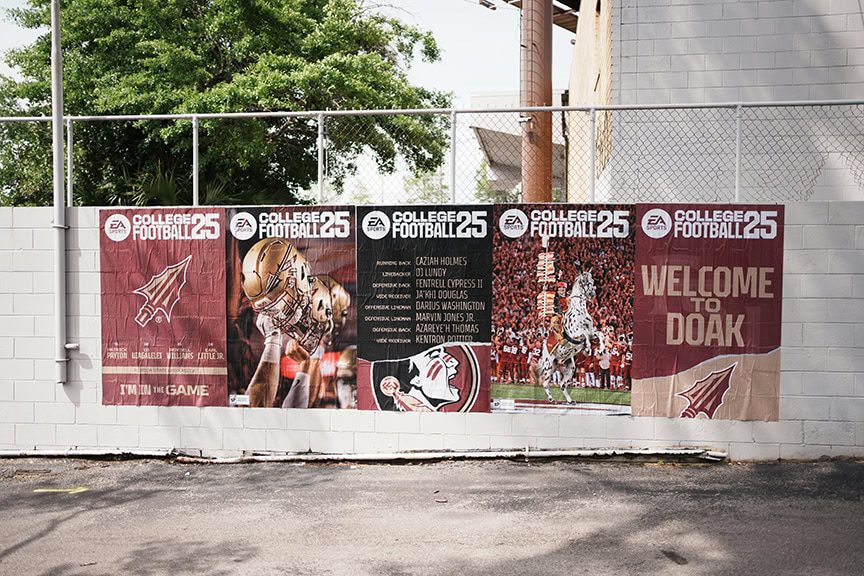
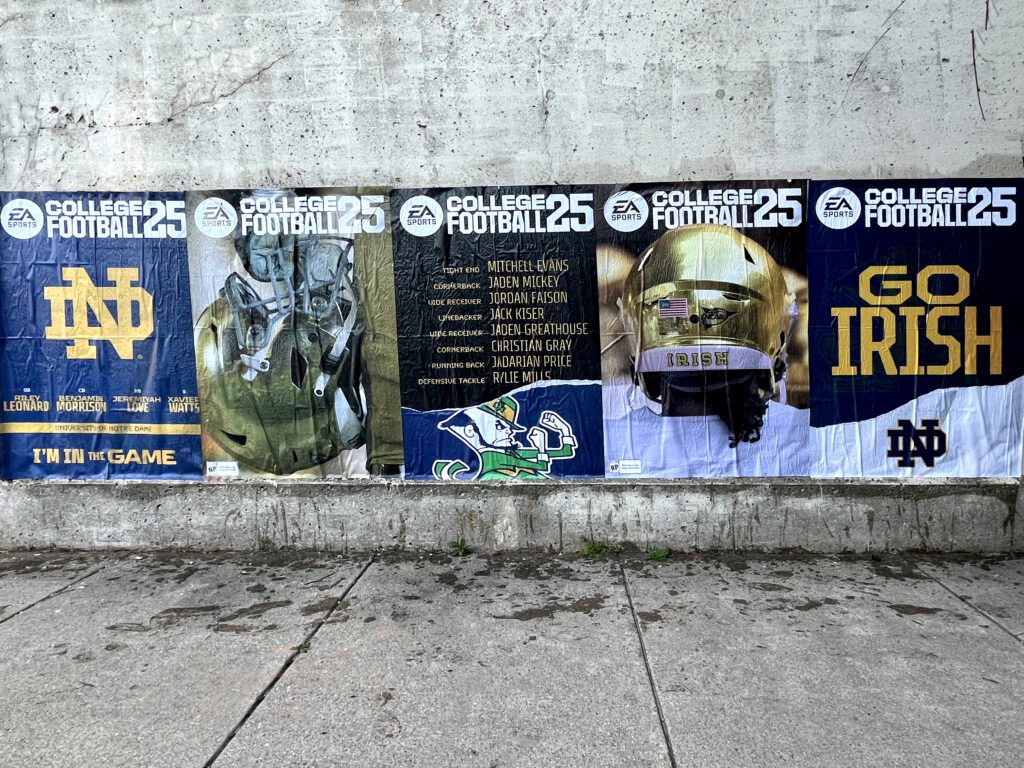
This matters most for brands that need credibility with working-class or middle-American audiences, but it applies broadly. Brands entering Nebraska for the first time — whether for a product launch, a streaming release, a tour announcement, a gaming campaign, or a cultural moment — benefit from the authenticity signal that street-level poster advertising carries. When EA Sports executed its FC 25 multi-city fly posting campaign, Nebraska was among the markets chosen precisely because physical presence in mid-market cities generates brand traction that pure digital campaigns don’t reproduce. Posters in the streets of Omaha and Lincoln created social-sharing moments and cultural conversation that extended the campaign’s reach well beyond the square footage of the walls they occupied.
Nebraska audiences also tend to stay. Unlike coastal cities with high resident turnover, Nebraska’s markets — particularly Omaha and Lincoln — have stable, long-resident populations. That means repeated exposure to a well-placed street poster campaign is genuinely cumulative. A young professional who walks or bikes through the Old Market three times a week, or a student who cuts through the Haymarket daily, sees your campaign multiple times across the posting window. Each impression reinforces the previous one. Fly posting in stable-residency markets builds brand familiarity faster than in transient ones, and Nebraska’s consumer populations are exactly that: stable, present, and receptive.
Surface quality determines campaign effectiveness. AGM scouts Nebraska’s physical landscape with the same rigor we apply to New York, Los Angeles, and Miami. The best fly posting surfaces in the state concentrate in urban cores, arts districts, entertainment corridors, and regional commercial hubs — locations where people move on foot, linger, and actually look at their surroundings. Here are the four zones that anchor Nebraska fly posting campaigns.
The Old Market is Nebraska’s highest-performing fly posting environment. The district is built on converted warehouse and commercial buildings from the 1880s through the 1920s — brick and masonry construction with large exterior walls that hold wheat paste exceptionally well for the full campaign duration. Cobblestone streets, preserved 19th-century architecture, restaurants, galleries, and an active nightlife scene draw tourists, young professionals, arts audiences, and the city’s dining crowd consistently throughout the week. Foot traffic in the Old Market on Thursday through Saturday evenings is dense and brand-attentive. Large-format 48×72 wheat paste posters in this zone operate as visual landmarks — the kind of placement that gets photographed, shared, and talked about. For any Nebraska campaign, the Old Market is the starting point.
The Haymarket sits at the meeting point of the University of Nebraska campus and downtown Lincoln — a converted brick warehouse corridor that has evolved into the city’s premier arts, music, dining, and event hub. Building facades, construction barriers from active development projects, and the constant movement of students, faculty, arts-goers, and young professionals create a rich fly posting environment. The Saturday Farmers Market draws thousands of pedestrians through this corridor during warmer months. Proximity to Pinnacle Bank Arena means concert and event nights amplify foot traffic sharply. Game-day Saturdays during the Cornhuskers season turn this district into one of the highest-impression windows in any secondary American market — tens of thousands of fans move through or near the Haymarket in the hours surrounding a Memorial Stadium kickoff. A Lincoln campaign that doesn’t include Haymarket placements is leaving its most powerful surface zone on the table.
Grand Island anchors south-central Nebraska’s regional commercial and agricultural economy. The Heartland Events Center is the market’s defining draw — concerts, rodeos, trade shows, and the Nebraska State Fair bring tens of thousands of regional visitors into Grand Island each year, creating campaign windows in which the effective market size expands dramatically beyond the resident population. Commercial zones along Highway 281 and the downtown Walnut Street corridor offer blank building sides and plywood construction barriers suitable for street poster campaigns. A fly posting campaign timed to a major Heartland Events Center event or State Fair window reaches not just Grand Island’s permanent residents but agricultural and logistics professionals traveling from surrounding Hall County and the broader south-central Nebraska region. For brands with messages relevant to that economy, this timing advantage is significant.
Bellevue sits directly south of Omaha along the Missouri River corridor, and its adjacency to Offutt Air Force Base gives it a population dynamic that no other Nebraska market shares. The military community generates consistent commercial traffic along the Highway 370 strip and through the Bellevue downtown corridor on Mission Avenue. Suburban residential density throughout the city provides audience depth, and the commercial zones along the 30th Street boundary between Bellevue and South Omaha extend campaign reach into Omaha’s southern population concentration. Campaigns that run simultaneously in Omaha and Bellevue achieve a geographic continuity across the metro that single-market buys cannot replicate — and at a combined cost that significantly undercuts equivalent reach in major metro markets.
Award Winning Personalized Service
You will get thoughtful, devoted, and individualized attention from our experienced, qualified, and professional personnel. Being one of the most illustrious agencies in Brooklyn, New York, American Guerrilla Marketing has been awarded the Best of Brooklyn title.
Nationwide
Industry City, Brooklyn, New York 11232
American Guerrilla Marketing
Hours
Mon - Fri: 9 AM - 5 PM
Sat & Sun: Closed
Automate your campaign with AGM’s Request for Proposal Builder. Simply answer a few quick questions about your campaign goals, markets, and timeline, and the system will generate a tailored presentation with recommended strategies, quantities, and pricing. Click the RFP Builder to instantly receive your customized proposal.
AGM operates two standard fly posting formats across all Nebraska markets. Pricing is fully inclusive: print production, crew labor, paste materials, and installation. There are no subcontractor fees, no markup tiers, no hidden line items. AGM handles everything in-house from print to proof.
The 24×36 is the standard street-level impact unit. At roughly two feet by three feet, these posters are built for volume and saturation — maximum coverage across multiple neighborhoods, high repetition, breadth of market penetration. When you want your campaign seen everywhere across a district, this is the format.
The 48×72 is the large-format statement piece. At four feet by six feet, this format is built for marquee placements — warehouse exterior walls, construction barriers on high-visibility corners, building sides facing busy intersections. Fewer placements, each one functioning as a visual landmark. When you need a single poster to stop people in their tracks, this is the format.
Both formats can be combined within a single Nebraska campaign. The most effective statewide approach typically pairs 48×72 placements in the Old Market and Haymarket — where large walls and high foot traffic reward the dominant format — with 24×36 density posting across surrounding neighborhoods and secondary markets to achieve both landmark impact and broad saturation. Contact AGM to discuss the right combination for your campaign objectives and timeline.
Every Nebraska fly posting campaign follows the same end-to-end process that has made AGM the trusted execution partner for clients including Netflix, The Onion, EA Sports, Biossance, and Shepard Fairey. There are no shortcuts, no outsourced steps, and no guesswork about where posters actually landed.
The direct execution model is foundational to AGM’s credibility. When brands of the caliber of Netflix or EA Sports trust us with their campaign execution, they need certainty that the campaign ran exactly as briefed. GPS photo proof closes that loop definitively. You don’t have to estimate whether your Nebraska campaign reached its planned placements — you can see each one. AGM has earned recognition as a Best of Brooklyn award winner and has built a national reputation on precisely this standard of documented execution.
Nebraska campaigns benefit from the same operational infrastructure that AGM deploys in New York, Los Angeles, Miami, and every other market we serve. The audience profile is different; the process is identical. That consistency is what allows brands to trust AGM with multi-city and multi-state campaigns — knowing that whether the poster is going up in the Old Market or in the Haymarket or in Grand Island’s commercial corridor, it’s being executed with the same rigor and documented with the same precision.
Nebraska offers a combination of advantages that coastal markets can’t replicate: substantially lower ambient advertising saturation means street-level posters command more share-of-attention per placement, stable long-term resident populations create genuine cumulative impression value, and the working-class Midwestern consumer psychology makes physical, present-in-the-streets advertising more credible than digital messaging. Omaha’s walkable Old Market district concentrates foot traffic in ways many secondary cities lack, and Lincoln’s campus-driven population density creates poster campaign conditions that punch well above the city’s size.
Multi-city Nebraska campaigns — Omaha and Lincoln simultaneously, or Omaha plus Bellevue plus Grand Island — are managed as unified projects with consistent creative, synchronized installation schedules, and combined GPS photo reporting. AGM has executed campaigns spanning 15 states simultaneously through the Party to the Polls × Daybreaker national activation, so statewide Nebraska coordination is well within our operational range. All crews work from the same brief, and the post-campaign proof package covers all markets in a single cohesive report.
Entry-level campaigns start at 100 posters in a single format — contact us for pricing for 24×36 street posters or contact us for pricing for 48×72 large-format placements. That’s a meaningful campaign in a single Nebraska market. For full statewide or multi-city coverage, campaigns typically scale to 200 or more posters across the combined markets. We work with each client to scope a campaign that aligns with their geographic objectives, timing windows, and budget realities.
Memorial Stadium home games bring more than 85,000 attendees into a city of roughly 300,000 — an extraordinary population surge concentrated in and around the university district on a single Saturday. The Haymarket corridor, campus perimeter streets, and downtown Lincoln fill with out-of-town fans, returning alumni, and local residents for hours before kickoff and well into the afternoon. Posters positioned in these zones the week of a home game receive an outsized impression volume that would cost considerably more to match through any other advertising format. Scheduling a Lincoln fly posting campaign to cover at least one home game Saturday is a high-leverage timing decision, particularly for brands targeting a broad Nebraska audience rather than just Lincoln residents alone.
Yes, and it is genuinely underutilized for this application. Grand Island — Nebraska’s agricultural logistics hub — concentrates the region’s agricultural workforce in a commercial environment that supports real street poster campaigns. The Heartland Events Center hosts trade shows and industry events that draw agricultural professionals from across south-central Nebraska. A fly posting campaign in Grand Island timed to one of those events reaches a hyper-targeted professional audience in a physical environment where they have time and attention to notice brand presence — the kind of precision targeting that broad digital campaigns rarely achieve in agricultural markets.
Nebraska experiences significant temperature ranges — hot humid summers and cold, sometimes brutal winters. Wheat paste adhesion performs best under moderate, dry conditions, and our installation teams time paste applications to avoid extreme cold or wet weather when possible. Summer campaigns benefit from dry surface conditions and faster adhesive curing. Winter campaigns require careful surface selection and attention to paste formulation. We factor Nebraska’s climate into surface recommendations and adhesive choices, prioritizing covered or sheltered surfaces where precipitation exposure is limited.
Smooth painted masonry and painted brick — common throughout the Old Market in Omaha and the Haymarket in Lincoln — hold wheat paste at the highest performance level. Plywood construction barriers, which appear frequently across active development zones in both cities, are also excellent surfaces. We avoid unpainted rough brick, heavily textured concrete, and any surfaces with active moisture intrusion. The late 19th-century warehouse construction that defines Omaha’s Old Market is among the best fly posting surface stock of any secondary American market — the walls are large, smooth, and structurally stable.
Every placement is photographed immediately after installation using GPS-enabled cameras. You receive a post-campaign photo report with geotagged images showing each poster in its specific location — the wall, the street, the surrounding context — alongside geolocation data confirming the address. This is a complete accounting of the campaign as executed, not a representative sample. If you need to present proof of placement to a client, a marketing director, or a stakeholder team, the AGM photo report provides that documentation with zero ambiguity.
EA Sports’ FC 25 launch was a rapid simultaneous multi-city street poster campaign that deployed fly posting across urban markets nationwide in the lead-up to the game’s release date. The campaign used physical street presence to generate cultural conversation, social sharing, and brand visibility in markets where a digital-only strategy would have blended into the background noise. Nebraska was among the markets included, reflecting both the game’s broad demographic reach and the strategic recognition that mid-market street campaigns can generate traction — both on the ground and through the organic social amplification that follows genuinely well-executed outdoor advertising.
Fly posting regulations vary by municipality and by specific surface. AGM operates within each Nebraska market’s legal framework, identifying permitted surfaces — privately owned walls and barriers where placement is authorized — for all campaign executions. We do not place posters on publicly owned property or surfaces without proper authorization. Our surface network in Nebraska includes privately held commercial buildings and construction barriers where campaigns are legally compliant. Contact us with your specific target area and we’ll give you a clear picture of what the placement landscape looks like in that zone.
Standard Nebraska campaigns require two to four weeks of lead time for surface scouting, print production, and crew scheduling. Campaigns tied to specific event windows — Cornhuskers home games, the Nebraska State Fair, a Pinnacle Bank Arena concert run — should be booked further in advance to guarantee installation in the optimal window before the event. Rush production and installation is possible with additional coordination; bring your timeline to us as early as possible and we’ll tell you what’s achievable within your schedule.
Entertainment and media brands — streaming services, record labels, film studios, gaming companies — use Nebraska fly posting for launch and awareness campaigns, often as part of multi-city national rollouts where Omaha and Lincoln are included for their concentrated urban audiences. Tour and event promoters run show announcement campaigns in advance of performances at the CHI Health Center or Pinnacle Bank Arena. Consumer goods brands entering mid-market distribution build physical brand presence ahead of retail availability. Nebraska’s stable consumer base, intense sports loyalty culture, and lower advertising saturation make it particularly responsive to campaigns built around identity, community, and street-level presence.