
November 25, 2026
Planning LED Trucks & Mobile Billboards in Worcester
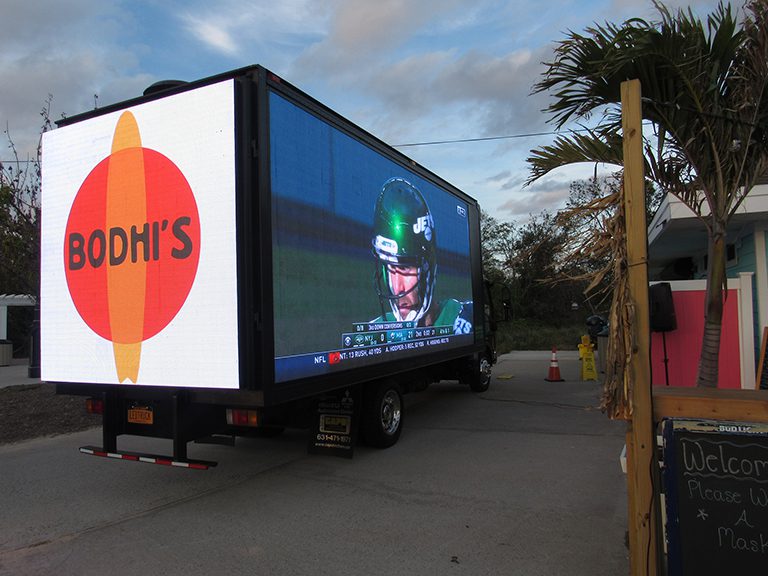
The standard way to buy a mobile billboard is to buy hours on a route. The truck drives a loop through a busy part of town, repeats it, and the campaign is measured in circuits completed.
That model is built for cities with a dense continuous core, where a loop passes the same large audience over and over and the driving between impressions is short. Worcester is not shaped like that, and buying it that way wastes most of the hours.
Worcester is node-rich and route-poor.
Node-rich, because this city produces concentrated, scheduled, predictable crowds at known locations on known dates. A Worcester Red Sox home game at Polar Park. A Broadway tour at the Hanover Theatre. Concert programming at Mechanics Hall. A midweek lunchtime market on the Worcester Common Oval through the summer. Each of those puts a defined audience in a defined place at a time you can read off a published schedule months ahead.
Route-poor, because the gaps between those nodes are not full of your audience. The three districts that matter, the Canal District, Shrewsbury Street and downtown, are separate positions with driving between them. A loop connecting them spends a substantial share of its hours on roads where the truck is passing traffic rather than people, and a screen read from a moving vehicle at speed is doing far less work than the same screen read by someone standing outside a venue.
So my advice here is consistent and it costs me route hours: in Worcester, stop buying the truck as a route and start buying it as a dwell instrument. Park it where the crowd already is, at the hour the crowd is there, and let the schedule do the targeting.
This page explains how that works in practice, which nodes are worth it, where a truck can actually stand, and why this is the one format that holds up through a Worcester winter.
Worcester is node-rich and route-poor
Let me be concrete about the geography, because this is the part that decides everything else.
The Canal District is compact. Short blocks, dense low-rise frontage, venues clustered within steps of Polar Park, and a district that revived around that ballpark over roughly the last decade. The whole useful area is walkable in minutes. That is excellent for a parked truck and nearly pointless for a driven one, because a loop through a district you can cross on foot in five minutes is passing the same handful of people repeatedly in the same few minutes.
Shrewsbury Street is linear. A restaurant row with al fresco patio dining along its length, walkable end to end. A truck driving it passes the patios once. A truck positioned near its concentration of seated diners is in front of an audience that is sitting outdoors for an hour. Those are not comparable outcomes.
Downtown is a third position, with the theatre frontage and the Worcester Common Oval. Its crowds arrive and depart in clusters on published dates rather than flowing continuously.
Between those three there is driving. That is the route-poor part. It is not that Worcester has no traffic, it is that the traffic is not where the audience you are buying is standing, and a mobile screen earns its keep from dwell and proximity rather than from speed and distance.
There is one genuine exception worth naming. If the goal is broad local awareness rather than reaching a specific crowd, daytime movement through the city has value because it covers ground a static format cannot. I will build that, but I will be honest that it is a different objective, and the client should pick one rather than paying for a compromise that does neither well.
The scheduled-crowd calendar is the media plan
In most markets the media plan is a map. Here it is a calendar, and these are the documents that matter.
The WooSox home schedule at Polar Park. This is the single most useful planning document in Worcester for any format, and especially this one. Minor league baseball runs a long home season through spring and summer, which means repeated, reliable, concentrated crowds at the same location on known dates. For a campaign that wants repeat exposure to the same local audience, you can build an entire schedule from it. Crowds arrive over a long pre-game window and leave in a concentrated burst, and both ends are useful to a parked screen.
The Hanover Theatre programme. Broadway tours, concerts, comedy, dance and family productions run through the year, and the programme is published well ahead. Theatre nights put a dressed, ticketed crowd into downtown on specific dates. The pre-show arrival window and the post-show exit are both high-value, and they are predictable to within a few minutes.
Mechanics Hall concert programming. The historic concert hall, with its own published schedule including choral and orchestral productions. Same pattern, different audience.
The Worcester Bravehearts at Hanover Insurance Park, on the Holy Cross campus, through the summer in the Futures Collegiate Baseball League. Useful specifically because it fills part of the summer gap when the campuses are empty.
The summer midweek programme on the Worcester Common Oval, including the Out to Lunch Festival and Farmers' Market. Daytime, lunchtime, aimed at downtown workers and residents, and recurring weekly. This is the best daytime node in the city and it is routinely overlooked because buyers of this format think in evenings.
University terms. Holy Cross, WPI, Clark, Worcester State and others give Worcester a student population that is large relative to the size of the city, and that is the structural rhythm of the year. The autumn arrival and the late spring departure are the two inflection points. I treat specific term dates as UNVERIFIED and pull them from each institution's published academic calendar rather than assuming.
The shape of the year that falls out of this: late spring through summer carries the baseball and the outdoor programme, early autumn combines the student return with good conditions and is the strongest single window, and deep winter is the footfall trough. Which brings me to why this format still works in the trough.
Kelley Square and why the busiest junction is a poor media position
Clients who look at a Worcester map find Kelley Square quickly. It is the Canal District's main junction, the node everything funnels through, and it is busy. The instinct is to put the truck there.
I push back on this almost every time.
Kelley Square is a complex junction and it congests on event evenings. Congestion sounds like an asset for a mobile billboard, because stopped traffic means long looks. Sometimes that is true. Here, three things work against it.
First, the attention in a complex junction belongs to the junction. Drivers negotiating a busy, geometrically demanding intersection are reading the road, not a screen. That is the condition where a mobile screen performs worst, and it is also the condition where its presence is least welcome.
Second, a truck in congestion is a truck that cannot leave. If the plan involves moving to a second position later in the evening, committing the vehicle to the most congested point in the district at the busiest hour removes that option.
Third, and most important, the people you actually want are fifty yards away on foot. The Canal District's value is pedestrian. The audience is walking between venues, queueing outside them, standing around outside them. A position that puts the screen in front of those people at walking pace does far more than a position that puts it in front of traffic at a junction.
So the Canal District plan is almost always a standing position near where people are on foot, chosen in advance with the property owner, set up before the crowd builds. Not a loop through Kelley Square.
The related planning point: a WooSox home game fills the Canal District and the surrounding parking simultaneously. That is the best audience of the week and the worst access of the week, and the two arrive together. Everything gets positioned early or not at all.
Winter: the format that keeps working, and what actually limits it
Here is the strategic case for this format in Worcester, and it is stronger than in most cities.
From roughly December through March, the other formats are compromised. Water-based adhesive will not cure reliably in an inland New England winter, so poster work is constrained to sheltered owner-consented positions and hoarding. Ground media is finished by salt, grit, freeze-thaw and ploughing. Snipe fixings corrode and low placements sit behind plough banks.
A mobile LED screen is unaffected by all of that. It carries its own surface and its own light, it does not need to adhere to anything, and it does not need the audience to look down. Worcester sits well inland and at higher elevation than the coast and is locally understood to be colder and snowier than Boston. I treat specific snowfall and temperature figures as UNVERIFIED. But the practical point stands: the harsher the winter, the larger this format's relative advantage.
Two further winter advantages are real.
Long nights. An LED screen is at its best against a dark background, and winter gives many more usable dark hours. An evening campaign can start much earlier in December than in June.
Low ambient light. Worcester's ambient light levels are far lower than a major market's, so the screen does not have to fight competing illumination. Image quality at a given output is simply better here than it would be in a brightly lit downtown.
Now the limits, honestly stated.
Footfall is in its trough. The screen works, but there may be nobody out to see it. Winter campaigns have to be aimed at the nodes, the theatre dates and whatever is programmed, rather than run into quiet streets.
Access is the serious constraint, and I think it is the worst of any market I plan in this region. Plough banks block kerbside positions, which is precisely where a truck needs to stand. A standing position surveyed in October may not exist in February. Storms remove whole working days. Any winter Worcester schedule needs real slack and a client who understands that some dates will be lost entirely.
Road conditions affect the screen itself. Slush and salt spray film a screen face quickly on an inland New England road. Winter operation means cleaning during the shift, not just before it, or the image degrades through the evening without anyone noticing.
Cold affects power and hardware. Extended sub-freezing operation is harder on power systems than mild conditions are. It is manageable, and it is a reason to work with crews who have run this region in January rather than ones who have not.
Where a truck can stand, and who controls that ground
Grey area, and I will be precise about the boundary between what we know and what we do not.
We have not verified Worcester's specific rules or enforcement practice for mobile advertising, vehicle-mounted displays, standing or idling. I flag that as UNVERIFIED. Neither Boston's published stance nor Cambridge's carries over to Worcester. Different municipality, different code, different enforcement culture. I will not cite a Worcester code section, a permit requirement, a fine or an enforcement claim that has not been checked directly against the current municipal code and confirmed with the City. No buyer should accept one from an operator who cannot show that check. If a campaign depends on a standing position in a public right of way, establishing what the City's actual process is comes before anything else, in writing.
What can be reasoned, and labelled as reasoning: Worcester has spent a decade and substantial public money on a visible redevelopment arc, with Polar Park as the anchor investment and the Canal District's turnaround as the narrative the city tells about itself. Cities in that posture tend to be protective of how their improved districts look and operate. A large screen parked at a civic focal point during a flagship event is conspicuous, and conspicuous things in recently reinvested districts attract attention. That is an inference about enforcement culture, not a verified fact.
The response is the same one that works for every format here, and Worcester makes it unusually achievable.
Stand on private ground with the owner's consent. The Canal District is an owner-operator district built from independent bars, breweries, venues and restaurants, with lots, yards and forecourts attached. The person who controls that ground is often on site during trading hours and can be spoken to directly. In a large market that request goes through an asset manager. Here it often goes through the person behind the bar, and they frequently have their own reason to want activity outside their door. A private lot position with written consent is better than a kerbside position in every respect: it is more certain, it is usually a better sightline, and nobody has to wonder about it.
Treat institutional ground separately. Holy Cross, WPI, Clark and Worcester State sit under their own institutional policies, which we have not researched and which I treat as UNVERIFIED. Hanover Insurance Park is on the Holy Cross campus, so a Bravehearts-timed campaign is an institutional conversation rather than a street one. Start that early.
Treat public space separately again. Anything involving the Worcester Common Oval or a public right of way goes through the City's actual process, confirmed first.
Our standard is written consent for every standing position, agreed run times, a named contact, and documentation. That is not bureaucracy for its own sake. It is what makes a large and visible vehicle a welcome part of an evening rather than a question somebody has to resolve.
Crew, shift shape and the drive between three districts
A mobile LED campaign is a driver and usually a second crew member. The second person matters more here than buyers assume, because the Worcester model is a parked one. Someone has to secure and manage the standing position, handle the owner relationship on the night, keep the screen face clean in winter conditions, and interact with the public who will come over and ask what it is.
That last point is the natural extension of this format in Worcester and I recommend it regularly. A parked screen at a Canal District game night or outside a theatre on a performance date is a stationary focal point with a crowd flowing past it for an hour. Pairing it with a street team turns a passive impression into a conversation and a sample or a scan. The screen gathers attention and the people convert it. In a city where the crowds are concentrated and scheduled, that pairing is far more productive than adding route hours.
Shift shape follows the node. For baseball, position well before gates and stay through the exit surge. For theatre dates, the pre-show arrival window and the post-show exit are the two moments, with a quiet stretch between that is worth using to reposition rather than idle. For the summer midweek programme on the Common Oval, it is a daytime shift, which most buyers of this format never consider.
Access is Worcester's operational advantage for the rest of the year. Compared with the bigger markets in this region, securing a position is far less of a fight, because the city has substantial surface and structured parking and none of the resident-permit saturation. For a vehicle this size, that is the difference between a plan that works and a plan that spends its evening looking for somewhere to be. Game nights reverse it completely, which is why the home schedule gets checked before any Canal District date is committed.
Night windows are generous. Once the bar trade thins on the usual New England pattern, the warehouse quarter and downtown get genuinely quiet. That is useful for repositioning and for getting out cleanly, though it is not an audience window.
What we talk Worcester clients out of
Buying route hours. The most common request and the one I argue with most. Loop hours between three separated districts put the screen in front of road rather than people. Convert most of those hours into standing time at scheduled nodes and the same campaign does considerably more.
Parking at Kelley Square during an event. Busy is not the same as attentive, and a truck committed to the most congested point in the district cannot move for the rest of the evening.
Ignoring the daytime nodes. The midweek summer programme on the Worcester Common Oval delivers a predictable, recurring downtown audience at lunchtime. Buyers fixed on evening campaigns miss it every time.
Running a student-targeted campaign in July. The campuses are what make this city punch above its size, and in summer they are empty. Weight summer toward the baseball programme and the downtown daytime audience instead.
Winter schedules with no contingency. Storms will remove dates and plough banks will remove standing positions. A fixed winter run with no slack is a promise somebody will have to break.
Treating a surveyed position as permanent. Snow changes the geometry of a site, hoarding appears and disappears around the continuing redevelopment, and tenancies change. We re-check standing positions close to the date rather than relying on an autumn survey.
Running the screen without anyone on the ground. A parked truck with nobody attending it is an object. A parked truck with a crew is an event, and in a city where the audience arrives in concentrated scheduled bursts, that difference is most of the value.
Frequently asked questions
Should a Worcester campaign use routes or fixed positions?
Fixed positions, for most objectives. Worcester’s audience concentrates at scheduled nodes like Polar Park on game nights and the downtown theatre venues on performance dates, with driving between the three main districts. Standing time in front of pedestrians delivers far more than loop hours spent passing traffic between them.
Does an LED truck work through a Worcester winter?
Better than any other format we run here. It carries its own surface and light, so freeze-thaw, road salt and ploughing do not affect the media. Long winter nights and low ambient light improve the image. The real constraints are plough banks removing kerbside standing positions, storms removing dates, and slush filming the screen face.
What is the best recurring schedule to plan around?
The WooSox home schedule at Polar Park. Minor league baseball runs a long home season through spring and summer, which gives repeated concentrated crowds at a fixed location on published dates. For repeat exposure to the same local audience, it is the most useful document in the city. Theatre programming provides the same predictability year-round.
Where can a truck legitimately stand in Worcester?
We build campaigns on private ground with written owner consent, which the Canal District’s owner-operator structure makes unusually achievable. Rules for public rights of way, standing and idling are UNVERIFIED by us, and we will not quote code we have not confirmed with the City. Campus ground is a separate institutional conversation.
Why avoid Kelley Square as a media position?
It is the Canal District’s main junction and it congests on event evenings, but drivers in a complex intersection are reading the road rather than a screen. A truck stuck there also cannot reposition. The pedestrian audience you actually want is a short distance away on foot, between and outside the venues.
What should a summer Worcester campaign target?
Not students. The campuses empty and the evening trade visibly thins, which affects this city more than a larger one. Weight summer toward the baseball programme, including the Bravehearts at Hanover Insurance Park, and toward the predictable midweek daytime audience on the Worcester Common Oval downtown.
Request a campaign quote
If you are planning a mobile LED campaign in Worcester, bring us the audience you want rather than the number of hours you were thinking of buying. The useful first step is matching your campaign to the right nodes on the city's published schedules, then working out where the vehicle can actually stand.
We will identify the standing positions, pursue written consent from the owners who control them, build in the contingency a New England winter demands, and tell you honestly when a route would serve you better than a position.
Request a campaign quote and tell us your dates, your audience and whether you want reach across the city or depth at specific events.

Ready to Run Your Campaign?
Call us or email us. We’ll tell you exactly what we can do in your market and what it costs.
Related Services
Explore similar advertising solutions offered by American Guerrilla Marketing.
American Guerrilla Marketing — Los Angeles
Street-level campaigns in Los Angeles and nationwide. Wheatpasting, LED trucks, street teams, and more.
(646) 776-2770
Related Articles
-
Billboards Company: How It Actually Works
November 25, 2026
-
LED Trucks & Mobile Billboards in Long Beach
November 25, 2026
-
Mobile billboard: How It Actually Works
November 25, 2026
-
LED Trucks & Mobile Billboards in Los Angeles
November 25, 2026
-
Mobile Billboard Advertising Explained for Brand Marketers
November 25, 2026