
November 25, 2026
Big Poster Sizes: A Field Guide From the Crew
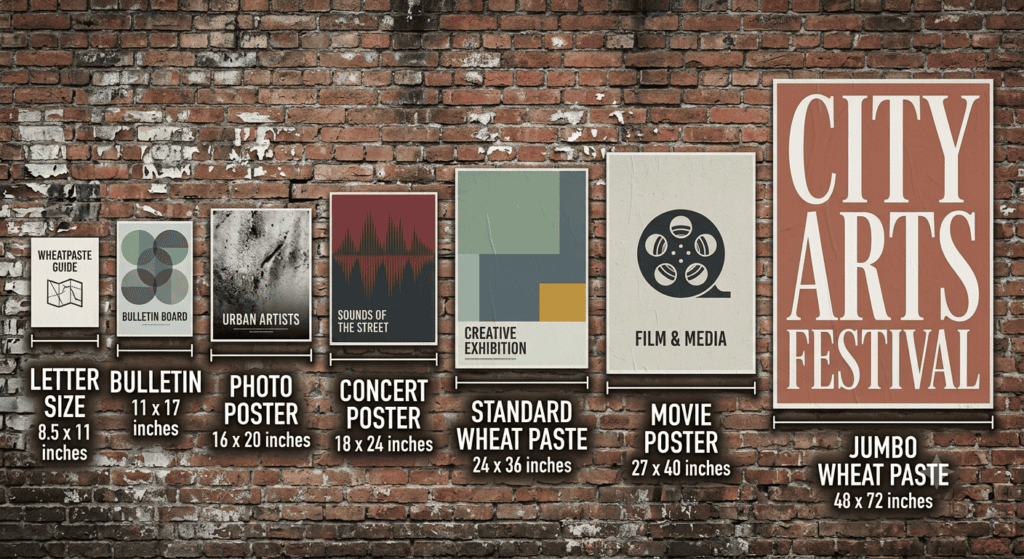
Nearly every campaign conversation I have starts in the wrong place. Someone asks what the biggest poster we can put up is, as though size were the whole question.
It is not. The real question is what size holds on the surface you have, in the weather you are going to get, installed by the number of people you are paying for, in the window the street gives you. A sheet that is too big for the wall is a worse campaign than a smaller sheet that sits flat and stays there.
I run install crews for American Guerrilla Marketing. We paste posters, hang snipes, cut stencils and run projection and LED Trucks nationwide. I have spent a lot of nights between two and six in the morning finding out which sizes behave and which ones fight you.
This is the field version. Not a printing chart. What the sizes actually do outside.
The sizes we actually run
There are a handful of formats that make up almost all of the large-format street work we do. Everything else is a special case.
Two foot by three foot. The workhorse single sheet. One person handles it alone in wind. It fits on narrow surfaces, utility boxes, hoarding panels between posts, the gaps that bigger sheets cannot use. Readable from across a two-lane street. This is the size I recommend when someone wants coverage rather than spectacle.
Twenty-four by thirty-six is the same thing in inches, and people use both phrasings, which causes confusion on print orders more often than you would think. Always confirm orientation as well as dimensions.
Three foot by four foot. A genuine step up in presence. Still one person in calm air, two if there is any wind at all. Good on plywood hoarding where the panel is wide enough to take it without crossing a seam.
Four foot by six foot. This is where the format starts behaving like a billboard. You feel it from down the block. It is also where single-person installs stop being realistic. The sheet is heavy when wet, it wants to fold onto itself, and once paper touches pasted paper it is finished.
The multi-sheet wall. This is the real answer to "big". We do not print one enormous sheet. We print panels and tile them on the wall, usually in columns, with a small overlap so the seam sheds water downward rather than catching it. Three panels wide by two high is common. Six panels wide by three high is a wall that stops traffic.
Tiling is how you get genuinely large images without the handling problems of a single giant sheet. A single sheet beyond about four by six is an argument with physics. Panels are not.
Why bigger is not automatically better
Paper gets heavy when it is wet, and wheat paste makes it very wet.
A four by six sheet soaked through has real weight, and that weight pulls down on the top edge while you are still trying to position the bottom. If the top is not bonded, the whole thing peels off in your hands and lands on the sidewalk, and a sheet that has touched the ground is scrap.
Wind is the other limit. A large sheet is a sail. Anything above a gentle breeze turns a four by six into something two people wrestle rather than install. We have aborted large-format work on waterfront blocks in Chicago and in the wind tunnels between tall buildings in downtown Dallas, moved to a sheltered elevation, and run the smaller format instead. That is a judgement call made on the street, not in a plan.
Surface flatness matters more as size goes up. A small sheet can ride over a shallow irregularity. A large sheet crossing a seam, a pipe, a change of plane or a protruding fixing will tent over it, and the tent is where wind gets underneath. Air behind a poster is the beginning of its failure.
So the honest guidance is this. Go as large as the surface is genuinely flat, and no larger.
What the surface decides
Before I pick a size, I look at what we are pasting onto.
Construction hoarding. The best surface we work. Plywood is porous, flat and large, and there is usually a site manager who can grant permission. Hoarding takes the biggest formats we run. Watch for the vertical posts behind the panels, because the panel can flex there and the paper will show the line.
Smooth painted masonry. Very good. Takes large formats well. Confirm the paint is sound and not chalking, because paste bonds to the paint, and if the paint lets go, your poster leaves with it.
Rough brick. Acceptable, with a caveat that matters for big sizes. The mortar lines create a grid of shallow channels, and the larger the sheet, the more of those lines it crosses. Fine detail softens at every line. On rough brick I size down and simplify the art.
Raw concrete and cinder block. Fine. Cinder block has the same mortar-line issue as brick.
What fails outright. Glossy paint, vinyl wrap, powder-coated metal, glass, anything oily, anything flaking. Paste needs a surface that absorbs. The bigger the sheet, the faster a non-absorbing surface betrays you, because there is more weight pulling on a bond that is not forming.
Crew and time, honestly
People underestimate this part badly.
Two foot by three: one installer, well under a minute of actual pasting once the surface is prepped. The time cost is walking the route, not the sheets.
Three by four: still one installer in calm conditions, noticeably slower, and a second pair of hands makes it comfortable rather than possible.
Four by six: two installers, properly. One holds and positions the top while the other works the body down and out. Call it a few minutes per sheet including prep.
Multi-panel wall: two to four people and a real block of time. A six-by-three panel wall with a ladder involved takes a meaningful chunk of a night by itself. We usually schedule a big wall as its own objective rather than something squeezed into a corridor run.
Height changes everything again. Anything above reach needs a ladder or an extension pole, and a ladder means one person is on the ladder and at least one is on the ground managing material and watching the street. Large sheets at height are the slowest work we do.
Our typical window is two in the morning to six, longer in neighbourhoods that stay busy. In parts of Brooklyn we start later because the streets do not quiet down. In downtown Los Angeles the window opens earlier. Near Broadway in Nashville we mostly work the side streets, because the main drag never really stops.
Weather, and how long big formats hold
The install order is fixed. Paste the surface. Lay the sheet. Paste over the top of the sheet, working from the centre outward to push air to the edges. The top coat is not optional, and skipping it is why self-installed posters curl at the corners within days.
For large formats the centre-outward discipline matters more, because there is simply more area for trapped air to hide in.
Rain inside the first few hours is the main enemy. The paste has not cured, water gets behind the sheet, and a large poster has enough weight to peel itself off once that happens. After full cure, rain is mostly harmless and can tighten the paper.
Hard freeze during cure is bad. In Chicago and Boston winter runs we mix slightly differently and keep routes tight so sheets are not sitting half-cured for hours in the cold. Humid summer nights in Houston and Atlanta cure slowly, which means a longer vulnerable window.
Sun fades ink. A four-colour image on a south-facing wall in Phoenix in July looks tired a lot sooner than the same image in Seattle.
Realistic life for a well-installed large sheet on a good surface runs from about two weeks to a couple of months. Multi-panel walls often outlast single sheets on the same block, because a tiled wall has no single edge big enough for wind to grab and lift.
Designing for big
Artwork is where most large-format campaigns are won or lost, and the fixes are boring.
Read it at distance. Print a scaled version, put it on a wall, walk twenty paces away at night and see what survives. Whatever you cannot read at that distance is decoration, not communication.
Type bigger than feels right. I have asked for larger type on almost every campaign I have run and I have never once asked for smaller.
Contrast hard. Street light is orange, dim, and comes from above at a harsh angle. Dark text on a dark field disappears completely. Thin light type on a busy photo disappears.
Avoid big flat gradients. They band when printed large and they go muddy under sodium light.
Design for tiling if you are going multi-panel. Keep the critical word or face away from a seam. Seams are inevitable, and a seam running through a face looks like a mistake even when it is perfectly installed.
Skip the QR code as a primary call to action on anything mounted above eye level. Nobody scans a code twelve feet up while walking. If you want a scan, put it at eye level on a surface people stand still in front of.
Paper and ink, because the stock decides the size
Size and paper are the same conversation, and buyers usually treat them as separate.
Heavy stock feels like quality in your hand and behaves badly on a wall. It resists conforming to texture, it holds its own shape when wet, and at large sizes that stiffness becomes tenting and lifted edges. The poster that felt most impressive in the box is often the one peeling by the weekend.
Lighter uncoated stock is what we want. It drinks paste, it goes limp enough to lie into a brick texture, and it dries tight against the wall. At large sizes this is not a preference, it is the difference between a sheet that bonds and a sheet that fights.
Coating is the other trap. A gloss or satin finish looks great under gallery light and repels paste on both faces. The top coat cannot soak in, so it sits on the surface, dries as a film, and flakes. If a sheet is going outside under paste, it needs to be uncoated. I ask about the finish on every job and I still catch it late sometimes.
Ink matters for longevity rather than install. Large formats are usually printed on wide roll equipment, and the ink chemistry varies. Some outdoor-rated inks hold colour for months. Some fade visibly in weeks on a sunny elevation. I cannot inspect a print shop's chemistry from a sidewalk, so what I do instead is set expectations by exposure. North-facing and shaded walls keep colour far longer than south-facing ones, and if a campaign depends on a specific colour staying true, we put it where the sun does not hit it all afternoon.
One more practical note. Large sheets ship rolled, and they arrive with a memory of that roll. Paper that has been tightly rolled for a week wants to curl back, which is a genuine handling problem at four by six in the dark. We flatten material before a run wherever we can, and when delivery timing makes that impossible, we plan for slower installs and more hands.
Measuring the wall before you order the print
The expensive mistake in large format is ordering before measuring, and it happens constantly.
Someone picks a size from a chart, prints a few hundred sheets, and then the crew arrives to find the hoarding panels are narrower than the poster, or the only clear run of flat surface is interrupted by a standpipe every eight feet. Now the material is wrong and the schedule is fixed.
So we scout first on anything above three by four. Scouting is dull and it is the highest-value hour of the whole campaign. We walk the target blocks in daylight, photograph the surfaces, measure the actual usable flat area on each one, note the obstructions, note which way the panels run, and note where a ladder can safely stand.
Usable flat area is the number that matters, not the wall size. A hoarding run that looks like sixty feet of poster space often contains four separate flat zones separated by posts, gates, signage and utility boxes. Those zones decide the format.
We also check sight lines while we are there. A wall can be perfectly flat and completely useless because a parked delivery truck sits in front of it every morning, or because the only viewing angle is from a road nobody walks. Big posters earn their size through viewing distance, so a surface with twenty feet of standoff beats a larger surface you can only see from three feet away.
Light gets checked at night, separately. A wall with no street light on it is invisible after dark, which halves the hours the campaign is working. Sometimes the fix is simply choosing the elevation that faces the lamp.
By the time we order print, we know how many of each size that route can actually take. That is why our size recommendations sometimes come back different from what the client asked for.
Permission, ordinance and removal
Clients ask whether big formats attract more attention from authorities than small ones. In practice, yes, simply because they are more visible, but the underlying situation is the same either way.
This is a grey area. Posting rules vary by municipality, enforcement is inconsistent, and the practical answer usually turns on who owns the surface rather than on a blanket city rule. I run crews, I am not a lawyer, and nothing here is legal advice.
What we control is risk management, and with large formats it matters more.
We prefer private surfaces where an owner can actually give permission. For big walls that nearly always means construction hoarding with a site manager, or a landlord with a vacant frontage. A written yes changes the whole character of the job, and it is the only way I will put up a multi-panel wall.
We document every install with photographs that show enough context to identify the location, plus the date.
We commit to removal. Large sheets left to rot are exactly why some property owners will not grant permission to anyone. Taking material down is what earns a second yes on the same block.
We avoid obvious trouble. Historic facades, active residential frontage, anything likely to generate a neighbour complaint rather than an owner conversation.
What I talk clients out of
One enormous single sheet. Someone always wants a ten-foot banner in one piece. It is a handling nightmare, it needs a perfectly flat surface that large, and the failure mode is total. Panels achieve the same visual result and survive.
Big formats on rough brick with detailed art. The mortar grid eats detail. Either simplify the art or move to a flatter surface.
Large sheets at height on a short schedule. Ladder work with big paper is slow. If the window is tight, we drop to a size one person can place from the ground and cover more ground instead.
Buying size instead of repetition. A single large poster on one block is a landmark. Twelve medium posters along a corridor people actually walk is a campaign. Most buyers would be better served by the second, and when the budget only supports one of those outcomes, I say so.
Large formats in a wind-exposed location without a fallback. If the only approved surface is a waterfront elevation, we plan a smaller format from the start rather than discovering the problem at three in the morning.
Where snipe advertising fits alongside big posters
The natural companion to a large-format run is Snipe Advertising, and the reason is coverage geometry.
Snipes are smaller, mounted quickly on poles, posts, plywood edges and the narrow vertical surfaces that a four by six sheet can never use. They are a different instrument. Big posters give you one strong impression on a block. Snipes give you repetition along the walk between blocks.
Run together, they do something neither does alone. A pedestrian sees the large image once, properly, then sees the same artwork six more times at a smaller scale on the way to the train. That repetition is what turns recognition into memory.
Snipes also install fast, which means a crew that is already out for a large wall can lay in corridor coverage on the same night without extending the window. On most campaigns where someone came to us asking only about big poster sizes, this is the addition that improved the result most.
Frequently asked questions
What is the biggest poster you can realistically paste in one piece?
Around four foot by six foot is the practical ceiling for a single sheet. Beyond that the wet paper is too heavy, it folds onto itself, and wind turns it into a sail. For anything larger we print panels and tile them on the wall with a small overlap, which gives a bigger finished image with far fewer failure modes.
Does a bigger poster last longer on the wall?
Not by itself. Longevity comes from the surface, the install quality and the first few hours of weather. A tiled multi-panel wall often outlasts a single large sheet nearby, because there is no single large edge for wind to lift. A big sheet on a glossy or flaking surface fails faster than a small one.
How many people does a large-format install need?
Two foot by three is a one-person sheet. Three by four is one person in calm air, more comfortable with two. Four by six needs two people properly, one positioning the top while the other works the body down. Multi-panel walls take two to four, and anything above reach adds a ladder plus a ground person.
Which surfaces take big posters best?
Construction hoarding first, because plywood is porous, flat, large and usually has a manager who can grant permission. Smooth painted masonry is a close second if the paint is sound. Rough brick and cinder block work but the mortar lines soften detail. Glossy paint, vinyl, metal, glass and anything oily will not hold.
Are large street posters allowed where I want to run?
It is a grey area. Rules vary by municipality, enforcement is inconsistent, and the practical answer usually depends on surface ownership rather than a citywide rule. We reduce risk by working private surfaces with owner permission, photographing every install, and committing to removal. I am an operator rather than a lawyer, so this is not legal advice.
How should artwork change for a bigger poster?
Make type larger than feels comfortable, push contrast hard because street light is dim and orange, and avoid large gradients that band when printed big. Test by printing a scaled version and reading it from twenty paces at night. For tiled walls, keep faces and key words away from the panel seams.
Pick the right size with people who install them
If you are sizing a poster campaign and want the answer that accounts for the actual wall, the actual weather and the actual crew, tell us where you want to run and what the artwork looks like. We will tell you what format that block supports, where we would tile instead of going single sheet, and what we would do differently.
Wheatpasting and Poster Campaigns, snipe advertising, sidewalk decals and stencils, Projection Advertising, LED trucks and Mobile Billboards, Street Teams and experiential, nationwide.
Request a campaign quote.

Ready to Run Your Campaign?
Call us or email us. We’ll tell you exactly what we can do in your market and what it costs.
Related Service
Explore similar advertising solutions offered by American Guerrilla Marketing.
American Guerrilla Marketing — Los Angeles
Street-level campaigns in Los Angeles and nationwide. Wheatpasting, LED trucks, street teams, and more.
(646) 776-2770
Related Articles
-
Wheatpasting & Poster Campaigns in Jacksonville, Florida
November 25, 2026
-
Poster Bleed and Trim for Street Use: What to Expect
November 25, 2026
-
Wheatpasting & Poster Campaigns in Reno, Nevada
November 25, 2026
-
Wheatpasting & Poster Campaigns in Salt Lake City
November 25, 2026
-
Wheatpasting & Poster Campaigns in Dallas, Texas
November 25, 2026