American Guerrilla Marketing
Nationwide Service
Media planning, media buying, billboard advertising, & guerrilla marketing
The entertainment capital of the world demands street-level presence. AGM executes fly posting and wheatpasting campaigns across Los Angeles, San Francisco, San Diego, and San Jose — reaching the tastemakers who drive cultural conversations nationwide.
No state in the country operates at this particular intersection of entertainment, technology, fashion, and independent creative culture simultaneously and at scale. Los Angeles is the origin point for American film, music, and streetwear — not historically but actively, right now, in ways that dictate what the rest of the country pays attention to. San Francisco sustains one of the world’s most celebrated street art traditions while also hosting the densest concentration of technology industry workers of any major American city. San Diego anchors a craft beverage and indie music scene that punches well above its geographic weight. San Jose sits at the center of Silicon Valley, where the streets outside technology company campuses are among the most strategically valuable ground-level advertising real estate on the planet.
Fly posting campaigns in California work because the state’s dominant consumer demographics are precisely the audiences that respond to street-level media. Creative professionals, musicians, fashion-forward young adults, tech startup employees, and entertainment industry workers move through dense walkable corridors every single day. They don’t just see fly posting — they interact with it, photograph it, share it, and integrate it into the cultural fabric of their neighborhoods. A wheat paste poster on Melrose Avenue or Valencia Street in San Francisco isn’t just an advertisement. It’s an artifact of the cultural moment that prompted it, placed in the environment where that culture is actively being made.
American Guerrilla Marketing has executed fly posting and wheatpasting campaigns for entertainment studios, streaming platforms, consumer packaged goods brands, fashion labels, gaming companies, and political campaigns across California. The state isn’t a single market — it’s five distinct cultural ecosystems stacked on top of each other, each requiring a different strategic approach to street poster placement, neighborhood targeting, and audience engagement. AGM’s California campaigns are designed with that granularity in mind, and the execution is handled directly by AGM’s in-house installation crews with no subcontractors involved at any stage.
AGM executes street poster and wheatpasting campaigns across Los Angeles, San Francisco, San Diego, and San Jose. Direct execution, GPS-documented reporting, no subcontractors. Clients include Netflix, Biossance, and EA Sports.
Select a city to explore Fly Posting Advertising opportunities.
Hollywood studios, independent record labels, streaming platforms, and talent management companies run ongoing street poster programs in California not because a single campaign demanded it, but because the entertainment industry understands that street presence in the right Los Angeles corridor functions as a baseline signal of cultural legitimacy. When a new album drops, a streaming series launches, or a fashion collab releases, fly posting in the Fairfax District, Silver Lake, or the Arts District is part of the activation playbook — not an afterthought. These brands have discovered that being on the street means being in the conversation in a way that digital ads, no matter how targeted, simply cannot replicate.
This dynamic played out clearly in a Netflix wheatpasting campaign AGM executed in Miami’s high-pedestrian entertainment corridors. Netflix deployed large-format street posters in zones where their target streaming audience clustered — near venues, along retail corridors, in arts districts — generating sustained visibility throughout a full release window. The posters remained in place and accumulated impressions across two weeks of foot traffic, reaching the entertainment-forward consumer demographic that drives streaming adoption in exactly the physical environment they inhabit outside work hours. The same strategic framework translates directly to California’s entertainment corridors: the Sunset Strip, the Hollywood & Highland zone, SoMa in San Francisco during tech conference season, and the Gaslamp Quarter in San Diego during major events. California’s entertainment corridors are structurally identical in their function — high pedestrian density, entertainment-forward audiences, discovery-mode consumer mindset.
What entertainment brands have figured out is that a street poster in the right neighborhood creates a fundamentally different perceptual context than a digital ad or a highway billboard. Street posters exist at eye level, without competing for attention against an infinite content feed. They’re discovered rather than delivered. They feel like something the neighborhood chose to have — and that implicit cultural endorsement is a quality that no programmatic ad buy can manufacture. California’s densest, most engaged urban neighborhoods create that discovery context at scale, and fly posting campaigns in California are specifically designed to exploit it.
Los Angeles doesn’t just consume cultural products — it manufactures them. The Melrose/Fairfax corridor is ground zero for American streetwear culture, with Supreme, Kith, and dozens of independent boutiques drawing a 20-32 demographic that treats the neighborhood as a social and cultural institution as much as a retail destination. The Arts District in DTLA anchors a creative professional community that spans fashion, music production, tech entrepreneurship, and visual art. Silver Lake and Echo Park sustain independent music scenes dense enough to support multiple venues per square mile, creating permanent pedestrian environments where the audiences brands want to reach are always moving.
Fly posting campaigns in Los Angeles benefit from the physical landscape as much as the demographic one. Blank construction plywood on Fairfax. Raw warehouse walls facing the loading dock alleys of the Arts District. Utility structures along Sunset Boulevard through Silver Lake. These surfaces become galleries during an active campaign, drawing eyes that have been trained by years of cultural programming to look for something new on them. AGM’s Los Angeles-based team — operating from 611 Wilshire Blvd, Suite 900, Los Angeles, CA 90017, reachable at (213) 328-4480 — handles placement strategy, installation, and GPS-documented photo reporting for every campaign executed in the market.
Award Winning Personalized Service
You will get thoughtful, devoted, and individualized attention from our experienced, qualified, and professional personnel. Being one of the most illustrious agencies in Brooklyn, New York, American Guerrilla Marketing has been awarded the Best of Brooklyn title.
Nationwide
Industry City, Brooklyn, New York 11232
American Guerrilla Marketing
Hours
Mon - Fri: 9 AM - 5 PM
Sat & Sun: Closed
Automate your campaign with AGM’s Request for Proposal Builder. Simply answer a few quick questions about your campaign goals, markets, and timeline, and the system will generate a tailored presentation with recommended strategies, quantities, and pricing. Click the RFP Builder to instantly receive your customized proposal.
San Francisco presents a genuinely unusual media environment that no other American city replicates. The Mission District has sustained a continuous tradition of large-format public art and political poster culture since the 1970s — Valencia Street and 24th Street are among the most visually sophisticated pedestrian corridors in the country, and the audiences that walk them are among the most visually literate. Simultaneously, the South of Market neighborhood hosts the North American offices of hundreds of technology companies, driving weekday lunchtime foot traffic from exactly the 25-40 professional demographic that consumer tech brands, gaming companies, and entertainment platforms most want to reach before general market awareness builds.
Street poster campaigns in San Francisco tend to run longer effective windows than in more weather-volatile markets. The Bay Area’s relatively mild climate means posters adhere well and retain visual quality across a full two-week campaign window when surface selection and adhesive application are managed correctly. AGM’s installation crews have extensive experience working SoMa’s warehouse-conversion building facades, the Castro’s retail-dense Castro Street corridor, and the Haight-Ashbury’s independent shop district on Haight Street — all surfaces that generate consistent foot traffic from engaged, brand-responsive audiences who regard visual culture on their streets as an extension of the neighborhood identity.
San Diego’s fly posting landscape is defined by the exceptional concentration of craft beverage, independent music, and lifestyle brand activity in neighborhoods like North Park, East Village, and Normal Heights. North Park’s North Park Way corridor operates at one of the highest brewery-per-square-mile densities of any American neighborhood, creating a permanent pedestrian discovery environment where young adults are already in the mindset of exploring new brands and new experiences. For craft beer labels, music tours, lifestyle apparel companies, and emerging food and beverage brands, San Diego offers a receptivity that larger, noisier markets frequently can’t match.
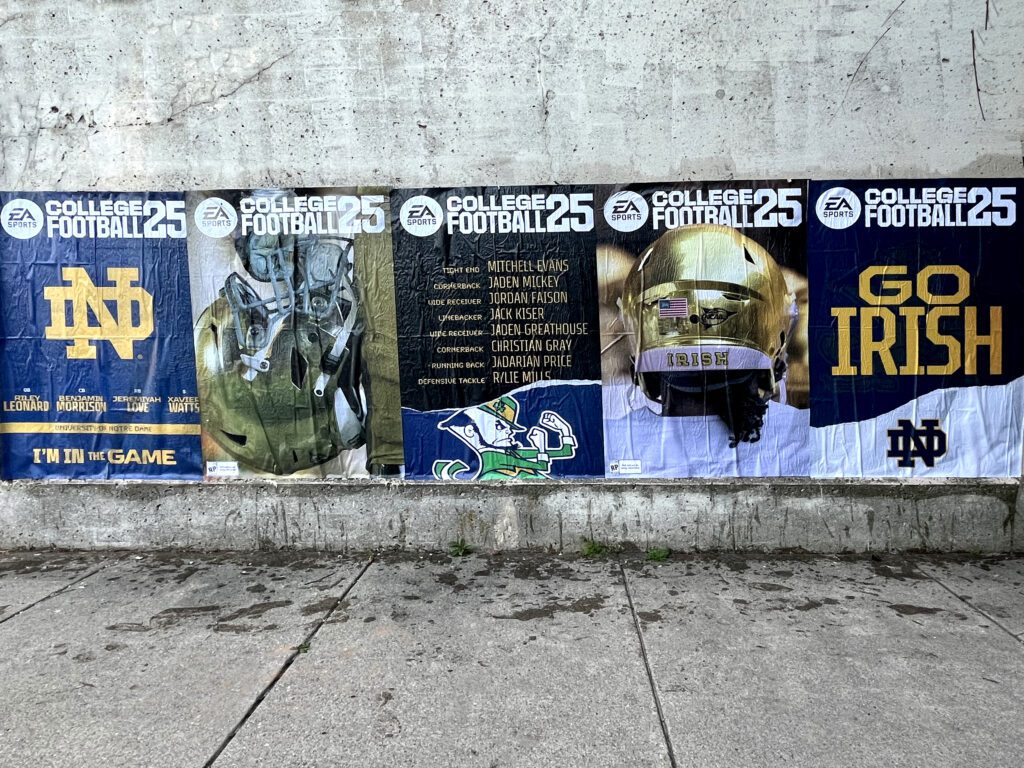
The EA Sports FC 25 campaign demonstrated how gaming and consumer tech brands use rapid multi-city fly posting activations to generate launch-window street presence in the exact markets where their core audience concentrates. San Diego’s SDSU student population and East Village bar corridor represent precisely the 18-28 gaming and entertainment demographic that campaigns like that one need to reach at street level — before the digital noise of launch day drowns out any individual channel. AGM serves the San Diego market from its Los Angeles office, with installation crews operating throughout San Diego County and familiar with each neighborhood’s specific surface characteristics and foot traffic patterns.
Silicon Valley’s geography makes San Jose a uniquely efficient fly posting market for technology brands. Consumer tech companies, gaming studios, software platforms, and hardware manufacturers are concentrated within a few miles of Downtown San Jose. The streets surrounding SAP Center, the SJSU campus zone, and the SoFA District — South First Area — are populated daily by the early-adopter, tech-forward demographic that product launch campaigns need to reach before general market awareness builds. A street poster campaign in San Jose isn’t ambient — it’s surgical targeting of the people most likely to drive product adoption in the critical first 30 days after launch.
Pre-launch buzz campaigns perform especially well in San Jose because the tech employee demographic that lives and works downtown is both highly connected on social media and deeply invested in the category of products being advertised. When a gaming company, consumer hardware brand, or software platform launches a fly posting campaign in SoFA or around the SJSU campus perimeter, the street-level imagery finds its way onto Instagram feeds, startup Slack channels, and product review forums within 48 hours of installation — earned amplification that extends the campaign’s effective reach well beyond the neighborhoods where AGM’s crews install it.
The breadth of California’s creative and commercial economy means that the brands running fly posting programs here span an unusually wide range of sectors. Entertainment and streaming platforms use fly posting in Los Angeles entertainment corridors as a core activation channel for originals launches and season renewals, building street presence in the neighborhoods where their core audience actually lives and socializes. Fashion and streetwear brands — particularly those targeting the 18-34 streetwear-adjacent demographic — run permanent programs in the Fairfax District and the Arts District, treating fly posting as an ongoing brand maintenance strategy rather than a campaign-by-campaign spend.
Craft beverage brands have found California’s bar-corridor neighborhoods — North Park in San Diego, the Mission in San Francisco, Silver Lake and Echo Park in Los Angeles — to be high-ROI environments for new product launches and seasonal availability campaigns. These are neighborhoods where the target consumer is already in discovery mode, already inclined toward independent brands, and already in the physical space where consumption decisions get made. A wheat paste poster on the corner of North Park Way and 30th Street reaches that consumer in precisely the right mental state and physical location simultaneously.
Technology and gaming companies have increasingly turned to fly posting as a way to reach the demographic that blocks digital ads most aggressively. Consumer tech early adopters, gaming audiences, and tech startup employees are among the highest ad-blocking cohorts in the country — and they’re disproportionately concentrated in San Jose, San Francisco’s SoMa, and LA’s Arts District and Silver Lake neighborhoods. Biossance demonstrated what’s possible when beauty and wellness brands commit to physical-world street advertising: their “Illuminate Your World” campaign combined wheat paste and sidewalk stencils in Los Angeles and New York beauty corridors, building brand impression depth that no digital impression can replicate. AGM’s California network spans all four major markets in the state, with the ability to execute single-city campaigns or coordinated statewide activations.
Every California fly posting campaign AGM executes begins with neighborhood mapping specific to the target market. AGM’s team identifies corridors based on three variables: pedestrian volume data, target demographic concentration, and available poster surfaces. California’s four major markets each require a different surface strategy. Los Angeles depends heavily on construction plywood, warehouse walls, and permitted posting zones concentrated in the Fairfax District, the Arts District, and Silver Lake. San Francisco’s warehouse-conversion buildings in SoMa offer large flat facades ideal for 48×72 large-format wheat paste. San Diego’s North Park and Normal Heights have utility structures and fence lines throughout their retail corridors that retain posters effectively across the campaign window. San Jose’s SoFA District has blank warehouse facades on 1st and South 1st Streets that anchor campaigns targeting the downtown young professional and arts crowd.
AGM handles the complete campaign in-house. Printing, wheat paste preparation, installation crew deployment, surface selection, and post-campaign GPS documentation are all managed directly — no subcontractors, no third-party installation vendors at any point in the process. Every poster placed by AGM in California is documented with GPS coordinates and timestamped photography delivered to the client as a comprehensive reporting package at campaign close. This documentation gives clients a verifiable record of where every poster appeared, when it was installed, and what condition it was in — the kind of accountability that outdoor advertising buyers require for campaign audit purposes and that most street media vendors are structurally unable to provide.
Campaigns in California typically run on a one-to-two week active window. AGM’s wheat-based adhesive is formulated to perform across California’s range of climate conditions — from coastal marine layer humidity in San Diego and San Francisco to the drier heat of Los Angeles’s inland neighborhoods — while remaining pressure-wash removable on standard surfaces. The adhesive formulation is environmentally responsible, leaves no permanent residue, and complies with surface-protection requirements across California’s major municipalities. AGM also coordinates with clients on timing relative to major events, neighborhood peak foot traffic windows, and competitive brand activity in the target markets.
100 posters — contact us for pricing
200 posters — contact us for pricing
Extra creative: contact us for pricing
The standard fly posting format for California campaigns. Ideal for multi-neighborhood density coverage across Los Angeles or sustained saturation along a single corridor like Melrose Avenue, Valencia Street in San Francisco, or North Park Way in San Diego. Scales efficiently across California’s multi-neighborhood creative districts. 72-hour rush production available up to 500 quantity for entertainment release windows and compressed launch timelines.
100 posters — contact us for pricing
200 posters — contact us for pricing
Extra creative: contact us for pricing
Dominant-presence format for fewer, larger, unmissable placements. Best deployed on the large warehouse walls of LA’s Arts District, SoMa’s building facades in San Francisco, or construction barriers in high-traffic downtown San Jose corridors. Exceptional visual authority for entertainment releases, major tech product launches, and fashion campaigns where a single bold image needs to stop foot traffic in its tracks rather than build coverage across multiple surfaces.
Yes. AGM operates fly posting and wheatpasting campaigns across all four markets in California. The Los Angeles market is served by AGM’s Los Angeles office at 611 Wilshire Blvd, Suite 900, Los Angeles, CA 90017 — reachable at (213) 328-4480. San Diego, San Francisco, and San Jose campaigns are supported through AGM’s California network with dedicated installation crews in each market. Clients can run campaigns in a single city or execute coordinated statewide activations across multiple California markets launching within the same installation window.
The right format depends on campaign objectives and which California markets you’re activating. The 24×36 format is the workhorse for density campaigns — if you want saturation across the Fairfax District, Silver Lake, and the Arts District simultaneously in Los Angeles, 100-200 posters at the standard size delivers meaningful neighborhood coverage. The 48×72 large-format is best when fewer, more dominant placements are the priority — warehouse walls in SoMa, construction barriers in downtown San Francisco, or landmark-scale surfaces in DTLA’s Arts District. Many California campaigns use both formats in the same activation, assigning each size to the neighborhoods where it performs best.
California campaigns typically run a one-to-two week active window. Los Angeles’s inland neighborhoods and San Diego’s temperate coastal climate both favor strong poster retention, with campaigns routinely lasting the full two weeks without significant degradation. San Francisco’s marine layer and occasional rain require careful surface selection and adhesive application management, which AGM’s San Francisco-experienced crews handle as a standard part of campaign planning. San Jose’s valley climate is generally favorable for full-window retention. AGM provides GPS-documented photo reporting throughout the campaign so clients can track placement condition across the full active window.
Entertainment and streaming are the dominant sectors because California’s dense, walkable, culturally engaged neighborhoods are home to the creative and entertainment professional demographic these brands most want to reach. Fashion, streetwear, and sneaker brands perform exceptionally in Los Angeles’s Fairfax and Melrose corridors. Technology and gaming brands have found San Jose and San Francisco’s SoMa to be high-return markets for pre-launch buzz campaigns targeting the early-adopter audience. Craft beverage brands targeting young adults in discovery mode consistently find San Diego’s North Park and Normal Heights among the highest-ROI markets in the country. Health, wellness, and beauty brands have executed successful campaigns across all four California markets.
Each California municipality has its own regulations governing street poster advertising. AGM’s installation crews work within established frameworks in each market, targeting permitted posting zones, construction barriers where posting is authorized, and private surfaces where property owner permission has been secured. AGM’s California operations are built around compliance with local regulations in each of the four markets it serves. Brands don’t need to independently navigate local ordinances — AGM manages the placement strategy to maximize legal campaign coverage and minimize the exposure that comes from non-compliant placements.
Every campaign AGM executes in California is documented with GPS-tagged, timestamped photography at each installation point. After the campaign closes, AGM delivers a comprehensive photo reporting package that includes precise location data for every poster placed, installation date information, and visual confirmation of placement condition. This documentation gives clients a verifiable audit trail of campaign execution — useful for internal reporting, creative team review, campaign planning for future activations, and accountability toward media agencies that require documented delivery confirmation. Mid-campaign check-in documentation can be requested for longer activations.
Multi-city California campaigns are a common request and something AGM’s network is specifically built to execute. Coordinated activations across Los Angeles, San Francisco, San Diego, and San Jose can be scheduled to launch within the same 48-72 hour installation window, creating a synchronized statewide street presence that amplifies the perception of cultural momentum. This approach is particularly effective for entertainment releases, gaming launches, and consumer product drops where unified market saturation across California’s major creative hubs signals broad cultural adoption. AGM coordinates printing, logistics, and installation scheduling across all four markets from a single client-facing point of contact.
Wheat paste is a mixture of wheat flour or starch and water that has been used to adhere paper to surfaces for centuries. AGM uses a wheat-based adhesive formulation because it holds effectively across California’s range of climate conditions while remaining environmentally responsible and fully pressure-wash removable from standard surfaces. Unlike synthetic adhesives or permanent mounting compounds, wheat paste doesn’t damage the underlying surface and complies with environmental and surface-protection requirements in California’s major municipalities. The adhesive bonds effectively to plywood, masonry, painted concrete, and metal — the primary surface types AGM works on throughout California’s urban neighborhoods.
AGM handles the complete campaign from printing through installation and documentation — no outside vendors, no handoffs to subcontractors at any stage. This end-to-end control means quality consistency from print to placement. AGM’s production team prints on heavy-weight paper stock engineered for outdoor adhesive application, with inks and coatings selected for weather resistance across California’s variable climate conditions. Clients provide print-ready files to AGM’s production team, and AGM manages all aspects of production scheduling, logistics to field crews, and installation execution. The result is a campaign where every element was managed by a single responsible party with full accountability for the outcome.
The minimum campaign size is 100 posters in the 24×36 format at contact us for pricing. For large-format 48×72 campaigns, the minimum is also 100 posters at contact us for pricing. Clients activating a single neighborhood in a single California city can execute a focused 100-poster campaign with meaningful local impact. Those running statewide activations across Los Angeles, San Francisco, San Diego, and San Jose typically scale to 100-200 posters per market, distributed across neighborhoods according to the strategy AGM maps in advance. Rush production — 72-hour turnaround on 24×36 — is available up to 500 quantity for campaigns running on compressed entertainment release timelines.
Standard lead time is 2-3 weeks from confirmed brief to installation. This covers creative approval, print production, logistics coordination, and installation crew scheduling across the target California markets. For campaigns requiring coordinated activation across multiple California cities simultaneously, 3-4 weeks lead time allows AGM to synchronize installation windows and ensure consistent campaign launch timing. Rush campaigns — particularly for entertainment releases on compressed timelines — can be accommodated through AGM’s 72-hour production capability on 24×36 format up to 500 posters, with field installation scheduled immediately following print completion and logistics delivery to the target markets.