American Guerrilla Marketing
Nationwide Service
Media planning, media buying, billboard advertising, & guerrilla marketing
Conquer America’s most diverse city with street-level poster campaigns built for Houston’s scale.
Houston is the fourth-largest city in the United States by population and the most ethnically diverse large city in America — a fact that is not just a demographic statistic but a defining structural feature of what makes advertising here both more complex and more rewarding than in any comparable market. The city of Houston proper holds 2.3 million residents, while the greater Houston metropolitan area stretches to 7.3 million people across a sprawling 10,000-square-mile footprint that is larger than the state of New Jersey. More than 145 languages are spoken across Houston’s neighborhoods. There is no racial or ethnic majority. The city’s demographics represent a simultaneous canvas for reaching Latino, African American, Asian American, and Anglo audiences in adjacent corridors — sometimes within a half-mile radius of each other — with a single coordinated fly posting campaign. No other American city offers that kind of cross-cultural geographic density.
Houston’s notorious lack of traditional zoning laws has produced an urban landscape unlike any other in the country. Industrial warehouses sit next to luxury condos. Independent barbecue joints occupy the ground floor of mixed-use developments. Art galleries operate out of converted auto shops. This zoning-free environment has created an eclectic built landscape where large blank walls, construction hoardings, and warehouse facades appear throughout the urban fabric — including in the entertainment districts where fly posting is most effective. In Midtown, along Washington Avenue, in EaDo, and throughout Montrose, these surfaces exist in abundance and provide the kind of high-visibility posting opportunities that cities with rigid zoning and uniform building codes simply cannot replicate. American Guerrilla Marketing has mapped Houston’s best posting surfaces over years of campaign execution and knows exactly where your posters will have the longest visibility and the highest daily impression count.
The sheer scale of Houston’s entertainment and cultural scene amplifies what fly posting can accomplish here. The Greater Houston area is home to over 337,000 college students across the University of Houston, Texas Southern University, Rice University, Houston Baptist University, and a constellation of community colleges — a massive young adult audience actively making decisions about music, entertainment, fashion, and consumer brands. Toyota Center regularly hosts top-tier concerts and NBA Houston Rockets games. White Oak Music Hall draws indie and alternative acts. Warehouse Live and Fitzgerald’s anchor the EaDo and Montrose scenes respectively. The House of Blues Houston brings national touring acts to the Midtown corridor. When a campaign drops posters in Midtown and EaDo the week before a major Toyota Center show, the timing creates a layered touchpoint — audiences encounter the poster on the street, then again in their social media feeds when friends share it, then experience the brand in a live event context days later.
Houston’s in-migration rate is among the highest of any major American city. The metro area grows by tens of thousands of new residents annually, many of them arriving from other states and countries and spending their first months actively building relationships with local brands, venues, and cultural institutions. These new arrivals are the ideal fly posting audience: they haven’t yet formed the brand loyalties and habit patterns that make long-term residents harder to reach, and they’re actively seeking visual cues about what’s worth their attention in their new city. A poster on a Montrose wall or a Heights storefront is, for a new Houstonian, a form of local orientation — a signal from the neighborhood about what matters here.
From Midtown's Main Street corridor to EaDo's warehouse walls to Montrose's Westheimer strip — AGM puts your campaign on the surfaces that Houston's most engaged audiences walk past every day. Get your free Houston campaign quote now.
Select a city to explore Fly Posting Advertising opportunities.
In most American cities, fly posting is discussed primarily in terms of neighborhood targeting: you identify the district, you place the posters, you reach the demographic that lives and socializes in that area. Houston demands a more sophisticated framework — one that understands fly posting not just as a neighborhood medium but as a cross-cultural simultaneous-reach mechanism. Because Houston’s most vibrant entertainment districts sit in close physical proximity to neighborhoods with radically different demographic identities, a well-designed Houston fly posting campaign can achieve something that digital advertising with all its precision targeting cannot: genuine simultaneous presence across racial and cultural communities that physically intersect in shared urban space.
Consider the geography. Montrose, Houston’s LGBTQ+ and arts hub, sits directly adjacent to the Museum District, which draws a multiracial, museum-going, culturally engaged crowd from across the city. Just east of Montrose, the Midtown corridor along Main Street is a young professional mixing zone where the city’s demographic complexity shows up in its bars, restaurants, and music venues every weekend night. South of Midtown, Third Ward — Houston’s historically Black cultural district, home to Texas Southern University and the landmark Project Row Houses — represents one of the most important cultural communities in the American South. These districts are not separated by long commutes or city limits; they are adjacent, interwoven neighborhoods that share arterial streets and overlapping populations. A poster placed on the Westheimer corridor is visible to a Montrose resident on their morning run, a Museum District visitor on their afternoon gallery tour, and a Midtown bar-goer on their Friday evening — three distinct demographic profiles encountering the same creative asset in the same 24-hour period.
This cross-cultural simultaneity is what makes fly posting in Houston a uniquely powerful medium for brands that want to build genuine cultural breadth rather than demographic silos. It’s why entertainment brands — music labels, film studios, streaming platforms — find Houston an exceptionally valuable fly posting market. It’s also why brands targeting Houston as their first major Texas market often discover that a Houston fly posting campaign reaches more demographic range than a comparable campaign in any other single American city. AGM’s Houston campaigns are planned with this cross-cultural architecture in mind, mapping placements to maximize coverage across Houston’s intersecting communities rather than simply saturating a single neighborhood.
AGM’s Houston fly posting packages are straightforward and inclusive. Every package covers location scouting, professional installation by AGM’s Houston crew, and complete photo documentation of every placement delivered within 48 hours of campaign completion.
Houston campaigns can be combined with other Texas market campaigns in Dallas, San Antonio, or Austin for statewide coverage at scaled rates. Reach out for a custom multi-market quote if you’re planning a coordinated Texas rollout.
Award Winning Personalized Service
You will get thoughtful, devoted, and individualized attention from our experienced, qualified, and professional personnel. Being one of the most illustrious agencies in Brooklyn, New York, American Guerrilla Marketing has been awarded the Best of Brooklyn title.
Nationwide
Industry City, Brooklyn, New York 11232
American Guerrilla Marketing
Hours
Mon - Fri: 9 AM - 5 PM
Sat & Sun: Closed
Automate your campaign with AGM’s Request for Proposal Builder. Simply answer a few quick questions about your campaign goals, markets, and timeline, and the system will generate a tailored presentation with recommended strategies, quantities, and pricing. Click the RFP Builder to instantly receive your customized proposal.
Effective fly posting in Houston requires understanding the city’s unique urban structure before placing a single poster. Unlike grid-based cities where neighborhoods follow a legible map, Houston’s entertainment zones evolved organically, and the highest-value posting corridors require local expertise to identify. AGM’s Houston strategy begins with a demographic mapping exercise — identifying where your target audience lives, socializes, and spends weekend evenings — and then cross-referencing that map against the highest-traffic posting surfaces in those corridors.
For music and entertainment brands, the EaDo and Midtown combination is typically the strongest Houston pairing. EaDo’s concentration of music venues — White Oak Music Hall a short drive north, Shell Energy Stadium in the district itself — creates an audience of concert-goers who are already primed to discover new music, new brands, and new events on the walls around the venues they frequent. Midtown’s bar corridor along Main Street captures the same demographic in its weekend nightlife context. Running both zones simultaneously doubles the touchpoints without significantly overlapping the audience, since EaDo draws more of a craft beer and arts crowd while Midtown leans toward the mainstream young professional market.
For lifestyle and apparel brands, the Montrose and Heights combination delivers the strongest demographic quality. The Westheimer corridor in Montrose — particularly the stretch between Shepherd Drive and Dunlavy Street — is lined with the kind of independent businesses that define Houston’s alternative consumer culture: vintage clothing stores, independent record shops, natural wine bars, and LGBTQ+-owned businesses. The Heights’ 19th Street is the more family-oriented version of this aesthetic, with antique shops, independent coffee roasters, and upscale casual restaurants serving a slightly older demographic. Together, these two districts capture Houston’s independent-minded, culturally engaged consumer base with exceptional efficiency.
Houston’s event calendar creates recurring high-value campaign windows that AGM actively plans around. The Houston Livestock Show and Rodeo — held annually at NRG Park from late February through mid-March — is the world’s largest livestock show and rodeo, attracting 2.5 million attendees and drawing national concert acts to the NRG Stadium stage. Campaigns that drop posters in Midtown and the Museum District corridor during Rodeo season capture the enormous foot traffic that spills out of NRG Park and into Houston’s entertainment districts after evening shows. Summer concert season at Toyota Center and White Oak Music Hall creates similar campaign windows. And Houston’s growing street art scene — with major murals in EaDo, Midtown, and the Heights contributing to a city-wide gallery aesthetic — means that fly posting exists in a visual context where large-format outdoor imagery is actively appreciated and engaged with by a population that values street-level aesthetics.
Houston is also a significant market for campaigns targeting specific ethnic communities with precision. The city’s Vietnamese-American business corridor in the Bellaire/Chinatown area, the historically Black neighborhoods of Third Ward and Fifth Ward, the Latino cultural community concentrated in the East End along Navigation Boulevard, and the South Asian community along Hillcroft Avenue each represent distinct geographic posting opportunities for brands with specific demographic targets. AGM’s Houston crew has developed placement strategies for each of these community corridors in addition to the mainstream entertainment district network. A brand launching in Houston with a specific demographic target — whether that’s Houston’s enormous Vietnamese-American population, its African American community, or its Latino population that comprises 45% of the city — can work with AGM to design a placement map that reaches that community at the street level.
The bar and restaurant district along Main Street between Downtown and the South Main arts corridor. Midtown is densest with foot traffic Thursday through Sunday evenings, drawing a 22–38 year old young professional crowd from across the city’s inner loop. The Midtown Greenway — a linear park and trail system running through the neighborhood — adds pedestrian exposure that extends beyond the nightlife window. The proximity of multiple METRORail stops means pedestrian volumes are higher here than in most Houston districts. Key posting surfaces include the exterior walls of Main Street venues, the construction hoardings along the Midtown corridor’s ongoing development projects, and the surfaces adjacent to the Main Street Square transit plaza.
Houston’s LGBTQ+ cultural and arts hub, running along Westheimer Road from Shepherd Drive to Dunlavy Street and extending north and south along Taft, Waugh, and Montrose Boulevard. The corridor hosts a dense concentration of independent restaurants, vintage boutiques, art galleries, and bars. The Menil Collection and the Rothko Chapel anchor the arts institutional dimension of the neighborhood. Key posting surfaces include the exterior walls of independent businesses along Westheimer, the alley-facing walls between Westheimer and Richmond Avenue, and the construction hoarding surfaces associated with Montrose’s ongoing development. Weekend foot traffic here is among the highest of any Houston inner-loop neighborhood.
The arts, sports, and entertainment district east of Downtown Houston, bounded roughly by US-59 to the south, I-10 to the north, and 75th Street to the east. EaDo’s conversion from industrial warehouses to galleries, breweries, and event spaces over the past decade has produced the kind of raw urban aesthetic that fly posting thrives in — blank warehouse walls, unmarked industrial facades, and construction hoarding along the district’s ongoing development perimeter. Shell Energy Stadium anchors the sports venue adjacency, and the concentration of breweries and music venues along the district’s main commercial corridors ensures steady weekend foot traffic from a 21–40 demographic. First look here is strong for entertainment, music, and arts brands.
Houston’s historic bungalow neighborhood northwest of Downtown, with 19th Street serving as the primary commercial corridor. The Heights attracts Houston’s 28–45 demographic — independent-minded, culturally engaged, and with higher-than-average household income. The neighborhood’s independent restaurant and boutique retail character creates posting opportunities on small commercial facades and utility boxes along 19th Street. Saturday and Sunday mornings bring brunch and farmers market foot traffic that creates additional high-quality impression windows outside the typical evening entertainment peak.
Third Ward’s Emancipation Avenue and Almeda Road corridor anchors Houston’s historically Black cultural district. Home to Texas Southern University, Project Row Houses, and Emancipation Park, Third Ward is essential for campaigns targeting Houston’s African American community. Fifth Ward, north of Downtown along Jensen Drive, is Houston’s other historically Black neighborhood with a strong community identity and growing arts presence. Both corridors require culturally informed creative and placement strategy, and AGM works with community-aware local partners in these neighborhoods to ensure campaigns are positioned with appropriate context and respect.
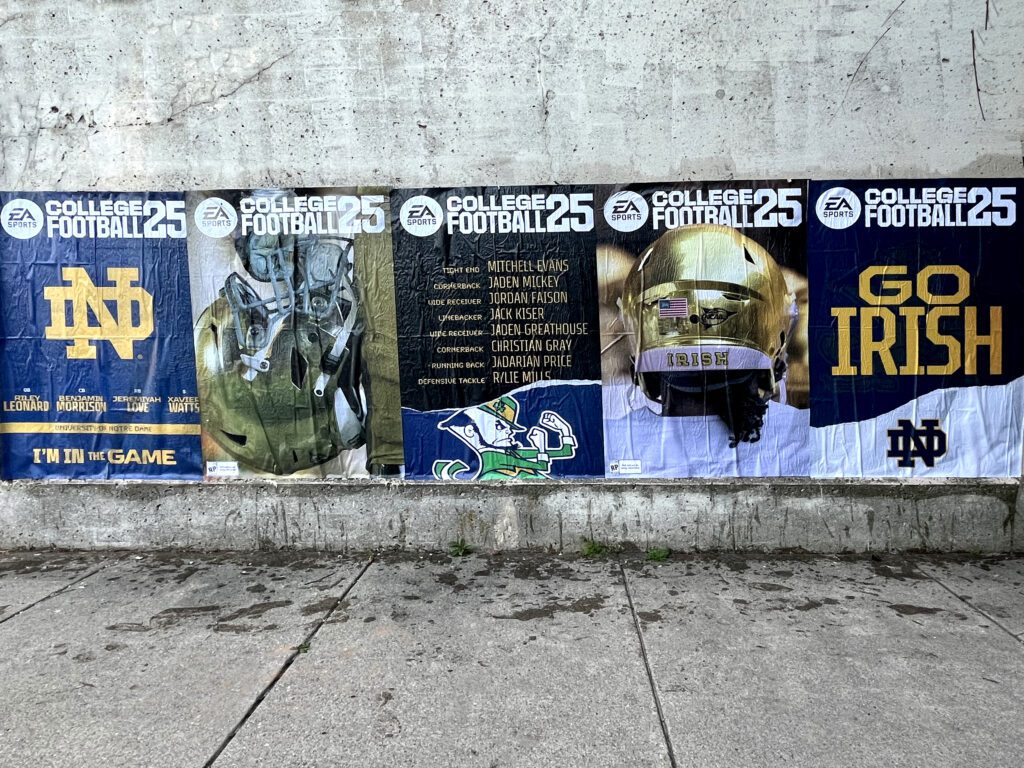
AGM has executed fly posting campaigns in Houston for entertainment clients including Netflix, whose Houston placements supported streaming platform launches with coordinated drops timed to specific release dates. We’ve worked with The Onion, EA Sports, Biossance, and Shepard Fairey — a client roster that includes brands with sophisticated creative standards and tight operational timelines. In Houston specifically, we bring a depth of local knowledge that translates directly into better placements: our crew knows which EaDo warehouse owners grant reliable surface access, which Montrose building managers maintain durable posting agreements, and which surfaces along the Midtown corridor receive the highest daily impression counts.
Our Houston process starts with a placement map delivered to you before any installation begins. You review the proposed locations, provide feedback or approval, and our crew executes from that confirmed plan. After installation, every placement is photographed with timestamp and GPS coordinates, and the full documentation package is in your hands within 48 hours. Houston clients who are managing campaigns remotely — many of our Houston clients are music labels, film distributors, and tech brands based in Los Angeles or New York — can verify their campaign’s physical footprint without ever visiting the city.
AGM also understands Houston’s particular operational characteristics. The city’s sprawl means crew logistics matter enormously — our Houston team maintains equipment, materials, and crew capacity distributed across the city’s key posting zones to avoid the travel time that would otherwise inflate execution windows in a 667-square-mile city. We’ve run Houston campaigns that deployed across Midtown, Montrose, EaDo, and the Heights on the same overnight schedule — a four-neighborhood simultaneous drop that requires local infrastructure most vendors cannot match.
Houston’s absence of traditional zoning creates both an opportunity and a challenge for fly posting campaigns. The opportunity is the abundance of blank industrial and commercial walls throughout the city’s inner-loop entertainment districts — warehouse facades, construction hoardings, and unmarked commercial building sides appear at a higher frequency in Houston than in comparably sized cities with strict zoning codes. The challenge is that this visual openness means posting surfaces are distributed across a sprawling urban landscape rather than concentrated in a compact walkable zone. AGM addresses this through deep local surface mapping: our Houston crew has spent years identifying the specific walls and hoardings in Midtown, Montrose, EaDo, and the Heights that offer the highest daily impression counts relative to foot traffic patterns. When you work with AGM in Houston, you’re not guessing at effective locations — you’re drawing from a vetted inventory of proven placements built through direct experience in the city.
The highest pedestrian foot traffic in Houston is consistently concentrated in four zones: the Midtown Main Street corridor on Thursday through Sunday evenings, the Westheimer corridor in Montrose on weekend afternoons and evenings, EaDo’s entertainment blocks during event and game nights at Shell Energy Stadium, and the 19th Street corridor in the Heights on weekend mornings and afternoons. Seasonal variations add additional high-traffic windows — the Houston Rodeo at NRG Stadium in February and March draws 2.5 million total attendees and spills significant foot traffic into the Midtown and Museum District corridors. Toyota Center events — Houston Rockets games and major touring concerts — concentrate foot traffic in the Downtown and Midtown corridors on game and show nights. AGM times placement and refresh cycles to align with these predictable peaks whenever campaign scheduling allows.
Yes, and Houston’s geographic structure makes this remarkably feasible. Unlike cities where different demographic communities are separated by long distances or city limit boundaries, Houston’s inner-loop neighborhoods concentrate multiple distinct communities within a relatively compact geographic area. AGM’s Houston placement network includes corridors specifically calibrated for different demographic targets: Third Ward and Emancipation Avenue for the African American community, the East End’s Navigation Boulevard area for Houston’s Latino community, the Bellaire and Harwin corridors for the Vietnamese-American and broader Asian American community, Montrose and Westheimer for the LGBTQ+ community, and mainstream young professional corridors in Midtown and the Heights. Campaigns can concentrate on a single community corridor or can deploy across multiple corridors simultaneously for cross-demographic reach — depending entirely on your campaign objectives and creative strategy.
Midtown Houston is AGM’s highest-volume posting zone in the city, combining consistent pedestrian foot traffic with an entertainment-oriented weekend population that is highly receptive to poster advertising. The Main Street corridor from Downtown to Midtown Greenway is lined with bars, restaurants, and event venues that draw a 22–38 year old professional crowd heavily weighted toward first-generation-in-city residents and recent transplants — exactly the demographic most open to discovering new brands. Midtown’s METRORail access also means that a segment of its weekend population arrives on foot without a car, extending the window during which they’re in a discovery mindset rather than a transit mindset. The district’s construction activity also generates a rotating inventory of fresh hoarding surfaces that can accommodate large-format campaign placements. For entertainment, music, lifestyle, and consumer brand campaigns targeting Houston’s young professional demographic, Midtown is typically the first location AGM recommends.
Yes, and event-timed campaigns are among AGM’s most requested Houston campaign types. The Houston Livestock Show and Rodeo — the world’s largest livestock show and rodeo by attendance, with 2.5 million visitors over roughly three weeks each February and March — creates one of the most concentrated pedestrian traffic events in any American city. Concert acts perform nightly at NRG Stadium as part of the Rodeo’s entertainment program, and post-show audiences regularly flow north into Midtown’s bar district. AGM positions campaigns to drop posters in Midtown and the Washington Avenue corridor in the days leading up to Rodeo season’s peak weekends, capturing both the Rodeo audiences and the general Houston population that is most active outdoors during the mild late-winter weather. Major Toyota Center concerts and Rockets playoff games create similar event-aligned campaign opportunities on a more frequent basis throughout the year.
Montrose and EaDo serve meaningfully different Houston demographics, which is exactly why covering both in a single campaign creates strong cross-community reach without redundancy. Montrose skews LGBTQ+-inclusive, arts-forward, and slightly older in its core demographic — the 28–42 year old independent-lifestyle consumer. EaDo skews toward the sports and music entertainment audience, with a broader demographic age range that peaks at 21–35 and includes more of Houston’s new-to-city young professional population. AGM’s recommended approach for a dual-zone Montrose and EaDo campaign is to allocate the larger-format 48″×72″ posters to EaDo’s warehouse walls, where the format’s visual dominance has the most impact, and use the 24″×36″ standard format for Montrose’s more intimate commercial corridor, where density of placement across multiple storefronts and alley surfaces builds cumulative awareness more effectively than a small number of oversized posters would.
Houston’s subtropical climate — characterized by high year-round humidity, frequent summer thunderstorms, and a heat index that regularly exceeds 100°F from June through September — creates genuine adhesion challenges that AGM addresses through material and formulation selection specific to the Houston environment. Our Houston campaigns use wheat paste formulations engineered for high-moisture surfaces, ensuring that the adhesive maintains bond integrity through the city’s frequent rain events without bubbling or peeling at the edges. Print stock selection for Houston campaigns prioritizes heavy-weight, moisture-resistant paper that minimizes warping during the city’s overnight humidity cycles. During peak summer months, AGM also adjusts installation timing to overnight and early morning windows when surface temperatures are lower and adhesive sets more reliably. The goal in every Houston campaign is a minimum two-week viable lifespan under normal weather conditions, and our material protocols are designed around that performance target.
Houston’s fly posting market is dominated by three broad categories: entertainment brands, lifestyle and consumer brands, and technology companies with Houston market ambitions. On the entertainment side, AGM regularly executes Houston campaigns for music labels announcing tour dates and album releases at Toyota Center, White Oak Music Hall, Warehouse Live, and House of Blues Houston. Film and streaming studios use Houston fly posting for both wide theatrical releases and platform originals — Houston’s demographic diversity makes it an important bellwether market for national entertainment campaigns. In the consumer and lifestyle space, AGM works with apparel brands, sneaker companies, and food and beverage brands building Houston distribution. The technology sector has grown significantly in Houston’s campaign mix as the city has developed a meaningful tech presence beyond its traditional energy industry base, with brands targeting Houston’s growing software and engineering workforce using fly posting in Midtown and EaDo as an employer brand and product awareness tool.
The majority of AGM’s Houston clients are not based in Houston. Music labels in New York and Los Angeles, film studios in Hollywood, tech brands in San Francisco and Austin — most of our Houston campaign clients manage the engagement remotely, and our process is specifically designed to make remote coordination seamless. The campaign begins with a remote briefing call or written brief, after which AGM produces a proposed placement map with specific wall locations, format recommendations, and timing for your review. Once you approve the map, our Houston crew executes the installation and delivers photo documentation — timestamped, geo-tagged, organized by neighborhood — within 48 hours of completion. Remote clients get the same documentation quality and coverage confidence as clients who are on the ground in Houston. We’ve successfully managed Houston campaigns for clients based in twelve states and several international markets without any in-person coordination required.
Given Houston’s geographic scale, AGM’s minimum recommendation for a Houston campaign that creates meaningful market presence is the 100-poster package. One hundred posters, strategically distributed across two or three target zones — for example, Midtown, Montrose, and EaDo — provide enough coverage in each zone to create the repetition and density that makes fly posting effective. Splitting fewer posters across Houston’s sprawling entertainment landscape results in insufficient saturation in any individual zone and limits the campaign’s ability to generate the cumulative impression frequency that drives brand recall. For clients who want to cover four or more Houston neighborhoods simultaneously or are launching a brand in the Houston market for the first time and need to establish broad awareness rather than targeted depth, the 200-poster package provides better geographic distribution across the city’s full inner-loop entertainment network. Clients with specific single-neighborhood targets can achieve effective saturation with the 100-poster package if placements are concentrated rather than distributed.