American Guerrilla Marketing
Nationwide Service
Media planning, media buying, billboard advertising, & guerrilla marketing
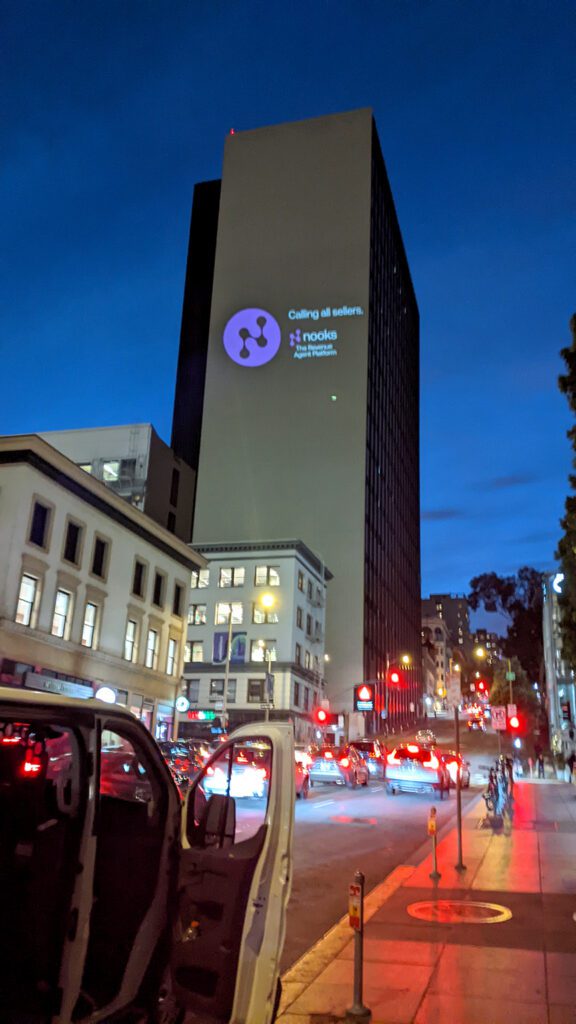
Guerrilla Projections in Milwaukee, WI
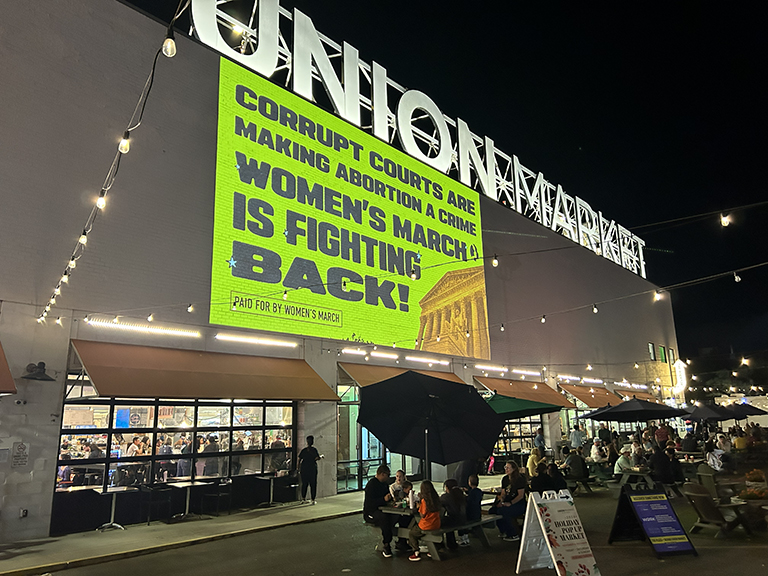
Walker’s Point, Historic Third Ward, Brady Street, Bay View, and downtown Water Street. 20,000-lumen building projection campaigns on Milwaukee’s best warehouse facades — from contact us for pricing.
Milwaukee occupies a rare position in the guerrilla projection landscape because of what its neighborhoods chose not to demolish. When the manufacturing economy contracted and the warehouse districts shed their industrial tenants, the buildings stayed. The Historic Third Ward and Walker’s Point didn’t get cleared for glass towers or surface parking — they got converted, building by building, into the galleries, restaurants, bars, studios, and nightlife venues that now pack their sidewalks from Thursday through Sunday with the exact demographic that projection advertising is designed to reach. The bones of a manufacturing city — multi-story masonry facades, flat concrete end-walls, painted surfaces spanning four and five stories of uninterrupted face — became the physical canvas for a visual advertising format that requires exactly those structural characteristics to perform at its highest level.
American Guerrilla Marketing is a Best of Brooklyn award winner whose projection campaigns have run for clients including The Weeknd, YouTube, Biossance, the US Marine Corps, the Women’s March, and Reproductive Freedom for All. AGM deploys 20,000-lumen commercial projection systems on building facades in Milwaukee — with Walker’s Point and the Historic Third Ward as the primary deployment environments — and maintains a national scouting team that conducts both digital and physical on-the-ground location evaluation before any campaign is confirmed. Every campaign is executed by AGM’s own direct technical crew, not subcontractors, ensuring consistent standards from equipment operation through post-campaign GPS-documented reporting.
AGM’s projection client roster includes Netflix, Disney, Coca-Cola, FanDuel, Live Nation, iHeartRadio, and the US Marine Corps. A confirmed case study: the US Marine Corps × CMA Fest Nashville — multi-night projections onto architectural surfaces throughout the festival footprint, reaching 80,000+ attendees across the campaign window. Projection advertising scales across every brand category; what our campaigns share is scale, precision, and a physical presence digital cannot replicate.
Milwaukee’s warehouse districts are among the strongest guerrilla projection environments in the Midwest for a specific, concrete reason: the building stock was built at a time when size, flatness, and structural mass were commercial virtues rather than liabilities. A three-story flat masonry wall on a Walker’s Point warehouse was designed to be seen from distance. It was never designed to be interesting at close range — no decorative articulation, no ornamental facade elements, no window grids interrupting the vertical run of masonry above the ground floor. That’s exactly the wall that produces a clean, vivid, large-format projection image from a 20,000-lumen system positioned on the other side of the street. The building’s original design intent and the projection format’s technical requirements align perfectly — and that alignment is rare, which is why Milwaukee’s warehouse districts produce projection environments that most cities simply cannot match.
Beyond the warehouse neighborhoods, Milwaukee’s Brady Street entertainment corridor, Bay View arts district, and downtown Water Street zone each offer distinct projection environments with their own audience profiles and seasonal patterns. The city’s summer festival calendar — anchored by Summerfest, the world’s largest music festival — creates recurring windows of elevated citywide foot traffic that projection campaigns can be timed around. And Milwaukee’s dense, socially active creative community means that organic social media documentation of projection campaigns tends to circulate effectively — amplifying earned media reach beyond the immediate physical audience at the wall on any given night.
Milwaukee's Warehouse Walls Are Waiting
20,000-lumen projection campaigns from contact us for pricing. Walker's Point, Historic Third Ward, Brady Street, Bay View. AGM's own crew, Best of Brooklyn award winner, GPS-documented results.
Milwaukee's Premier Projection Districts
Milwaukee’s five main projection environments cover a range of audiences, building types, and seasonal patterns. AGM’s national scouting team evaluates candidate surfaces in each district using physical on-the-ground assessment combined with digital pre-screening. The following district-by-district breakdown covers the key projection characteristics of each zone.
Walker’s Point Arts District — IDEAL
Walker’s Point is AGM’s primary Milwaukee projection environment. The neighborhood’s warehouse and light-industrial building stock includes multi-story facades of painted concrete, EIFS, and smooth masonry — large, flat surfaces with minimal window interruption above the ground-floor level. Buildings in Walker’s Point frequently feature full end-walls: the broad, flat, windowless faces at the gable ends of warehouse structures that span the full height and width of the building with no architectural interruption. These end-walls are among the best projection surfaces found anywhere — a 20,000-lumen system positioned 80 to 150 feet away can fill that entire face with a sharp, saturated image readable from multiple city blocks. Walker’s Point’s street-level audience is one of Milwaukee’s most socially active: the neighborhood anchors the city’s arts community and its LGBTQ+ nightlife scene, producing a concentrated, smartphone-active audience on Thursday through Saturday nights that documents and shares visual experiences in public space at a higher rate than most Milwaukee neighborhoods. For product launches, entertainment releases, consumer brand activations, and campaigns whose message resonates with a creative, progressive, arts-engaged audience, Walker’s Point is the correct starting point for any Milwaukee projection discussion.
Historic Third Ward Arts District — IDEAL
The Historic Third Ward is Milwaukee’s premier converted-industrial arts district — a compact zone of former warehouse and factory buildings now housing galleries, design studios, upscale restaurants, boutique retail, and event venues. The district’s building stock is exceptional for projection advertising: former industrial structures with large, flat painted masonry facades, smooth concrete end-walls, and building heights of three to six stories that provide a large vertical canvas for projected imagery. Third Ward facades along the primary pedestrian streets are positioned at throw distances of 60 to 140 feet from the opposite sidewalk or from adjacent lots — well within the operational range of AGM’s 20,000-lumen system. The Third Ward audience is a mix of arts patrons, design professionals, restaurant diners, and nightlife regulars who converge in the district on Thursday through Saturday evenings. This demographic is educated, high-income, and socially active — a valuable target audience for luxury consumer products, creative industry brands, entertainment releases, and premium hospitality campaigns. AGM’s national scouting team has specifically evaluated Third Ward surfaces for projection suitability, identifying the buildings with the strongest combination of surface quality, viewing geometry, and foot traffic adjacency.
Brady Street Entertainment Corridor
Brady Street is one of Milwaukee’s most storied neighborhood entertainment corridors — a strip of bars, restaurants, independent retail, and music venues running through the Lower East Side neighborhood. Brady Street’s building stock reflects its age: late-19th and early-20th century commercial buildings with brick facades of varying surface quality and upper-story walls of mixed paint conditions. AGM’s scouting team evaluates Brady Street surfaces individually, identifying the specific walls where surface color and flatness are sufficient for projection quality at the available throw distances. The best Brady Street surfaces tend to be painted upper-story masonry on commercial blocks with accessible throw positions from across the street or from adjacent lots. The Brady Street audience is a blend of neighborhood residents and destination diners and nightlife visitors — a younger, creative demographic with strong Milwaukee roots and consistent weekend evening presence. For brands with appeal to an engaged, local-culture-connected Milwaukee audience, Brady Street provides a secondary projection environment with a distinctly neighborhood character.
Bay View Arts Area
Milwaukee’s Bay View neighborhood has emerged as a significant arts community over the past decade — a concentration of galleries, maker spaces, independent restaurants, and creative-profession residents that generates evening foot traffic anchored to arts events and neighborhood programming. Bay View’s commercial zone along South Kinnickinnic Avenue and the surrounding blocks includes commercial buildings of varying ages and surface types; AGM’s scouting team evaluates individual surfaces for projection suitability rather than approving the area broadly. The best Bay View projection surfaces are light-painted masonry commercial buildings with adequate face area and clear sightlines from available throw positions. The Bay View audience is arts-engaged, locally rooted, and skews toward creative professionals and residents — a demographic that is visually literate and socially active on platforms where projection documentation circulates. For campaigns targeting Milwaukee’s creative residential community outside the warehouse district core, Bay View provides a complementary projection environment to Walker’s Point and the Third Ward.
Downtown Water Street Zone
Milwaukee’s downtown Water Street entertainment district runs through the city’s central bar and nightlife zone, drawing a broad-demographic city-center crowd on weekend evenings. Commercial buildings along Water Street and the adjacent blocks include a range of surface types — from older masonry commercial structures with paintable faces to newer construction with less suitable exterior cladding. AGM’s scouting team evaluates Water Street surfaces site by site, identifying the specific building faces that meet projection quality standards within the available throw geometry. The Water Street audience is broader and more demographically diverse than the warehouse district neighborhoods — a general-public nightlife crowd rather than an arts-focused or creative-community-specific demographic. For brands targeting a wide Milwaukee audience across multiple demographic segments, Water Street’s central location and general-public nightlife draw provide reach that the more specialized warehouse district environments don’t match in raw demographic breadth.
Campaign Formats For Milwaukee's Warehouse District Audiences
Product Launch Projection
A consumer product or brand launch projected on a Walker’s Point or Third Ward warehouse facade — using the scale and surprise of a large building projection to create a street-level brand moment that generates organic social documentation from a socially active, creative-community audience. Product launches in warehouse district environments benefit from the implicit brand signal of the setting: projecting on a repurposed industrial building in an arts district communicates creative brand values that resonate with the design-aware, arts-engaged audiences who populate these neighborhoods on Friday and Saturday nights.
Entertainment Release Campaign
A music or media release projected as a large-format building image in Walker’s Point or the Third Ward — artist imagery, album artwork, release date, or streaming platform branding on a warehouse wall that commands attention from a full city block in either direction. Milwaukee’s arts-active nightlife audience is exactly the demographic that entertainment labels and streaming platforms target: young, creative, socially active, and consistently present in the city’s arts neighborhoods on the evenings when projection campaigns run.
Summerfest and Festival-Adjacent Activation
Summerfest — the world’s largest music festival, held annually on Milwaukee’s lakefront — generates millions of attendees over its 11-day run, drawing both local Milwaukee residents and out-of-state visitors into a massive shared event environment. Projection campaigns in Milwaukee neighborhoods during Summerfest’s run intercept a citywide audience in a heightened social and entertainment mindset. Adjacent neighborhoods like the Historic Third Ward, Walker’s Point, and the downtown zone see elevated foot traffic from festival visitors who explore the city before and after each day’s programming. Festival-adjacent timing is one of the highest-value windows in Milwaukee’s projection calendar.
Multi-Night Warehouse District Run
A consecutive two-or-three-night campaign in Walker’s Point or the Historic Third Ward — building audience awareness through repetition across multiple peak evenings. The first night generates organic documentation; that documentation, shared across social platforms, brings new audience members to the location specifically to encounter and photograph the projection. By the second and third nights, the campaign has generated its own awareness loop — people are coming because they saw someone else’s photo, not just because they happened to walk past. This compounding organic reach effect is strongest in the socially active arts-district neighborhoods where Milwaukee’s projection advertising performs best.
Plan Your Guerrilla Projection Campaign in Milwaukee, WI
Tell us about your campaign goals, target audience, and preferred locations. Our team will help you plan a high-impact guerrilla projection campaign tailored to your needs.
Award Winning Personalized Service
You will get thoughtful, devoted, and individualized attention from our experienced, qualified, and professional personnel. Being one of the most illustrious agencies in Brooklyn, New York, American Guerrilla Marketing has been awarded the Best of Brooklyn title.
Nationwide
Industry City, Brooklyn, New York 11232
American Guerrilla Marketing
Hours
Mon - Fri: 9 AM - 5 PM
Sat & Sun: Closed
Automate your campaign with AGM’s Request for Proposal Builder.
Automate your campaign with AGM’s Request for Proposal Builder. Simply answer a few quick questions about your campaign goals, markets, and timeline, and the system will generate a tailored presentation with recommended strategies, quantities, and pricing. Click the RFP Builder to instantly receive your customized proposal.
Running a Milwaukee Projection Campaign: The AGM Process
A Milwaukee projection campaign starts with a brief that identifies the target neighborhood, campaign objective, audience profile, and timing. For most Milwaukee campaigns, the district question resolves quickly: Walker’s Point for arts-community and nightlife audiences, the Historic Third Ward for upscale consumer and arts-patron audiences, Brady Street for neighborhood entertainment culture, Bay View for creative residential communities, and Water Street for broad downtown reach. Some campaigns benefit from a two-district approach — deploying one projector in Walker’s Point and a second in the Third Ward on the same night, covering both warehouse-district audiences simultaneously.
Once the district is confirmed, AGM’s national scouting team deploys for advance physical assessment. Milwaukee’s warehouse districts require careful surface-by-surface evaluation because building quality varies significantly within short distances. A block of Walker’s Point might include an ideal projection surface — a large, flat, light-painted concrete end-wall — adjacent to a building with dark brick or a heavily windowed face that would produce a poor result. AGM’s scouting team walks each candidate block, photographs candidate surfaces, records GPS coordinates and throw geometry, confirms power access, and documents foot traffic patterns at the specific times the campaign will run. This advance work is what makes the difference between a campaign that hits a great wall in a great location and a campaign that misses by half a block and hits a wall that absorbs light rather than reflecting it.
On campaign night, AGM’s two-person technical crew arrives with the 20,000-lumen projector, generator, complete power solution, electronics bundle, and mobility unit. Setup in Milwaukee’s warehouse district environments takes 30 to 60 minutes. The projection launches at dusk — precisely timed to the threshold at which the 20,000-lumen system achieves maximum visual impact as ambient light drops — and runs for a four-to-six-hour window that covers the peak Thursday-through-Saturday nightlife period in Walker’s Point and the Third Ward. The crew remains on-site throughout the full campaign run, documenting the deployment and managing conditions. After breakdown, the post-campaign GPS-documented report is compiled and delivered digitally.
AGM’s Milwaukee campaigns benefit from a building stock that was designed for exactly the scale and visual weight that guerrilla projection requires. The warehouse buildings in Walker’s Point and the Third Ward weren’t engineered with projection advertising in mind, but their industrial scale, structural flatness, and light-painted surface conditions produce results that carefully designed projection-ready surfaces sometimes don’t match. Milwaukee’s industrial legacy is, for AGM’s purposes, a competitive advantage in the Wisconsin projection market.
Case Studies: Product Launches And Entertainment Releases
Two AGM campaigns are directly relevant to the kinds of activations that perform strongest in Milwaukee’s warehouse district environment.
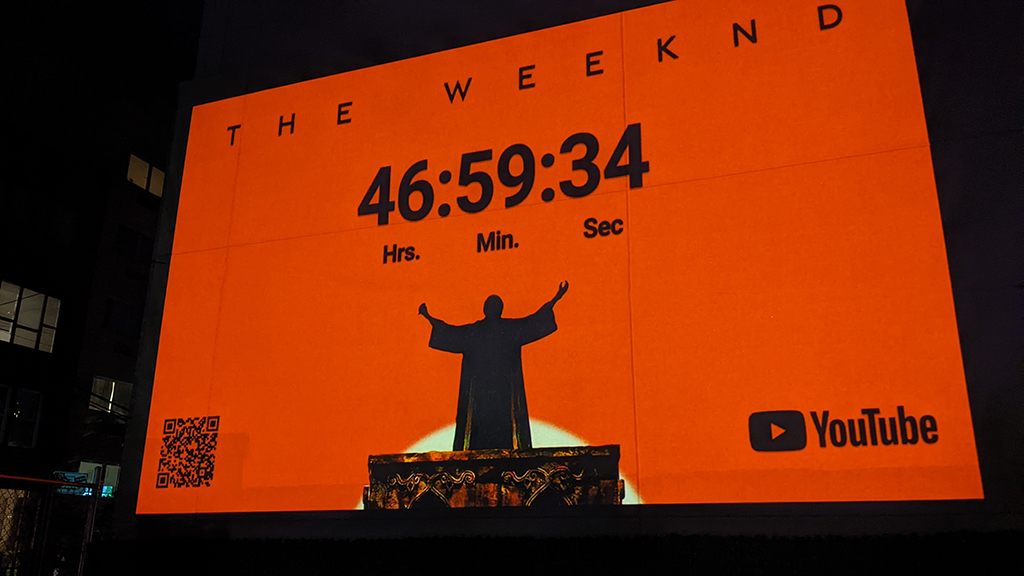
The Weeknd × YouTube — New York City
For a music release campaign involving The Weeknd and YouTube, AGM deployed building projection advertising in a dense New York City environment to create a street-level branded entertainment moment. The campaign’s core mechanic — projecting artist imagery and release branding onto a prominent urban building face at night — generated organic audience documentation that extended the campaign’s reach far beyond the physical audience at the deployment site. People photographed and shared the projection image across social platforms, turning the physical deployment into an earned-media asset that lived beyond the campaign night itself. Milwaukee’s Walker’s Point and Historic Third Ward are among the strongest Midwest environments for replicating this mechanic. Both neighborhoods carry an arts-active, socially engaged, smartphone-documenting nightlife audience on Thursday through Saturday evenings. An entertainment release projected onto a Walker’s Point warehouse end-wall reaches exactly the demographic that documented and shared the New York City Weeknd campaign — and Milwaukee’s warehouse-scale building stock delivers a larger, more visually arresting projected image than the smaller building facades typically available in a dense Manhattan streetscape.
Biossance × Sephora — Product Launch
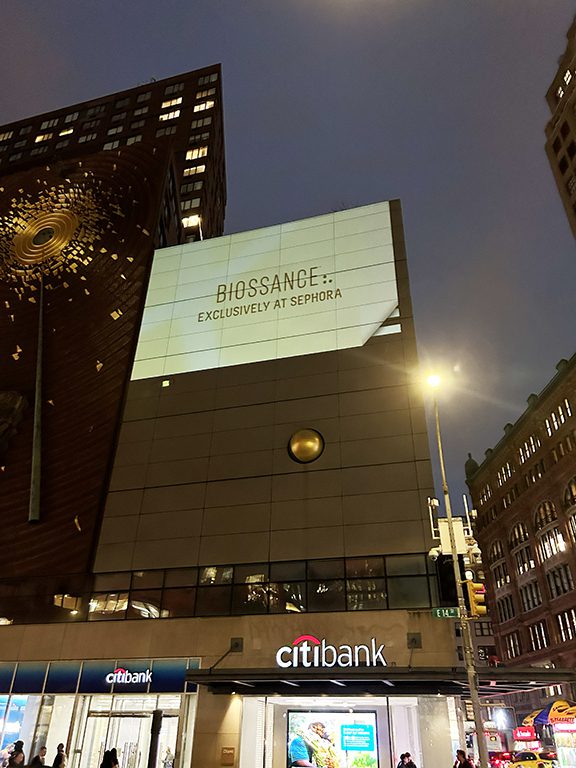
AGM’s product launch work with Biossance demonstrates what consumer brand projection advertising looks like when the campaign creative, the deployment location, and the audience profile are properly matched. Biossance is a sustainable skincare brand with a design-forward identity and a core demographic of educated, design-aware consumers — exactly the demographic that shops at Sephora and exactly the demographic that inhabits Milwaukee’s Historic Third Ward on any given Saturday night. The Biossance projection campaign used building-scale advertising to create a brand moment in an arts-district environment where design values are recognized and appreciated. Milwaukee’s Third Ward is a natural successor environment for a campaign of this type: the building stock produces the physical scale, the converted-gallery-and-restaurant landscape produces the audience, and the neighborhood’s implicit design-literacy means that a well-executed projection creative is received as a visual statement rather than just an advertisement. Consumer brands in beauty, lifestyle, food and beverage, fashion, and consumer electronics whose demographic profile aligns with the design-aware, arts-engaged urban consumer will find Milwaukee’s warehouse districts among the most receptive projection environments in the Midwest.
Milwaukee Projection Campaign Investment
Building projection advertising in Milwaukee is priced at contact us for a quote. . That rate covers AGM’s 20,000-lumen commercial projector, generator and complete power solution, electronics bundle, mobility unit, and AGM’s own two-person technical crew — the same crew that scouted the location — for setup, full-duration operation, and breakdown. No subcontractors are deployed. No separate charges apply for equipment transport, crew, or power. The campaign runs from dusk for a standard four-to-six-hour window covering the peak nightlife period in Walker’s Point, the Third Ward, and Milwaukee’s other entertainment districts.
Advance location scouting for Milwaukee — physical on-the-ground evaluation of candidate surfaces in your target district — is available at approximately contact us for pricing. AGM’s national scouting team conducts this evaluation in advance of the campaign date and delivers GPS-documented findings that become part of the pre-campaign planning package. Campaigns requiring permitted building placements or private-property building agreements carry location fees of Contact us for a custom quote. per night depending on the specific property. Multi-night Milwaukee campaigns — two or three consecutive evenings in Walker’s Point or the Third Ward, for example — are available at the standard per-projector-per-night rate.
For brands considering a dual-district activation — Walker’s Point and the Historic Third Ward simultaneously, or Walker’s Point and Brady Street on the same night — AGM coordinates both projection units, crew deployments, and location scouts as a single campaign package. Each projector is priced separately at contact us for pricing, with scouting for each district handled independently. Multi-district deployments are particularly effective for product launches and entertainment releases where the goal is to saturate multiple Milwaukee arts and nightlife audiences on the same campaign night.
The Milwaukee Projection Advertising Audience
Milwaukee’s warehouse district audiences are among the most valuable in the Wisconsin projection market from a campaign perspective. Walker’s Point and the Historic Third Ward concentrate a specific demographic — creative professionals, arts community members, design-engaged consumers, and nightlife regulars in the 22-to-45 age range — in a contained geographic zone on Thursday through Saturday evenings. This audience is high-value for consumer brands because it indexes strongly on discretionary spending in design, fashion, food, entertainment, and lifestyle categories. It is socially active in a way that maximizes organic projection documentation: these neighborhoods are where Milwaukee’s Instagram-active, creative-industry social-media users congregate, which means projection campaigns in these zones generate documentation and sharing at higher rates than a comparably-sized general-population audience elsewhere in the city.
The broader Milwaukee projection market — Brady Street, Bay View, downtown Water Street — adds demographic range: Brady Street’s neighborhood entertainment crowd, Bay View’s creative residential community, and Water Street’s general-public nightlife audience all provide reach into Milwaukee audiences that the warehouse districts don’t exclusively own. AGM’s scouting team can help match your campaign’s specific audience objective to the Milwaukee district that delivers the best-qualified audience for your brand and creative strategy.
Coverage & Estimated Impressions
| Zone / Area | Peak Hours | Foot Traffic | Est. Nightly Impressions | Best For |
|---|---|---|---|---|
| Walker’s Point Arts District | 8PM–12AM | Moderate | 2,500–12,000 | Product Launch |
| Historic Third Ward Arts District | 8PM–12AM | Moderate | 2,500–12,000 | Event Promotion |
| Brady Street Entertainment Corridor | 8PM–12AM | Moderate | 2,500–12,000 | Brand Awareness |
| Bay View Arts Area | 8PM–12AM | Moderate | 2,500–12,000 | Political |
| Downtown Water Street Zone | 8PM–12AM | Moderate | 2,500–12,000 | Sports |
Frequently Asked Questions
Walker’s Point combines three characteristics that are rare to find simultaneously in a single urban district: ideal building stock, high-quality projection surfaces, and a socially active target audience. The neighborhood’s warehouse and light-industrial buildings include multi-story painted concrete and masonry end-walls — flat, light-colored, uninterrupted surfaces that reflect a 20,000-lumen system with maximum fidelity. Those surfaces sit directly alongside some of Milwaukee’s highest-concentration nightlife and arts foot traffic, anchored by the neighborhood’s arts community and LGBTQ+ nightlife scene. And the Walker’s Point audience is among Milwaukee’s most socially active on visual documentation platforms — they photograph and share what they encounter in public space at a rate that amplifies campaign reach beyond the physical audience at the wall.
The Historic Third Ward’s former factory and warehouse buildings were constructed at an industrial scale that aligns almost perfectly with large-format projection requirements. Multi-story flat masonry facades — built for structural mass rather than architectural expressiveness — provide the large, uninterrupted, light-colored surface areas that a 20,000-lumen system needs to produce a sharp, saturated image at full building scale. Window interruptions are typically minimal above the ground-floor retail level on former warehouse buildings, and the structural flatness of industrial masonry — no projecting cornices, pilasters, or decorative facades above the base — means the image lands on a clean planar field rather than a complex architectural surface that would distort or fragment the projected picture.
Yes. Summerfest and Milwaukee’s other major summer events — Festa Italiana, German Fest, Irish Fest, the Polish Fest, and PrideFest — all generate citywide foot traffic elevations that benefit projection campaigns in adjacent neighborhoods. Walker’s Point, the Historic Third Ward, downtown Water Street, and Brady Street all see increased pedestrian activity during major lakefront festival programming as event visitors spread into the surrounding city before and after attending the festivals. AGM can time campaign deployment to align with specific festival dates when advance booking provides sufficient lead time. Summerfest in particular — running for 11 days in late June and early July — creates the longest continuous elevated-foot-traffic window in Milwaukee’s annual calendar.
Consumer product launches in Milwaukee’s warehouse districts follow a format proven by campaigns like AGM’s Biossance × Sephora deployment: the projection creates a street-level visual moment that places the product or brand in a physical environment inhabited by the target consumer. Walker’s Point and the Historic Third Ward attract a design-aware, high-discretionary-spending consumer who is already in the geographic zone of the campaign’s target demographic. The projection’s scale — filling a multi-story warehouse face — creates a visual impact that drives organic documentation and sharing, extending the launch moment beyond the physical audience at the wall on the campaign night. For beauty, lifestyle, fashion, food and beverage, and consumer electronics brands whose core consumer profile aligns with the creative, urban, arts-engaged Milwaukee demographic, the warehouse district projection format produces both immediate impression volume and sustained organic reach.
Brady Street attracts a neighborhood-loyal, locally-rooted Milwaukee audience — longtime residents and regulars of the Lower East Side neighborhood who use the corridor’s bars, restaurants, and music venues as a consistent nightlife destination rather than a destination they travel to from across the city. This audience is younger-skewing, Milwaukee-born-or-long-term-resident, and has a neighborhood attachment to the Brady Street identity that makes them receptive to local-culture-referencing brand messages. For consumer brands, food and beverage companies, local businesses, and organizations targeting a locally-rooted Milwaukee audience rather than the transplant-and-visitor mix of the warehouse districts, Brady Street provides a distinct demographic angle on the city’s nightlife geography.
Bay View and Walker’s Point both serve arts-engaged Milwaukee audiences, but with distinct demographic profiles and geographic contexts. Walker’s Point is denser, more concentrated, and produces higher raw foot traffic volume on weekend nights — anchored by nightlife infrastructure that draws citywide rather than neighborhood-only audiences. Bay View is a residential arts community whose foot traffic is more neighborhood-concentrated and less nightlife-dependent — lower raw volume, but a more locally-rooted, arts-community-specific demographic. Brands targeting Milwaukee’s creative class in a neighborhood-community context fit Bay View’s audience profile; brands seeking maximum volume from an arts-active audience fit Walker’s Point better. For campaigns where the goal is neighborhood community resonance rather than raw foot traffic, Bay View is the more precise tool.
Water Street’s downtown entertainment zone produces a broad-demographic nightlife audience — a general-public Milwaukee crowd that is less arts-specific and less creative-community-concentrated than the warehouse district audiences. Water Street’s commercial buildings vary in projection suitability; AGM’s scouting team evaluates individual surfaces rather than approving the corridor broadly, looking for the specific faces with adequate light color, flatness, and available throw distance. For campaigns whose audience objective is broad Milwaukee demographic reach — rather than the targeted arts-community profile of Walker’s Point or the Third Ward — Water Street’s central location and general-population nightlife draw provides reach that the more specialized warehouse neighborhoods don’t replicate in raw demographic breadth.
Yes — and Walker’s Point is the most efficient single location in Milwaukee for doing exactly that. The neighborhood’s arts community, gallery programming, and creative-professional residential base concentrate the city’s arts-engaged population in a defined geographic zone on Thursday through Saturday evenings. For campaigns whose creative message resonates with arts-literate, design-aware, visually engaged consumers — luxury brands, entertainment labels, arts institutions, creative-industry organizations — Walker’s Point provides a more targeted audience than any general-population Milwaukee deployment environment. Historic Third Ward adds an upscale creative-consumer dimension; Bay View adds a locally-rooted residential arts-community dimension. AGM’s scouting team can advise on the optimal Milwaukee district for each specific campaign audience objective.
Projection campaigns in Walker’s Point or the Historic Third Ward can be timed to specific gallery openings, arts events, or neighborhood programming nights when arts-focused foot traffic in the target district is at its highest concentration. Gallery opening nights — typically Friday evenings — produce pedestrian traffic that is explicitly arts-engaged and moving between multiple venues in the neighborhood, making the audience maximally receptive to additional visual stimuli encountered in the street environment. AGM’s team coordinates campaign timing with the client’s awareness of local arts programming, and advance scouting confirms the best surfaces in the target district for the specific event date. Early booking is recommended for campaigns tied to specific gallery or arts programming dates.
The strongest projection surfaces in the Historic Third Ward are the end-walls and upper-story faces of former warehouse and factory buildings — large, flat, light-painted masonry or concrete faces with minimal window interruption above the ground-floor level. These buildings typically date from the late 19th through early 20th century and were constructed with the structural mass and visual simplicity of industrial architecture rather than the ornamentation of contemporary commercial construction. Their sheer scale — four to six stories of relatively uninterrupted masonry — gives the 20,000-lumen projection system a large field to work with, producing image sizes that register visually from full city blocks in either direction. AGM’s scouting team evaluates Third Ward surfaces individually, prioritizing buildings with documented light-colored paint, flat wall planarity, and accessible throw positions.
Projection advertising regulations vary by specific location, property type, and municipality requirements. AGM’s team navigates permitting and location considerations as part of campaign planning for every Milwaukee market. Some campaigns are executed in guerrilla public-space configurations that don’t require advance permitting. Others — particularly campaigns requiring specific building placement or private-property access — involve direct engagement with property owners and, where necessary, local authorities. Permitted or private-property location fees for Milwaukee range from Contact us for a custom quote. per night depending on the specific building, neighborhood, and arrangement. AGM’s national scouting team identifies the most practical deployment approach for each specific campaign objective and location requirement.
A single-night campaign creates a projection moment — maximum impact on one evening for the audience present at the wall during the campaign window. A two-night campaign creates a projection event — audience members who see documentation of the first night become intentional visitors on the second, and the organic social reach compounds across both nights as documentation from night one brings new eyes to night two. Two-night campaigns in Walker’s Point and the Historic Third Ward are particularly effective for product launches and entertainment releases where the goal is to build sustained awareness across a weekend rather than generate a single high-energy moment. The per-night rate is identical for both nights; the second night’s impact typically exceeds the first because the audience’s documentation activity on night one has already begun the earned-media amplification cycle.
Our Campaign Locations
Browse All States
Explore Guerrilla Projections opportunities across the United States.
49 States • 192 Cities
More AGM Outdoor Advertising Services
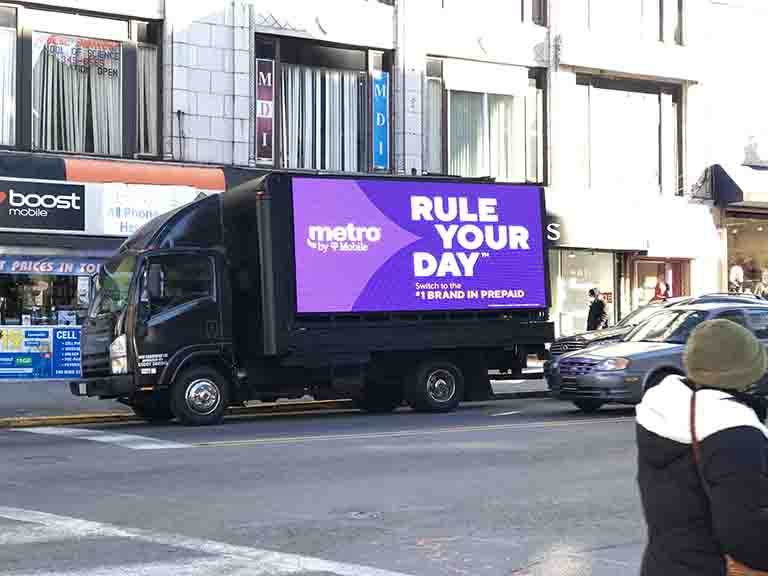
Led Billboard Trucks
Mobile LED displays that bring your brand to any location, any event.
Fly Posting
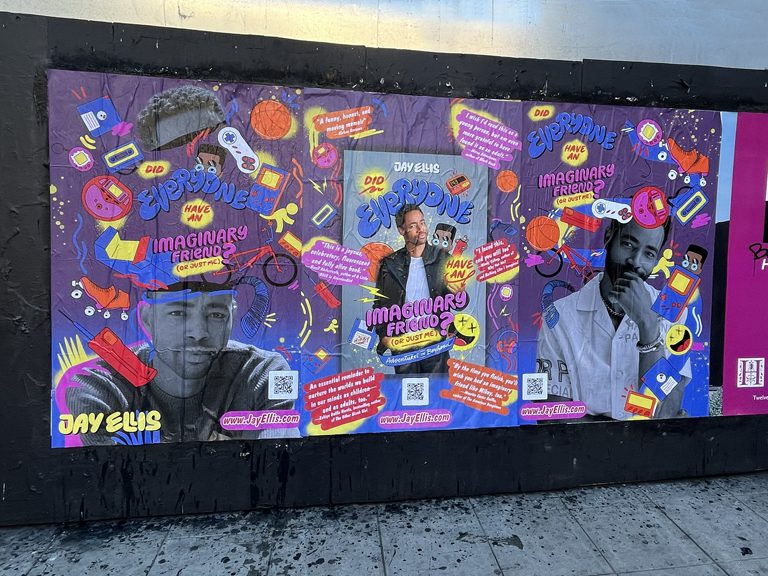
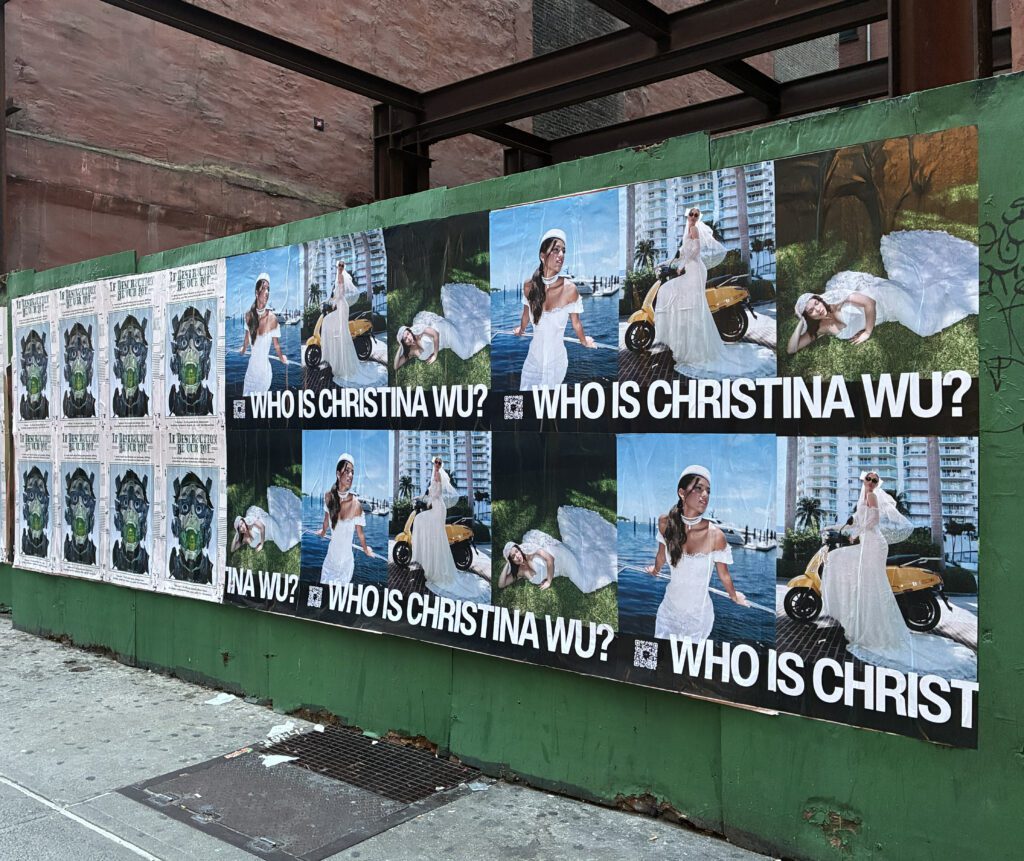
Street-level poster saturation across walls, construction sites, and corridors.

Sidewalk Decals
Ground-level branded decals at pedestrian hotspots and event entrances.

Sidewalk Stencils
Creative stencil campaigns that put your brand in the path of pedestrians.