American Guerrilla Marketing
Nationwide Service
Media planning, media buying, billboard advertising, & guerrilla marketing
Guerrilla Projections in Cranston, RI
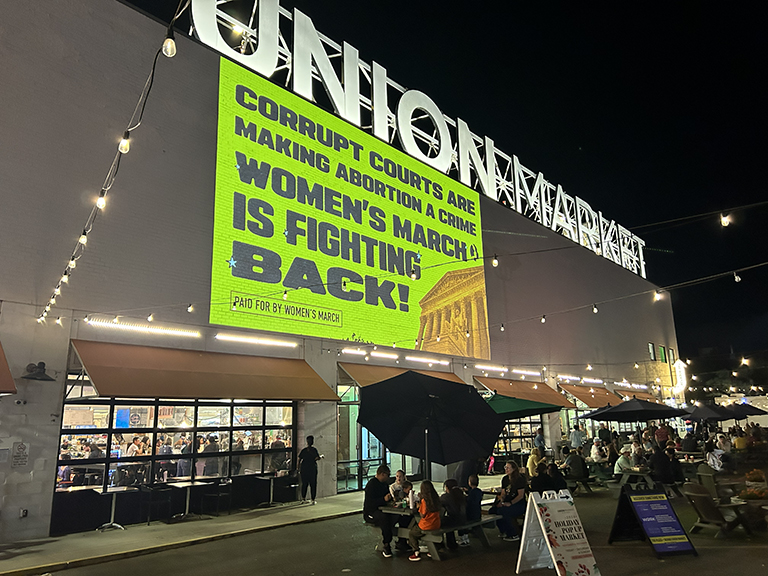
The Cranston Print Works historic mill complex carries exterior wall faces that have stood for two centuries — blank, broad, and built for exactly the kind of large-scale visual statement that AGM’s 20,000-lumen projection system delivers. Cranston’s Atwood Avenue corridor and Garden City commercial arts zone add pedestrian-dense audience windows that make the building projection format pay off across the full market.
Cranston is Rhode Island’s second-largest city and sits immediately south of Providence along the metropolitan corridor that connects the state’s urban core to its southern suburban communities. The city’s projection advertising landscape is anchored by one of the most historically and physically significant mill complexes in New England — the Cranston Print Works, a former textile printing facility that operated from the early nineteenth century and left behind a campus of brick mill buildings with exterior wall faces of genuinely monumental scale. For a guerrilla projection campaign, the Print Works represents a rare opportunity: a surface large enough to hold a projected image at building-spanning dimensions, in a historic complex that carries cultural weight and visual character well beyond what any newly constructed building could provide, in a market where projection advertising is genuinely uncommon and where the format’s novelty drives documentation and earned media returns that more saturated markets cannot replicate.
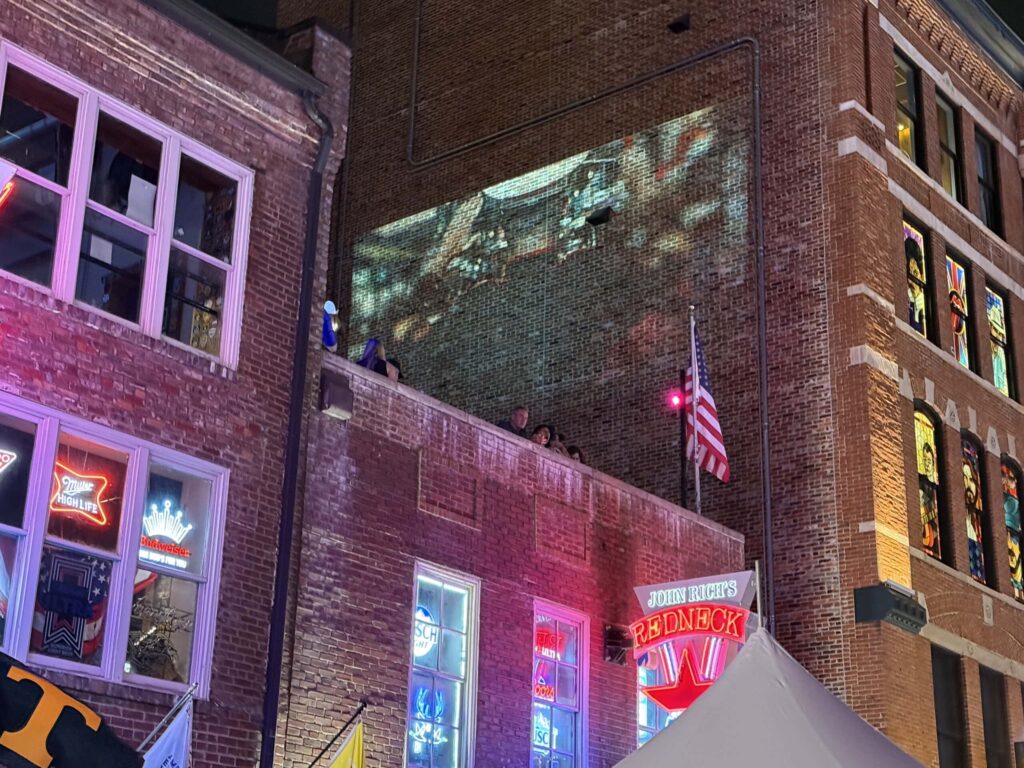
AGM’s projection client roster includes Netflix, Disney, Coca-Cola, FanDuel, Live Nation, iHeartRadio, and the US Marine Corps. A confirmed case study: the US Marine Corps × CMA Fest Nashville — multi-night projections onto architectural surfaces throughout the festival footprint, reaching 80,000+ attendees across the campaign window. Projection advertising scales across every brand category; what our campaigns share is scale, precision, and a physical presence digital cannot replicate.
Past AGM projection clients include Coca-Cola, Live Nation, and iHeartRadio, with multi-night campaigns that generated earned media coverage and massive organic social sharing.
Beyond the Print Works, Cranston’s Atwood Avenue entertainment zone provides a more conventional commercial corridor projection environment — restaurants, bars, retail establishments, and service businesses in a pedestrian-accessible street of consistent evening foot traffic. Garden City’s commercial arts corridor adds a third zone with a distinct audience character, more family-oriented and retail-focused than Atwood Avenue’s nightlife-centered mix but with its own pedestrian density on evenings and weekends. Together, the three Cranston projection zones cover the city’s full audience range: the culturally engaged arts community, the entertainment district nightlife audience, and the commercial retail corridor shopper — three distinct segments reachable through targeted placement in the zone whose physical and pedestrian characteristics best match the campaign objective.
Cranston's Historic Walls Are Waiting
The Print Works. Garden City. Atwood Avenue. Cranston's projection zones offer historic industrial scale, commercial audience density, and a media environment where your campaign stands alone. Contact AGM to start planning your Cranston guerrilla projection campaign.
Browse Cities in Rhode Island
Select a city to explore Guerrilla Projections opportunities.
Why Cranston Makes A Strong Guerrilla Projection Investment
The argument for Cranston as a projection advertising market is not primarily about population density — it is about competitive media isolation and physical surface quality. Cranston’s outdoor advertising landscape is not saturated. Unlike Providence’s downtown, where multiple outdoor media formats compete for visual attention along the pedestrian corridors, Cranston’s entertainment zones carry relatively few high-impact visual media placements. A building projection in the Atwood Avenue corridor or at the Print Works is not competing with digital displays, large-format billboards, or other projection campaigns — it occupies the visual field essentially without competition, which produces the earned media response, the social documentation, and the novelty-driven press coverage that make projection advertising distinctive as a format.
The Print Works’ physical scale amplifies this effect. A projection on the exterior wall face of the Print Works is not simply a large ad; it is a visual transformation of a historic landmark — an image appearing on a wall that Cranston residents have driven or walked past for years, suddenly illuminated at building scale with a campaign message or brand identity. That transformation generates the kind of surprise and documentation that urban consumers in Providence or Boston, accustomed to larger-scale visual media, might process as expected. For a Cranston audience that encounters it on the Print Works facade, it is genuinely extraordinary, and the documentation it generates circulates through Cranston and Providence social networks as shared testimony to something unusual and worth seeing.
Cranston’s proximity to Providence — a short drive or public transit ride — means that a campaign at the Print Works can draw documentation and coverage from Providence’s larger creative and press community without requiring a separate Providence campaign investment. The Providence press covers Cranston events, the Providence social networks connect to Cranston residents, and the earned media generated by a Cranston Print Works projection has a reach that extends significantly beyond the Cranston audience alone.
Cranston's Projection Zones — Surface And Audience By District
Cranston Print Works Historic Industrial Complex
The Cranston Print Works complex occupies a historic textile printing campus on Cranston Street, with multi-story brick mill buildings of the type that characterized nineteenth-century New England textile manufacturing. The exterior wall faces of the Print Works buildings are large, flat, and built from the dense brick masonry common to New England mill construction — a surface that, when painted or weathered to a lighter tone, provides a strong projection canvas. The scale of the available wall faces at the Print Works substantially exceeds what conventional commercial buildings in the Cranston market can offer, making this the primary candidate surface for campaigns seeking maximum projection size and the cultural resonance of a historic industrial setting. AGM’s scouting team evaluates specific wall sections and projector positioning approaches at the Print Works based on current access, surface conditions, and sight-line geometry for each campaign’s specific creative and audience parameters. The complex’s mixed-use redevelopment has brought a creative and arts community presence to the campus that adds a native audience of culturally engaged residents in proximity to the primary projection surface.
Garden City Commercial Arts Corridor
Garden City is Cranston’s upscale commercial center — a planned retail and commercial district with a walkable pedestrian environment, a concentration of retail, dining, and service establishments, and a consistent flow of shoppers and diners on evenings and weekends throughout the year. The building facades along Garden City’s commercial core include a mix of mid-century commercial construction and newer retail-format buildings, with exterior surfaces ranging from brick veneer to smooth stucco and painted panel cladding. Lighter-toned smooth surfaces in Garden City — the commercial buildings with white or light-gray stucco and panel exteriors — provide workable projection canvases for campaigns that want the Garden City retail audience rather than the Print Works arts community. The Garden City zone is most effective for consumer retail brand campaigns, restaurant and food brand launches, and regional retail awareness campaigns targeting Cranston’s family and professional shoppers.
Atwood Avenue Entertainment Zone
Atwood Avenue is Cranston’s primary evening entertainment corridor — a commercial street of restaurants, bars, and retail establishments that generates consistent pedestrian activity on Friday and Saturday evenings and on weekday evenings in the summer months. The building stock along Atwood Avenue is primarily former commercial construction of the early-to-mid twentieth century, with exterior facades of brick, stucco, and painted commercial panel in a variety of tones and textures. The most projection-favorable surfaces on Atwood Avenue are the blank side and rear walls of corner commercial buildings, which tend to be larger in area and less interrupted by fenestration than the primary street-facing facades. Atwood Avenue’s evening foot traffic is most concentrated between 6:00 and 11:00 PM, with the highest density on weekend evenings coinciding with the dinner-to-nightlife transition when the largest number of pedestrians are actively moving through the corridor.
Plan Your Guerrilla Projection Campaign in Cranston, RI
Tell us about your campaign goals, target audience, and preferred locations. Our team will help you plan a high-impact guerrilla projection campaign tailored to your needs.
Award Winning Personalized Service
You will get thoughtful, devoted, and individualized attention from our experienced, qualified, and professional personnel. Being one of the most illustrious agencies in Brooklyn, New York, American Guerrilla Marketing has been awarded the Best of Brooklyn title.
Nationwide
Industry City, Brooklyn, New York 11232
American Guerrilla Marketing
Hours
Mon - Fri: 9 AM - 5 PM
Sat & Sun: Closed
Automate your campaign with AGM’s Request for Proposal Builder.
Automate your campaign with AGM’s Request for Proposal Builder. Simply answer a few quick questions about your campaign goals, markets, and timeline, and the system will generate a tailored presentation with recommended strategies, quantities, and pricing. Click the RFP Builder to instantly receive your customized proposal.
Creative Campaign Formats That Work in the Cranston Market
Historic Venue and Landmark Projections
The Cranston Print Works offers something that commercial building facades cannot: the visual and cultural weight of a genuine historic landmark. Brands and campaigns that project on the Print Works exterior are making a statement about the relationship between their identity and the community’s physical and cultural heritage. This is a distinctly powerful position for brands with strong community narratives, heritage product stories, or local-authenticity positioning that benefits from association with a historic Rhode Island landmark.
Retail and Restaurant Launches
New retail and restaurant openings in Cranston’s Atwood Avenue and Garden City zones use building projection campaigns to generate awareness and foot traffic in the weeks surrounding their launch. A projection on an Atwood Avenue commercial wall the evening before a grand opening reaches the exact neighborhood audience most likely to become early regular customers, while generating social documentation that extends the campaign’s reach through the connected Cranston and Providence social networks.
Regional Brand Awareness
National and regional brands seeking presence in the Rhode Island market use Cranston building projection campaigns to establish visibility in Providence’s southern metropolitan zone without the higher media saturation of the Providence downtown corridors. Cranston’s media novelty — the relative scarcity of high-impact outdoor visual advertising in the market — delivers higher organic documentation rates per pedestrian than more saturated markets, improving the earned media return on the campaign investment.
Arts and Community Campaigns
The Print Works arts community and Cranston’s broader cultural fabric make the market receptive to arts institution campaigns, community advocacy messaging, and cultural event promotion that connects with a locally engaged audience. Projection campaigns on the Print Works exterior for arts-sector clients carry a site-specific resonance — the historic textile mill as the canvas for a contemporary arts campaign — that amplifies the message through the association between the content and the location.
Building A Cranston Projection Campaign — Process And Timeline
Scouting Cranston’s Wall and Positioning Options
AGM’s Cranston scouting process focuses on three distinct zones with different physical and audience characteristics. At the Print Works, the evaluation centers on identifying the specific wall sections that offer the best combination of surface quality, usable dimensions, and projector positioning access — the mill’s campus layout creates multiple potential approach geometries, and the scouting phase determines which geometry produces the largest, sharpest projected image relative to the available pedestrian sight lines. At Atwood Avenue, the scouting focuses on blank side and rear walls of corner commercial buildings with clear sight-line access from the pedestrian zone. At Garden City, smooth-surfaced commercial buildings with southern or western exposures are prioritized for their surface reflectivity and their visibility from the commercial corridor’s pedestrian flow. The scouting phase is priced at approximately Contact us for a custom quote. for the Cranston market and delivers a confirmed wall, projector position, and dimensional template specification before creative development begins.
Creative Adaptation for Cranston’s Surface Character
The Print Works’ exterior surfaces have a specific visual character — the warm brick tone, the irregular texture of aged masonry, the architectural details of mill-building construction — that shapes the creative experience in ways that a smooth commercial wall does not. Campaign creative intended for Print Works deployment is often enhanced by design treatments that acknowledge or work with the surface texture rather than fighting it: bold graphics, high-contrast color palettes, and simple compositions that read strongly even when the surface introduces some visual noise beneath the projected image. AGM’s technical team advises on surface-specific creative considerations during the design development phase for Cranston campaigns targeting the Print Works exterior.
Campaign Execution and Documentation
AGM’s two-person crew deploys the 20,000-lumen system at the confirmed projector position on the campaign evening, activating at the onset of effective darkness and running through the target neighborhood’s peak foot-traffic window. Post-campaign documentation — GPS records, timing logs, and professional still photography — is delivered within forty-eight hours of the campaign night. For Print Works projections, the documentation photography carries distinctive visual quality — the historic mill facade as backdrop to the projected campaign image — that performs particularly well as earned media content and social distribution material, often generating organic engagement beyond what standard urban building projection photography produces.
What the Biossance × Sephora Launch Proves About Retail Market Entry
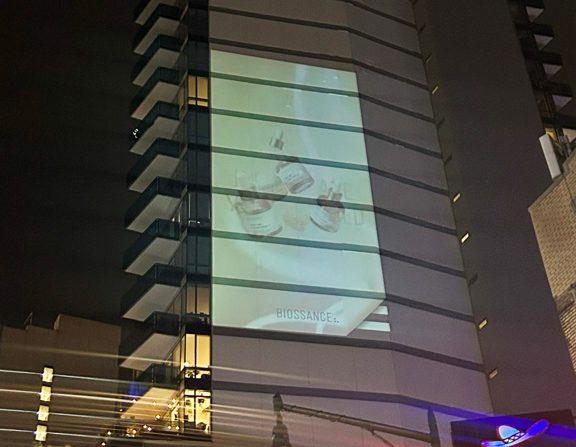
AGM’s deployment of the Biossance product launch at Sephora Union Square in New York City provides a directly applicable model for understanding how building projection campaigns generate retail market entry impact. The campaign placed a large-scale projection on a building surface adjacent to the Sephora retail location, visible to the dense pedestrian flow of Union Square during peak evening shopping and dining hours. The projection’s combination of physical scale — visible from distances that conventional signage cannot reach — and organic documentation by the pedestrians who encountered it produced a media event that extended the campaign’s effective reach to audiences far beyond those present at the projection location on the night of deployment.
The model translates directly to Cranston’s commercial retail market. A brand entering the Cranston or southern Rhode Island consumer market — opening a retail location in Garden City, launching a product in the Atwood Avenue dining corridor, or establishing brand awareness in advance of a regional distribution expansion — can use a Cranston building projection campaign to generate the documentation, social distribution, and local press coverage that a conventional paid media placement in the same market cannot produce reliably. Cranston’s media novelty strengthens the model: in a market where projection advertising is genuinely unexpected, the earned media return on the same per-night investment substantially exceeds what the identical campaign would deliver in a more saturated media environment.
What It Costs To Project In Cranston
Guerrilla projection campaigns in Cranston are priced at contact us for a quote. covering AGM’s complete deployment package: the 20,000-lumen commercial projection system, generator and power solution, electronics bundle, mobility unit, and the two-person technical crew for setup, full operation, and breakdown. The system is self-contained and requires no external infrastructure or venue coordination for standard deployments.
Advance scouting for the Cranston market — covering the Print Works, Atwood Avenue, and Garden City zones — is priced at approximately contact us for a quote. produces a confirmed wall and creative template specification ready for client use. Private-property access for campaigns requiring direct coordination with the Print Works management or Garden City commercial property owners adds Contact us for a custom quote. per night based on the specific building and campaign parameters. Multi-night Cranston campaigns are priced at the per-night unit rate with logistics managed through a single campaign engagement.
Who Campaigns in Cranston
Cranston’s projection advertising clients include regional retailers opening in the Garden City and Atwood Avenue commercial zones, consumer brands establishing presence in the southern Rhode Island market, arts and cultural organizations using the Print Works complex for programming and community campaigns, and national brands seeking the earned media amplification of a large-scale projection on a historically significant Rhode Island landmark. The consistent driver across all client types is the value of a media format that generates genuine local attention in a market where outdoor advertising competition is limited and where the physical scale and cultural character of the Print Works makes every projection campaign a distinctive visual event.
Frequently Asked Questions
The Cranston Print Works offers a combination of projection-relevant physical characteristics that are genuinely unusual: exterior wall faces with multi-story scale significantly larger than most commercial building surfaces in the Rhode Island market, a historic industrial character that gives projected campaigns a cultural resonance that newer construction cannot provide, and a campus setting that allows projection from approach angles not available in dense urban street contexts. The combination of physical scale, cultural weight, and positioning flexibility makes the Print Works one of the most distinctive projection surfaces in the New England region.
Garden City and the Print Works serve different campaign objectives and audiences within the Cranston market. Garden City’s commercial retail character — upscale shopping, family dining, professional services — makes it the stronger choice for retail brand campaigns, product launches, and consumer awareness campaigns targeting Cranston’s family and professional demographic. The Print Works’ historic industrial character and arts community association makes it the stronger choice for campaigns seeking cultural credibility, arts-sector authority, and the visual impact of a landmark-scale projection. The scouting and planning phase determines which zone best serves a specific campaign’s creative and audience objectives.
Atwood Avenue’s foot traffic peaks on Friday and Saturday evenings between approximately 6:00 and 11:00 PM, driven by the corridor’s concentration of restaurants and bars that draw neighborhood residents, city-wide diners, and social groups seeking an evening entertainment destination. Weekday evenings in summer months generate a secondary foot-traffic peak from outdoor dining and after-work social activity. The corridor’s pedestrian density is lower than Providence’s Federal Hill or Westminster Street on comparable evenings, but the competitive media isolation of the Atwood Avenue market means that a projection in this zone generates proportionally higher per-viewer documentation and engagement rates than denser but more saturated markets.
A Cranston projection, particularly at the Print Works, generates press coverage and social distribution that reaches the broader Providence media market without requiring a separate Providence campaign investment. Providence’s local television stations and digital outlets cover major Cranston events; the Providence and Cranston social communities are substantially overlapping given the geographic proximity of the two cities. A brand or campaign that deploys in Cranston as part of a Rhode Island strategy effectively reaches Providence audiences through earned media channels while also establishing direct presence in the Cranston commercial market, creating a geographic coverage range that exceeds what either city alone would provide at the same budget.
Cranston’s Atwood Avenue and Garden City corridors attract consumer brands in food and beverage, retail fashion, home goods, and professional services that are targeting the southern Rhode Island metropolitan demographic — primarily households in the middle-to-upper income range, with strong family and community orientation. The Print Works attracts brands seeking association with Rhode Island’s arts and industrial heritage — brands with heritage narratives, craft or artisanal positioning, or cultural authenticity values that benefit from the historic mill building as a campaign setting. Entertainment brands targeting a younger or more urban demographic are typically better served by the Providence market’s university-affiliated population than by Cranston’s more suburban audience profile.
Yes, with appropriate site access coordination. The Cranston Print Works campus is a privately managed commercial complex, and projection campaigns targeting the building’s exterior walls require either confirmed public-access projector positioning from the adjacent street or alley, or direct coordination with Print Works management for campaigns requiring on-campus projector placement. AGM manages this coordination as part of the campaign planning process. Access parameters and any associated private-property costs are determined during the scouting and planning phase before the campaign is scheduled.
Atwood Avenue’s foot traffic peaks in the 7:00 to 10:00 PM window on Friday and Saturday evenings, with the sharpest concentration occurring between 7:30 and 9:30 PM as dinner service reaches its busiest point and the transition to bar and nightlife activity begins. Earlier in the evening — 5:30 to 7:00 PM — foot traffic is lighter but growing; after 10:30 PM it begins to thin on weeknights and continues at moderate levels on weekend evenings. AGM calibrates projection activation timing to the specific target zone’s peak window, which for Atwood Avenue means beginning no later than 8:00 PM to capture the corridor’s densest pedestrian concentration.
Cranston skews somewhat older, more family-oriented, and more homeowner-concentrated than Providence’s urban core, which draws a higher proportion of renters, university affiliates, and young creative professionals. Consumer brands targeting established households, family decision-makers, and middle-to-upper income suburban Rhode Island residents find Cranston’s corridors well-aligned with their audience profile. Brands targeting young adults, early adopters, and the arts-and-culture-oriented consumer that defines Providence’s Jewelry District and Federal Hill demographics are typically better served by a Providence campaign, potentially with Cranston as a secondary market in a multi-city Rhode Island strategy.
Garden City’s commercial layout is more auto-oriented than a traditional urban pedestrian corridor, which affects projection campaign planning in two ways. First, projector positioning must account for both pedestrian and vehicular sight lines, since a meaningful portion of Garden City’s audience encounters the corridor from vehicles rather than on foot. Second, effective projection placement in Garden City prioritizes building walls that are visible from both the pedestrian paths and the parking areas and access roads that connect the commercial district’s buildings. AGM’s Garden City scouting specifically evaluates walls for dual vehicular and pedestrian visibility, which can substantially expand the effective reach of a campaign in an auto-oriented commercial context.
AGM targets walls with a minimum usable projection surface of approximately 30 by 20 feet for standard commercial campaign formats in the Cranston market, with preference for surfaces of 40 by 30 feet or larger for maximum visual impact. The Print Works complex substantially exceeds these minimums, offering wall sections of 60 feet or more in width and four to five stories in height. Atwood Avenue’s commercial buildings typically offer 25-to-40-foot wall sections on their blank side walls, which fall within the standard range. Garden City’s commercial buildings vary considerably by structure and require case-by-case scouting evaluation.
Cranston’s central commercial corridors — Atwood Avenue, Garden City, and the Print Works — are three to seven miles from downtown Providence, a drive of approximately ten to twenty minutes depending on traffic and the specific origin and destination points within each city. This proximity makes Cranston-Providence campaign combinations among the most logistically straightforward multi-city deployments in AGM’s national network. A crew and equipment set that activates in Providence on Friday night can reposition to Cranston on Saturday without any additional staging, travel, or overnight accommodation costs that would be required for markets further apart.
More AGM Outdoor Advertising Services
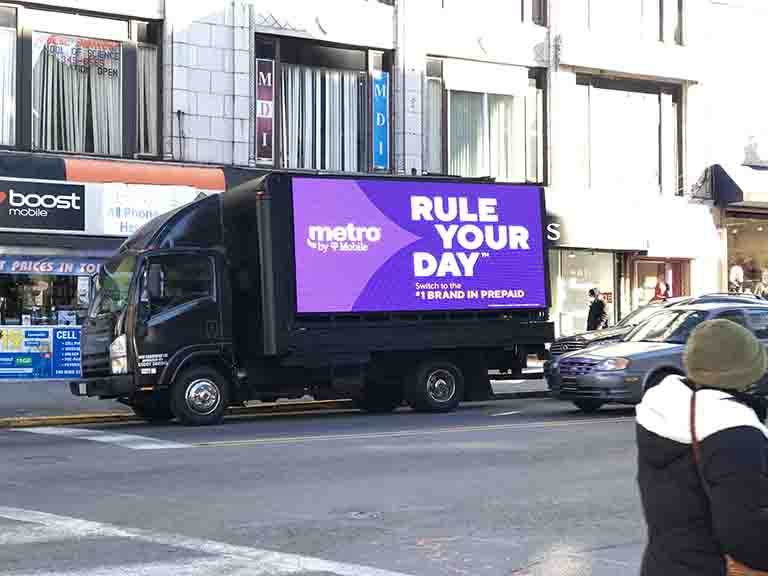
Led Billboard Trucks
Mobile LED displays that bring your brand to any location, any event.
Fly Posting
Street-level poster saturation across walls, construction sites, and corridors.

Sidewalk Decals
Ground-level branded decals at pedestrian hotspots and event entrances.

Sidewalk Stencils
Creative stencil campaigns that put your brand in the path of pedestrians.