American Guerrilla Marketing
Nationwide Service
Media planning, media buying, billboard advertising, & guerrilla marketing
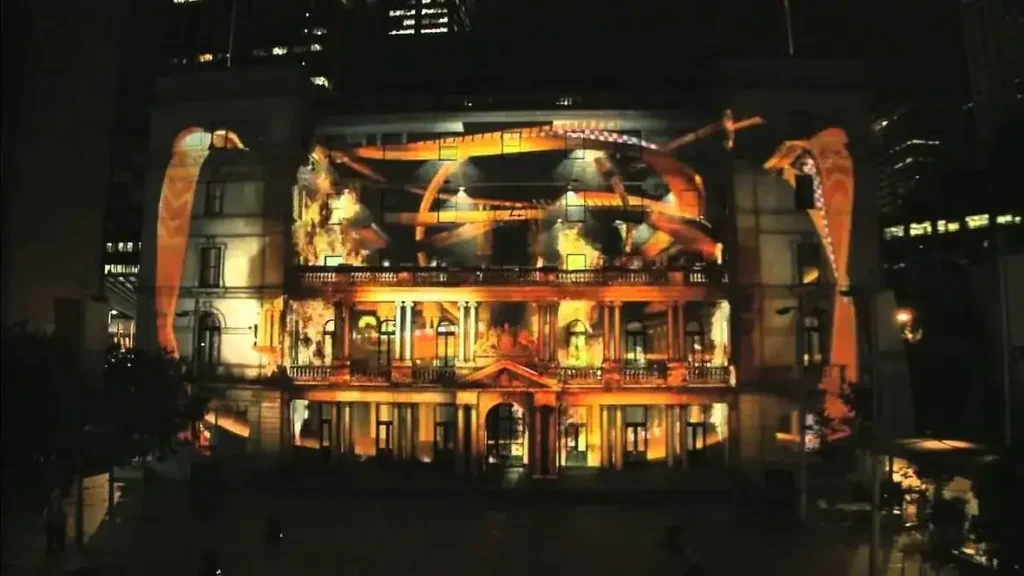
From Chicago’s warehouse-lined arts corridors to Rockford’s performing arts district — AGM deploys 20,000-lumen projection campaigns on building facades across Illinois. Nighttime advertising that stops foot traffic and earns earned media without a single permit application for most activations.
Illinois is one of the most architecturally rich projection advertising states in the country. The combination of Chicago’s enormous warehouse stock and the state’s secondary markets — Aurora, Joliet, and Rockford — gives brands an unusually wide range of building surfaces, foot traffic patterns, and audience demographics to work with. Where some states require a single-market campaign to make an impression, Illinois lets you scale from a neighborhood activation in a Chicago arts district all the way to a multi-city statewide tour across the state’s diverse nighttime economy.
Chicago alone contains more prime projection real estate than most entire states. The city’s history of industrial manufacturing left behind a legacy of flat, large-format warehouse exteriors across neighborhoods like Pilsen, Fulton Market, and the West Loop — surfaces that were essentially built for projection advertising before projection advertising existed. Add in the entertainment density of Logan Square, Wicker Park, and Lincoln Park, and you have a city where a single-night deployment can generate thousands of impressions from pedestrians, rideshare passengers, and diners stepping out for the evening.
But the Illinois opportunity extends well beyond Chicago’s city limits. Aurora’s Stolp Island arts district and Rockford’s Coronado Performing Arts Center corridor both support meaningful projection campaigns for regional brands, touring entertainment, advocacy organizations, and product launches targeting the state’s suburban and secondary-market consumers. These markets offer lower competing visual noise than Chicago’s core and often deliver a higher percentage of organic social documentation per passerby — people are more surprised, more likely to photograph, and more likely to share when a building-scale image appears in a city they didn’t expect to see it.
AGM’s national scouting team maintains active location intelligence across all four Illinois markets. Before any campaign launches, our team combines digital satellite analysis with physical on-the-ground assessment to identify the specific walls, throw distances, and sight lines that produce clean, sharp imagery. The result is a campaign that looks intentional, professional, and impossible to ignore — because the wall selection made it that way from the start.
AGM deploys 20,000-lumen building facade campaigns across Chicago, Aurora, Joliet, Rockford, and Illinois markets statewide. Tell us your city, your date, and your creative vision — we'll handle the rest.
Select a city to explore Guerrilla Projections opportunities.
Illinois’s nighttime entertainment economy is remarkably concentrated along specific corridors that happen to align with the building types most suited to projection advertising. Warehouse districts, former industrial zones, and arts corridors typically feature the blank, flat, light-colored exterior walls that maximize the output of a 20,000-lumen commercial projection system. Those same corridors attract the restaurant-goers, concertgoers, bar patrons, and gallery visitors who represent the most engaged nighttime audiences for brand messaging.
The format itself has a quality that digital screens cannot replicate: scale. A projection on a four-story warehouse face creates an image that dwarfs any traditional outdoor advertising unit. There is no media buy in the state of Illinois that delivers a 40-foot-tall brand image in the heart of a restaurant district for a single-night execution. That physical scale triggers a different cognitive response than a billboard — it registers as an event rather than an advertisement, which is exactly why branded projection campaigns generate social documentation at rates that other outdoor formats cannot approach.
Illinois audiences have a sophisticated media sensibility built by decades of exposure to Chicago’s advertising and entertainment industry. That sophistication actually works in favor of well-executed projection campaigns. Chicagoans and residents of the state’s major secondary markets recognize high-production outdoor advertising when they see it, and they respond to it as a signal of brand credibility and cultural relevance — especially when the projection appears in a neighborhood that has meaning to them.
Chicago is the flagship Illinois projection market and one of the strongest building facade campaign cities in the United States. The Pilsen arts district alone contains more usable warehouse wall square footage than some entire metro areas. Combine that with the nightlife density of Wicker Park, the restaurant corridor of the West Loop, and the gallery scene of Logan Square, and Chicago supports multi-location, multi-night campaigns at a scale few American cities can match. AGM has deployed campaigns across Chicago’s arts and entertainment districts and maintains detailed wall intelligence across the city’s most productive projection zones.
Aurora’s downtown arts district anchored by Stolp Island and the Benton Street entertainment corridor offers a compact, high-foot-traffic zone with building surfaces that punch well above what most brands expect from a Chicago suburb. The city’s arts investment and RiverEdge Park programming bring audiences downtown on weeknights and weekends alike, making it viable for campaigns targeting the suburban Chicago consumer without the logistical complexity of a full Chicago deployment.
Joliet’s Rialto Square Theatre district gives projection campaigns an entertainment-adjacent context that few Illinois secondary markets can match. Audiences arriving for and departing from performances represent an engaged, concentrated consumer cluster — exactly the kind of nighttime foot traffic that makes guerrilla projection advertising efficient. The Chicago Street corridor and Riverfront Arts Center area extend the viable projection zone beyond the theatre block itself.
Rockford’s East State Street entertainment corridor and the downtown zone surrounding the Coronado Performing Arts Center offer flat building faces in a market that sees genuine nighttime activity concentrated in a walkable area. The Riverview Ice House district adds a secondary zone for campaigns that want to reach different demographic segments within the same market. Rockford responds well to entertainment-facing and regional brand campaigns that speak to the city’s identity as an independent cultural hub.
Tell us about your campaign goals, target audience, and preferred locations. Our team will help you plan a high-impact guerrilla projection campaign tailored to your needs.
Award Winning Personalized Service
You will get thoughtful, devoted, and individualized attention from our experienced, qualified, and professional personnel. Being one of the most illustrious agencies in Brooklyn, New York, American Guerrilla Marketing has been awarded the Best of Brooklyn title.
Nationwide
Industry City, Brooklyn, New York 11232
American Guerrilla Marketing
Hours
Mon - Fri: 9 AM - 5 PM
Sat & Sun: Closed
Automate your campaign with AGM’s Request for Proposal Builder. Simply answer a few quick questions about your campaign goals, markets, and timeline, and the system will generate a tailored presentation with recommended strategies, quantities, and pricing. Click the RFP Builder to instantly receive your customized proposal.
The quality of a guerrilla projection campaign depends as much on wall selection as it does on creative execution. In Illinois, this matters across every market from Chicago to Rockford, and AGM’s scouting team evaluates each location against a consistent set of surface criteria before any campaign is confirmed.
The ideal Illinois projection surface is large, flat, and light-colored. Large means a minimum of two to three stories of uninterrupted vertical face — the kind of scale that makes a brand image visible from half a block away. Flat means a planar surface without curves, returns, or irregular geometry that would distort image edges. Light-colored means white, off-white, light gray, or painted concrete that reflects a high percentage of the projected light back toward the audience. Dark brick — common in older Illinois industrial buildings — absorbs significant light and reduces image brightness and color saturation.
Window density is a critical factor. A wall with minimal or no window openings produces a clean, uninterrupted image. A wall with regular window grids creates dark voids within the projected image that fragment the creative. In Chicago’s Pilsen and Fulton Market districts, the former industrial buildings often feature long blank wall runs specifically because they were built for manufacturing rather than office use — no windows needed on the loading dock face of a factory. Those surfaces are exceptional for projection advertising.
Surface texture affects image sharpness. Smooth painted concrete or stucco delivers the cleanest, sharpest results. Rough brick scatters light across mortar joints, slightly softening edge definition. It is not a dealbreaker — many of the most striking projection campaigns in Illinois have run on textured brick — but brands with fine-detail logos or small-point typography should prioritize smooth surfaces when they’re available. Obstructions between the projector and the wall are the hardest constraint to work around: trees, utility poles, scaffolding, and parked vehicle overhead clearance all break the image and cannot be corrected in post-production. AGM’s physical scouting eliminates these surprises before campaign day.
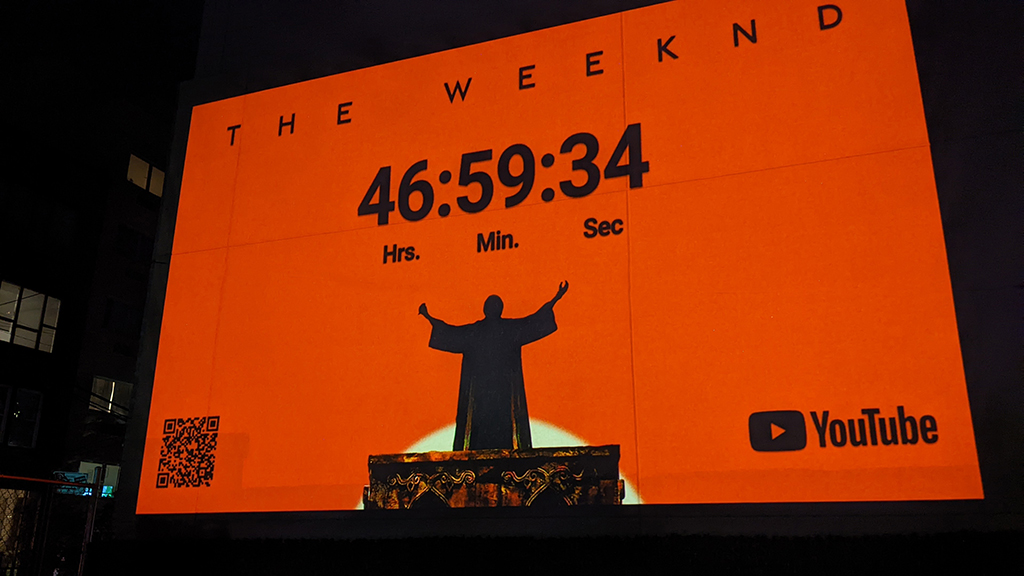
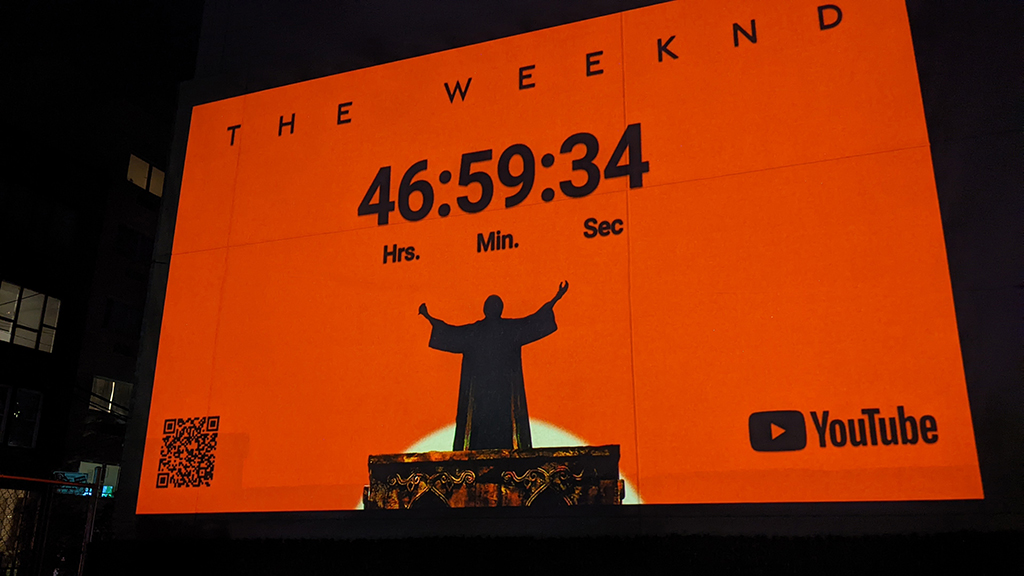
When YouTube needed to generate cultural momentum around a major artist release drop with The Weeknd, the campaign needed a format that could cut through the visual noise of one of the world’s most advertising-saturated cities. The answer was building-scale guerrilla projections deployed across high-foot-traffic nightlife and entertainment corridors — surfaces large enough to create a sense of spectacle and placed precisely where the artist’s core audience would encounter them organically.
The execution demonstrated several principles that apply directly to Illinois campaigns. First, wall selection drove the outcome more than anything else — clean, large-format surfaces in nightlife corridors produced social documentation rates that traditional outdoor placements couldn’t approach. Second, the timing of the projection relative to the entertainment cycle mattered: projections deployed during peak nighttime hours, when the target audience was already engaged and present, generated disproportionate organic reach. Third, the scale of the image — projected at a size that no digital screen could replicate in that environment — made the installation feel like an event, not an ad. Illinois brands launching into the entertainment, music, and consumer space can apply exactly the same logic across Chicago’s arts and nightlife districts.
Album drops, film premieres, streaming platform launches, and live event countdowns. Chicago’s entertainment audience density makes it one of the strongest markets in the country for entertainment-facing projection campaigns. Looping visuals tied to release dates or countdown timers drive organic social documentation and pre-release awareness.
Consumer goods, retail brands, and CPG companies use projection advertising in Illinois to turn a launch moment into a cultural event. A 40-foot brand image in a Chicago arts corridor does what a press release cannot — it puts the product in front of consumers who weren’t looking for it and makes them feel like they discovered something.
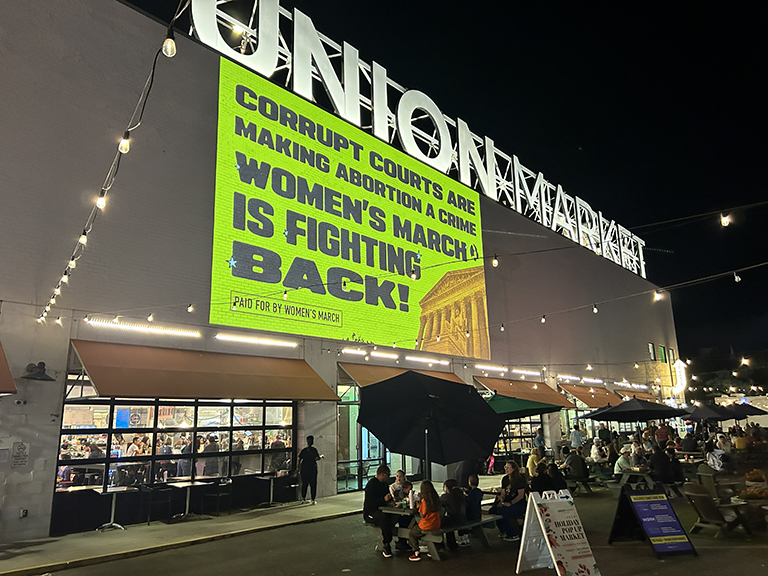
Advocacy organizations, nonprofits, and cause-driven brands use projection advertising to place their message in front of engaged urban audiences at scale. Illinois’s politically active metro populations make Chicago and secondary markets effective channels for advocacy campaigns that need to reach progressive and centrist voters in a visible, shareable format.
Brands building market presence in Illinois — regional expansions, new market entries, and heritage brands refreshing their positioning — use guerrilla projections to establish street-level recognition. A building-scale brand image in the right corridor delivers more cultural currency than months of digital impression buying.
Every Illinois guerrilla projection campaign begins with location scouting. AGM’s team conducts both digital analysis — satellite review, pedestrian traffic data, nighttime imagery — and physical on-the-ground evaluation to identify the walls, throw distances, and sight lines that will produce the strongest result. For Chicago campaigns, scouting typically generates five to ten candidate walls per district, which are then narrowed to the optimal selection based on surface quality, audience reach, and creative fit.
Once locations are confirmed, the creative team finalizes the projection files to the specific surface dimensions of the selected wall. Aspect ratio, resolution, and color treatment are all calibrated to the physical characteristics of the projection surface and the 20,000-lumen output of AGM’s commercial projection system. The technical crew — AGM’s own technicians, never subcontractors — handles all logistics from equipment transport and generator setup through projection operation and breakdown. Campaigns typically run from dusk through a four-to-six-hour active window, with multi-night runs available for brands that need sustained market presence.
Post-campaign, AGM provides GPS-documented location analysis and a full reporting package that includes photography, video documentation, and audience exposure data. This documentation serves both internal brand review and earned media use — many Illinois clients repurpose campaign imagery in digital advertising, social media, and press coverage that extends the campaign’s reach well beyond the original projection nights.
Guerrilla projection campaigns in Illinois are priced at contact us for a quote. That rate covers the full equipment bundle — 20,000-lumen commercial projector, generator and power solution, electronics package, and mobility unit — along with AGM’s two-person technical crew for setup, operation, and breakdown. Projection timing begins at dusk, with a typical active window of four to six hours per night.
Multi-night campaigns and multi-market deployments covering several Illinois cities are available and typically deliver a stronger cost-per-impression outcome than single-night activations. Advance location scouting runs approximately contact us for a quote. when required. Campaigns on permitted or private-property locations carry additional costs ranging from Contact us for a custom quote. per night depending on the building owner, market, and negotiation. Most Illinois campaigns operate in public-facing spaces where traditional guerrilla placement logistics apply without location fees.
The Illinois projection advertising market draws from a wide client base. Entertainment brands — record labels, streaming platforms, concert promoters, and film studios — use Chicago’s entertainment districts to reach culturally engaged urban consumers ahead of major releases. Consumer goods brands leverage the foot traffic density of Chicago’s restaurant and nightlife corridors for product launches that need to feel like cultural moments. Advocacy organizations and political campaigns use projection advertising to place messages in front of high-density audiences in a format that generates organic social documentation and press coverage. Regional brands expanding into Illinois, national brands refreshing their presence in a competitive market, and startups entering the Chicago consumer space all find projection advertising an efficient and high-credibility way to establish visual market presence.
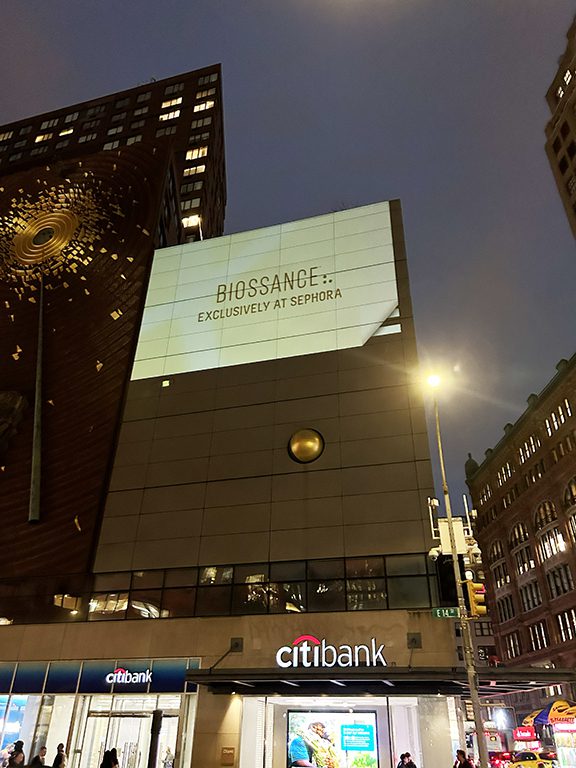
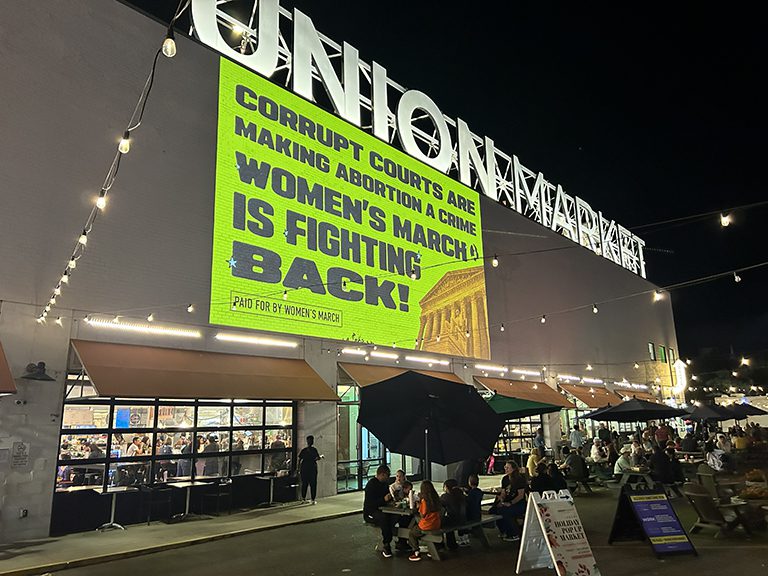
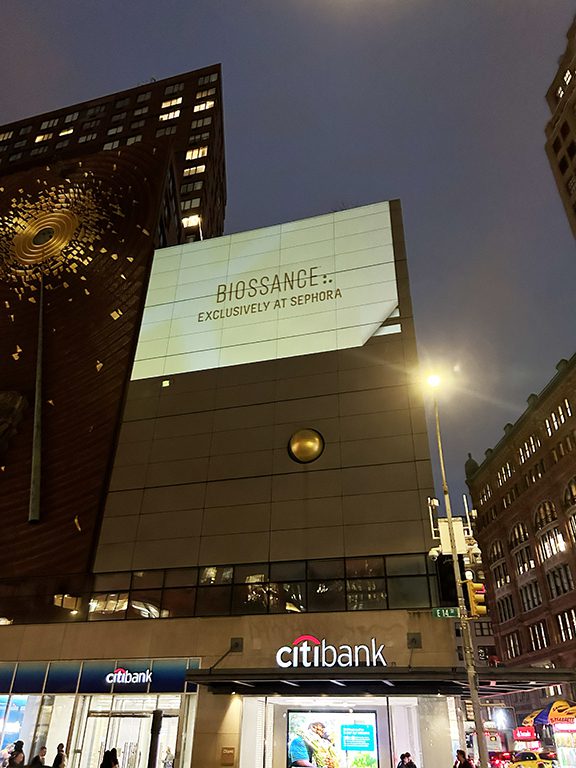
AGM has worked with a national client roster that includes Biossance, The Weeknd, the US Marine Corps, the Women’s March, and Reproductive Freedom for All — campaigns across product launches, entertainment, advocacy, and military recruiting. That breadth of experience means the Illinois campaigns we plan draw on tested strategies from dozens of successful activations across the country’s most competitive urban markets.
AGM’s projection client roster includes Netflix, Disney, Coca-Cola, FanDuel, Live Nation, iHeartRadio, and the US Marine Corps. A confirmed case study: the US Marine Corps × CMA Fest Nashville — multi-night projections onto architectural surfaces throughout the festival footprint, reaching 80,000+ attendees across the campaign window. Projection advertising scales across every brand category; what our campaigns share is scale, precision, and a physical presence digital cannot replicate.
| Zone / Area | Peak Hours | Foot Traffic | Est. Nightly Impressions | Best For |
|---|---|---|---|---|
| Chicago | 8PM–12AM | Moderate | 2,500–12,000 | Product Launch |
| Aurora | 8PM–12AM | Moderate | 2,500–12,000 | Event Promotion |
| Joliet | 8PM–12AM | Moderate | 2,500–12,000 | Brand Awareness |
| Rockford | 8PM–12AM | Moderate | 2,500–12,000 | Political |
| Entertainment & Release Campaigns | 8PM–12AM | Moderate | 2,500–12,000 | Sports |
| Product Launch Projections | 8PM–12AM | Moderate | 2,500–12,000 | Concert/Festival |
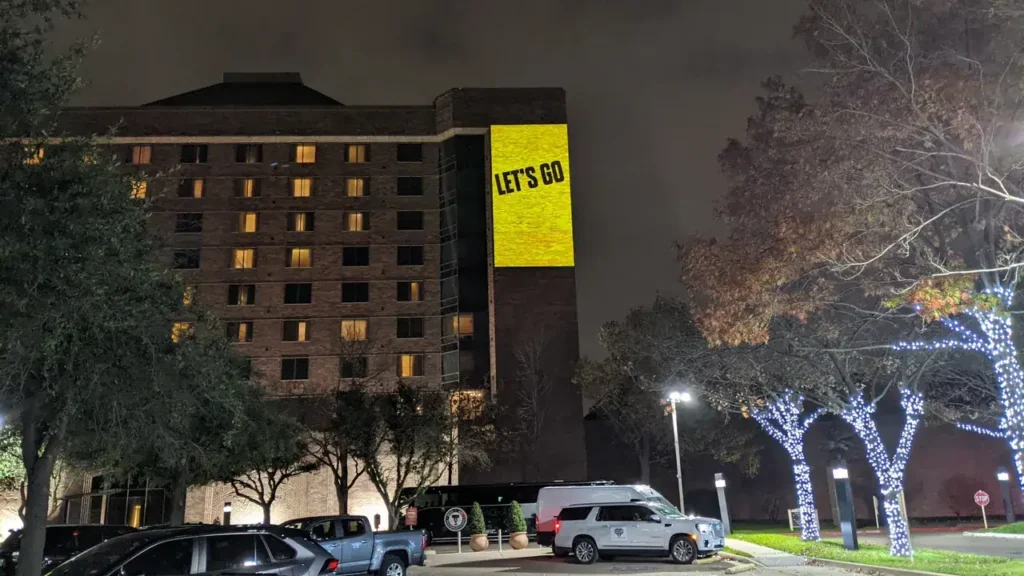
AGM deploys a 20,000-lumen commercial projection system — projector, generator, power solution, and mobility unit — to a pre-scouted location in an Illinois entertainment or arts district. The system projects a brand image or video onto a large, flat building facade at a scale of 30 to 60 feet or larger. The projection runs from dusk through a four-to-six-hour active window. AGM’s two-person technical crew handles all setup, operation, and breakdown. No permits are required for most standard Illinois guerrilla projection placements.
Most guerrilla projection placements in Illinois do not require a permit when operating from public space without fixed installation. The equipment is mobile, projection is a light image rather than a physical installation, and setup and breakdown happen without permanent modification to any surface. Campaigns on private property require property owner permission. AGM’s team navigates the specific logistics of each Illinois market to ensure campaigns operate effectively within applicable rules.
Chicago is the premier Illinois projection market by volume of viable surfaces, nighttime foot traffic, and audience engagement. Pilsen, Fulton Market, and the West Loop offer warehouse-scale walls with the surface characteristics that produce the strongest results. Aurora, Joliet, and Rockford all support meaningful campaigns in their respective downtown and arts district corridors. The right city depends on where your target audience concentrates and what demographic profile your campaign needs to reach.
Rain reduces projection quality by scattering light on wet surfaces and compromising the audience experience. AGM does not operate in active rain. Illinois’s shoulder seasons — spring and fall — offer long nights, mild temperatures, and active outdoor pedestrian traffic, making them ideal projection windows. Summer in Illinois supports strong campaigns, particularly in Chicago where outdoor nightlife peaks from May through September. Winter campaigns are feasible in Chicago’s more protected corridor locations but are scheduled around weather windows.
The optimal Illinois projection surface is two to five stories tall with a minimum width of 30 to 40 feet of uninterrupted flat face. Taller and wider surfaces allow for larger image scale, which increases visibility distance and social documentation rates. Chicago’s Pilsen and Fulton Market districts contain many former industrial buildings with exactly these characteristics — four-story blank facade runs that were built for manufacturing use and have no windows on their primary exterior walls.
Most Illinois guerrilla projection campaigns run one to three nights. Single-night activations work well for launch events, entertainment release dates, and advocacy moments tied to a specific date. Multi-night runs — two to five nights — build accumulated market awareness and increase the total audience exposure in markets where different demographics occupy the same corridors on different days of the week. Multi-night Chicago campaigns often deploy across different districts on consecutive nights to extend geographic reach within the same market.
Yes, and timing to live events is one of the most effective Illinois projection strategies. Deploying adjacent to a concert, festival, gallery opening, or sporting event concentrates audience exposure during the highest foot traffic window of the night. Chicago offers continuous live event programming across its entertainment districts that provides natural deployment opportunities every weekend and many weeknights throughout the active projection season.
Entertainment brands, consumer goods companies, advocacy organizations, retail brands, and political campaigns all use projection advertising in Illinois. Chicago’s entertainment industry concentration attracts music labels and streaming platforms. The state’s large urban consumer base makes it effective for product launches and retail activations. Illinois’s politically engaged metro populations make it a strong market for advocacy and issue-based campaigns that need to reach urban voters in a high-visibility format.
AGM recommends a four-to-six-week lead time for Illinois campaigns to allow sufficient time for location scouting, creative file preparation and technical calibration, and logistics coordination. High-demand date windows — major event weekends, holiday programming, and launch-aligned dates — book faster and may require eight to ten weeks of advance planning. Contact AGM as early as possible to secure preferred Illinois dates and locations.
The Illinois campaign package includes the 20,000-lumen commercial projector, generator and power solution, electronics bundle, and mobility unit. AGM’s two-person technical crew — direct AGM employees, not subcontractors — handles transport, setup, full projection operation, and complete breakdown. The package also includes GPS-documented location analysis and a post-campaign reporting package with photography and video documentation. Multi-night campaigns and multi-city Illinois tours are available at coordinated rates.