American Guerrilla Marketing
Nationwide Service
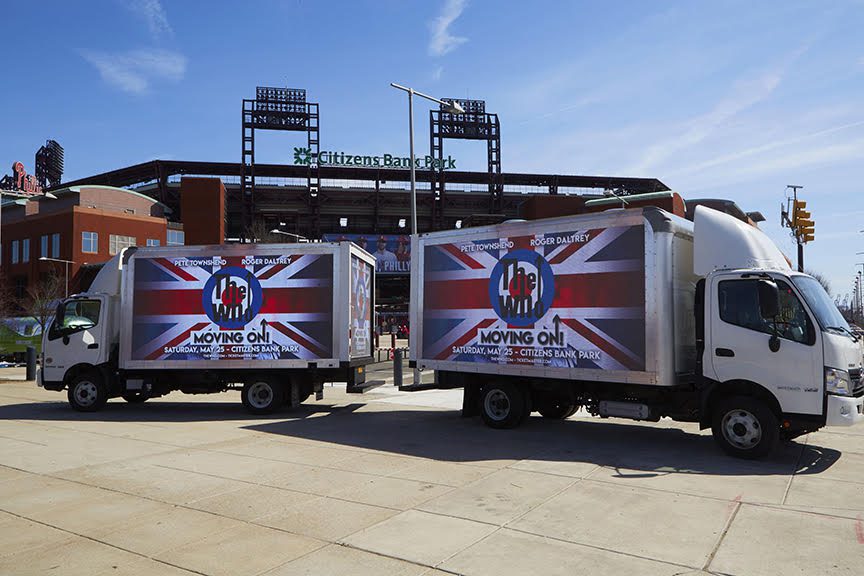
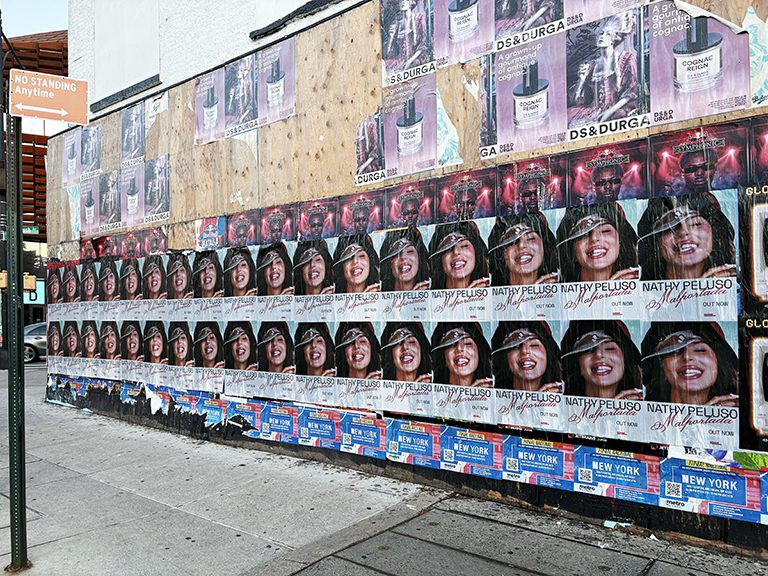
Media planning, media buying, billboard advertising, & guerrilla marketing
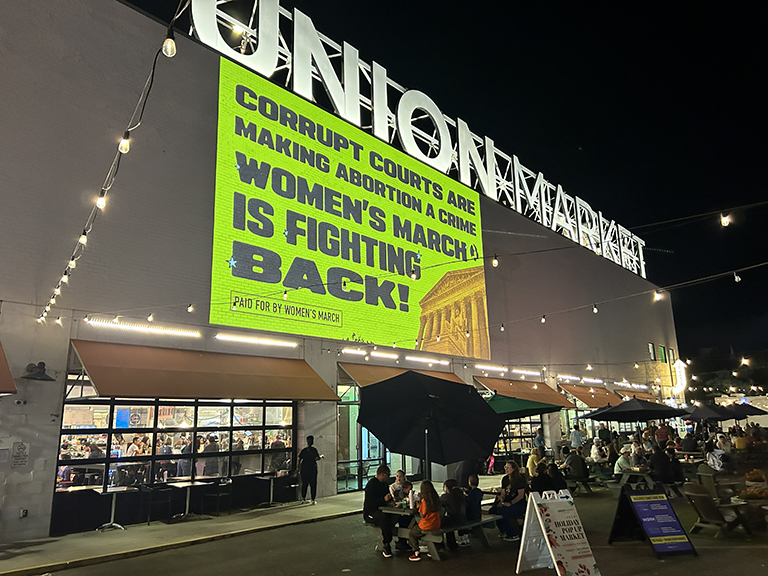
AGM has executed real campaigns on Washington, DC streets — from the Women’s March to reproductive rights advocacy. When a message needs to own a city block, we know how to put it on the wall.
No city in America amplifies a message the way Washington, DC does. The audience here isn’t just local — it’s national press, government officials, international delegations, and the cameras that follow them. When a projection hits a DC building facade, it’s not just seen by pedestrians. It ends up in editorial photos, television B-roll, and social media posts shared across the country within hours.
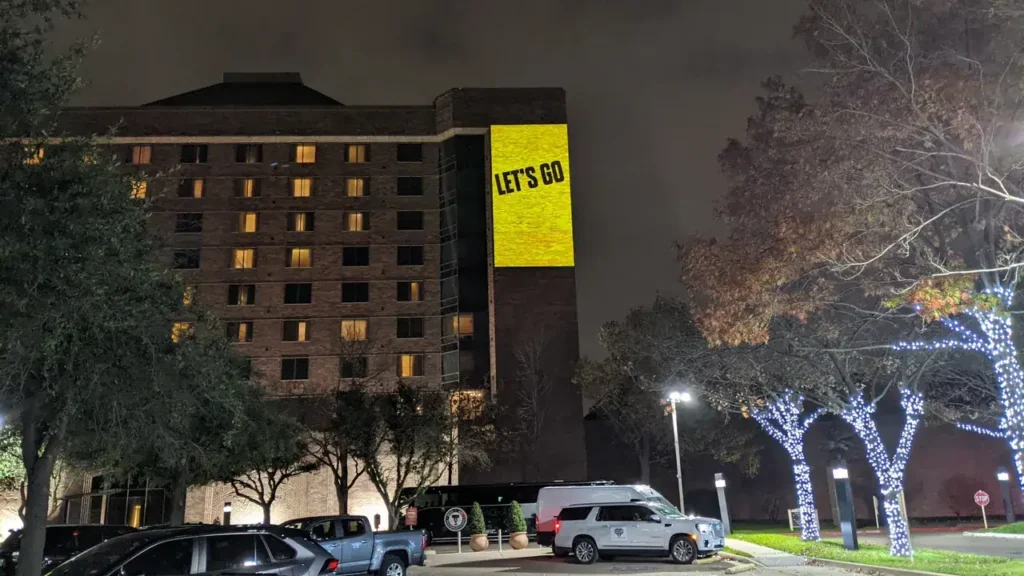
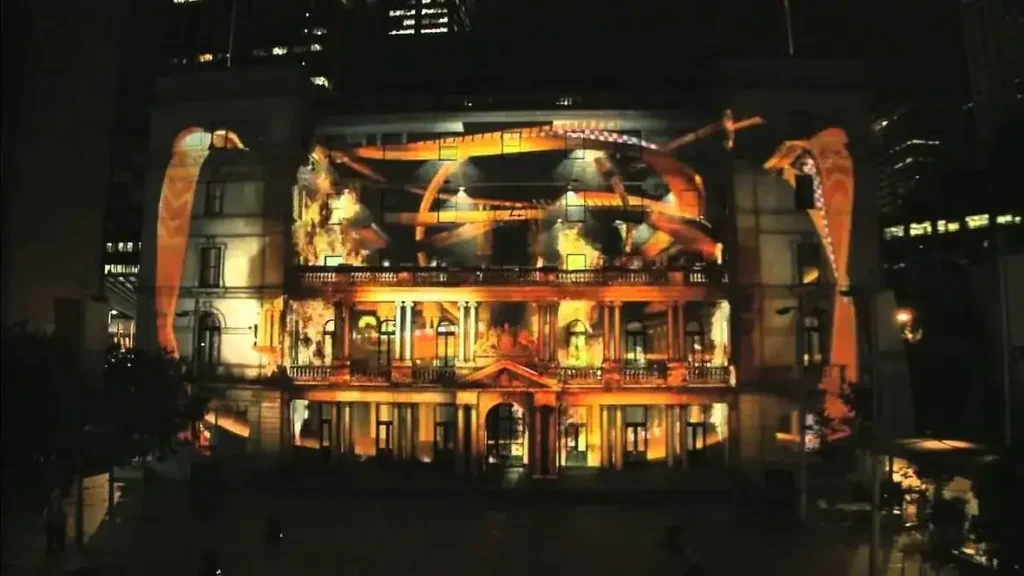
American Guerrilla Marketing has executed guerrilla projection campaigns directly on Washington, DC streets — not nearby, not in a DC suburb, not in a “DMV market” — in DC itself. Our team has scouted these neighborhoods, identified the surfaces, coordinated the technical execution, and deployed our 20,000-lumen projection systems on some of the most politically charged nights this city has seen.
If you’re running an advocacy campaign, a nonprofit push, a political messaging initiative, or a brand that wants to make a statement in the capital of the United States, AGM is the team that has already done it here. We bring direct experience, our own technical crew, and a production system built for the kind of visibility Washington, DC demands.
AGM has executed guerrilla projections on Washington, DC streets. If your campaign belongs in the capital, our crew has already been there. Let's talk about what your DC activation looks like.
Select a city to explore Guerrilla Projections opportunities.
These are not adjacent markets. These are not regional activations. Both campaigns below were executed directly in Washington, DC by AGM’s crew, using our equipment, on our logistics. This is what direct experience looks like.
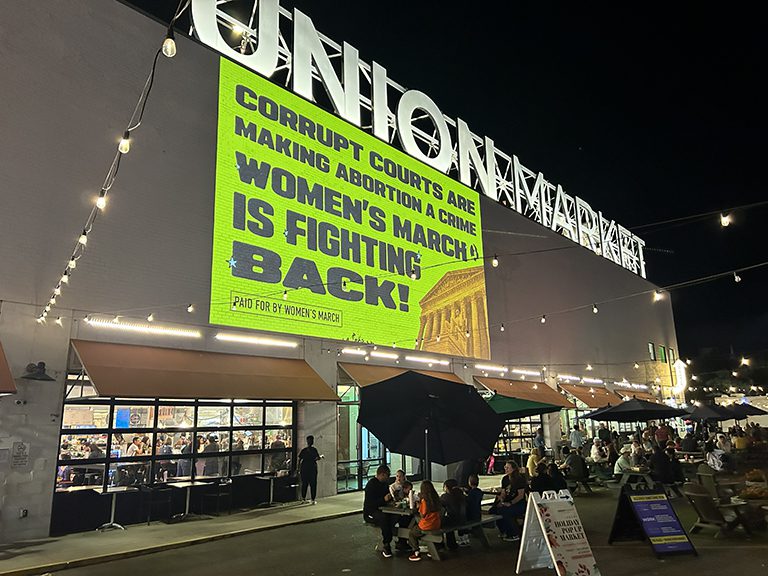
AGM deployed a large-scale civic guerrilla projection during the Women’s March in Washington, DC, projecting messaging onto building facades along DC streets during one of the most-watched political gatherings in the country. The projection reached an audience of marchers, press, and bystanders in the heart of the capital and was captured across news and social media. This is the kind of moment where scale, timing, and technical reliability are everything — AGM delivered all three on-site in DC.
AGM executed a guerrilla projection campaign for Reproductive Freedom for All directly in Washington, DC. The campaign put advocacy messaging on DC building walls at a moment of national political debate, reaching audiences in the streets and generating press visibility beyond the immediate footprint of the activation. AGM’s production team managed scouting, logistics, technical setup, and on-site operation for this advocacy projection from start to finish.
These two campaigns establish Washington, DC as a proven AGM market with direct execution history — not a new territory we’re testing, but a city where our crew has already put messaging on the walls. Organizations running advocacy, cause-based, or politically adjacent campaigns in DC should know that AGM is not new to these streets.
Washington, DC has a distinctive built environment — a mix of historic masonry facades, blank industrial walls in transitional neighborhoods, and dense entertainment corridors with heavy foot traffic after dark. AGM’s national scouting team has assessed the DC market both digitally and physically on the ground. Here are the neighborhoods and districts that offer the strongest projection opportunities.
The Shaw and U Street neighborhoods are among the best projection environments in DC. Historic blank masonry walls are common throughout the corridor, providing the large, clean projection surfaces that 20,000-lumen systems are built for. The area has high nightlife density — restaurants, bars, music venues — which means strong foot traffic well into the late evening. The community here is politically engaged, and U Street specifically carries deep cultural significance in DC that makes messaging land with weight. For advocacy and culturally resonant campaigns, this corridor is a top-tier DC location.
NoMa and the Union Market warehouse district offer some of the best raw projection infrastructure in DC. Rapidly gentrifying, the neighborhood still has a significant stock of blank industrial facades — the kind of large, uninterrupted surfaces that make projection imagery dramatic and legible from a distance. The mix of established residents, new development, and an emerging food and retail scene means foot traffic is growing, and the audience skews toward demographics that engage with brand and cause-based messaging alike. For campaigns that want scale and visual impact, NoMa is a primary target.
Georgetown delivers a different kind of DC audience — affluent, influential, and international. The waterfront draws heavy foot traffic on evenings and weekends, and the entertainment district surrounding it has a density of restaurants and nightlife that keeps pedestrians on the street after dark. Campaigns targeting a higher-income DC demographic or seeking visibility among the kind of audience that includes policy influencers, lobbyists, and business leadership find Georgetown effective. Surface availability requires advance scouting; AGM’s team identifies viable locations for each production.
H Street NE is one of DC’s densest and most walkable entertainment strips. The restaurant and bar concentration along this corridor keeps foot traffic strong from evening into late night, and the neighborhood’s arts-forward character means audiences here are receptive to bold visual messaging. Blank building walls along and adjacent to the corridor provide projection opportunities, and the strip’s culture of discovery makes guerrilla activations well-suited to organic social amplification. This corridor works well for brands and campaigns seeking engagement with DC’s younger, culturally active demographic.
The Navy Yard area has transformed into one of DC’s most active entertainment destinations, with Nationals Park anchoring a dense cluster of bars, restaurants, and residences. On game nights and event evenings, foot traffic here is exceptional — concentrated audiences, high dwell time, and strong social media activity surrounding events make this zone ideal for capturing attention at scale. The visual environment is modern and dense, and projection placement adjacent to the stadium entertainment complex puts messaging directly in front of large, already-engaged crowds.
Adams Morgan remains one of DC’s most vibrant and diverse nightlife corridors, with blank building walls accessible along and off the main strip. Evening foot traffic here is consistent and heavy, and the neighborhood’s reputation for independence, culture, and activism makes it a strong fit for advocacy campaigns and culturally resonant brand messaging. The building stock in Adams Morgan includes older masonry structures with the kind of large blank wall sections that projection systems use effectively. AGM’s scouting team can identify and assess exact surface candidates in advance of any DC deployment.
Capitol Hill’s entertainment corridor — running through Barracks Row and the surrounding residential streets — offers a distinct DC audience that is politically educated, civically engaged, and receptive to message-forward advertising. Blank wall availability varies, and proximity to the Capitol complex means the symbolic weight of Capitol Hill activations is real. For campaigns with government-adjacent messaging or nonprofit organizations wanting to put their cause in direct proximity to the halls of power, Capitol Hill carries unique strategic value as a projection market.
Tell us about your campaign goals, target audience, and preferred locations. Our team will help you plan a high-impact guerrilla projection campaign tailored to your needs.
Award Winning Personalized Service
You will get thoughtful, devoted, and individualized attention from our experienced, qualified, and professional personnel. Being one of the most illustrious agencies in Brooklyn, New York, American Guerrilla Marketing has been awarded the Best of Brooklyn title.
Nationwide
Industry City, Brooklyn, New York 11232
American Guerrilla Marketing
Hours
Mon - Fri: 9 AM - 5 PM
Sat & Sun: Closed
Automate your campaign with AGM’s Request for Proposal Builder. Simply answer a few quick questions about your campaign goals, markets, and timeline, and the system will generate a tailored presentation with recommended strategies, quantities, and pricing. Click the RFP Builder to instantly receive your customized proposal.
Washington, DC attracts a different concentration of campaign categories than almost any other American city. The presence of advocacy organizations, government-adjacent brands, nonprofits, and international entities creates demand for projection advertising that goes well beyond consumer brand launches. Here are the campaign types AGM regularly executes in DC and similar markets.
AGM has direct execution experience with advocacy projection in Washington, DC. Cause-based organizations use guerrilla projection to put their message on the walls of the city at pivotal moments — marches, hearings, national conversations. The format creates visuals that press and the public respond to, generating earned media alongside the direct audience impression.
Nonprofit organizations use guerrilla projection in DC to create visible moments that support fundraising campaigns, awareness drives, and donor engagement. A projection in a high-profile DC neighborhood signals organizational scale and seriousness in a way that digital-only campaigns cannot replicate. AGM has worked with advocacy nonprofits and understands the budget structures and approval processes these organizations operate under.
Washington, DC is the primary market for campaigns that intersect with political discourse. Organizations communicating on policy issues, electoral priorities, or civic participation find guerrilla projection in DC uniquely effective. The format reaches audiences on the street while generating visual content that travels well through press and social channels — extending the campaign’s reach far beyond the physical footprint of a single night’s deployment.
Brands with a footprint in the DC market — consumer, professional services, tech, and media — use guerrilla projection to launch products or campaigns with the visual impact a press release cannot deliver. DC’s dense media environment means a well-executed projection event has a higher probability of editorial coverage than in many other markets. AGM coordinates campaign logistics so the activation is designed for both street-level impact and documentation.
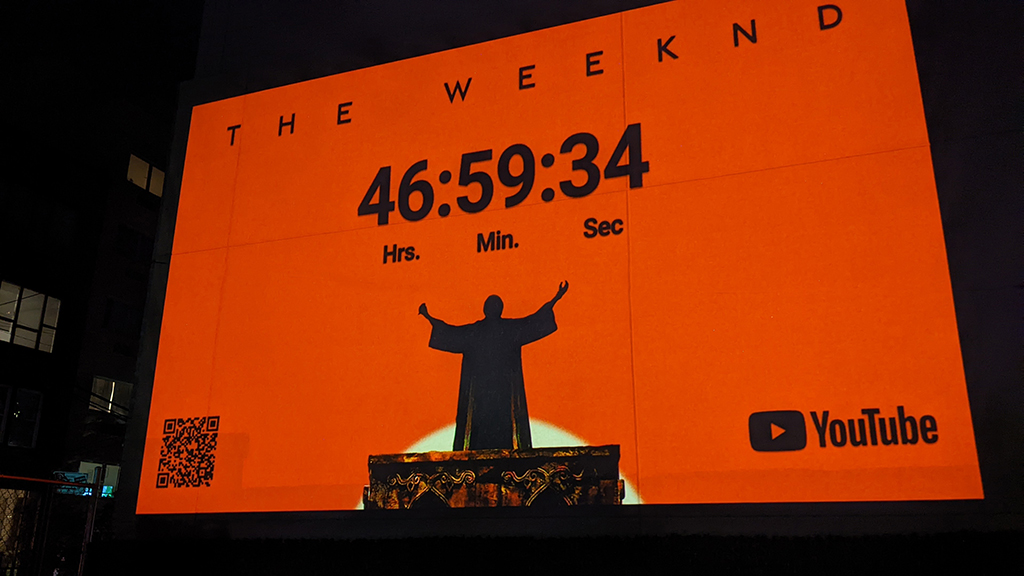
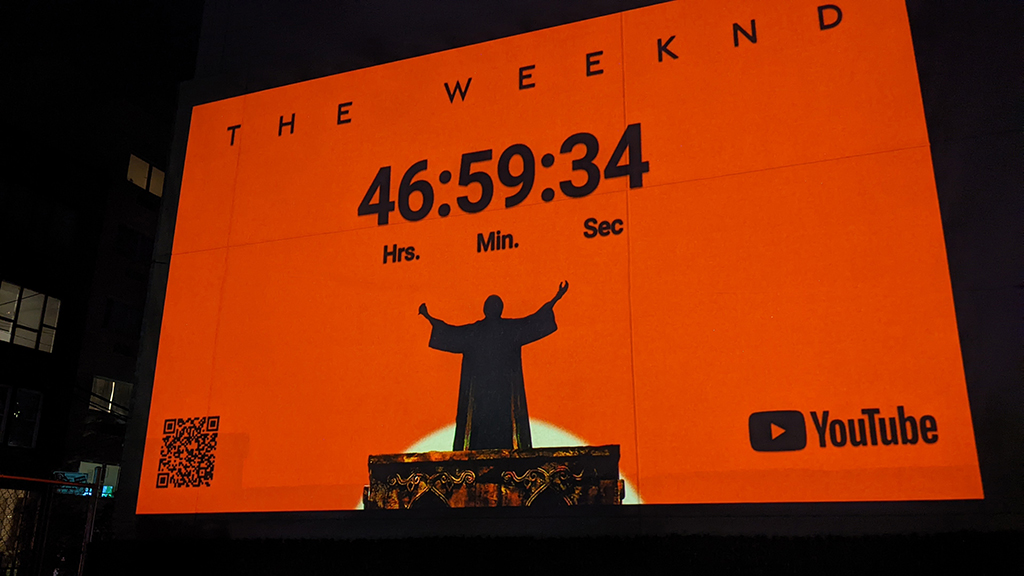
Film studios, music labels, streaming platforms, and touring artists use guerrilla projection to build market-level awareness in DC around release dates and touring announcements. AGM has produced projection activations for entertainment clients including The Weeknd and YouTube. DC’s combination of high foot traffic neighborhoods and media presence makes it an effective entertainment marketing market alongside the major coastal cities.
Consulting firms, law firms, policy organizations, defense-adjacent brands, and associations with Washington, DC operations use guerrilla projection to establish presence and authority in the capital market. These campaigns often target specific neighborhoods where their audience concentrates — Georgetown, Capitol Hill, K Street adjacents — and AGM’s scouting team identifies surfaces that maximize visibility within those zones.
Every AGM campaign goes through the same production process — the one that has worked in New York, Los Angeles, Miami, and on the streets of Washington, DC. There are no shortcuts in this production, and no steps outsourced. AGM’s own team handles every phase.
Before a projector is deployed, the location has to be right. AGM’s national scouting team conducts both digital scouting — satellite analysis, street view mapping, permit research — and physical on-the-ground scouting for markets where advance location work is purchased. For Washington, DC, we have prior on-the-ground experience that informs our location recommendations. GPS-documented location analysis identifies the best available surfaces, assesses sight lines, confirms power logistics, and evaluates pedestrian traffic patterns. Location scouting for DC is available as an advance service at approximately contact us for a quote.
Projection artwork needs to be engineered for scale — not just scaled up from a social media graphic. AGM’s creative standards for projection work include proper aspect ratio, contrast levels that survive projection onto real-world surfaces, and legibility at distance. Clients provide approved artwork and messaging; AGM prepares it for production deployment. For campaigns where multiple surfaces or multiple creative executions are planned, artwork is tested against projected surfaces prior to the primary deployment.
On deployment night, AGM’s two-person technical crew arrives at the scouted location with the full production system — a 20,000-lumen commercial projector, generator and power solution, and the electronics bundle needed for clean, stable operation. The crew handles setup, alignment, and operation from dusk through the end of the run. Typical run duration is 4 to 6 hours. The crew manages the equipment throughout the deployment and handles full breakdown at the end of the night. No subcontractors. AGM’s own technicians, trained on this equipment, on-site for the full production.
Every AGM deployment includes documentation of the activation — photography and video captured on-site for client use and reporting. Post-campaign documentation includes GPS-referenced location records. For clients with reporting requirements — advocacy organizations, nonprofits, institutional clients — AGM’s documentation provides the evidence of execution needed for internal reporting and stakeholder communication. We know that in DC especially, the documentation of a campaign matters as much as the campaign itself.
Washington, DC is priced at the outside-NYC rate.
Guerrilla Projection — Washington, DC
Includes: 20,000-lumen projector, generator and power solution, electronics bundle, mobility unit, two-person technical crew, setup, operation, and breakdown. Starts at dusk, typical run 4–6 hours.
Location Scouting (Advance)
Physical on-the-ground and digital scouting, GPS-documented analysis, location recommendations.
Permitted or Private-Property Locations
Legally secured placements on permitted public or private-property surfaces.
Multi-Night Runs
Extended campaigns across consecutive or non-consecutive nights in Washington, DC.
Multi-projector deployments and multi-night campaigns are available and may be structured to fit extended advocacy runs or campaign timelines. Contact AGM to discuss the scope and timeline of your DC activation.
The Washington, DC market draws a distinct mix of organizations that use guerrilla projection advertising differently than any other American city. The common thread is this: in DC, a campaign that reaches the street-level audience also reaches the people who write about it, legislate around it, and broadcast it. The earned media multiplier in Washington is unusually high.
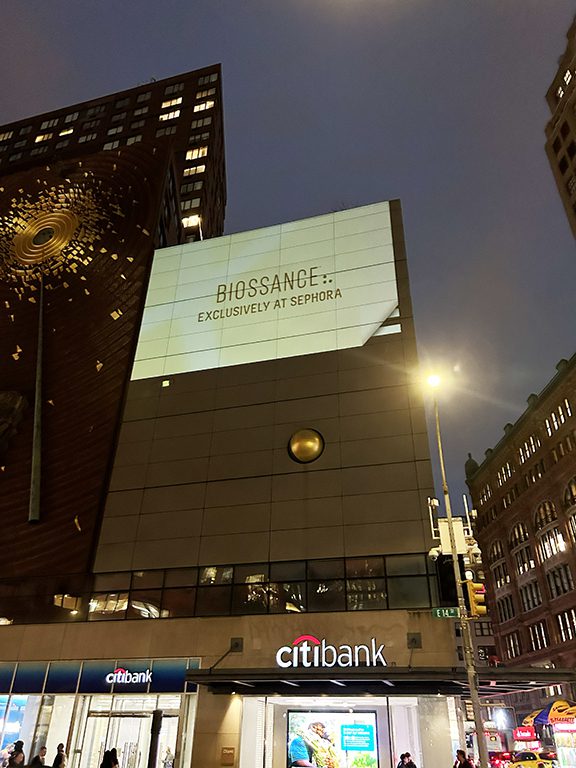
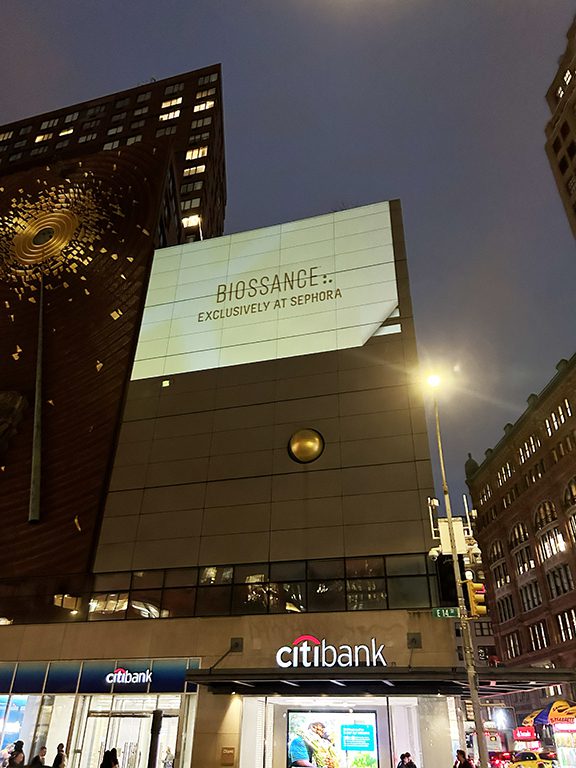
AGM has worked with clients including Biossance, The Weeknd, the US Marine Corps, Women’s March, Reproductive Freedom for All, and YouTube. The range of that client list reflects the range of the format — guerrilla projection works for advocacy, entertainment, and brand alike. In Washington, DC specifically, the advocacy and cause-based side of that list is particularly well-developed in our execution history.
AGM’s projection client roster includes Netflix, Disney, Coca-Cola, FanDuel, Live Nation, iHeartRadio, and the US Marine Corps. A confirmed case study: the US Marine Corps × CMA Fest Nashville — multi-night projections onto architectural surfaces throughout the festival footprint, reaching 80,000+ attendees across the campaign window. Projection advertising scales across every brand category; what our campaigns share is scale, precision, and a physical presence digital cannot replicate.
| Zone / Area | Peak Hours | Foot Traffic | Est. Nightly Impressions | Best For |
|---|---|---|---|---|
| Shaw / U Street Corridor | 9PM–2AM | Very High | 25,000–120,000 | Product Launch |
| NoMa / Union Market Warehouse District | 9PM–2AM | Very High | 25,000–120,000 | Event Promotion |
| Georgetown Waterfront and Entertainment Area | 9PM–2AM | Very High | 25,000–120,000 | Brand Awareness |
| H Street NE Arts and Entertainment Corridor | 9PM–2AM | Very High | 25,000–120,000 | Political |
| Navy Yard / Nationals Park Entertainment Zone | 9PM–2AM | Very High | 25,000–120,000 | Sports |
| Adams Morgan Nightlife Corridor | 9PM–2AM | Very High | 25,000–120,000 | Concert/Festival |
Yes — direct, on-the-ground execution in Washington, DC. AGM deployed guerrilla projections at the Women’s March in Washington, DC and for Reproductive Freedom for All in Washington, DC. These are not adjacent-market activations or case studies from a similar city — they are campaigns our crew ran on DC streets with our equipment. This direct experience is a primary reason organizations running advocacy or cause-based campaigns in DC choose AGM.
Washington, DC’s regulatory environment for outdoor advertising and public-space activations is managed through multiple jurisdictions — DC city agencies, the National Park Service, and in some cases federal authorities, depending on the proximity to federal property. Guerrilla projections on private property surfaces do not carry the same permitting burden as government-property activations. AGM’s scouting team assesses the regulatory context of each proposed DC location before production. For legally secured permitted or private-property placements, budget an additional Contact us for a custom quote. per night.
Locations in proximity to the National Mall, the Capitol, the White House, or other federal property fall under National Park Service and federal jurisdiction, which creates a different and more complex permitting environment than standard DC city locations. AGM’s team assesses each proposed location’s regulatory status during the scouting phase. In many cases, strong visibility near high-profile DC destinations can be achieved from private-property or city-managed surfaces that do not require federal permitting — and often those positions offer superior projection geometry compared to open Mall areas.
For advocacy and cause-based campaigns, Shaw/U Street and NoMa/Union Market are the top two DC neighborhoods — blank masonry walls, high foot traffic, and politically engaged audiences. For brand and entertainment campaigns targeting a broader DC demographic, H Street NE and Adams Morgan both offer strong nightlife density and walkable audiences. Georgetown delivers access to an affluent, influential DC demographic. The right neighborhood depends on your campaign’s target audience and messaging — AGM’s scouting recommendation accounts for both surface availability and audience alignment.
AGM has executed advocacy projection campaigns with nationally visible political messaging in Washington, DC. We are not new to this category. Our crew has deployed campaigns for reproductive rights organizations and civic marches in DC, and we understand the production and logistical considerations that come with politically sensitive activations — timing, documentation, crew conduct, and site selection. We do not editorialize on client messaging; our job is professional execution of the campaign as designed and approved by the client.
Washington, DC foot traffic skews toward educated, politically engaged, and professionally active adults. The city has one of the highest concentrations of graduate-degree holders of any major American city, and its population includes an unusual density of journalists, government employees, policy professionals, lobbyists, and nonprofit staff. This is an audience that reads messaging actively rather than passively — guerrilla projections in DC are likely to be read, photographed, and shared by an audience that is more than typically attentive to public visual communication. For advocacy campaigns, this audience profile is a significant asset.
Washington, DC has an exceptionally high press density — national and local print, broadcast, and digital media, plus a constant flow of international press corps. A well-timed and well-placed guerrilla projection in DC has legitimate potential to generate earned media coverage beyond the street-level audience. AGM documents every activation with photography and video. Advocacy clients in particular have used DC projections as a press strategy — creating a visual event that local and national media can photograph and broadcast alongside their coverage of the campaign or cause.
AGM’s 20,000-lumen commercial projection systems produce images that scale to building-facade dimensions — typically filling several stories of wall surface from a standard deployment distance. Image size and brightness are a function of throw distance, ambient light conditions, and surface reflectivity. DC deployments typically start at dusk to maximize lumen effectiveness. AGM’s technical crew optimizes placement geometry on-site for each deployment. Legibility from 100+ feet on clean facade surfaces is standard for our equipment at 20,000 lumens.
AGM can deploy multiple projectors simultaneously in Washington, DC — either at a single location with multiple surfaces, or at different locations across the city on the same night with separate crews. Multi-projector deployments are priced per projector at contact us for a quote. For campaigns that want simultaneous coverage across multiple DC neighborhoods, AGM coordinates the logistics to deploy multiple units in the same evening. This is particularly effective for advocacy campaigns that want to cover multiple high-visibility districts in a single night’s activation.
The minimum lead time for a Washington, DC guerrilla projection depends on the complexity of the campaign. For campaigns using locations already identified from AGM’s prior DC scouting experience, timelines can compress significantly. For campaigns requiring advance location scouting of new surfaces, at least two to four weeks of advance time allows for proper scouting, creative preparation, and logistics coordination. Advocacy campaigns tied to specific dates — marches, hearings, legislative calendars — should contact AGM as early as possible to secure the production timeline needed for those dates.
AGM uses its own trained technical crew — not subcontractors. Every DC deployment is staffed by AGM’s own technicians who are trained on our specific 20,000-lumen projection systems, generators, and electronics bundles. This means the same production standards that have worked on high-visibility DC campaigns like the Women’s March and Reproductive Freedom for All apply to every production we run in the market. We don’t hand off to local crews and hope the equipment gets set up correctly — AGM’s crew manages the activation from setup through breakdown.
Yes. Multi-night campaigns in Washington, DC are available and common for advocacy and brand campaigns that need sustained visibility over a period of days. Multi-night runs can cover the same location on consecutive nights or rotate across different DC neighborhoods for broader market coverage. Extended campaigns are priced at contact us for a quote. with multi-night production schedules coordinated by AGM in advance. For campaigns tied to advocacy calendars — multi-day events, legislative sessions, ongoing fundraising periods — multi-night deployment structures are often the right format.