American Guerrilla Marketing
Nationwide Service
Media planning, media buying, billboard advertising, & guerrilla marketing
Guerrilla Projections in Pawtucket, RI

The Hope Artiste Village carries some of the largest blank mill-building facades in New England — former rubber and textile mill walls spanning multiple stories of dense brick masonry that AGM’s 20,000-lumen projection system can fill completely. The Blackstone River Arts District and Main Street corridor add walkable pedestrian zones that bring the audience to the wall.
Pawtucket sits at the intersection of two distinct histories that directly shape its value as a guerrilla projection market. It is the birthplace of American industrial manufacturing — Slater Mill, established in 1793 on the Blackstone River, is widely recognized as the start of the American Industrial Revolution — and it is, in the contemporary moment, one of the most active arts communities in New England, built largely within the physical shells of those same industrial buildings. The Hope Artiste Village, a former rubber and textile mill complex on Main Street, has become the most prominent arts hub in the city: a multi-building campus of studios, galleries, event spaces, and creative organizations occupying one of the largest mill building complexes in Rhode Island. Its exterior wall faces — massive expanses of brick masonry spanning four to six stories across long wall sections — are among the most extraordinary projection surfaces in the state.
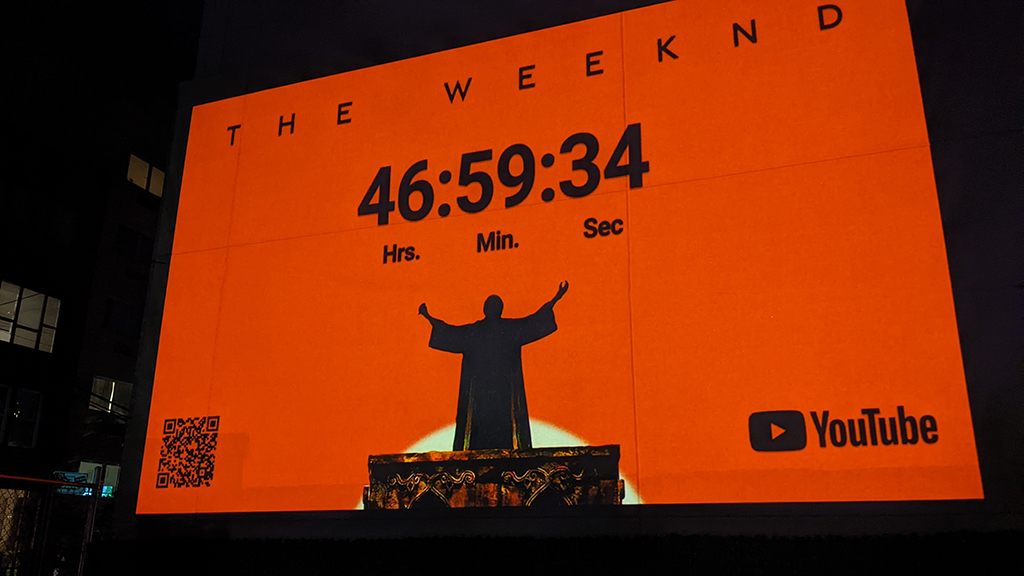
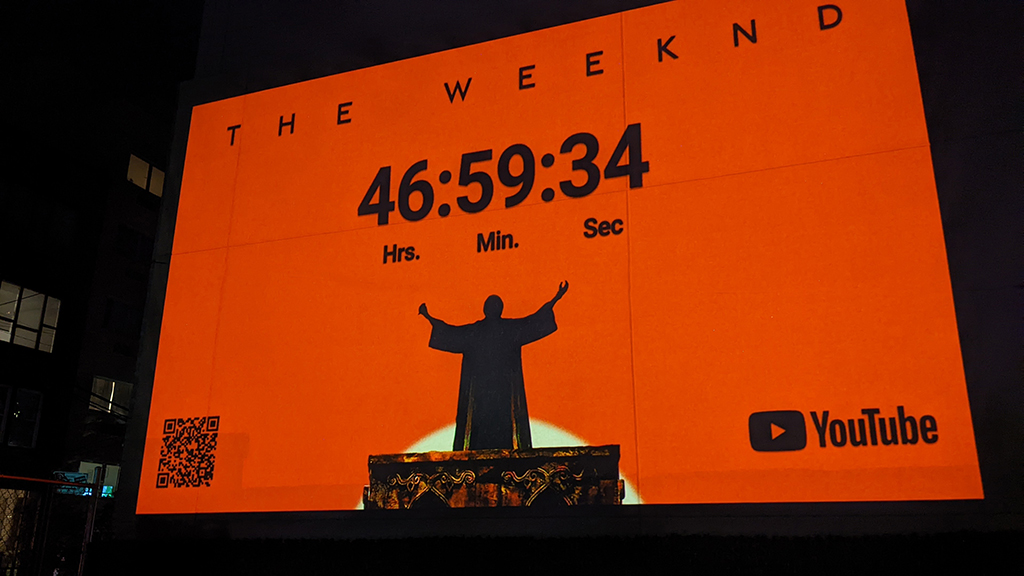
AGM’s projection client roster includes Netflix, Disney, Coca-Cola, FanDuel, Live Nation, iHeartRadio, and the US Marine Corps. A confirmed case study: the US Marine Corps × CMA Fest Nashville — multi-night projections onto architectural surfaces throughout the festival footprint, reaching 80,000+ attendees across the campaign window. Projection advertising scales across every brand category; what our campaigns share is scale, precision, and a physical presence digital cannot replicate.
AGM has executed guerrilla projection campaigns for brands including Netflix, Disney, and FanDuel — deploying high-impact visual activations onto architectural surfaces in major markets nationwide.
What makes Pawtucket exceptional as a projection market is the alignment between the physical scale of its mill building inventory and the cultural engagement of its arts community population. The people who work in, attend events at, and live near the Hope Artiste Village are precisely the people most likely to document and share an unexpected building projection — and the people most likely to be out moving through the Blackstone River Arts District and Main Street corridor on the evenings when a campaign is active. That alignment of ideal surface, ideal audience, and concentrated foot traffic in proximity to the surface creates projection campaign conditions that are genuinely unusual and that deliver earned media and organic social returns that larger, more saturated markets often cannot match at the same campaign investment level.
Pawtucket's Mill Walls Are Ready for Your Campaign
Hope Artiste Village. Blackstone River Arts District. Main Street. Pawtucket's projection zones offer mill-building scale, arts community documentation culture, and a media environment where your campaign stands out. Contact AGM to plan your Pawtucket building projection campaign.
Our Campaign Locations
Browse Cities in Rhode Island
Select a city to explore Guerrilla Projections opportunities.
Why Pawtucket's Mill Heritage Creates Exceptional Projection Opportunities
The mill building as a projection surface has specific physical advantages that are worth understanding in detail. Rhode Island’s mill buildings were constructed with a particular structural logic: a long, repetitive bay system of masonry load-bearing walls with relatively small, evenly spaced windows providing light to the manufacturing floors within. The result is an exterior elevation with a very high ratio of solid wall to window — far higher than a conventional commercial or residential building — and with wall sections of continuous brick masonry spanning fifty to a hundred feet or more in width at heights of three to six stories. These are, physically speaking, ideal projection canvases: large, flat, relatively smooth, and minimally interrupted by the transparent or reflective surfaces that create dead spots in projected images.
The Hope Artiste Village exemplifies this profile at maximum scale. The building’s exterior wall faces on the Main Street-facing elevations are among the largest continuous projection surfaces in the Pawtucket and Providence metro area, offering projection dimensions that exceed what any conventional commercial building in either city can provide. When AGM’s 20,000-lumen system is deployed at the correct distance from one of these wall faces, the resulting projection image covers the wall at a scale that produces a genuinely arresting visual spectacle — an image that is visible from distances of well over a hundred feet in multiple directions and that dominates the visual field of anyone in the surrounding pedestrian zone.
Pawtucket’s arts community adds the audience layer that makes this surface inventory commercially productive. Unlike an isolated industrial building in a non-pedestrian zone, the Hope Artiste Village sits within a walkable arts district that brings a culturally engaged, socially connected population into proximity with the building’s exterior walls on a regular basis. Opening receptions, arts events, gallery walks, and the general social activity of the arts community create consistent foot traffic in the zones adjacent to the mill buildings, providing the concentrated audience that projection campaigns require to generate organic documentation and earned media distribution.
Pawtucket's Projection Zones — Where The Right Walls Are
Hope Artiste Village — Former Rubber and Textile Mill Complex
The Hope Artiste Village is Pawtucket’s marquee projection surface — a multi-building former mill complex on Main Street with exterior wall faces that span multiple stories of brick masonry at scale rarely available in conventional urban building stock. The complex houses arts studios, galleries, performance spaces, and creative businesses that generate a consistent population of culturally engaged visitors and residents in proximity to its exterior walls. The most projection-viable wall sections at Hope Artiste Village are the building elevations facing Main Street and the adjacent parking areas, which provide clear sight lines from the projector position to the wall face across the available right-of-way or parking surface. AGM’s scouting process evaluates the specific wall sections and projector positioning geometries at Hope Artiste Village with careful attention to the building’s existing lighting, any tenanted ground-floor commercial signage that affects the lower wall sections, and the orientation of pedestrian foot traffic relative to the projected image’s primary facing direction.
Downtown Main Street Arts Corridor
Pawtucket’s downtown Main Street corridor provides a more conventional commercial pedestrian projection environment adjacent to the Hope Artiste Village campus — restaurants, retail establishments, bars, and service businesses in a mixed-use commercial streetscape with varying building scale and surface quality. The Main Street corridor’s evening foot traffic is driven by the arts community and the downtown entertainment population, with the highest density concentrated on arts event evenings and weekend nights when the Hope Artiste Village and adjacent venues are most active. Building facades along Main Street include former commercial buildings of the late-nineteenth and early-twentieth century in brick and masonry, with blank upper-floor and side-wall sections accessible for projection from the street level. AGM’s Main Street scouting focuses on corner buildings and mid-block structures with blank side walls that are visible from the primary pedestrian flow and accessible from clear projector positions in the adjacent parking or street right-of-way.
Blackstone River Arts District
The Blackstone River Arts District encompasses the waterfront and adjacent zones along the Blackstone River that runs through Pawtucket’s downtown, including repurposed mill buildings, arts organizations, and recreational infrastructure that together form one of southern New England’s more distinctive riverfront arts environments. The Arts District’s waterfront character — the visual drama of the river, the historic mill context, the open sky above the river corridor — provides a projection surface setting with distinctive visual qualities that purely urban street-context projections do not have. Building facades in the Blackstone River Arts District include the sides and waterfront elevations of former mill structures adjacent to the river, with surface characteristics that reflect the diversity of the mill building stock: painted brick, raw masonry, and in some cases concrete block or panel cladding that was added during mid-century renovations to the original nineteenth-century structures.
Riverfront Area
Pawtucket’s Riverfront zone, where the Blackstone River meets the downtown commercial fabric, offers a projection context with the characteristic visual appeal of waterfront settings: open space that allows extended viewer distance, river and sky as backdrop to building facade projections, and outdoor recreational infrastructure that draws pedestrians and cyclists through the zone on evenings and weekends. Riverfront building facades visible from the public access areas along the river provide projection surface candidates with good sight-line access from the water-facing side, and AGM’s scouting evaluates these surfaces for the combination of size, reflectivity, and projector positioning access that determines campaign viability at each specific location.
Plan Your Guerrilla Projection Campaign in Pawtucket, RI
Tell us about your campaign goals, target audience, and preferred locations. Our team will help you plan a high-impact guerrilla projection campaign tailored to your needs.
Award Winning Personalized Service
You will get thoughtful, devoted, and individualized attention from our experienced, qualified, and professional personnel. Being one of the most illustrious agencies in Brooklyn, New York, American Guerrilla Marketing has been awarded the Best of Brooklyn title.
Nationwide
Industry City, Brooklyn, New York 11232
American Guerrilla Marketing
Hours
Mon - Fri: 9 AM - 5 PM
Sat & Sun: Closed
Automate your campaign with AGM’s Request for Proposal Builder.
Automate your campaign with AGM’s Request for Proposal Builder. Simply answer a few quick questions about your campaign goals, markets, and timeline, and the system will generate a tailored presentation with recommended strategies, quantities, and pricing. Click the RFP Builder to instantly receive your customized proposal.
Creative Campaign Types That Work in Pawtucket
Arts and Cultural Institution Campaigns
The Hope Artiste Village and its surrounding arts community provide an immediate native audience for projection campaigns from arts organizations, galleries, and cultural institutions. A projection on the Village’s exterior wall for a gallery opening, arts programming season launch, or creative community fundraising moment reaches the exact target audience in its home environment, generating documentation and social sharing from arts-community members whose networks are precisely calibrated to amplify arts-sector content.
Consumer Brand Launches in Arts Corridors
Consumer brands entering the Rhode Island market that want to establish credibility with the arts and creative professional demographic use Pawtucket’s Hope Artiste Village and Main Street corridor for launch campaigns that position the brand within an authentic arts-district context. The mill building scale of the projection makes the brand statement physically monumental, while the cultural resonance of the setting adds the authenticity dimension that urban creative audiences respond to most strongly.
Advocacy and Civic Campaigns
Pawtucket’s arts community and the broader Blackstone River corridor population include a high concentration of civically engaged Rhode Island residents whose social networks connect directly to the state’s political and advocacy ecosystem. Projection campaigns on Hope Artiste Village or Main Street for advocacy organizations targeting Rhode Island’s creative and working-class communities reach an audience with strong civic engagement and high propensity to distribute campaign messages through their social connections.
Entertainment Releases and Cultural Moments
Music, film, and entertainment releases targeting the Rhode Island and southern New England audience use Pawtucket’s arts district as an entry point into the creative community that drives cultural conversation in the region. A projection at Hope Artiste Village timed to a major release or cultural event reaches the arts-forward audience that early-adopts entertainment content and whose social distribution amplifies campaign reach through the connected New England arts network.
Building A Pawtucket Projection Campaign From The Ground Up
Scouting the Hope Artiste Village and Surrounding Zones
AGM’s Pawtucket scouting process centers on the Hope Artiste Village as the primary candidate surface, with supplementary evaluation of Main Street corridor walls and Blackstone River Arts District building facades. The Village scouting documents each available wall section’s dimensions, surface condition, current lighting and signage obstructions, and the projector positioning options accessible from the adjacent street and parking infrastructure. The Pawtucket scouting phase is priced at approximately Contact us for a custom quote. for the full market evaluation and delivers a confirmed wall, projector position, and dimensional template specification that the client’s creative team uses to develop projection-ready assets. Because the Hope Artiste Village is a managed campus with private tenants, access coordination for projector positioning within the campus boundary requires advance management communication that AGM handles as part of the planning process.
Creative Template and Asset Development
Hope Artiste Village’s brick exterior surfaces have specific visual characteristics that inform creative adaptation for Pawtucket campaigns. The warm red-to-brown brick tone of the mill buildings means that projected colors in the warm spectrum — reds, oranges, yellows — read with more surface resonance than cool blues and greens, which contrast sharply but cleanly against the brick background. AGM’s technical team provides surface-specific color and contrast guidance to creative teams developing assets for Pawtucket deployments, ensuring that the final projection renders at maximum visual impact on the specific wall surface confirmed during scouting. Projection-ready asset delivery follows a template specification locked to the confirmed wall dimensions and projector geometry.
Campaign Night and Documentation
The campaign evening follows the same AGM operational protocol as all deployments: the two-person technical crew positions the self-contained 20,000-lumen projection system at the confirmed location before dusk, aligns and calibrates the image against the wall surface, and activates the projection at the onset of effective darkness. The system runs for four to six hours through the peak foot-traffic window for the target Pawtucket zone. Post-campaign documentation is delivered within forty-eight hours — GPS location records, timing logs, and still photography from multiple angles and distances, formatted for press distribution and social content use. Hope Artiste Village projection photography, with the massive mill building as the visual backdrop, carries distinctive aesthetic quality that performs well in organic social distribution and press coverage contexts.
The Women's March and What Civic Projection at Scale Teaches Us
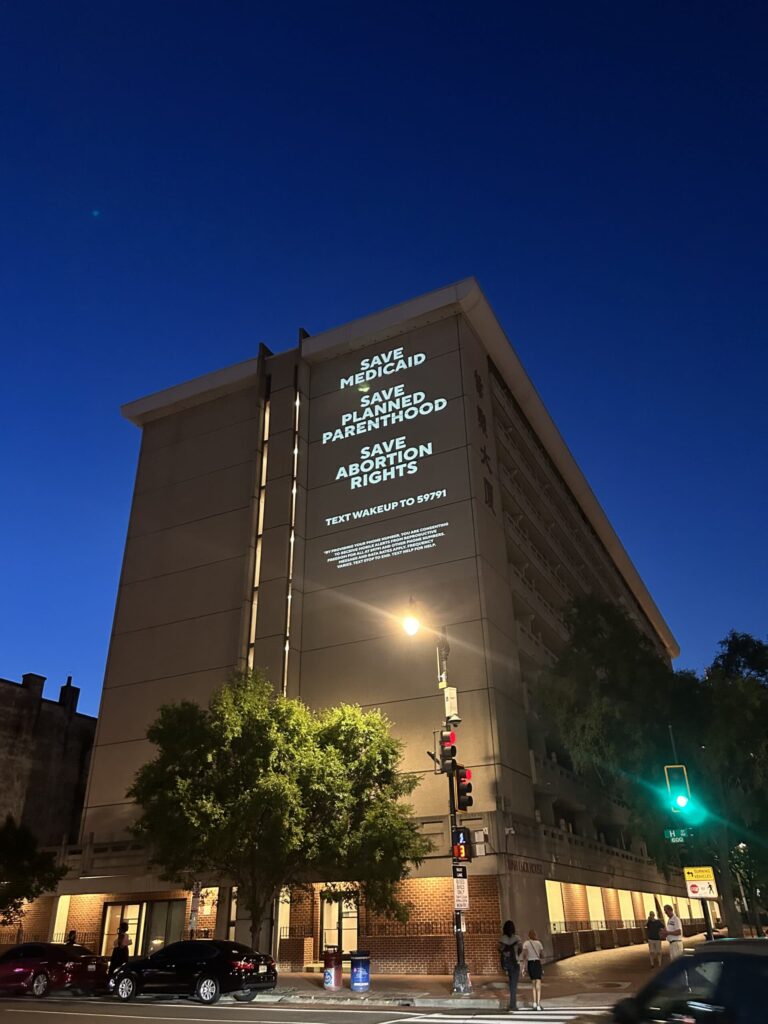
When AGM executed the Women’s March building projection campaign in Washington, DC — placing a large-scale image on a high-visibility building facade in the path of what became one of the largest single-day demonstrations in American civic history — the campaign demonstrated a principle that applies directly to advocacy and civic projection work in markets like Pawtucket. The projection’s power came not just from its visual scale or its message content, but from its precise placement at a moment of concentrated civic energy: hundreds of thousands of people moving through the capital with cameras, emotionally engaged, already connected by shared purpose. The organic documentation that those viewers generated distributed through social platforms at speeds and volumes that no conventional media campaign could have produced, creating an earned media moment whose reach vastly exceeded the projection’s direct physical audience.
Pawtucket’s civic character makes this framework directly applicable. The city’s arts community and working-class neighborhood population include a high concentration of politically engaged Rhode Island residents who participate in state and local advocacy campaigns, organize around labor, housing, and environmental issues, and maintain the kind of social network connectivity that makes earned media from a well-placed building projection distribute with extraordinary efficiency. A projection on the Hope Artiste Village or the Main Street corridor for an advocacy organization targeting Rhode Island’s creative and working communities reaches exactly the audience whose documentation and sharing behavior amplifies the campaign beyond its in-person viewership — and does so in a physical setting whose mill-building scale adds visual gravitas to the message that a conventional commercial building wall cannot provide.
Pawtucket Projection Advertising — Investment And Scope
Building projection campaigns in Pawtucket are priced at contact us for a quote. covering the full AGM deployment system: the 20,000-lumen commercial projection unit, generator and power solution, electronics bundle, mobility unit, and the two-person technical crew for complete setup, operation, and breakdown. The rate is consistent with AGM’s national per-night pricing for all markets outside New York City.
The advance scouting phase for the Pawtucket market — covering Hope Artiste Village, the Main Street corridor, and the Blackstone River Arts District — adds approximately Contact us for a custom quote. for the full evaluation. Private-property access coordination for Hope Artiste Village deployments that require positioning within the campus boundary may involve additional coordination costs depending on the specific access requirements and the building management’s participation terms. Multi-night Pawtucket campaigns are priced at the same per-night rate, with the close proximity to Providence making multi-city Rhode Island campaign structures logistically straightforward and cost-efficient.
Who Uses Building Projection Campaigns in Pawtucket
Pawtucket’s projection advertising clients reflect the city’s distinctive position as an arts community hub within a post-industrial urban context. Arts organizations and creative institutions use Hope Artiste Village projections for programming awareness, fundraising campaigns, and community engagement moments tied to the Village’s own event calendar. Consumer brands targeting the Rhode Island arts and creative professional market use Pawtucket as an entry point that positions the brand within an authentic mill-building arts district context without the higher media saturation of Providence’s downtown corridors. Advocacy organizations working with Rhode Island’s creative, labor, and community populations use the Main Street and Blackstone River District for civic projection campaigns. Entertainment companies targeting New England’s arts-forward young professional and creative audience use Hope Artiste Village projections for release activations that connect the brand or artist with the aesthetic sensibility of the mill building arts community.
Frequently Asked Questions
The Hope Artiste Village is a former rubber and textile mill complex on Main Street in Pawtucket, converted to a multi-building arts campus housing studios, galleries, creative businesses, and performance spaces. Its projection value comes from the combination of exterior wall faces with multi-story scale that substantially exceeds what conventional commercial buildings can offer, a surface condition — aged mill brick with a relatively consistent and large-format texture — that reflects projection at readable quality, and a resident arts community that provides a native audience with high documentation and social sharing propensity on the evenings when campaigns are active.
The Blackstone River Arts District and the Hope Artiste Village overlap geographically and share a community of arts-focused residents and visitors, but they offer different projection environments. Hope Artiste Village provides the largest and most structurally consistent projection surfaces in the market, with the best projector positioning access from the adjacent Main Street infrastructure. The Blackstone River Arts District adds waterfront character — open sky, river context, outdoor recreational infrastructure — that gives projection campaign documentation a distinctive visual quality, while offering somewhat smaller and more varied building surfaces that require case-by-case scouting evaluation to confirm projection viability.
Pawtucket’s Main Street generates its highest evening foot traffic on arts event nights — Hope Artiste Village opening receptions, gallery walks, and scheduled cultural events — when the arts community concentrates in the corridor from approximately 6:00 PM through 10:00 PM. Standard Friday and Saturday evenings generate moderate foot traffic from restaurant and bar patrons in the downtown area. The corridor’s pedestrian density is lower than Providence on comparable nights without special events, which is offset by significantly higher per-viewer documentation rates driven by the arts community’s social media engagement habits and the novelty of building projection advertising in the Pawtucket market.
Yes. The Riverfront zone provides projection-viable building surfaces facing the public access areas along the Blackstone River, with the open river space allowing extended viewer distance and the waterfront setting adding visual interest to campaign documentation. AGM evaluates specific Riverfront surface options during the scouting phase, with attention to the combination of wall size, surface quality, projector positioning access, and the pedestrian or recreational audience present during the target projection window. Riverfront projections are most effective during the warmer months when outdoor recreational use of the riverside paths and areas concentrates an active audience in proximity to the available building surfaces.
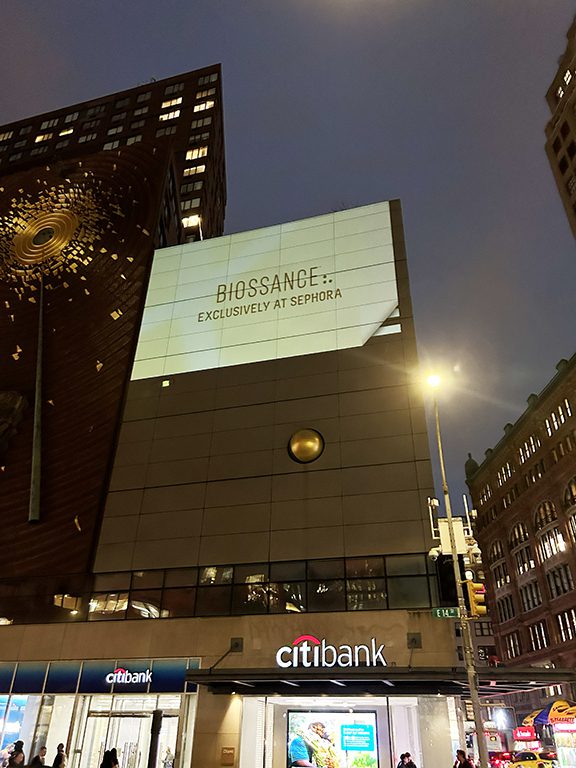
Consumer brands in personal care, food and beverage, fashion, technology, and lifestyle categories have used mill-building arts district projections to establish cultural credibility with the creative professional and arts-engaged consumer who defines the target audience for many brand campaigns. AGM’s experience with the Biossance launch at Sephora — a campaign in a high-foot-traffic commercial environment with strong arts community adjacency — provides a direct template for how consumer brands use large-scale projection in cultural environments to generate both the direct audience exposure and the organic social documentation that extends the campaign’s reach beyond its in-person viewers. Mill-building arts districts like Pawtucket’s Hope Artiste Village provide the physical scale and cultural resonance that maximizes the return on that model.
The Hope Artiste Village building exteriors substantially exceed typical urban commercial building facade dimensions. Where a standard commercial building in a New England city might offer a blank wall section of 20 to 40 feet in width and two to four stories in height, the Hope Artiste Village mill buildings carry wall sections of 60 to 100 feet or more in width at four to six stories of continuous brick masonry. This scale advantage translates directly into projection image size — a projection filling a 70-foot-wide, five-story wall face produces an image visible from distances and at visual impact levels that a 30-by-30-foot commercial building wall cannot approach with the same projector specification.
Yes, and this is one of Pawtucket’s most distinctive projection market characteristics. The Hope Artiste Village arts community — working artists, gallery staff, creative professionals, arts students — have above-average social media engagement rates, a strong visual content sharing culture rooted in documenting artistic work and events, and an existing habit of photographing and sharing striking visual experiences in and around the campus. When a building projection activates on the Village exterior, the documentation response from the arts community on and near the campus tends to be faster, more thorough, and more widely distributed than equivalent projections in commercial-only environments where audiences lack that pre-existing visual documentation orientation.
A minimum planning window of two to three weeks allows AGM to complete the Hope Artiste Village scouting evaluation, confirm the wall and projector position, coordinate any necessary access with building management, develop the creative template, and schedule the technical crew. For campaigns tied to specific Hope Artiste Village events — opening receptions, arts fairs, performance dates — earlier planning is strongly recommended to ensure the wall and access are confirmed well before the target event date. Multi-night Pawtucket campaigns benefit from a four-to-six-week planning window to manage coordination across multiple projection evenings.
Yes. Pawtucket and Providence are separated by approximately three miles — a five-to-ten-minute drive between central Pawtucket and downtown Providence. This proximity allows AGM to plan and manage campaigns in both cities within the same operational window, with crew and equipment moving between markets on successive evenings without additional staging or travel overhead. A Pawtucket Hope Artiste Village projection on one evening and a Providence Jewelry District projection on the following evening is a common multi-city Rhode Island campaign structure that establishes presence across both markets within a single week’s campaign run.
Pawtucket operates within Providence’s broader media market — local television, the Providence Journal, and regional digital outlets cover Pawtucket events — which means press coverage from a major Pawtucket projection (particularly a Hope Artiste Village projection at building scale) reaches the full Providence metro audience without requiring separate market press outreach. The lower outdoor advertising saturation in Pawtucket compared to Providence’s downtown corridors means that a Pawtucket projection generates proportionally higher novelty-driven documentation and media coverage per campaign investment. The combination of Providence market media reach with Pawtucket’s higher novelty coefficient makes Pawtucket projections particularly effective for brands and organizations that want maximum earned media impact on a defined per-night budget.
Friday evenings generate the highest standard weekly foot traffic in Pawtucket’s Main Street corridor, driven by the combination of arts community social activity, restaurant dinner service, and the beginning of the weekend entertainment cycle. Saturday evenings are strong but slightly lower in foot traffic in the immediate Main Street zone, with activity more dispersed across the Hope Artiste Village campus and the Blackstone River area. Arts event nights — which occur throughout the week depending on the Hope Artiste Village and gallery programming calendar — can generate concentrated foot traffic on any day of the week that exceeds standard Friday levels, making event-aligned campaign timing particularly valuable for Pawtucket projection deployments.
Our Campaign Locations
Browse All States
Explore Guerrilla Projections opportunities across the United States.
49 States • 192 Cities
More AGM Outdoor Advertising Services
Led Billboard Trucks
Mobile LED displays that bring your brand to any location, any event.

Fly Posting
Street-level poster saturation across walls, construction sites, and corridors.

Sidewalk Decals
Ground-level branded decals at pedestrian hotspots and event entrances.

Sidewalk Stencils
Creative stencil campaigns that put your brand in the path of pedestrians.