American Guerrilla Marketing
Nationwide Service
Media planning, media buying, billboard advertising, & guerrilla marketing
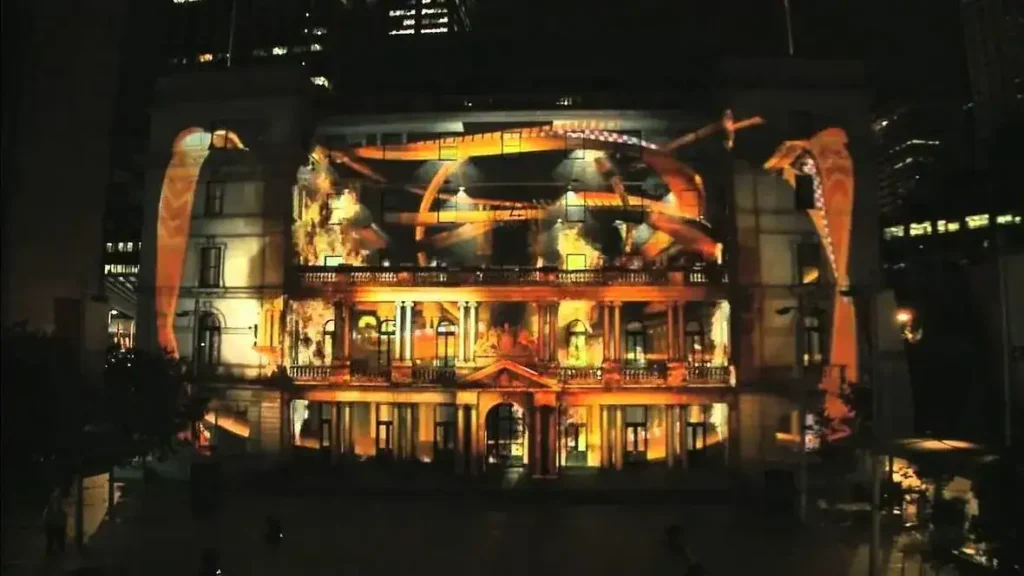
Tucson is one of America’s most authentically arts-engaged cities — and one of its most under-deployed projection markets. 4th Avenue, Congress Street, Barrio Viejo, and the University of Arizona corridor offer surfaces, audiences, and a cultural character that turns a projection campaign into a genuine community moment.
Tucson is not Phoenix, and that’s precisely the point. The city has a creative culture that didn’t develop through transplant and development money — it grew over decades through artists, musicians, academics, activists, and community organizations who built something genuine in the high desert. That authenticity shapes how Tucson’s audiences respond to visual communication in their public spaces. A projection campaign in Tucson isn’t processed as advertising that was purchased. It’s received as a statement, a gesture, an intervention — and that distinction in audience response is what makes Tucson a projection market with qualities that no Phoenix suburb can replicate.
The US Marine Corps selected AGM for a guerrilla projection campaign during CMA Fest in Nashville, projecting onto high-traffic surfaces during peak festival activity and reaching 80,000+ attendees.
The University of Arizona’s presence in the city — with more than 50,000 enrolled students and a full-time faculty and staff community that exceeds 15,000 — means that a significant segment of Tucson’s population consists of exactly the young, socially engaged, high-sharing demographic that amplifies guerrilla projection campaigns through organic social documentation. University adjacent areas, the 4th Avenue corridor that connects the university to downtown, and the Congress Street entertainment zone collectively create a geographic band through Tucson’s central core where foot traffic is consistently strong, social media behavior is high, and visual cultural engagement is genuine rather than passive. This is not an audience that needs to be told to photograph interesting things — they arrive already prepared to document and share.
Tucson’s annual event calendar creates audience concentration windows that dramatically amplify the potential reach of a projection campaign beyond its normal foot traffic baseline. The Tucson Gem and Mineral Show — the largest gem, mineral, and jewelry show in the world — draws specialists, collectors, dealers, and enthusiasts from more than 50 countries over multiple weeks in late January and early February. At peak, Tucson’s population effectively swells with tens of thousands of international visitors who are staying in hotels throughout the city and moving through entertainment and dining areas in the evenings. The All Souls Procession, one of the largest folk art events in the Southwest, draws tens of thousands to Tucson’s streets every November. Tucson Meet Yourself brings cultural programming to downtown every October. These events are not generic foot traffic spikes — they concentrate specific, passionate, culturally engaged audiences in Tucson’s streets who respond to visual statements in the public environment with an intensity that casual tourists don’t match.
Tucson’s compact downtown geography — where 4th Avenue, Congress Street, and Barrio Viejo are all within comfortable walking distance of each other — creates an unusual operational advantage for projection campaigns. In Phoenix or Scottsdale, the entertainment districts that deliver the strongest projection audiences are geographically dispersed enough that a single-night deployment can only practically cover one district at a time. In Tucson’s downtown core, a mobile deployment can potentially reach multiple distinct neighborhood audiences within a single operational evening, either through strategic single-site placement at a confluence point, or through equipment repositioning between high-foot-traffic zones. This geographic concentration amplifies the value of every Tucson projection hour in ways that larger, more sprawling markets cannot match.
4th Avenue, Congress Street, Barrio Viejo — AGM has the equipment, the crew, and the location intelligence to deploy a Tucson campaign that feels built for this city, not just run in it. One night, one wall, one conversation that reaches well beyond the block.
Select a city to explore Guerrilla Projections opportunities.
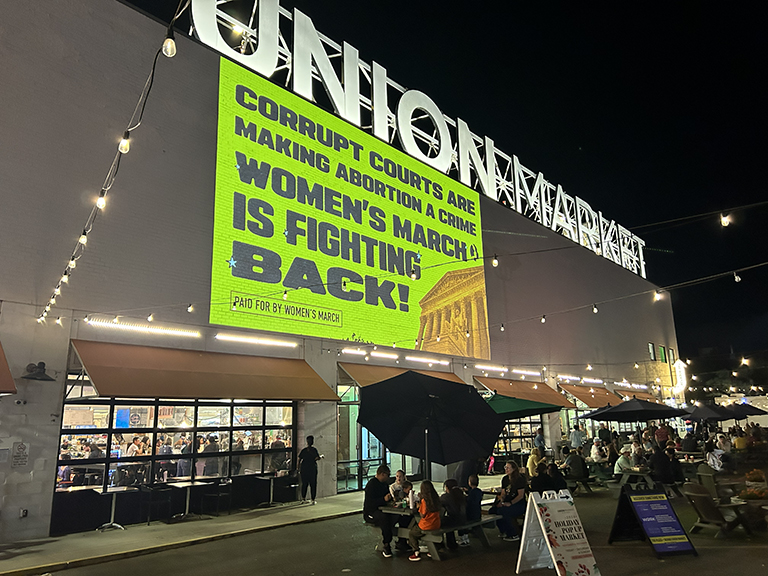
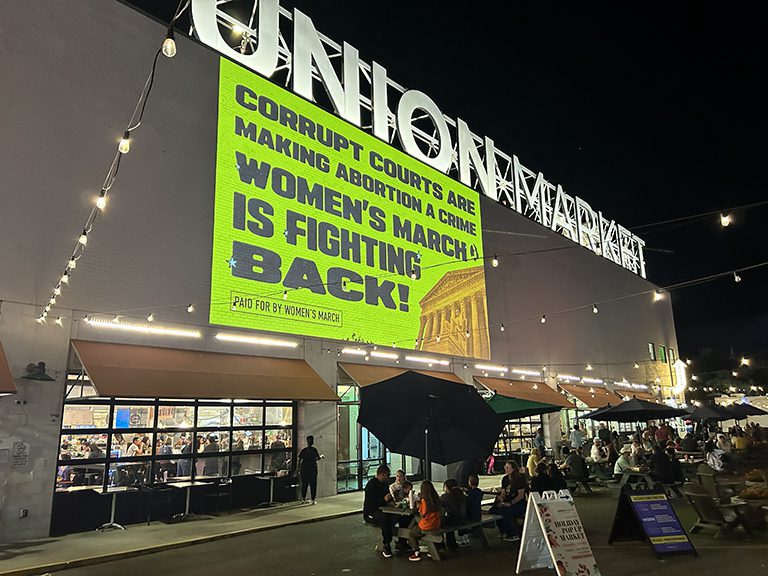
AGM’s work for the Women’s March — a Washington, D.C. projection that reached national media coverage and social amplification extending well beyond the geographic audience present at the activation — demonstrates what advocacy projection looks like when executed at scale with the operational precision that national organizations require. The Women’s March campaign demanded the same dual-layer scouting, equipment calibration, crew deployment, and documentation standards that AGM applies to every engagement, from a Tucson neighborhood projection to a Washington monument district campaign. What changes with market size is the operational logistics. What doesn’t change is the process, the crew standard, and the documentation quality. Organizations considering advocacy projection in Tucson can book knowing that AGM’s national advocacy campaign experience — including the Women’s March and the Reproductive Freedom for All Scottsdale campaign — informs every element of how their Tucson campaign will be planned, executed, and documented.
4th Avenue is Tucson’s most projection-ready corridor and has been a genuine cultural artery of the city for decades — not a recently curated approximation of one. The avenue’s blocks are lined with independently owned restaurants, bars, vintage shops, record stores, and music venues whose character gives the street an authenticity that purpose-built entertainment districts can’t manufacture. Pedestrian traffic on 4th Avenue is mixed-age, locally resident-heavy, and culturally engaged: the kind of audience that actively notices and discusses visual content encountered in the street environment. Building surfaces along 4th Avenue range from vintage commercial facades to newer mixed-use structures, and AGM scouts identify the specific surfaces within the corridor that offer the combination of scale, surface quality, and viewing angle required for maximum projection impact. The avenue’s orientation and its concentration of outdoor-facing establishments create a natural pedestrian dwell environment where projection content has time to be read, not just glimpsed.
Congress Street is Tucson’s downtown entertainment backbone — the stretch of historic commercial buildings, performance venues, bars, and restaurants that draws the city’s nightlife audience into the blocks around Hotel Congress and the surrounding entertainment zone. Congress Street’s built environment is particularly well-suited for projection work: the historic commercial buildings that line the corridor offer large, flat facade sections with the surface character that projection systems perform best on. The Congress Street audience on a weekend evening skews toward the late-twenties through early forties range — working artists, musicians, local professionals, University adjacent staff, and the creative community that makes Tucson’s cultural scene distinct from Phoenix’s more corporate entertainment character. This audience is specifically attuned to the kind of visual boldness that a 20,000-lumen building projection represents, and their social documentation behavior makes Congress Street projections consistently strong performers for organic amplification.
Barrio Viejo is one of Tucson’s oldest neighborhoods and one of its most visually distinctive — a collection of historic adobes, painted walls, and community art installations that have made the district a destination for photographers, artists, and cultural tourists who seek out the authentic historical character of the city. The walls of Barrio Viejo are not blank commercial surfaces — they carry texture, color, and historical presence that gives projection content a different visual character than projection on generic urban facades elsewhere. AGM’s creative team specifically calibrates content for Barrio Viejo surfaces to work with the visual character of the historic walls rather than against it. The neighborhood’s preservation context means that any physical installation in Barrio Viejo requires specific sensitivity and authorization — but projection, which leaves no physical trace on the surfaces it uses, is a uniquely appropriate advertising medium in a historic district where permanent alteration of the built environment is appropriately restricted.
The streets and entertainment areas adjacent to the University of Arizona campus create a demographic targeting environment available in few other Tucson locations: a high-concentration young adult audience with strong social media behavior, genuine cultural engagement, and the kind of peer influence that makes organic social amplification particularly effective. University adjacent areas include the entertainment and retail blocks along University Boulevard, the Speedway corridor, and the residential and commercial zones that function as the student community’s off-campus social infrastructure. Projection campaigns targeting the UA demographic benefit from scheduling alignment with the academic calendar — fall semester (August through December) and spring semester (January through May) deliver the highest student population concentration. Summer deployments reach a different mix of year-round residents and summer session students, which may be intentional for campaigns targeting the Tucson community beyond the transient student population.
The blocks around Pennington Street and Stone Avenue in Tucson’s downtown core represent the zone where municipal civic infrastructure, arts organizations, and the Congress Street entertainment world converge. The Rialto Theatre, the Tucson Museum of Art, and a cluster of arts organizations anchor this stretch with consistent evening programming that drives audience concentration on performance and opening nights. Building surfaces in this corridor include both modern civic structures and historic commercial buildings, providing a varied projection landscape that rewards specific scouting rather than generic surface assumptions. Campaigns deployed here on performance nights at the Rialto or museum opening events reach a deliberately curated arts audience — older, higher-income, arts-engaged, and community-invested — that represents a distinct demographic from the 4th Avenue student and young-professional crowd.
Tell us about your campaign goals, target audience, and preferred locations. Our team will help you plan a high-impact guerrilla projection campaign tailored to your needs.
Award Winning Personalized Service
You will get thoughtful, devoted, and individualized attention from our experienced, qualified, and professional personnel. Being one of the most illustrious agencies in Brooklyn, New York, American Guerrilla Marketing has been awarded the Best of Brooklyn title.
Nationwide
Industry City, Brooklyn, New York 11232
American Guerrilla Marketing
Hours
Mon - Fri: 9 AM - 5 PM
Sat & Sun: Closed
Automate your campaign with AGM’s Request for Proposal Builder. Simply answer a few quick questions about your campaign goals, markets, and timeline, and the system will generate a tailored presentation with recommended strategies, quantities, and pricing. Click the RFP Builder to instantly receive your customized proposal.
Tucson has a deep tradition of community activism, social organizing, and civic engagement that makes it one of the most receptive environments in Arizona for advocacy and social justice projection campaigns. The city’s proximity to the US-Mexico border, its significant Indigenous and Latino community presence, its active LGBTQ+ advocacy organizations, and its university-amplified progressive political engagement all create a community that is specifically attentive and responsive to visual messages deployed in the public space. Organizations running issue campaigns, ballot initiative efforts, or cause-driven awareness work find in Tucson an audience already primed to engage with advocacy content — an audience that doesn’t need to be convinced that public communication matters, because they’ve been participating in it for decades.
Tucson’s creative economy — its live music scene, its visual arts community, its film culture, its theater and performance infrastructure — creates a consistent stream of cultural events that benefit from guerrilla projection as a promotional and atmospheric tool. Concert announcements, album releases, festival launches, gallery opening promotions, and film premiere teasers all find natural audiences in Tucson’s arts-engaged street culture. The 4th Avenue and Congress Street corridors are already understood by Tucson’s cultural community as places where creative events happen — a projection in these spaces for an arts or music event reads as culturally congruent rather than intrusive, and generates the kind of community excitement that conventional event advertising doesn’t produce. AGM’s entertainment client roster demonstrates national-scale experience with exactly this category of cultural event activation.
AGM’s projection client roster includes Netflix, Disney, Coca-Cola, FanDuel, Live Nation, iHeartRadio, and the US Marine Corps. A confirmed case study: the US Marine Corps × CMA Fest Nashville — multi-night projections onto architectural surfaces throughout the festival footprint, reaching 80,000+ attendees across the campaign window. Projection advertising scales across every brand category; what our campaigns share is scale, precision, and a physical presence digital cannot replicate.
Brands targeting college-age and young adult consumers find in Tucson’s University of Arizona adjacent areas one of the most concentrated demographic targeting environments in the Arizona market. Technology brands, clothing and lifestyle labels, streaming platforms, consumer electronics companies, and food and beverage brands whose core consumer is 18–28 find that a well-executed projection in the university corridor creates the kind of campus cultural moment that digital advertising on university platforms cannot manufacture. On-campus advertising is governed by university administration. A projection on a building near campus is in the public environment where students actually live and socialize — and where they’re fully present and responsive, not splitting their attention with coursework or campus activities.
Tucson’s event calendar creates specific audience concentration windows that transform the city’s foot traffic profile for days or weeks at a time. The Tucson Gem and Mineral Show draws international buyers, collectors, and enthusiasts with specialized knowledge and significant purchasing power — an audience that is present in Tucson’s hotels and entertainment venues every evening during the show. The All Souls Procession draws tens of thousands of participants and spectators through Tucson’s streets in a cultural spectacle that creates one of the most extraordinary pedestrian concentration events in the Southwest. Tucson Meet Yourself’s cultural programming, the Arizona International Film Festival, and the regular calendar of 4th Avenue Street Fair events all create defined audience windows that AGM can build campaign timing around with precision. Event-timed Tucson projections represent some of the most efficient audience targeting opportunities in the Arizona market.
AGM’s Tucson scouting process begins with digital analysis — satellite imagery, street-level survey data, ambient light modeling — and is completed with physical on-the-ground scouting in the 4th Avenue corridor, Congress Street, Barrio Viejo, and the University of Arizona adjacent zones. Tucson’s districts have distinct physical characters that require specific surface evaluation: Barrio Viejo’s historic adobe walls behave differently under projection than the commercial brick and concrete facades of the Congress Street corridor. 4th Avenue’s narrow block character creates different viewing-angle constraints than Tucson’s wider downtown arterials. Physical scouting documents these distinctions in detail, producing location recommendations that are grounded in actual Tucson surface conditions rather than assumptions based on general market knowledge. Location scouting in Tucson runs approximately contact us for a quote. is the investment that separates campaigns that perform from campaigns that merely execute.
Tucson’s arts-saturated visual environment sets a higher implicit standard for projection creative than many comparable markets. The city’s residents are accustomed to encountering sophisticated visual work — murals, public installations, gallery content, street art — in their daily movement through the city. A projection campaign whose creative quality falls short of this ambient visual standard will be noticed but not respected by Tucson’s arts-engaged audience. AGM’s production team works with clients to ensure that creative content is calibrated not only for the technical parameters of the identified Tucson surface — scale, aspect ratio, brightness, color rendering — but also for the aesthetic context of the district where it will appear. Content designed for Barrio Viejo surfaces requires different visual sensibility than content designed for the Congress Street commercial corridor. This contextual calibration is what produces projections that feel designed for Tucson rather than dropped into it.
AGM deploys a two-person technical crew for every Tucson engagement with the full operational infrastructure: 20,000-lumen commercial projection system, generator and complete power solution, electronics bundle, and mobility unit. Tucson’s downtown core is compact, which creates operational advantages around equipment access, repositioning logistics, and crew movement between locations. Campaigns launch at dusk — Tucson’s longitude and altitude create distinct sunset timing across the year, and the crew adjusts launch timing to actual conditions rather than fixed clock times. Operational runs typically cover four to six hours through Tucson’s peak evening foot traffic. The mobility unit allows repositioning within the operational night if the crew identifies a surface or angle adjustment that will improve campaign performance based on observed real-time conditions — an option that AGM’s commitment to direct crew deployment makes available, since the technicians have the authority and knowledge to make these judgment calls in the field.
Every Tucson campaign concludes with the standard AGM documentation package: professional photography captured during the operational run, GPS-documented location records with precise coordinate data, an operational summary covering launch timing and run duration, and image files delivered in press-ready and social-ready formats. Tucson’s active local media environment — the Arizona Daily Star, Tucson Sentinel, KVOA, KGUN, and the city’s active arts and culture media ecosystem — provides earned media infrastructure that well-executed projections can generate coverage from. AGM provides the photography and technical documentation that editorial teams need when developing stories about projection campaigns. For advocacy and cause-driven clients whose work benefits from documented evidence of public presence, AGM’s GPS-confirmed location records and professional photography serve as post-campaign evidence that satisfies organizational reporting, grant reporting, and donor communication requirements.
Tucson campaign pricing is contact us for a quote. — the same rate that applies across AGM’s outside-NYC markets, covering the complete deployment: 20,000-lumen commercial projection system, generator and full power solution, electronics bundle, mobility unit, and AGM’s two-person direct technical crew handling setup, operation, and breakdown through the full night. Location scouting in Tucson runs approximately . mitted or private-property locations — where advance negotiation with Tucson property owners or coordination with relevant municipal bodies is required — are priced contact us for a custom quote..
Tucson’s compact downtown geography creates an interesting multi-location dynamic for clients interested in reaching multiple districts in a single night. While a single projector positioned at a well-selected location can deliver reach across adjacent audiences, a two-projector deployment in Tucson — one on 4th Avenue and one on Congress Street, for example — can simultaneously reach two distinct district audiences with the same campaign creative, delivering combined impression reach that a single-site deployment cannot match. Two-projector Tucson campaigns are priced at contact us for a quote. for the two-unit deployment, plus applicable scouting. Contact AGM to discuss multi-location Tucson campaign configurations and how they apply to specific campaign objectives.
Tucson’s projection clients reflect the city’s identity as a culturally rich, politically engaged, university-centered community with a deeply rooted arts scene. Advocacy organizations — particularly those working on immigration, environmental, social justice, and civic issues that are specifically salient in Tucson’s border-state, university-city context — use projection campaigns to reach an audience already engaged with the issues at stake and already present in the public spaces where community conversations happen. National advocacy organizations that have tested Arizona markets consistently find that Tucson’s activist history and community organizing culture create a receptive environment for projection campaigns that feel culturally congruent with the city’s values rather than artificially imposed from outside.
Arts organizations, music promoters, film festival organizers, and cultural events use Tucson’s projection environment to build local buzz for events whose audience is concentrated in exactly the neighborhoods where AGM deploys. A projection for a 4th Avenue event on 4th Avenue, for an audience that lives and socializes on 4th Avenue, is the most efficient audience targeting available — no media buy is more locally specific. National brands targeting young consumers use the University of Arizona adjacent areas for demographic precision that Arizona’s other major markets can’t match at the same concentration level. Tucson’s Gem and Mineral Show creates an international visitor audience that businesses serving collectors, jewelry industry professionals, and geological sciences enthusiasts find uniquely worth targeting during the show’s annual run.
| Zone / Area | Peak Hours | Foot Traffic | Est. Nightly Impressions | Best For |
|---|---|---|---|---|
| 4th Avenue Street Fair Corridor | Fri–Sat 7PM–2AM | Very High | 20,000–50,000 | Events / Brand |
| University of Arizona Campus Perimeter | Daily 10AM–9PM | High | 15,000–30,000 | Youth / Consumer |
| Hotel Congress / El Presidio | Fri–Sat 9PM–2AM | High | 12,000–25,000 | Arts / Nightlife |
| Tucson Gem & Mineral Show (seasonal) | Show dates | Extreme | 45,000–85,000 | B2B / Tourism |
| Rillito Regional Park Pathway | Daily 6AM–8PM | Moderate | 8,000–16,000 | Health / Outdoor |
| Oracle Road / Foothills | Weekend 12–7PM | Moderate | 10,000–20,000 | Lifestyle / Retail |
4th Avenue delivers a rare combination of attributes that make it genuinely projection-friendly: a locally resident-heavy audience that is culturally engaged and specifically attuned to visual content in the street environment; building surfaces along the avenue that include appropriately scaled, well-oriented blank facades; a corridor character that makes a projection feel like cultural participation rather than commercial intrusion; and strong outdoor dwell time driven by the avenue’s outdoor dining, street culture, and foot-traffic-oriented business mix. Compared to Phoenix entertainment districts that attract higher tourist volumes, 4th Avenue’s audience has deeper Tucson community roots, which means that a projection campaign here reaches people who will talk about it with their networks over days and weeks, not just photograph it and move on. That community resonance is a Tucson-specific projection asset.
Barrio Viejo’s historic preservation designation means that any physical intervention in the built environment requires specific authorization through Tucson’s historic preservation process. Projection, critically, is not a physical intervention — it leaves no mark, no residue, and no permanent alteration on any surface it uses. This makes projection uniquely compatible with historic district use constraints that rule out painted advertising, physical installation, or structural modification. AGM’s scouting process in Barrio Viejo evaluates surfaces specifically for their historic character and identifies projection angles and content approaches that work with the visual heritage of the adobe and territorial-style architecture rather than overwhelming it. Content calibration for Barrio Viejo surfaces is specifically designed to be aesthetically congruent with the district’s visual language — not just technically visible, but visually resonant with the neighborhood’s historic character.
The University of Arizona concentrates more than 50,000 enrolled students in and around Tucson’s downtown core — a demographic that is 18–24, mobile-first, social-media-native, and specifically inclined to document and share interesting visual experiences encountered in their physical environment. This audience has both high social amplification behavior and high peer influence within their networks: when a UA student photographs a projection on University Boulevard and posts it, that post reaches networks of similarly aged, similarly engaged people across Arizona, nationally, and in the student’s home state. The UA student demographic also tends to concentrate its social behavior in relatively predictable geographic zones — the 4th Avenue corridor, Congress Street, and the University adjacent commercial areas — which makes location selection for university-targeted projections more precise than for demographically broader campaigns in dispersed urban markets.
The Tucson Gem and Mineral Show draws buyers, dealers, collectors, and enthusiasts from more than 50 countries for multiple weeks in late January and early February, substantially expanding Tucson’s effective population during the show period. These visitors stay in hotels across the city and move through Tucson’s downtown entertainment areas in the evenings. A projection campaign running during Gem Show weeks reaches not only Tucson’s resident community but also an international visitor population with specific professional expertise, significant purchasing power, and strong social documentation behavior. Gem Show visitors are active on specialized social media communities and industry channels where imagery from the show — including environmental imagery like a striking building projection in Tucson’s downtown — circulates to global audiences who follow the annual event. Campaign timing to Gem Show weeks effectively internationalizes the audience for a Tucson local projection deployment.
Congress Street’s peak evening foot traffic is lower in absolute volume than Phoenix’s Roosevelt Row during a First Friday event, but it delivers a higher proportion of long-term Tucson residents and arts-community participants relative to tourist and visitor traffic. The quality of community engagement on Congress Street — where regulars know the venue owners, the musicians playing that night, and the neighboring arts organizations — creates a social environment where a projection campaign generates deeper, more networked word-of-mouth than a higher-volume but more tourist-diluted audience produces. For campaigns that prioritize community resonance and local credibility over raw impression count, Congress Street’s audience quality profile makes it a strong choice. For campaigns that prioritize absolute pedestrian impression count, Phoenix’s larger entertainment districts deliver higher numbers — but at lower community depth and engagement quality per impression.
Tucson’s arts community sets a high implicit visual standard for creative work encountered in the public environment. Content that is visually sophisticated — with considered composition, intentional color relationships, and graphic clarity that holds up at building scale — is received positively by an audience accustomed to encountering serious visual work in murals, public art installations, and gallery contexts. Messaging that is direct and specific — that says one thing clearly at scale, without visual clutter — performs better in Tucson than campaigns that try to pack in multiple messages or call-to-action elements that require close reading. Political and advocacy content benefits from visual assertiveness: Tucson’s audience responds to messages that declare rather than suggest. Commercial content that tries to mimic the aesthetic language of community art — without the honesty that community art carries — tends to be seen through quickly and generates skeptical rather than engaged responses.
Yes, and multi-night Tucson series campaigns are a particularly effective format for clients whose campaign objectives include sustained community presence across multiple districts or demographic audiences. A four-night series that covers 4th Avenue, Congress Street, Barrio Viejo, and the University adjacent corridor reaches meaningfully different audience profiles in each location while building cumulative community awareness of the campaign as it moves through the city’s neighborhoods. Social documentation from each night’s location adds to the campaign’s online presence progressively, creating a week-long social media narrative from a single geographic campaign deployment. Multi-night Tucson series are priced at contact us for a quote. for each night of the series, with scouting and logistics planned as a single integrated engagement rather than separate single-night bookings.
In Phoenix or Scottsdale, the entertainment districts that deliver distinct audience profiles are separated by driving distances that make same-night equipment repositioning logistically complex. In Tucson, the core entertainment and cultural districts — 4th Avenue, Congress Street, Barrio Viejo, and the downtown arts corridor — are all within a roughly half-mile radius of each other in the central city. This means that AGM’s mobility unit can physically reposition within a single operational night, shifting from a 4th Avenue deployment in the early evening peak through to a Congress Street deployment for the later nightlife audience, reaching two distinct demographic concentrations with the same equipment and crew in a single operational night. Whether multi-district single-night deployments are appropriate for a specific campaign depends on creative and operational factors that the scouting and planning process determines — but Tucson’s geography makes the option available in a way that most markets don’t permit.
Tucson’s media ecosystem includes local television stations — KVOA (NBC), KGUN (ABC), KOLD (CBS) — whose assignment editors track local visual events and community happenings that generate audience interest. The Arizona Daily Star and Tucson Sentinel cover local events with civic and community relevance. Tucson Weekly and similar alternative publications cover arts, culture, and community events with specific interest in unconventional visual and media work. Tucson’s arts and music blogs and social media communities — which are active and internally influential despite their smaller scale compared to Phoenix’s media footprint — generate coverage and discussion that reaches Tucson’s cultural community with high relevance and specificity. AGM’s documentation package provides the professional photography and technical information that each of these outlet types requires when covering a projection event, and AGM can advise clients on which outlets are most aligned with their campaign’s subject matter and editorial angle.
Tucson has a history of public advocacy, community organizing, and grassroots visual communication that gives its residents a specific literacy in reading visual statements deployed in the public environment. Unlike cities where projection advertising is primarily novel spectacle, Tucson audiences bring context to projection encounters — an awareness that visual statements in public space carry intention and meaning, and an inclination to read and discuss that intention rather than simply observe it. For advocacy campaigns, this audience literacy is a significant asset: the message isn’t just seen, it’s understood and engaged with. For commercial campaigns, this literacy creates a responsibility to bring genuine creative quality and honest messaging, because Tucson audiences are specifically attuned to detecting campaigns that perform community engagement without genuine investment. Brands that show up authentically — with creative work and messaging that takes the audience seriously — find Tucson’s community character a substantial campaign amplifier.
Barrio Viejo’s architectural heritage includes painted adobe, lime-washed concrete block, territorial-style brick, and plastered masonry walls — surface types whose specific technical characteristics affect how projection light reflects and how colors render at scale. Adobe and lime-washed surfaces tend to have moderate absorption and consistent matte reflectivity that produces good color rendering and minimal hotspot issues. Painted concrete block provides a flatter, more uniform projection surface that is technically easier to work with but aesthetically less distinctive than the varied textures of historic adobe. AGM scouts evaluate every Barrio Viejo candidate surface for its current surface condition — painted versus bare, uniform versus textured, intact versus with visible weathering — and document how the specific surface characteristics will interact with the planned creative content under the projection system’s output. Surface condition changes with weathering and repainting, so scout documentation dates are noted in the scouting deliverable.
Yes, and winter visitor audiences in Tucson create a distinct campaign opportunity that is specific to the November through March period. Tucson is a significant snowbird destination — particularly for Canadians and Midwesterners who winter in the Sonoran Desert — and this population moves through Tucson’s downtown entertainment areas, restaurants, and cultural venues during winter months in consistent numbers. The Gem and Mineral Show’s February timing is partly a function of the snowbird population that makes Tucson’s winter months its most internationally visited season. A projection campaign running in Congress Street or 4th Avenue during winter visitor peak season reaches not only Tucson’s year-round residents but also a visitor population with disposable income, leisure time, and a specific interest in experiencing what Tucson’s cultural scene offers. For brands and causes whose message has relevance to this winter visitor demographic, Tucson’s January through March window delivers an audience composition that the city’s summer population alone doesn’t include.