American Guerrilla Marketing
Nationwide Service
Media planning, media buying, billboard advertising, & guerrilla marketing
Guerrilla Projections in Santa Fe, NM

Canyon Road galleries, Railyard warehouse walls, Guadalupe Street after dark — AGM deploys 20,000-lumen building projection campaigns in the arts capital of the American Southwest.
Santa Fe’s Arts Economy and Why Projection Advertising Belongs Here
Santa Fe’s position as the arts capital of the American Southwest is not a marketing claim — it is a structural economic reality. The city hosts more galleries per capita than nearly any other American city, centered on Canyon Road’s roughly mile-long concentration of more than 100 galleries, studios, and arts spaces. The gallery economy employs a significant proportion of Santa Fe’s professional workforce and drives an arts-tourism industry that draws collectors, buyers, and culturally motivated visitors from across the United States and internationally, across all four seasons. This arts infrastructure creates a projection advertising market with unusual characteristics: the audiences assembled in Santa Fe’s gallery corridors and arts districts are not passive pedestrians processing the visual environment unconsciously — they are active, attentive, visually trained consumers who stop to examine what they see, discuss it, photograph it, and share it.
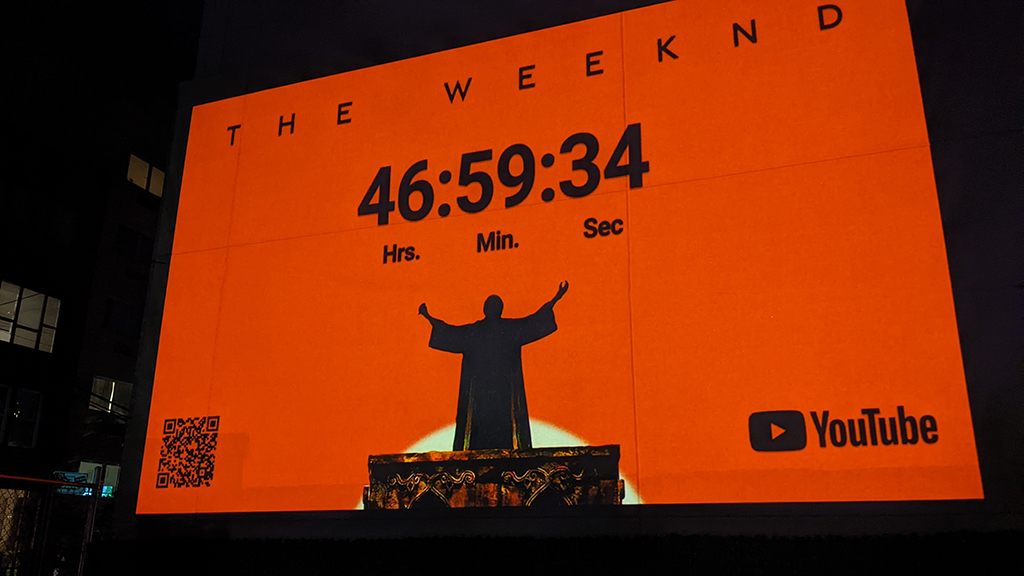
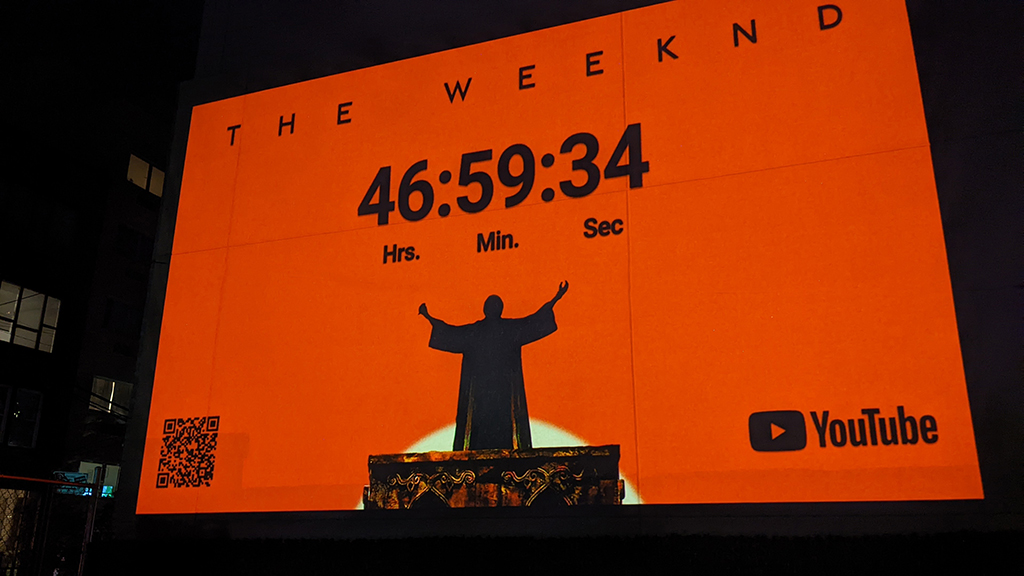
The US Marine Corps selected AGM for a guerrilla projection campaign during CMA Fest in Nashville, projecting onto high-traffic surfaces during peak festival activity and reaching 80,000+ attendees.
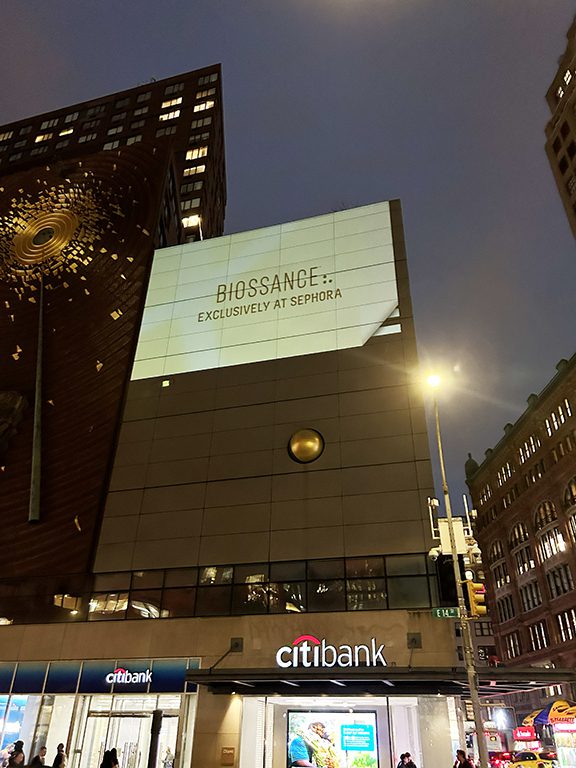
AGM’s projection client roster includes Netflix, Disney, Coca-Cola, FanDuel, Live Nation, iHeartRadio, and the US Marine Corps. A confirmed case study: the US Marine Corps × CMA Fest Nashville — multi-night projections onto architectural surfaces throughout the festival footprint, reaching 80,000+ attendees across the campaign window. Projection advertising scales across every brand category; what our campaigns share is scale, precision, and a physical presence digital cannot replicate.
Santa Fe’s historic built environment reinforces that opportunity. The city’s preservation ordinances maintain Pueblo Revival and territorial architectural standards across the historic district and throughout the arts corridor zones, producing exterior building faces finished predominantly in smooth plaster and painted stucco. These are among the most technically favorable projection surfaces in any American market — light-receptive, matte, flat, and free of the reflective glass and irregular metal cladding that degrade projection quality in contemporary commercial construction. Canyon Road’s gallery buildings and the Railyard Arts District’s warehouse-scale structures sit at the apex of this surface quality, presenting projection canvases that produce images with maximum color saturation, sharpest edge definition, and the visual impact that sophisticated arts audiences recognize and respond to.
The Railyard Arts District has transformed Santa Fe’s southern arts geography over the past two decades. Where the historic rail yard once served freight operations, the complex now anchors gallery spaces, arts nonprofits, SITE Santa Fe contemporary art center, farmers market operations, and performance venues within warehouse-scale structures whose exteriors present large, unobstructed wall faces to the surrounding pedestrian environment. Guadalupe Street’s restaurant and entertainment corridor runs directly adjacent to the Railyard zone, connecting its arts programming to the city’s dining economy and sustaining foot traffic past the warehouse walls well into late evening hours on weekends and programming nights.
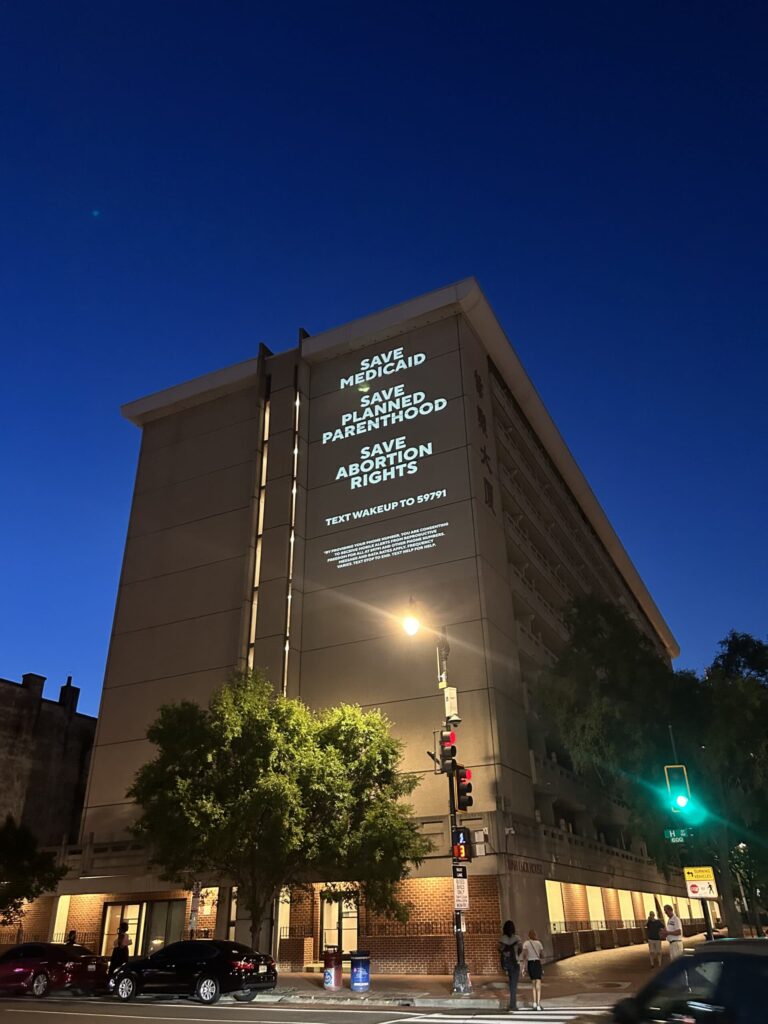
Reproductive Freedom for All’s building projection campaign in Scottsdale, Arizona provides the most directly comparable precedent in AGM’s Southwest portfolio for the Santa Fe context. Scottsdale’s arts district audience — gallery-literate, politically aware, culturally active, high-income — aligns closely with Santa Fe’s core projection campaign demographic. That campaign produced immediate audience response, substantial organic social media documentation, and earned media coverage that extended reach well beyond the execution nights. The Santa Fe audience operates at an even deeper level of arts engagement, suggesting per-impression response rates that exceed what Scottsdale’s arts corridors delivered — particularly for campaigns whose creative content is visually sophisticated rather than generic
Project in the Arts Capital of the Southwest
AGM executes 20,000-lumen building projection campaigns on Canyon Road, across the Railyard Arts District, and throughout Santa Fe's gallery corridors. Full-service from site scouting through documentation — your campaign, in the city where arts audiences pay attention.
Our Campaign Locations
Browse Cities in New Mexico
Select a city to explore Guerrilla Projections opportunities.
The Four Wall Zones That Make Santa Fe A Premium Projection Market
Canyon Road Arts District
Canyon Road is one of the most gallery-dense pedestrian corridors in North America. The street’s roughly mile-long run through the historic arts district packs more than 100 galleries, studios, and arts institutions into a walkable format that keeps the evening audience on foot, moving slowly between openings, pausing at garden gates, lingering at outdoor sculpture installations, and stopping to examine whatever catches their eye. Building faces along Canyon Road are predominantly territorial and Pueblo Revival style — two-story and single-story stucco and plaster-finished structures with solid exterior walls and minimal window-to-wall ratio on the upper stories and side elevations. These blank plaster surfaces face the road at multiple height levels throughout the corridor, creating multiple wall candidates within a single contiguous gallery district.
The audience on Canyon Road on a Friday or Saturday evening of a gallery opening is one of the most concentrated gatherings of arts buyers, cultural tourists, collectors, and gallery professionals accessible through any outdoor advertising format. These are not commuters or casual passersby — they are people who have come specifically to engage with art in a walkable outdoor environment. A projection campaign on a Canyon Road building face reaches this assembled audience in precisely the attentive state that projection media is designed to exploit.
Railyard Arts District — Warehouse Walls at Scale (Ideal)
The Railyard Arts District’s former depot and freight warehouse buildings are the finest large-format projection surfaces in Santa Fe. Built for industrial freight operations, these structures feature exterior wall faces designed for function rather than aesthetics — broad, flat, minimally fenestrated surfaces that run 60 to 100 feet in width at heights of 25 to 40 feet on the primary façades. From a projection standpoint, this means surface area measured in thousands of square feet, flat plaster and painted masonry finishes that accept projected light without scatter or distortion, and horizontal profiles that allow wide-aspect image configurations. At 20,000 lumens from 80 to 120 feet of throw distance, the system achieves maximum image size on these walls with full color fidelity across the complete projection area.
The Railyard’s pedestrian plaza and the activity generated by SITE Santa Fe’s programming, the farmers market, and the district’s restaurant and gallery tenants maintain audience presence throughout the evening on active programming nights. The district’s foot traffic patterns bring pedestrians directly into the sightline of Railyard warehouse wall projections from Guadalupe Street, from the Railyard Park pedestrian zone, and from the residential and arts district streets that intersect the district’s perimeter — covering the assembled audience from multiple viewing positions simultaneously.
Guadalupe Street Entertainment Corridor
Guadalupe Street functions as the commercial spine of the Railyard Arts District zone, linking the district’s arts programming with Santa Fe’s restaurant economy to the north and connecting the Railyard’s cultural institutions with the Design District’s boutique commercial environment to the south. Building faces along Guadalupe include the Railyard warehouse façades to the east and commercial and mixed-use buildings to the west whose stucco and painted masonry finishes provide additional projection surface options in a corridor that sustains active pedestrian traffic from early evening through midnight on weekend nights. The restaurant and bar programming on Guadalupe generates a dining and nightlife audience that adds to the gallery-hop crowd moving through the district on programming evenings — a combined audience that spans a wider demographic range than the Canyon Road gallery audience alone.
Design District near Sanbusco Market Center
The Design District surrounding the Sanbusco Market Center adds a premium commercial character to Santa Fe’s projection geography. Interior design showrooms, boutique retail, contemporary galleries, and arts-adjacent hospitality businesses occupy a mixed-use commercial area whose building stock includes modern construction alongside converted warehouse and commercial space, all featuring smooth stucco and EIFS finishes that are technically favorable for projection. The audience in the Design District represents the affluent Santa Fe resident and high-end visitor demographic that shops, dines, and entertains in the district’s boutique commercial environment — a consumer segment distinct from the arts-tourist audience on Canyon Road but equally high-income and visually literate.
Projection campaigns in the Design District reach this premium consumer audience during their active shopping and dining hours, in a commercial context where brand imagery in the physical environment has strong contextual relevance. The Sanbusco Market Center’s anchor position gives the district consistent traffic patterns that make projection campaign timing more predictable than in purely event-driven audiences.
Santa Fe's Audience: Arts Buyers, Cultural Tourists, And Gallery Regulars
Santa Fe’s projection campaign audience is defined by its arts-tourism economic identity. The city’s gallery economy draws a disproportionately high share of high-income, culturally active, arts-buying visitors relative to its resident population of approximately 85,000 — making its effective campaign audience larger than the resident base alone would suggest. Arts buyers who travel to Santa Fe specifically for Canyon Road or Indian Market represent an audience with both the disposable income and the visual sophistication to engage with projection advertising in ways that generic outdoor audiences do not. Local arts community members — gallery directors, practicing artists, collectors, and arts institution professionals — add an industry-insider audience with strong social media influence in arts networks. Cultural tourists, including international visitors attending SITE Santa Fe or the many gallery events throughout the year, extend the audience’s geographic origin and social sharing reach beyond New Mexico. A single projection campaign on Canyon Road or at the Railyard can reach all three of these audience segments in a single evening execution window.
Plan Your Guerrilla Projection Campaign in Santa Fe, NM
Tell us about your campaign goals, target audience, and preferred locations. Our team will help you plan a high-impact guerrilla projection campaign tailored to your needs.
Award Winning Personalized Service
You will get thoughtful, devoted, and individualized attention from our experienced, qualified, and professional personnel. Being one of the most illustrious agencies in Brooklyn, New York, American Guerrilla Marketing has been awarded the Best of Brooklyn title.
Nationwide
Industry City, Brooklyn, New York 11232
American Guerrilla Marketing
Hours
Mon - Fri: 9 AM - 5 PM
Sat & Sun: Closed
Automate your campaign with AGM’s Request for Proposal Builder.
Automate your campaign with AGM’s Request for Proposal Builder. Simply answer a few quick questions about your campaign goals, markets, and timeline, and the system will generate a tailored presentation with recommended strategies, quantities, and pricing. Click the RFP Builder to instantly receive your customized proposal.
What Kinds of Campaigns Run Best in Santa Fe
Luxury Brand Activations
Santa Fe’s arts-tourism audience — high-income arts buyers, international collectors, and culturally active professionals — represents one of the most premium outdoor advertising targets in the American Southwest. Consumer brands in luxury goods, fine jewelry, high-end fashion, hospitality, and design reach this demographic through projection advertising in Canyon Road and the Railyard zone with a brand context that is inherently arts-adjacent and culturally elevated, without the incongruence of luxury advertising in mass-traffic outdoor formats.
Advocacy and Political Campaigns
Santa Fe’s politically engaged, arts-literate community makes it a receptive market for advocacy projection campaigns that communicate through strong visual language. The city’s gallery-educated audience is accustomed to art that carries political and social content; a building projection campaign in this environment is understood immediately as intentional, crafted communication. Political campaigns running in Santa Fe’s competitive electoral districts find the arts corridor audience engaged, present, and already predisposed to public-facing civic messaging.
Arts Institution and Festival Marketing
SITE Santa Fe, the Santa Fe Indian Market, the International Folk Art Market, the Santa Fe Chamber Music Festival, and the city’s year-round cultural calendar create natural alignment between projection campaigns and arts institution marketing. Projection advertising during festival weeks reaches peak arts-tourism audiences assembled specifically for cultural engagement — the highest-concentration, most attentive audience that the Santa Fe market assembles throughout the year.
Hospitality and Tourism Campaigns
Santa Fe’s status as a national arts tourism destination makes it a viable platform for hospitality, travel, and tourism brand campaigns targeting the cultural traveler. Building projection campaigns in the Railyard and Canyon Road zones reach arts tourists during the evening of their arrival — when they are actively exploring the city’s cultural geography, open to discovering experiences, and making hospitality and entertainment decisions for their visit’s remaining days.
Entertainment and Streaming Campaigns
Santa Fe’s arts community — connected to music, performance, film, and contemporary culture through SITE Santa Fe and the city’s broader creative infrastructure — provides an entertainment-engaged audience for streaming releases, film festival promotion, music campaigns, and cultural entertainment marketing. Projection advertising in the Railyard zone reaches this audience in their primary cultural gathering environment, where entertainment media consumption decisions are actively forming on the evenings of gallery openings and arts events.
Building A Santa Fe Guerrilla Projection Campaign
Location Identification and Surface Analysis
AGM’s Santa Fe scouting process focuses on Canyon Road’s gallery corridor, the Railyard Arts District warehouse perimeter, the Guadalupe Street commercial spine, and the Design District near Sanbusco. Wall candidates are evaluated for surface type (plaster, stucco, painted masonry), building face dimensions, projector positioning options, sightline clearance from pedestrian zones and public streets, and ambient lighting conditions during the evening execution window. Santa Fe’s historic preservation context is factored into site selection — wall candidates are screened for any site-specific access or aesthetic restrictions applicable to the specific location, and permitted or private-property approaches are developed where building owner engagement is the appropriate access strategy.
Creative Calibration for the Santa Fe Context
Santa Fe’s arts audience is sophisticated enough to notice creative quality immediately — and to dismiss creative that fails to match the visual intelligence of the gallery context they are standing in. AGM’s technical preparation for Santa Fe campaigns includes image optimization for the specific surface geometry of each confirmed wall, with particular attention to color calibration and edge definition on the light plaster and stucco surfaces that dominate the Canyon Road and Railyard wall inventory. Creative assets that perform most effectively in Santa Fe have strong graphic clarity, bold color contrast, and a visual identity confident enough to hold its own in an environment saturated with high-quality art.
Campaign Night Operations
Santa Fe projection campaigns launch at dusk, when the evening’s natural light drop enables maximum image contrast on the target wall surfaces. AGM’s two-person technical crew manages all equipment positioning, calibration, and operation from site arrival through the end of the projection window. Setup from crew arrival to projection launch typically runs 60 to 90 minutes. Campaign windows extend four to six hours through the peak gallery-hop and nightlife period — 8 PM through 1 AM on Friday and Saturday evenings corresponds to the highest-concentration audience window on Canyon Road and Guadalupe Street. Multi-site executions — Canyon Road plus Railyard, or Railyard plus Guadalupe — are achievable within a single evening using the mobile projection unit for repositioning.
Documentation and Content Distribution
Every Santa Fe campaign produces professional photography and video documentation throughout the projection window. In the Santa Fe context, documentation quality matters: the gallery-adjacent visual environment in the Canyon Road and Railyard zones produces striking campaign imagery that photographs and films exceptionally well, with the architectural character of historic Santa Fe providing a distinctive setting that distinguishes the documentation from generic street projection content. Post-campaign deliverables include GPS-verified location confirmation, edited photo and video assets formatted for social media and press use, and full audience environment documentation capturing the assembled gallery-night crowd in the projection field of view.
Santa Fe Projection Advertising Investment
Guerrilla projection campaigns in Santa Fe are priced at contact us for a quote. . That rate covers the complete technical package: a 20,000-lumen commercial projection system, generator and power solution, electronics bundle, mobility unit, two-person AGM technical crew, and all setup, operation, and breakdown labor. Multi-night campaigns — running two to five consecutive evenings across the Canyon Road and Railyard corridors — are available with pricing structured by campaign scope. Event-adjacent campaigns timed to Santa Fe Indian Market, Folk Art Market, or SITE Santa Fe programming windows require advance booking to guarantee crew and equipment availability during the city’s highest-demand periods.
Advance location scouting for Santa Fe is approximately when a dedicated physical scouting visit is required. Permitted or private-property locations — buildings where AGM secures formal access agreements with Canyon Road gallery owners, Railyard district tenants, or Design District property managers — are priced at Contact us for a custom quote. per night. Projection timing begins at dusk; typical Santa Fe campaign windows run five to six hours to capture the full gallery-hop through nightlife audience cycle.
Campaign Work That Reflects Santa Fe's Audience Profile
Reproductive Freedom for All’s building projection campaign in Scottsdale, Arizona is the Southwest precedent that most closely maps to the Santa Fe audience and market structure. That campaign deployed in Old Town Scottsdale — a gallery district with a politically engaged, high-income arts audience comparable to Santa Fe’s Canyon Road demographic — and used building facade projection to create immediate, visually dominant public presence around an advocacy issue. The campaign generated audience engagement, social media documentation, and earned media coverage that extended the message well beyond its physical geography and execution window. The creative approach: bold, graphically strong, and clearly intentional in its visual language — exactly the creative register that performs best in front of arts audiences trained to engage with intentional visual communication. Santa Fe’s Canyon Road and Railyard audience is the natural next step for this type of campaign in the Southwest.
Who Uses Guerrilla Projections in Santa Fe
- Luxury consumer brands targeting Santa Fe’s high-income arts-buyer and collector demographic
- Advocacy organizations communicating issue-based campaigns to Santa Fe’s politically engaged arts community
- Arts institutions promoting SITE Santa Fe, gallery programs, and festival events
- Hospitality and travel brands reaching cultural tourists during their active exploration of the city
- Political campaigns targeting Santa Fe’s competitive state and municipal electoral districts
- Entertainment companies promoting releases to the city’s culturally active population
- Design and interior brands reaching the Design District’s professional and affluent consumer audience
Coverage & Estimated Impressions
| Zone / Area | Peak Hours | Foot Traffic | Est. Nightly Impressions | Best For |
|---|---|---|---|---|
| Canyon Road Arts District | 8PM–12AM | Moderate | 2,500–12,000 | Product Launch |
| Railyard Arts District | 8PM–12AM | Moderate | 2,500–12,000 | Event Promotion |
| Guadalupe Street Entertainment Corridor | 8PM–12AM | Moderate | 2,500–12,000 | Brand Awareness |
| Design District near Sanbusco Market Center | 8PM–12AM | Moderate | 2,500–12,000 | Political |
Frequently Asked Questions
The Railyard warehouse buildings offer a combination of surface characteristics that is rare in any American market: very large flat wall faces (60 to 100+ feet wide, 25 to 40 feet tall) in plaster and painted masonry, minimal window penetration, clear sightlines from multiple pedestrian positions, and an active evening audience from the district’s programming and Guadalupe Street restaurant activity. These buildings were engineered for freight operations, which means their exterior wall geometry is maximally simple — large, uninterrupted surfaces designed for structural function rather than aesthetic complexity. That same simplicity makes them exceptional projection canvases where 20,000-lumen systems achieve maximum image size and brightness with no surface-imposed constraints on image geometry.
Santa Fe’s arts tourism draws a disproportionately high-income, culturally active visitor population relative to the city’s size — an audience that comes specifically to engage with art and makes purchasing decisions around that engagement. This is not a general tourist audience consuming attractions passively; it is an arts-buying audience that allocates substantial discretionary spending to cultural experiences and arts purchases. Consumer and luxury brands targeting high-income adult consumers find Santa Fe’s arts-district audiences represent exceptional per-impression value compared to general outdoor advertising audiences of similar size, because the demographic concentration of arts buyers, collectors, and culturally active professionals in Canyon Road and the Railyard zone is extraordinarily high.
Yes — these are among the most valuable campaign timing windows in New Mexico. Santa Fe Indian Market (held annually in August) draws approximately 100,000 visitors over its weekend and generates the highest pedestrian density on Canyon Road and in the historic district of any event in the year. The International Folk Art Market in July also concentrates an international arts-buying audience in Santa Fe during its run. Projection campaigns deployed during either festival week reach a far larger and more internationally diverse arts audience than standard weekend campaigns — but advance booking of six to eight weeks is required to guarantee crew and equipment availability during these peak-demand periods.
Canyon Road’s buildings are predominantly territorial and Pueblo Revival style — low to mid-rise structures finished in smooth plaster and painted stucco on exterior walls. These finishes accept projected light with excellent color saturation and edge definition across the full projected image area. The plaster and stucco surfaces on Canyon Road are generally in good condition, without the heavy weathering or inconsistent paint coverage that can affect projection quality on older building stock in other markets. Upper-story and side-wall surfaces on many Canyon Road buildings are particularly clean projection candidates — flat, smooth, and without the awning, signage, and merchandise obstructions that clutter the street-level retail zones.
The Design District offers different campaign advantages than the Railyard. While the Railyard has the largest wall surfaces and the highest arts-event audience concentration, the Design District offers a more boutique, commerce-driven environment with a premium resident and professional consumer audience rather than a tourist and gallery-visitor demographic. Design District building faces feature modern commercial construction finishes — smooth stucco and EIFS — that are technically favorable for projection. The Design District works best for campaigns targeting Santa Fe’s affluent resident consumer base and the professional design and interiors community, rather than the international arts-tourist audience that concentrates on Canyon Road and at the Railyard.
Santa Fe’s gallery-educated audience responds most strongly to projection creative with a clear visual identity and graphic confidence — bold compositions, strong color contrast, and imagery that communicates a defined concept without explanatory text. Because the audience is trained to engage with sophisticated visual art, weak or generic creative is evaluated and dismissed more quickly here than in markets without deep visual arts literacy. Campaign creative that would be considered visually interesting in a general market becomes genuinely competitive in the Canyon Road environment only when it is graphically strong enough to hold attention alongside the gallery art visible in the surrounding windows and doorways.
Santa Fe’s historic preservation ordinances apply primarily to physical alterations to historic structures — not to temporary light projection, which makes no physical contact with building surfaces and leaves no residue or mark. From a preservation standpoint, projection advertising is among the least impactful approaches to using historic building architecture as campaign infrastructure. AGM evaluates each Santa Fe wall candidate with the specific site’s historic status and any applicable overlay restrictions in mind, and structures access accordingly — guerrilla executions from public right-of-way for walls that don’t require building access, and permitted approaches where building owner engagement is preferred or required by site conditions.
The viewing distance from Guadalupe Street to the primary Railyard warehouse wall faces varies by specific wall position, but typical viewing distances range from approximately 60 to 120 feet depending on the street width and building setback at the specific projection site. At these distances, a 20,000-lumen system projects images that are legible, well-saturated, and visually dominant from the street-level pedestrian position. Longer viewing distances — available from the Railyard Park pedestrian zone on the southern side — extend the effective audience zone to 150 feet or more, at which distance the image size on a full warehouse wall face becomes the dominant visual element in the viewer’s field of view.
The premium arts-tourism demographic in Santa Fe affects campaign strategy in several important ways. Creative quality must meet a higher bar than in general outdoor markets — this audience knows good visual design and evaluates what it sees critically. Campaign timing alignment with gallery opening nights and festival programming windows yields dramatically higher-concentration audience windows than standard evening execution. The social sharing behavior of this demographic tends toward curated, high-quality documentation rather than quick snapshots — which means the post-campaign social amplification from Santa Fe executions often includes higher-production-value user-generated content that extends campaign reach into arts-collector and cultural-tourist networks nationally and internationally.
Santa Fe has long-standing outdoor lighting ordinances designed to reduce light pollution and protect the surrounding night sky — requirements that mandate downward-directed, shielded, and low-intensity exterior lighting in many zones. For projection advertising, these dark sky lighting standards are genuinely advantageous: reduced ambient artificial lighting in the surrounding environment increases the apparent brightness and contrast of projected images relative to the background. Canyon Road and the Railyard Arts District both benefit from lower ambient light levels than comparable arts districts in cities without dark sky ordinances, which means AGM’s 20,000-lumen system achieves higher effective image contrast at Santa Fe than in brighter urban environments — a direct benefit to projection campaign visual impact in this market.
Nob Hill’s weekend (Friday and Saturday) foot traffic meaningfully exceeds weeknight levels — the corridor draws its largest audiences on these evenings as dining and nightlife activity peaks and university-adjacent social culture concentrates. Thursday evenings see notably higher activity than Sunday through Wednesday, making a Thursday-Friday-Saturday campaign window the highest-reach execution schedule in Albuquerque. Weeknight campaigns (Sunday through Wednesday) reach a smaller but still meaningful audience that skews more toward arts professionals, industry workers, and the older dining demographic rather than the broader entertainment crowd that dominates weekend evenings. Campaign timing within the week is matched to each brand’s target demographic and reach goals.
Our Campaign Locations
Browse All States
Explore Guerrilla Projections opportunities across the United States.
49 States • 192 Cities
More AGM Outdoor Advertising Services
Led Billboard Trucks
Mobile LED displays that bring your brand to any location, any event.

Fly Posting
Street-level poster saturation across walls, construction sites, and corridors.

Sidewalk Decals
Ground-level branded decals at pedestrian hotspots and event entrances.

Sidewalk Stencils
Creative stencil campaigns that put your brand in the path of pedestrians.