American Guerrilla Marketing
Nationwide Service
Media planning, media buying, billboard advertising, & guerrilla marketing
Guerrilla Projections in Rochester, NY
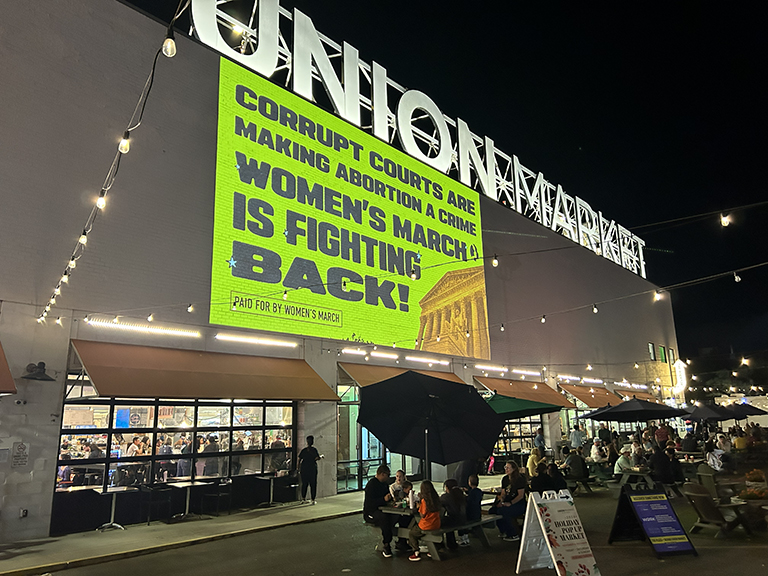
South Wedge gallery walls, East End nightlife corridors, Corn Hill’s historic masonry, Browns Square warehouse facades — AGM deploys 20,000-lumen building projection campaigns across western New York’s arts revival city.
Rochester’s Arts Revival and the Building Projection Advertising Opportunity
Rochester’s downtown arts revival has been one of the more quietly successful urban cultural transformations in the northeastern United States. The South Wedge neighborhood — anchored by South Avenue between the downtown core and Highland Avenue — developed from a once-declining residential corridor into a dense arts and creative industry district with gallery spaces, craft food and beverage establishments, boutique retailers, and the independent venue programming that draws a regular arts and nightlife audience from across Monroe County. Adjacent to Highland Park and positioned near the University of Rochester’s campus presence, South Wedge has built a geographic identity that anchors it as Rochester’s primary arts pedestrian district — the neighborhood whose Thursday-through-Saturday evening population provides the most concentrated arts-literate audience available in any Monroe County location.
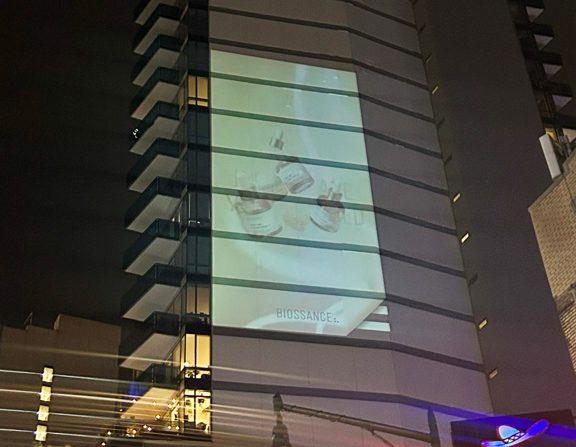
AGM has executed guerrilla projection campaigns for brands including Netflix, Disney, and FanDuel — deploying high-impact visual activations onto architectural surfaces in major markets nationwide.
The East End entertainment corridor provides a complementary dimension to Rochester’s projection geography — a nightlife-focused zone along Monroe Avenue and the surrounding blocks east of downtown, where restaurant programming, live music venues, comedy clubs, and bar activity sustains pedestrian flow through the week. East End’s building stock combines mid-century commercial construction with earlier 20th-century brick commercial architecture, giving the corridor a mix of surface types that include strong projection candidates among its painted masonry and smooth concrete block structures. The district’s younger professional and student demographic generates social documentation behavior that produces good earned media amplification from well-executed projection campaigns.
Corn Hill, one of Rochester’s oldest surviving neighborhoods on the Genesee River’s west bank, has sustained its identity as a historic arts district anchored by the Corn Hill Arts Festival — one of the state’s oldest and largest outdoor arts events — and by a residential and commercial fabric of Victorian-era brick buildings along Exchange Boulevard and the surrounding streets. The NOTA corridor north of Monroe Avenue has emerged as a developing secondary arts zone with gallery and arts organization tenants in a block of mid-century commercial and light industrial buildings. Together, these five distinct districts give Rochester a projection campaign geography that spans different audience demographics, building surface types, and campaign timing windows throughout the year.
The Women’s March on Washington advocacy campaign demonstrated how building projection advertising creates immediate, large-scale public visibility for political and social issue messaging — projecting statements onto the building facades of Washington, DC’s advocacy corridors during a moment of intense national attention, reaching the assembled audience and gathered press with visual communication at a scale that no traditional advocacy format achieves. Rochester’s civically engaged, artistically active urban population carries the same combination of political engagement, social documentation behavior, and advocacy community presence that made the Women’s March campaign’s physical presence in DC amplify into national earned media coverage. For advocacy organizations running campaigns in Monroe County and across upstate New York, Rochester’s arts districts provide the structural conditions for building projection advertising to achieve comparable impact at the regional scale.
Bring Your Campaign to Rochester's Arts Corridors
AGM executes 20,000-lumen building projection campaigns in South Wedge, East End, Corn Hill, Browns Square, and NOTA. Full service from site scouting through post-campaign documentation — Rochester, done right.
Browse Cities in New York
Select a city to explore Guerrilla Projections opportunities.
Rochester's Strongest Projection Corridors
South Wedge Arts District
South Wedge’s projection geography concentrates on South Avenue and the immediately surrounding blocks — a corridor where gallery spaces, arts studios, boutique shops, and independent restaurants create a walkable mixed-use environment with genuine evening foot traffic. The district’s building stock transitions from early 20th-century commercial buildings with brick and painted masonry faces in the northern section, nearer downtown, to a mix of commercial and converted residential buildings as South Avenue extends toward Highland. The most favorable projection surfaces are the painted masonry upper-story and side-wall faces on the commercial blocks — flat, uniformly colored surfaces above the retail signage line where projected images find visual space without competing against street-level commercial clutter. South Wedge gallery programming concentrates audience assembly on opening evenings, when the arts-professional and creative community animates the corridor in the Thursday-through-Saturday evening window that also sees the district’s strongest general nightlife activity.
The South Wedge audience is genuinely arts-engaged rather than simply nightlife-oriented — gallery visitors, working artists, creative industry professionals, and arts educators populate the corridor alongside the restaurant and bar patrons. This arts-professional composition produces higher-quality per-impression engagement for advocacy, arts institution, and brand campaigns than a purely entertainment-demographic audience provides.
East End Nightlife and Entertainment Corridor
East End’s Monroe Avenue corridor generates Rochester’s most consistent weeknight pedestrian traffic outside of scheduled events. The combination of restaurant programming, live music venues, comedy performance spaces, and late-night bars on Monroe and the East End cross-streets sustains active foot traffic from early evening through the early morning hours across Tuesday through Saturday. Building faces along Monroe and the adjacent blocks range from mid-century commercial masonry with painted concrete block surfaces to earlier brick commercial structures — the painted and smoother-faced buildings offering the best projection surface quality in the corridor. Street-facing upper-story wall sections on the taller commercial buildings in East End provide projected image positions above the ambient signage and storefront level, visible from the pedestrian zone and vehicle traffic on Monroe simultaneously.
The Memorial Art Gallery, Rochester’s primary art museum, occupies the university-adjacent zone directly accessible from East End’s western edge. Gallery programming evenings at MAG extend the East End arts audience with a museum-visitor demographic — collectors, arts educators, and cultural tourists — that overlaps with but is distinct from the standard East End nightlife crowd, adding cultural depth to the corridor’s evening demographic composition on programming nights.
Corn Hill Arts District
Corn Hill’s projection geography draws on the character of its Victorian-era residential and commercial streetscape along Exchange Boulevard and the surrounding blocks on the Genesee River’s west bank. The neighborhood’s brick and painted masonry building faces — mid-19th through early 20th-century construction — provide projection candidates consistent with Rochester’s urban character at that era, on surfaces that photograph with the warm textural quality of historic American city architecture. Painted masonry structures in the Corn Hill commercial zone offer the strongest projection surface conditions; raw brick performs adequately at 20,000 lumens but produces softer image edge definition than smooth-faced alternatives in the same corridor.
Corn Hill Arts Festival weekends, held annually in July, produce the highest single-event audience density in Corn Hill’s year — hundreds of thousands of visitors transform the neighborhood’s streets into a pedestrian-only arts market over two days. Projection campaigns timed to the festival reach peak-assembly outdoor arts audiences at the corridor’s most active annual moment. Outside festival season, Corn Hill’s regular arts programming sustains a more modest but consistent evening activity rhythm appropriate for campaigns targeting the neighborhood’s resident arts and professional community.
Browns Square Neighborhood Warehouse Buildings
The Browns Square neighborhood north of downtown Rochester carries a collection of former industrial and warehouse buildings with the flat, broad-and-tall surface geometry that allows large-format projection campaigns — exterior masonry walls at dimensions closer to what Buffalo’s industrial districts provide than to what Rochester’s commercial arts-district building stock makes available. These warehouse structures offer projection surfaces measured in hundreds to thousands of square feet on the larger building faces, allowing image dimensions that dominate the visual environment of the surrounding block at a scale not achievable on South Wedge or East End’s commercial building faces.
The neighborhood’s combination of arts organization tenants, creative industry occupants, and proximity to downtown positions it as a primary target for campaigns that require industrial-scale image presence — brand activations where the visual scale of the projection is central to the campaign’s impact, or advocacy campaigns where maximum visual dominance of the surrounding environment is the primary communication objective.
NOTA (North of the Avenue) Arts Corridor
The NOTA corridor — North of the Avenue, referring to the streets north of Monroe Avenue around North Goodman Street — has developed into a secondary arts district with gallery spaces, arts nonprofits, and creative industry tenants occupying mid-century commercial and light industrial buildings. NOTA’s building stock features painted masonry and concrete block exteriors with the flat surface profiles of 1950s-through-1970s commercial construction — surfaces that, when painted, provide good projection conditions for high-saturation color content. The corridor’s arts community audience skews toward working artists and arts-organization professionals rather than the general nightlife and dining crowd of South Wedge and East End, giving NOTA projection campaigns a specific arts-industry targeting dimension that complements campaigns in the more entertainment-oriented districts.
NOTA’s emergence as a recognized arts corridor is relatively recent, which means its audience is smaller and less continuously active than South Wedge or East End — but its arts-professional audience composition is high-quality for campaigns specifically targeting that demographic segment, and its building surfaces tend toward the smoother, more recently painted profiles of mid-century commercial construction that perform better for projection than the rougher brick of South Wedge’s older commercial buildings.
Who The South Wedge And East End Draw On Weekend Nights
Rochester’s arts district evening audience reflects the city’s dual identity as both a legacy industrial city with strong working-class civic roots and a university town with deep connections to the arts through the University of Rochester, Rochester Institute of Technology, the Memorial Art Gallery, and the George Eastman Museum. The arts community that populates South Wedge on gallery opening evenings — gallery directors, working artists, arts educators, collectors, and the creative professional class broadly — is more tightly networked within arts circles than in larger metros, which means social media documentation from South Wedge projection campaigns reaches relatively small but highly connected arts-sector networks nationally and internationally. The East End’s entertainment and young professional demographic produces higher-volume social documentation from a broader demographic range, with sharing behavior that extends into general Rochester area social media networks rather than specifically arts-professional circles. Combined, a multi-night campaign covering both South Wedge and East End accesses the full spectrum of Rochester’s culturally engaged and socially active evening population in a single campaign week.
Plan Your Guerrilla Projection Campaign in Rochester, NY
Tell us about your campaign goals, target audience, and preferred locations. Our team will help you plan a high-impact guerrilla projection campaign tailored to your needs.
Award Winning Personalized Service
You will get thoughtful, devoted, and individualized attention from our experienced, qualified, and professional personnel. Being one of the most illustrious agencies in Brooklyn, New York, American Guerrilla Marketing has been awarded the Best of Brooklyn title.
Nationwide
Industry City, Brooklyn, New York 11232
American Guerrilla Marketing
Hours
Mon - Fri: 9 AM - 5 PM
Sat & Sun: Closed
Automate your campaign with AGM’s Request for Proposal Builder.
Automate your campaign with AGM’s Request for Proposal Builder. Simply answer a few quick questions about your campaign goals, markets, and timeline, and the system will generate a tailored presentation with recommended strategies, quantities, and pricing. Click the RFP Builder to instantly receive your customized proposal.
Campaign Types That Fit the Rochester Market
Advocacy and Issue Campaigns
Rochester’s progressive civic culture — with roots in the city’s abolition and suffragette history, and continued through an active contemporary advocacy community — creates receptive conditions for advocacy projection campaigns in South Wedge and East End. The city’s arts-professional audience is politically engaged and socially active on digital platforms, producing earned media amplification for advocacy campaigns that address issues their community cares about. Monroe County’s competitive local and state electoral geography makes Rochester’s urban arts districts meaningful targets for political projection advertising.
Arts and Cultural Events
Rochester Fringe Festival, Corn Hill Arts Festival, and the city’s year-round arts programming calendar create natural alignment windows for arts institution and cultural event promotion campaigns. Building projection campaigns deployed in South Wedge and East End in the days before major cultural events reach the arts community audience when their event attention is most actively forming — maximizing the efficiency of event promotion investment relative to post-event campaigns that reach the same audience after attendance decisions have been made.
Consumer Brand Campaigns
Rochester’s professional class — concentrated in optics and imaging, biomedical devices, technology, and financial services sectors with Rochester-heritage companies — represents a well-educated, higher-income consumer demographic accessible through arts district projection campaigns. Consumer brands targeting the upstate New York professional market find South Wedge and East End a viable campaign platform that reaches the professional demographic in their arts-district leisure environment without the reach fragmentation of digital advertising targeting in the same market.
University and Academic Awareness
The University of Rochester, Rochester Institute of Technology, and the cluster of additional higher education institutions in the metro area contribute substantial student, faculty, and staff populations to Rochester’s arts district evening economy. Building projection campaigns in South Wedge and East End reach this university-affiliated demographic alongside the professional arts community — a combined audience appropriate for educational institutions, academic publishers, research advocacy campaigns, and brands targeting the educated young professional segment that universities concentrate in their host cities.
Corporate and Professional Awareness
Rochester’s corporate history — the Eastman Kodak, Xerox, Bausch + Lomb, and Paychex era — and the successor technology, medical device, and professional services companies that have grown in its wake create demand for corporate brand awareness campaigns targeting the city’s professional population. Building projection campaigns in Rochester’s downtown-adjacent arts districts reach the professional workforce in their evening environment, outside digital channels where corporate advertising encounters declining attention from the same audience.
Planning And Executing A Rochester Projection Campaign
Rochester Site Survey and Wall Identification
AGM’s Rochester scouting process evaluates South Wedge’s South Avenue corridor, the East End Monroe Avenue zone, Corn Hill’s Exchange Boulevard block, the Browns Square warehouse area, and the NOTA corridor for wall surface type and condition, building face dimensions, projector positioning options from public right-of-way, ambient lighting levels during the target execution window, and pedestrian volume on the target evenings. Rochester’s arts district geography is compact enough that a single physical scouting visit can cover all five primary zones in a focused day. Event calendar review at the scouting phase identifies Rochester Fringe, Corn Hill Arts Festival, and South Wedge gallery opening schedules that can align campaign timing with peak audience windows.
Image Preparation for the Rochester Market
Rochester’s building stock presents a surface variety that influences image preparation: smooth painted masonry on mid-century commercial buildings in East End and NOTA supports high-saturation color content and fine-detail imagery; brick surfaces on South Wedge’s older commercial buildings and Corn Hill’s Victorian blocks require broader color masses and reduced fine-detail to maintain image quality across surface texture variation; warehouse masonry in Browns Square falls in between depending on specific wall condition. AGM configures campaign creative for each confirmed wall location’s specific surface profile, ensuring that image quality is maintained across the variety of surface conditions Rochester’s diverse neighborhood building stock presents.
Campaign Night Operations in Rochester
Rochester projection campaigns launch at dusk, with AGM’s two-person crew managing all equipment setup, alignment, and operation from site arrival through breakdown. Setup from crew arrival to projection launch runs approximately 60 to 90 minutes. Campaign windows typically extend four to six hours through the peak pedestrian period — 8 PM through 1 AM on Friday and Saturday evenings in South Wedge and East End, and aligned to festival programming windows for Corn Hill and Fringe executions. Multi-district coverage — South Wedge plus East End, or East End plus NOTA — is achievable within a single evening using the mobile projection unit for repositioning, given Rochester’s compact geography.
Documentation and Post-Campaign Asset Delivery
Every Rochester campaign includes professional photography and video documentation throughout the projection window. Documentation captures the projection at full brightness against the night environment, with the specific architectural character of each Rochester district visible in the surrounding context — the Victorian commercial brick of South Wedge or Corn Hill, the mid-century masonry of East End and NOTA, the industrial scale of Browns Square warehouse walls. Post-campaign deliverables include GPS-verified location confirmation, image quality and coverage documentation, audience environment footage, and all assets formatted for brand use across social media distribution, earned media pitching, and internal marketing reporting.
Rochester Guerrilla Projection Advertising Rates
Guerrilla projection campaigns in Rochester are priced at contact us for a quote. . That rate covers a 20,000-lumen commercial projection system, generator and power solution, electronics bundle, mobility unit, two-person AGM technical crew, and all setup, operation, and breakdown labor. Multi-night Rochester campaigns spanning South Wedge, East End, and Browns Square are available with scope-based pricing.
Event-adjacent campaigns timed to Rochester Fringe, Corn Hill Arts Festival, or East End entertainment programming require advance booking — typically four to six weeks — to confirm crew and equipment availability during peak calendar periods. Advance location scouting for Rochester is approximately . Permitted or private-property locations in Rochester are priced at Contact us for a custom quote. per night. Rochester’s geographic relationship with Buffalo makes combined two-market campaigns — Buffalo on one set of nights, Rochester on consecutive nights — logistically practical with a single crew mobilization from Brooklyn.
Campaign Work That Informs The Rochester Approach
The Women’s March on Washington advocacy projection campaign demonstrated how building projection advertising concentrates political messaging into high-visibility public presence at moments of maximum audience attention — placing advocacy statements on building facades in Washington during the period of national focus on the march, reaching both the assembled audience and the press with visual communication at a scale that no traditional advocacy format achieves. The campaign generated earned media coverage in national and political press that amplified the projection’s message well beyond the physical geography of the DC execution. Rochester’s civic arts community carries the same combination of issue engagement, social media connectivity, and advocacy community presence that made the Women’s March campaign’s DC imagery circulate nationally — and advocacy campaigns deploying building projection advertising in Rochester’s South Wedge and downtown corridors can reach that same audience in their own geographic territory.
The United States Marine Corps × CMA Fest campaign in Nashville demonstrated how large-scale brand awareness campaigns use building projection advertising to create prominent presence adjacent to major entertainment events — reaching the assembled concert and festival audience with brand imagery at a scale that intercepts attention without requiring active opt-in from the audience. That approach maps directly to Rochester’s event-adjacent projection opportunities: Fringe Festival, Corn Hill Arts Festival, and East End programming weekends all generate audience assemblies comparable in concentration to a major Nashville entertainment event, giving brands the same event-adjacent impression opportunity in a Upstate New York arts market.
Who Uses Projection Advertising in Rochester
- Advocacy organizations working Monroe County-specific and statewide New York issue campaigns
- Arts institutions promoting South Wedge gallery programming, Rochester Fringe, and Corn Hill Arts Festival
- Consumer brands targeting Rochester’s optics, biomedical, and technology professional demographic
- University and academic institutions building awareness among the Rochester higher education community
- Corporate brands establishing or strengthening recognition in the Rochester professional market
- Political campaigns targeting Monroe County’s competitive state legislative and local electoral districts
- Entertainment companies promoting releases to Rochester’s music and arts-engaged population
Coverage & Estimated Impressions
| Zone / Area | Peak Hours | Foot Traffic | Est. Nightly Impressions | Best For |
|---|---|---|---|---|
| South Wedge Arts District | 8PM–1AM | High | 8,000–35,000 | Product Launch |
| East End Nightlife and Entertainment Corridor | 8PM–1AM | High | 8,000–35,000 | Event Promotion |
| Corn Hill Arts District | 8PM–1AM | High | 8,000–35,000 | Brand Awareness |
| Browns Square Neighborhood Warehouse Buildings | 8PM–1AM | High | 8,000–35,000 | Political |
| NOTA (North of the Avenue) Arts Corridor | 8PM–1AM | High | 8,000–35,000 | Sports |
Frequently Asked Questions
South Wedge’s combination of gallery programming, arts-professional resident population, and walkable corridor geometry that keeps audiences on foot and in view of surrounding building faces makes it the highest-quality per-impression projection location in Rochester. The district’s Thursday-through-Saturday evening audience assembly is predictable enough for campaign timing to be planned with confidence, and the arts-professional composition of that audience produces higher organic documentation rates and stronger social media amplification than a general nightlife audience generates. For campaigns where audience quality matters more than raw impression volume, South Wedge outperforms every other Rochester location.
Rochester and Buffalo are approximately 70 miles apart on I-90 — about an hour’s drive — making combined two-market campaigns practical with a single crew mobilization from Brooklyn. A campaign structure that runs Thursday-Friday in Rochester and Saturday-Sunday in Buffalo (or the reverse) covers both major upstate New York arts markets in a single week with one crew deployment, distributing the Brooklyn-to-upstate mobilization cost across both markets. This multi-market approach doubles the upstate campaign’s geographic reach without doubling the per-market cost, making it efficient for organizations running statewide New York campaigns or for brands seeking simultaneous Western New York penetration.
Yes. The Rochester Fringe Festival, typically held in September, is one of the largest fringe festivals in North America by attendance — drawing hundreds of thousands of visitors over approximately two weeks to venues throughout the downtown and arts district corridor. The festival concentrates a particularly arts-engaged, performance-literate, and socially active audience in Rochester’s downtown and South Wedge neighborhoods during the festival window, making Fringe week one of the highest-value campaign timing opportunities in the Rochester arts calendar. Fringe campaigns require advance booking of six to eight weeks to guarantee crew and equipment availability during this high-demand period.
Corn Hill’s building stock is predominantly Victorian-era brick and painted masonry — mid-19th through early 20th century construction along Exchange Boulevard and the surrounding residential and commercial streets. Painted masonry surfaces in the commercial zone provide good projection conditions: uniformly colored base surfaces with minimal texture variation that accept projected light cleanly across the image area. Raw brick surfaces in Corn Hill introduce mortar-line and surface texture variation that reduces image sharpness at the fine-detail level but remains workable for bold graphic content at 20,000 lumens. AGM’s Corn Hill wall selection prioritizes the smoothest painted masonry structures and the flat upper-story wall sections that minimize texture impact on image quality.
East End’s Monroe Avenue entertainment corridor functions as Rochester’s primary destination nightlife zone — the neighborhood to which the city’s evening entertainment audience gravitates regardless of specific venue or programming. Its combination of restaurant, live music, comedy performance, and bar variety creates a foot traffic pattern that holds consistently across the week, peaking Thursday through Saturday but maintaining meaningful activity on Tuesday and Wednesday compared to other Rochester neighborhoods. The corridor’s self-selecting entertainment audience — people who have chosen East End as their destination for the evening — stays present in the zone for extended periods as they move between venues, creating higher-than-average dwell time in the immediate corridor environment for projection campaigns positioned on East End’s primary blocks.
Yes. University of Rochester’s campus is in the Highland Park-adjacent zone directly connected to South Wedge via South Avenue, and RIT’s campus connects to the city’s arts district economy through the creative-professional community that graduates retain in Rochester after completion. Both institutions contribute student and faculty audiences to South Wedge and East End’s evening populations — particularly during the academic year from September through May. Campaign timing during the fall semester, when both institutions are in full session and students are most active in the city’s nightlife geography, maximizes university audience penetration. Spring semester (January through May) represents the second peak. Summer campaigns reach a reduced university audience but maintain the professional community that is present year-round.
Browns Square’s warehouse and former industrial buildings provide projection surface dimensions larger than what Rochester’s commercial arts district building stock allows. Wall faces on the larger structures in the neighborhood span 40 to 70 feet in width at heights of 25 to 45 feet on the upper-story and side-wall surfaces — image areas that allow 20,000-lumen projection to achieve visual dominance in the surrounding block environment at a scale not available on South Wedge’s or East End’s commercial buildings. Exact dimensions are confirmed during the physical scouting phase for each campaign, as individual building orientation, wall condition, and available projector positioning vary within the Browns Square zone.
Rochester’s arts revival has fundamentally changed the projection campaign opportunity in the city in two related ways. First, it has built walkable arts district foot traffic where none existed — South Wedge and East End now sustain reliable Thursday-through-Saturday evening audience assemblies that project campaigns can target with confidence, whereas ten years ago neither neighborhood held the pedestrian density projection advertising requires. Second, the arts revival has brought the specific arts-professional and creative-economy audience to these corridors — an audience that documents, shares, and amplifies visual content at rates significantly higher than the general urban population. The combination of audience density and audience quality that now exists in South Wedge and East End has made Rochester a viable projection market that it simply was not before the arts revival built the infrastructure on which projection campaigns depend.
Rochester’s audience composition — arts professionals in South Wedge, technology and optics professionals across the broader professional community, and university-educated young professionals in East End — responds most strongly to creative that demonstrates visual intelligence without sacrificing immediate legibility. South Wedge’s arts community appreciates creative with genuine graphic sophistication and a clear conceptual identity; weak or generic creative is evaluated and dismissed quickly by an audience trained in visual assessment. East End’s broader professional demographic responds to strong graphic impact and memorable visual simplicity more than to art-world conceptual sophistication. Campaigns covering both districts benefit from creative that can work across both registers — bold enough for East End’s entertainment demographic, sophisticated enough for South Wedge’s arts-professional audience.
NOTA’s nighttime pedestrian activity is concentrated around gallery openings, arts organization programming evenings, and events in the corridor’s arts venues rather than continuous nightlife flow comparable to South Wedge or East End. On non-programming evenings, NOTA’s foot traffic is lower than either of those districts. For campaigns requiring maximum impression volume, NOTA works best as a component of a multi-district campaign that includes South Wedge or East End as the primary site, with NOTA adding a supplementary arts-professional audience reach that complements the primary district’s broader demographics. For campaigns specifically targeting the working-artist and arts-organization professional demographic with precision, NOTA’s lower volume but higher arts-professional concentration gives it genuine value as a targeted deployment zone when timing aligns with programming evenings.
More AGM Outdoor Advertising Services
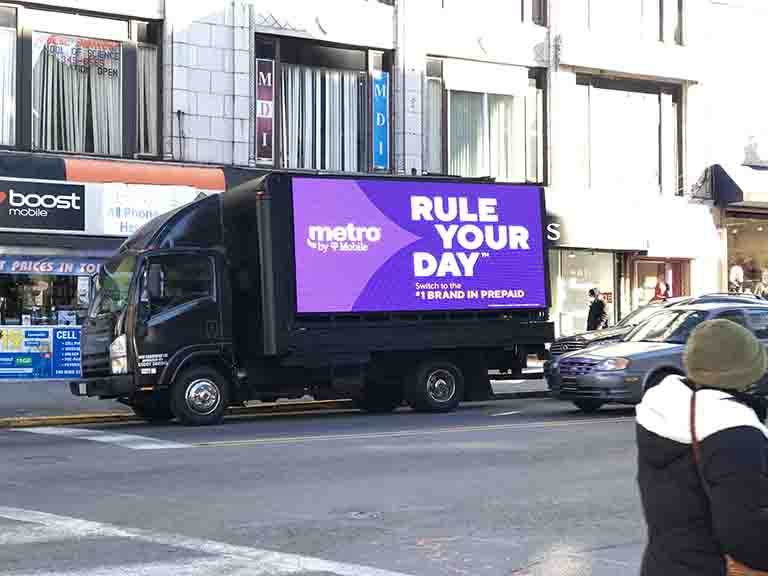
Led Billboard Trucks
Mobile LED displays that bring your brand to any location, any event.
Fly Posting
Street-level poster saturation across walls, construction sites, and corridors.

Sidewalk Decals
Ground-level branded decals at pedestrian hotspots and event entrances.

Sidewalk Stencils
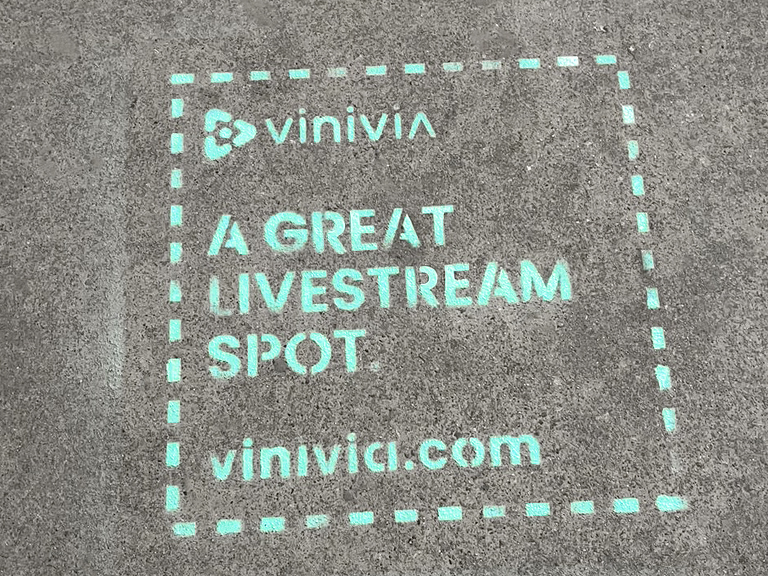
Creative stencil campaigns that put your brand in the path of pedestrians.