American Guerrilla Marketing
Nationwide Service
Media planning, media buying, billboard advertising, & guerrilla marketing
Guerrilla Projections in Connecticut
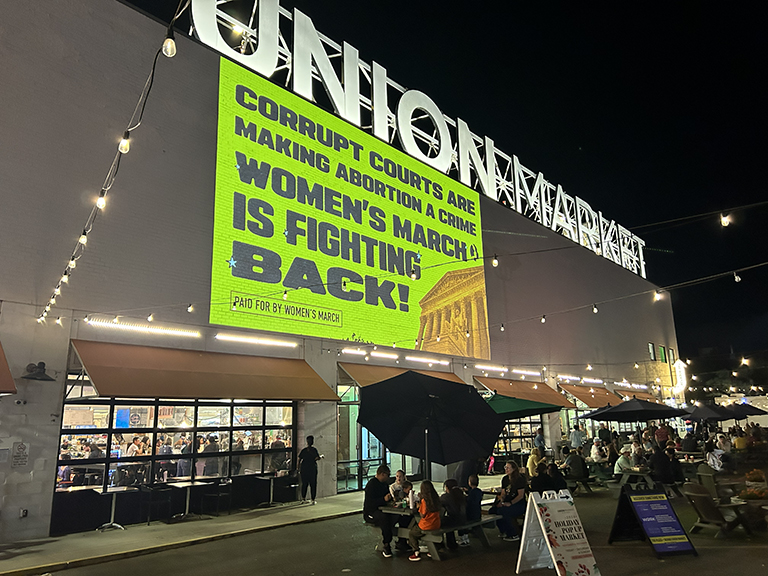
From Bridgeport’s industrial waterfront to Hartford’s civic arts corridors, Connecticut packs an unusual density of projection-ready building surfaces into a state that sits at the center of the Northeast’s most concentrated media corridor.
Connecticut as a Projection Advertising Market
Connecticut sits between New York City and Boston, carrying outsized cultural and economic weight relative to its geographic footprint. Its four primary urban markets — Bridgeport, Hartford, New Haven, and Stamford — each maintain distinct entertainment districts, active nighttime economies, and built environments that include exactly the kind of large, flat, well-positioned building facades that make guerrilla projection advertising land with visual force. The state’s industrial heritage left behind enormous masonry and concrete structures in every major city — former factories, warehouse blocks, parking garage end-walls, and commercial buildings with blank upper floors — that function as natural projection screens once the sun goes down.
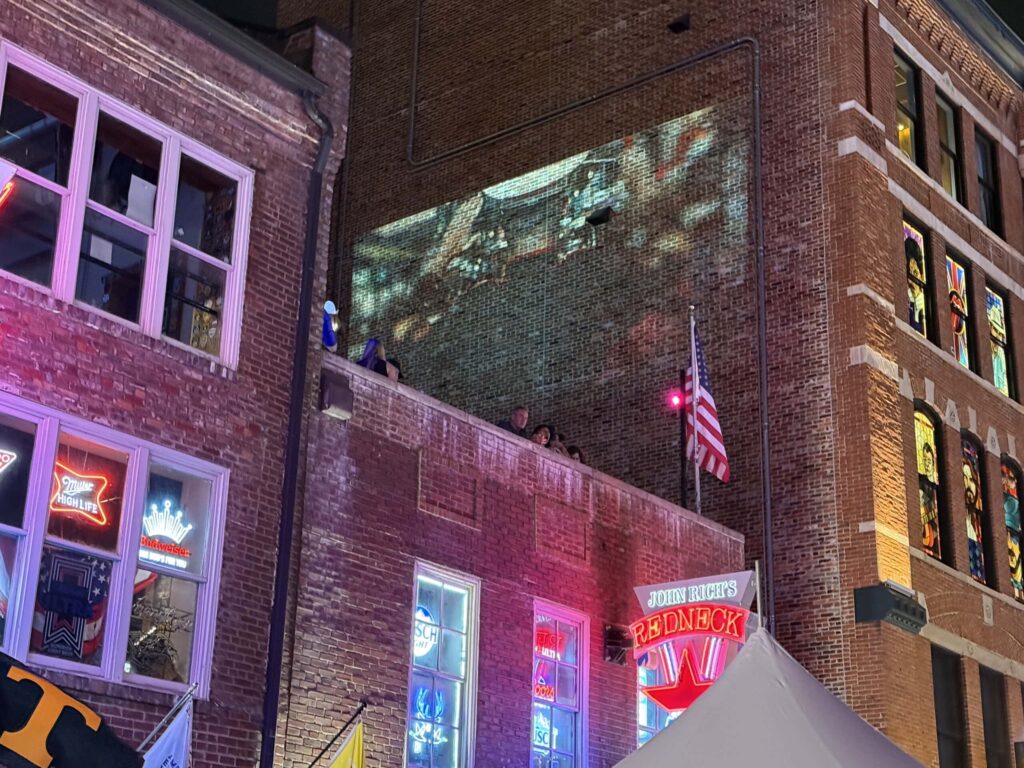
AGM’s projection client roster includes Netflix, Disney, Coca-Cola, FanDuel, Live Nation, iHeartRadio, and the US Marine Corps. A confirmed case study: the US Marine Corps × CMA Fest Nashville — multi-night projections onto architectural surfaces throughout the festival footprint, reaching 80,000+ attendees across the campaign window. Projection advertising scales across every brand category; what our campaigns share is scale, precision, and a physical presence digital cannot replicate.
Past AGM projection clients include Coca-Cola, Live Nation, and iHeartRadio, with multi-night campaigns that generated earned media coverage and massive organic social sharing.
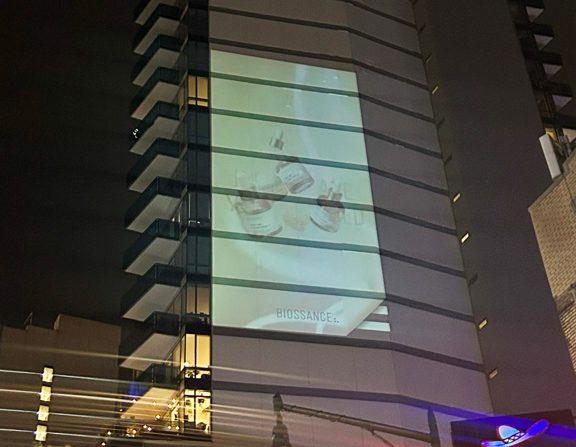
American Guerrilla Marketing deploys 20,000-lumen commercial-grade projection systems that throw images onto building facades at sufficient brightness to compete with urban ambient light. The resulting display measures fifty, seventy, or more than a hundred feet across depending on the throw distance and surface geometry. That physical scale is what separates guerrilla projection advertising from every other format in the out-of-home media landscape — it occupies architectural space, commands peripheral attention, and produces the kind of visual impression that people document with their phones and share before the campaign crew has even finished the night’s run.
AGM’s national scouting team uses both digital GIS analysis and physical on-the-ground reconnaissance to catalogue locations across Connecticut’s urban markets. That research informs every campaign brief from day one. When a client targets the Connecticut market, they draw on a continuously updated inventory of surfaces, viewing angles, pedestrian flow patterns, and logistical access points that makes campaign planning faster and more precise than any improvised approach could produce.
Connecticut’s compact geography is a strategic asset for multi-market campaigns. Bridgeport, New Haven, Hartford, and Stamford are all within ninety minutes of each other by road. A single mobilization of AGM’s equipment and crew can produce a four-night statewide tour hitting each major market on consecutive evenings, which is an efficiency that larger, more spread-out states simply cannot match. For clients who want Northeast corridor coverage without the budget commitment of a major New York City campaign, Connecticut often provides more projection-surface square footage per dollar than any surrounding market.
Launch Your Connecticut Projection Campaign
AGM's scouting team has documented projection-ready surfaces in Bridgeport, Hartford, New Haven, and Stamford. Whether you need a single market in a single night or a coordinated statewide tour, the 20,000-lumen system, the experienced crew, and the location intelligence are ready to move on your timeline.
Browse Cities in Connecticut
Select a city to explore Guerrilla Projections opportunities.
Four Cities, Four Distinct Campaign Profiles
Bridgeport anchors the southwest corridor with the state’s largest population and a built environment defined by its industrial past. The Steel Point development along the harbor introduced newer construction with large, light-colored facade sections alongside the South End’s older warehouse stock. The Downtown arts corridor has attracted galleries, studios, and creative businesses that pull an engaged nighttime audience into corridors that were once purely industrial. The Black Rock neighborhood adds a residential entertainment zone with the distinctive character of a New England maritime community that’s been adopted by artists and young professionals.
Hartford operates as the state capital and its cultural headquarters simultaneously. The Parkville Arts District hosts some of New England’s most credible gallery programming in repurposed factory buildings that were purpose-built for the kind of projection-scale surfaces that make campaigns there visually definitive. Downtown Hartford near the XL Center concentrates event-night audiences in a compact geography. Front Street has emerged as a hospitality and entertainment destination that draws people into the downtown core on nights when the arena isn’t programmed. The Blue Hills corridor extends the city’s accessible surface inventory into residential creative territory.
New Haven carries the cultural gravity of Yale’s institutional presence without operating as a campus town. The university pulls an educated, culturally engaged, and socially connected population into the city’s dining, arts, and entertainment infrastructure. Chapel Street runs as one of the most active pedestrian corridors in New England, and the Erector Square complex in Fair Haven provides some of the most photogenic industrial projection surfaces in the state. The Ninth Square arts district adds a downtown concentration of adapted historic commercial buildings, and the State Street commercial zone extends the market’s surface inventory into the city’s commercial spine.
Stamford operates differently from Connecticut’s other major cities — it’s a genuine satellite of New York’s financial industry, with a corresponding density of corporate professionals who live within walking distance of a real entertainment district. Bedford Street and the Harbor Point development have transformed what was once a commuter city into a genuine destination. The South End’s warehouse buildings remain some of the most technically capable projection surfaces in the state, presenting large, flat, lightly colored facades at standoff distances that allow for maximum image scale.
Connecticut's Best Projection Surfaces By District
Wall selection determines campaign quality more than any other single variable. AGM evaluates every candidate location against a consistent set of technical criteria: surface dimensions, color and reflectivity, texture uniformity, window-to-wall ratio, available projector standoff distance, clear sightlines, audience viewing position, and ambient light competition. In Connecticut, four districts consistently produce the highest-performing campaign environments.
Parkville Arts District — Hartford
The former industrial buildings concentrated along the Parkville Arts District’s core corridors include some of the largest blank masonry surfaces in central Connecticut. These structures were built to manufacturing scale — multiple stories of brick and concrete with minimal window openings on upper floors and large blank sections on side and rear elevations that face open lots or low-density streets. The combination of building scale, surface quality, and the district’s concentrated creative-industry audience makes Parkville one of the most technically and culturally appropriate locations for projection campaigns in the state. Gallery openings, studio events, and the general activity of a functioning arts district generate the evening foot traffic that passive projection advertising needs to accumulate meaningful impressions.
Erector Square Arts Complex — New Haven
Located in Fair Haven on the edge of New Haven’s downtown, the Erector Square complex comprises multiple former manufacturing buildings that have been adapted to arts and creative-industry uses. Their exterior walls — smooth concrete and painted masonry on structures ranging from four to seven stories — present some of the cleanest projection surfaces in the city. The complex’s positioning near transit corridors and its relative separation from downtown’s commercial signage density means a projected image registers with unusual clarity against the surrounding nightscape. The arts-programming activity at Erector Square generates the kind of engaged, creative-class audience that responds to projection media the way few other demographic groups do.
Steel Point and South End Warehouse District — Bridgeport
Bridgeport’s dual-zone geography in the Steel Point and South End areas creates complementary campaign options within a few blocks of each other. Steel Point’s newer construction includes buildings with light-colored cladding and large blank facade sections visible from the harbor-side corridor. The South End warehouse district’s older masonry buildings present darker, more textured surfaces that still perform effectively under 20,000 lumens of directed projection output. The industrial character of the South End provides a visual tension between the projected content and the building’s physical character that adds a dimension of authenticity that’s difficult to manufacture in more polished commercial environments.
Harbor Point and Bedford Street — Stamford
Stamford’s Harbor Point mixed-use development includes several mid-rise structures with light-colored facades and large blank sections on parking-level and service-function walls that face the waterfront corridor. Bedford Street’s entertainment district surfaces — converted commercial buildings with substantial blank upper floors facing the pedestrian spine — provide a different but equally capable canvas. The South End’s warehouse buildings, several blocks from the main entertainment strip, offer the kind of massive, uninterrupted facades that campaigns prioritizing image scale should target. Audiences moving between Harbor Point restaurants and the Bedford Street entertainment district provide high-density passive viewing exposure across a natural pedestrian circuit.
Ninth Square Arts District — New Haven
The Ninth Square sits at the intersection of downtown commercial density and New Haven’s arts infrastructure. The district’s adapted historic commercial buildings include several with substantial blank upper-floor facades above ground-level retail that generates reliable evening foot traffic. Corner buildings along the district’s major intersections offer wide viewing angles — a projected image on a corner-facing wall reaches two perpendicular streets simultaneously, which can double effective impressions per campaign night without additional equipment cost. The Ninth Square’s mix of restaurant diners, gallery visitors, and general nightlife activity creates a diverse audience profile within a compact geographic footprint.
Plan Your Guerrilla Projection Campaign in Connecticut
Tell us about your campaign goals, target audience, and preferred locations. Our team will help you plan a high-impact guerrilla projection campaign tailored to your needs.
Award Winning Personalized Service
You will get thoughtful, devoted, and individualized attention from our experienced, qualified, and professional personnel. Being one of the most illustrious agencies in Brooklyn, New York, American Guerrilla Marketing has been awarded the Best of Brooklyn title.
Nationwide
Industry City, Brooklyn, New York 11232
American Guerrilla Marketing
Hours
Mon - Fri: 9 AM - 5 PM
Sat & Sun: Closed
Automate your campaign with AGM’s Request for Proposal Builder.
Automate your campaign with AGM’s Request for Proposal Builder. Simply answer a few quick questions about your campaign goals, markets, and timeline, and the system will generate a tailored presentation with recommended strategies, quantities, and pricing. Click the RFP Builder to instantly receive your customized proposal.
Creative Formats for Connecticut Projection Campaigns
Advocacy and Civic Campaigns
Connecticut’s politically engaged urban populations — concentrated in New Haven and Hartford — respond powerfully to civic-scale projection content. Advocacy organizations have used guerrilla projection advertising to drive awareness for ballot measure campaigns, nonprofit initiatives, and issue-based messaging where physical scale creates a sense of institutional weight that digital formats cannot match. The state’s progressive political culture in its major cities makes advocacy projection advertising one of the most naturally resonant formats in the Connecticut market.
Entertainment Releases
Music releases, streaming drops, and film campaigns use guerrilla projection advertising in Connecticut to create the kind of street-level cultural moments that generate organic social media documentation. A projection campaign on the Erector Square complex or a Hartford warehouse wall produces content that fans capture and share before the crew has broken down equipment. Connecticut’s position between New York and Boston means social reach from a local campaign extends into both adjacent major metro audiences.
Product Launches and Retail
Stamford’s corporate consumer base and New Haven’s university-adjacent retail corridor are natural targets for product launches targeting educated, high-income audiences. Building projection advertising in a premium entertainment district signals brand ambition in a way that no static outdoor placement can replicate. The medium itself communicates investment and differentiation, which matters in markets where consumers are sophisticated enough to register the distinction.
Event and Venue Promotion
Hartford’s XL Center programming, New Haven’s performing arts calendar, and Bridgeport’s entertainment venue circuit create natural windows for projection campaigns that drive advance awareness in markets where audiences already skew toward active event attendance. Projection advertising in an entertainment district reaches people who are in exactly the right mindset to respond to event-based messaging — they’re already out, already engaged, already making decisions about what to do next.
Campaign Planning: From Scouting To Post-campaign Documentation
Location Analysis and Scouting
Every Connecticut campaign starts with a rigorous location analysis. AGM’s scouting process combines satellite imagery review, street-level reconnaissance, and nighttime visibility assessments that produce a ranked shortlist of campaign-ready surfaces. Each location is evaluated for surface dimensions, color and texture profile, ambient light levels, available projector standoff positions, generator access, and audience viewing position. Advance scouting is available as a standalone service at approximately contact us for a quote.
Creative Formatting and Technical Preparation
Creative content is formatted to the specific aspect ratio and scale of the confirmed wall. This involves understanding how architectural features — cornices, window bands, material transitions — affect image composition at the actual projected size. Content that reads cleanly on a presentation monitor reads very differently when it’s sixty feet tall on a brick facade. AGM’s technical preparation process accounts for surface geometry, reflectivity variation, and ambient light conditions before campaign night begins.
Campaign Night Operations
AGM’s own crew — not subcontractors — handles every aspect of the campaign night. The 20,000-lumen projection system arrives with a self-contained generator and power solution, requiring no connection to building electrical infrastructure. Setup typically requires one to two hours, and the projection run begins at dusk, operating for four to six hours. The crew manages technical adjustments as ambient light conditions change through the evening and conducts a complete breakdown by end of run.
Post-Campaign Reporting
Every AGM campaign includes GPS-documented location records along with professional photography and video that clients use for press releases, social media, investor presentations, and internal campaign reporting. The visual assets generated by a projection campaign are often as valuable as the campaign impressions themselves — projection media is inherently cinematic, and the documentation it produces consistently performs across every content channel clients deploy it through.
Pricing for Connecticut Guerrilla Projection Campaigns
Connecticut projection campaigns are priced at contact us for a quote. This rate includes the complete production package: the 20,000-lumen commercial projection system, a dedicated generator and power solution, the full electronics bundle, mobility unit for equipment transport, and a two-person technical crew covering setup, operation, and breakdown from dusk through the end of the campaign run.
Advance location scouting, when added to the campaign package, is approximately contact us for a quote. Permitted or private-property locations — where AGM secures formal authorization from a building owner before the campaign night — add Contact us for a custom quote. per night depending on the specific building, neighborhood, and market conditions. Multi-night campaigns in Connecticut typically carry planning efficiencies that reduce the per-night operational profile relative to single-night executions.
Advocacy Projection At Scale: The Women's March Model
When the Women’s March organization needed to amplify its civic messaging beyond the physical event footprint, building projection advertising provided the scale and visual authority the campaign required. AGM deployed projections onto landmark building facades along the DC corridor, creating images that ran dozens of feet tall and were visible from blocks away in the city’s densely populated neighborhoods. The campaign produced substantial earned media coverage and social media documentation that extended the messaging reach far beyond the physical projection nights.
For advocacy organizations operating in Connecticut — where civic engagement on issues from housing and environmental action to electoral politics runs consistently high — this model provides a direct template. Connecticut’s university cities, with their concentrated young adult populations and social media connectivity, are among the most receptive markets in the Northeast for advocacy-driven projection content. A campaign that runs on the Erector Square complex or a Front Street building wall in Hartford doesn’t just reach the people walking past — it reaches everyone in their network who sees the documentation they post.
Who Uses Guerrilla Projection Advertising in Connecticut
Advocacy organizations working ballot measures, legislative campaigns, and issue awareness initiatives have found projection advertising particularly effective in Connecticut’s college cities. Hartford and New Haven both host populations that are politically active, socially networked, and visually sophisticated enough to engage with campaign-scale projection media as more than a novelty.
Entertainment brands — record labels, streaming platforms, film campaigns — include Connecticut’s markets in Northeast release rollouts, particularly when the state’s position between New York and Boston makes it a natural regional bridge in a coordinated multi-market strategy. Regional event promoters use projection campaigns to drive advance awareness in competitive entertainment markets where cutting through standard advertising channels is increasingly difficult.
Retail and product launch clients in the Stamford corridor, where a high concentration of corporate professionals lives within walking distance of a genuine entertainment district, use projection advertising as a premium brand-building tool that distinguishes them from competitors relying on conventional outdoor placements. The medium itself communicates a level of creative ambition that static formats cannot replicate.
Coverage & Estimated Impressions
| Zone / Area | Peak Hours | Foot Traffic | Est. Nightly Impressions | Best For |
|---|---|---|---|---|
| Parkville Arts District | 8PM–12AM | Moderate | 2,500–12,000 | Product Launch |
| Erector Square Arts Complex | 8PM–12AM | Moderate | 2,500–12,000 | Event Promotion |
| Steel Point and South End Warehouse District | 8PM–12AM | Moderate | 2,500–12,000 | Brand Awareness |
| Harbor Point and Bedford Street | 8PM–12AM | Moderate | 2,500–12,000 | Political |
| Ninth Square Arts District | 8PM–12AM | Moderate | 2,500–12,000 | Sports |
Frequently Asked Questions: Guerrilla Projections in Connecticut
AGM covers Bridgeport, Hartford, New Haven, and Stamford as primary Connecticut markets, with additional capacity in secondary cities including Waterbury, Norwalk, Danbury, New Britain, and Meriden. The national scouting team has documented projection-ready locations across the state’s major urban and entertainment districts, and new markets can be researched and qualified as part of campaign planning for clients who need geographic coverage beyond the four primary cities.
Winter extends the effective projection window significantly. Dusk arrives earlier, which means a four-to-six-hour campaign run begins before most evening restaurant and entertainment crowds have gone home. Street trees lose their foliage in winter, which frequently improves line-of-sight from projector positions to building facades. AGM’s equipment operates without performance degradation in cold weather, and the audiences that are active in Connecticut’s entertainment districts during winter months tend to be intentional — they’re there for specific events or dining experiences, which concentrates exposure in high-intent settings.
Permit requirements vary by municipality across Connecticut. In many cases, projecting a temporary image onto a building exterior from a mobile unit positioned on a public street or adjacent lot does not require a formal permit, though local ordinances differ and should be researched for each specific campaign location. When private-property authorization is obtained from a building owner, the regulatory framework shifts substantially. AGM’s team researches applicable local requirements during campaign planning and addresses any outstanding questions before campaign night to ensure operations proceed without interruption.
The standard planning timeline for a Connecticut campaign is two to four weeks for a straightforward execution — confirmed location, prepared creative assets, and standard public-facing projection. Campaigns that require advance scouting of a new market, private-property authorization from a building owner, or coordination with a specific event window typically need four to eight weeks. AGM has executed accelerated campaigns in Connecticut markets when all logistical variables were already resolved, but sufficient planning time produces consistently better outcomes and eliminates day-of pressure.
Multi-city Connecticut tours are logistically efficient and strategically effective. The state’s compact geography means an equipment crew can move between Bridgeport, New Haven, Hartford, and Stamford within ninety minutes of road travel, making consecutive-night multi-market campaigns a practical extension of a single equipment mobilization. A four-night statewide tour hitting one major market per night generates comprehensive Connecticut coverage from a single crew deployment, which is an efficiency unavailable in larger, more geographically spread states.
The Connecticut market supports a wide range of campaign types, each with distinct city concentrations. Advocacy organizations find New Haven and Hartford most receptive. Entertainment releases target the young adult populations concentrated in those same university-adjacent markets. Premium retail and product launches target Stamford’s professional consumer base. Event promoters work all four cities depending on venue programming. The common thread is that any brand or organization seeking to create a high-impact visual moment in a northeastern media market can find a suitable audience and surface in Connecticut.
Connecticut functions as a bridge market in Northeast corridor campaign strategies. Social media documentation from a Connecticut projection campaign reaches audiences in both adjacent major metro areas, extending effective reach beyond the state’s population. For national brands running coordinated regional rollouts, Connecticut’s geographic position makes it a natural inclusion in campaigns targeting the Boston-to-Philadelphia Northeast corridor without requiring the budget premium of a full New York City market buy.
Standard campaign runs begin at dusk and operate for four to six hours, capturing peak evening foot traffic in Connecticut’s entertainment districts — typically from around 7:00 PM through midnight or 1:00 AM depending on the market and season. Multi-night campaigns build cumulative impression frequency across consecutive evenings. Extended-hour campaigns are available for specific event windows where late-night programming keeps significant audiences in entertainment districts past the standard run window.
AGM’s scouting process combines digital analysis — satellite imagery, street-level reconnaissance, pedestrian traffic data, and ambient light assessment — with physical on-the-ground visits to candidate locations. Each site is evaluated for surface dimensions, texture, color and reflectivity profile, available standoff distance, sightlines, generator placement options, and logistical constraints. The output is a ranked shortlist that matches the client’s campaign objectives with the most technically suitable and strategically positioned surfaces in the target market.
Connecticut’s industrial heritage left a significant stock of brick masonry and painted concrete structures across Bridgeport, Hartford, and New Haven. Smooth-painted brick, light-colored stucco, concrete block, and EIFS cladding outperform raw dark brick on brightness and color saturation metrics because they reflect more of the projected light rather than absorbing it. AGM’s scouting process specifically identifies surfaces with the highest reflectivity and lowest window-to-wall ratio in each target district, which is why campaign results in Connecticut consistently exceed what clients estimate based on lumen specifications alone.
More AGM Outdoor Advertising Services
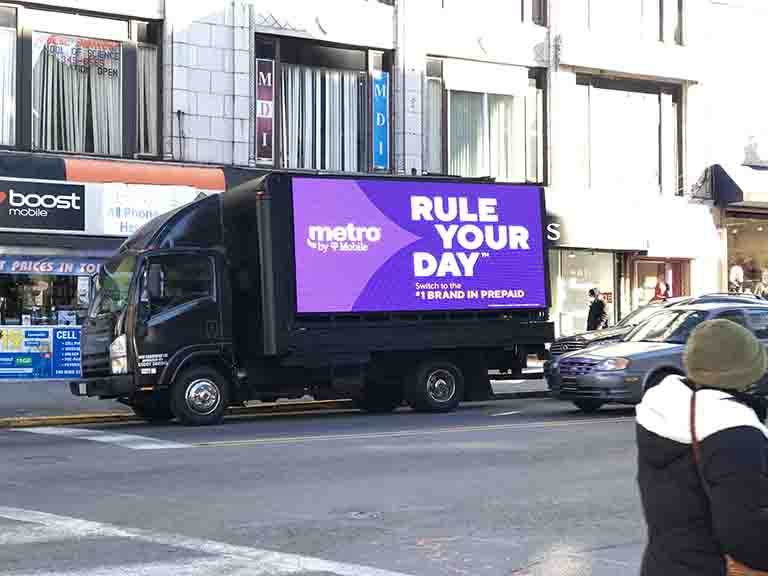
Led Billboard Trucks
Mobile LED displays that bring your brand to any location, any event.
Fly Posting
Street-level poster saturation across walls, construction sites, and corridors.

Sidewalk Decals
Ground-level branded decals at pedestrian hotspots and event entrances.

Sidewalk Stencils
Creative stencil campaigns that put your brand in the path of pedestrians.