American Guerrilla Marketing
Nationwide Service
Media planning, media buying, billboard advertising, & guerrilla marketing
Guerrilla Projections in Minnesota

From Minneapolis warehouse walls to Duluth’s lakefront corridors, AGM puts 20,000-lumen projection campaigns on building facades that stop people mid-stride and generate content that travels.
Minnesota’s Media Market and Why Projection Advertising Works Here
Minnesota is a market that punches above its population weight. The Twin Cities rank among the top fifteen television markets in the country, and the arts infrastructure — the Walker Art Center, the Guthrie Theater, the thriving Northeast Minneapolis gallery corridor, the decades of live music culture that has produced nationally recognized acts — creates a population that is visually literate, culturally engaged, and primed to respond to ambitious outdoor creative work. When a projection appears on a building facade in this market, it lands in front of an audience trained to notice and engage with visual culture.
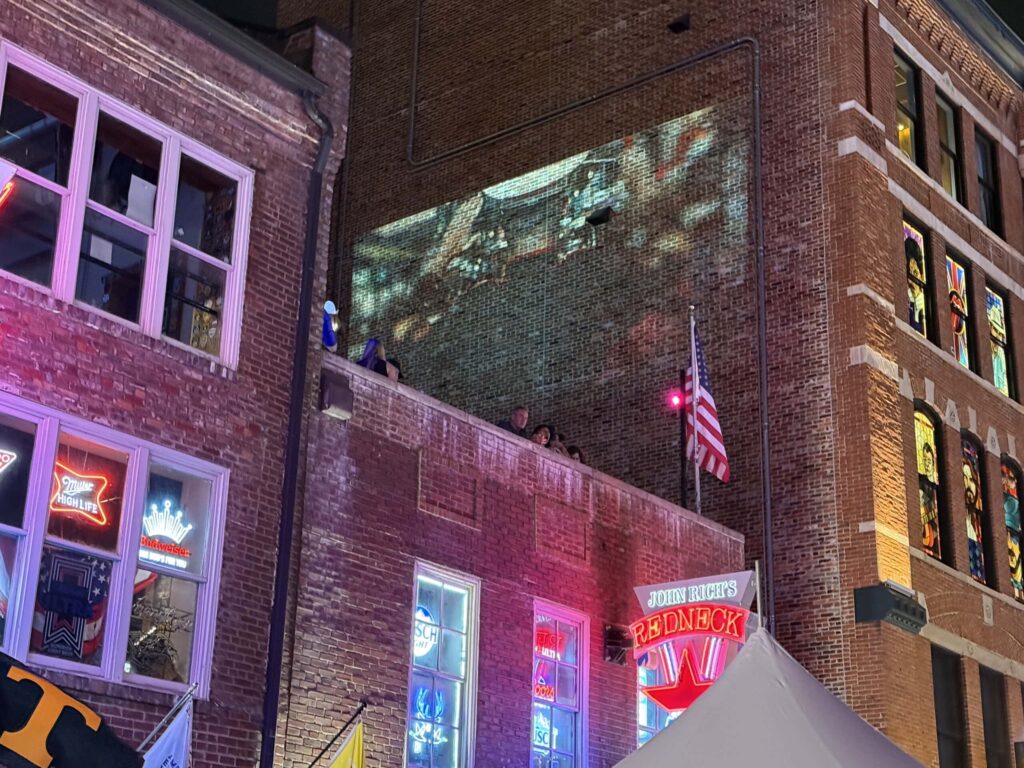
The US Marine Corps selected AGM for a guerrilla projection campaign during CMA Fest in Nashville, projecting onto high-traffic surfaces during peak festival activity and reaching 80,000+ attendees.
Beyond the Twin Cities, Minnesota’s regional cities each carry characteristics that make projection advertising tactically valuable. Duluth commands a mix of Great Lakes tourism, University of Minnesota Duluth student activity, and a compact entertainment district along Canal Park. Rochester is shaped by Mayo Clinic — one of the world’s most recognized healthcare institutions — and the constant rotation of patients, medical professionals, and corporate travelers who orbit it year-round. Saint Paul brings a distinct arts and cultural identity entirely separate from Minneapolis, anchored by Lowertown’s warehouse arts community and the West 7th entertainment corridor.
Minnesota’s darkness is a campaign asset that most Southern markets can’t match. From October through April, nightfall arrives early and entertainment district foot traffic extends well into the evening. That extended projection window — more dark hours, more audience exposure per deployment — makes Minnesota a high-efficiency market for outdoor projection advertising. A campaign that captures four hours of visibility in a warm-weather market can run six or seven hours here during winter months, covering every restaurant-goer, bar patron, and late-evening commuter passing through a targeted corridor.
The state’s civic engagement levels are also relevant. Minnesota consistently ranks among the highest in voter participation and public awareness of political and cultural issues. Advocacy campaigns, awareness initiatives, and cause-driven organizations find that outdoor projection messaging in Minnesota receives both active audience attention and media pickup — local newsrooms actively cover visual street-level campaigns in ways that double the earned media return.
Ready to Project Across Minnesota?
AGM scouts, designs, and executes guerrilla projection campaigns in Minneapolis, Saint Paul, Duluth, Rochester, and beyond. Tell us your market, your message, and your timeline.
Browse Cities in Minnesota
Select a city to explore Guerrilla Projections opportunities.
Minnesota's Building Inventory: Why The Walls Are Right
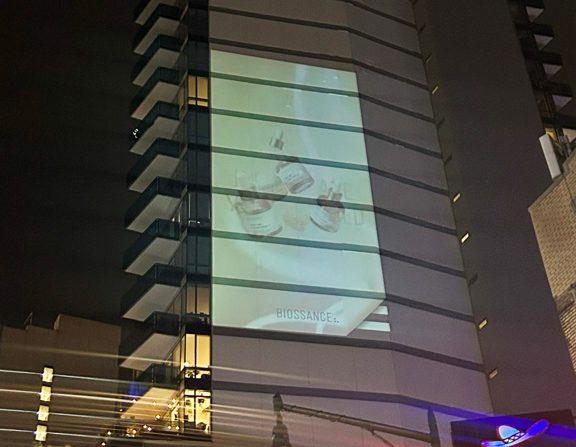
The single most critical factor in any projection campaign is the wall. Minnesota’s industrial and commercial history has produced an unusually strong concentration of projection-ideal surfaces, particularly in Minneapolis and Duluth. Both cities built through industrial booms in the late nineteenth and early twentieth centuries, leaving behind warehouse buildings with enormous, flat, windowless exterior faces — precisely what a 20,000-lumen commercial projection system is designed to fill.
Minneapolis’s North Loop neighborhood stands as one of the most projection-favorable districts in the entire Midwest. Block after block of converted warehouse buildings, former industrial lofts, and multi-story parking structures present exterior walls with minimal window interruption, flat surfaces, and light-colored finishes that reflect projector output with high fidelity. Critically, the North Loop is also one of the Twin Cities’ most active restaurant and nightlife corridors, meaning any projection reaching those walls hits an audience that is already outside, already moving, and already paying attention to what’s around them.
Duluth’s Canal Park district offers a different wall profile — a mix of converted industrial buildings, waterfront entertainment venues, and commercial structures with substantial exterior surfaces framed by Lake Superior as natural ambient backdrop. Saint Paul’s Lowertown warehouse district represents some of the state’s most underutilized projection real estate: brick industrial facades and warehouse-era buildings in a neighborhood with consistent evening traffic driven by arts events, dining, and a creative community that skews visually attentive. Rochester’s downtown is more contemporary but the Civic Center district and Peace Plaza area provide workable surfaces with strategic placement.
Minnesota Markets: Where Agm Operates
Minneapolis
The primary Minnesota projection market. The North Loop and Warehouse District offer the highest concentration of projection-ideal wall surfaces in the state — former industrial buildings with multi-story flat faces and strong nighttime foot traffic from dining, entertainment, and arts venues. Northeast Minneapolis adds a walkable arts-dense corridor popular with creative professionals and younger demographics. Uptown and downtown’s 7th Street corridor offer distinct audience profiles accessible across a campaign run.
Saint Paul
Lowertown’s warehouse architecture is among the strongest projection surface inventory in the Twin Cities metro. The West 7th Street entertainment corridor and Grand Avenue deliver active evening audiences. Saint Paul carries a distinct cultural identity — not simply Minneapolis’s neighbor — and messaging that speaks to the specific Saint Paul community resonates with authenticity that generic Twin Cities campaigns miss.
Duluth
Canal Park drives consistent tourism and entertainment foot traffic with the visual drama of Lake Superior as ambient context. The Superior Street arts corridor and Lincoln Park Craft District layer cultural audience depth. Duluth’s tourism-heavy population means projection campaigns reach both local residents and out-of-town visitors who carry documentation of what they see back to social networks across the country.
Rochester
Mayo Clinic’s gravitational pull generates consistent high-income professional and visitor traffic through Rochester’s downtown. Medical conferences, specialist referral travel, and corporate business surrounding the healthcare sector create a precision audience difficult to reach through conventional outdoor media. The Peace Plaza area and South Broadway entertainment corridor anchor nighttime activity for projection placement.
Plan Your Guerrilla Projection Campaign in Minnesota
Tell us about your campaign goals, target audience, and preferred locations. Our team will help you plan a high-impact guerrilla projection campaign tailored to your needs.
Award Winning Personalized Service
You will get thoughtful, devoted, and individualized attention from our experienced, qualified, and professional personnel. Being one of the most illustrious agencies in Brooklyn, New York, American Guerrilla Marketing has been awarded the Best of Brooklyn title.
Nationwide
Industry City, Brooklyn, New York 11232
American Guerrilla Marketing
Hours
Mon - Fri: 9 AM - 5 PM
Sat & Sun: Closed
Automate your campaign with AGM’s Request for Proposal Builder.
Automate your campaign with AGM’s Request for Proposal Builder. Simply answer a few quick questions about your campaign goals, markets, and timeline, and the system will generate a tailored presentation with recommended strategies, quantities, and pricing. Click the RFP Builder to instantly receive your customized proposal.
What Brands Are Running Projection Campaigns in Minnesota
Entertainment brands have been among the most active users of guerrilla projection advertising in markets like the Twin Cities. AGM’s campaign for The Weeknd and YouTube illustrates the playbook: deploying a large-format building projection in a high-traffic entertainment district in the days surrounding a major release, generating street-level documentation that feeds directly into social media amplification and creates visual proof of a cultural moment happening in real space. The Twin Cities’ music culture and entertainment audience demographic make this approach highly replicable for streaming platforms, labels, and artists with regional release events or tour announcements.
Corporate and healthcare brands use Rochester with precision that broader markets don’t allow — reaching Mayo Clinic visitors and medical professionals in an area where those audiences concentrate is difficult through traditional outdoor media but highly achievable through projection advertising positioned in documented pedestrian traffic corridors. Consumer brands making Midwest market entries treat Minneapolis as a first impression that sets tone for regional rollout. The North Loop audience shares what it sees; a building facade campaign in that neighborhood becomes content that travels through networks the brand may not have direct access to otherwise.
Advocacy campaigns have found Minnesota particularly responsive. The state’s politically active and civically engaged population means advocacy projections in Minneapolis or Saint Paul generate both immediate audience response and earned media pickup at a rate that outperforms many similarly sized markets nationally.
Creative Formats For Minnesota Projection Campaigns
Entertainment Release Campaigns
Album drops, streaming premiere countdowns, tour date reveals. The Twin Cities entertainment and music culture makes projection campaigns in the North Loop, Uptown, and Northeast corridors exceptionally effective for entertainment marketing moments.
Corporate and Brand Activations
Regional market entries, product launches, brand awareness campaigns aimed at specific Minneapolis or Saint Paul demographics. The professional and creative-class audiences in these corridors respond to visually ambitious executions.
Advocacy and Awareness Campaigns
Minnesota’s civic engagement culture creates responsive audiences for cause-driven messaging. Large-format building projection in high-traffic public corridors amplifies advocacy campaigns with visual impact that traditional media placement can’t replicate.
Healthcare and Conference Activations
Rochester’s Mayo Clinic ecosystem creates a unique precision market for healthcare brands and medical device companies. Projection campaigns placed during major conferences or event windows reach concentrated professional audiences.
The Projection Campaign Process in Minnesota
Every Minnesota campaign begins with location scouting. AGM’s national scouting team reviews target markets through a combination of digital analysis — satellite imagery, street-level photography review, pedestrian traffic pattern data — and physical on-the-ground evaluation. Physical scouting confirms what digital tools cannot fully capture: actual surface texture and finish condition, sightline obstructions from trees or street infrastructure, ambient light competition from nearby signage, and crew positioning logistics that vary block by block.
Creative development runs parallel to location work. For entertainment campaigns, imagery typically arrives pre-finished from label or studio creative teams; AGM’s technical crew optimizes it for projection fidelity on the specific selected surface. For branded and advocacy campaigns, design conversations include how color, contrast, and scaled typography translate from screen to a building-sized projection environment — the differences are significant and require experienced adjustment.
Equipment preparation for Minnesota’s cold-weather months is standard practice for AGM’s direct technical crew. Generators and electronics are prepped for low-temperature operation. The crew deployed to Minnesota campaigns are AGM’s own technicians — not subcontractors — who handle cold-weather logistics as part of routine operational preparation. Setup, operation through the projection window, and breakdown are all included in the campaign package.
Documentation is built into every deployment. Professional still photography and video captured during the projection run become immediately usable campaign assets — typically ready for social media, press outreach, and client reporting within hours of the campaign night. Multi-night campaigns build a broader documentation set with multiple surface angles and audience reaction footage.
Minnesota Projection Advertising Investment
Guerrilla projection campaigns across Minnesota markets are priced at contact us for a quote. Each deployment includes the 20,000-lumen commercial projection system, generator and complete power solution, full electronics bundle, AGM’s two-person technical crew, and all setup, operation, and breakdown. Projection typically begins at dusk and runs four to six hours through peak entertainment district activity. Multi-night campaigns are available across all Minnesota markets.
Advance location scouting — separate from the deployment — runs approximately contact us for a quote. Campaigns requiring permitted or private-property venues add contact us for a quote. depending on building and market conditions. Multi-city Minnesota packages covering Minneapolis, Saint Paul, Duluth, and Rochester can be structured around a shared launch window or event to concentrate reach and optimize the overall campaign investment.
Who Uses Guerrilla Projection Advertising in Minnesota
Entertainment labels and streaming platforms activating around Twin Cities release windows and tour dates. Healthcare and medical device companies targeting the Mayo Clinic professional ecosystem in Rochester. Consumer brands making regional Midwest market entries through Minneapolis. Advocacy organizations, political campaigns, and nonprofit groups who value the civic amplification that Minnesota audiences and media outlets provide for visual street-level campaigns.
Universities and academic institutions — the University of Minnesota system, Mayo Clinic’s academic programs, regional campuses — have used building projection advertising around major recruiting events, institutional announcements, and community engagement initiatives. AGM’s national client roster spans entertainment, consumer products, defense, healthcare, and advocacy sectors — all of whom have deployed projection advertising in markets with Minnesota’s combination of arts engagement and civic energy.
AGM’s projection client roster includes Netflix, Disney, Coca-Cola, FanDuel, Live Nation, iHeartRadio, and the US Marine Corps. A confirmed case study: the US Marine Corps × CMA Fest Nashville — multi-night projections onto architectural surfaces throughout the festival footprint, reaching 80,000+ attendees across the campaign window. Projection advertising scales across every brand category; what our campaigns share is scale, precision, and a physical presence digital cannot replicate.
Coverage & Estimated Impressions
| Zone / Area | Peak Hours | Foot Traffic | Est. Nightly Impressions | Best For |
|---|---|---|---|---|
| Minneapolis | 8PM–12AM | Moderate | 2,500–12,000 | Product Launch |
| Saint Paul | 8PM–12AM | Moderate | 2,500–12,000 | Event Promotion |
| Duluth | 8PM–12AM | Moderate | 2,500–12,000 | Brand Awareness |
| Rochester | 8PM–12AM | Moderate | 2,500–12,000 | Political |
Frequently Asked Questions: Guerrilla Projections in Minnesota
AGM deploys projection campaigns in Minneapolis, Saint Paul, Duluth, Rochester, and surrounding markets. The Twin Cities are the primary activation zone, but the scouting team evaluates smaller Minnesota markets when specific campaign objectives and audience targeting make them the right fit.
Cold weather requires additional equipment preparation — generators and electronics adapted for low-temperature operation — but it does not prevent execution. Minnesota winters actually extend effective campaign hours, with early sunsets from October through March creating longer projection windows each night than summer markets provide. The extended dark period is a tactical advantage, not a limitation.
The North Loop and Warehouse District offer the highest density of projection-ideal surfaces in Minneapolis — former industrial buildings with multi-story flat exterior faces, light-colored finishes, and strong nighttime foot traffic from restaurants and entertainment venues. Northeast Minneapolis and Uptown are strong alternatives with distinct audience demographics and viable surface inventory.
Yes, and that focus is precisely what makes Rochester valuable. Mayo Clinic draws high-income visitors, medical professionals, and corporate business travelers through the city year-round. Projection advertising placed in the Peace Plaza area and South Broadway corridor reaches this audience during evening hours with precision that traditional outdoor media can’t match. Healthcare brand awareness campaigns and medical conference activations perform particularly well.
Requirements vary by city and situation — whether the projection falls on public or private property, and where the crew positions equipment. AGM’s operational team handles permit research and compliance as part of campaign planning. For many deployments, projecting from a legally positioned location onto a building facade requires no special permit. Logistics are navigated on a market-by-market basis.
The base rate is contact us for a quote. Advance location scouting adds approximately contact us for a quote. Permitted or private-property venues add contact us for a quote. Multi-night campaigns are available and allow clients to build broader audience reach and a larger documentation asset library across one or more Minnesota markets.
AGM’s national scouting team combines digital analysis — satellite imagery, street-level review, pedestrian traffic data — with physical on-the-ground scouting. For Minnesota markets, physical visits are particularly important to evaluate surface texture in cold-weather conditions, ambient light competition from streetlamps and adjacent signage, and crew positioning logistics for winter operation.
Yes, and social documentation is one of the most significant drivers of projection advertising value. AGM documents every campaign with professional still photography and video footage, typically ready for client use within hours of the projection night. Bystanders organically sharing their own footage extends reach well beyond the physical audience present at the projection site itself.
The system can fill walls from two stories to ten or more stories tall depending on projection distance and surface conditions. Larger surfaces create greater visual impact and visibility from farther distances. Former warehouse buildings in Minneapolis and Duluth typically offer walls in the four-to-eight-story range — well within the projector’s output capacity and easily visible across an entire city block or adjacent plaza.
Yes. Clients frequently combine Minneapolis and Saint Paul into a single campaign window, or add Duluth and Rochester to create statewide coverage around a launch or event. AGM coordinates multi-market logistics including crew scheduling, equipment routing, and unified documentation delivery so clients receive a coherent campaign package across multiple markets.
Entertainment labels and streaming platforms targeting Twin Cities music and film audiences, healthcare companies activating around Rochester’s Mayo Clinic ecosystem, consumer brands entering the Midwest market through Minneapolis, advocacy organizations, and political campaigns. The Minnesota market’s combination of arts engagement and civic participation makes it responsive across a wide range of campaign objectives.
More AGM Outdoor Advertising Services
Led Billboard Trucks
Mobile LED displays that bring your brand to any location, any event.

Fly Posting
Street-level poster saturation across walls, construction sites, and corridors.

Sidewalk Decals
Ground-level branded decals at pedestrian hotspots and event entrances.

Sidewalk Stencils
Creative stencil campaigns that put your brand in the path of pedestrians.