American Guerrilla Marketing
Nationwide Service
Media planning, media buying, billboard advertising, & guerrilla marketing
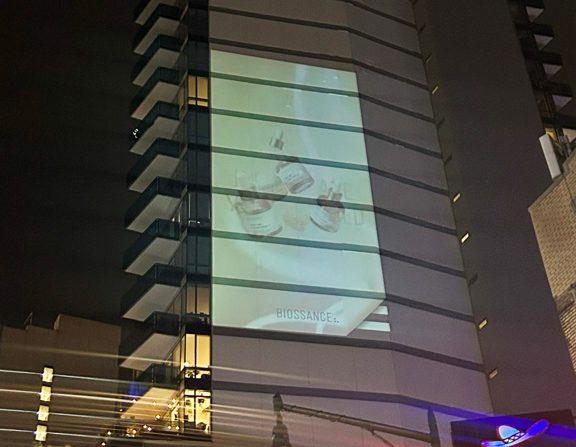
Guerrilla Projections in Warwick, RI
Warwick’s Apponaug Village arts corridor, the commercial entertainment zone around TF Green Airport, and the Post Road commercial corridor give building projection campaigns a market with a regionally diverse audience, lower media competition than Providence, and specific zone opportunities that reach travelers, local residents, and commercial corridor shoppers in concentrated windows.
Warwick is Rhode Island’s second-most-populous city and its primary commercial gateway — home to T.F. Green Airport, the state’s major commercial aviation hub, and a sprawling commercial corridor along Post Road that serves the southern Rhode Island metropolitan area with retail, dining, hospitality, and entertainment options that draw a regional audience from across the Providence metro. The city’s projection landscape is different from Providence, Pawtucket, and Cranston in a way that is commercially significant: Warwick’s primary audience is not a concentrated urban arts community but a broadly distributed regional consumer population that moves through commercial zones, hospitality facilities, and the airport environs in patterns defined by commerce, travel, and suburban entertainment rather than arts culture and nightlife. That audience profile changes the kind of campaign that performs best in the Warwick market — and AGM’s scouting and campaign planning process accounts for those differences in audience concentration, site character, and campaign timing when developing a Warwick deployment strategy.
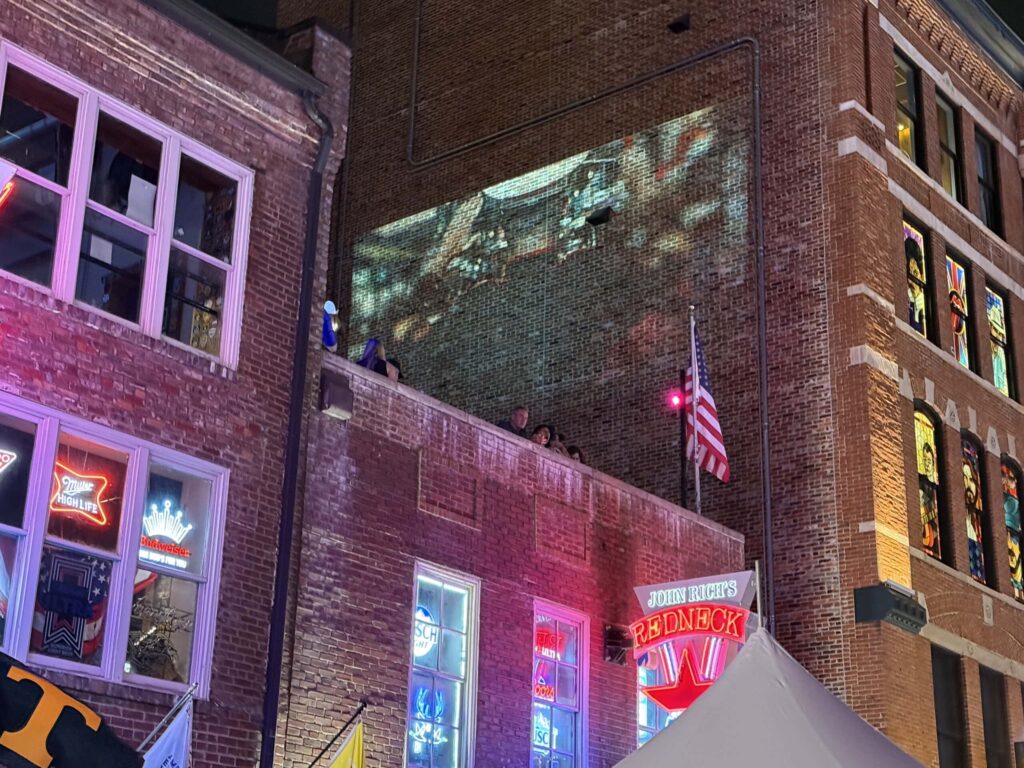
AGM’s projection client roster includes Netflix, Disney, Coca-Cola, FanDuel, Live Nation, iHeartRadio, and the US Marine Corps. A confirmed case study: the US Marine Corps × CMA Fest Nashville — multi-night projections onto architectural surfaces throughout the festival footprint, reaching 80,000+ attendees across the campaign window. Projection advertising scales across every brand category; what our campaigns share is scale, precision, and a physical presence digital cannot replicate.
AGM has executed guerrilla projection campaigns for brands including Netflix, Disney, and FanDuel — deploying high-impact visual activations onto architectural surfaces in major markets nationwide.
The Apponaug Village arts corridor represents the exception within Warwick’s commercial character: a walkable historic district in the city’s older downtown zone where arts organizations, boutique retailers, and restaurants have concentrated over the past decade, creating a more urban, pedestrian-oriented environment that functions similarly to the arts corridors in Providence and Cranston. For campaigns targeting Warwick’s culturally engaged local audience, Apponaug Village provides a projection context with genuine arts-district character in a city that is otherwise primarily oriented toward commercial and retail activity. For campaigns targeting the broader regional audience — travelers, airport-adjacent hospitality guests, Post Road commercial shoppers — the TF Green entertainment zone and Post Road corridor offer different audience access with distinct competitive media conditions.
Reach Warwick — and Everyone Passing Through It
Apponaug Village. TF Green Airport zone. Post Road. Warwick's projection environments cover three distinct Rhode Island audiences — and TF Green sends your campaign home with travelers across the Northeast. Contact AGM to start planning your Warwick building projection campaign.
Browse Cities in Rhode Island
Select a city to explore Guerrilla Projections opportunities.
Warwick's Projection Market — Three Zones, One Connected Audience
Understanding Warwick as a projection market requires recognizing that its three primary zones — Apponaug Village, the TF Green Airport entertainment district, and Post Road — serve overlapping but distinct audience segments that respond to different campaign approaches. Apponaug Village’s foot-traffic audience is primarily local Warwick residents with arts and cultural engagement, supplemented by Providence-metro visitors who travel to the district specifically for its arts and dining offerings. The TF Green zone draws a regional and transient audience of travelers, business visitors, airport-adjacent hotel guests, and the commercial activity generated by the airport’s throughput of several million passengers annually. Post Road’s commercial corridor serves the broad suburban consumer audience of central and southern Rhode Island — households across a wide geographic area who make the Post Road corridor their shopping, dining, and entertainment destination rather than traveling to Providence’s urban core.
A projection campaign that targets Apponaug Village reaches the Warwick arts community and the Providence-metro arts audience who visits the district. A campaign in the TF Green zone reaches a geographically diverse audience that includes visitors from across the Northeast and beyond — a segment with above-average spending power, above-average travel frequency, and a social media sharing behavior shaped by the documentation culture of frequent travel. A Post Road campaign reaches the broad southern Rhode Island consumer demographic in a commercial context that aligns with retail, service, and food and beverage brand objectives. Each zone has a distinct value proposition, and the scouting process determines which zone’s projection-viable surfaces and audience profile best match a given campaign’s objectives.
Where Guerrilla Projection Advertising Works In Warwick
Apponaug Village Arts Corridor
Apponaug Village is the historic core of Warwick’s downtown — a district of nineteenth and early twentieth-century commercial buildings around a traditional village green, now housing arts organizations, boutique retailers, restaurants, and community-oriented businesses that generate pedestrian activity on evenings and weekends throughout the year. The district’s building stock includes former commercial buildings with brick and masonry exteriors at two to four stories, with blank side-wall and upper-floor sections accessible for projection from the adjacent street and parking infrastructure. Apponaug Village’s foot traffic is most concentrated on Friday and Saturday evenings and on arts event dates — gallery openings, community festivals, and arts programming nights that draw Warwick’s culturally engaged residents and Providence-area visitors to the district. The projection environment in Apponaug Village is more intimate than the larger-scale industrial walls of Pawtucket or Cranston, but the community character of the district gives campaigns deployed here a local resonance and organic documentation authenticity that more commercially oriented Warwick zones do not provide.
TF Green Airport Entertainment Zone
The commercial and hospitality zone surrounding T.F. Green Airport represents a distinctive projection environment: a cluster of hotels, restaurants, bars, and entertainment establishments that serve an audience largely defined by its travel activity rather than its local community identity. Airport-adjacent zones concentrate a transient population with spending power, social media connectivity, and a documentation propensity shaped by the travel experience’s inherent orientation toward sharing and recording new environments. Building facades in the TF Green zone include the exteriors of hotel and hospitality facilities, commercial retail and restaurant buildings, and airport service infrastructure, with surface options that vary considerably in projection viability depending on orientation, scale, and surface type. AGM’s TF Green zone scouting focuses on the commercial entertainment buildings and hospitality structures with projection-viable exteriors in the concentrated zone south of the terminal, where both vehicular and pedestrian traffic create a multi-modal audience for projection campaigns deployed in the evening and early-night hours.
Post Road Commercial Entertainment Corridor
Post Road — Route 1 — runs through the heart of Warwick’s commercial zone as the spine of the city’s retail, dining, and entertainment activity, with a dense concentration of chain and independent businesses that together form one of the most commercially active corridors in Rhode Island. The Post Road building stock is primarily mid-to-late twentieth century commercial construction — strip mall anchors, freestanding commercial buildings, and mixed-use retail facilities — with exterior surfaces that vary considerably in projection viability. The most projection-favorable Post Road surfaces are the blank end-walls and rear facades of anchor commercial buildings at key intersections, which carry larger wall areas than the primary storefronts and are visible from the corridor’s vehicular and pedestrian flow from multiple approach directions. Post Road’s audience is primarily automotive, which shapes the projection campaign approach in this zone: maximum image size and bold, simple creative treatments that read instantly at passing vehicular speed are the priority parameters for Post Road deployments, in contrast to the more pedestrian-oriented campaign approach that works best in Apponaug Village and the TF Green pedestrian zone.
Plan Your Guerrilla Projection Campaign in Warwick, RI
Tell us about your campaign goals, target audience, and preferred locations. Our team will help you plan a high-impact guerrilla projection campaign tailored to your needs.
Award Winning Personalized Service
You will get thoughtful, devoted, and individualized attention from our experienced, qualified, and professional personnel. Being one of the most illustrious agencies in Brooklyn, New York, American Guerrilla Marketing has been awarded the Best of Brooklyn title.
Nationwide
Industry City, Brooklyn, New York 11232
American Guerrilla Marketing
Hours
Mon - Fri: 9 AM - 5 PM
Sat & Sun: Closed
Automate your campaign with AGM’s Request for Proposal Builder.
Automate your campaign with AGM’s Request for Proposal Builder. Simply answer a few quick questions about your campaign goals, markets, and timeline, and the system will generate a tailored presentation with recommended strategies, quantities, and pricing. Click the RFP Builder to instantly receive your customized proposal.
Campaign Creative Types That Connect in Warwick's Commercial and Airport Zones
Travel, Hospitality, and Regional Tourism
The TF Green Airport entertainment zone provides a concentrated audience of regional travelers and hospitality guests whose social media activity includes a high proportion of travel documentation. Brands in travel, hospitality, regional tourism, and destination marketing use TF Green zone projections to reach this audience at the point of arrival or departure — the moments of highest geographic orientation and strongest brand receptivity to destination and lifestyle messaging.
Retail and Consumer Brand Awareness
Post Road’s commercial corridor audience — the broad southern Rhode Island consumer demographic — represents one of the largest retail-oriented projection audiences in the state. Consumer brands, retail chains, and food and beverage companies entering or expanding in the southern Rhode Island market use Post Road projection campaigns to generate brand awareness with the regional shopping audience in its primary commercial environment, reaching households across a wide geographic range who share Post Road as their primary commercial corridor.
Arts and Community Campaigns in Apponaug Village
Apponaug Village’s arts and community character makes it the right zone for projection campaigns that need the authenticity of a walkable arts district setting rather than the commercial character of Post Road or the transient audience of the airport zone. Arts organizations, community events, and brands seeking local-community resonance in Warwick use Apponaug Village projections to connect with the city’s most culturally engaged resident population.
Regional Brand Launches and Multi-Market Campaigns
Brands launching across the Rhode Island market use Warwick as a third or fourth deployment point in a multi-city Rhode Island campaign strategy — following Providence and Pawtucket with a Warwick activation that extends geographic reach into the southern metro area. Warwick’s geographic position at the southern edge of the Providence metro makes it the natural market to complete statewide coverage without requiring travel to smaller outlying Rhode Island markets.
From Scouting To Activation — Building A Warwick Projection Campaign
Warwick Market Scouting
AGM’s Warwick scouting process evaluates all three zones — Apponaug Village, the TF Green entertainment district, and Post Road — with zone-specific assessment criteria that reflect the distinct physical and audience characteristics of each area. At Apponaug Village, the scouting focuses on blank side and upper-floor walls of the historic commercial buildings with access from adjacent streets and parking. At the TF Green zone, the evaluation emphasizes building facades visible from both pedestrian and vehicular approaches to the entertainment district, with attention to the orientation relative to the heaviest traffic flows from the terminal. On Post Road, the scouting targets end-walls and rear facades of anchor commercial buildings with the largest available projection surfaces and the best visibility from the corridor’s primary northbound and southbound lanes. The Warwick scouting phase is priced at approximately Contact us for a custom quote. for the full market evaluation across all three zones.
Creative Development and Surface Adaptation
Warwick’s three projection zones require distinct creative orientations. Apponaug Village campaigns are designed for pedestrian viewing distances — detailed, photogenic compositions that reward close examination and generate high-quality documentation photography. TF Green zone campaigns are designed for a mixed pedestrian and low-speed vehicular audience — bold, readable compositions that communicate instantly across a range of viewing distances and angles. Post Road campaigns prioritize maximum readability at vehicular speed — bold graphic treatments with minimal fine detail, high-contrast color palettes, and simple compositions that deliver the brand or campaign message in the three to five seconds that a passing driver allocates to peripheral visual stimuli. AGM’s creative guidance for Warwick campaigns specifies the appropriate design orientation based on the confirmed zone and the audience profile of the target deployment location.
Campaign Execution and Documentation
AGM’s two-person crew deploys the self-contained 20,000-lumen system at the confirmed Warwick projector position, activating at effective darkness and running through the target zone’s peak audience window. Post-campaign documentation — GPS records, timing logs, and still photography — is delivered within forty-eight hours and formatted for press and social distribution. For TF Green zone campaigns, AGM captures documentation photography from angles that include both the projected building facade and the airport-adjacent visual environment, producing campaign imagery with a distinctive travel-context aesthetic that performs well in hospitality and regional tourism distribution channels.
What the Women's March Projection Proves About Reach and Moment
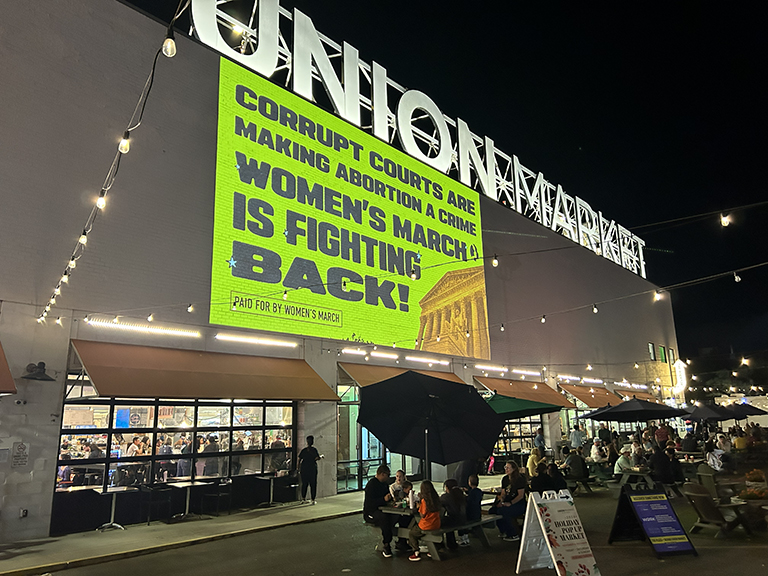
The Women’s March projection campaign that AGM deployed in Washington, DC illustrates a principle that translates directly to Warwick’s airport-adjacent TF Green zone: geographic position, combined with audience concentration, creates projection opportunities where the direct viewership dramatically understates the campaign’s actual reach. The Women’s March projection was powerful not because it was in a densely populated urban neighborhood — the Washington, DC metro has many such neighborhoods — but because it was positioned precisely at the intersection of the largest possible concentrated audience and a shared moment of civic engagement, which meant that every member of that audience was already primed to document, share, and amplify what they saw.
The TF Green Airport zone operates on a variant of this principle. Travelers and airport-adjacent guests are at a moment of heightened sensory awareness — they are in transit, oriented toward new experiences, and actively documenting their journey for social sharing. A projection in the TF Green zone does not need to compete with the ambient media saturation of an urban entertainment district to generate documentation; the travel context itself primes the audience to photograph and share anything that provides a visually compelling moment. For advocacy campaigns, brand launches, and tourism and hospitality campaigns that want to reach a broad, geographically distributed social sharing audience from a single Rhode Island activation point, the TF Green zone provides a uniquely concentrated opportunity to reach travelers who carry the campaign documentation to their home communities across the Northeast and beyond.
Warwick Projection Campaign Investment
Building projection campaigns in Warwick are priced at contact us for a quote. covering the complete AGM deployment system: the 20,000-lumen commercial projection unit, generator and power solution, electronics bundle, mobility unit, and the two-person technical crew for setup, full operation, and breakdown. The rate is consistent with AGM’s national per-night pricing for all Rhode Island markets and requires no venue infrastructure or external electrical connection for standard deployments.
The advance scouting phase for Warwick — covering Apponaug Village, the TF Green zone, and Post Road — adds approximately contact us for pricing. Private-property or permitted access for campaigns requiring building management coordination in any of the three zones adds Contact us for a custom quote. per night based on the specific building and campaign parameters. Warwick’s position within the Rhode Island geographic cluster makes it straightforwardly combinable with Providence, Pawtucket, and Cranston in multi-city campaign structures without requiring separate logistics overhead beyond the per-night crew and equipment rate.
Who Campaigns in Warwick
Warwick’s projection advertising clients span a commercial range defined by the city’s airport gateway character and its role as southern Rhode Island’s commercial hub. Regional retailers expanding in the southern Rhode Island market use Post Road projections for brand awareness with the commercial corridor audience. Hospitality brands and regional tourism organizations use the TF Green zone for campaigns reaching the airport’s traveling audience. Arts organizations and community groups use Apponaug Village for audience-specific campaigns targeting Warwick’s culturally engaged local community. National brands targeting the broader Rhode Island and southern New England consumer market use Warwick as the final southern anchor of a multi-city Rhode Island campaign strategy that covers the full state population from Providence to Warwick. The consistent driver across all Warwick client types is the need to reach a market audience that is geographically anchored in the southern metro area rather than concentrated in Providence’s urban core.
Frequently Asked Questions
Apponaug Village is Warwick’s historic downtown district — a cluster of nineteenth and early-twentieth-century commercial buildings around a traditional village green, now housing arts organizations, boutique retailers, and restaurants. It provides a walkable, pedestrian-oriented arts-district projection environment in a city otherwise dominated by auto-oriented commercial development. For campaigns targeting Warwick’s arts and culturally engaged local audience, Apponaug Village is the only zone in the city that provides genuine arts-district character and the documentation culture that comes with it.
T.F. Green Airport processes several million passengers annually, creating a sustained flow of travelers, business visitors, and hospitality guests through the surrounding commercial and entertainment zone throughout the year. The airport-adjacent entertainment district benefits from consistent hotel and restaurant occupancy tied to airport activity, generating a relatively stable evening foot traffic base even outside peak tourist or event seasons. The traveler audience’s above-average social media activity and travel-documentation propensity makes the TF Green zone particularly valuable for brands and campaigns that want to reach an audience with geographic distribution well beyond Rhode Island.
Post Road’s commercial corridor carries primarily mid-to-late twentieth-century commercial construction — freestanding commercial buildings, strip mall anchors, and big-box retail facilities with exterior surfaces ranging from brick veneer to EIFS and panel cladding. The most projection-favorable surfaces along Post Road are the blank end-walls of anchor commercial buildings, which tend to be the largest uninterrupted wall sections in the corridor. EIFS and smooth panel-clad end-walls produce the most vivid projection results; brick-veneer end-walls are workable but introduce texture that reduces apparent brightness at long vehicular viewing distances.
Yes. The TF Green zone’s pedestrian and vehicular flows are concentrated between the terminal, the parking facilities, and the surrounding hotel and entertainment district in patterns that create predictable high-density audience windows during peak departure and arrival periods. A projection positioned in the zone between the terminal and the nearest hotel and entertainment cluster reaches the highest concentration of traveler audience in the shortest time window. AGM’s scouting evaluates the specific building facades and projector positions in this zone that achieve maximum visibility during the terminal’s peak daily travel hours in the early evening, which align with the onset of effective darkness across most of the calendar year.
Warwick’s Post Road commercial corridor is best suited to consumer brands in retail, food and beverage, home goods, and regional services that are targeting the broad southern Rhode Island suburban consumer demographic. National retail chains entering or expanding in the Rhode Island market, regional food and beverage brands driving awareness ahead of Post Road retail distribution, and service sector companies targeting the broad Warwick and southern Rhode Island consumer household base all find Post Road projection campaigns aligned with their audience objectives. Hospitality, travel, and tourism brands are better served by the TF Green zone, while arts and cultural brands are better served by Apponaug Village.
Warwick and Providence target meaningfully different retail audiences within the Rhode Island market. Providence’s urban consumer base — younger, more arts-oriented, more likely to shop independent and specialty retail — is better reached through Jewelry District or Federal Hill projections. Warwick’s commercial corridor audience — broader in geographic origin, more household-oriented, more likely to shop national retail chains and commercial food and beverage brands — is better reached through Post Road or Apponaug Village projections depending on the brand’s positioning within the retail spectrum. For brands with truly mass-market Rhode Island objectives, a multi-city Rhode Island campaign that includes both Providence and Warwick covers both ends of the state’s retail consumer spectrum.
Yes. Apponaug Village’s historic commercial district is genuinely walkable — a compact cluster of buildings around the village center where pedestrian movement between destinations is natural and active. The scale of the district is smaller than Providence’s Jewelry District, which means that the concentration of pedestrian traffic in proximity to available projection surfaces is higher per linear block, even though the absolute number of pedestrians is lower than in a major urban entertainment corridor. A projection on an Apponaug Village commercial building wall is visible to a higher percentage of the district’s foot traffic than equivalent campaigns in larger and more dispersed urban entertainment zones.
Post Road’s vehicular traffic peaks in two windows: a late-afternoon commute peak from approximately 4:30 to 6:30 PM and an evening dining-and-shopping peak from approximately 6:00 to 9:00 PM. The evening window is the more valuable for projection campaigns, as it coincides with the onset of effective darkness that enables high-contrast projection visibility. Pedestrian traffic on Post Road is limited compared to urban corridors but concentrates around restaurant and entertainment entrances in the evening window. AGM calibrates Post Road campaign timing to the evening commercial peak, which aligns with both maximum vehicular exposure and the projection visibility conditions of the post-dusk hours.
Yes. Warwick’s event calendar — concerts and events at the nearby Dunkin’ Donuts Center in Providence, sporting events, and regional tourism peaks associated with the summer season — can be incorporated into Warwick campaign timing strategy to maximize the airport-zone and commercial corridor audience concentration on specific campaign dates. AGM’s planning process references the regional event calendar during campaign scheduling to identify dates where the TF Green zone and Post Road corridors will have elevated audience concentrations driven by specific regional events beyond the standard daily commercial traffic baseline.
For a first Warwick campaign, AGM typically recommends two consecutive nights — one night to establish the campaign presence and generate initial documentation and social distribution, a second night to benefit from the word-of-mouth and social sharing generated by the first night’s audience and to capture any media coverage that follows the first-night documentation. For campaigns in the TF Green zone with a specific event or peak travel window as the timing anchor, a single night aligned with the peak window can be appropriate if the audience concentration is sufficient on that specific date. The planning phase determines the optimal duration based on the confirmed zone, the campaign’s earned media objectives, and the client’s budget parameters.
Documentation from Warwick building projections reaches earned media audiences through two distinct channels. The first is local Rhode Island press — the Providence Journal, local television stations, and regional digital outlets that cover Warwick commercial and arts events and whose readership spans the full Providence metro area. The second is the social distribution of the traveler and regional audience who documents and shares the campaign in real time, whose home communities span the Northeast and whose posts reach networks outside Rhode Island’s press catchment area. TF Green zone projections in particular benefit from the traveler audience’s social distribution to networks far beyond Rhode Island, creating geographic earned media reach that is disproportionate to the direct local viewership of a single Warwick deployment.
More AGM Outdoor Advertising Services
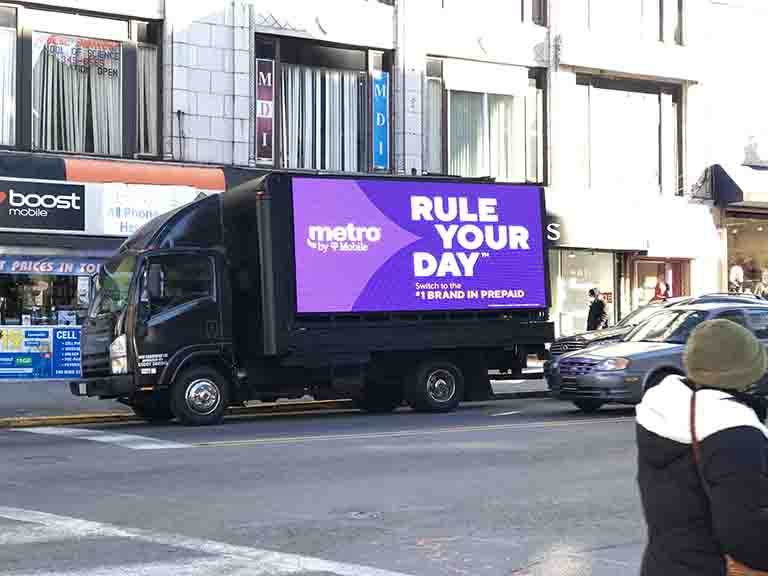
Led Billboard Trucks
Mobile LED displays that bring your brand to any location, any event.
Fly Posting
Street-level poster saturation across walls, construction sites, and corridors.

Sidewalk Decals
Ground-level branded decals at pedestrian hotspots and event entrances.

Sidewalk Stencils
Creative stencil campaigns that put your brand in the path of pedestrians.