American Guerrilla Marketing
Nationwide Service
Media planning, media buying, billboard advertising, & guerrilla marketing
Guerrilla Projections in Morgantown, WV

High Street’s dense student foot traffic, the Metropolitan Theatre’s arts-district character, and West Virginia University’s 28,000-strong campus population make Morgantown one of the highest-engagement projection advertising markets in the entire Appalachian region.
Morgantown’s Projection Advertising Environment
Morgantown is West Virginia’s most dynamically active projection advertising market, and the reason comes down to a single variable that most mid-size Appalachian cities cannot match: concentration. High Street’s entertainment and retail corridor packs more engaged, social-media-active pedestrians into fewer blocks than any comparable corridor in the state, driven by West Virginia University’s enrollment of more than 28,000 students who treat the High Street zone as their de facto outdoor living room during evening hours throughout the academic year. A building projection on High Street at 10 PM on a Thursday evening during the fall semester is not an advertising placement — it is a public event, and the audience treats it accordingly.
Past AGM projection clients include Coca-Cola, Live Nation, and iHeartRadio, with multi-night campaigns that generated earned media coverage and massive organic social sharing.
The WakeUp Coalition’s advocacy projection campaign in Austin, Texas showed exactly what happens when a community-relevant message meets a young, politically engaged, social-media-active pedestrian audience in a compact entertainment district: organic documentation begins within minutes of the first image hitting the wall, the footage moves through social networks in real time, and the campaign’s visual footprint expands far beyond the physical block where the projection is running. Morgantown’s High Street reproduces that dynamic with a student audience whose social networks extend to home communities across West Virginia, across neighboring states, and into the national social platforms where WVU’s broad alumni and prospective student base monitors what is happening in Morgantown.
Beyond High Street, Morgantown’s Metropolitan Theatre district adds an arts-and-culture-oriented pedestrian audience that complements the student concentration with older, more professionally established residents whose engagement with public visual culture is just as active and whose documentation behavior is equally productive for campaigns that want to build earned media reach alongside organic social amplification. The Hazel Ruby McQuain Amphitheatre zone creates outdoor gathering opportunities adjacent to scenic public spaces that can support projection campaigns aligned with the city’s strong outdoor recreation and civic engagement culture.
AGM’s approach to Morgantown campaigns applies the full national production standard: 20,000-lumen commercial projection system, direct two-person technical crew, physical advance scouting of High Street and the Metropolitan Theatre district, GPS-documented location analysis, and comprehensive post-campaign documentation delivered within five business days. The agency’s Best of Brooklyn recognition and its track record with major entertainment, advocacy, and consumer brand clients across national markets means that every Morgantown campaign benefits from strategic and operational context drawn from execution in markets far larger and more complex than Morgantown itself.
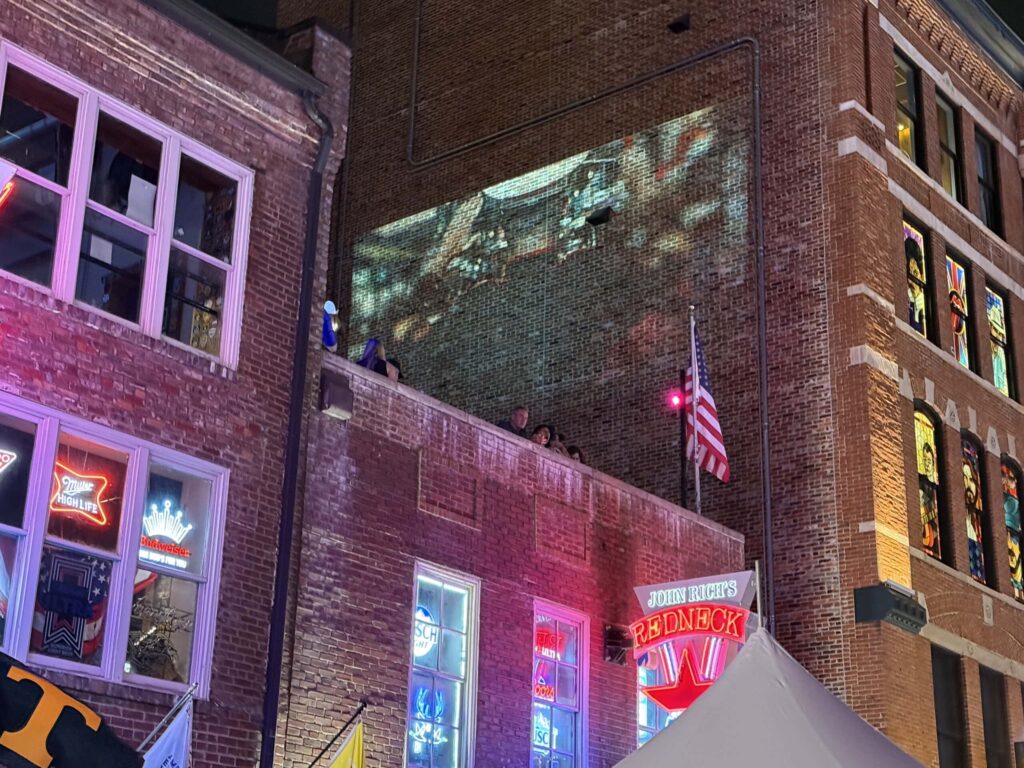
AGM’s projection client roster includes Netflix, Disney, Coca-Cola, FanDuel, Live Nation, iHeartRadio, and the US Marine Corps. A confirmed case study: the US Marine Corps × CMA Fest Nashville — multi-night projections onto architectural surfaces throughout the festival footprint, reaching 80,000+ attendees across the campaign window. Projection advertising scales across every brand category; what our campaigns share is scale, precision, and a physical presence digital cannot replicate.
Morgantown’s academic calendar shapes the campaign planning calculus in ways that are unique to university-town markets. The windows of maximum campaign value — when student density on High Street is at its peak — are the fall semester (August through December, excluding Thanksgiving) and the spring semester (January through April, excluding spring break). Summer offers lower foot traffic but also lower noise competition in the pedestrian environment, which can favor campaigns targeting Morgantown’s permanent resident community rather than its student population. Campaign timing relative to WVU’s exam calendar, major athletic events, and campus programming directly affects the audience density available for each campaign night.
Project on Morgantown's Highest-Traffic Walls
High Street, the Metropolitan Theatre district, the McQuain Amphitheatre — AGM deploys 20,000-lumen projection campaigns across Morgantown's most active corridors. Reach WVU's student population and the broader Morgantown community where they gather.
Browse Cities in West Virginia
Select a city to explore Guerrilla Projections opportunities.
High Street And The College Town Advantage
High Street is Morgantown’s most important projection advertising asset, and its advantages extend well beyond raw foot traffic numbers. The street’s function as the primary entertainment corridor for a major university town creates audience characteristics that go beyond mere density: these are young adults who are accustomed to encountering cultural and commercial messages in their environment and who have both the social media tools and the behavioral habits to convert a visual encounter into organic digital reach. A pedestrian on High Street at 9 PM on a Saturday night has their phone accessible, their social accounts active, and a social network full of peers who are interested in what is happening on High Street right now.
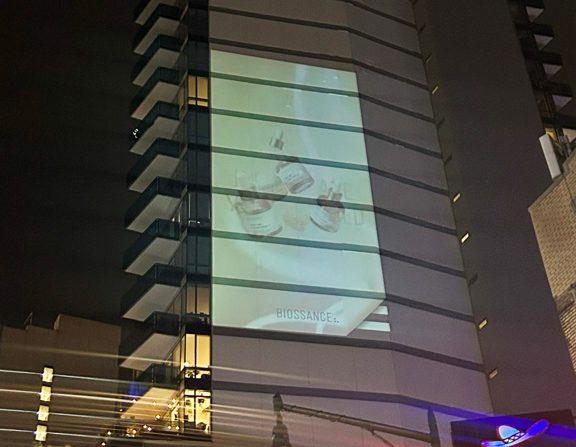
The building stock along High Street reflects its function as a university entertainment corridor. Two- and three-story commercial buildings housing bars, restaurants, and retail occupy most of the street’s active blocks, with blank wall sections visible above the ground-floor commercial layer on many buildings. The mix of painted brick, stucco-finished facades, and concrete building faces creates a surface inventory that favors campaigns with bold, high-contrast graphics whose visual impact reads clearly at 20–40 feet of image height — the scale achievable from typical High Street throw distances of 40–80 feet in the corridor’s urban geometry.
The concentration effect on High Street creates a multiplier for organic documentation that open-plaza or wide-boulevard projection zones cannot match. When a projection appears on a High Street wall during peak evening hours, the hundreds of pedestrians within visual range of the projected surface represent a simultaneous audience pool that documents the projection from multiple angles, in multiple social formats, and distributes that documentation into overlapping social networks whose cumulative reach is many times larger than the immediate physical audience. That multiplier is the college town advantage — and it is why Morgantown’s High Street consistently outperforms comparably sized markets on per-campaign organic reach metrics.
Surface Quality Along Morgantown's Projection Corridors
High Street Arts and Entertainment Corridor
High Street’s building inventory presents a varied surface profile that rewards careful pre-campaign scouting. The most productive projection surfaces along the corridor are the blank upper-floor wall sections of mid-block buildings — typically two- or three-story commercial construction from the early-to-mid 20th century, with painted masonry or stucco finishes that reflect AGM’s 20K-lumen output with better saturation than unpainted brick. Corner buildings on key High Street intersections often present side-wall faces that are blank from the second story upward and accessible from the perpendicular side street for projector positioning — a configuration that places the projected image at the visual intersection of two pedestrian streams, maximizing cumulative audience exposure within a single operating window. AGM’s physical scouting specifically identifies these corner-wall opportunities as among High Street’s highest-value campaign surfaces.
Metropolitan Theatre Arts District Area
The Metropolitan Theatre is one of Morgantown’s most architecturally significant historic venues, and the blocks surrounding it on High Street and the connecting streets have developed a distinct arts and entertainment identity anchored by independent businesses, performance venues, and the culturally engaged audiences they attract. The building stock in the Metropolitan Theatre district includes older commercial and institutional construction with masonry surfaces that range from rough brick — which requires the full 20K-lumen output for adequate saturation — to painted and plastered facades that perform significantly better for projection campaigns seeking vivid color output. The arts-oriented audience profile in this zone makes it particularly receptive to entertainment, cultural institution, and creative-sector brand campaigns whose creative aesthetic aligns with the historic character of the theater district.
Hazel Ruby McQuain Amphitheatre Area
The McQuain Amphitheatre sits along the Monongalia River adjacent to the Hazel Ruby McQuain park zone, providing an outdoor gathering infrastructure — seating, open lawn, river backdrop — that creates event-style audience concentrations on evenings when programming or casual public use draws community members to the space. The building surfaces adjacent to and near the amphitheatre zone include both institutional and commercial structures whose wall faces may support projection campaigns that use the outdoor gathering context as their audience platform. Campaigns timed to amphitheatre events or deployed during evening hours when the park draws leisure audience from the surrounding residential neighborhoods create a different audience profile than the High Street student concentration — older, more resident-community-oriented, and aligned with outdoor recreation and public space culture.
Plan Your Guerrilla Projection Campaign in Morgantown, WV
Tell us about your campaign goals, target audience, and preferred locations. Our team will help you plan a high-impact guerrilla projection campaign tailored to your needs.
Award Winning Personalized Service
You will get thoughtful, devoted, and individualized attention from our experienced, qualified, and professional personnel. Being one of the most illustrious agencies in Brooklyn, New York, American Guerrilla Marketing has been awarded the Best of Brooklyn title.
Nationwide
Industry City, Brooklyn, New York 11232
American Guerrilla Marketing
Hours
Mon - Fri: 9 AM - 5 PM
Sat & Sun: Closed
Automate your campaign with AGM’s Request for Proposal Builder.
Automate your campaign with AGM’s Request for Proposal Builder. Simply answer a few quick questions about your campaign goals, markets, and timeline, and the system will generate a tailored presentation with recommended strategies, quantities, and pricing. Click the RFP Builder to instantly receive your customized proposal.
Content That Lands with Morgantown Audiences
Advocacy and Community Campaigns
The WakeUp Coalition’s projection campaign in Austin demonstrated how a message with genuine community resonance generates extraordinary organic amplification from a young, engaged pedestrian audience — exactly the dynamic that Morgantown’s High Street student population produces. Advocacy campaigns whose content reflects the lived experiences and values of WVU’s student body and Morgantown’s progressive community find in High Street an audience that treats organic documentation of the projection as a form of political and social expression in its own right, extending the campaign’s reach far beyond the physical street.
Entertainment and Music Releases
WVU’s student population represents exactly the demographic profile that entertainment brands want to reach through out-of-home media: 18–26, music and streaming engaged, socially active, and accustomed to encountering entertainment content in their nighttime public environment. Album drops, streaming countdown campaigns, and entertainment release projections on High Street during active semester weekends reach this audience at peak receptivity and generate the highest organic documentation rates of any campaign type deployed in Morgantown’s primary corridor.
Consumer Brand Launches and Awareness
National and regional consumer brands entering the Morgantown market — or targeting the 18–26 demographic specifically — use High Street projections to establish visible brand presence in a corridor where the audience’s social network reach multiplies the physical campaign’s effective footprint by orders of magnitude. A brand that projects on High Street during a WVU game weekend reaches not just the thousands of pedestrians who encounter the wall directly but the thousands more who see the documentation shared by those pedestrians on Instagram, TikTok, and Snapchat throughout the same evening.
Public Health and Institutional Campaigns
WVU Health and its affiliated medical programs, state and county public health agencies, and student wellness organizations use Morgantown projections for public health awareness campaigns targeting a student population with documented receptivity to visual health communication in peer-facing public spaces. The format’s scale — a projection at 30–40 feet of image height on a building the audience walks past daily — converts a public health message from a flyer or screen ad into an environmental statement that reads as significant rather than dismissible.
Running A Projection Campaign In Morgantown
Morgantown campaign preparation begins with a physical scouting visit to High Street and the Metropolitan Theatre district, typically three to four weeks before the planned campaign date. AGM’s scouting team walks the corridor during daylight hours to assess surface dimensions, material and reflectivity, window density, and projector positioning options from the sidewalk and from side-street positions perpendicular to High Street. Evening scouting walks — conducted at the planned campaign hours to evaluate ambient light conditions, foot traffic patterns, and competing visual elements — supplement the daytime assessment with operational context that satellite review cannot capture.
High Street’s pedestrian density during peak campaign hours creates a logistical management consideration that differs from lower-density deployment environments. The projection crew must position equipment on a street where active pedestrian flow continues throughout the operating window, and the physical footprint of the generator and mobility unit must be managed without blocking pedestrian passage or interfering with the adjacent businesses’ normal operations. AGM’s pre-campaign scouting specifically identifies equipment positions that integrate cleanly into High Street’s active pedestrian environment — typically side-street or parking-adjacent positions that provide the required throw distance without occupying high-traffic walkway space.
Content calibration for Morgantown campaigns accounts for High Street’s relatively close projection geometry. Most usable High Street surfaces are accessible at 40–80 feet of throw distance, producing image heights of 25–45 feet — visible to the immediate pedestrian audience at close range and to any viewer with sightlines to the projected building from adjacent intersections. Content should be formatted for legibility at 15–80 feet of viewing distance, with text sized appropriately and graphic elements bold enough to read at both close range and the wider sightlines that High Street’s cross-intersections create.
Post-campaign documentation delivers high-resolution photo and video assets from multiple positions — including wide-angle captures that show the projection in the context of High Street’s active pedestrian environment — within five business days of the final campaign night. Those assets are produced specifically for social media distribution formats as well as formal campaign reporting, acknowledging that Morgantown clients typically want shareable documentation that communicates campaign scale and audience engagement alongside the formal operational record.
Morgantown Campaign Investment
Building projection advertising in Morgantown is priced at contact us for a quote. . That rate includes the 20,000-lumen commercial projection system, generator and integrated power solution, electronics bundle, mobility unit, and a two-person AGM technical crew managing all phases of the campaign from arrival through complete breakdown. Projection operations begin at dusk and run four to six continuous hours per night.
Advance location scouting for Morgantown is available at approximately Contact us for a custom quote. for the market, credited toward the total campaign investment for confirmed activations. Multi-night Morgantown campaigns carry the same per-night rate, with crew and equipment remaining in market between nights. Clients who want to run a Morgantown campaign in conjunction with a Charleston or Huntington activation across the same week can structure a multi-city West Virginia engagement that shares pre-campaign logistics across multiple markets.
Who Projects In Morgantown
Morgantown’s projection advertising market is anchored by three primary client categories. Entertainment brands — music labels, streaming platforms, film distributors — use High Street to reach the 18–26 demographic that represents their core consumer base, leveraging the student population’s documentation behavior to multiply campaign reach through organic social amplification. Advocacy organizations and civic campaigns use Morgantown’s politically engaged student population as both a direct audience and an amplification network, knowing that a message that lands with WVU students travels through their social networks to communities across West Virginia and the mid-Atlantic region. Consumer brands targeting the college-age demographic use High Street as a primary activation surface, treating Morgantown’s student concentration as both a target audience in its own right and a reach vehicle into the broader consumer networks those students inhabit. AGM’s national client experience — including work with the WakeUp Coalition and other advocacy and entertainment clients — informs every Morgantown campaign brief with strategic context on what content performs, what timing works, and how to position the activation for maximum organic reach within the university town environment.
Coverage & Estimated Impressions
| Zone / Area | Peak Hours | Foot Traffic | Est. Nightly Impressions | Best For |
|---|---|---|---|---|
| High Street Arts and Entertainment Corridor | 8PM–12AM | Moderate | 2,500–12,000 | Product Launch |
| Metropolitan Theatre Arts District Area | 8PM–12AM | Moderate | 2,500–12,000 | Event Promotion |
| Hazel Ruby McQuain Amphitheatre Area | 8PM–12AM | Moderate | 2,500–12,000 | Brand Awareness |
Frequently Asked Questions
High Street combines the highest pedestrian density in the Morgantown market with a student audience whose documentation and social sharing behavior multiplies campaign reach far beyond the physical audience count. No other corridor in the city produces the same concentration of engaged, social-media-active pedestrians per block during evening hours throughout the academic year. The street’s function as WVU students’ primary nighttime destination means that a projection deployed there is encountered by thousands of potential documenters within a single operating window.
WVU’s academic calendar directly determines the audience density available for High Street campaigns. The highest-value windows are the active weeks of the fall semester (late August through early December) and the spring semester (mid-January through late April). Exam periods reduce foot traffic as students shift from nightlife to library mode. Summer semester reduces the student population to a fraction of its fall and spring peak. AGM helps clients identify the specific semester weeks that align with their campaign objectives and audience targets within Morgantown’s academic calendar rhythm.
Yes, though the audience composition varies by campaign zone and time of week. High Street peak hours skew heavily toward the student population during the academic year. The Metropolitan Theatre district’s evening programming draws a broader resident and faculty audience alongside students. The McQuain Amphitheatre zone attracts community residents and families in addition to students, particularly on weekends when outdoor programming draws non-student Morgantown residents to the riverfront area. Multi-zone campaigns can deliberately target both audience segments by deploying in different districts.
Bold, high-contrast graphic content with immediate visual impact performs best with the college-age pedestrian audience on High Street. Motion content — animated loops, countdowns, dynamic typography — outperforms static images in documentation rates and social sharing frequency. Content with cultural references, humor, or challenge-format creative elements generates higher engagement from a demographic that has been trained to recognize and respond to social-media-native content formats. Text-heavy designs are less effective; strong graphic imagery with minimal but impactful copy works best in the medium’s physical context.
The Metropolitan Theatre district provides an arts-oriented complement to High Street’s entertainment-corridor character, drawing an audience that skews older and more artistically engaged than the typical student nightlife crowd. Campaigns whose creative aesthetic aligns with historic arts-district character — rather than the high-energy entertainment graphics optimized for High Street — perform particularly well in the Metropolitan Theatre zone. AGM evaluates the relative value of High Street versus Metropolitan Theatre placement for each campaign based on the client’s creative approach and audience objectives.
Yes, and game-day aligned campaigns in Morgantown are among the most effective the market offers. WVU football home games draw tens of thousands of fans into the Morgantown metro, with significant overflow into the High Street and downtown entertainment districts before and after games. Basketball home games at the WVU Coliseum generate a similar fan concentration. Projections deployed on High Street on game weekends reach both the resident student population and visiting fans from across West Virginia and neighboring states, producing audience breadth well beyond a standard semester weeknight campaign.
High Street’s wall inventory is medium-scale — primarily two- and three-story commercial buildings with blank upper-floor wall sections accessible at 40–80 foot throw distances — producing image heights of 25–45 feet. That scale is highly legible for pedestrians at close range on the corridor itself and visible to wider audiences from adjacent intersections. The Metropolitan Theatre district presents similar scale with slightly more varied surface character. The McQuain Amphitheatre zone offers lower-density surface options with more open throw geometry, potentially allowing larger image dimensions on suitable institutional building faces in the vicinity.
AGM’s crew positions all equipment — projector, generator, mobility unit — in side-street or parking-adjacent positions that maintain the required throw distance to the target wall without occupying High Street’s active pedestrian walkway. This typically means projecting from a perpendicular side street or from a parking-adjacent position at the mouth of an alley or cutthrough adjacent to the main corridor, rather than from a position on High Street itself. The physical scouting process specifically identifies deployment positions that integrate the equipment footprint into the street geometry without disrupting pedestrian flow or creating safety concerns in the active nighttime environment.
Yes. Morgantown’s student population and High Street’s documentation behavior make it an excellent test environment for campaign concepts targeting the 18–26 demographic. The market’s concentrated audience, its high organic amplification rates, and its manageable operational scale allow campaign concepts to be validated — creative performance, surface positioning, operating window timing — at lower total cost than a major metro test while producing audience engagement data that is directly applicable to larger university-town and college-market deployments. AGM can structure a Morgantown test campaign with the explicit design objective of generating performance data for subsequent larger-market scaling.
Large WVU events — football games, graduation ceremonies, major concerts at the Coliseum — can shift pedestrian flow patterns in ways that affect campaign positioning. AGM’s pre-campaign scouting includes an assessment of any major events scheduled on or adjacent to the planned campaign date, and the crew monitors on-the-ground conditions on the campaign night before committing to the final equipment position. If event-driven pedestrian changes require a position adjustment, the crew uses the pre-identified backup positioning options to maintain campaign coverage while adapting to the modified audience flow pattern.
AGM recommends three to four weeks of advance lead time for standard Morgantown campaigns. For campaigns aligned with specific WVU events — football game weekends, homecoming, graduation — four to six weeks of advance booking is advisable, as location demand in the High Street corridor increases around high-traffic academic events. Summer campaigns, which benefit from lower logistical competition for prime locations, can often be arranged in two to three weeks. Rush bookings within two weeks are sometimes possible but may limit surface options and creative production time.
The McQuain Amphitheatre zone and the adjacent riverfront park area can support projection campaigns that use the outdoor gathering context — the audience assembled for events or using the park for leisure — as the projection audience base. Suitable building surfaces in proximity to the amphitheatre need to be confirmed through physical scouting, as the park zone’s open character and landscaping create obstructions that differ from street-corridor deployments. For campaigns specifically targeting the amphitheatre audience during event programming, AGM coordinates timing and positioning with the facility’s event calendar and any applicable park-use permit requirements.
More AGM Outdoor Advertising Services
Led Billboard Trucks
Mobile LED displays that bring your brand to any location, any event.

Fly Posting
Street-level poster saturation across walls, construction sites, and corridors.

Sidewalk Decals
Ground-level branded decals at pedestrian hotspots and event entrances.

Sidewalk Stencils
Creative stencil campaigns that put your brand in the path of pedestrians.