American Guerrilla Marketing
Nationwide Service
Media planning, media buying, billboard advertising, & guerrilla marketing
Guerrilla Projections in Charlotte, NC
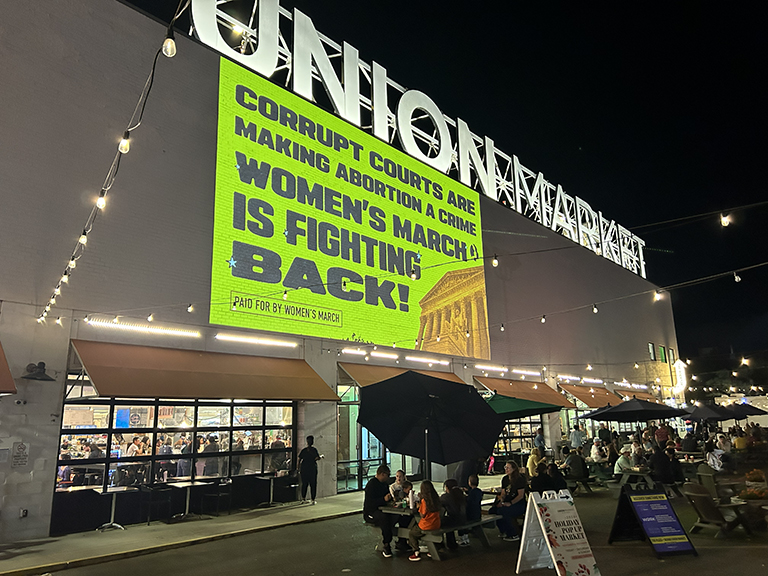
The Queen City runs on two tracks — corporate banking power and a surging creative nightlife — and AGM’s 20,000-lumen projection campaigns are built to reach both audiences where they actually spend their evenings.
Charlotte’s Dual Identity Is a Projection Advertiser’s Advantage
Charlotte is the kind of city that confounds advertisers who try to fit it into a single category. As the second-largest banking hub in the United States by assets, it anchors a metropolitan economy built on financial services, corporate headquarters, and a professional class that relocates here from New York, Boston, and Chicago with sophisticated brand awareness and strong disposable income. At the same time, neighborhoods like Camp North End, NoDa, and South End have produced a genuinely thriving creative economy — arts studios, independent restaurants, gallery walk circuits, converted warehouse-turned-social destinations — that draws an equally engaged but entirely different audience out into the streets on weekend and weekday evenings alike.
Guerrilla projection advertising is one of the few formats that operates effectively across both of these audiences simultaneously. A 20,000-lumen projection on a Camp North End warehouse face reaches the creative and arts-forward crowd moving through that complex on a Friday evening. The same format deployed near Spectrum Center on a Panthers game night reaches the financially comfortable Uptown professional streaming out of the arena district after a game. Neither audience is easy to reach through conventional outdoor media — the creative crowd is ad-skeptical by nature, and the Uptown professional class has long since moved their attention away from static billboard placements. Building facade projection commands attention from both cohorts precisely because it is unexpected, physically dominant, and impossible to scroll past.
Charlotte’s population growth story is another major factor that brands frequently overlook when evaluating the market. The metro has added hundreds of thousands of residents over the past decade, and a substantial portion of those arrivals are young professionals who relocated from other major cities and have not yet been conditioned by Charlotte’s existing outdoor media inventory. They haven’t driven past the same billboards for years. They haven’t developed the unconscious filtering that longtime locals apply to familiar advertising placements. Projection advertising lands on this large newcomer segment as a genuinely novel visual encounter — the kind of surprise that drives social sharing and brand recall in ways that established media formats in saturated markets cannot replicate.
Charlotte Is Ready. Are You?
Camp North End's warehouse walls. NoDa's gallery district facades. South End's restaurant corridor building faces. AGM deploys 20,000-lumen projection across Charlotte's best surfaces — contact us for a quote. complete crew and equipment included.
Our Campaign Locations
Browse Cities in North Carolina
Select a city to explore Guerrilla Projections opportunities.
How Advocacy Campaigns Use Building Projection In The Queen City
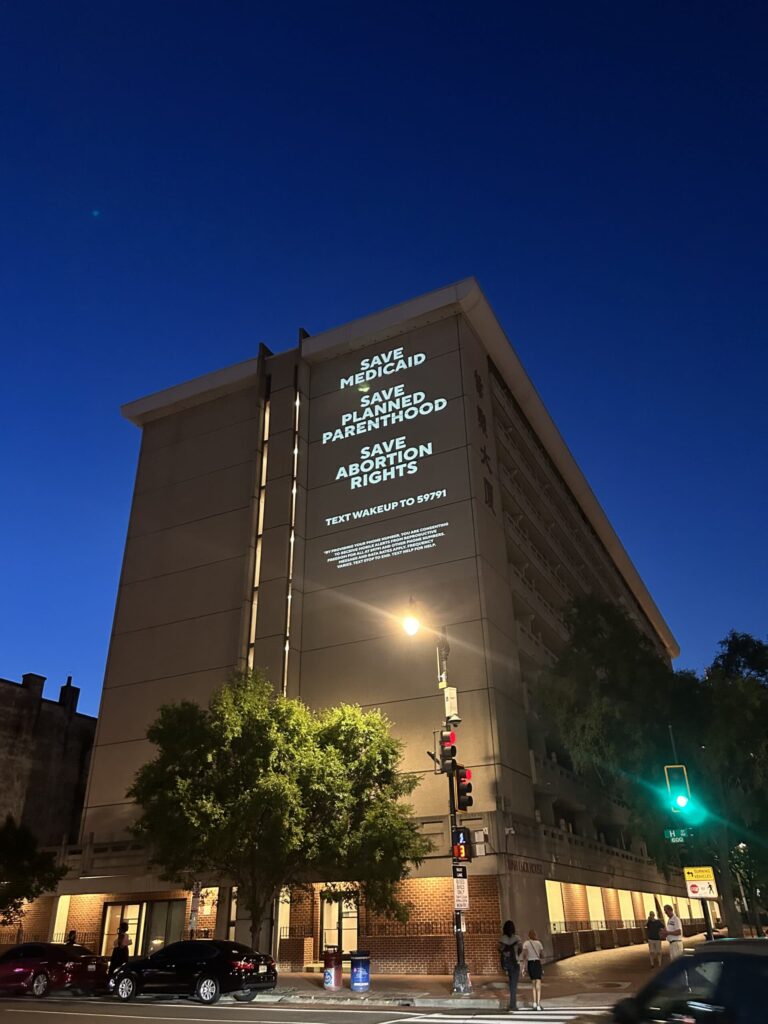
American Guerrilla Marketing ran building facade projection campaigns during the Women’s March in Washington, DC — one of the largest public demonstrations in American political history — amplifying advocacy messaging into the evening hours on DC building exteriors when traditional signage had gone dark and the physical presence of the march was winding down. The campaign extended the visibility of the movement’s messaging beyond the march’s formal conclusion, reaching both participants and passersby moving through the city after dark. It demonstrated a core principle that applies to every advocacy campaign AGM has executed: projection advertising does not compete with the event — it extends the event’s presence into the urban fabric after the organized programming ends.
Charlotte’s civic environment makes advocacy projection an especially productive format in the right campaign windows. As a major Southern metro with a politically diverse population, a large HBCU community through Johnson C. Smith University and nearby institutions, and a Uptown district that hosts civic gatherings, marches, and public demonstrations with regularity, Charlotte generates the kind of engaged public audience that advocacy projection advertising is designed to reach. The format’s physical scale — filling an entire building face with messaging at a brightness that commands attention from a block away — operates at a register that advocacy content on social platforms simply cannot match in the physical space of a city.
The timing logic for advocacy campaigns in Charlotte parallels the Women’s March approach: project when the target audience is already concentrated and emotionally engaged. If a community event is drawing people into a Charlotte neighborhood at night, a projection on a nearby building face captures that audience with full visual saturation. If a civic moment is creating pedestrian movement through Uptown or South End, the projection advertising goes to where the people are rather than waiting for them to encounter a static placement. AGM’s scouting team can identify surfaces within practical proximity of Charlotte’s civic gathering points, and the mobility unit allows repositioning if campaign conditions shift.
Charlotte's Best Projection Surfaces
Charlotte’s building stock varies dramatically across its neighborhoods, and surface quality for projection advertising follows that variation closely. The neighborhoods below contain the city’s highest-value projection real estate — each chosen because of the combination of wall quality, pedestrian volume, and nighttime audience character that makes the physical location productive as a campaign environment. AGM scouts evaluate every proposed Charlotte surface individually, but these corridors represent the city’s established projection infrastructure.
Camp North End
The former industrial manufacturing complex on North Tryon Street is the single most technically valuable projection location in Charlotte. The massive smooth painted warehouse exteriors offer long, unbroken wall runs with minimal window interruption across multiple connected structures — exactly the kind of surface that a 20,000-lumen projection system fills with sharp, vivid, full-color content at maximum impact. Camp North End has evolved into a mixed-use arts destination with food halls, creative offices, gallery space, and event venues that draw a consistent and engaged weekend evening crowd. The audience here is the creative professional demographic: educated, brand-aware, digitally connected, and exactly the kind of person who photographs a striking projection and posts it organically. Private-property arrangements with Camp North End’s management can unlock access to some of the finest wall surfaces in the Southeast for permitted projection placements.
NoDa — North Davidson Arts District
The North Davidson Arts District is Charlotte’s most established arts neighborhood, concentrated along 36th Street and the Davidson Street corridor in converted mill structures and gallery buildings with flat painted masonry facades well-suited to mid-scale projection. NoDa hosts gallery walk nights that draw consistent pedestrian traffic through the district on designated evenings, with bars and restaurants maintaining active patronage throughout the week. The building faces along this corridor — many of them former industrial structures adapted for arts and commercial use — offer flat painted masonry that reflects a 20,000-lumen system cleanly when surface color is adequate. NoDa’s audience is distinctly creative and community-oriented: the kind of people who stop, discuss, and share visual experiences rather than walking past without engagement.
South End Entertainment Corridor
The converted warehouse buildings strung along the light rail through South End represent Charlotte’s most commercially concentrated nighttime pedestrian corridor. Restaurant and bar density along the light rail spine drives heavy foot traffic Thursday through Saturday evenings, with the pedestrian pattern being specifically useful for projection advertising: people are moving slowly, stopping frequently at outdoor seating, and looking across the street at building faces as part of the natural visual behavior of navigating a restaurant district at night. The flat industrial building faces on the non-street-front sides of South End warehouse structures — particularly on the less-trafficked cross streets — offer strong projection surfaces with the South End pedestrian audience in clear view. Timing a projection for peak Thursday or Saturday evening traffic can reach thousands of pedestrians in a single operational night.
Uptown Charlotte — Arena District near Spectrum Center
The arena district surrounding Spectrum Center is Charlotte’s highest peak-traffic outdoor environment on Panthers NFL and Hornets NBA event nights. Corporate building towers and entertainment venue exteriors provide building faces visible from the streets that tens of thousands of fans flood during pre-game and post-game windows. Smooth corporate building facades and the blank end walls of entertainment venue structures offer viable projection surfaces when viewing geometry can be established at adequate distance. The audience on event nights is unique among Charlotte’s projection locations: demographically diverse, economically comfortable, emotionally activated by the event, and physically concentrated in a multi-block radius around the arena for predictable multi-hour windows. AGM scouts Uptown surfaces on a campaign-by-campaign basis given the density of competing visual stimuli and the permitting complexity of the CBD environment.
LoSo — Lower South End Arts Area
The emerging Lower South End creative zone south of downtown Charlotte is in the early stages of the neighborhood transformation that South End completed a decade earlier. Newer blank stucco and painted concrete mid-rise building faces stand alongside converted warehouse structures, and the growing nighttime restaurant and bar scene is producing increasing evening pedestrian density week over week as new tenants continue to arrive. For brands seeking to establish presence in a Charlotte neighborhood before it reaches saturation — with excellent wall surfaces, a growing but not yet crowded creative audience, and significantly less competing visual advertising than South End or NoDa — LoSo represents a genuine opportunity. AGM scouts LoSo surfaces with particular attention to wall orientation, construction quality, and pedestrian traffic patterns as the neighborhood continues to densify.
Plan Your Guerrilla Projection Campaign in Charlotte, NC
Tell us about your campaign goals, target audience, and preferred locations. Our team will help you plan a high-impact guerrilla projection campaign tailored to your needs.
Award Winning Personalized Service
You will get thoughtful, devoted, and individualized attention from our experienced, qualified, and professional personnel. Being one of the most illustrious agencies in Brooklyn, New York, American Guerrilla Marketing has been awarded the Best of Brooklyn title.
Nationwide
Industry City, Brooklyn, New York 11232
American Guerrilla Marketing
Hours
Mon - Fri: 9 AM - 5 PM
Sat & Sun: Closed
Automate your campaign with AGM’s Request for Proposal Builder.
Automate your campaign with AGM’s Request for Proposal Builder. Simply answer a few quick questions about your campaign goals, markets, and timeline, and the system will generate a tailored presentation with recommended strategies, quantities, and pricing. Click the RFP Builder to instantly receive your customized proposal.
Creative Formats That Work in the Queen City
Financial Services Brand Campaigns
Charlotte’s banking culture generates a client base that traditional outdoor advertising struggles to reach with novelty. Financial services brands — wealth management, fintech, corporate banking subsidiaries — use Camp North End and South End projections to reach the professional demographic in a non-corporate visual environment that reframes brand perception. A building-scale campaign at night in a creative district sends a distinct signal about a financial brand that a Uptown billboard cannot replicate.
Advocacy & Community Campaigns
Charlotte’s civic identity — shaped by its diverse and growing population, its HBCU heritage, and its ongoing evolution as a Southern progressive metro — makes it a strong market for advocacy projection advertising. The Women’s March projection model — amplifying messaging onto building facades during and after major public gatherings — translates directly to Charlotte’s civic environment during demonstrations, community events, and legislative action moments.
Consumer Brand Launches
Brands launching in the Southeast use Charlotte as a flagship market because of its demographic diversity, high income levels, and social connectivity. A Camp North End projection on a Friday night reaches a cross-section of Charlotte’s creative professional class in a single evening. A South End projection on a Saturday reaches the millennial restaurant-goer demographic at peak concentration. Both are achievable within the same campaign budget and scouting investment.
Sports & Entertainment Activation
Charlotte’s Panthers and Hornets home game schedule creates reliable event-aligned projection windows around Spectrum Center throughout the NFL and NBA regular seasons. Music events at Spectrum Center and PNC Music Pavilion add additional high-density windows. Entertainment properties — streaming platforms, music labels, gaming brands — find the event-aligned projection format particularly effective for reaching the 21–40 demographic that Charlotte sports audiences over-represent.
Startup & Tech Market Entry
Charlotte’s growing fintech and healthcare tech sectors have created a startup ecosystem that increasingly looks for differentiated marketing formats to signal momentum and credibility. A building projection campaign in Camp North End or NoDa, timed to a product launch or funding announcement, reaches the local tech and creative professional community with a level of visual impact that press releases and digital ads do not achieve in the physical city.
Real Estate & Development Marketing
Charlotte’s perpetual construction and development boom has created an active market for real estate projection campaigns targeting buyers and renters in the demographic corridors adjacent to new projects. Projecting a development’s brand or lifestyle imagery onto blank building faces in the target neighborhood — NoDa, South End, LoSo — reaches exactly the aspirational residents those projects are built to attract, in the neighborhood context where the purchase decision is made most viscerally.
How Agm Scouts And Evaluates Charlotte Projection Surfaces
Charlotte’s building inventory varies considerably from one block to the next, and the difference between a high-performing projection surface and a visually marginal one can be a single variable: the tone of the painted exterior, the presence of a tree line breaking the beam path, or a window configuration that fragments the image across five feet of glass. AGM’s national scouting team — combining digital analysis with physical on-the-ground evaluation — documents every proposed Charlotte surface before any campaign goes to execution. The goal is to ensure that on the night of deployment, the surface performs at the standard a 20,000-lumen commercial projection system is capable of.
The surface variables AGM evaluates in Charlotte follow a consistent framework. Reflectivity comes first: the whiter and smoother the wall, the more fully the projector’s output translates into a vivid, high-contrast image. Charlotte’s former industrial buildings in Camp North End, NoDa, and LoSo often feature painted masonry or smooth stucco exteriors that hit the high end of the reflectivity range. Darker brick — common in older downtown Charlotte structures — absorbs lumens rather than reflecting them, producing a dimmer, less saturated image that reduces campaign impact. Where a dark-brick surface is the only option for a specific campaign location, AGM advises clients on realistic expectations relative to the output from an ideal white surface.
Flatness and continuity are evaluated in tandem with color. A flat, unbroken wall plane — the primary reason Camp North End’s warehouse faces are so highly valued — allows the full projection image to land sharp from edge to edge. Rounded corners, architectural protrusions, irregular surface features, and window openings all introduce distortion and dead zones that fragment the projected image. For Charlotte campaigns, AGM prioritizes surfaces where the available blank wall area matches or exceeds the intended projection frame, with adequate throw distance — typically 100 to 200 feet — available from a stable projector position on the mobility unit. The mobility unit itself provides flexibility in positioning that fixed-mount systems lack, allowing AGM’s crew to optimize the throw angle on execution night based on actual site conditions.
Pedestrian viewing geometry completes the assessment. A technically excellent wall surface in a Charlotte alley that no one walks past after dark has no advertising value regardless of its reflectivity. AGM’s scouting maps pedestrian traffic flow, identifies the natural viewing angles from sidewalks and outdoor dining areas, and confirms that the projection surface is oriented to maximize exposure to the evening pedestrian audience. In South End, that often means projecting on the faces of warehouse buildings visible from the light rail pedestrian crossings and restaurant patio positions. In NoDa, it means targeting the building faces that the gallery walk circuit naturally orients toward. The scouting phase exists to ensure that the campaign’s visual impact is matched by genuine audience delivery.
The AGM Campaign Process in Charlotte
Charlotte campaigns follow the same rigorously structured four-phase process that AGM applies to every national engagement. Advance scouting deploys AGM’s team to Charlotte for both digital pre-analysis and physical ground inspection of candidate surfaces. Every location is evaluated across the full technical checklist — reflectivity, flatness, beam path obstructions, viewing geometry, pedestrian traffic volume, and any permitting considerations specific to the Charlotte municipality. The scouting phase costs approximately contact us for a quote. produces a ranked shortlist with full documentation, photography, and GPS records for every evaluated surface.
Creative development follows scouting. AGM’s production team works with clients to develop projection content engineered specifically for exterior building display at the scale Charlotte’s warehouse surfaces demand. Typography must be bold and legible at 100 feet or more. Color contrast must be high enough to read clearly against the ambient light of Charlotte’s nighttime entertainment corridors. Motion, when incorporated, must be deliberate and slow enough for pedestrians to register in a brief viewing window. The creative developed for a Charlotte building projection is fundamentally different from a social media graphic or a digital display ad — it is designed for the physical, three-dimensional environment of a nighttime city block.
Execution night brings AGM’s own direct technical crew — our operators, not subcontractors, a distinction that matters for quality control and accountability — to the confirmed Charlotte location with the complete operational package: 20,000-lumen projector, generator and power solution, full electronics bundle, and mobility unit. Setup begins before dark. From dusk, the projection runs for four to six hours with continuous crew operation. For multi-night Charlotte campaigns — a Thursday-Friday-Saturday run through South End during peak traffic windows, for example — the same surface can be activated on successive evenings, dramatically compounding the total impression count without restarting the scouting or creative investment.
Pricing For Charlotte Projection Advertising
Charlotte projection advertising is priced at contact us for a quote. This rate includes everything required to execute the campaign: the 20,000-lumen commercial projection system, self-contained generator and power solution, full electronics bundle, mobility unit, and a two-person technical crew handling setup, operation through the night, and complete breakdown. It is an all-in operational rate with no separate line items for equipment rental, crew labor, or transportation within the Charlotte metro.
Advance location scouting runs approximately Contact us for a custom quote. for the Charlotte market, covering full digital and physical surface evaluation, GPS documentation, pedestrian traffic mapping, and permitting research. For campaigns requiring formal private-property arrangements — such as building owner agreements at Camp North End, South End venues, or NoDa commercial properties — location rights are structured separately and typically range from Contact us for a custom quote. per night depending on property terms.
Multi-night Charlotte campaigns are strongly advisable for brands seeking meaningful cumulative impression counts. Executing on Thursday, Friday, and Saturday in South End, for instance, reaches the peak pedestrian windows of Charlotte’s busiest entertainment days across three separate crowd cycles. The scouting and creative development investment stays fixed regardless of the number of execution nights, making the incremental cost of additional nights dramatically lower than the cost of the initial night when amortized across the full campaign.
Who Uses Guerrilla Projection in Charlotte
Charlotte’s client base for building projection advertising reflects the city’s economic and cultural breadth. Financial services firms — banks, wealth management companies, fintech startups launching in the Southeast — use projection campaigns to reach the professional class in creative district environments that reframe brand perception. Consumer brands entering the Southeast market choose Charlotte as a flagship projection city because of its demographic diversity, strong income levels, and the earned media potential of a Camp North End or South End facade campaign generating social sharing. Advocacy organizations targeting Charlotte’s civic audiences use projection during and after public gatherings. Entertainment properties activate the city’s Hornets and Panthers event night audience with sports-aligned campaign timing.
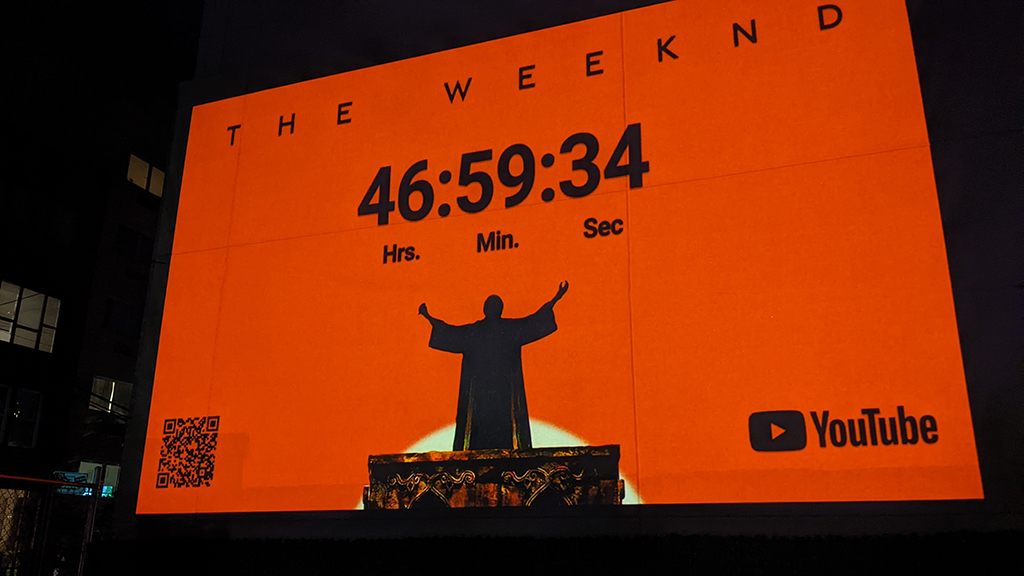
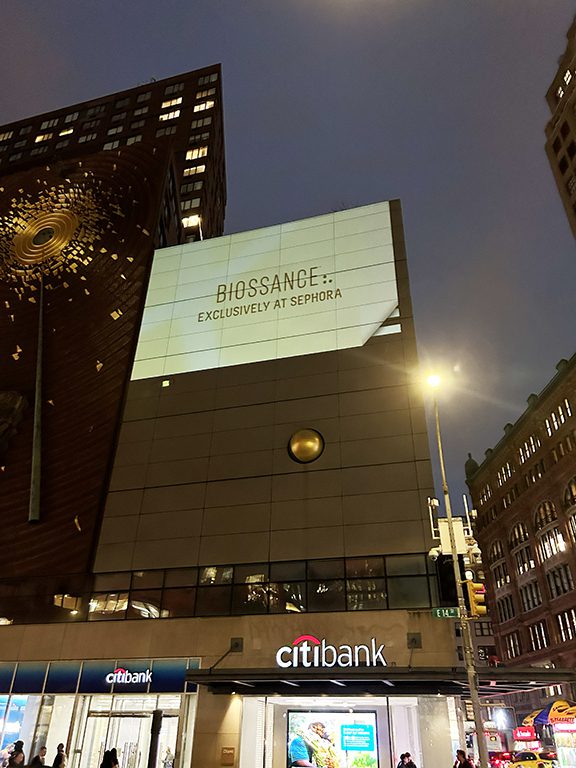
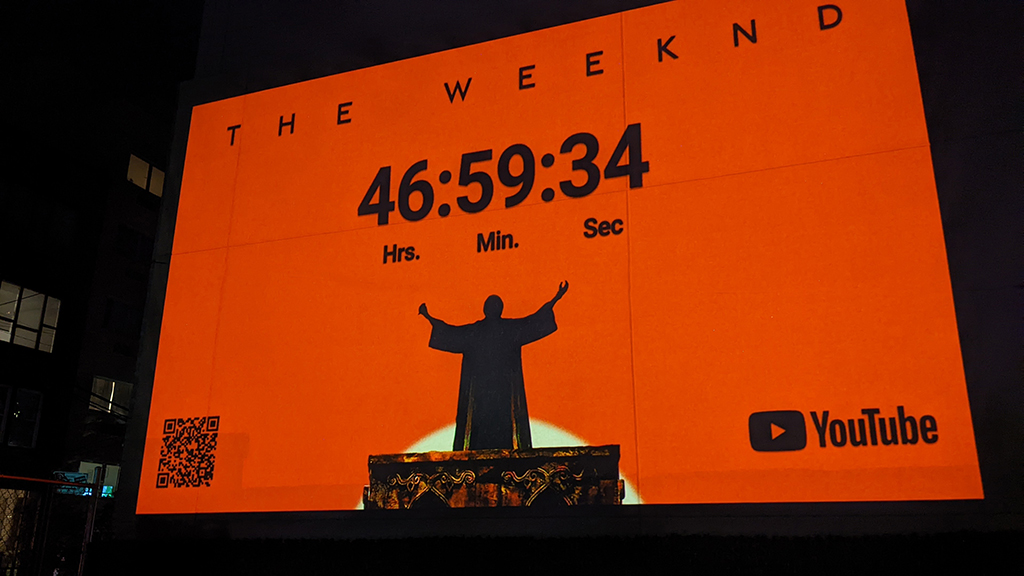
AGM holds a Best of Brooklyn industry recognition and counts among our clients organizations including Biossance, The Weeknd, the US Marine Corps, Women’s March, Reproductive Freedom for All, and YouTube. Our national scouting team brings both digital and physical on-the-ground evaluation to every Charlotte engagement, and GPS-documented post-campaign reporting gives every client a clear accountability record for what was executed and where. The direct technical crew model — AGM’s own operators on every job — means that the quality control standards applied to our highest-profile national campaigns apply equally to every Charlotte projection night.
AGM’s projection client roster includes Netflix, Disney, Coca-Cola, FanDuel, Live Nation, iHeartRadio, and the US Marine Corps. A confirmed case study: the US Marine Corps × CMA Fest Nashville — multi-night projections onto architectural surfaces throughout the festival footprint, reaching 80,000+ attendees across the campaign window. Projection advertising scales across every brand category; what our campaigns share is scale, precision, and a physical presence digital cannot replicate.
Coverage & Estimated Impressions
| Zone / Area | Peak Hours | Foot Traffic | Est. Nightly Impressions | Best For |
|---|---|---|---|---|
| Camp North End | 9PM–2AM | Very High | 25,000–120,000 | Product Launch |
| NoDa | 9PM–2AM | Very High | 25,000–120,000 | Event Promotion |
| South End Entertainment Corridor | 9PM–2AM | Very High | 25,000–120,000 | Brand Awareness |
| Uptown Charlotte | 9PM–2AM | Very High | 25,000–120,000 | Political |
| LoSo | 9PM–2AM | Very High | 25,000–120,000 | Sports |
Frequently Asked Questions
Yes, and event nights near Spectrum Center represent some of Charlotte’s strongest pedestrian density windows for outdoor projection. Pre-game and post-game pedestrian flows through the Uptown arena district are concentrated, predictable, and emotionally activated — the ideal conditions for building facade advertising to land with maximum attention. AGM scouts Uptown surfaces within practical proximity of Spectrum Center for event-aligned campaigns, identifying wall positions that capture the natural pedestrian flow on game nights without requiring permits that the CBD’s more heavily regulated core might involve.
Camp North End’s building management team is the appropriate contact for private-property projection arrangements on the campus, and AGM’s advance scouting phase includes outreach to property management as part of the permitting and access research for every proposed location. Private-property arrangements at venues like Camp North End — where building owner cooperation unlocks access to some of the Southeast’s finest blank wall surfaces — add a location rights cost that typically ranges from Contact us for a custom quote. per night, in addition to the . -projector equipment and crew rate.
NoDa gallery walk nights concentrate exactly the audience most likely to stop, engage with, and share a building projection — arts-forward, creative-economy-adjacent residents who are actively looking for visual experiences as part of the evening’s purpose. Unlike a general pedestrian flow moving through a corridor toward a destination, gallery walk attendees are already oriented toward visual engagement and community gathering. They stop longer, discuss what they see with companions, and photograph it at a higher rate than comparable crowds in other Charlotte districts. AGM times NoDa projection campaigns to align with gallery walk dates whenever possible for maximum audience receptivity.
The South End light rail creates a linear pedestrian spine that concentrates movement along a predictable corridor, making it easier to identify projection surfaces that the maximum pedestrian volume passes by or faces during peak hours. The light rail’s own lighting and the restaurant strip’s ambient illumination create a brighter ambient environment than some other Charlotte corridors, which is a factor AGM accounts for in projector placement — positioning the projector at closer throw distance when possible to maintain image brightness relative to the ambient light level. Thursday through Saturday evenings in South End deliver Charlotte’s highest consistent restaurant-district foot traffic, making those nights the strongest execution windows for a South End projection campaign.
Financial services firms, professional services brands, and technology companies with enterprise sales motions have found Charlotte’s Uptown environment productive for projection campaigns aligned to specific corporate event windows — financial industry conferences, bank shareholder events, and professional association gatherings that bring large numbers of financial professionals into Uptown’s entertainment corridors on scheduled evenings. Consumer fintech brands and wealth management platforms in particular have used building facade campaigns in Uptown as a way to reach the demographic most likely to become high-value customers in a format that communicates scale and confidence rather than the transactional tone of digital direct-response advertising.
LoSo’s current pedestrian density is meaningfully lower than South End or NoDa, which is both a limitation and an opportunity depending on the campaign objective. For brands primarily focused on raw impression count, LoSo is not yet the right Charlotte neighborhood. For brands that want premium wall surfaces — LoSo’s newer construction delivers some of the cleanest blank stucco and painted concrete in Charlotte — in an environment where the projection stands out rather than competing with high ambient commercial activity, LoSo offers a genuinely uncrowded visual environment. As LoSo’s restaurant and nightlife density increases over the next few years, the neighborhood’s projection value as both surface quality and audience size will increase simultaneously.
Multi-night Charlotte campaigns running Thursday through Saturday in South End are operationally straightforward and highly advisable for campaigns focused on maximizing total impression counts. The three peak nights of South End’s restaurant and bar week each attract distinct crowd compositions — Thursday’s after-work professional crowd, Friday’s mixed dining-first audience, and Saturday’s highest-density recreational foot traffic — giving the campaign three separate passes at the corridor’s pedestrian audience rather than the single exposure a one-night deployment produces. The scouting, creative, and logistics overhead is identical for a one-night or three-night run, making the incremental cost per additional night the straightforward per-projector rate of contact us for pricing.
Charlotte’s rapid population growth has delivered a large class of recent arrivals who have not been conditioned by years of exposure to the city’s existing billboard and outdoor ad inventory. Longtime Charlotte residents have developed the unconscious filtering that urban populations apply to familiar advertising placements — the brain learns to tune out signage it has seen hundreds of times. New arrivals have not developed that filter yet. A building projection is visually unexpected regardless of how long you’ve lived in Charlotte, but it lands as especially novel on someone who has been in the city for fewer than three years and hasn’t built up deep familiarity with any specific corridor’s visual landscape. Given how many Charlotte newcomers fit that profile, the format’s freshness advantage is particularly potent in this market right now.
The most effective Charlotte projection campaigns for a dual audience use visual design that operates at two reading distances simultaneously: bold, graphic imagery that reads as a striking visual statement from a block away for the fast-moving pedestrian, and a more detailed compositional element — brand identity, product imagery, or a short message — that rewards the closer engagement of someone who stops to look. The corporate professional audience responds to scale and production quality as signals of brand credibility. The creative audience responds to visual craft, unexpected composition, and conceptual interest. A campaign that delivers on both registers — visually bold at distance, visually rich on closer engagement — performs across both Charlotte audience segments without requiring separate executions for each neighborhood.
Camp North End’s industrial heritage is one of its greatest advantages as a projection environment. The former manufacturing complex’s buildings were constructed for pure function, which means the exterior walls are large, flat, continuous, and architecturally featureless — no ornamental facades, no regular window grid interrupting the wall surface, no curved or angled architectural gestures that distort a projected image. The whitewashed and painted plaster exteriors on many of Camp North End’s warehouse structures reflect light cleanly and at high efficiency. Newer Charlotte construction, by contrast, often features more architectural expression — irregular window patterns, surface treatments, decorative elements — that reduce the blank, flat, reflective wall area available for projection. For sheer technical surface quality, Camp North End competes with the best industrial-heritage projection environments in the Southeast.
AGM’s post-campaign documentation captures on-site photography and video of the active projection, GPS-verified location records, and structured reporting — the documentation that clients use for internal evaluation and proof-of-performance. Organic social sharing from Charlotte passersby is not systematically tracked by AGM but is a regular byproduct of high-visibility projection campaigns in NoDa, Camp North End, and South End, where smartphone-carrying foot traffic is dense and content-sharing behavior is active. AGM recommends that clients establish a search monitoring protocol for campaign-specific hashtags or brand mentions in the Charlotte market during and immediately following execution nights to capture the earned media conversation that projection campaigns typically generate.
Our Campaign Locations
Browse All States
Explore Guerrilla Projections opportunities across the United States.
49 States • 192 Cities
More AGM Outdoor Advertising Services
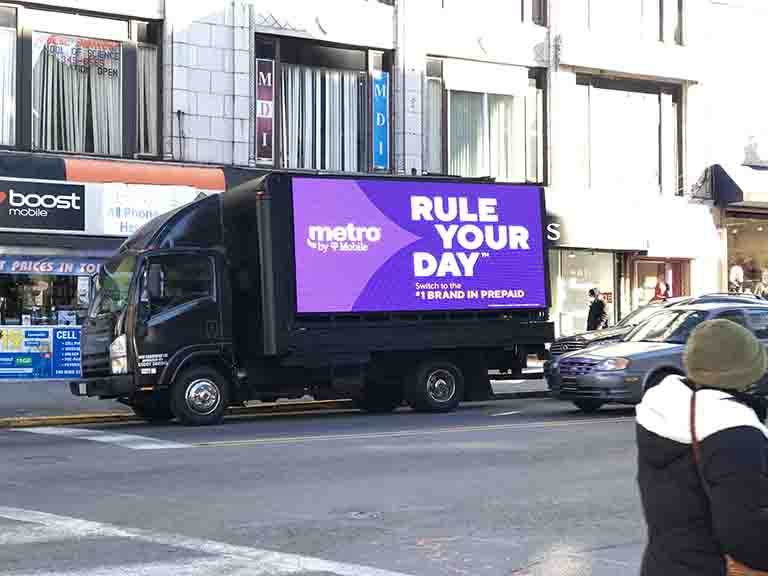
Led Billboard Trucks
Mobile LED displays that bring your brand to any location, any event.
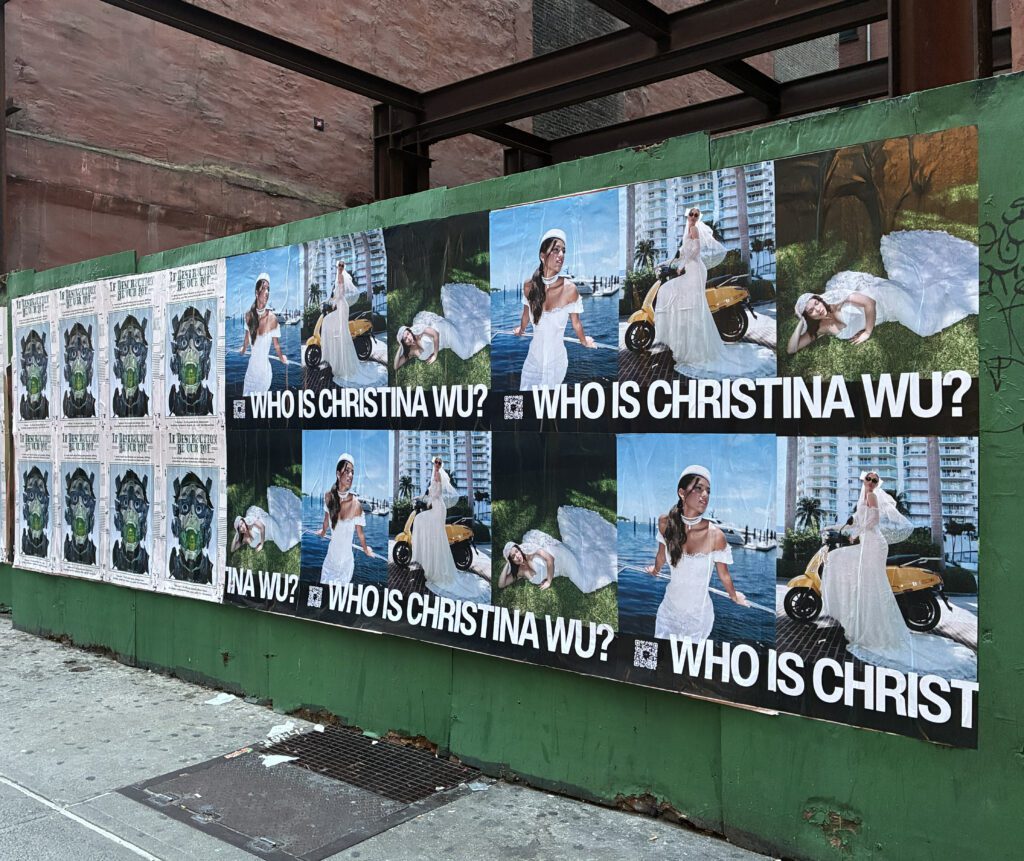
Fly Posting
Street-level poster saturation across walls, construction sites, and corridors.

Sidewalk Decals
Ground-level branded decals at pedestrian hotspots and event entrances.

Sidewalk Stencils
Creative stencil campaigns that put your brand in the path of pedestrians.