American Guerrilla Marketing
Nationwide Service
Media planning, media buying, billboard advertising, & guerrilla marketing
Guerrilla Projections in Knoxville, TN

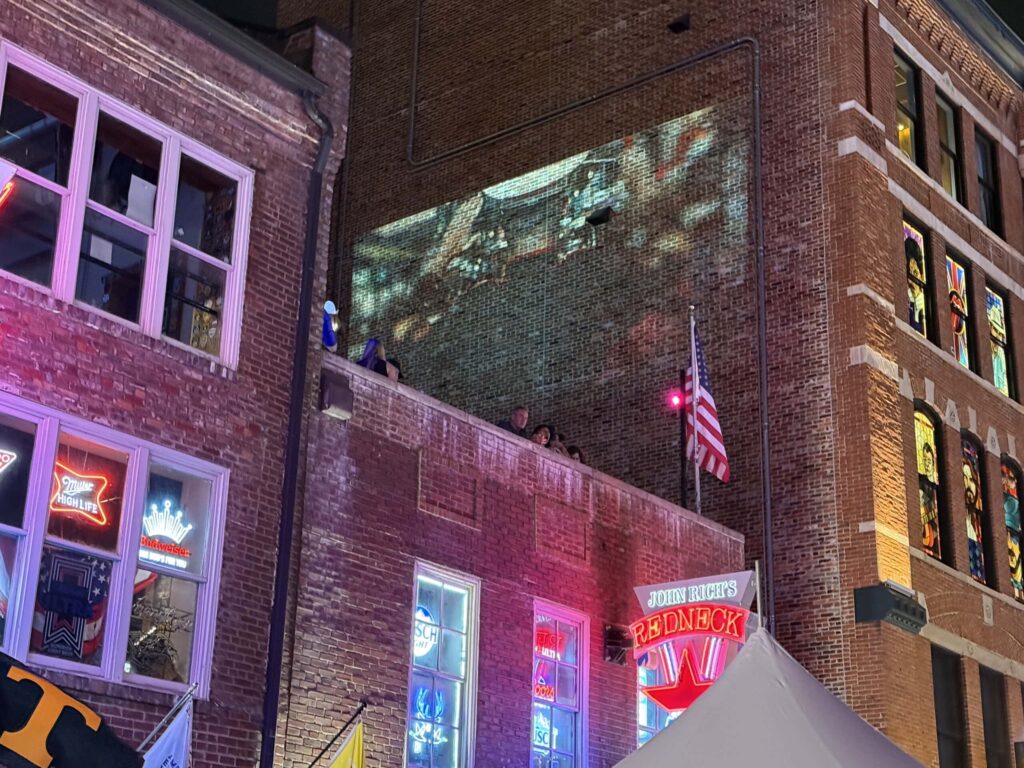
Old City is Knoxville’s projection advertising sweet spot — dense nightlife, a pedestrian entertainment zone, blank building walls, and a young, socially active crowd that documents everything they find remarkable. AGM’s 20,000-lumen system gives them something worth documenting.
Old City, Gay Street, and the East Tennessee Projection Opportunity
Knoxville is a city of layered identities — a college town anchored by one of the country’s largest public universities, a regional commercial hub serving a broad swath of East Tennessee, and an arts and entertainment community that has steadily built one of the South’s more interesting nightlife and cultural scenes around Old City and the Gay Street corridor. For building projection advertising, the intersection of those identities creates an unusual opportunity: the audience that gathers in Knoxville’s entertainment districts is simultaneously young and college-influenced, locally engaged and arts-aware, and socially active in the specific way that makes organic campaign amplification predictable and consistent.
AGM’s projection client roster includes Netflix, Disney, Coca-Cola, FanDuel, Live Nation, iHeartRadio, and the US Marine Corps. A confirmed case study: the US Marine Corps × CMA Fest Nashville — multi-night projections onto architectural surfaces throughout the festival footprint, reaching 80,000+ attendees across the campaign window. Projection advertising scales across every brand category; what our campaigns share is scale, precision, and a physical presence digital cannot replicate.
AGM has executed guerrilla projection campaigns for brands including Netflix, Disney, and FanDuel — deploying high-impact visual activations onto architectural surfaces in major markets nationwide.
Old City sits at the center of that opportunity. The district’s pedestrian character — walkable, densely activated by bars, restaurants, and live music venues, and structured around blocks that concentrate foot traffic in predictable corridors — is exactly what projection advertising requires from an audience standpoint. When AGM’s equipment projects onto an Old City building wall, the audience isn’t scattered across a diffuse urban geography. It’s concentrated within the visual range of the projection by the same entertainment infrastructure that makes Old City Knoxville’s nightlife hub. Every person walking between venues, standing outside waiting for entry, or moving through the district on their way to their evening’s destination encounters the projection in an environment designed to hold their attention.
The University of Tennessee campus runs parallel to Knoxville’s downtown entertainment districts, connected by Gay Street and the surrounding grid. During the academic year, UT’s student population extends its presence into Old City and the Gay Street corridor through the evenings — mixing with the local and regional audience that makes up the broader Knoxville entertainment scene. On home football game weekends, the degree of that overlap is extreme: Neyland Stadium is one of the largest college football venues in the country, and the movement of that crowd through Knoxville’s surrounding streets before and after games creates pedestrian traffic concentrations that projection campaigns can intercept at peak audience size.
Beyond the university dynamic, Knoxville’s broader entertainment geography gives projection advertising multiple zone options. Market Square is Knoxville’s outdoor dining and entertainment hub — a public plaza surrounded by restaurant and bar frontage that draws consistent crowds across the week. The 100 Block of Gay Street is the city’s most linear entertainment corridor, a stretch of outdoor seating, boutique retail, and live entertainment venues that generates consistent pedestrian movement in both directions. Fort Sanders, the historic neighborhood adjacent to the UT campus, provides an arts and cultural quarter with a more residential and academic character. Worlds Fair Park, site of the 1982 World’s Fair and home to the iconic Sunsphere, adds a civic-scale outdoor venue adjacent to the downtown core. Together, these zones give Knoxville’s projection advertising geography a range and flexibility that a city its size doesn’t always possess.
The competitive advertising landscape in Knoxville’s entertainment districts is, by most measures, underexploited at the building projection scale. While Nashville has seen projection advertising activity and Memphis has a sophisticated arts community that generates demand for experiential media, Knoxville’s entertainment corridors have not been regularly activated with building projection campaigns. The first brand to run a major projection campaign in Old City or on Gay Street establishes a precedent in a market whose audience — young, arts-engaged, socially active — is structurally predisposed to engage with and amplify the format.
Old City Is Ready. Is Your Brand?
Knoxville's Old City and Gay Street entertainment zone is East Tennessee's most projection-ready environment — dense nightlife, blank building walls, and an audience that documents everything remarkable. AGM's 20,000-lumen system and national scouting team will put your brand on those walls.
Browse Cities in Tennessee
Select a city to explore Guerrilla Projections opportunities.
Knoxville's Best Projection Surface Zones
AGM’s advance scouting process evaluates Knoxville’s projection surface inventory across five distinct zones, each with different architectural character, surface quality distribution, and audience profile. The scouting process identifies the specific buildings within each zone whose wall characteristics — tone, planarity, window interruption level, and approach geometry — meet the technical standards for high-quality projection advertising.
Old City Arts and Entertainment District — IDEAL
Old City is Knoxville’s projection advertising ideal — the district where surface quality, audience concentration, and social amplification potential align most completely. The district’s mix of converted warehouse buildings and older commercial construction provides upper-story wall faces with the geometry that projection advertising favors: solid masonry above the ground-floor commercial zone, minimal window interruption, and flat planar surface area large enough to support imagery at meaningful scale. The specific character of Old City’s building stock — structures that were built for use rather than for visual openness — means that solid upper-story wall surface is proportionally larger relative to building height than in architecturally more recent commercial construction.
The audience that gathers in Old City on Thursday through Saturday nights and during event-adjacent evenings is dominated by the 21-to-35 demographic — the most social-media-active age cohort, with the highest rates of smartphone camera use in public settings and the strongest social sharing behavior when they encounter something visually extraordinary in their environment. A projection campaign in Old City reaches this audience at its peak social activity — in an entertainment setting, with their phones already out, in the specific state of heightened visual engagement that nightlife environments produce. The organic documentation and distribution that follows a striking Old City projection night can reach substantially larger audiences than the direct in-person viewers, through the social networks of everyone who was present and chose to share.
Market Square Arts Zone
Market Square is Knoxville’s outdoor dining and community gathering hub — a historic public plaza ringed by restaurant and bar frontage whose outdoor seating and open layout creates a consistent evening audience in a fixed location. From a projection advertising standpoint, Market Square offers something that corridor-based zones don’t: a stationary audience. Diners at outdoor tables and gathering crowds in the plaza remain in the projection viewing zone for extended periods, producing longer average dwell times than a moving pedestrian audience generates. That extended dwell time means the projection content has more opportunity to complete animated sequences, deliver full narrative arcs, or simply register more deeply in the viewer’s memory through repeated exposure over the course of a meal or social gathering.
Building surfaces adjacent to Market Square include the facades of the historic commercial buildings surrounding the plaza — structures whose exterior construction often includes large solid wall sections with adequate surface quality for projection. AGM’s scouting evaluation identifies the specific Market Square-adjacent buildings whose wall geometry, surface tone, and sightline from the plaza seating areas produce the strongest projection display conditions for audiences in the square itself.
100 Block of Gay Street Entertainment Corridor
The 100 Block of Gay Street is Knoxville’s primary outdoor entertainment spine — a stretch of the city’s historic commercial main street that has been activated with outdoor dining, retail, and entertainment programming that draws consistent pedestrian traffic through its corridor. Buildings along Gay Street’s 100 Block include the kind of older commercial masonry construction — multi-story facades with solid upper-story wall sections above the retail and restaurant level — that provides workable projection surfaces. The corridor’s pedestrian character, with movement in both directions along the street, means that projection on a wall facing the corridor is encountered by audiences approaching from two opposite directions simultaneously.
Gay Street’s entertainment character extends the social amplification dynamic present in Old City — the audience in this corridor is out for entertainment, has their phone accessible, and is in the state of heightened engagement with their physical environment that generates the documentation behavior projection campaigns depend on. Timing a projection campaign to Gay Street during peak activity hours — Thursday through Saturday evenings during the academic year, and during UT event weekends — maximizes direct audience contact with the projection content.
Fort Sanders Neighborhood Arts Corridor
Fort Sanders is the historic neighborhood immediately adjacent to the UT campus — a walkable urban neighborhood whose population is predominantly students, graduate students, and university-affiliated residents living in the close-in housing that surrounds the campus. The Fort Sanders arts corridor carries a character distinct from Old City and Gay Street: less oriented toward nightlife destination traffic and more rooted in the daily life of the neighborhood’s resident population, which includes a significant arts and creative community alongside the university population. Projection campaigns in Fort Sanders reach a different segment of Knoxville’s young audience — the student and academic population in their neighborhood environment rather than in a dedicated nightlife zone.
Fort Sanders’ building stock includes a mix of older residential and small commercial structures, and surface quality varies more than in the commercial entertainment districts. AGM’s scouting evaluation for Fort Sanders campaigns identifies the specific commercial and mixed-use buildings in the corridor with adequate surface quality for projection deployment — typically the older masonry commercial structures at neighborhood intersection points where the commercial character concentrates foot traffic.
Worlds Fair Park Area — Sunsphere Adjacency
Worlds Fair Park, adjacent to downtown Knoxville and home to the iconic Sunsphere — Knoxville’s defining skyline landmark from the 1982 World’s Fair — provides a civic-scale outdoor venue environment with surface options on the commercial and civic buildings surrounding the park. The Sunsphere itself is a recognizable landmark that creates strong visual context for projection campaigns deployed in its vicinity — the brand that projects in the Sunsphere’s neighborhood shares visual association with Knoxville’s most iconic architectural landmark. The park’s open geometry allows for longer throw distances and consequently larger projected image scales than the constrained street corridors of Old City and Gay Street.
The Worlds Fair Park area sees its highest foot traffic during events — UT functions that use the park and convention center, downtown Knoxville festivals, and seasonal programming. Campaign timing coordinated with these events captures the elevated audience concentrations that move through the park and the surrounding buildings during event hours, maximizing direct audience reach for the deployment investment.
Creative Formats That Work In Knoxville's Entertainment Zones
Knoxville’s audience — shaped by the UT campus’s college town energy, the arts district’s creative orientation, and the broader East Tennessee community’s regional character — responds most powerfully to creative that has genuine personality. This isn’t a market where a brand logo at building scale is sufficient to generate the kind of engagement that makes projection advertising’s investment worthwhile. The audience in Old City and Gay Street expects to encounter interesting things in their entertainment environment, and the projection creative needs to be interesting enough to stop people who are already engaged in the activity that brought them out for the evening.
Entertainment and Music Campaigns
Knoxville’s music scene — anchored by the Tennessee Theatre and a network of smaller live venues throughout Old City — makes it a natural market for entertainment industry projection campaigns. Tour announcements, album launches, and event countdowns use Old City and Gay Street building projection to reach the live music audience in their preferred gathering environment. UT’s enormous campus amplifies entertainment campaign reach through the student population’s social networks.
University and Collegiate Brand Campaigns
The University of Tennessee’s presence in Knoxville creates a specific collegiate market opportunity — one of the largest student bodies in the country, concentrated in a city whose entertainment infrastructure is substantially sized around serving that student population. Brands targeting 18-to-24-year-olds — consumer electronics, streaming platforms, food and beverage, athletic apparel — use Knoxville projection campaigns to reach the UT audience with the kind of impact that a campus-centric approach can’t match at building scale.
Advocacy and Issue Campaigns
Knoxville’s politically engaged student population and its established arts community make it a productive market for advocacy projection advertising. The guaranteed public delivery of building projection — reaching audiences regardless of their digital media settings or platform preferences — is especially valuable for advocacy campaigns in a university market where the target audience is sophisticated enough to actively filter digital advertising but present in the outdoor entertainment environment where projection campaigns operate.
Regional Brand and Retail Campaigns
Knoxville is East Tennessee’s commercial hub — the regional anchor for retail, healthcare, and professional services across a broad surrounding territory. Consumer brands entering or expanding in the East Tennessee market use building projection in Knoxville’s entertainment corridors to establish brand presence with the regional commercial audience in the same premium-format visual context that major national campaigns use in larger metros.
Plan Your Guerrilla Projection Campaign in Knoxville, TN
Tell us about your campaign goals, target audience, and preferred locations. Our team will help you plan a high-impact guerrilla projection campaign tailored to your needs.
Award Winning Personalized Service
You will get thoughtful, devoted, and individualized attention from our experienced, qualified, and professional personnel. Being one of the most illustrious agencies in Brooklyn, New York, American Guerrilla Marketing has been awarded the Best of Brooklyn title.
Nationwide
Industry City, Brooklyn, New York 11232
American Guerrilla Marketing
Hours
Mon - Fri: 9 AM - 5 PM
Sat & Sun: Closed
Automate your campaign with AGM’s Request for Proposal Builder.
Automate your campaign with AGM’s Request for Proposal Builder. Simply answer a few quick questions about your campaign goals, markets, and timeline, and the system will generate a tailored presentation with recommended strategies, quantities, and pricing. Click the RFP Builder to instantly receive your customized proposal.
Executing a Projection Campaign in Knoxville
Advance location scouting for Knoxville is priced at approximately contact us for a quote. and is the starting point for any first-time Knoxville deployment. The scouting process covers Old City, Market Square, the Gay Street corridor, Fort Sanders, and the Worlds Fair Park area, identifying the specific buildings in each zone whose wall characteristics meet AGM’s projection quality standards. The scouting deliverable provides ranked surface recommendations with specific projector placement guidance, throw distance calculations, and sightline confirmation from the audience viewing positions at each candidate location.
Creative development follows surface confirmation. For Old City and Gay Street campaigns, where the audience is a moving pedestrian crowd at distances of 50 to 150 feet from the wall, creative is developed for short visual engagement windows — content that makes an immediate, strong first impression and rewards slightly longer observation with additional visual content. For Market Square campaigns, where the stationary outdoor dining audience provides extended dwell time, creative can be structured for longer narrative arcs that unfold over 20 to 60 seconds without requiring the audience to stop and wait.
On campaign night, AGM’s own two-person direct technical crew manages complete deployment. Equipment arrives two hours before the projection window for setup and calibration. The 20,000-lumen system is positioned, leveled, and calibrated to the specific surface geometry of the confirmed location. Power infrastructure is deployed from the generator solution. The crew operates the system through the full four-to-six-hour campaign window, monitoring calibration and managing any technical adjustments, and completes breakdown after the window closes.
Post-campaign documentation for Knoxville campaigns includes professional photography and video of the projection on the building in its Old City or Gay Street context — imagery that captures the surrounding entertainment environment as well as the projection itself, providing documentary evidence of the campaign’s in-market presence for press outreach and internal reporting.
Knoxville Building Projection Advertising Pricing
Projection advertising campaigns in Knoxville are priced at contact us for a quote. That rate is all-inclusive: AGM’s 20,000-lumen commercial projection system, generator and full power solution, electronics bundle, mobility unit, two-person direct technical crew — AGM’s own employees, not subcontractors — and complete setup, operation, and breakdown are all included. Projection windows begin at dusk and typically run four to six hours, timed to the peak activity hours of Knoxville’s downtown entertainment corridors.
Advance location scouting at approximately Contact us for a custom quote. is recommended for first-time Knoxville deployments. Permitted or private-property locations — where formal building-owner agreements ensure guaranteed surface access — are negotiated separately contact us for a custom quote.. Campaigns combining Knoxville with Nashville or Chattanooga in the same activation week are available as coordinated multi-city deployments with unified logistics planning.
Case Studies: Product Launches and Advocacy in University Markets
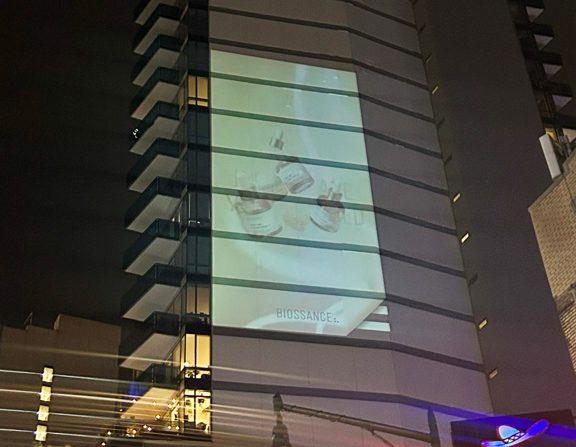
The Biossance × Sephora campaign that American Guerrilla Marketing executed for the clean beauty brand demonstrated what projection advertising delivers in the specific context of a product launch targeting a young, aesthetically engaged audience: an unforgettable first impression at brand scale. The campaign used building projection to introduce the Biossance brand to a new market audience at a visual quality level that immediately communicated premium positioning — the format itself signals confidence and investment in a way that banner ads and social posts structurally cannot. For Knoxville campaigns targeting UT students and the Old City nightlife demographic with new product launches, the Biossance model illustrates the ceiling of what projection advertising can achieve in a first-impression context.
The Reproductive Freedom for All advocacy campaign demonstrated a different dimension: projection advertising’s ability to deliver urgent public messaging to a young, politically engaged audience that has developed extensive digital advertising filters. University markets — and Knoxville is quintessentially a university market — are full of people who have consciously opted out of digital advertising through ad blockers, platform preferences, and content filters. Building projection advertising in Old City reaches those people anyway, in the physical public space they share with everyone else in the entertainment zone, without algorithmic mediation. For advocacy campaigns that need to reach the 18-to-30 demographic in Knoxville’s entertainment districts, projection advertising is the only channel that reaches the full cohort — including those who have filtered everything else out.
Who Uses Building Projection Advertising In Knoxville
Entertainment brands — record labels, tour promoters, streaming platforms, venue operators — use Knoxville projection campaigns to reach the live music and entertainment audience concentrated in Old City and the Gay Street corridor. UT athletics programs and their sponsors use projection advertising to amplify team identity and reach the student fan base in the downtown entertainment zone. Consumer brands targeting 18-to-30-year-olds use Knoxville’s university market concentration to reach a high-density version of their target demographic in a physical environment where brand impressions are formed at the highest recall rate. Advocacy organizations use the format’s guaranteed public reach to deliver messages in the most-trafficked outdoor entertainment corridors in East Tennessee. Regional retailers and service brands entering the East Tennessee market use building projection to establish brand awareness with the Knoxville consumer base in a format that competitors haven’t yet deployed.
Coverage & Estimated Impressions
| Zone / Area | Peak Hours | Foot Traffic | Est. Nightly Impressions | Best For |
|---|---|---|---|---|
| Old City Arts and Entertainment District | 8PM–1AM | High | 8,000–35,000 | Product Launch |
| Market Square Arts Zone | 8PM–1AM | High | 8,000–35,000 | Event Promotion |
| 100 Block of Gay Street Entertainment Corridor | 8PM–1AM | High | 8,000–35,000 | Brand Awareness |
| Fort Sanders Neighborhood Arts Corridor | 8PM–1AM | High | 8,000–35,000 | Political |
| Worlds Fair Park Area | 8PM–1AM | High | 8,000–35,000 | Sports |
Frequently Asked Questions
Old City combines the physical surface quality of converted warehouse and older commercial architecture with the audience concentration of Knoxville’s densest nightlife district and the social amplification behavior of the 21-to-35 demographic that dominates its evening crowds. The district’s pedestrian character means the audience is stationary enough to observe projection content at meaningful dwell times, and its entertainment orientation means they’re in the specific state of heightened environmental engagement that produces the strongest organic documentation and sharing response.
The 100 Block of Gay Street functions as Knoxville’s primary outdoor dining and entertainment promenade — a corridor with consistent two-directional pedestrian movement that places projection advertising in the sightline of audiences approaching from opposite ends of the block simultaneously. The street’s entertainment character means viewers encounter the projection while already engaged with their environment. Buildings along this corridor include older masonry commercial structures with upper-story solid wall faces that provide workable projection surfaces above the ground-floor retail and dining activity.
Yes, and UT home football weekends represent one of Knoxville’s highest-value projection campaign windows. Neyland Stadium’s capacity of over 100,000 people means that home game days bring an extraordinary concentration of fans, alumni, and visitors through the surrounding city corridors before and after games. A projection campaign deployed on a UT home game evening reaches this amplified audience at the moment of highest community energy — before the game in anticipation, or after in shared celebration. For brands with any Tennessee athletics connection or community identity angle, the game-day audience is projection advertising’s most receptive Knoxville environment.
Market Square’s strength as a projection zone is primarily about audience behavior rather than surface architecture. The outdoor dining and gathering character of the plaza produces a stationary audience with extended dwell times — people who remain in the projection viewing zone for 30 to 90 minutes rather than the seconds-to-minutes typical of moving pedestrian traffic. This extended dwell time allows projection creative to unfold in longer sequences, with more narrative content and more opportunities for the brand message to register with depth. Surface quality on adjacent historic commercial buildings varies, and AGM’s scouting evaluation identifies the specific buildings whose walls meet projection quality standards for Market Square deployments.
The Worlds Fair Park and Sunsphere area provides a civic-scale outdoor projection environment with longer effective throw distances than Old City’s constrained street corridors — enabling larger projected image scales on the commercial and civic building faces surrounding the park. The Sunsphere’s status as Knoxville’s most recognized skyline landmark creates strong visual association for any projection campaign deployed nearby. The area is most productively used for event-tied campaigns that benefit from the park’s event venue infrastructure, and it provides geographic reach into a part of the downtown core that Old City campaigns don’t cover.
Fort Sanders is where Knoxville’s student and academic population lives — the close-in neighborhood adjacent to UT whose residential base is predominantly university-affiliated. Projection campaigns in Fort Sanders reach this audience in their neighborhood environment rather than in a dedicated nightlife destination, creating a different impression context: a brand that appears on a Fort Sanders building is positioned as part of the neighborhood’s everyday life rather than as an entertainment-district advertiser. For brands seeking deeper residential penetration into the UT-adjacent population, Fort Sanders provides a projection zone with distinct geographic and audience reach from the Old City and Gay Street entertainment districts.
AGM’s post-campaign documentation package for Knoxville includes professional photography and video of the projection in its environmental context — capturing both the image on the building and the surrounding Old City or Gay Street setting — GPS-documented location data, and campaign performance notes. This documentation is formatted to support press outreach to local Knoxville media and regional Tennessee entertainment press, social media publication on client channels, and internal stakeholder reporting. Projection campaigns in Knoxville, as in most East Tennessee markets, frequently generate local news coverage because the format remains novel in the market.
The tailgate culture around Neyland Stadium concentrates in the areas surrounding the stadium and along the pedestrian routes that connect the stadium to downtown Knoxville and the Vol Walk corridor. Projection campaigns in the blocks adjacent to these tailgate zones — specifically in the Old City and Gay Street areas closest to the stadium approach routes — reach the tailgate audience as it moves between the stadium environment and the downtown entertainment corridor before and after games. For maximum tailgate audience reach, campaigns are timed to the pre-game and post-game hours when this movement is at its highest density.
Country music and rock artists with a Southern or Appalachian identity connect particularly well with Knoxville’s audience — the UT student base and the broader East Tennessee community share musical tastes that align with Tennessee’s country and Americana heritage. Live music venues and event promoters use Knoxville projection campaigns to reach the deeply engaged live music audience in Old City’s venue district. Streaming platforms and entertainment technology brands find Knoxville’s large student population provides a high-concentration target for subscription and trial campaigns. Sports brands with any UT athletics association — or simply with a college football identity — connect powerfully with the orange-clad passionate fan community that defines Knoxville’s entertainment culture.
A four-to-six-hour projection window — AGM’s standard campaign duration — captures the full peak activity arc of Old City’s nightlife, which typically runs from approximately 8:00 PM through 1:00 AM or 2:00 AM on active nights. For maximum brand recall, campaigns should run for at least four hours, ensuring that the full evening crowd — early arrivals, mid-evening peak, and late-night audience segments — all encounter the projection. Repeated impression exposure over the course of the full evening window significantly improves recall rates compared to shorter deployment windows that capture only one segment of the evening’s audience flow.
The Sunsphere itself — a gold glass sphere atop a steel tower — is not a conventional projection surface, but the commercial and institutional buildings surrounding Worlds Fair Park provide projection surface options whose visual proximity to the Sunsphere creates strong contextual association. A brand that projects in the Sunsphere’s visual neighborhood shares the frame of Knoxville’s most iconic architectural landmark. For campaigns that benefit from place-based visual association with the city’s most recognized structure, the Worlds Fair Park area provides that contextual framing in combination with the park’s open geometry that allows larger-scale projected imagery than constrained street corridors permit.
More AGM Outdoor Advertising Services
Led Billboard Trucks
Mobile LED displays that bring your brand to any location, any event.

Fly Posting
Street-level poster saturation across walls, construction sites, and corridors.

Sidewalk Decals
Ground-level branded decals at pedestrian hotspots and event entrances.

Sidewalk Stencils
Creative stencil campaigns that put your brand in the path of pedestrians.