American Guerrilla Marketing
Nationwide Service
Media planning, media buying, billboard advertising, & guerrilla marketing
Guerrilla Projections in Denver, CO
RiNo’s warehouse walls. LoDo’s game-night crowds. The Golden Triangle’s cultural density. Denver gives guerrilla projection campaigns the most diverse and creatively receptive canvas in the Mountain West — and AGM has the 20,000-lumen firepower to own it.
Denver: The Flagship Projection Market of the Mountain West
Denver is the undisputed flagship of Colorado’s guerrilla projection landscape, and one of the strongest projection markets in the entire country outside the coastal metros. The city’s River North Arts District — universally known as RiNo — has become a projection advertiser’s ideal environment: industrial-era warehouse buildings with vast smooth facades, a creatively sophisticated foot traffic population that gathers nightly from gallery openings through last call, and a cultural identity that actively embraces bold visual experiences in public space. Lower Downtown’s historic brick architecture near Coors Field adds a sports-adjacent audience layer at scale. The Golden Triangle Creative District and Globeville’s industrial zone extend the projection canvas across distinct Denver neighborhoods, each with its own audience profile and aesthetic character.
Denver’s urban culture is more visually sophisticated than most American cities its size. The city has invested aggressively in public art, large-format murals, and architectural distinction — its residents are conditioned to notice and engage with compelling visual experiences in public space rather than tuning them out. Projection advertising in Denver lands in this context as a natural extension of the city’s visual culture, which means the audience doesn’t just see it — they respond to it, photograph it, and share it through social networks with an organic enthusiasm that passive advertising in traditional formats cannot generate.
The city’s demographic profile compounds its projection value. Denver’s population skews younger, more educated, and more economically mobile than most Mountain West cities. Tech sector growth has drawn tens of thousands of professionals from coastal markets who carry high brand awareness and are native social media sharers. The city’s outdoor lifestyle culture attracts people who are already mobile, outdoors-oriented, and comfortable with visual boldness. These characteristics combine to produce one of the highest organic amplification rates per projection night of any non-coastal American city.
AGM brings full national scouting capability to Denver — digital satellite analysis, traffic data overlays, and physical on-the-ground walkthroughs of RiNo warehouse blocks, LoDo historic facades, Curtis Street positions, Globeville industrial walls, and Golden Triangle building surfaces. Denver’s scale and the variety of its projection environments make location selection genuinely consequential. The specific wall, on the specific block, facing the specific direction — that granularity is what AGM’s scouting process exists to get right before equipment is ever loaded into a vehicle.
Own Denver's Most Iconic Walls
AGM deploys 20,000-lumen guerrilla projections across RiNo, LoDo, the Golden Triangle, Globeville, and Curtis Street. Denver's most creative audiences, at their most visually receptive moments — scouting, creative, crew, and full documentation handled end to end.
Browse Cities in Colorado
Select a city to explore Guerrilla Projections opportunities.
Denver's Premier Projection Districts
RiNo (River North Arts District) Warehouse Walls
RiNo is Denver’s projection anchor. The industrial-era warehouse buildings along Brighton Boulevard, Larimer Street, and the surrounding grid offer smooth concrete and painted brick facades running 50 to over 100 feet high — some of the largest uninterrupted projection surfaces of any urban neighborhood in the Mountain West. The district’s identity as Denver’s creative center means its audience is not only present in large numbers but genuinely receptive to unexpected visual experiences. Foot traffic from gallery openings, brewery visits, restaurant crowds, and venue-hopping weekenders creates a sustained audience from dusk well past midnight. A projection in RiNo does not compete with existing visual noise — it becomes part of the neighborhood’s ongoing visual conversation for the duration of the activation and beyond, through the organic social sharing it generates.
LoDo (Lower Downtown) Near Coors Field
Lower Downtown Denver concentrates foot traffic at a scale that few urban neighborhoods outside New York can match on game nights. The historic brick warehouse architecture that defines LoDo’s character provides diverse projection surfaces within walking distance of Coors Field, Ball Arena, and the Union Station transit hub. Pre- and post-game crowds moving through LoDo’s bar, restaurant, and entertainment zone create projection audience concentrations that can reach several thousand viewers within a single city block on a Rockies or Nuggets game night. LoDo’s activation energy — the sense of collective celebration that surrounds major sports events — compounds the emotional impact of any projection campaign running in that environment. A brand that shows up in that space, at that moment, is part of the city’s experience of its own excitement.
Curtis Street Arts District
The Curtis Street corridor connects downtown Denver to the Denver Performing Arts Complex and draws a consistent evening crowd oriented toward theater, opera, symphony, and cultural events at one of the largest performing arts facilities in the country. Buildings along and adjacent to Curtis offer broad facade surfaces in a zone where pedestrians move slowly and with purpose — they are on their way to or from a cultural experience, in exactly the mindset that makes projection advertising most effective. Curtis Street audiences tend to be older, higher-income, and more culturally engaged than the RiNo crowd, making the district particularly valuable for luxury, financial, healthcare, and high-culture brand campaigns targeting those demographics.
Globeville Industrial Zone
Globeville’s industrial architecture provides some of Denver’s largest single-facade projection surfaces — warehouse buildings and production facilities with exterior walls that allow projections at the top end of AGM’s image size range, in some cases exceeding 80 feet in both horizontal and vertical dimensions. The neighborhood is undergoing rapid creative and commercial development, attracting art studios, tech businesses, and creative professional tenants who are establishing a new audience layer atop the existing industrial workforce population. Globeville projections reach this emerging creative community before the district fully gentrifies — an early-mover advantage for brands that want to be associated with what comes next in Denver’s growth geography.
Golden Triangle Creative District
Denver’s Golden Triangle is home to the Denver Art Museum, the Clyfford Still Museum, History Colorado, and a dense cluster of galleries, creative firms, and design-forward restaurants and bars. The district’s pedestrian culture and concentration of culturally curious residents and visitors creates a high-quality audience for campaigns with artistic, cultural, or brand aesthetic dimensions. Museum opening nights and gallery events concentrate exactly the audience — arts-engaged, design-literate, socially connected — that most responds to unexpected projection experiences in shared civic space. For luxury, fashion, film, and culture-adjacent brands, the Golden Triangle offers a Denver audience that is harder to reach through mass-market channels.
What To Project: Creative Formats For Denver Campaigns
Arts and Cultural Launch Projections
Denver’s arts scene makes it one of the strongest markets in the country for cultural projection campaigns. Film studios, streaming services, galleries, music labels, and performing arts organizations use RiNo and Golden Triangle projections to reach exactly the audiences most likely to engage, attend, and amplify. A projection timed to a museum opening, gallery show, or album release reaches Denver’s cultural gatekeepers in the physical spaces they inhabit — far more effectively than any targeted digital placement at comparable cost.
Tech and Talent Recruitment Projections
Denver’s surging tech sector creates sustained demand for software engineers, product managers, data scientists, and creative professionals. Projecting recruitment messaging or employer brand imagery in RiNo — where large portions of Denver’s tech workforce live, socialize, and form their impressions of employers — creates above-the-line brand presence in a medium that digital recruiting cannot replicate. For companies competing for the same talent pool, being the brand that shows up physically in the neighborhood where that talent gathers on Friday night is a meaningful differentiation.
Sports and Entertainment Projections
LoDo’s proximity to Coors Field and Ball Arena gives sports-adjacent brands a natural projection location anchored to game-night audience concentrations that are already emotionally activated. Playoff pushes, season openers, championship series, and major sports media events all create natural projection moments. The energy of a crowd moving through LoDo before or after a major game compounds a projection’s visual impact in ways that no static campaign environment can replicate. For entertainment brands, this energy transfer is a feature worth building campaigns around.
Social and Advocacy Projections
Denver’s progressive urban culture makes it one of the strongest American cities for advocacy, civic, and social cause projection campaigns. The city’s young, educated, values-driven population responds to messaging aligned with environmental, social, and democratic values — and responds with the social sharing behavior that extends reach far beyond the physical projection audience. RiNo and the Golden Triangle reach the specific demographic — 25-to-45, college-educated, politically engaged — that drives social cause campaigns from awareness through action in major American cities.
Plan Your Guerrilla Projection Campaign in Denver, CO
Tell us about your campaign goals, target audience, and preferred locations. Our team will help you plan a high-impact guerrilla projection campaign tailored to your needs.
Award Winning Personalized Service
You will get thoughtful, devoted, and individualized attention from our experienced, qualified, and professional personnel. Being one of the most illustrious agencies in Brooklyn, New York, American Guerrilla Marketing has been awarded the Best of Brooklyn title.
Nationwide
Industry City, Brooklyn, New York 11232
American Guerrilla Marketing
Hours
Mon - Fri: 9 AM - 5 PM
Sat & Sun: Closed
Automate your campaign with AGM’s Request for Proposal Builder.
Automate your campaign with AGM’s Request for Proposal Builder. Simply answer a few quick questions about your campaign goals, markets, and timeline, and the system will generate a tailored presentation with recommended strategies, quantities, and pricing. Click the RFP Builder to instantly receive your customized proposal.
How AGM Executes a Denver Projection Campaign
Denver campaigns begin with AGM’s full dual-scouting protocol. The national scouting team runs digital analysis of candidate districts — RiNo, LoDo, Globeville, Golden Triangle, Curtis Street — using satellite mapping, street-level imagery, and pedestrian traffic data to build a ranked shortlist of candidate wall surfaces. Physical on-the-ground walkthroughs follow for confirmed candidates, evaluating surface color, texture, and condition, confirming power and generator staging positions, documenting viewing cones and audience sightlines, and photographing each location at the approximate ambient light level of the planned activation time. Nothing is confirmed until the physical walkthrough validates what the digital analysis projected. Advance scouting is billed at approximately contact us for a quote.
Creative alignment follows scouting. AGM’s production team reviews client artwork against confirmed wall dimensions and the specific ambient light environment of the selected Denver location. RiNo’s warehouse facades benefit from relatively limited competing signage in certain blocks, which improves contrast. LoDo’s game-night environment includes competing ambient light from stadium infrastructure and street lighting, which our team accounts for in image contrast optimization. Finals are reviewed against the confirmed surface before campaign night.
Execution begins at dusk on activation night. AGM’s two-person direct technical crew — AGM’s own technicians, not subcontracted operators — handles all load-in, generator staging, projector calibration, and image alignment from the pre-scouted position. The crew manages the entire activation autonomously: no client presence required. Projections run four to six hours from dusk, covering Denver’s peak audience windows across all target districts. Post-campaign, the crew captures photography and video for the client documentation package, which includes GPS-verified location data and a formal summary report delivered within a week of the activation.
For clients requiring private-property permitted activations — which offer greater creative control and pre-approved placement certainty — AGM identifies and negotiates appropriate Denver locations. Private-property activation costs are Contact us for a custom quote. per night, depending on the specific property and arrangement.
Denver Guerrilla Projection Pricing
AGM’s Denver campaigns are priced at contact us for a quote. — the standard AGM rate for Colorado markets outside the New York City metro. That rate is fully inclusive: 20,000-lumen commercial projector, generator and complete power solution, electronics bundle, mobility unit, and a two-person technical crew for setup, full-night operation, and breakdown. There are no add-on crew charges, no equipment surcharges, and no fuel fees. The Contact us for a custom quote. covers the complete, operational package for one projector running one night in Denver.
Advance location scouting is billed at approximately Contact us for a custom quote. for the Denver market. Multi-night Denver campaigns are available and recommended — consecutive nights in RiNo or LoDo build cumulative audience exposure and generate the organic conversation that compounds projection impact across the campaign run. Denver can also serve as the flagship component of a broader statewide Colorado campaign alongside simultaneous activations in Aurora, Colorado Springs, or Fort Collins.
Who Uses Guerrilla Projections in Denver
Denver’s brand activation landscape draws campaigns from technology companies building employer brand in a competitive talent market, entertainment brands reaching Denver’s arts and culture audience ahead of launches, streaming services targeting the young professional demographic that populates RiNo and LoDo, advocacy organizations using Golden Triangle and RiNo projections to mobilize Denver’s politically engaged population, and luxury brands positioning in a market where per-capita income has risen sharply alongside the city’s tech sector growth.
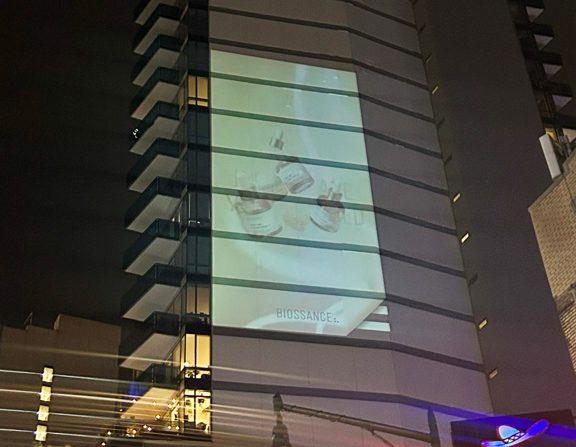
AGM’s client history spans organizations from Biossance and The Weeknd to the US Marine Corps and YouTube — brands that understand the difference between renting space in a digital feed and claiming a physical presence in a city’s most important visual environments. Denver’s projection advertising landscape is still meaningfully less competitive than New York or Los Angeles, which means brands that move now are establishing presence in a market before the field gets crowded.
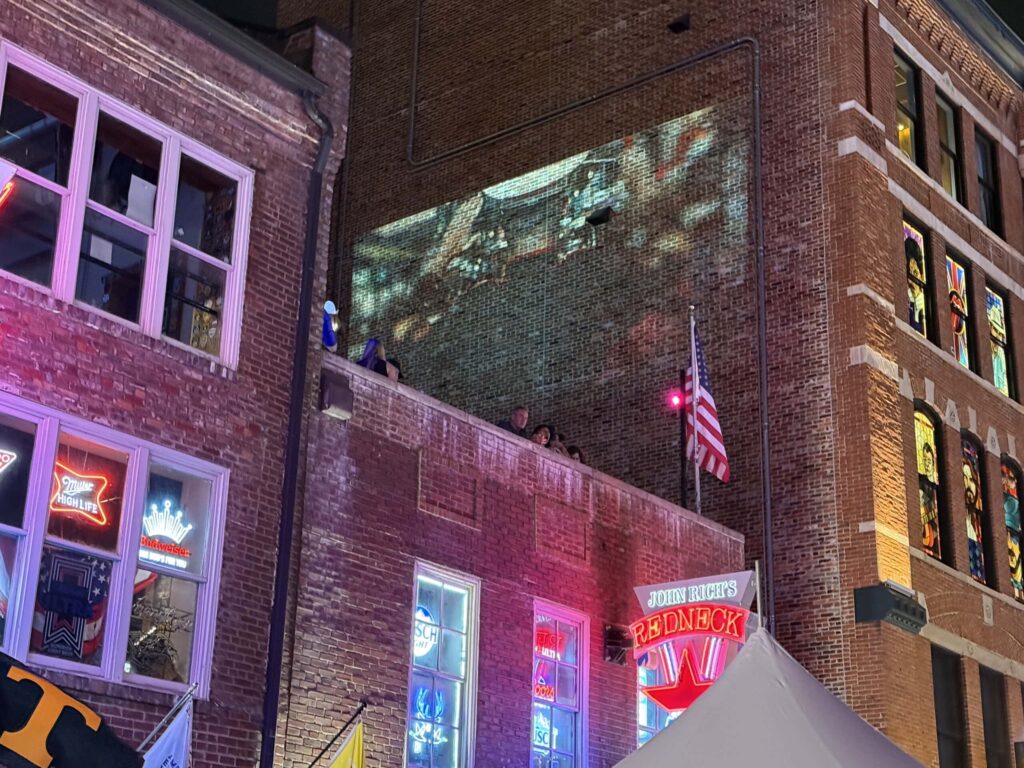
AGM’s projection client roster includes Netflix, Disney, Coca-Cola, FanDuel, Live Nation, iHeartRadio, and the US Marine Corps. A confirmed case study: the US Marine Corps × CMA Fest Nashville — multi-night projections onto architectural surfaces throughout the festival footprint, reaching 80,000+ attendees across the campaign window. Projection advertising scales across every brand category; what our campaigns share is scale, precision, and a physical presence digital cannot replicate.
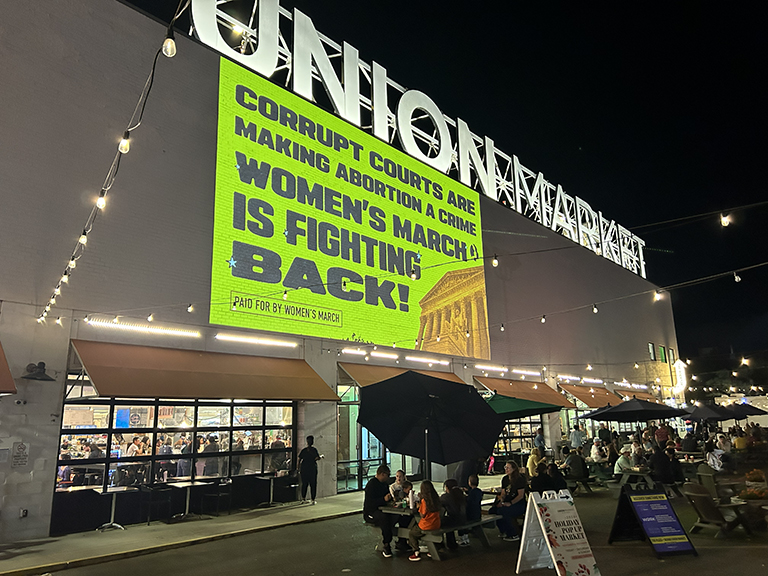
Case Study: Reproductive Freedom For All — Washington, Dc
When Reproductive Freedom for All built an urgent awareness campaign around reproductive rights ahead of a critical national mobilization, they partnered with AGM to project their messaging onto prominent building facades in Washington, DC during peak evening hours. The 20,000-lumen campaign generated thousands of direct audience exposures and significant organic social amplification as bystanders documented and shared what they encountered in real time.
The visual scale of the projection — message occupying an entire building face in the center of a populated public space — created a media moment that extended campaign reach far beyond the physical audience. Earned media coverage in Washington and beyond carried the imagery to audiences in markets where no projector was deployed. The campaign demonstrated what AGM delivers for cause-driven clients at the national level: not just equipment and crew, but a strategic placement approach that maximizes the intersection of audience concentration, timing, and visual impact.
Denver’s population — educated, politically engaged, and deeply attuned to social and environmental causes — mirrors the DC audience profile in the ways that matter most for cause-driven projection work. The city’s arts and creative identity also makes it naturally responsive to brand campaigns committed to a strong visual concept. Whatever the campaign objective, Denver’s audience rewards bold execution in ways that more passive advertising formats simply do not.
Coverage & Estimated Impressions
| Zone / Area | Peak Hours | Foot Traffic | Est. Nightly Impressions | Best For |
|---|---|---|---|---|
| RiNo (River North Arts District) Warehouse Walls | 9PM–2AM | Very High | 25,000–120,000 | Product Launch |
| LoDo (Lower Downtown) Near Coors Field | 9PM–2AM | Very High | 25,000–120,000 | Event Promotion |
| Curtis Street Arts District | 9PM–2AM | Very High | 25,000–120,000 | Brand Awareness |
| Globeville Industrial Zone | 9PM–2AM | Very High | 25,000–120,000 | Political |
| Golden Triangle Creative District | 9PM–2AM | Very High | 25,000–120,000 | Sports |
Frequently Asked Questions About Guerrilla Projections in Denver
RiNo combines three characteristics that make it an exceptional projection environment: large, smooth warehouse facades that serve as premium projection screens; a creative, visually curious audience that gathers there nightly from gallery openings through last call; and a cultural identity that actively celebrates bold visual experiences in public space. The district’s foot traffic is sustained and concentrated across a walkable area, meaning a single projector position can reach a large, engaged audience without requiring the wide geographic dispersion that suburban or corridor markets demand. RiNo is Denver’s projection showcase location for good reason — it produces the conditions for projection advertising to work at its highest level.
LoDo’s historic brick warehouse architecture creates natural canyons where projection images on tall building faces are visible from extended sight lines down the street grid. The density of buildings relative to street width concentrates pedestrian movement in predictable corridors, ensuring that a projection positioned on the right facade reaches a sustained audience rather than a scattered one. The neighborhood’s proximity to Coors Field and Ball Arena adds a critical variable: on game nights, that foot traffic density multiplies dramatically, giving projection campaigns access to some of the largest single-evening audience concentrations available in any Denver location.
Coors Field holds approximately 50,000 spectators, and a meaningful portion of that audience moves through LoDo before and after games via street-level pedestrian traffic rather than direct parking access. During playoff games and marquee matchups, LoDo foot traffic in the blocks near the stadium can reach several thousand pedestrians per hour during peak pre- and post-game windows. A well-positioned projection within sightline of major pedestrian flow in those blocks reaches an audience that is emotionally activated, socially connected, and mobile-phone-ready — the optimal conditions for organic social amplification of a projection campaign image.
RiNo’s audience skews younger, higher-energy, and brewery-and-bar-oriented. The Golden Triangle’s audience is more museum-going, gallery-attending, and design-literate — older on average, higher income, and more engaged with institutional cultural programming. This distinction makes the Golden Triangle the stronger location for luxury, fashion, financial services, and cultural institution campaigns targeting an affluent arts audience, while RiNo remains the stronger choice for brands targeting creative professionals, tech workers, and entertainment-oriented young adults. Both districts are accessible within a single Denver campaign; AGM can identify the right district for each specific campaign objective.
AGM’s two-person crew handles all logistics from load-in through breakdown — generator staging, projector placement, cable management, image alignment, and continuous operation monitoring throughout the projection run. In Denver’s dense downtown grid, the crew plans load-in routes in advance, coordinates timing to avoid peak pedestrian traffic during equipment staging, and positions the generator to minimize audible disruption to surrounding businesses. Clients provide no on-site support; AGM manages the entire operational footprint. Post-campaign, the crew completes documented breakdown and removes all equipment, leaving no trace of the activation at the location.
Denver’s culture — built around craft brewing, outdoor adventure, public art, music, and a design-forward aesthetic — creates an audience that holds creative quality to a high standard. Projection campaigns with strong visual concepts and genuine creative commitment outperform campaigns with generic brand messaging by a wide margin in this market. The audience is sophisticated enough to distinguish between a campaign that took creative risks and one that phoned it in. AGM’s production team can provide guidance on projection-optimized creative approaches for Denver audiences, but the fundamental principle is straightforward: the bolder the concept, the stronger the response.
Ball Arena and Red Rocks both generate large pedestrian audiences that move through surrounding areas before and after events. Ball Arena’s location in LoDo’s entertainment district places it within the same geographic zone as AGM’s core Denver projection positions. Red Rocks Amphitheatre, in Morrison southwest of Denver, creates projection opportunities on the access corridor but requires different location scouting given the non-urban environment. For both venues, AGM can identify specific projection positions that maximize event-adjacent audience exposure — contact AGM to discuss event-specific campaign timing and positioning.
Globeville’s industrial architecture provides wall surfaces at a scale that Denver’s more densely developed neighborhoods cannot replicate. Warehouse and production buildings with exterior walls running 60 to over 100 feet in height allow projection images at sizes that create genuine landmark-scale visual events — images visible not just from adjacent sidewalks but from surrounding blocks and, in some positions, from elevated highway vantage points. As the neighborhood undergoes creative and commercial development, early-campaign placements in Globeville reach an emerging audience that will grow significantly in size and influence over the next several years.
AGM’s national scouting team conducts physical walkthroughs of Denver’s warehouse districts — RiNo, Globeville, and adjacent zones — on foot, evaluating each candidate wall surface against a consistent set of criteria: surface color and texture, facade orientation relative to primary pedestrian flow, throw distance for the proposed projector position, power and generator staging options, ambient light interference from street infrastructure, and viewing cone geometry from multiple approach angles. Photographs are taken at the expected dusk light level for each candidate. The physical walkthrough findings are cross-referenced against the earlier digital analysis before any location is confirmed for a campaign.
In Denver’s urban core, the usable projection window runs from approximately 30 to 45 minutes after sunset — when ambient light has dropped below the threshold where image contrast becomes compelling — through the end of peak nightlife activity, typically between midnight and 1:00 AM depending on the day of week and season. That window spans four to six hours in most Denver locations, covering the full arc of evening activity from early dinner crowds through late-night foot traffic. Summer dusk arrives around 8:30 to 9:00 PM, pushing the projection start later. Fall and winter dusk at 5:30 to 7:30 PM provides earlier campaign windows that capture dinner and happy hour audiences as well as late-night crowds.
Denver is the largest and most densely populated city in the Mountain West, with a metropolitan population exceeding three million and an urban core that concentrates that population in walkable, entertainment-oriented districts at a scale no other Mountain West city approaches. Salt Lake City, Albuquerque, Tucson, and Boise all have meaningful projection potential, but none matches Denver’s combination of urban density, creative-professional population concentration, and foot traffic volume in entertainment districts during evening hours. For brands prioritizing raw audience volume in the Mountain West, Denver is the primary activation target; other markets serve complementary or supplementary roles.
AGM’s standard post-campaign package includes GPS-verified location documentation, crew photography and video of the projection in operation (including wide-context shots showing the projection in relation to surrounding environment and audience), and a formal written summary report covering campaign parameters, location details, operational timeline, and visual asset inventory. This package is delivered within one week of the activation date. Clients may use all documentation materials freely for internal reporting, investor presentations, PR, and social content. Where clients have advance press relationships in Denver media, AGM can coordinate documentation timing to support earned media placement.
More AGM Outdoor Advertising Services
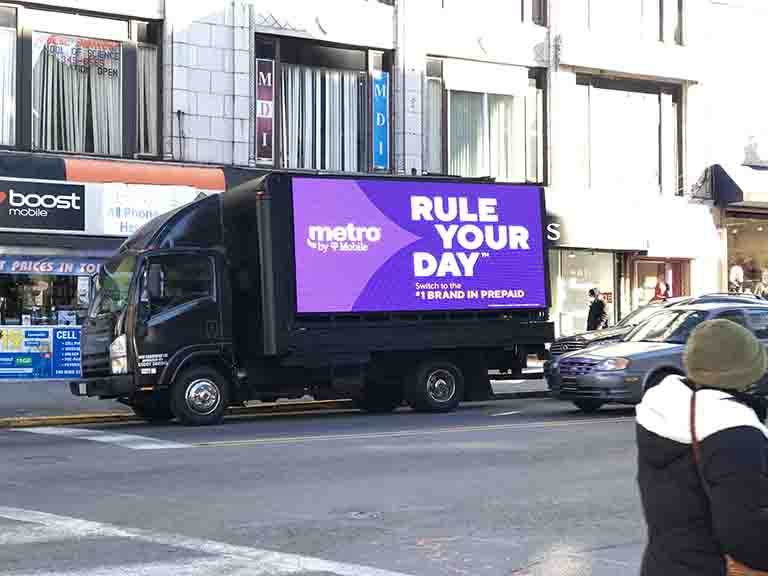
Led Billboard Trucks
Mobile LED displays that bring your brand to any location, any event.
Fly Posting
Street-level poster saturation across walls, construction sites, and corridors.

Sidewalk Decals
Ground-level branded decals at pedestrian hotspots and event entrances.

Sidewalk Stencils
Creative stencil campaigns that put your brand in the path of pedestrians.