American Guerrilla Marketing
Nationwide Service
Media planning, media buying, billboard advertising, & guerrilla marketing
Guerrilla Projections in Charleston, WV
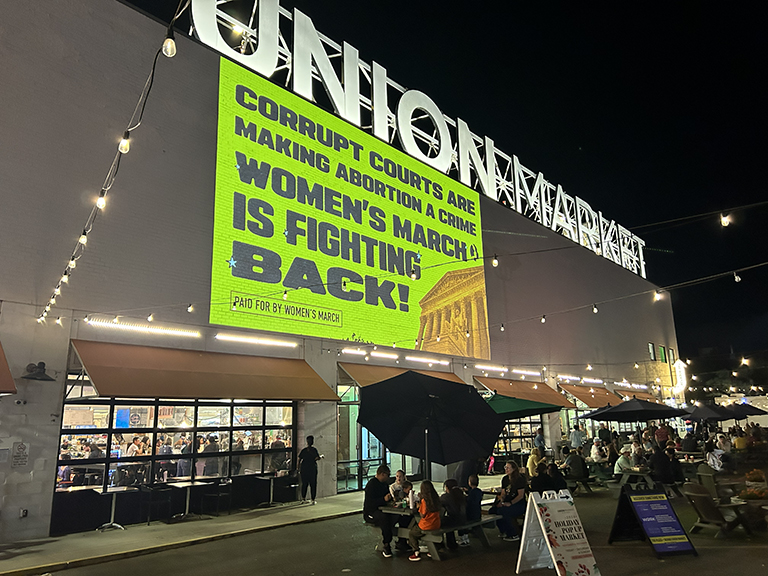
Charleston’s Capitol Street sits at the intersection of state political power and downtown nightlife — making it one of the most strategically potent locations for advocacy campaigns, brand launches, and building projection advertising in the Appalachian region.
Charleston as a Projection Advertising Platform
West Virginia’s capital city offers projection advertisers something that very few markets in the country can: a single downtown corridor where the audience includes the state’s elected officials, their staff, the lobbyists who work to influence them, the journalists who cover the process, and the residents who live with the outcomes. Capitol Street in Charleston during a legislative session window is not an ordinary pedestrian thoroughfare. It is the most concentrated policy audience in the Mountain State, assembled within walking distance of a building inventory that projection campaigns can transform into a visible, unavoidable statement in the urban environment.
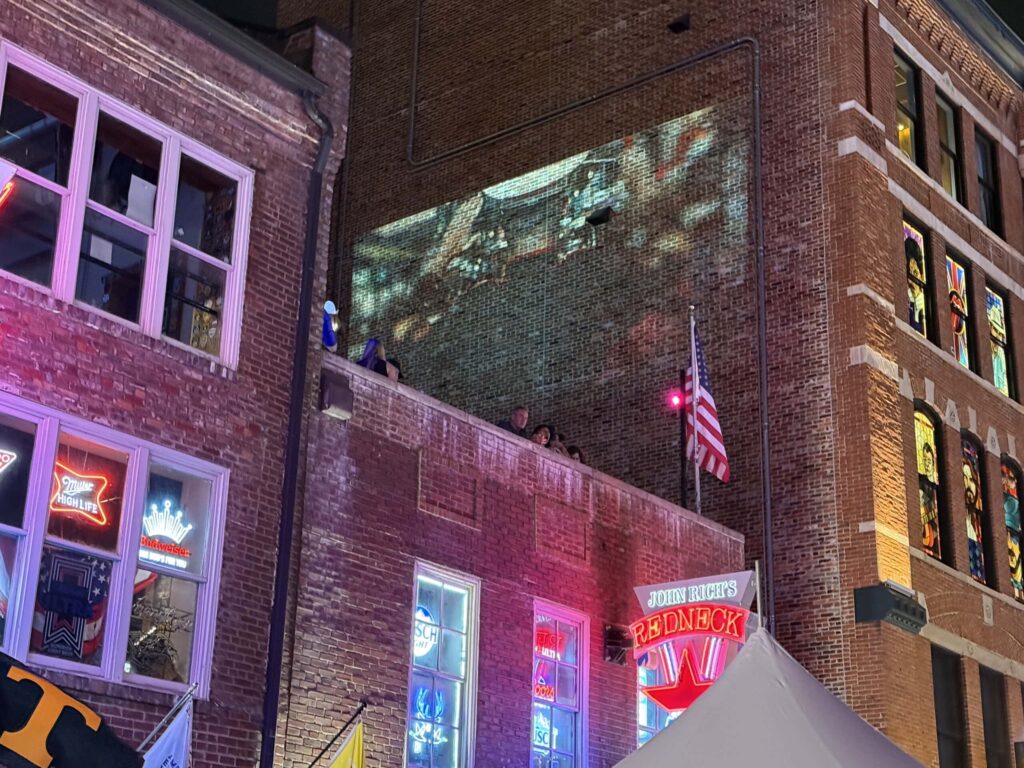
AGM’s projection client roster includes Netflix, Disney, Coca-Cola, FanDuel, Live Nation, iHeartRadio, and the US Marine Corps. A confirmed case study: the US Marine Corps × CMA Fest Nashville — multi-night projections onto architectural surfaces throughout the festival footprint, reaching 80,000+ attendees across the campaign window. Projection advertising scales across every brand category; what our campaigns share is scale, precision, and a physical presence digital cannot replicate.
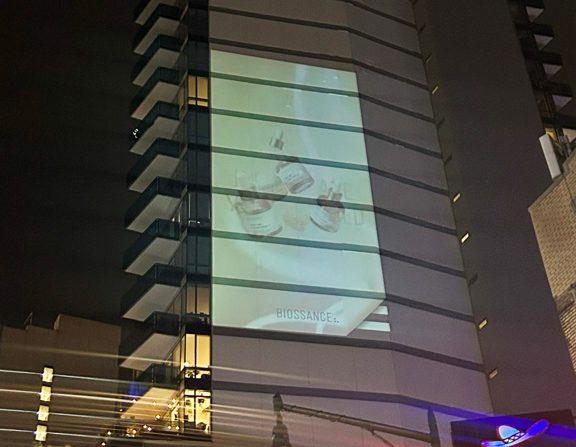
AGM has executed guerrilla projection campaigns for brands including Netflix, Disney, and FanDuel — deploying high-impact visual activations onto architectural surfaces in major markets nationwide.
Beyond the capital’s policy geography, Charleston functions as a regional commercial and cultural center whose East End arts district, Clay Center cultural campus, and South Hills entertainment zone collectively generate a diverse nighttime audience across multiple district types. The East End has attracted restaurants, galleries, and bars whose combined foot traffic creates a consistently engaged arts-district audience in the evenings. The Clay Center’s performance and exhibition programming draws arts-oriented Kanawha Valley residents for events that convert cultural patrons into projection campaign audiences as they move through the surrounding streets before and after performances.
The WakeUp Coalition’s advocacy campaign in Austin, Texas demonstrated how building projection converts a message with community relevance into a public event whose visual scale generates media coverage and social amplification well beyond the campaign’s physical footprint. That dynamic operates with particular force in a capital city like Charleston, where the concentration of policy-influencing audiences within a compact geographic radius means that a single-night projection on Capitol Street can generate media pickup from every political reporter covering the legislative session — multiplying earned media reach by orders of magnitude beyond what the organic pedestrian audience alone would produce.
AGM’s approach to Charleston campaigns applies the agency’s full national production standard: 20,000-lumen commercial projection system, direct two-person technical crew, advance physical scouting of Capitol Street and the East End, and comprehensive GPS-documented location analysis and post-campaign reporting. Charleston’s compact downtown geography means that scouting can comprehensively cover the city’s highest-priority projection zones in a single physical visit, accelerating the pre-campaign timeline relative to larger, more dispersed metros.
Charleston’s Kanawha River setting creates natural ambient light conditions that favor projection campaigns. The river valley’s lower horizon and the absence of the tall-building light pollution that characterizes major urban cores means that even on nights with light cloud cover, AGM’s 20K-lumen system produces high-contrast, fully saturated imagery on Charleston’s mixed brick and concrete building surfaces. The city’s climate delivers reliable spring, summer, and fall projection windows, with the legislative session calendar (January through March) providing the most politically strategic campaign timing for advocacy-oriented clients.
Project on Charleston's Most Impactful Walls
Capitol Street, the East End, the Clay Center — AGM deploys 20,000-lumen projection campaigns across Charleston's highest-value corridors. Reach the Mountain State's political and cultural audiences on the walls where it matters most.
Browse Cities in West Virginia
Select a city to explore Guerrilla Projections opportunities.
Capitol Street And The State Capital Advantage
The Capitol Street corridor in Charleston runs from the downtown commercial core toward the West Virginia State Capitol complex — one of the most architecturally distinguished state capitol buildings in the country — creating a pedestrian and vehicle corridor that carries the state’s political traffic between the legislative chambers and the hotels, restaurants, and office buildings where that traffic takes its breaks, makes its calls, and conducts its business. A projection campaign on a Capitol Street building face is not visible only to the pedestrians passing beneath it. It is visible to every driver and passenger moving through the corridor, to every office window that faces the wall, and to every journalist whose beat includes the building that houses the state’s most influential decision-makers.
For advocacy organizations whose campaigns target legislative outcomes — state budget decisions, regulatory actions, judicial appointments, or policy passage — Capitol Street provides a physical campaign medium whose audience quality cannot be replicated by any other out-of-home format in West Virginia. Digital billboards on the I-64 reach consumers. Radio spots reach commuters. A building projection on Capitol Street reaches the people who write the laws, the people who lobby to shape them, and the people who report on what both groups are doing. That audience specificity, at the budget level of a guerrilla projection campaign, is a genuinely rare opportunity.
Session windows — typically January through March in the West Virginia legislative calendar — are the highest-strategic-value campaign periods for Capitol Street advocacy projections. The density of policy-relevant audiences in the corridor is at its peak during those months, and the political media coverage of legislative activity means that a visible public statement in the capitol neighborhood has a high probability of generating earned media pickup from outlets whose readers include exactly the people the advocacy campaign most wants to reach.
Where Charleston's Best Projection Walls Are Located
Capitol Street Entertainment Corridor
Capitol Street’s commercial building stock includes a mix of early-20th-century masonry and mid-century commercial construction that presents blank wall faces on upper floors, side elevations, and parking-structure end-walls throughout the corridor. The street’s combination of government-adjacent audience during business hours and restaurant-and-bar audience during evening hours creates two distinct campaign windows within a single deployment. Daytime proximity to the Capitol campus makes the corridor the preferred zone for advocacy campaigns targeting legislators and their staff; evening foot traffic from the Capitol Street dining scene makes it equally viable for consumer brand and entertainment campaigns whose audience is the city’s general nightlife demographic.
East End Arts District
Charleston’s East End has emerged as the city’s most arts-forward neighborhood, hosting a growing cluster of galleries, independent restaurants, craft bars, and creative businesses whose patrons are among the most visually engaged pedestrian audiences in the metro. The East End’s building stock — primarily two- and three-story late-Victorian and early-20th-century commercial buildings — presents brick facades with blank wall sections above the ground-floor commercial layer, alongside newer construction gaps and parking-adjacent wall faces that offer cleaner surface profiles. Campaigns in the East End reach an audience that is culturally aware, locally invested, and socially active — a profile that drives the organic documentation behavior that makes guerrilla projection campaigns generate earned reach beyond the physical footprint of the activation.
Arts Zone Near the Clay Center for the Arts and Sciences
The Clay Center for the Arts and Sciences anchors one of Charleston’s most culturally significant campus zones, drawing performing arts audiences, science museum visitors, and educational programming participants into a concentrated area whose building environment includes both the Center itself — a landmark contemporary structure — and the surrounding blocks of older commercial and institutional buildings with viable projection surfaces. Evening programming at the Clay Center creates consistent foot traffic adjacent to the projection-eligible buildings in the surrounding blocks, and the arts-oriented audience profile makes this zone particularly receptive to cultural, institutional, and entertainment campaigns whose creative aesthetic aligns with the Center’s programming character.
South Hills Entertainment Area
South Hills is Charleston’s residential entertainment zone, located on the hillside south of downtown and serving a local audience of residents, families, and neighborhood regulars whose relationship to the Charleston downtown is more residential than transactional. The area’s commercial nodes — concentrated around the Corridor G and the South Hills neighborhood commercial strips — include small commercial buildings with blank wall sections that are accessible for medium-scale projection campaigns. South Hills campaigns reach a distinctly local, resident-oriented audience that is less exposed to out-of-home advertising than the downtown corridor, which creates a novelty premium that consumer and community-oriented brands can leverage for local awareness campaigns.
Plan Your Guerrilla Projection Campaign in Charleston, WV
Tell us about your campaign goals, target audience, and preferred locations. Our team will help you plan a high-impact guerrilla projection campaign tailored to your needs.
Award Winning Personalized Service
You will get thoughtful, devoted, and individualized attention from our experienced, qualified, and professional personnel. Being one of the most illustrious agencies in Brooklyn, New York, American Guerrilla Marketing has been awarded the Best of Brooklyn title.
Nationwide
Industry City, Brooklyn, New York 11232
American Guerrilla Marketing
Hours
Mon - Fri: 9 AM - 5 PM
Sat & Sun: Closed
Automate your campaign with AGM’s Request for Proposal Builder.
Automate your campaign with AGM’s Request for Proposal Builder. Simply answer a few quick questions about your campaign goals, markets, and timeline, and the system will generate a tailored presentation with recommended strategies, quantities, and pricing. Click the RFP Builder to instantly receive your customized proposal.
Campaign Content for Charleston's Audiences
Advocacy and Policy Campaigns
The WakeUp Coalition’s Austin projection demonstrated how community-relevant advocacy messaging converts building scale into public attention that traditional media cannot replicate. Charleston’s Capitol Street replicates that formula at the state legislative level. Advocacy campaigns timed to legislative sessions reach the most concentrated policy audience in West Virginia within a single nighttime operating window, generating both direct impressions on decision-makers and the earned media follow-through that extends campaign reach to every West Virginia resident paying attention to state politics.
Cultural and Arts Institution Campaigns
Charleston’s density of arts institutions — the Clay Center, the Culture Center, the Sunrise Museum — creates consistent demand for building projection campaigns tied to exhibition openings, performing arts programming announcements, and cultural fundraising initiatives. The city’s arts community actively monitors public visual culture, and a projection campaign near the Clay Center or in the East End arts corridor reaches an audience that will document and share it as a cultural event in its own right, not merely as advertising.
Healthcare and Public Awareness
Charleston’s role as the state capital and its position at the center of West Virginia’s healthcare policy debate make it a productive market for public health and healthcare institution awareness campaigns. CAMC, Thomas Health, and state agency campaigns targeting both public audiences and the policy community that shapes healthcare legislation find in Charleston’s Capitol Street corridor a campaign environment whose dual audience — public pedestrian and political professional — is uniquely valuable for healthcare advocacy messages.
Regional Brand and Retail Launches
Consumer brands entering the Kanawha Valley market or establishing regional presence in central West Virginia use Charleston projection campaigns to create visible launch-moment statements in the state’s commercial and cultural center. The East End arts district’s arts-engaged audience and the Capitol Street corridor’s evening dining crowd collectively deliver a broad downtown consumer demographic that encompasses the city’s most brand-influential residents.
Planning And Executing A Charleston Projection Campaign
Charleston campaigns begin with a physical scouting visit to the target district — Capitol Street, the East End, or the Clay Center zone — to assess building surfaces, projector positioning options, pedestrian flow patterns, and any permit or property owner requirements. The city’s compact downtown geography allows AGM’s scouting team to cover all primary and backup surface candidates in a single field visit, typically requiring two to three weeks of advance lead time before the planned campaign date.
Charleston’s permit environment for outdoor projection campaigns is manageable relative to major metro markets. The city’s event and installation permit processes have established frameworks that apply to temporary outdoor visual installations, and AGM handles all permit research and city outreach as part of standard pre-campaign preparation. For campaigns targeting Capitol Street during legislative sessions, AGM advises booking four to six weeks in advance to accommodate any coordination required with state government operations during peak session periods.
On the campaign night, the two-person technical crew arrives at the deployment location 90 minutes before planned projection start. Charleston’s downtown configuration — particularly the Capitol Street corridor — typically allows equipment setup from street-level positions without requiring elevated platforms or special access arrangements. The 20K-lumen system deploys and calibrates within 60–75 minutes of crew arrival, and projection operations begin at dusk and run four to six hours continuously through the operating window.
The East End arts district’s building geometry creates close-range projection opportunities where throw distances of 40–70 feet produce image heights of 25–40 feet — medium scale that is highly legible to pedestrians at street level and generates strong documentation because audiences can capture both the projection and the urban street context in a single smartphone frame. Capitol Street’s wider commercial corridor allows longer throw distances and correspondingly larger image sizes on the multi-story commercial building faces along the corridor.
Documentation throughout the campaign night captures the projected image from multiple angles, the street environment and audience context, and any earned media or community engagement generated during the operating window. Post-campaign reporting is delivered within five business days: high-resolution photo and video assets, operational notes, audience observation context, and all documentation materials for client distribution and campaign reporting.
Charleston Campaign Rates
Building projection advertising in Charleston is priced at contact us for a quote. . That rate covers the 20,000-lumen commercial projection system, generator and integrated power solution, electronics bundle, mobility unit, and a two-person AGM technical crew for all phases of the campaign night from arrival through complete breakdown. Projection operations begin at dusk and run four to six continuous hours.
Advance location scouting for Charleston is available at approximately Contact us for a custom quote. for the market, credited toward the campaign total for confirmed activations. Private-property or permitted location arrangements for specific Capitol Street surfaces run Contact us for a custom quote. per night depending on the building and access requirements. Multi-night Charleston campaigns carry the same per-night rate with crew and equipment remaining in the market across consecutive evenings.
Who Uses Projection Advertising In Charleston
Charleston’s projection advertising market is anchored by advocacy organizations whose target audience — state legislators, their staff, and the political and media community that surrounds the capitol — makes Capitol Street the most cost-effective out-of-home advertising surface in West Virginia for policy-focused campaigns. Healthcare organizations, state agencies, and nonprofit institutions use Charleston projections for public awareness campaigns that benefit from the city’s dual audience of policy professionals and general public. Arts institutions use the East End and Clay Center zones for programming launches and fundraising campaigns. Consumer brands use Capitol Street and East End deployments for market-entry statements that establish local presence in the state’s commercial and cultural center. The WakeUp Coalition’s experience running advocacy projection campaigns — using building facade media to generate public attention and earned media coverage for a community cause — provides a direct template for Charleston’s advocacy campaign environment, where the audience concentration makes every dollar of projection investment work harder than in a dispersed suburban market.
Coverage & Estimated Impressions
| Zone / Area | Peak Hours | Foot Traffic | Est. Nightly Impressions | Best For |
|---|---|---|---|---|
| Capitol Street Entertainment Corridor | 8PM–1AM | High | 8,000–35,000 | Product Launch |
| East End Arts District | 8PM–1AM | High | 8,000–35,000 | Event Promotion |
| Arts Zone Near the Clay Center for the Arts and Sciences | 8PM–1AM | High | 8,000–35,000 | Brand Awareness |
| South Hills Entertainment Area | 8PM–1AM | High | 8,000–35,000 | Political |
Frequently Asked Questions
Capitol Street is the only location in West Virginia where a single-night building projection reaches an audience that includes state legislators, their staff, lobbyists, political journalists, and the policy-engaged public simultaneously. The convergence of political power and media coverage in a single downtown corridor means that campaigns deployed on Capitol Street during legislative sessions generate earned media pickup at rates that no other location in the state can match. For advocacy organizations whose message targets state-level policy outcomes, Capitol Street is the highest-ROI outdoor campaign surface in West Virginia.
Capitol Street’s commercial building stock provides the city’s most politically valuable projection surfaces. The East End arts district offers brick and masonry facades with strong audience density and arts-engaged pedestrian culture. The Clay Center area provides institutional-context walls adjacent to a performing arts audience. Each zone has distinct surface characteristics and audience profiles, and AGM selects among them based on each campaign’s strategic objectives during the physical scouting and planning phase.
Yes. This is one of the most effective campaign applications for Charleston guerrilla projections. Legislators and legislative staff move through the Capitol Street corridor regularly during session periods, and a projection campaign deployed on a building in that corridor is encountered directly by the policy audience without any media intermediary. Combined with the earned media pickup that a visible public projection generates from statehouse reporters, a single Capitol Street campaign night can produce direct impressions on decision-makers and amplified coverage to their constituents simultaneously.
The Clay Center’s performing arts and museum programming creates consistent event-driven foot traffic in the surrounding blocks on performance nights — audiences arriving and departing who are in an experiential, visually receptive mindset. Building projections in the vicinity of the Clay Center capture those audiences as they move through the surrounding streets, and the arts-oriented character of the Clay Center’s programming creates alignment between the campaign format and the audience’s cultural expectations. The Center’s contemporary architecture also provides distinctive visual backdrop context for campaigns that project on adjacent older commercial structures.
The East End’s evening foot traffic is driven by its cluster of restaurants, craft bars, and gallery spaces, which generate consistent pedestrian activity from approximately 6 PM to midnight on most evenings and running later on weekends. The district’s audience is locally rooted — Charleston residents who have adopted the East End as their neighborhood dining and entertainment hub — making it a high-retention audience for campaign content whose message has local relevance. The concentration of arts-engaged patrons also drives above-average organic documentation rates per pedestrian encounter compared to generic commercial downtown corridors.
AGM’s scouting team physically visits Charleston’s target districts to assess building surfaces, projector positioning, pedestrian dynamics, and permit requirements. All permit research — including any temporary outdoor installation permits required by the City of Charleston — is handled by AGM as part of standard pre-campaign preparation. For Capitol Street campaigns adjacent to state government facilities, AGM reviews any applicable coordination requirements with state operations and advises clients on timing and approach to ensure clean deployment without conflict with official activity.
Yes. Legislative session timing — typically January through March — is the most strategically valuable campaign window for advocacy-oriented projection campaigns on Capitol Street. AGM recommends four to six weeks of advance booking for session-window campaigns to allow thorough scouting, permit coordination, and content production before the legislative activity peaks. Campaigns deployed during bill introduction and committee hearing periods tend to generate the strongest earned media pickup, as statehouse reporters are most actively monitoring developments in the capitol environment during those windows.
On Capitol Street, AGM’s crew typically positions the projection system at street level on the opposite side of the street from the target wall, using the corridor’s width to achieve throw distances of 50–100 feet depending on the specific surface. In the East End, closer building geometries allow 40–70-foot throw distances in the narrower pedestrian blocks. The mobility unit carrying projector, generator, and electronics parks at the deployment position, with the two-person crew managing all equipment from that central position throughout the operating window.
Multiple projectors can operate simultaneously in Charleston, each targeting a distinct surface in the same district or in different districts across the city. A dual-projector Charleston campaign might deploy one unit on Capitol Street targeting the political audience and a second unit in the East End targeting the arts community — activating two distinct audience segments in a single operating window. Each projector unit includes its own generator and crew allocation; AGM can deploy multiple-unit configurations in Charleston with appropriate advance planning and crew staffing.
Absolutely. Local Charleston businesses use guerrilla projection campaigns for grand openings, rebranding announcements, product launches, and community engagement events that benefit from large-scale public visibility in the city’s most active pedestrian corridors. The format is accessible to businesses of any size — the per-projector-per-night rate is a fixed cost that delivers a defined level of production quality and campaign reach regardless of whether the client is a national brand or a local operator launching their first location. AGM works with local clients on content development, surface selection, and timing to make the campaign investment as effective as possible for the specific objective.
AGM delivers a comprehensive post-campaign documentation package within five business days of the final campaign night. That package includes high-resolution photo documentation from multiple angles and positions, video footage of the projection in operation, operational notes from the crew covering conditions and any relevant field observations, and audience context notes from the operating window. All media assets are provided in full resolution for client use in social media distribution, earned media pitching, internal campaign reporting, and performance benchmarking for future campaigns.
South Hills and Capitol Street serve fundamentally different audience objectives. Capitol Street reaches the city’s policy, media, and evening dining audiences — a mix of high-influence professionals and general consumers in the city’s commercial center. South Hills reaches a locally rooted residential audience whose connection to Charleston is neighborhood-based rather than transactional. Consumer brands and community organizations that want to reach Charleston residents as neighbors rather than as downtown consumers often find South Hills more effective; advocacy and awareness campaigns that want maximum policy audience concentration choose Capitol Street without exception.
More AGM Outdoor Advertising Services
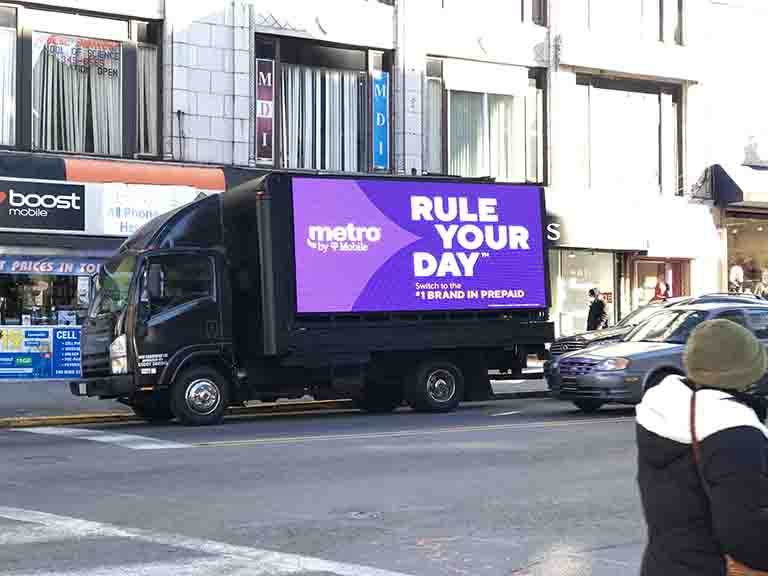
Led Billboard Trucks
Mobile LED displays that bring your brand to any location, any event.
Fly Posting
Street-level poster saturation across walls, construction sites, and corridors.

Sidewalk Decals
Ground-level branded decals at pedestrian hotspots and event entrances.

Sidewalk Stencils
Creative stencil campaigns that put your brand in the path of pedestrians.