American Guerrilla Marketing
Nationwide Service
Media planning, media buying, billboard advertising, & guerrilla marketing
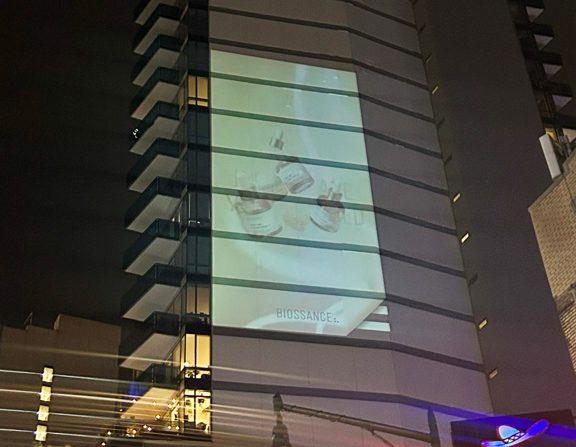
Guerrilla Projections in Yonkers, NY

28 minutes from Grand Central on Metro-North, with a revitalized waterfront and a city actively building its arts identity — AGM deploys 20,000-lumen building projection campaigns at New York City’s northern edge.
Yonkers: New York City’s Northern Edge and a Distinct Projection Market
Yonkers occupies the first city north of the Bronx on the Hudson River, linked to Grand Central Terminal by Metro-North’s express service in approximately 28 minutes — a commute time that positions Yonkers firmly within the New York City metropolitan orbit rather than the standalone upstate market category. This proximity defines the city’s audience composition for projection campaign purposes: a Yonkers projection campaign reaches residents whose daily professional and social lives are intertwined with New York City’s networks, whose media consumption and social sharing behavior reflect the metropolitan area’s creative-professional culture, and whose demographic characteristics are shaped by the city’s ongoing transformation from industrial-era decline to urban revival destination. What makes Yonkers a genuinely interesting projection market rather than simply a budget-priced proxy for the Bronx is that it has a distinct civic identity and a developing arts infrastructure built over the past two decades that gives it character beyond mere geographic adjacency.
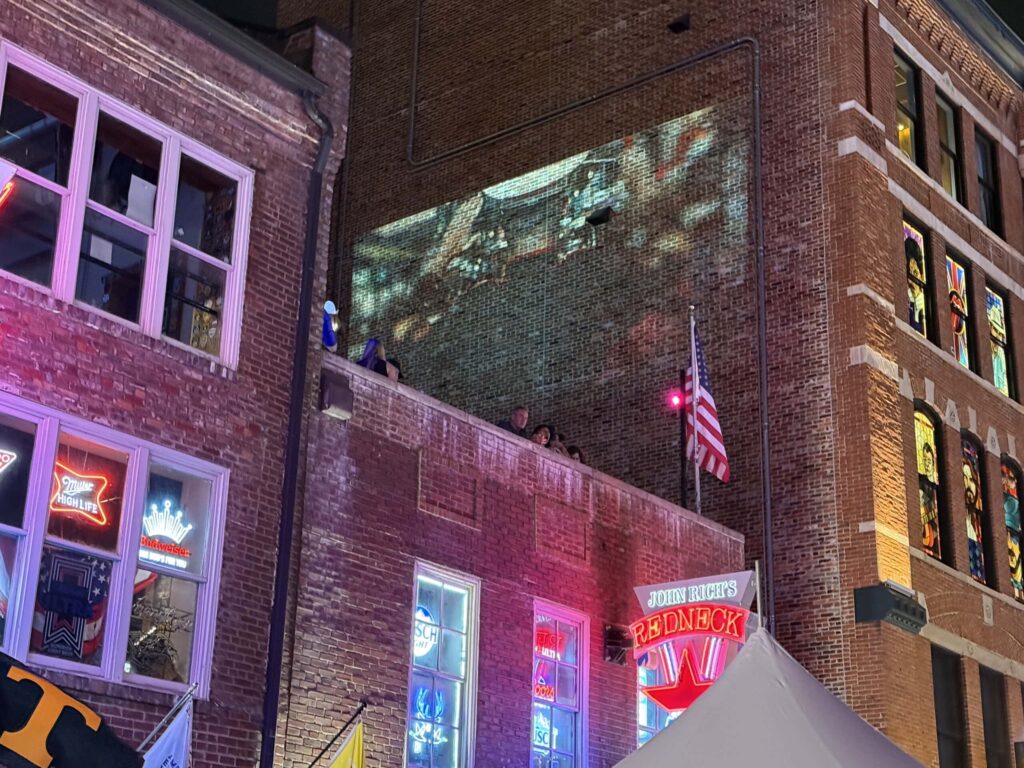
AGM’s projection client roster includes Netflix, Disney, Coca-Cola, FanDuel, Live Nation, iHeartRadio, and the US Marine Corps. A confirmed case study: the US Marine Corps × CMA Fest Nashville — multi-night projections onto architectural surfaces throughout the festival footprint, reaching 80,000+ attendees across the campaign window. Projection advertising scales across every brand category; what our campaigns share is scale, precision, and a physical presence digital cannot replicate.
AGM has executed guerrilla projection campaigns for brands including Netflix, Disney, and FanDuel — deploying high-impact visual activations onto architectural surfaces in major markets nationwide.
The Saw Mill River Daylighting project stands as Yonkers’s most consequential contribution to its own projection campaign geography. The project, which uncovered and restored a portion of the Saw Mill River that had flowed underground through downtown Yonkers for decades, created a new category of public space in the city’s downtown: a linear waterfront zone with pedestrian infrastructure, fountain features, and year-round programming flanked by the exterior walls of former commercial and industrial buildings. Those building faces — previously oriented toward a buried culvert and largely invisible to the public environment — are now the walls of an active waterfront public space, where audiences assemble specifically to be in the outdoor environment. For projection advertising, this configuration is structurally ideal: blank building faces bordering a pedestrian zone where visitors are stationary, present, and documentation-active rather than in rapid transit through the space.
Getty Square anchors Yonkers’s downtown commercial and civic geography at the intersection of Main Street, South Broadway, and the Hudson-facing waterfront corridor — the natural gathering point for the city’s evening arts and entertainment audience. Gallery spaces, arts organizations, restaurants, and cultural venues concentrated in the Getty Square zone have developed alongside the city’s decade-plus revitalization effort, adding programming that draws both Yonkers residents and the Metro-North commuter audience to the downtown for evening and weekend activity. Nodine Hill’s arts district character extends the city’s projection geography into its hillside residential neighborhoods, with gallery spaces and arts organizations occupying commercial nodes in a neighborhood of Victorian and early 20th-century brick buildings whose exterior masonry provides projection candidates with the distinctive architectural character of older New York residential development.
The WakeUp Coalition’s Austin campaign showed precisely how building projection advertising performs in markets undergoing active urban transformation — where the audience is engaged with the city’s revitalization identity, where the physical environment is improving rapidly enough that new public spaces create new campaign opportunities each year, and where the civic culture primes residents to engage with and document unexpected outdoor visual experiences as part of their relationship with the city’s changing character. Yonkers fits this description exactly: a city in motion, with an audience that is both a reflection of the NYC metropolitan area’s creative culture and a participant in their own city’s identity construction. Projection campaigns in Yonkers reach both of those dimensions simultaneously.
Bring Your Campaign to Yonkers — On the Hudson, 28 Minutes from Grand Central
AGM executes 20,000-lumen building projection campaigns on the Saw Mill River waterfront, through Getty Square, and across Yonkers's developing arts corridors. Full service from scouting through post-campaign documentation.
Browse Cities in New York
Select a city to explore Guerrilla Projections opportunities.
Yonkers' Five Strongest Projection Locations
Saw Mill River Waterfront Arts Zone (Ideal)
The Saw Mill River waterfront zone is the strongest single projection environment in Yonkers. The daylighting project created a publicly accessible linear waterfront running through downtown with pedestrian infrastructure — paths, bridges, seating, and fountain features — alongside the exterior walls of former commercial and light industrial structures that now face the waterway directly. These building walls — primarily smooth painted masonry and painted concrete on former commercial structures — provide projection surfaces bordering a public space where audiences are present specifically to experience the outdoor environment. The waterfront’s programming calendar generates predictable audience assembly windows: art installations, outdoor markets, seasonal events, and community programming throughout the year bring visitors into the space at regular intervals above and beyond the ambient pedestrian activity that the waterfront generates during good weather.
The sightlines from the waterfront pedestrian zone to the flanking building walls are generally excellent — clear horizontal distances of 40 to 100 feet from audience position to wall surface, with minimal overhead obstruction and consistent viewing angles from the walkway and bridgework. A projection positioned on a prominent Saw Mill River-facing building face reaches the assembled waterfront audience from multiple vantage points simultaneously, without the diffusion of attention that occurs in more linear pedestrian corridors.
Downtown Getty Square Arts Corridor
Getty Square’s position at the confluence of Yonkers’s primary downtown commercial streets and the Hudson River-facing waterfront makes it the natural center of the city’s evening arts and entertainment geography. The square itself functions as the downtown’s primary public gathering point — a hub from which galleries, restaurants, and arts venues radiate through the immediately surrounding commercial blocks. Building faces around Getty Square and along the connecting Main Street and South Broadway corridors include a mix of pre-war brick commercial construction — two to four-story buildings with painted masonry upper stories — and mid-century commercial structures with painted concrete block and smooth masonry faces. The pre-war brick buildings with painted upper-story faces offer the best projection conditions in the Getty Square zone: flat, uniformly colored surfaces above the retail signage level with clear street-level sightlines.
The Getty Square audience combines Yonkers residents who treat downtown as their neighborhood destination with the Metro-North commuter flow that passes through the downtown corridor between the train station and the surrounding residential neighborhoods. The commuter component of this audience is particularly notable: Metro-North commuters in Yonkers represent a demographic heavily composed of New York City-connected professionals whose social media networks reach into the city’s creative, business, and entertainment communities.
Nodine Hill Arts District
Nodine Hill occupies the hillside terrain northwest of Yonkers’s downtown, with a neighborhood character defined by Victorian and early 20th-century residential architecture mixed with commercial storefronts and arts organization tenants that have developed the district’s arts identity over the past decade. Gallery spaces, artists’ studios, and arts nonprofits give Nodine Hill the working-artist neighborhood character that differentiates it from the commercial arts district profile of Getty Square — a zone where the audience is primarily arts-industry insiders and arts-adjacent residents rather than the general entertainment and dining demographic. Building faces in the arts-adjacent commercial blocks of Nodine Hill include painted brick and masonry storefronts with the compact, urban-residential architectural profile of early 20th-century New York hillside neighborhoods. Painted masonry and smooth plaster surfaces on the commercial and converted residential buildings provide the best projection candidates in the district.
Trevor Park Area
The Trevor Park area — the residential and commercial blocks adjacent to Trevor Park in the central Yonkers geography — offers neighborhood-scale projection territory serving a primarily resident audience in a walkable park-adjacent zone. Building faces in the Trevor Park vicinity include early 20th-century masonry construction with the flat brick and painted concrete profiles common to Yonkers’s pre-war residential neighborhoods. The park itself functions as a public gathering space that activates evening pedestrian activity in the surrounding blocks during warm weather months, with park-adjacent commercial storefronts serving the neighborhood’s restaurant, café, and retail functions. Projection campaigns in the Trevor Park zone reach a primarily resident-audience demographic — Yonkers residents moving through their neighborhood environment for daily and leisure activities — a target appropriate for civic, community, and locally relevant brand campaigns that benefit from neighborhood-level reach rather than destination-district impression volume.
Greyston Development Area
The Greyston development area in southwest Yonkers, anchored by the Greyston Foundation’s social enterprise campus, represents an emerging community development and arts zone actively building both physical infrastructure and programming capacity. The Greyston campus’s converted industrial and commercial buildings feature exterior masonry faces appropriate for projection campaigns that align with the area’s community development and social impact identity. Programming on and around the Greyston campus — including events associated with the Greyston bakery’s social enterprise operations and community programming — brings an audience to the area that is engaged with the social impact mission of the surrounding institutions. Projection campaigns in the Greyston zone reach a combination of campus participants and partners, the southwest Yonkers residential community, and visitors who come to the campus for its events and cultural programming — an audience appropriate for social impact advocacy campaigns, community-facing brand activations, and civic awareness initiatives.
The Audience Yonkers' Waterfront Revival Is Attracting
The transformation of Yonkers’s Saw Mill River waterfront and downtown arts infrastructure has attracted a changing audience profile over the past decade. The city’s demographic transformation — driven by the appeal of lower rents relative to New York City, Metro-North access to Manhattan, and the improving quality of the downtown public environment — has brought a growing cohort of young professionals, creative industry workers, and arts-engaged residents to Yonkers neighborhoods that were less populated with this demographic five years ago. These new residents maintain strong connections to New York City’s creative, professional, and entertainment networks through their daily commute and social media engagement, which means projection campaign documentation from Yonkers waterfront and downtown events enters social media networks that extend into the full New York metropolitan area. Alongside this newer demographic, Yonkers’s established working-class and immigrant communities contribute a culturally diverse resident audience whose civic engagement and neighborhood investment give projection campaigns in the community spaces of Getty Square and the waterfront a genuine local resonance that out-of-town brand campaigns cannot manufacture without connecting authentically to the city’s character.
Plan Your Guerrilla Projection Campaign in Yonkers, NY
Tell us about your campaign goals, target audience, and preferred locations. Our team will help you plan a high-impact guerrilla projection campaign tailored to your needs.
Award Winning Personalized Service
You will get thoughtful, devoted, and individualized attention from our experienced, qualified, and professional personnel. Being one of the most illustrious agencies in Brooklyn, New York, American Guerrilla Marketing has been awarded the Best of Brooklyn title.
Nationwide
Industry City, Brooklyn, New York 11232
American Guerrilla Marketing
Hours
Mon - Fri: 9 AM - 5 PM
Sat & Sun: Closed
Automate your campaign with AGM’s Request for Proposal Builder.
Automate your campaign with AGM’s Request for Proposal Builder. Simply answer a few quick questions about your campaign goals, markets, and timeline, and the system will generate a tailored presentation with recommended strategies, quantities, and pricing. Click the RFP Builder to instantly receive your customized proposal.
What Campaign Types Work in Yonkers
Advocacy and Social Impact
Yonkers’s ongoing urban transformation — and the advocacy and community organizing around housing, arts access, waterfront development, and civic participation that has shaped its trajectory — creates receptive conditions for advocacy projection campaigns in the downtown and waterfront zones. The Metro-North commuter audience adds a New York City professional demographic whose social media connectivity extends advocacy campaign documentation reach into NYC-wide professional and advocacy networks from a Yonkers execution base.
Consumer Brand Activations
Yonkers’s position as a NYC-adjacent market undergoing active demographic transformation — bringing a younger, more professionally oriented residential population into a revitalized downtown — creates a viable consumer brand activation opportunity for brands seeking metropolitan New York market presence at pricing below full NYC rates. The Saw Mill River waterfront provides a distinctive and visually premium campaign setting unavailable in most New York City borough locations at comparable cost.
Corporate and Development Campaigns
The real estate development and corporate sectors building awareness of Yonkers’s transformation story find building projection campaigns in the downtown and waterfront zones effective for reaching both the local professional demographic and the Metro-North commuter audience. Companies recruiting from the Westchester County professional market, or positioning their brand within the Yonkers revitalization narrative, find projection advertising in the waterfront zone a higher-visibility alternative to conventional Westchester outdoor placements.
Arts Festival and Cultural Events
Yonkers Arts Weekend, the Hudson River Museum’s programming, and the waterfront’s event calendar create alignment opportunities for arts institution and cultural event promotion campaigns throughout the year. Building projection campaigns in the Saw Mill River waterfront zone and Getty Square corridor during arts event windows reach the city’s peak arts audience assemblies — the moments when the Yonkers arts community and its visitors are most concentrated in the downtown geography.
Political and Civic Campaigns
Yonkers’s competitive local political landscape — with contested city council, mayoral, and Westchester County legislative races — and its position in a New York State assembly and senate district that includes significant competitive electoral geography make the downtown and waterfront projection zones viable political advertising targets. Projection campaigns in the Saw Mill River waterfront and Getty Square reach a concentrated registered voter population in the city’s highest-turnout precincts during their most physically present, publicly engaged evening hours.
Building And Running A Yonkers Projection Campaign
Yonkers Site Evaluation and Wall Selection
AGM’s Yonkers scouting process evaluates the Saw Mill River waterfront building faces, the Getty Square arts corridor, Nodine Hill’s commercial arts blocks, the Trevor Park vicinity, and the Greyston campus zone for wall surface type and condition, building face dimensions, projector positioning options from the waterfront promenade, public right-of-way, and accessible viewing positions, ambient lighting conditions, and audience assembly patterns during the target execution window. The Saw Mill River waterfront zone has been the subject of multiple prior planning and documentation efforts related to the daylighting project, making wall inventory identification particularly efficient through existing documentation and AGM’s regional campaign experience in the New York metro area.
Campaign Configuration for the Hudson Valley Market
Yonkers’s building stock presents a surface profile typical of early-to-mid 20th century American urban construction — painted brick and masonry on commercial structures, smooth concrete block on mid-century buildings, and occasional smooth plaster finishes on more recently renovated structures. AGM’s image configuration for Yonkers campaigns accounts for the specific surface characteristics at each confirmed wall location: painted masonry provides good projection conditions for high-saturation color content; raw brick introduces surface texture variation that requires broader graphic masses and reduced fine-detail in campaign creative to maintain image quality across the mortar-line variation. The waterfront building faces, which tend toward recently painted masonry as part of the broader waterfront improvement program, often provide the cleanest projection conditions in the Yonkers market.
Night-of Execution in Yonkers
Yonkers projection campaigns launch at dusk, with AGM’s two-person crew managing all equipment setup, calibration, and operation from arrival through breakdown. Setup from crew arrival to projection launch runs approximately 60 to 90 minutes. Campaign windows run four to six hours through the peak audience period — 8 PM through midnight on Friday and Saturday evenings for the Saw Mill River waterfront and Getty Square zones, aligned to specific event programming windows for waterfront and civic events. AGM crews stage from the Brooklyn office at Industry City — approximately 25 miles from downtown Yonkers via the Bronx River Parkway or I-87 — making same-day crew deployment to Yonkers practical for evening campaigns without requiring overnight staging in Westchester County.
Documentation and Asset Delivery
Every Yonkers campaign includes professional photography and video documentation throughout the projection window. Yonkers waterfront documentation is particularly distinctive: the Saw Mill River’s urban waterscape provides a visual setting — running water, bridge features, and the surrounding historic and contemporary building context — that gives campaign imagery a geographic specificity immediately recognizable to Yonkers residents and the broader Hudson Valley audience. Documentation packages include GPS-verified location confirmation, image quality and coverage documentation, audience environment footage from the waterfront and surrounding streets, and all assets formatted for brand use in social distribution, earned media pitching, and internal reporting.
Yonkers Building Projection Advertising Pricing
Guerrilla projection campaigns in Yonkers are priced at contact us for a quote. . That rate covers the complete technical package: a 20,000-lumen commercial projection system, generator and power solution, electronics bundle, mobility unit, two-person AGM technical crew, and all setup, operation, and breakdown labor. Multi-night Yonkers campaigns — running two to three consecutive evenings across the Saw Mill River waterfront, Getty Square, and Nodine Hill zones — are available with scope-based pricing.
The proximity of Yonkers to AGM’s Brooklyn office at Industry City reduces the effective mobilization cost compared to campaigns in more distant upstate New York markets — the same crew deployment that reaches Yonkers in 25 to 30 minutes from Brooklyn can continue to the Bronx or return to Manhattan for additional campaign elements within the same day. Advance location scouting for Yonkers is approximately . Permitted or private-property locations — particularly in the Saw Mill River waterfront zone, where building owner engagement may facilitate superior positioning — are priced at Contact us for a custom quote. per night.
How Advocacy Campaign Work Translates To Yonkers
The WakeUp Coalition’s building projection campaign in Austin concentrated maximum campaign visibility into the arts district corridors where the highest-density urban audience was assembled and most attentive — achieving organic social documentation and earned media amplification through the combination of strong visual content, well-selected wall placement, and an audience whose arts-district engagement made unexpected public visual experiences resonant rather than anomalous. Yonkers’s Saw Mill River waterfront zone replicates the structural conditions that made the Austin campaign effective: a public outdoor space where an intentionally assembled audience is present for extended periods, building faces that serve as natural projection canvases for that audience’s viewing position, and a civic culture that treats the public space itself as a canvas for the city’s developing arts identity.
The Women’s March on Washington advocacy projection campaign demonstrated how issue-based messaging achieves national visibility through building projection at moments of concentrated civic attention — using the physical presence of projected imagery on building facades during a major civic event to reach assembled audiences and gathered media with visual communication at a scale no traditional advocacy format achieves. Yonkers’s ongoing urban development story carries its own concentrated civic attention: campaigns that engage with Yonkers’s revitalization narrative, its waterfront transformation, or its community development trajectory reach an audience actively invested in that story — and whose social media documentation of projection campaigns that connect to their city’s identity extends campaign reach into networks engaged with urban revitalization, New York State civic issues, and the broader Hudson Valley conversation.
Who Deploys Projection Campaigns in Yonkers
- Advocacy organizations working Yonkers-specific and Westchester County social, civic, and environmental issues
- Consumer brands targeting the NYC-adjacent Westchester market and Metro-North professional commuter audience
- Real estate and development companies building awareness of Yonkers’s urban transformation to attract residents, investors, and commercial tenants
- Arts institutions promoting Yonkers Arts Weekend, Hudson River Museum programming, and waterfront cultural events
- Political campaigns targeting Yonkers City Council, mayoral, and Westchester County electoral districts
- Corporate brands recruiting in the Westchester professional market or building recognition in the lower Hudson Valley
- Entertainment companies promoting releases to Yonkers and the lower Hudson Valley audience through a high-visibility outdoor execution
Coverage & Estimated Impressions
| Zone / Area | Peak Hours | Foot Traffic | Est. Nightly Impressions | Best For |
|---|---|---|---|---|
| Saw Mill River Waterfront Arts Zone (Ideal) | 8PM–1AM | High | 8,000–35,000 | Product Launch |
| Downtown Getty Square Arts Corridor | 8PM–1AM | High | 8,000–35,000 | Event Promotion |
| Nodine Hill Arts District | 8PM–1AM | High | 8,000–35,000 | Brand Awareness |
| Trevor Park Area | 8PM–1AM | High | 8,000–35,000 | Political |
| Greyston Development Area | 8PM–1AM | High | 8,000–35,000 | Sports |
Frequently Asked Questions
The Saw Mill River waterfront combines three conditions that projection campaigns require at ideal intensity: a public outdoor space where audiences assemble specifically to be present in the environment (rather than passing through), building faces with accessible projection surface geometry bordering that space, and a programming calendar that creates predictable high-density audience windows throughout the year. Unlike linear pedestrian corridors where audiences move continuously past a single point, the waterfront’s outdoor-room configuration creates extended dwell time — visitors are present in the projection field of view for the duration of their waterfront visit, not just the moment of passing the projection site.
Yonkers’s immediate adjacency to the Bronx and its 28-minute Metro-North connection to Grand Central give the city’s downtown audience a demographic composition that includes significant proportions of New York City-connected professionals, creatives, and metro-area cultural consumers. The influx of younger professional residents attracted to Yonkers by lower housing costs relative to NYC, combined with the established diversity of the city’s residential community, produces a campaign audience that extends campaign reach into New York City social media networks through the documentation and sharing behavior of the NYC-connected Yonkers resident population. A Yonkers projection campaign effectively reaches into the New York City metropolitan audience without requiring full NYC pricing.
Yes, though the timing requires alignment with commuter schedules. Metro-North commuters move through downtown Yonkers primarily in the morning (outbound to Manhattan) and evening (return from Manhattan) rush periods — the return commute, typically running from 5:30 PM through 8:30 PM, passes through the Getty Square zone between Yonkers station and the surrounding residential neighborhoods. Projection campaigns that launch early in the dusk window — by 7:30 PM in summer, when it stays light later — can capture the tail end of the return commute audience before transitioning to the full evening pedestrian audience. Getty Square projections timed to Thursday and Friday evening commuter peaks combined with the weekend evening arts and entertainment crowd cover both commuter and leisure-time audience segments within a single week’s execution.
Getty Square and the surrounding downtown commercial corridors offer a mix of surface types reflecting the area’s pre-war to mid-century commercial development history. Pre-war brick commercial buildings — two to four-story structures with painted upper-story masonry — provide the most commonly available projection candidates in the zone, with painted masonry offering better image quality than raw brick. Mid-century commercial construction with smooth painted concrete block surfaces is also common and provides excellent projection conditions on painted faces. Some newer commercial and mixed-use construction on the waterfront-adjacent blocks features contemporary masonry or stucco finishes that provide premium projection surface conditions. AGM’s scouting process identifies the strongest candidates by surface type and wall geometry within the Getty Square zone for each specific campaign.
Urban revitalization consistently creates better projection surfaces over time. As buildings are renovated, facades are cleaned, painted, and improved — converting rough or weathered brick surfaces to painted masonry that performs better for projection, and revealing former blank wall faces that were previously obscured by accumulated additions, signage, or adjacent buildings demolished in the revitalization process. The Saw Mill River Daylighting is the most dramatic example — a project that literally created new publicly accessible building faces by removing the infrastructure that previously hid them. Ongoing revitalization in the Getty Square zone, Nodine Hill, and the broader downtown area continues to add to the available projection surface inventory as each building renovation improves the condition and accessibility of the surrounding building faces.
Yes. Yonkers’s location at the top of the Bronx on I-87 makes it easily combinable with Bronx executions — the Mott Haven arts district or the Grand Concourse corridor — in the same evening or consecutive nights with minimal repositioning time. A Manhattan execution the following evening is straightforward from a Yonkers or Bronx staging base. For brands or organizations running multi-borough New York City metropolitan campaigns, Yonkers serves as the northernmost execution zone in a campaign that can span Yonkers → Bronx → Harlem → Manhattan in consecutive nights using a single crew deployment from the Brooklyn office, distributing mobilization costs across multiple execution markets efficiently.
Yonkers’s dual identity — NYC-adjacent metropolitan area demographics combined with a distinct civic character rooted in its own revitalization narrative — rewards creative that can speak to both registers without forcing a choice between them. Brand campaigns that acknowledge Yonkers’s character without condescending to it — engaging genuinely with the waterfront’s new identity, the arts district’s development, or the city’s own pride in its transformation — connect authentically with the resident audience. The Metro-North professional commuter demographic responds to the same sophisticated brand communication that performs in Manhattan; the Yonkers resident community responds to authenticity about their own city. Campaigns that respect both of these dimensions, rather than treating Yonkers as simply a cheaper New York City media buy, generate the strongest organic documentation and resident-audience engagement.
The Saw Mill River waterfront’s linear configuration — a pedestrian promenade alongside a channeled waterway flanked by building faces — creates projector positioning constraints and opportunities specific to the zone’s geometry. Projectors can be positioned on the promenade itself (facing the opposite building face across the waterway and promenade width), on the footbridges crossing the river (providing slightly elevated viewing angles), or on adjacent streets and accessible areas perpendicular to the waterway. Typical throw distances from projector to target wall across the waterfront zone range from 40 to 90 feet depending on the specific waterfront segment and available positioning, within the optimal range for 20,000-lumen projection. AGM’s scouting confirms the specific positioning options and clearances for each target wall in the waterfront zone.
Downtown Yonkers’s weekend evening pedestrian density has grown meaningfully over the past five years as the waterfront revitalization, arts programming, and restaurant development have built a more active evening economy. Friday and Saturday evenings in the Getty Square zone and along the Saw Mill River waterfront now sustain consistent foot traffic from early evening through midnight — still below the densities of Allentown in Buffalo or South Wedge in Rochester in absolute terms, but meaningfully active by the standards of outer-ring New York metropolitan suburbs. The waterfront’s programming events generate the highest single-evening pedestrian concentrations in the downtown zone. The Metro-North return commute adds a reliable evening movement of professionals through the downtown from 6 PM through 8 PM on weekday evenings, providing a secondary audience window for campaigns that launch before the weekend leisure crowd peaks.
Every Yonkers campaign produces professional photography and video documentation throughout the projection window. The Saw Mill River waterfront provides a particularly distinctive documentation setting — the urban waterway, fountain features, and historic building backdrop give Yonkers campaign imagery a geographic specificity immediately recognizable to Yonkers residents and the broader lower Hudson Valley audience. Documentation is captured in formats appropriate for social media distribution, editorial press submission, and internal brand reporting. The waterfront’s programming calendar and the distinctive visual character of the Saw Mill River zone make Yonkers projection documentation more visually specific to its location than documentation from more generic commercial corridors — an asset for brands that want their campaign imagery to carry a clear sense of place alongside the projection content itself.
More AGM Outdoor Advertising Services
Led Billboard Trucks
Mobile LED displays that bring your brand to any location, any event.

Fly Posting
Street-level poster saturation across walls, construction sites, and corridors.

Sidewalk Decals
Ground-level branded decals at pedestrian hotspots and event entrances.

Sidewalk Stencils
Creative stencil campaigns that put your brand in the path of pedestrians.