American Guerrilla Marketing
Nationwide Service
Media planning, media buying, billboard advertising, & guerrilla marketing
Guerrilla Projections in New York City, NY

AGM is based in Brooklyn. We execute building projection campaigns across all five boroughs — SoHo loft faces, Williamsburg warehouse walls, DUMBO’s industrial buildings, Times Square perimeter, and beyond. contact us for a quote.
New York City: AGM’s Flagship Projection Advertising Market
New York City is not simply the largest projection advertising market in America — it is the market that defined what building projection advertising means as a professional discipline. AGM’s operations are rooted in Brooklyn, with the team based at Industry City, Unit 28, in Sunset Park — positioned within the city itself for direct access to a market whose building stock, audience density, and social media dynamics have no equivalent anywhere in the world. When a 20,000-lumen projection appears on a cast-iron building face in SoHo or on a Williamsburg warehouse wall after midnight, it enters the visual field of one of the most photographed urban environments on earth — a context where organic documentation, entertainment press coverage, and social media sharing amplify campaign reach in ways that campaigns in smaller, less-photographed markets cannot replicate regardless of execution quality or creative strength.
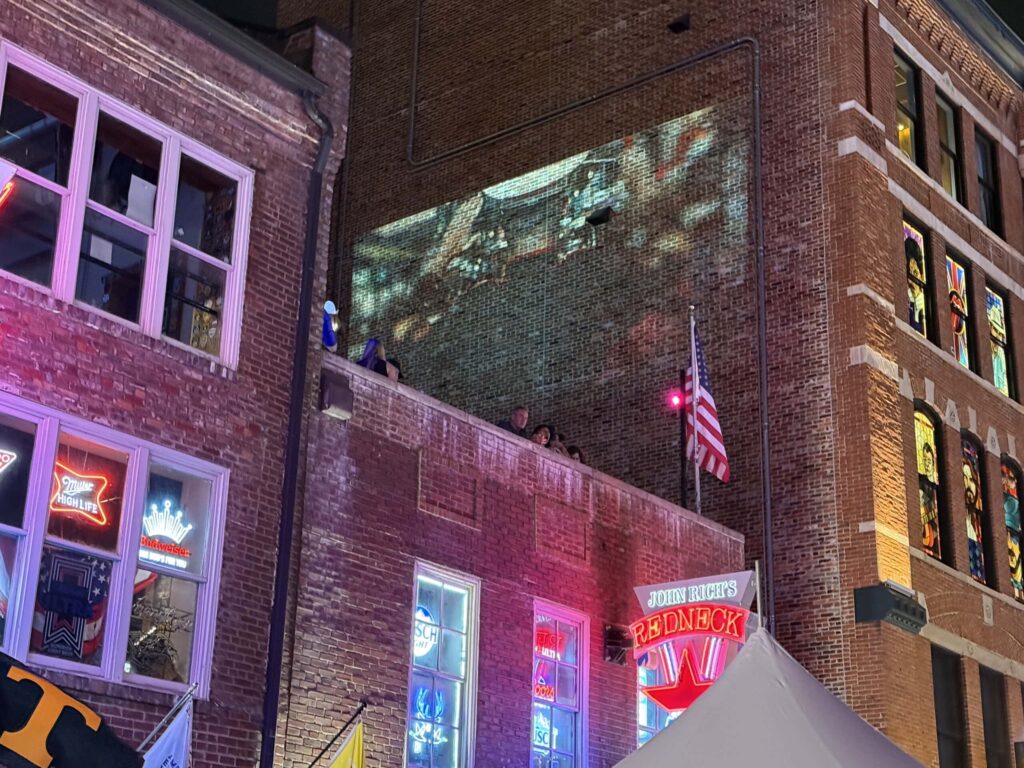
AGM’s projection client roster includes Netflix, Disney, Coca-Cola, FanDuel, Live Nation, iHeartRadio, and the US Marine Corps. A confirmed case study: the US Marine Corps × CMA Fest Nashville — multi-night projections onto architectural surfaces throughout the festival footprint, reaching 80,000+ attendees across the campaign window. Projection advertising scales across every brand category; what our campaigns share is scale, precision, and a physical presence digital cannot replicate.
AGM has executed guerrilla projection campaigns for brands including Netflix, Disney, and FanDuel — deploying high-impact visual activations onto architectural surfaces in major markets nationwide.
The scale of the opportunity is structural. New York City’s five boroughs collectively support a nighttime pedestrian economy that dwarfs any other American city — millions of daily passersby on foot, moving through pedestrian-scale streets, active in the outdoor environment from early morning through the late hours across all five boroughs simultaneously. The city’s arts, entertainment, retail, and nightlife economy concentrates evening audiences in defined geographic corridors — SoHo and the gallery districts, Williamsburg and Bushwick, the Meatpacking District and Chelsea, Times Square’s perimeter streets, DUMBO’s industrial waterfront — where the combination of high foot traffic, socially active audiences, and visually rich building architecture creates optimal projection campaign conditions night after night throughout the year.
Manhattan’s projection geography concentrates in its gallery, retail, and entertainment corridors. SoHo’s cast-iron loft district carries five-to-seven-story commercial buildings from the 1850s through 1890s, their upper stories presenting smooth painted masonry wall faces to Broadway, Greene, and Prince Streets — surface geometry that is both technically favorable for 20,000-lumen projection and architecturally distinctive enough that campaign photography taken in SoHo registers as New York City without geographic labeling. The Meatpacking District’s former slaughterhouse and cold-storage architecture and Chelsea’s gallery corridor contribute additional Manhattan wall inventory in a combined West Side zone that draws one of the most fashion-conscious, arts-engaged, and internationally connected nighttime audiences in the city.
Brooklyn’s projection geography is defined by the waterfront manufacturing and industrial legacy that shaped the borough’s physical character for a century. The former factory and freight buildings of Williamsburg’s North Side corridor present exterior walls of brick and painted masonry at heights and widths that give 20,000-lumen projection systems room to achieve their maximum image dimensions — surfaces where projected content covers thousands of square feet and registers as the dominant visual element in the surrounding block. Bushwick’s warehouse arts district and DUMBO’s former industrial buildings extend Brooklyn’s projection map, while Industry City in Sunset Park — AGM’s home campus — anchors the Sunset Park industrial corridor with a creative economy campus whose building faces and resident audience make it both a staging ground and a campaign venue.
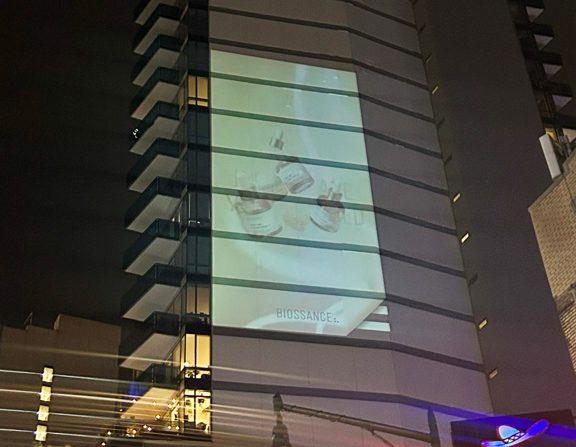
The two campaigns that most visibly define New York City projection advertising in AGM’s portfolio are The Weeknd’s YouTube countdown campaign and Biossance’s product launch at Sephora’s Union Square flagship — both executed in New York City, both reaching New York City’s extraordinary daily audience, and both generating the kind of national earned media return that New York City’s media density makes uniquely achievable. These campaigns are the reference points for understanding what building projection advertising accomplishes in this market at its highest expression, and they are a direct product of AGM’s operational presence in New York as its home market and primary campaign environment.
New York City Is Where It Gets Real
AGM's Brooklyn office executes 20,000-lumen building projection campaigns across all five boroughs. SoHo loft faces, Williamsburg warehouse walls, DUMBO under the bridge, Times Square perimeter — we know every wall. contact us for a quote.
Browse Cities in New York
Select a city to explore Guerrilla Projections opportunities.
Manhattan Projection Zones: Where The City's Walls Work Hardest
SoHo and the Cast-Iron Loft District
The SoHo cast-iron loft district is the most iconically New York projection environment in AGM’s national portfolio. Five-to-seven-story commercial and manufacturing buildings from the 1850s through 1890s present upper stories of smooth painted masonry — above the retail-level cast-iron facades — to Broadway, Greene, Wooster, and the surrounding SoHo grid. Upper-story wall sections range from 20 to 40 feet in height and 30 to 60 feet in width on the broader building facades, positioned above the ambient retail lighting and signage of the street level, giving projected imagery visual space that registers above the commercial environment without competing against it. The SoHo pedestrian audience spans international fashion visitors and gallery tourists who come specifically to experience the neighborhood, alongside the restaurant-and-bar crowd, the residents of lofts and apartments throughout the district, and the creative professionals whose studios and offices populate the upper floors of the surrounding buildings. Daily foot traffic on Broadway through SoHo is among the highest of any arts-retail corridor in North America, with weekend evening density in the 8 PM to midnight window exceeding what most American cities achieve on their best event nights.
Meatpacking District and Chelsea Gallery Corridor
The Meatpacking District occupies a grid of low to mid-rise masonry buildings from Gansevoort Street to West 14th between Hudson and 10th Avenue — former slaughterhouse and cold-storage infrastructure whose exterior masonry walls range from smooth painted surfaces on renovated structures to original brick on the more historic buildings. The neighborhood’s transformation into a premium nightlife, fashion, and hospitality zone has added an affluent evening audience and strong international media visibility to a geographic zone whose industrial building bones fit projection advertising naturally. Fashion flagships, destination restaurants, and nationally prominent nightlife venues populate the Meatpacking’s streets, generating an evening audience with high social media documentation rates and significant influencer and press presence.
Chelsea’s gallery corridor runs for approximately 15 blocks along 10th and 11th Avenues through the highest concentration of contemporary arts galleries in the Western Hemisphere outside of major international art fair weeks. Gallery opening evenings — concentrated on Thursdays through Saturdays — assemble a combined audience of arts collectors, gallery professionals, museum curators, arts journalists, and the broader cultural audience that treats Chelsea’s gallery walks as a regular social activity. Projection campaigns timed to Chelsea gallery opening evenings reach an arts-professional audience whose social media documentation within collector and industry networks reaches a globally connected arts audience that is difficult to assemble through any other single-market campaign approach.
Times Square Perimeter — 8th and 9th Avenues
Times Square’s core zone operates at digital screen brightness levels — many thousands of lumens across combined signage systems — that make individual building projection advertising non-competitive within the immediate square perimeter. The surrounding blocks immediately west on 8th and 9th Avenues between West 40th and West 56th Streets provide a strategically valuable alternative: building faces that capture the overflow audience from Times Square’s extraordinary pedestrian volumes without operating within the screen-saturation zone that would render projection invisible. Daily pedestrian counts on 8th and 9th Avenues in this range place them among the highest-traffic outdoor advertising positions in New York City. A 20,000-lumen projection on a prominent 8th Avenue building face reaches an audience that is simultaneously massive in scale and in a heightened state of visual alertness from navigating the Times Square environment — conditions that translate to above-average campaign awareness and documentation rates for projection campaigns positioned at these perimeter locations.
Brooklyn's Warehouse Wall Advantage
Williamsburg Warehouse Walls — Bedford Avenue Corridor and North Side
The Williamsburg waterfront industrial corridor on the North Side carries building wall inventory that rivals the best industrial-zone projection surfaces AGM accesses in any American market. Former factory, warehouse, and freight buildings facing the Bedford Avenue and North 7th, 8th, and 9th Street corridors present brick and painted masonry exterior walls that span 40 to 80 feet in width at heights of 30 to 50 feet on the largest structures — comparable in scale to the finest industrial warehouse walls in Buffalo’s Larkin District, with the added advantage of an audience demographic and social media activation rate that no other market in the country can match at comparable volume. Williamsburg’s resident population — creative industry professionals, musicians, visual artists, tech workers, and the broader 22-to-40-year-old entertainment and arts consumer audience that defines the neighborhood — produces organic documentation rates for projection campaigns that consistently surprise first-time NYC campaign clients. A 20,000-lumen projection on a Williamsburg warehouse wall at 10 PM generates photo and video documentation from dozens of individual pedestrian audience members within the first hour, with that documentation reaching artist, music, and brand social media networks that collectively hold millions of followers before the projection window closes for the night.
DUMBO, Bushwick, and Industry City — Brooklyn’s Full Projection Portfolio
DUMBO’s former industrial buildings — primarily brick and cast-iron manufacturing structures from the late 19th and early 20th century — offer projection surfaces beneath and adjacent to the Manhattan Bridge’s dramatic stone anchorage towers, with sightlines from the waterfront park and DUMBO’s pedestrian streets. The Manhattan Bridge’s visual presence as background for DUMBO projection campaign documentation produces imagery that is among the most photographically distinctive in AGM’s national portfolio: building projection advertising with one of New York City’s most recognizable architectural landmarks visible in the same frame. The DUMBO pedestrian audience includes both the neighborhood’s growing residential population and the steady stream of tourists who visit the waterfront park for the iconic views of the Manhattan skyline — a combined local-and-tourist audience active in the outdoor environment throughout daylight and early evening hours.
Bushwick’s warehouse arts district — centered on the Bushwick Collective’s extensive outdoor mural installations along Jefferson Street and the surrounding blocks — adds a street-art-literate audience whose daily engagement with public outdoor creative work makes projection campaigns native to their environment rather than unexpected intrusions in it. Audiences in Bushwick are accustomed to encountering large-scale visual work on building walls; they approach projection campaigns with curiosity and engagement rather than the brief double-take that characterizes audiences in environments where large outdoor imagery is unusual. Industry City in Sunset Park, where AGM’s Brooklyn office is based, provides a creative campus of converted industrial buildings with exterior walls facing the surrounding streets — a built-in campaign venue with a year-round audience of designers, food producers, manufacturers, and creative economy workers alongside the visitors who come to the campus for its retail, dining, and arts programming.
Plan Your Guerrilla Projection Campaign in New York City, NY
Tell us about your campaign goals, target audience, and preferred locations. Our team will help you plan a high-impact guerrilla projection campaign tailored to your needs.
Award Winning Personalized Service
You will get thoughtful, devoted, and individualized attention from our experienced, qualified, and professional personnel. Being one of the most illustrious agencies in Brooklyn, New York, American Guerrilla Marketing has been awarded the Best of Brooklyn title.
Nationwide
Industry City, Brooklyn, New York 11232
American Guerrilla Marketing
Hours
Mon - Fri: 9 AM - 5 PM
Sat & Sun: Closed
Automate your campaign with AGM’s Request for Proposal Builder.
Automate your campaign with AGM’s Request for Proposal Builder. Simply answer a few quick questions about your campaign goals, markets, and timeline, and the system will generate a tailored presentation with recommended strategies, quantities, and pricing. Click the RFP Builder to instantly receive your customized proposal.
Queens and the Industrial Waterfront
Long Island City’s industrial waterfront in Queens — the former factory and warehouse buildings adjacent to the East River between the Queensboro Bridge and the Hunter’s Point waterfront park — presents projection wall candidates in painted masonry and brick facing the river-view blocks, with sightlines from Queens-side streets and the waterfront path. The neighborhood’s rapid residential transformation over the past decade has introduced a large young professional population alongside the remaining creative industry tenants, producing a mixed residential-and-creative-professional audience that supports evening outdoor activity year-round. Astoria’s commercial corridors along Steinway Street and the elevated N and W train lines offer additional Queens projection capacity in a neighborhood with strong evening restaurant and entertainment activity drawing from one of New York’s most culturally diverse borough populations. Campaigns requiring five-borough geographic breadth can incorporate Queens locations alongside Manhattan and Brooklyn executions through multi-site coordination within a single campaign deployment window.
The Audience That Makes Nyc Projection Campaigns Go Viral
New York City’s projection campaign audience differs from every other American market in one foundational characteristic: the social media documentation rate. New York City pedestrians — particularly in the creative-professional-dominated neighborhoods of Williamsburg, SoHo, and Bushwick — document unexpected outdoor visual experiences at rates that translate a single building projection into dozens of individual social media posts within the first hour of a campaign night. The cumulative social media reach of that distributed documentation — across Instagram, TikTok, Twitter, and platform-specific niche networks in music, art, fashion, and entertainment — regularly exceeds the direct audience of the physical projection by factors of ten to one hundred or more, depending on the creative content and the audience networks of the specific documenters who share it. This multiplication effect is structural to the New York City market, not a consequence of any single campaign’s creative merit: the city’s population of socially connected creative professionals, influencers, journalists, and entertainment industry workers produces earned media amplification at a scale that no other American city’s audience can replicate regardless of execution quality. For brands and organizations deploying building projection campaigns in New York City, the physical audience is the beginning of the campaign’s reach — not its ceiling.
What Campaign Types Define NYC Projection Advertising
Entertainment Release Campaigns
New York City is the global center of the entertainment industry — labels, streaming platforms, film studios, management companies, and promoters all maintain flagship operations here and deploy launch campaigns in this market first. Building projection advertising is the physical marketing format most consistent with the scale and visibility expectations of major entertainment releases in New York City: it occupies the streets the entertainment audience walks through, is documented by that audience organically, and generates national press coverage in the entertainment and marketing media concentrated in the city.
Consumer Brand Activations
New York City’s retail geography — SoHo’s brand flagships, Union Square’s commercial anchors, the Meatpacking’s premium consumer zone — makes it the most competitive consumer brand launch environment in North America. Building projection advertising at these positions creates brand presence at a physical scale that occupies real estate in the most competitive brand environment in the country. The documentation of that presence by the retail-consumer audience in these corridors reaches beauty, fashion, and lifestyle audiences nationally and internationally through social sharing and press coverage.
Advocacy and Political Campaigns
New York’s progressive political culture and the national visibility of its advocacy community make the city’s arts and entertainment corridors powerful platforms for issue campaigns. Advocacy building projection advertising in SoHo, Williamsburg, or Chelsea reaches nationally influential progressive and arts-professional audiences in their own geographic territory, generating press coverage in the national media concentrated in New York City that amplifies campaign reach to audiences far beyond the physical execution sites.
Corporate Awareness and Recruitment
New York City’s concentration of major corporations, financial institutions, tech companies, and professional services firms makes it the most important single market for corporate brand awareness targeting professional audiences. Building projection campaigns in Chelsea, the Meatpacking District, and Times Square perimeter blocks reach senior professionals, financial industry workers, and the creative and tech professional community in their specific evening environments — outside digital channels where corporate advertising reaches this demographic with declining effectiveness.
Fashion, Luxury, and Cultural Campaigns
New York City’s fashion industry — anchored in SoHo, the Meatpacking, and Midtown’s showroom district — and its global reputation as a fashion and luxury capital make building projection advertising a natural vehicle for fashion brands, luxury goods companies, and cultural institutions seeking physical presence in the city’s most visually active environments. Fashion campaigns on SoHo building faces reach the international fashion audience in the specific geographic context where fashion culture is most actively consumed, documented, and distributed.
How Agm Executes Across The Five Boroughs
Borough Selection and Site Reconnaissance
NYC campaign planning begins with borough and neighborhood selection that aligns campaign geography with target audience demographics and campaign objectives. A music release campaign targeting the creative-professional and entertainment-industry audience prioritizes Williamsburg, Bushwick, and SoHo. A retail brand launch prioritizes SoHo, Union Square adjacency, and the Meatpacking zone. An advocacy campaign targeting national media amplification prioritizes Manhattan corridors with strong press and influencer density. Once neighborhoods are identified, AGM’s site reconnaissance process evaluates wall candidates for surface type, dimensions, projector positioning options, sightline clearance, and ambient lighting — a process accelerated significantly by AGM’s years of direct campaign experience throughout the five-borough geography.
Creative Configuration for NYC Building Geometry
New York City’s building stock is more varied than any other American market — cast-iron loft facades, brick warehouse walls, smooth masonry commercial buildings, painted concrete, and occasional modern construction all coexist within individual neighborhoods. AGM’s image configuration for each campaign accounts for the specific surface material, base color, and wall geometry at each selected location. SoHo’s smooth painted upper-story masonry allows for the highest image sharpness and color saturation of any Manhattan surface profile. Williamsburg and Bushwick’s brick surfaces require broader color masses and less fine-detail creative to maintain image quality across the mortar texture variation. DUMBO’s brick and cast-iron surfaces fall in between — favorable for strong graphic imagery with good overall saturation but some fine-detail softening from surface texture at close viewing distances.
Multi-Borough Execution Night
AGM’s two-person technical crew launches each NYC projection campaign at dusk — typically between 7:30 and 9:00 PM depending on season — from the first target location. Setup and calibration from crew arrival to projection launch runs approximately 60 to 90 minutes. Campaign windows run four to six hours through the peak audience period, covering the 9 PM to 2 AM window that represents maximum pedestrian density across most New York City projection zones. Multi-neighborhood campaigns — for example, a Brooklyn North Side execution followed by a Manhattan SoHo execution in the same night — use the mobile projection unit for repositioning, with transit time between Brooklyn and Manhattan accounted for in the campaign timeline. Campaigns requiring simultaneous multi-borough coverage deploy independent crews from the Industry City staging point.
NYC Campaign Documentation and Press-Ready Asset Delivery
Every New York City campaign produces professional photography and video documentation throughout the projection window. NYC documentation captures two distinct asset types: the projection itself — image quality, wall coverage, brightness, and color saturation — and the audience and environment context — pedestrians in the projection field of view, street-level response, and the distinctive architectural character of the surrounding neighborhood. Both asset types are delivered in social media-optimized and press-ready formats. AGM’s documentation team is experienced in shooting NYC projection campaigns under the specific lighting conditions of each neighborhood’s night environment, producing imagery that consistently meets the quality bar for editorial publication in entertainment, marketing, and general press outlets that cover the city’s creative activations.
New York City Projection Advertising Pricing
Guerrilla projection campaigns in New York City are priced at contact us for a quote. — AGM’s special rate for its home market. That rate covers a 20,000-lumen commercial projection system, generator and complete power solution, electronics bundle, mobility unit, two-person AGM technical crew, and all setup, operation, and breakdown labor. Multi-night NYC campaigns are available with pricing structured by total campaign scope; the per-night rate applies consistently across all campaign durations.
Advance location scouting for specific NYC neighborhoods is approximately contact us for a quote. when a dedicated physical scouting visit is required beyond AGM’s existing site knowledge. Permitted or private-property locations in New York City — buildings where AGM secures formal access agreements with property owners or managers in SoHo, Williamsburg, DUMBO, or other target neighborhoods — are priced at Contact us for a custom quote. per night depending on building access and site conditions. NYC campaign windows run four to six hours from dusk through the peak audience period.
For multi-borough campaigns requiring simultaneous deployment in Manhattan and Brooklyn, pricing is additive across the independent crew deployments required for each simultaneous market. Campaign planning conversations can address multi-borough coordination logistics and pricing based on specific campaign requirements.
Two Nyc Campaigns That Define What's Possible
The Weeknd × YouTube — Building Projection as Release-Day Infrastructure
In the weeks before a major entertainment release, The Weeknd and YouTube deployed building projection campaigns on New York City building facades as physical countdown infrastructure — projecting imagery that counted down to the release across walls in the city’s arts and entertainment corridors. The projections appeared on Brooklyn and Manhattan walls during evening hours, documenting exactly as the campaign intended: pedestrians encountered them unexpectedly during their regular movement through the city, immediately captured the imagery on their phones, and shared the documentation into their social media networks before moving on. The social media documentation from those organic encounters reached entertainment fans globally ahead of the release date, creating pre-release awareness that arrived in feeds with the authenticity of user-generated content — discovered, shared, and discussed by people who had actually encountered it in physical space — rather than the recognizable patterns of paid digital promotion.
Entertainment and marketing press covered the campaign as a news event rather than paid advertising, generating editorial coverage in publications and on platforms that reach entertainment audiences nationally and internationally. The campaign’s physical existence on building walls — visible to anyone passing through the execution neighborhoods during the campaign nights, not just to users served a digital ad impression — created a kind of cultural reality for the pre-release countdown that no screen-based campaign could manufacture. Building projection advertising in New York City produces this type of press and social amplification consistently because the city’s media density and the social connectivity of its arts-and-entertainment audience population are structured to amplify unexpected physical creative activations into media events.
Biossance × Sephora — Union Square Product Launch
Biossance’s partnership with Sephora for a product launch at Union Square used building projection advertising as retail launch infrastructure at one of New York City’s highest-volume commercial intersections. Union Square is served by six subway lines, anchored by the Greenmarket and surrounded by flagship retail including the Sephora location associated with the campaign — a geographic node where daily foot traffic reaches six-figure daily counts, drawing shoppers, commuters, tourists, and New York residents from across the boroughs and the surrounding region. The campaign placed Biossance brand and product imagery on building faces in the Union Square zone at a visual scale appropriate to the surrounding urban environment — imagery that registered as the dominant visual element in the visual field of Union Square pedestrians rather than as a small-format advertisement competing for attention within their phone’s interface.
For a beauty brand launching through a retail partnership at a specific location, the strategic logic was precise: project brand imagery into the physical geography immediately surrounding the point of sale, in the same blocks where the consumer purchase decision was actively forming among the Union Square shopping audience. The campaign’s organic documentation — photographed by Union Square pedestrians and shared through beauty, lifestyle, and New York City culture social media networks — extended campaign reach into national and international beauty audiences who were not physically present at Union Square but who encountered the campaign through the social media of those who had. The combination of point-of-sale physical presence and organic social amplification through beauty-audience networks is a campaign dynamic that no digital media placement strategy in the same market can replicate at comparable authenticity or cost efficiency.
Who Runs Guerrilla Projections in New York City
- Entertainment labels, streaming platforms, and management companies running release, launch, and promotional campaigns in AGM’s home market
- Consumer brands in beauty, fashion, lifestyle, and retail activating at New York City’s flagship commercial intersections
- Advocacy organizations seeking national media amplification through New York City’s media-dense environment
- Political campaigns targeting New York City’s competitive mayoral, city council, state legislative, and federal electoral districts
- Fashion and luxury brands with flagship presence in SoHo, the Meatpacking, and Midtown
- Corporate brands building professional audience awareness in New York City’s business-dense corridors
- Arts institutions and cultural organizations promoting programming and cultural events to the city’s arts-engaged population
- Sports teams and entertainment venue operators running event-adjacent campaigns in the city’s entertainment districts
Coverage & Estimated Impressions
| Zone / Area | Peak Hours | Foot Traffic | Est. Nightly Impressions | Best For |
|---|---|---|---|---|
| SoHo and the Cast-Iron Loft District | 9PM–2AM | Very High | 25,000–120,000 | Product Launch |
| Meatpacking District and Chelsea Gallery Corridor | 9PM–2AM | Very High | 25,000–120,000 | Event Promotion |
| Times Square Perimeter | 9PM–2AM | Very High | 25,000–120,000 | Brand Awareness |
| Williamsburg Warehouse Walls | 9PM–2AM | Very High | 25,000–120,000 | Political |
| DUMBO, Bushwick, and Industry City | 9PM–2AM | Very High | 25,000–120,000 | Sports |
Frequently Asked Questions
New York City projection campaigns are priced at contact us for a quote. — AGM’s special rate for its home market. That rate covers the complete technical package: a 20,000-lumen commercial projection system, generator and power solution, electronics bundle, mobility unit, two-person AGM technical crew, and all setup, operation, and breakdown labor. The Contact us for a custom quote. NYC rate is the only market exception in AGM’s national pricing structure; all other markets outside of New York City are priced at contact us for a quote.
AGM executes campaigns across all five boroughs. Manhattan and Brooklyn account for the majority of NYC campaign executions, reflecting their concentration of arts and entertainment district foot traffic and industrial building wall inventory. The most frequently deployed Manhattan zones are SoHo, the Meatpacking District, Chelsea, and the Times Square perimeter. Brooklyn’s most active projection zones are Williamsburg, Bushwick, DUMBO, and Industry City in Sunset Park. Queens campaigns concentrate in Long Island City and Astoria. Bronx and Staten Island campaigns are executed on a project-by-project basis based on specific campaign geography requirements.
Williamsburg’s North Side warehouse walls combine three characteristics that projection campaigns require at maximum intensity: surface scale, surface quality, and audience density. Wall faces of 40 to 80 feet in width at 30-to-50-foot heights provide image dimensions that dominate the visual environment of the surrounding block. Brick and painted masonry finishes — particularly the smoothly painted warehouse exteriors in the corridor — provide acceptable to excellent projection surfaces depending on specific wall condition. And Williamsburg’s creative-professional, music-engaged, and arts-active evening population produces social media documentation rates for projection campaigns that consistently exceed those of comparable-scale executions in other markets — making Williamsburg earned media amplification one of AGM’s most reliable NYC campaign advantages.
Times Square’s existing digital signage operates at combined brightness levels that would render a 20,000-lumen projection nearly invisible if deployed on building faces within the core sign district. AGM’s Times Square strategy targets the surrounding perimeter blocks — 8th and 9th Avenues between approximately West 40th and West 56th Streets — where building faces capture the extraordinary pedestrian volumes generated by the Times Square ecosystem without competing against the signage brightness levels of the core zone. This positioning gives campaigns the benefit of Times Square’s audience concentration while maintaining image brightness and contrast appropriate for building projection to actually register. The perimeter position also avoids the aesthetic confusion of projecting within Times Square’s existing signage landscape, giving projected images clear visual context rather than blending into the surrounding screen array.
Yes, with appropriate timeline planning. A two-site campaign covering Williamsburg and SoHo in the same evening is logistically achievable — the transit between Williamsburg and SoHo via the Williamsburg Bridge or the J/M/Z subway takes approximately 15 to 20 minutes in light traffic, allowing crew repositioning between a 9 PM Williamsburg launch and a midnight SoHo setup without operational conflict. Three-site single-night campaigns are more compressed and require careful timeline management but are achievable. Multi-borough simultaneous campaigns — for example, a Williamsburg and a SoHo execution running concurrently — require independent crews from the Industry City staging point, with pricing additive across the simultaneous deployments.
AGM’s Brooklyn office is located at Industry City, Unit 28, Brooklyn, NY 11232. Phone: (646) 776-2770. Industry City in Sunset Park is a 35-acre campus of converted industrial and warehouse buildings housing creative studios, manufacturers, food and beverage brands, tech companies, and arts organizations — a destination campus in its own right and, for AGM, the staging point for all New York City and New York State campaign deployments. Campaign inquiries, site scouting coordination, crew scheduling, and technical preparation for all NY State campaigns are managed from the Brooklyn office. Clients are welcome to coordinate directly with the Brooklyn team for NYC-specific campaign planning.
New York City projection campaigns run under two primary access structures: guerrilla executions from public right-of-way, where the projector is positioned on a public sidewalk or accessible area and projects onto an adjacent building facade without formal building-owner authorization; and permitted or private-property executions, where AGM secures formal access agreements with building owners or property managers. Guerrilla-style executions are standard for many NYC locations — particularly in Williamsburg, SoHo, and Bushwick — where public right-of-way positioning provides adequate throw distance and projector placement without requiring building access. Permitted executions are appropriate for locations requiring building roof access, building premises entry, or explicit owner authorization, and are priced accordingly contact us for a custom quote..
Entertainment companies — labels, streaming platforms, film studios, and management companies — are the most frequent deployers of building projection advertising in New York City, consistent with the city’s role as the global entertainment industry’s primary marketing market. Consumer brands in beauty, fashion, and lifestyle are the second most active category, using NYC projections for product launches and brand activations at the city’s flagship retail intersections. Advocacy organizations and political campaigns represent a significant and growing category, particularly in neighborhoods — Williamsburg, SoHo, Chelsea — where the audience’s high social media connectivity amplifies advocacy campaign reach into nationally visible networks.
SoHo on a weekend evening generates sustained pedestrian density that is among the highest of any arts-and-retail corridor in any American city — Broadway between Houston and Canal sees foot traffic volumes comparable to Times Square’s perimeter blocks. What distinguishes SoHo from higher-volume corridors like Times Square itself is the combination of density and audience quality: SoHo’s pedestrian mix of international fashion visitors, gallery tourists, and local creative professionals produces higher per-impression social documentation and brand awareness rates than the general-tourist audience that dominates Times Square. For campaigns targeting the arts, fashion, and creative professional demographic, SoHo delivers higher-quality impressions per viewer than Times Square’s larger but more diffuse audience composition.
Manhattan loft building facades — particularly SoHo’s cast-iron and painted-masonry upper-story profiles — reward creative with strong graphic clarity and bold color contrast rather than fine-detail imagery. The upper-story position of most Manhattan loft building projections places the image above street-level eye line, which means viewers register the projection from a slight upward angle at distances of 30 to 80 feet. At these distances and angles, broad graphic forms, high-contrast color masses, and clear typographic elements (when used) perform better than complex photographic imagery with fine detail. Brand logos, single strong product images, and bold typographic or illustrative content all perform consistently well on Manhattan loft surfaces. AGM’s technical team provides creative guidance specific to each wall during the campaign preparation phase.
All New York City campaigns include professional photography and video documentation throughout the projection window, captured by AGM’s documentation team alongside the technical crew. NYC documentation captures both the projection quality (image coverage, brightness, color saturation, and edge definition on the target wall) and the audience and environment context (pedestrian presence in the projection field of view, street-level response, surrounding architectural character). Post-campaign deliverables are formatted for three use cases: social media distribution (optimized resolutions and aspect ratios for Instagram, TikTok, and Twitter); earned media pitching (editorial-quality still photographs and video clips suitable for press submission); and internal brand reporting (image coverage documentation and GPS-verified location confirmation). Turnaround on post-campaign asset packages is typically three to five business days from execution night.
Yes — and this is one of the most common and most effective projection campaign use cases in New York City. Release-day or release-week projection campaigns in Williamsburg, SoHo, and other high-social-documentation zones generate organic audience documentation that distributes campaign imagery into the social media networks of the city’s entertainment-connected audience at exactly the moment when fan engagement with new releases is at its peak. Documentation shared by Williamsburg residents during an album release projection campaign enters the social media feeds of music-engaged audiences with the authenticity of a personal discovery rather than a paid promotional post — a fundamentally different mode of campaign reach that no digital advertising format can replicate. Release-adjacent campaign windows require advance booking to guarantee crew and equipment availability during peak release periods.
DUMBO’s distinction from other NYC projection environments comes from the combination of its building architecture and its visual context. The former industrial and manufacturing buildings under and around the Manhattan Bridge anchorage provide brick and cast-iron exterior walls in a compact geographic area with clear sightlines from the DUMBO pedestrian streets and the waterfront park. The Manhattan Bridge’s presence as visual background for DUMBO projection documentation produces imagery with a geographic specificity and architectural drama that is immediately identifiable as New York City even without location context — projection imagery with the Bridge in frame photographs as a visual statement rather than just a projection documentation. The DUMBO audience includes both a growing neighborhood residential population and consistent tourist traffic to the waterfront park for Manhattan skyline views, providing a reliable mixed local-and-visitor audience throughout the year.
The Meatpacking District and Chelsea have overlapping geographies but distinct audience compositions and campaign values. The Meatpacking targets the premium nightlife, fashion, and hospitality audience — high-spending, image-conscious, international in demographic composition, active in the physical environment from early evening through the early morning hours. Its building architecture — converted slaughterhouse and cold-storage masonry — provides rough-to-smooth exterior wall surfaces depending on specific structure and renovation history. Chelsea’s gallery corridor targets the arts-professional and collector audience specifically — gallery directors, curators, artists, art advisors, and collectors whose social networks reach into art-market audiences nationally and globally. Chelsea’s gallery programming evenings (Thursday through Saturday) concentrate this arts-professional audience in a predictable geographic zone at predictable times, making campaign timing alignment more precise than in the Meatpacking’s more diffuse entertainment-calendar timing.
More AGM Outdoor Advertising Services
Led Billboard Trucks
Mobile LED displays that bring your brand to any location, any event.

Fly Posting
Street-level poster saturation across walls, construction sites, and corridors.

Sidewalk Decals
Ground-level branded decals at pedestrian hotspots and event entrances.

Sidewalk Stencils
Creative stencil campaigns that put your brand in the path of pedestrians.