American Guerrilla Marketing
Nationwide Service
Media planning, media buying, billboard advertising, & guerrilla marketing
Guerrilla Projections in Albuquerque, NM

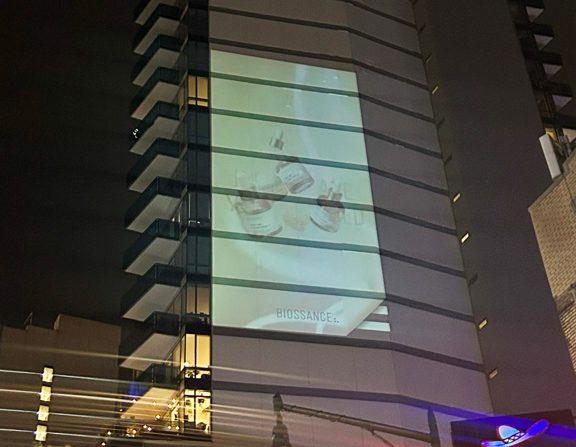
From the neon-lit arts corridor of Nob Hill to the massive industrial walls of the Rail Yards Market — AGM deploys 20,000-lumen building projection campaigns in New Mexico’s largest city.
Albuquerque’s After-Dark Geography and the Case for Guerrilla Projections
Albuquerque spreads across the Rio Grande valley at 5,300 feet elevation, and its nighttime arts economy concentrates where Route 66 still runs as Central Avenue through Nob Hill. This mile-plus stretch of independent restaurants, craft cocktail bars, arts galleries, and live music venues forms the backbone of Albuquerque’s walkable evening culture. Foot traffic stays active well past midnight on weekends; the University of New Mexico campus feeds an engaged student demographic from the eastern end; and local arts institutions run regular programming that draws audiences from across the metro. For projection advertising, the Nob Hill corridor is the highest-concentration evening audience in New Mexico.
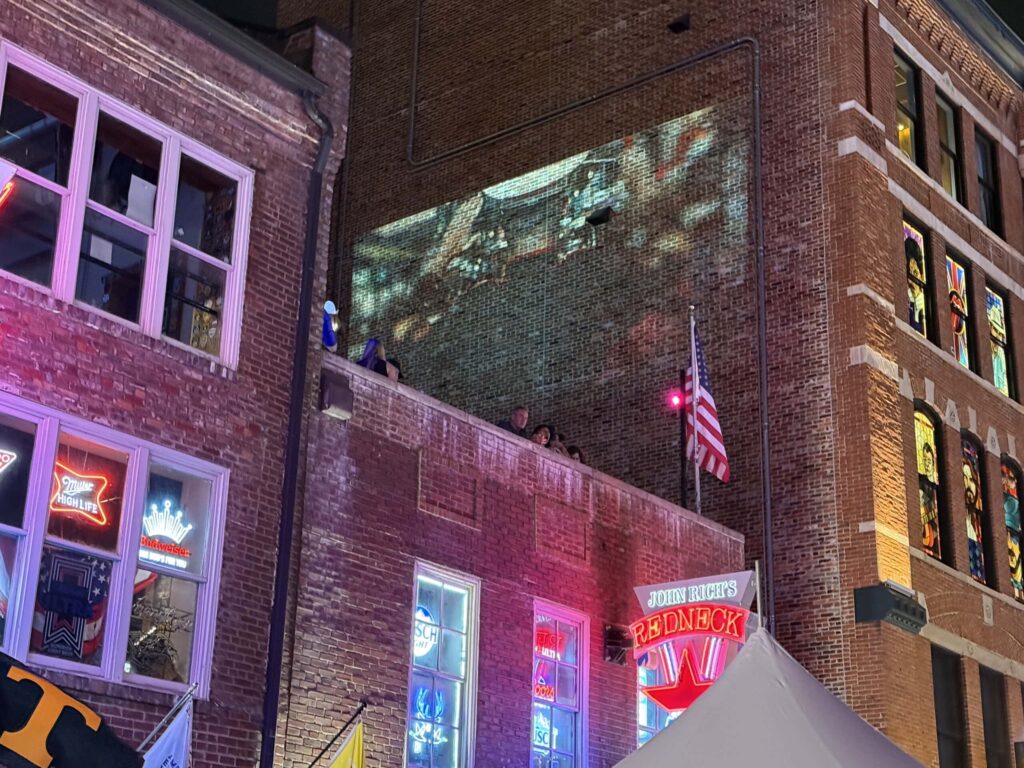
The US Marine Corps selected AGM for a guerrilla projection campaign during CMA Fest in Nashville, projecting onto high-traffic surfaces during peak festival activity and reaching 80,000+ attendees.
The Rail Yards Market operates on a completely different scale. The former Atchison, Topeka & Santa Fe Railway manufacturing shops near downtown Albuquerque are among the most significant surviving examples of late 19th and early 20th century industrial architecture in the Southwest. Their brick and plaster-faced building facades run long, flat, and tall — built for freight and manufacturing, which means they lack the window banks, curtain walls, and surface irregularities that compromise projection quality on commercial and residential structures. A 20,000-lumen system deployed against a Rail Yards building face produces image coverage measured in thousands of square feet, generating the kind of physically dominant projection presence that makes pedestrians stop mid-stride and reach for their phones.
Albuquerque’s audience demographic is broader than any other New Mexico market. Approximately 22,000 University of New Mexico students live within walking distance of Nob Hill, providing a consistent young adult population across the academic year. The city’s creative community — painters, sculptors, filmmakers, gallery professionals — gravitates toward both Nob Hill and the East Downtown/EDo arts zone throughout the week. Restaurant patrons, nightlife visitors, and arts event attendees round out an evening audience that spans age groups, income levels, and cultural backgrounds in ways that smaller New Mexico markets cannot replicate. This demographic diversity means a single Albuquerque projection campaign reaches multiple distinct target audiences within one execution window.
The East Downtown neighborhood — known as EDo — adds gallery density and arts studio concentration to the Albuquerque campaign map directly adjacent to the downtown core. The 4th Street arts corridor and the broader downtown arts walk extend the city’s projection geography north and south of the Central Avenue spine, giving campaigns the option of multiple wall targets in different districts within a single night’s execution.
Launch Your Albuquerque Projection Campaign
AGM executes 20,000-lumen building projection campaigns across Nob Hill, the Rail Yards Market, East Downtown, and beyond. Our crew handles scouting, technical execution, and full post-campaign documentation — you get results, not logistics.
Browse Cities in New Mexico
Select a city to explore Guerrilla Projections opportunities.
Five Albuquerque Locations Where Building Projection Campaigns Deliver
Nob Hill, Central Avenue — Route 66 Arts Corridor (Ideal)
The Nob Hill district’s run of Central Avenue between Carlisle Boulevard and Washington Street is the projection campaign’s primary target in Albuquerque. This is Route 66 in active operation — not as a heritage tourist strip but as a functioning arts and entertainment district where locals and visitors share a walkable commercial street with genuine nighttime density. Gallery spaces, craft restaurants, cocktail bars, vintage shops, and independent performance venues all occupy the street-level commercial storefronts along this corridor, producing foot traffic that peaks between 8 PM and midnight on Friday and Saturday evenings.
Building facades on and adjacent to Central Avenue range from smooth painted masonry on 1950s and 1960s commercial blocks to contemporary infill buildings with stucco and EIFS finishes — all favorable projection surfaces. Clear sightlines from Central Avenue itself and from the parallel residential blocks to the south allow projection images to register from multiple vantage points simultaneously. A campaign on this corridor reaches the combined audience of restaurant diners, gallery visitors, bar patrons, and the UNM crowd moving between campus and the commercial district in a single execution window.
Rail Yards Market — Industrial-Scale Projection Canvas (Ideal)
The Rail Yards complex off 2nd Street SW near downtown Albuquerque houses some of the largest flat projection surfaces available in any Southwest market. The former roundhouse, machine shops, and locomotive maintenance buildings feature exterior masonry and plaster wall faces that span significant lengths and heights, with minimal window interruption — a direct product of their industrial design purpose. These are working-buildings-made-blank-walls, and they represent exactly the kind of surface geometry where 20,000-lumen projection systems achieve their maximum impact.
The Rail Yards Market operates on weekends, drawing thousands of visitors to the complex for its artisan vendors, food, and cultural programming. A Friday or Saturday evening campaign timed to market activity reaches an audience that is already assembled, already engaged with the district’s cultural identity, and already in the habit of documenting and sharing their Rail Yards experience on social media. Off-market evenings, the complex’s position adjacent to the downtown corridor still captures foot traffic from the surrounding neighborhood and arts district visitors moving through the area.
East Downtown / EDo Arts Zone
The East Downtown neighborhood sits immediately east of Albuquerque’s downtown core and has developed over the past decade into a concentrated arts district with gallery spaces, studios, creative agency offices, and arts-oriented hospitality businesses. The EDo zone’s building stock reflects the neighborhood’s transition from light industrial to creative industry use — warehouse conversions, former commercial buildings now occupied by galleries, and purpose-built creative spaces, most of which feature the kind of smooth, painted exterior walls that accept projection cleanly.
EDo’s evening foot traffic concentrates on gallery opening nights and around the district’s restaurant and bar programming, creating predictable high-density audience windows that campaign timing can target precisely. The neighborhood’s position between downtown’s entertainment venues and Nob Hill’s nightlife district means it sits in the flow of evening movement across the central Albuquerque corridor — audiences traveling between districts pass through EDo, and a projection campaign on a prominent EDo building face captures that in-transit audience along with the district’s resident visitors.
4th Street Arts Corridor
The 4th Street corridor running north from downtown Albuquerque has emerged as a secondary arts axis with gallery spaces, studios, and arts-adjacent businesses occupying a mix of early 20th century commercial buildings and mid-century structures. The building stock along this corridor frequently features the smooth stucco and painted masonry finishes common to New Mexico’s mid-century commercial architecture — light-receptive surfaces with minimal window penetration on upper floors and side walls that face clear sightlines from the street and adjacent parking areas.
The 4th Street corridor’s character is less densely walkable than Nob Hill but offers campaign advantages in wall geometry — buildings here tend to have less cluttered building faces and more continuous blank wall sections than the heavily signaged Central Avenue commercial strip. Campaigns on 4th Street reach arts community insiders and the creative professional audience that gravitates toward the district’s gallery programming, complementing a Nob Hill or EDo execution with a different audience segment in a single multi-site campaign night.
Downtown Albuquerque Arts Corridor
Downtown Albuquerque’s central core hosts the city’s primary event venues, performing arts facilities, and sports entertainment infrastructure, generating concentrated audience movement on event nights that makes projection campaigns particularly impactful. The Kimo Theatre, Albuquerque Convention Center, and surrounding dining and entertainment blocks create evening foot traffic clusters that vary significantly by night — a concert at the El Rey, a Lobo game weekend, or a downtown arts walk event can multiply the audience density in the central corridor several times over compared to a standard weeknight.
Building faces throughout downtown range from historic brick and stone commercial structures to 1970s and 1980s institutional buildings with smooth painted concrete — all serviceable projection surfaces. A campaign positioned to intercept event-night audiences moving through downtown toward parking, transit, or adjacent entertainment zones achieves reach efficiency that standard billboard placement cannot match, because the audience is on foot, moving slowly, and highly receptive to the visual environment around them.
Who Shows Up On Central Avenue After Sunset
Understanding Albuquerque’s projection campaign audience requires recognizing how the city’s evening culture layers. University of New Mexico students populate the Nob Hill corridor from early evening through late night on weekdays and weekends, providing a consistent young adult demographic that skews toward social media engagement and organic content sharing. Arts community members — gallery professionals, working artists, collectors, and creative industry workers — attend openings and programming throughout the week and cluster particularly on Thursday and Friday evenings. Restaurant diners and bar patrons add a broad adult demographic through the dinner and late-night hours. International and domestic tourists exploring Route 66’s cultural geography move through the Nob Hill corridor in the early evening before transitioning to the broader nightlife circuit. A single projection campaign in this environment reaches all four audience segments simultaneously — the kind of audience overlap that brand campaigns in single-demographic markets cannot access.
Plan Your Guerrilla Projection Campaign in Albuquerque, NM
Tell us about your campaign goals, target audience, and preferred locations. Our team will help you plan a high-impact guerrilla projection campaign tailored to your needs.
Award Winning Personalized Service
You will get thoughtful, devoted, and individualized attention from our experienced, qualified, and professional personnel. Being one of the most illustrious agencies in Brooklyn, New York, American Guerrilla Marketing has been awarded the Best of Brooklyn title.
Nationwide
Industry City, Brooklyn, New York 11232
American Guerrilla Marketing
Hours
Mon - Fri: 9 AM - 5 PM
Sat & Sun: Closed
Automate your campaign with AGM’s Request for Proposal Builder.
Automate your campaign with AGM’s Request for Proposal Builder. Simply answer a few quick questions about your campaign goals, markets, and timeline, and the system will generate a tailored presentation with recommended strategies, quantities, and pricing. Click the RFP Builder to instantly receive your customized proposal.
Creative Campaign Types That Perform in Albuquerque
Advocacy and Political Messaging
Albuquerque’s politically engaged urban population and diverse demographic composition make it a receptive market for advocacy projection campaigns. The city sits in Bernalillo County, the most vote-dense county in New Mexico, making urban projection advertising a high-efficiency vehicle for political messaging. Advocacy organizations running ballot issue campaigns, voter turnout drives, or public awareness initiatives find the Nob Hill and downtown corridors reach concentrated registered voter populations during their most receptive evening hours.
Music and Entertainment Marketing
Albuquerque’s entertainment-engaged population — shaped by the city’s active live music scene, film production industry, and close relationship with national touring acts at Isleta Amphitheater and Kiva Auditorium — is a natural target for projection campaigns promoting album releases, streaming platform drops, film openings, and theatrical engagements. Projection advertising in the Nob Hill corridor reaches this audience in a cultural environment where entertainment content is consumed enthusiastically and shared widely.
Consumer Brand Activations
Consumer brands targeting the Southwest regional market, lifestyle audiences, and arts-engaged demographics find Albuquerque’s Central Avenue corridor an effective primary deployment zone. The Nob Hill district’s concentration of independent businesses, arts institutions, and experiential dining creates a consumer environment where brand projection campaigns feel integrated rather than intrusive — part of the visual fabric of a district that already treats its physical environment as a canvas.
Corporate Awareness and Talent Campaigns
Albuquerque’s growing technology, biomedical, and creative industry sector has created demand for corporate awareness campaigns targeting professional and technical audiences. Companies recruiting in Albuquerque’s expanding job market, building brand recognition among the university-educated workforce, or announcing expansions and openings find projection advertising in high-visibility urban corridors an effective complement to digital recruitment and awareness channels that reach the same professional demographic.
AGM’s projection client roster includes Netflix, Disney, Coca-Cola, FanDuel, Live Nation, iHeartRadio, and the US Marine Corps. A confirmed case study: the US Marine Corps × CMA Fest Nashville — multi-night projections onto architectural surfaces throughout the festival footprint, reaching 80,000+ attendees across the campaign window. Projection advertising scales across every brand category; what our campaigns share is scale, precision, and a physical presence digital cannot replicate.
Sports and Event Promotion
Albuquerque Isotopes baseball games, UNM Lobos athletics, and the city’s robust concert and festival calendar generate concentrated audience assemblies that projection campaigns can target precisely. Event-adjacent projections deployed on the approach corridors to Isotopes Park, The Pit, or downtown entertainment venues reach audiences who are already physically mobilized and in a heightened state of engagement with their environment — conditions that maximize projection campaign impact and social documentation.
From First Scout To Final Frame: The Albuquerque Campaign Process
Image Engineering for Each Wall
Once target walls are confirmed, AGM’s technical team optimizes all campaign creative for the specific projection geometry of each selected building face. Throw distance from projector position to wall, surface height and width, surface material and base color, and competing ambient light sources all factor into image configuration. At 20,000 lumens, the system achieves full-saturation color projection across a range from bright white stucco to medium-tone painted concrete. Creative files are formatted and pre-tested for each target wall before crew deployment — no improvisation on execution night.
Night-of Deployment
AGM’s two-person technical crew arrives at each selected Albuquerque location as ambient light begins to drop at dusk. Equipment setup, calibration, and alignment typically require 60 to 90 minutes from arrival to projection launch. Campaigns run for four to six hours following launch, covering the peak pedestrian window across Nob Hill, the Rail Yards zone, or whichever corridors are targeted. The mobile projection unit allows repositioning between walls within a single evening when multi-site coverage is part of the campaign scope.
Campaign Wrap and Asset Delivery
Every Albuquerque execution includes professional photography and video documentation throughout the projection run. Post-campaign deliverables include GPS-verified location documentation, imagery formatted for social media distribution, earned media pitching, and internal brand reporting. Documentation captures the projection at full brightness against the night sky, audience response in the surrounding environment, and the full sweep of the image on the target building face — assets that extend campaign value well beyond the physical execution window.
Albuquerque Projection Advertising Rates
Guerrilla projection campaigns in Albuquerque are priced at contact us for a quote. . The rate covers a 20,000-lumen commercial projection system, generator and power solution, complete electronics bundle, mobility unit for repositioning, two-person AGM technical crew, and all setup, operation, and breakdown labor. Multi-night Albuquerque campaigns are available, with pricing structured around total campaign scope. Campaigns launch at dusk; typical projection windows run four to six hours through the peak audience period.
Advance location scouting for Albuquerque is approximately when a dedicated physical scouting visit is required. Private-property or permitted building locations in Albuquerque — where AGM secures formal access agreements with building owners or operators — are priced at Contact us for a custom quote. per night, depending on the specific building and access arrangement.
Campaign Work That Shapes The Albuquerque Approach
The WakeUp Coalition’s advocacy projection campaign in Austin, Texas is the most directly applicable precedent for Albuquerque execution. That campaign deployed building projection advertising in Austin’s concentrated arts and entertainment corridors to generate immediate public presence around a specific advocacy window — using building facades as campaign infrastructure in a Sunbelt city with an active nighttime arts economy and an engaged urban audience. The campaign achieved audience response, social media documentation, and earned media impact that extended reach well beyond the physical geography of the execution nights. Albuquerque’s Central Avenue corridor mirrors Austin’s arts district structure, and the same projection approach applies with equal force.
The Reproductive Freedom for All campaign in Scottsdale, Arizona demonstrated the Southwest regional market’s full operational viability for building projection advertising — confirming that arid climate conditions, high-desert elevation, and plaster-and-stucco building stock support high-quality projection execution with the same results documented in coastal and major-metro markets. Albuquerque’s campaign geography sits within the same Southwest operational framework, and the technical execution is consistent with that regional campaign experience.
Who Runs Guerrilla Projections in Albuquerque
- Political campaigns targeting Bernalillo County’s high-density registered voter population
- Advocacy organizations building public visibility around New Mexico-specific issue campaigns
- Entertainment companies promoting releases to Albuquerque’s film-and-music-engaged population
- Consumer brands reaching arts-district demographics and the Southwest regional market
- Event promoters building advance awareness for concerts, festivals, and cultural programming
- Sports organizations driving audience engagement around game-night campaigns
- Corporate brands building recognition and talent awareness in New Mexico’s growing professional market
Coverage & Estimated Impressions
| Zone / Area | Peak Hours | Foot Traffic | Est. Nightly Impressions | Best For |
|---|---|---|---|---|
| Nob Hill, Central Avenue | 8PM–1AM | High | 8,000–35,000 | Product Launch |
| Rail Yards Market | 8PM–1AM | High | 8,000–35,000 | Event Promotion |
| East Downtown / EDo Arts Zone | 8PM–1AM | High | 8,000–35,000 | Brand Awareness |
| 4th Street Arts Corridor | 8PM–1AM | High | 8,000–35,000 | Political |
| Downtown Albuquerque Arts Corridor | 8PM–1AM | High | 8,000–35,000 | Sports |
Frequently Asked Questions
Nob Hill’s combination of factors is difficult to replicate elsewhere in the metro: sustained evening foot traffic from multiple audience segments (students, arts community, dining/nightlife patrons, tourists), walkable street geometry that slows pedestrian movement and increases dwell time, a Route 66 identity that makes unexpected visual experiences feel appropriate rather than intrusive, and building faces with favorable projection surface characteristics throughout the corridor. No other Albuquerque district delivers the same combination of audience volume, demographic diversity, and surface availability in a single walkable area.
Route 66’s alignment through Albuquerque as Central Avenue created the city’s primary east-west pedestrian and commercial corridor — a street that has sustained walkable commercial activity for nearly a century because of the road’s role as an intercontinental travel route. That heritage translates to a consistently active nighttime economy, a visual culture accustomed to roadside spectacle, and an audience of both locals (who know the corridor well and treat it as their primary entertainment destination) and visitors (who are exploring the Route 66 experience and actively documenting it). Projection advertising on this corridor inherits that visual culture and engages both audience types simultaneously.
Yes, and event-adjacent timing in Albuquerque is particularly effective. Isotopes Park sits in a position that generates audience movement along Central Avenue before and after games. UNM Lobo football and basketball events produce concentrated foot traffic from The Pit and University Stadium into Nob Hill. Coordinating a projection campaign to coincide with a high-attendance game night adds thousands of event-attending audience members to the standard evening foot traffic population, significantly increasing total impressions within the execution window. Campaign booking for event-adjacent execution typically requires three to four weeks of advance coordination.
The Rail Yards Market building faces range from two-story structures to larger industrial footprints with exterior wall heights exceeding 30 feet and face widths of 60 feet or more on some structures. At 20,000 lumens from standard throw distances of 80 to 150 feet, AGM’s projection system can cover these wall faces end-to-end with full image saturation. Precise image dimensions for any specific Rail Yards wall are confirmed during the scouting phase, when throw distance, wall geometry, and projector positioning options are measured and documented. In general, the Rail Yards walls allow for some of the largest image projections achievable in any Albuquerque location.
Three to four weeks of lead time covers the standard Albuquerque campaign cycle — site confirmation, creative optimization, crew scheduling, and equipment logistics. Brands with confirmed creative assets and a flexible execution window can sometimes compress this timeline. Event-adjacent campaigns (Balloon Fiesta, specific game nights, festival windows) require six to eight weeks of advance booking to guarantee crew and equipment availability during peak-demand periods. Campaigns requiring advance physical scouting visits typically add one to two weeks to the preparation timeline if the scouting and creative preparation phases cannot run concurrently.
Campaigns with strong visual content and clear single-image impact consistently outperform text-heavy or information-dense creative in the Central Avenue corridor environment. Advocacy messaging with a single bold visual statement, brand imagery with a memorable visual identity, entertainment campaign artwork with a distinctive graphic presence, and political campaign visuals designed for immediate recognition all perform strongly on this corridor. The Nob Hill audience is visually literate — they engage with strong imagery and dismiss weak visual design with equal speed. Creative quality matters more in this corridor than in markets with less sophisticated visual arts engagement.
Albuquerque does not impose blanket restrictions on temporary projection advertising in the Nob Hill corridor or other Central Avenue commercial zones. As with any market, specific site-level conditions — active event permits, private property boundaries, and municipal event restrictions — can affect individual wall choices. AGM evaluates each target location against applicable local regulations during the scouting phase and structures each execution to comply with the conditions of the specific site. Guerrilla executions from public right-of-way positions are the most flexible approach; permitted executions provide greater operational control where access agreements are available.
Old Town Albuquerque sits approximately two miles west of Nob Hill, and its evening visitor population is more concentrated in the early evening around the plaza and restaurant zone before dispersing. A dedicated Old Town area execution — with a wall selection targeting the surrounding commercial and arts blocks — can reach this tourist-heavy audience. However, Old Town’s building architecture tends toward adobe construction with more irregular surfaces than the commercial blocks of Central Avenue, and the area’s evening activity window is shorter than Nob Hill’s late-night draw. Albuquerque campaigns targeting the arts-tourist audience are most commonly anchored in Nob Hill, with Old Town as a possible secondary site.
Most Albuquerque projection campaigns run a minimum of one night per site. Single-night executions provide complete campaign documentation, a full four-to-six-hour projection window, and a usable social media and press asset package. Multi-night campaigns in Albuquerque — running two to five consecutive evenings on the same wall or across multiple district locations — build audience accumulation and enable brands to capture multiple weather conditions and crowd configurations for documentation. AGM structures Albuquerque campaigns to match the specific objectives of each client, and campaign duration is determined by reach goals and budget rather than a fixed minimum requirement beyond the per-night rate.
Professional photography and video documentation are included in every Albuquerque campaign. AGM’s crew captures the projection at full brightness against the night environment, documenting both the image quality on the target building face and the audience environment surrounding the execution. Post-campaign deliverables include edited photo and video assets formatted for social media, GPS-verified location documentation confirming the execution site and wall, and an audience estimation based on site foot traffic data. Additional documentary footage — drone perspective, time-lapse, or extended crowd documentation — can be arranged as an add-on to any Albuquerque campaign.
Nob Hill’s weekend (Friday and Saturday) foot traffic meaningfully exceeds weeknight levels — the corridor draws its largest audiences on these evenings as dining and nightlife activity peaks and university-adjacent social culture concentrates. Thursday evenings see notably higher activity than Sunday through Wednesday, making a Thursday-Friday-Saturday campaign window the highest-reach execution schedule in Albuquerque. Weeknight campaigns (Sunday through Wednesday) reach a smaller but still meaningful audience that skews more toward arts professionals, industry workers, and the older dining demographic rather than the broader entertainment crowd that dominates weekend evenings. Campaign timing within the week is matched to each brand’s target demographic and reach goals.
More AGM Outdoor Advertising Services
Led Billboard Trucks
Mobile LED displays that bring your brand to any location, any event.

Fly Posting
Street-level poster saturation across walls, construction sites, and corridors.

Sidewalk Decals
Ground-level branded decals at pedestrian hotspots and event entrances.

Sidewalk Stencils
Creative stencil campaigns that put your brand in the path of pedestrians.