American Guerrilla Marketing
Nationwide Service
Media planning, media buying, billboard advertising, & guerrilla marketing
Grand Rapids built an audience for large-format public art long before projection advertising arrived. ArtPrize trained an entire city to stop and look up. The walls, the audience, and the cultural appetite are all already here.
Most cities require a projection campaign to do two things at once: get the audience’s attention and convince them that a building covered in light is worth stopping for. Grand Rapids skips the second step. ArtPrize — the annual public art competition that draws hundreds of thousands of visitors and installs artwork on buildings, bridges, and public surfaces throughout downtown — has spent over a decade training Grand Rapids residents to expect large-format visual art in unexpected places. When a projection appears on a Heartside Neighborhood warehouse wall or an ArtPrize corridor facade, the audience’s first response is engagement, not confusion.
AGM’s projection client roster includes Netflix, Disney, Coca-Cola, FanDuel, Live Nation, iHeartRadio, and the US Marine Corps. A confirmed case study: the US Marine Corps × CMA Fest Nashville — multi-night projections onto architectural surfaces throughout the festival footprint, reaching 80,000+ attendees across the campaign window. Projection advertising scales across every brand category; what our campaigns share is scale, precision, and a physical presence digital cannot replicate.
AGM has executed guerrilla projection campaigns for brands including Netflix, Disney, and FanDuel — deploying high-impact visual activations onto architectural surfaces in major markets nationwide.
This cultural priming is a genuine competitive advantage for brands and organizations running projection campaigns in Grand Rapids. The city’s population is educated about the form. They understand that the image on the wall is intentional, that it means something, and that it’s worth investigating. The time a projection campaign spends breaking through audience resistance — the initial “what is that?” processing period — is dramatically compressed in Grand Rapids compared to markets without ArtPrize’s training effect.
Grand Rapids also has one of the most productive outdoor projection inventories in the Midwest. Heartside Neighborhood’s warehouse buildings — some of the most architecturally significant former industrial structures in west Michigan — provide broad, flat masonry facades well-suited to full-coverage projections. The Cherry Street arts district has developed a gallery and creative business cluster that attracts a nightly arts-engaged pedestrian audience. The ArtPrize corridor through downtown Grand Rapids has surfaces that have hosted some of the most ambitious public art installations in the country, and the Leonard Street corridor adds neighborhood-scale projection opportunities to the downtown-centered inventory.
American Guerrilla Marketing brings the same complete operational platform to Grand Rapids that we deploy across our national market footprint — 20,000-lumen commercial projection system, generator and power solution, electronics bundle, mobility unit, and our direct technical crew. We don’t subcontract in Grand Rapids. The same team quality that serves our New York, Miami, and Los Angeles clients serves your Grand Rapids campaign.
ArtPrize built the audience. The walls are waiting. Let's put your campaign where the city is already paying attention.
Select a city to explore Guerrilla Projections opportunities.
The ArtPrize corridor through downtown Grand Rapids is the city’s highest-profile outdoor art environment, with surfaces that have hosted installations viewed by hundreds of thousands of people during the competition’s annual run. Outside of ArtPrize season, these same surfaces — building facades facing the Grand River, the downtown commercial streetscape, and the pedestrian corridors connecting the city’s cultural anchor institutions — remain active with daily foot traffic from residents, workers, and visitors. A projection campaign in the ArtPrize corridor benefits from the established visual context: audiences in this part of downtown are already attuned to large-format public visual media and will engage with a projection as a continuation of the city’s established visual culture rather than an interruption to it.
Heartside is Grand Rapids’ most compelling projection environment for pure wall scale. The neighborhood’s former industrial and warehouse buildings have the broad, minimally-windowed facades that give a 20,000-lumen projection room to expand to its full potential. Heartside has also undergone substantial creative and commercial development, with galleries, studios, restaurants, and bars generating consistent evening foot traffic from the arts and creative community that has anchored the district’s transformation. A projection on a Heartside warehouse wall operates in a neighborhood where the audience is predisposed to engage with visual interventions in public space — and where the building surfaces themselves are inherently photogenic.
The Cherry Street corridor has developed as one of Grand Rapids’ most active arts and creative business clusters, with galleries, design studios, specialty retail, and dining drawing a consistent nightly audience of arts-engaged residents and visitors. Buildings along Cherry Street are generally mid-scale with masonry facades that suit projections in the 30 to 50-foot height range. The district’s audience profile — younger, creative, culturally active — is among the most valuable in the Grand Rapids market for brands targeting that demographic. Cherry Street projections are particularly effective for arts-adjacent brands, entertainment properties, and advocacy campaigns that want to reach an audience already in the habit of engaging with creative work.
The Leonard Street corridor extends into the north side of Grand Rapids, connecting the downtown arts cluster with residential neighborhoods that have seen growing commercial and creative investment. Buildings along Leonard Street include older commercial masonry structures that provide viable projection surfaces in a context distinct from the downtown and Heartside environments — a neighborhood-scale setting where a projection reaches a more locally-rooted audience than the visitor-heavy ArtPrize corridor or the destination-driven Cherry Street district. Leonard Street is particularly useful for community-oriented campaigns that need to reach Grand Rapids residents in their own neighborhoods rather than in destination arts environments.
ArtPrize draws hundreds of thousands of visitors to Grand Rapids during its annual run in September and October, concentrating the largest arts-engaged audience in west Michigan in the downtown corridor simultaneously. A projection campaign timed to ArtPrize reaches that concentrated visitor population during their peak engagement with Grand Rapids’ visual culture — a unique window that exists nowhere else in the state.
Heartside’s warehouse building facades provide the largest projection surfaces in Grand Rapids — surfaces wide enough and tall enough to execute brand campaigns at a scale that commands the surrounding streetscape rather than competing with it. This format is the natural choice for brand launches, major announcements, and campaigns that need visual dominance in the Grand Rapids market.
Advocacy and community-focused projections in Grand Rapids benefit from the city’s established arts-engagement culture. An audience trained by ArtPrize to engage with public art installations approaches a community advocacy projection with the same attention and openness it would give a gallery work — which means the message lands with fewer processing barriers than in markets without that cultural groundwork.
Brands with genuine connections to arts, design, creativity, and culture find Grand Rapids an exceptionally receptive market. The city’s identity as a creative hub — validated annually by ArtPrize’s international attention — means that arts-aligned brand campaigns operate here with a credibility they need to earn in markets with weaker cultural arts infrastructure.
Three to five night campaigns running continuously in the Heartside or Cherry Street districts build the cumulative audience reach that Grand Rapids’ evening pedestrian culture sustains. The city’s active arts and restaurant scene keeps people circulating through these districts on weekday evenings as well as weekends, giving multi-night campaigns the opportunity to build genuine word-of-mouth and organic social documentation across multiple audience cycles.
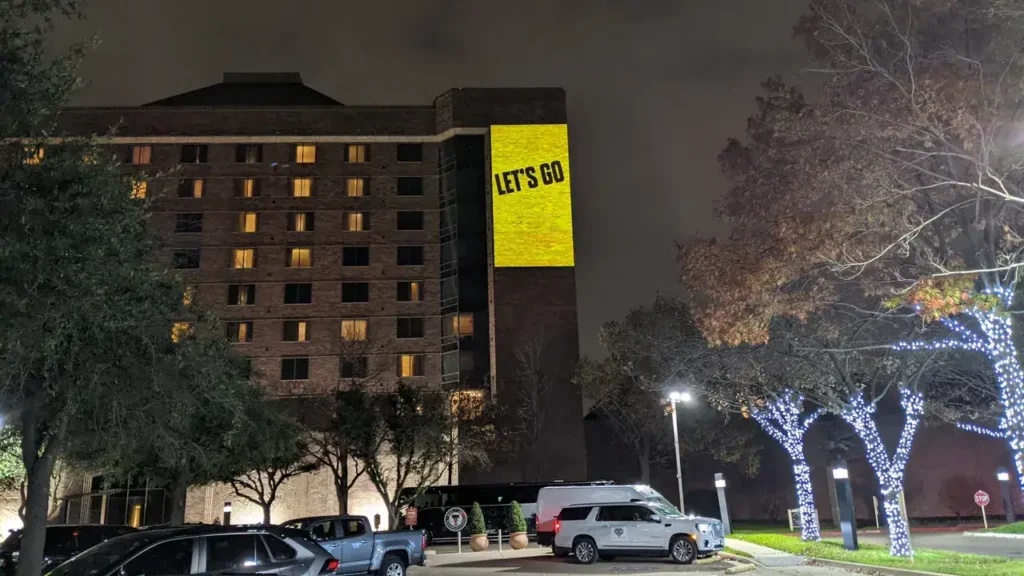
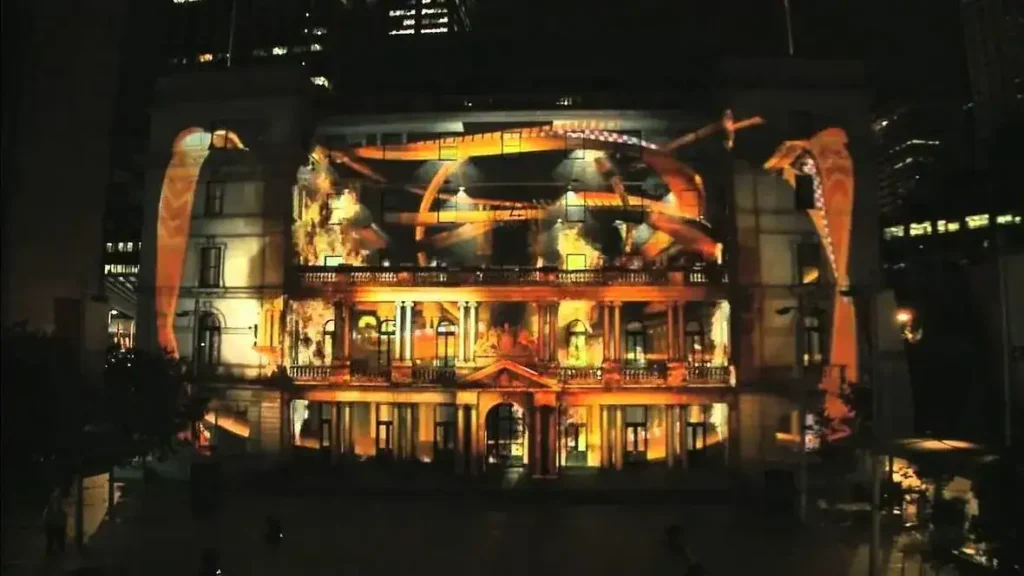
Grand Rapids’ warehouse and industrial building stock provides the kind of visually textured surfaces that make animated projection particularly striking — brick and masonry that interacts with moving light in ways that plain white walls don’t. Animated sequences running on Heartside warehouse facades at night create an effect that ArtPrize audiences will find familiar in form and immediately engaging in content.
Tell us about your campaign goals, target audience, and preferred locations. Our team will help you plan a high-impact guerrilla projection campaign tailored to your needs.
Award Winning Personalized Service
You will get thoughtful, devoted, and individualized attention from our experienced, qualified, and professional personnel. Being one of the most illustrious agencies in Brooklyn, New York, American Guerrilla Marketing has been awarded the Best of Brooklyn title.
Nationwide
Industry City, Brooklyn, New York 11232
American Guerrilla Marketing
Hours
Mon - Fri: 9 AM - 5 PM
Sat & Sun: Closed
Automate your campaign with AGM’s Request for Proposal Builder. Simply answer a few quick questions about your campaign goals, markets, and timeline, and the system will generate a tailored presentation with recommended strategies, quantities, and pricing. Click the RFP Builder to instantly receive your customized proposal.
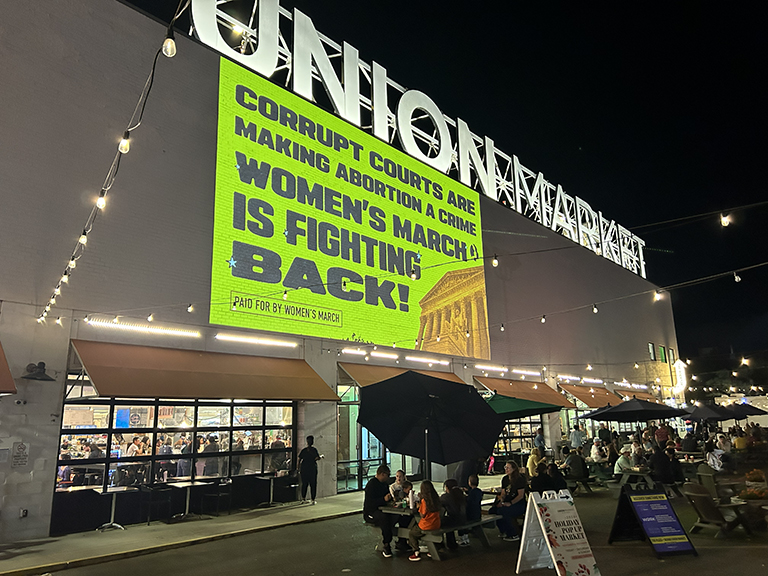
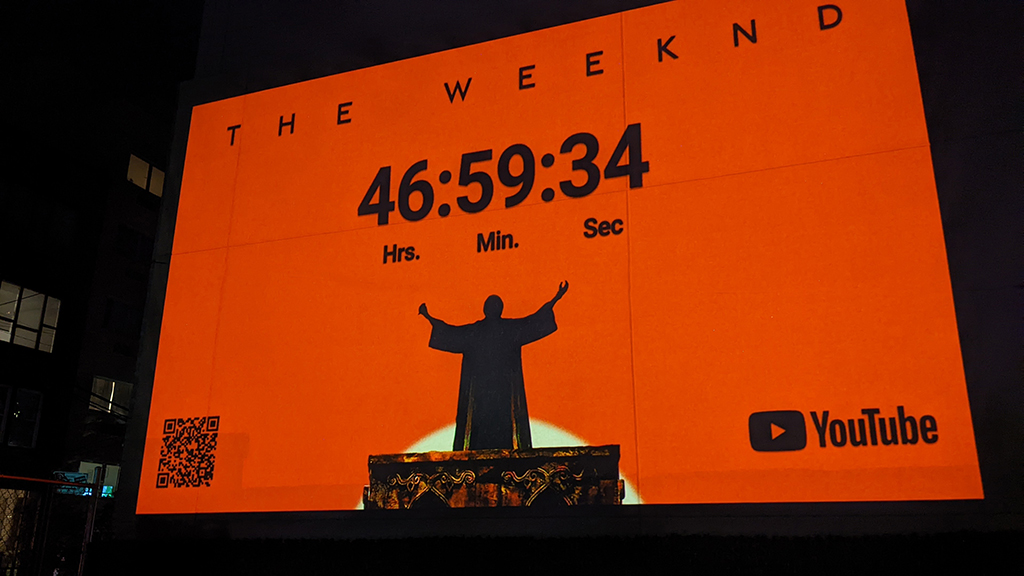
American Guerrilla Marketing deployed projection advertising across downtown Austin for the WakeUp Coalition, running projections on warehouse exteriors and blank building faces in high-foot-traffic corridors to drive awareness for a community advocacy campaign. The campaign’s strategy was built around passive reach — meeting people where they already were, on the sidewalk, moving through their ordinary evening, rather than asking them to attend an event or seek out the campaign’s message.
Grand Rapids is structured almost ideally for this approach. The city’s walkable downtown and arts corridor geography concentrates a significant portion of the Grand Rapids population in a defined pedestrian zone on evenings and weekends. Heartside, Cherry Street, and the ArtPrize corridor all generate consistent foot traffic from residents and visitors who are already in a state of engaged attention — they’re out in the city, looking around, open to what they encounter. A building projection campaign reaching those pedestrians meets a fundamentally different audience psychology than digital or broadcast advertising directed at people sitting at home. The WakeUp Coalition model — go to the audience rather than wait for the audience to come to you — is the natural fit for Grand Rapids’ walkable, arts-oriented street culture.
Our national scouting team has documented Grand Rapids building surfaces across all primary projection districts. The assessment process covers wall dimensions, surface material and condition, ambient light contamination at evening operating hours, sightlines from approaching pedestrian and vehicle traffic, and logistical access for the crew and equipment. Advance scouting for Grand Rapids is available for approximately contact us for a quote. produces a documented location options package with photographs, measurements, and operational notes specific to each candidate surface.
Grand Rapids’ projection inventory spans a wide range of scales — from Heartside’s five-story warehouse walls to Cherry Street’s more intimate mid-scale facades. Content that works on one scale won’t necessarily work on another without calibration. We work with your creative team to establish exact projection dimensions for the target surface, ensuring proper aspect ratio coverage and, for animated content, appropriate pacing for the ambient energy level of the specific environment. Grand Rapids’ visually sophisticated audience responds to production quality, and content that is precisely sized and cleanly executed performs better than content that was designed for a different context and adapted for the projection surface.
Grand Rapids has an active outdoor media regulatory framework, and projections in the downtown ArtPrize corridor and Heartside Neighborhood involve city permit requirements and, in most cases, property owner coordination for wall access and equipment staging. AGM manages both processes. Fully permitted, property-owner-consented locations in Grand Rapids carry an additional cost of Contact us for a custom quote. per night above the base operational rate. Our team’s familiarity with the Grand Rapids outdoor media environment makes the coordination process more efficient than a brand or agency attempting to navigate it independently.
AGM’s two-person technical crew handles setup, calibration, operation, and breakdown for every Grand Rapids campaign. The crew arrives ahead of dusk to position the projector and power system, calibrate focus and brightness for the target wall at the specific projection distance, and confirm content playback before the public operating window opens. During the projection run — typically four to six hours from dusk — a crew member remains on-site managing the equipment and responding to any calibration or technical needs. No hand-off to local operators. No unattended equipment. The campaign runs as specified, from start to finish, under AGM supervision.
Every Grand Rapids campaign includes GPS-documented location data and post-campaign photography. The Heartside Neighborhood warehouse environment is particularly photogenic — the combination of the historic industrial architecture, the Grand Rapids streetscape, and the scale of the projection creates documentation images that stand alone as compelling visual content. Clients who need expanded reporting packages receive structured post-campaign deliverables including location documentation, audience environment photography, and reach reporting suitable for internal stakeholder presentation and earned media distribution.
Grand Rapids campaigns are priced at contact us for a quote. . The rate covers the complete operational package:
Advance location scouting for Grand Rapids is approximately . mitted and private-property locations add Contact us for a custom quote. per night. ArtPrize season timing is a premium scheduling window — campaigns planned for ArtPrize weeks should be initiated well in advance, as both permitting and property coordination become more competitive during the event period.
Grand Rapids’ arts infrastructure — museums, galleries, performing arts organizations, arts education institutions — uses building projection campaigns to create visible moments in the public streetscape during programming announcements, anniversary celebrations, and community engagement initiatives. In a city with ArtPrize’s cultural profile, arts-sector projections operate in a market that understands and values the form intrinsically.
Grand Rapids has a growing creative and professional class concentrated in the Heartside, Cherry Street, and downtown arts districts. Brands targeting the 25–40 professional and creative demographic — in categories from tech and financial services to consumer goods and lifestyle brands — find Grand Rapids’ arts corridor audiences well-matched to their target profile.
West Michigan’s advocacy sector — working across environmental, social justice, health equity, and civic engagement issues — uses projection campaigns to reach Grand Rapids community members in public space with messages that the city’s arts-educated audience approaches with genuine openness. The WakeUp Coalition model of passive community reach applies directly to the Grand Rapids market context.
Grand Rapids’ status as a tourism destination — craft beer capital of Michigan, ArtPrize host, growing convention and events market — creates natural demand for projection campaigns from hospitality brands, destination marketing organizations, event properties, and tourism promotion efforts targeting visitors and potential visitors to the city.
Brands entering the west Michigan market for the first time use projection campaigns to create visible launch moments in the Grand Rapids streetscape. A building projection in Heartside or the ArtPrize corridor is a credible way for a national brand to announce itself in a city that evaluates brands in part by their willingness to show up in the physical spaces the community values.
| Zone / Area | Peak Hours | Foot Traffic | Est. Nightly Impressions | Best For |
|---|---|---|---|---|
| ArtPrize Corridor | 8PM–1AM | High | 8,000–35,000 | Product Launch |
| Heartside Neighborhood Warehouse Buildings | 8PM–1AM | High | 8,000–35,000 | Event Promotion |
| Cherry Street Arts District | 8PM–1AM | High | 8,000–35,000 | Brand Awareness |
| Leonard Street Corridor | 8PM–1AM | High | 8,000–35,000 | Political |
ArtPrize is the highest-audience-concentration window for downtown Grand Rapids projection campaigns — the event draws hundreds of thousands of visitors in September and October, creating peak foot traffic in the ArtPrize corridor and surrounding districts. That said, Grand Rapids’ arts and restaurant culture supports strong projection campaign performance throughout the year. Non-ArtPrize campaigns have the advantage of less competing visual activity in the downtown environment.
ArtPrize has trained Grand Rapids residents to engage with large-format public visual art as a normal part of the city’s cultural life. When a projection campaign appears on a building wall in Grand Rapids, the audience processes it as visual culture rather than intrusive advertising — they stop, look, photograph, and discuss rather than filtering it out. This cultural priming is a genuine advantage for projection campaigns in Grand Rapids that doesn’t exist in markets without that kind of sustained public art programming.
Heartside’s warehouse buildings combine the surface characteristics most favorable for outdoor projection: large continuous masonry facades with minimal window interruption, heights of three to five stories, and consistent north- or east-facing orientation that reduces daytime sun bleaching of the surface. The buildings’ age and construction means their facade planes are flat and regular rather than the textured cladding systems found on newer commercial buildings. For projection purposes, they’re essentially ideal.
Yes. The WakeUp Coalition campaign in Austin is a direct example — AGM deployed projection advertising on warehouse exteriors and blank building faces in high-foot-traffic corridors to drive community awareness for an advocacy campaign, reaching pedestrians who had not sought out the message and turning passive street traffic into engaged viewers. That exact model applies to Grand Rapids’ community-oriented campaign objectives.
Yes. Cherry Street, Leonard Street, and Heartside Neighborhood are all distinct from the ArtPrize corridor concentration and provide different audience profiles and building inventories. Campaigns that need to reach neighborhood-scale Grand Rapids audiences rather than the destination arts crowd specifically often perform better in Cherry Street or Leonard Street contexts than in the downtown ArtPrize zone.
Yes — Grand Rapids and Detroit together provide coverage of Michigan’s two largest and most distinct metro markets. The two cities serve different audience demographics and cultural contexts, and a campaign that runs in both reaches a genuinely different cross-section of the Michigan population in each location. AGM coordinates multi-city Michigan campaigns centrally, with unified documentation and logistics management across both markets.
The ArtPrize corridor through downtown Grand Rapids is subject to city of Grand Rapids outdoor media permit requirements and, for specific buildings, property owner coordination for wall access and equipment staging. AGM handles both the city permit process and property owner outreach as part of campaign planning. The timeline and cost of permit coordination is factored into the campaign planning process from the initial proposal stage.
Michigan winters extend Grand Rapids’ effective projection operating window significantly. From October through March, dusk arrives early enough that projections go live before the restaurant and bar evening rush rather than after it, adding one to two hours of prime-audience operating time compared to summer campaigns. Grand Rapids’ active winter restaurant and arts scene keeps pedestrian traffic in the downtown corridors on cold evenings — the audience doesn’t disappear when the temperature drops.
Yes. Animated sequences, looping brand narratives, motion graphics, and video content are all viable formats for Grand Rapids campaigns. Heartside’s textured masonry surfaces interact with animated light in a way that’s visually distinctive — the grain of the brick becomes part of the image rather than competing with it. For arts-forward and entertainment campaigns in Grand Rapids, animated content is often the recommended format.
Cherry Street’s evening audience skews younger and creative — gallery visitors, design professionals, restaurant and bar patrons, and the arts-engaged residents who live in and near the corridor. It’s a more concentrated and demographically consistent audience than the broader ArtPrize corridor or the Heartside Neighborhood, and it responds particularly well to campaigns that speak to creative culture, arts, and the values of the design and cultural economy.