American Guerrilla Marketing
Nationwide Service
Media planning, media buying, billboard advertising, & guerrilla marketing
Guerrilla Projections in New Haven, CT
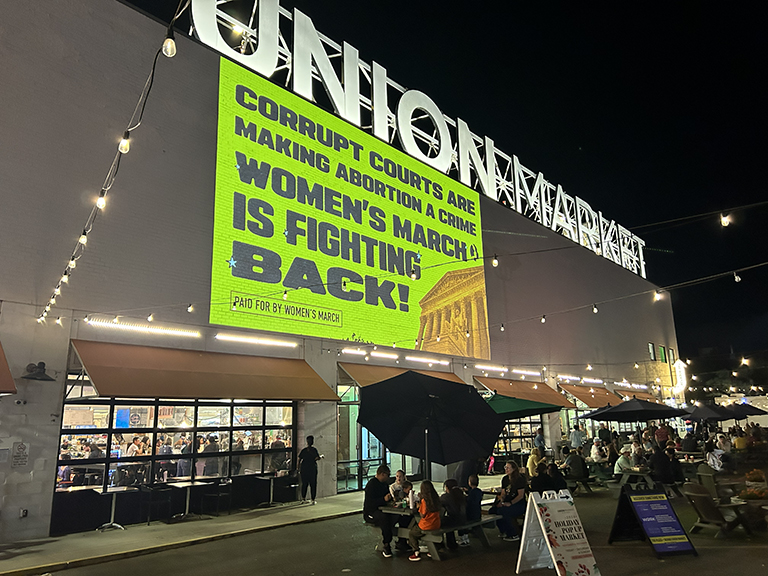
New Haven’s layered cultural economy — Yale’s institutional gravity, a nationally recognized arts scene, and one of New England’s most active pedestrian dining corridors — makes it a projection advertising market that punches well above its population size.
New Haven as a Projection Advertising Market
New Haven occupies a particular position in the Connecticut market — it’s a medium-sized city with a cultural footprint that far exceeds what its population numbers would predict. Yale University functions as a perpetual engine of intellectual and creative activity, pulling professors, graduate students, artists, writers, and a globally connected faculty community into the city’s dining and arts infrastructure every evening. The Elm City’s restaurant scene is nationally ranked; its gallery and performance calendar rivals cities three times its size. The result is an unusually dense concentration of culturally engaged, socially networked, high-education adults who spend their evenings in the exact corridors where guerrilla projection advertising can reach them at its most impactful.
The US Marine Corps selected AGM for a guerrilla projection campaign during CMA Fest in Nashville, projecting onto high-traffic surfaces during peak festival activity and reaching 80,000+ attendees.
AGM’s projection client roster includes Netflix, Disney, Coca-Cola, FanDuel, Live Nation, iHeartRadio, and the US Marine Corps. A confirmed case study: the US Marine Corps × CMA Fest Nashville — multi-night projections onto architectural surfaces throughout the festival footprint, reaching 80,000+ attendees across the campaign window. Projection advertising scales across every brand category; what our campaigns share is scale, precision, and a physical presence digital cannot replicate.
American Guerrilla Marketing’s approach to the New Haven market reflects this cultural specificity. The surfaces we identify for campaign deployment are chosen not only for their technical characteristics — dimensions, reflectivity, window ratio — but for their position within the city’s cultural geography. A wall in the Erector Square complex serves a different audience than a wall on Chapel Street, and both serve a different audience than a surface in the Ninth Square arts district. Understanding those distinctions is what allows AGM to match clients’ campaign objectives with the right combination of surface and audience in a market where the wrong location selection produces mediocre results even from an excellent technical platform.
New Haven’s building stock provides a genuine range of projection surface quality. The Fair Haven neighborhood’s industrial buildings — particularly the Erector Square complex — present some of the cleanest, most scale-appropriate surfaces in Connecticut. Chapel Street’s commercial corridor offers a different profile: buildings with more window interruption but with pedestrian traffic density that often compensates for reduced surface perfection. The Ninth Square’s adapted historic commercial buildings sit between these two extremes in both surface quality and audience density. State Street’s commercial zone extends the market’s geographic reach into a corridor with its own distinct audience character.
The city’s university population creates a social media amplification dynamic that few Connecticut markets can match. When a projection campaign runs on a New Haven building wall during an active evening in the arts district or on Chapel Street, the probability that multiple people with large social networks will document and publish that image is significantly higher than in markets without a concentrated young-adult, university-adjacent population. That organic amplification is part of the effective reach calculation for any campaign in this market — the physical impressions on campaign night are the floor of the campaign’s reach, not the ceiling.
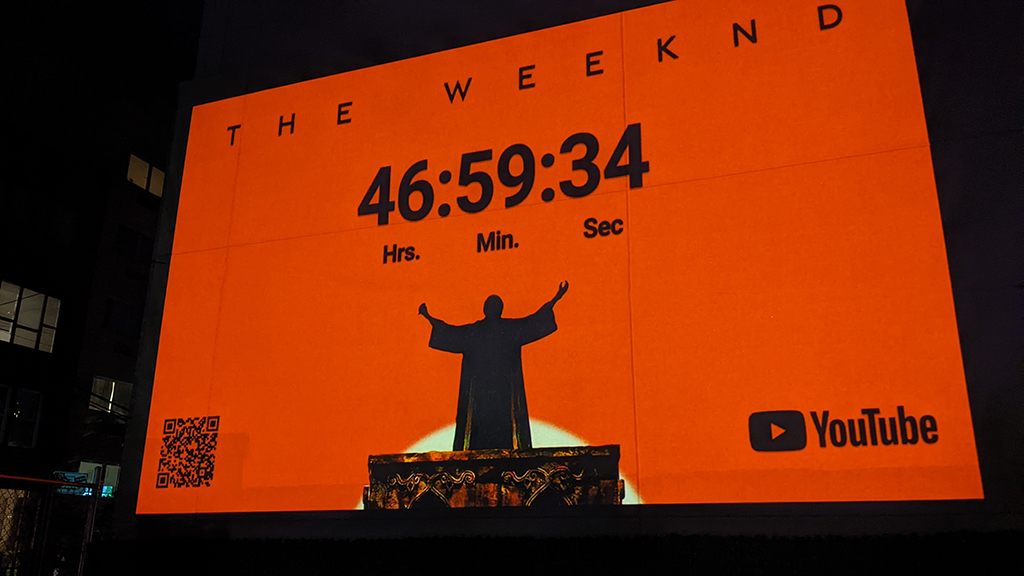
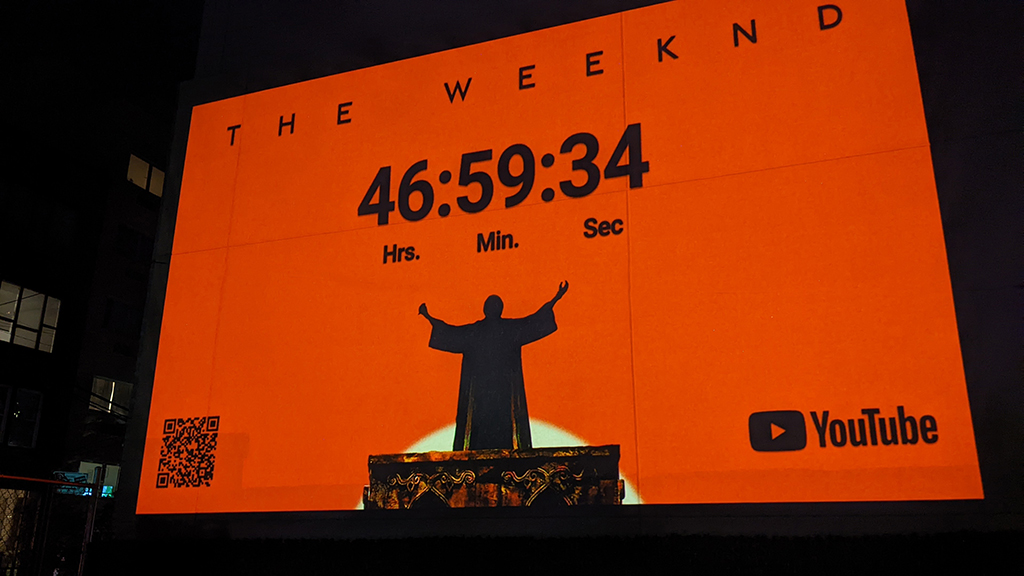
The Weeknd × YouTube countdown campaign demonstrates exactly how entertainment brands use building projection advertising to create the kind of cultural moments that documentation-oriented audiences amplify organically. When a projection runs in a corridor populated by fans with smartphones and social media followings, the physical campaign generates digital reach that compounds the original investment significantly. New Haven’s university-adjacent entertainment corridors are among the highest-amplification environments in the Connecticut market for exactly this reason.
Project in New Haven's Cultural Corridors
Erector Square's industrial facades, Chapel Street's evening crowds, the Ninth Square's arts community — AGM has the New Haven market scouted and ready. Tell us your campaign objectives and we'll build the right location plan around them.
Our Campaign Locations
Browse Cities in Connecticut
Select a city to explore Guerrilla Projections opportunities.
New Haven's Projection Surface Landscape
Identifying the highest-performing projection surfaces in New Haven requires evaluating a set of physical and operational criteria that define whether a wall will deliver the visual impact a campaign requires. Surface area sets the maximum image size. Surface color and reflectivity determine how much of the projector’s 20,000-lumen output reaches the audience versus being absorbed into the material. Window-to-wall ratio determines how much of the image appears on opaque surface versus glass. Available standoff distance — the gap between the projector position and the wall face — determines image scale at a given lens and throw configuration. Sightlines and viewing position determine whether the audience can actually see the full image, which is complicated in urban environments by street furniture, parked vehicles, trees, and architectural projections.
Erector Square Arts and Industrial Complex — Fair Haven
The Erector Square complex in Fair Haven represents New Haven’s most technically capable projection environment. The former manufacturing buildings — four to seven stories of concrete and painted masonry with minimal window openings on upper floors — present continuous surface areas that allow for projected images reaching fifty to eighty feet in height at standard throw distances. The complex’s exterior walls are predominantly smooth or lightly textured, which supports high color saturation and image sharpness compared to raw brick surfaces that scatter and absorb projected light. The complex’s location near Fair Haven’s arts corridor means evening programming in the zone brings an engaged audience to proximity with the projection, and the relative absence of commercial signage competition makes the projected image the dominant visual element in the landscape.
Downtown Chapel Street Entertainment Corridor
Chapel Street runs as New Haven’s primary evening pedestrian spine, connecting the Yale campus to the city’s restaurant, bar, and entertainment district. The sheer volume of foot traffic along Chapel Street — compounded during Yale events, gallery nights, and weekend evenings — makes it the highest raw-impression corridor in the New Haven market. Building surfaces along the corridor range from well-suited to moderately challenging from a technical perspective: some structures present substantial blank upper-floor facades above retail, while others have higher window-to-wall ratios that require careful image composition to avoid the visual interruption of glass panels. AGM’s scouting identifies the specific buildings where technical quality and audience density converge at maximum value.
Ninth Square Arts District
The Ninth Square occupies the zone where downtown commercial activity meets New Haven’s arts infrastructure. The district’s adapted historic commercial buildings include several with blank upper-floor facades that face active evening sidewalks, and the combination of restaurant, gallery, and bar traffic in this compact zone creates consistent pedestrian density throughout the evening hours. Corner buildings in the Ninth Square offer the additional advantage of dual-street visibility — a projected image on a corner-facing wall can be seen from two perpendicular approaches simultaneously, which compounds impressions per image hour without requiring additional equipment. The district’s arts-forward character makes it particularly well-suited to entertainment releases and cultural institution campaigns that resonate with the creative-professional and arts-engaged demographic concentrated here.
State Street Commercial Zone
State Street’s commercial spine extends the New Haven campaign map into a corridor with a distinct audience mix — a blend of neighborhood residents, commuters, and commercial-district pedestrians who represent a broader demographic cross-section than the university-adjacent arts corridors. Several buildings along State Street’s commercial blocks include substantial blank upper-floor sections or side walls facing adjacent streets, and the corridor’s ambient light profile is lower than downtown Chapel Street, which means projected images register with relatively higher visual contrast. Campaigns targeting a general consumer awareness objective rather than a culture-specific creative community often perform particularly well in this zone.
Creative Formats For The New Haven Market
Entertainment Releases and Streaming Campaigns
New Haven’s university population, combined with the city’s nationally recognized arts community, creates one of the most receptive audiences in the Northeast for entertainment-world building projection advertising. Album releases, streaming platform countdowns, film premieres, and tour announcements all find a highly socially connected audience in New Haven’s evening corridors — an audience that documents, shares, and amplifies the campaign’s organic reach at above-average rates.
Cultural Institution and Arts Programming
New Haven’s gallery season, performing arts calendar, and university-affiliated programming generate a year-round audience for arts-sector projection advertising. Theater companies, presenting organizations, and visual arts institutions use building projection campaigns to announce new seasons, individual performances, and exhibition openings in a visual language that resonates with the city’s culturally fluent audience without requiring the budget of traditional mass-market advertising.
Brand Launches and Consumer Products
The combined demographic of Yale affiliates and New Haven’s creative-professional resident community creates a concentrated population of educated, higher-income, culturally sophisticated consumers. Brand launches targeting this profile benefit from the premium positioning signal of building projection advertising — a medium that communicates creative ambition and investment in a market where sophisticated consumers register the distinction between conventional outdoor placements and projection-scale media.
Advocacy and Social Impact Campaigns
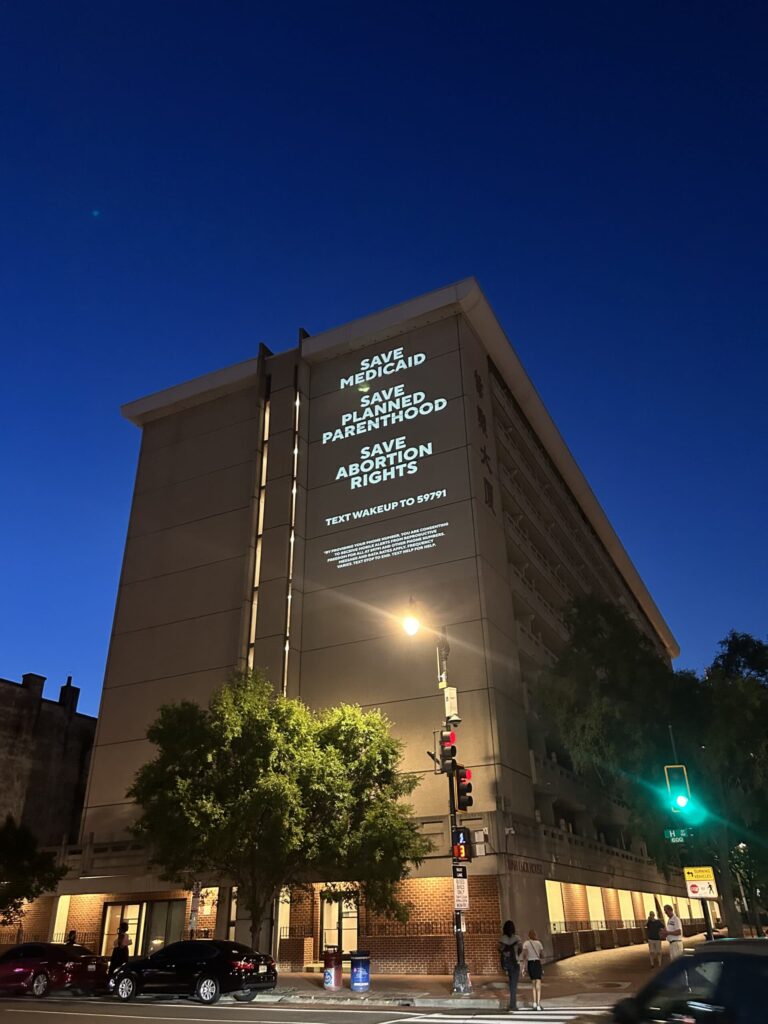
New Haven’s politically active university community and the city’s strong nonprofit and social advocacy sector make it a productive market for civic-scale projection messaging. Issue-based campaigns, ballot measure awareness, and social equity initiatives find receptive audiences in the corridors where Yale’s graduate students, faculty, and socially engaged local residents concentrate on evenings when projection campaigns can reach them directly.
Plan Your Guerrilla Projection Campaign in New Haven, CT
Tell us about your campaign goals, target audience, and preferred locations. Our team will help you plan a high-impact guerrilla projection campaign tailored to your needs.
Award Winning Personalized Service
You will get thoughtful, devoted, and individualized attention from our experienced, qualified, and professional personnel. Being one of the most illustrious agencies in Brooklyn, New York, American Guerrilla Marketing has been awarded the Best of Brooklyn title.
Nationwide
Industry City, Brooklyn, New York 11232
American Guerrilla Marketing
Hours
Mon - Fri: 9 AM - 5 PM
Sat & Sun: Closed
Automate your campaign with AGM’s Request for Proposal Builder.
Automate your campaign with AGM’s Request for Proposal Builder. Simply answer a few quick questions about your campaign goals, markets, and timeline, and the system will generate a tailored presentation with recommended strategies, quantities, and pricing. Click the RFP Builder to instantly receive your customized proposal.
How AGM Executes New Haven Projection Campaigns
Location Scouting in New Haven’s Varied Building Stock
New Haven’s building stock varies significantly across its entertainment and arts corridors. Erector Square’s industrial surfaces require different projection positioning strategies than Chapel Street’s commercial facades, which in turn differ from the Ninth Square’s adapted historic buildings. AGM’s scouting process accounts for these variations with physical assessments that measure actual surface dimensions, test available standoff positions, document window placement and percentage, and assess ambient light competition at the specific hours relevant to campaign deployment. Advance scouting is approximately contact us for a quote.
Creative Content Preparation
Campaign creative is prepared with the confirmed wall’s specific characteristics in mind. A building on Erector Square that supports an eighty-foot-tall image requires very different compositional decisions than a Chapel Street commercial facade where the projected image needs to work within a more complex surrounding visual environment. AGM’s technical team formats assets to the confirmed surface geometry, adjusts for reflectivity and texture conditions, and ensures that the final image reads with the intended hierarchy and visual impact at the actual projected scale.
Campaign Night Operations
AGM’s own technical crew — never subcontracted — manages every stage of the New Haven campaign night. The 20,000-lumen system and self-contained generator arrive as a mobile package that requires no access to building electrical infrastructure. Setup takes one to two hours, the campaign run begins at dusk and typically operates for four to six hours, and the crew handles complete breakdown by end of run. Any technical adjustments needed as ambient light conditions change through the evening are managed in real time by the on-site crew.
Documentation Delivery
Every campaign includes GPS-documented location records and professional photography and video of the projection at full scale. The Erector Square complex in particular produces documentation imagery that performs exceptionally in digital distribution — the combination of industrial architecture, projection-scale imagery, and nighttime atmosphere creates content with a visual quality that consistently outperforms conventional advertising photography across social media, press, and earned media channels.
New Haven Projection Advertising Pricing
New Haven building projection campaigns are priced at contact us for a quote. This rate encompasses the complete production package: the 20,000-lumen commercial projection system, generator and power solution, full electronics bundle, mobility unit, and the two-person technical crew managing setup through breakdown. The system is self-contained — no building electrical connection is required and no relationship with the host building’s management is necessary for public-facing campaigns.
Advance location scouting adds approximately contact us for a quote. Private-property campaigns — where AGM secures formal authorization from the building owner before the campaign night — add Contact us for a custom quote. per night. Multi-city tours combining New Haven with Hartford or Bridgeport on consecutive nights carry planning efficiencies relative to separate single-market deployments.
Case Study: The Weeknd × YouTube — Cultural Moment at Scale
The Weeknd and YouTube’s collaborative release countdown campaign used building projection advertising to create street-level cultural events in entertainment corridors timed precisely to the artist’s release moment. AGM deployed 20,000-lumen systems onto building facades in high-foot-traffic locations, projecting imagery that covered multiple stories of building surface at scale calculated to dominate the visual landscape of the surrounding block. The campaign generated organic social documentation from the audiences who encountered it — people stopped, photographed, and shared what they were seeing, extending the campaign’s reach into digital networks far beyond the physical impressions accumulated on campaign nights.
This model translates directly to the New Haven market. The university-adjacent corridors — Chapel Street, the Ninth Square, and even the arts-engaged Erector Square neighborhood — host exactly the audience that turns a projection campaign into a documentation event. When a large image appears on a familiar building in a corridor that thousands of socially networked young adults move through every evening, the organic amplification dynamic activates in a way that markets without concentrated young-adult populations cannot replicate. For entertainment brands, streaming platforms, and cultural institutions planning releases or announcements targeting the 18-to-35 demographic, New Haven is one of the highest-yield projection advertising markets in the state.
Who Uses Projection Advertising In New Haven
Entertainment brands and music industry campaigns represent a significant and growing share of New Haven’s projection calendar, drawn by the university population’s cultural engagement and social media connectivity. Streaming platforms and record labels running Northeast release campaigns regularly include New Haven in the Connecticut leg of coordinated regional rollouts, particularly when the Yale-adjacent audience aligns with the campaign’s target demographic.
Cultural institutions — Yale’s own arts programs, independent theaters, music presenters, and gallery organizations — use projection advertising to announce programming in a market where the target audience responds to creative visual communication more enthusiastically than to conventional advertising. The medium signals creative investment, which matters in a city where audiences distinguish between brands and institutions that understand cultural context and those that don’t.
Advocacy organizations and social impact campaigns find New Haven’s university population and active nonprofit sector a productive audience for issue-based projection messaging. Campaigns running in the Chapel Street and Ninth Square corridors reach a demographic that is politically engaged, socially aware, and connected to networks that can extend campaign reach through organic digital amplification.
Coverage & Estimated Impressions
| Zone / Area | Peak Hours | Foot Traffic | Est. Nightly Impressions | Best For |
|---|---|---|---|---|
| Erector Square Arts and Industrial Complex | 8PM–12AM | Moderate | 2,500–12,000 | Product Launch |
| Downtown Chapel Street Entertainment Corridor | 8PM–12AM | Moderate | 2,500–12,000 | Event Promotion |
| Ninth Square Arts District | 8PM–12AM | Moderate | 2,500–12,000 | Brand Awareness |
| State Street Commercial Zone | 8PM–12AM | Moderate | 2,500–12,000 | Political |
Frequently Asked Questions: Guerrilla Projections in New Haven, CT
Parkville’s former industrial buildings combine the two variables that define a high-performing projection location: physically appropriate surfaces — large, flat, minimally interrupted by windows, often painted or concrete — and a culturally engaged audience that spends evening hours in the district for gallery programming and arts events. The synthesis of excellent building stock and an arts-forward audience makes Parkville the highest-value projection zone in the Hartford market.
Sold-out or near-capacity XL Center events push thousands of pedestrians through the downtown corridors before and after programming. Projecting onto a building wall in these corridors during event nights produces impression volumes that non-event evenings cannot replicate. AGM schedules event-aligned campaigns against the XL Center calendar, identifying nights when audience density peaks and ensuring the campaign is deployed precisely when foot traffic through the projection zone is at maximum levels.
Late autumn through early spring produces the longest usable projection hours per night because dusk arrives early and ambient light levels drop quickly. November through March campaigns can begin projecting as early as 4:30 to 5:00 PM, extending the effective campaign window well ahead of typical dinner service and nightlife crowds. Summer months offer later dusk but warmer weather that keeps people outdoors in entertainment districts for longer after dark — both seasons have strategic advantages depending on campaign objectives.
Yes, and this is one of Hartford’s particular strengths as a campaign market. Legislative sessions, gubernatorial addresses, major ballot measure campaigns, and civic rallies all create concentrated audiences of politically engaged individuals in and around the Capitol complex and downtown Hartford. Advocacy campaigns timed to these windows reach audiences whose attention is already focused on the relevant issues, which significantly increases the probability of meaningful engagement with projection-scale messaging.
AGM’s team has established a process for approaching building owners in arts districts like Parkville that begins with transparent communication about the campaign’s nature, timeline, and creative content. Many building owners in arts districts are receptive to projection campaigns because the association with creative industry activity aligns with the character they’ve cultivated for their properties. Authorized private-property campaigns add Contact us for a custom quote. per night but provide significantly greater operational flexibility, including the ability to run campaigns on scheduled repeat nights without re-scouting access logistics.
Hartford’s dual audience responds to distinct creative approaches. The arts community in Parkville responds strongly to visually ambitious content — work that uses the building scale as an intentional creative variable rather than simply resizing an existing advertisement. The civic and professional audience downtown responds to content with clear, legible messaging that communicates quickly to people moving through the corridor on their way to and from programming. Campaigns that serve both audiences typically establish a strong visual identity at distance and layer in message specificity as viewers move closer to the projection.
Image dimensions vary depending on the confirmed wall’s size and the projector standoff distance available at each location. In the Parkville Arts District, industrial building facades can support projected images thirty to eighty feet tall and proportionally wide depending on aspect ratio and available throw distance. In downtown Hartford, commercial building facades and parking structures typically support images in the thirty-to-sixty-foot range. AGM’s technical team confirms specific achievable dimensions during the scouting phase and formats creative content accordingly.
Front Street’s pedestrian-priority design and the surrounding vehicle circulation infrastructure are compatible with AGM’s mobile projection unit deployment. The generator-powered system requires no connection to building electrical service, and the crew manages equipment positioning within the available vehicle circulation areas adjacent to the projection zone. Specific access logistics are confirmed during the scouting phase to account for any event-specific restrictions or seasonal changes in the corridor’s traffic management.
Yes — multi-city Connecticut tours running Hartford alongside New Haven, Bridgeport, or Stamford are a common and cost-effective campaign structure. Hartford to New Haven is approximately fifty minutes by road; Hartford to Bridgeport is approximately one hour. Sequential-night campaigns with the same equipment crew covering multiple markets over a three-or-four-night tour are logistically straightforward and reduce the per-night fixed cost relative to separate single-market deployments.
Post-campaign deliverables include GPS-documented location records, professional photography capturing the projection at its full scale from multiple angles, and video footage of the campaign run. These assets are provided to clients for social media publication, press coverage, investor documentation, and internal reporting. The photography from Hartford’s Parkville district in particular — industrial buildings, projection-scale images, nighttime atmosphere — consistently produces visually compelling content that outperforms studio photography in social media engagement metrics.
Our Campaign Locations
Browse All States
Explore Guerrilla Projections opportunities across the United States.
49 States • 192 Cities
More AGM Outdoor Advertising Services
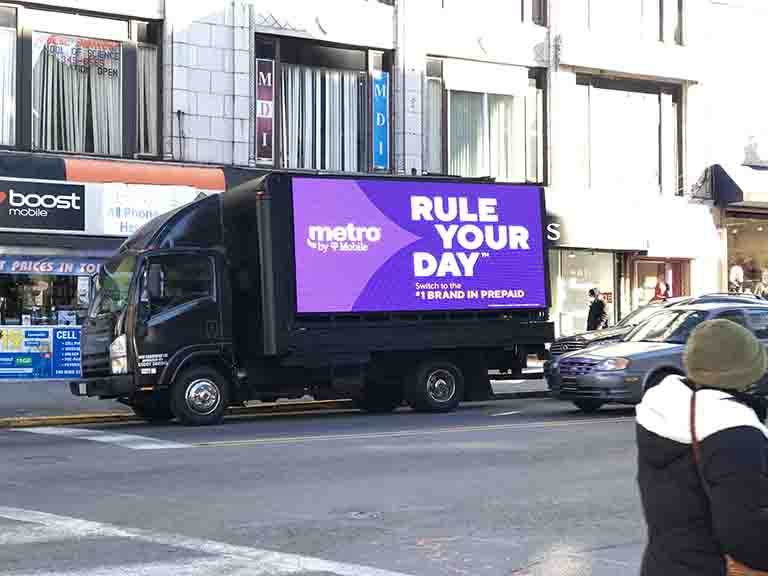
Led Billboard Trucks
Mobile LED displays that bring your brand to any location, any event.
Fly Posting
Street-level poster saturation across walls, construction sites, and corridors.

Sidewalk Decals
Ground-level branded decals at pedestrian hotspots and event entrances.

Sidewalk Stencils
Creative stencil campaigns that put your brand in the path of pedestrians.