
November 22, 2026
Lumens Needed for Outdoor Projection: A Field Guide
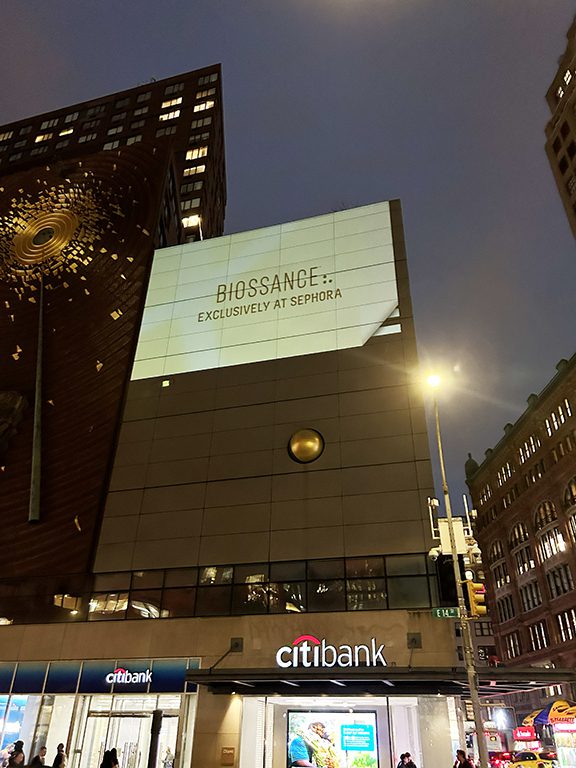
Nearly every projection enquiry we get includes a lumens question, and nearly every one of them is asking the wrong thing.
The question people ask is “how many lumens do I need”. The question that determines whether the campaign looks good is “how much light is already on that wall, and how big do you want the image”.
Lumens are one input. They are not the input. I have watched a very bright projector produce a weak, washed-out image on a streetlit wall, and I have watched a modest projector produce something genuinely striking on a dark alley facade twenty feet away.
This page explains how brightness actually behaves outdoors, what we use in practice, and why the honest answer to “how many lumens” is usually a question back.
No numbers here are a price. They are output figures and working rules from doing this at night on real walls.
What a lumen rating actually tells you, and what it hides
A projector’s lumen rating describes total light output under test conditions. It says nothing about the conditions you will be working in.
Three things erode that number before it reaches a viewer’s eye.
Spread. The same light spread over a bigger image is dimmer per square foot. Double the width of your projection and you have roughly quartered the brightness on the surface, because area grows with the square. This is the single most ignored fact in outdoor projection. Clients ask for a bigger image and assume brightness is unaffected.
Surface. A light matte wall reflects most of what hits it. Dark brick absorbs a great deal of it. Red brick, dark grey concrete and weathered dark cladding can swallow a large portion of your output before anyone sees it.
Ambient light. Every streetlight, storefront window, parking garage, passing headlight and illuminated sign in the vicinity is adding light to the wall that your artwork has to beat. Contrast, not brightness, is what the eye reads.
Add a fourth for honesty: lens and throw. A long-throw lens at distance loses less than you might assume, but beam path through humid or hazy air scatters light, and on a damp night you will see it.
So the useful framing is not lumens. It is lumens, divided by image area, against the ambient light already on the surface, modified by how reflective that surface is.
That is why our first site question is never about the projector. It is about the wall and the streetlights.
The brightness tiers we actually work in
Here is how I think about output in practical bands. These are working categories, not product recommendations.
Low output, roughly in the low thousands of lumens. Battery-friendly, small, quiet. Useful indoors, under awnings, in covered passages, in genuinely dark alleys at short throw with a small image. Outdoors on a street-facing wall, it will disappoint. People buy these for guerrilla projection constantly and are let down.
Mid output, roughly five to ten thousand lumens. This is where usable outdoor work starts in dark conditions. A dark, light-coloured wall, a modest image, a short to medium throw, and this band performs well. On a streetlit facade it struggles.
High output, roughly twelve to twenty thousand lumens. This is our common working band for building-scale projection in real downtown conditions. Enough to hold contrast against moderate ambient light on an image that reads from across a street.
Very high output, above twenty thousand lumens. Large facades, long throw, difficult ambient conditions, or images that need to read from a block away. Heavier, hungrier for power, more demanding to transport and mount, and the power requirement usually means a generator or a building feed rather than batteries.
The pattern across those tiers is that each step up buys you either image size or ambient tolerance. It does not buy you both at once. A very bright projector thrown across a huge facade in a brightly lit plaza can still look thin.
Image size is the real multiplier
If you take one thing from this page, take this.
Going from a twenty foot wide image to a forty foot wide image, with the same projector, cuts surface brightness to roughly a quarter. Going to eighty feet wide cuts it to roughly a sixteenth.
That is why “make it bigger” is the most expensive request in projection, not in money terms but in physics terms. There is no setting that compensates.
Which means image size is a creative decision with a technical cost, and it should be made early, with the wall and the ambient conditions in front of you.
In practice we often recommend a smaller, punchier image over a larger, weaker one. A twenty-five foot mark that is crisp and bright reads better from the sidewalk and photographs dramatically better than a sixty foot mark that is grey and soft. Clients who have seen both in person almost always agree afterwards.
The exception is long sightlines. If the audience position is a block away, or across a river, or on a highway approach, size wins and you need the output to support it. That is where the very high output band earns its weight.
Ambient light is the thing that beats you
Projector output is the only variable most buyers think about, and ambient light is the variable that usually decides the outcome.
Modern LED streetlights are brighter and whiter than the old sodium fixtures, and many American cities have converted. That conversion made a lot of previously workable walls harder. A white LED fixture washing a facade at a shallow angle puts an even sheet of light across your canvas that your artwork has to exceed.
Storefront and lobby light matters at ground level. A wall that is dark above the second floor can be useless below it.
Illuminated signage on or near the target building is a direct competitor, and it is usually on a timer you do not control.
Parking structures are a frequent surprise. The open deck of a garage across the street throws a lot of ambient light sideways.
Headlights sweep across lower walls on any street with traffic, and they put moving bright bands through the bottom of your image.
So we survey at night, with the streetlights on, in the same season when possible. A wall evaluated in daylight is a wall you know nothing about.
Where the wall has fixable ambient problems, sometimes a cooperative property owner will turn off a facade floodlight or a sign for a few hours. That conversation is worth having and it has saved sites for us. It also only happens if you have the permission relationship in the first place, which is another argument for doing the property outreach properly.
Surface reflectivity, colour and texture
Light-coloured, matte and flat. That is the whole brief.
Painted light concrete is the most reliable common surface in American downtowns, and it is forgiving of modest output.
Clean light limestone is excellent and makes a mid-output rig look expensive.
Smooth light brick works well. Red brick works only with very high contrast artwork, and it drinks output, so push the brightness band up a tier for the same result.
Dark cladding, dark painted surfaces and weathered dark masonry are poor. They absorb so much that even very high output looks flat.
Glass is a non-starter. It reflects a smear rather than holding an image, so glass towers that look like perfect canvases in a photograph are among the worst real surfaces you can pick.
Polished metal behaves like glass with hot spots. Corrugated metal turns type into a barcode.
Texture eats detail before it eats brightness. Heavy mortar lines, rough stucco and deep aggregate break up fine type and thin linework. On rough surfaces, go bolder and simpler rather than brighter.
And windows. Every window opening in the projection zone is a black rectangle in your artwork, and no lumen figure fixes it. Either design the artwork around the glazing pattern or pick a different wall.
Contrast, artwork and why bright artwork matters more than a bright projector
Projectors add light. They cannot add darkness.
That one sentence resolves most outdoor artwork problems.
Anything black in your file is simply the absence of projected light, which means it will be whatever the wall already looks like. On a streetlit facade, your black is light grey. On a dark alley wall, your black is genuinely dark and the image pops.
So outdoor projection artwork should be built as light elements on a dark field. Big bright marks, bold type, strong solid shapes, generous weight.
What fails: thin typefaces, light hairlines, subtle gradients, mid-tone photography, dark type on a light background, drop shadows, and anything that depends on fine detail.
What works: single bold wordmark, four to six words of copy, a strong icon, high saturation colour, and plenty of empty space, which costs nothing because empty space is just the projector not emitting.
Colour affects perceived brightness too. White and pale yellow read brightest. Deep blues and dense reds read considerably dimmer at the same output, because the projector is filtering more of its light away. A deep blue logo on a red brick wall in a streetlit block is the most common artwork disappointment we see, and it is a brightness problem disguised as a design choice.
I would rather have a mid-output projector running bold white artwork on a light matte wall than a very high output rig running thin navy type on dark brick. The first one looks like a campaign. The second looks like a mistake.
Power, heat and the practical cost of brightness
Brightness has operational consequences beyond the image.
Power draw rises with output. Low and mid output rigs can run from battery packages for a useful window, which is silent and a genuine advantage in residential or mixed-use blocks. High and very high output generally means an inverter generator or a building feed.
That changes the whole night. A generator is the noisiest thing in the kit and it attracts attention. It needs placement downwind and away from residential windows, with proper cable runs and ramps at any crossing point. A building feed solves the noise but requires a cooperating property, which means permission was already secured.
Heat rises with output too. Bright projectors move a lot of air and need clear intake and exhaust. Inside a closed vehicle in summer, a high output rig will recirculate its own hot exhaust and throttle or shut down. That is one of the standard reasons we place the projector outside the vehicle on warm nights even when the vehicle is carrying it.
Weight and transport rise as well. The very high output band is a two-person lift with real case handling, not something one operator sets up alone on a sidewalk.
So when I say “each brightness tier buys you image size or ambient tolerance”, understand that it also costs you silence, mobility and setup speed. Those are the trades.
Weather, haze and how brightness behaves on a bad night
Brightness does not save you from weather.
Steady rain ends a night regardless of output. Wet air scatters the beam, wet masonry goes blotchy and reflective, and the sidewalk empties of the audience anyway. We build a backup night into every booking and make the call in the late afternoon.
Light drizzle is survivable with covers and a sheltered shooting position, though contrast drops and documentation suffers.
Haze and light fog make the beam itself visible, which some campaigns love and some hate. A visible beam looks dramatic in photographs and costs you contrast on the wall, because light scattering in the air is light not reaching the surface. Higher output helps here more than almost anywhere else.
Cold reduces battery run time sharply, which matters most for the low and mid output battery-powered rigs. It also means letting cases equalise before powering up, because a cold projector pulled from a warm vehicle fogs internally.
Heat throttles bright rigs, as above.
Snow on the ground raises ambient light noticeably, which is a rare case of weather working against you in a way nobody anticipates.
Permission, ordinance and the grey area
Brightness intersects with permission more than people expect, so it belongs on this page.
Projection Advertising sits in a grey area across most of the country. Many municipal sign ordinances were written for things that are attached, erected, painted or posted, and a beam of light is none of those. Some cities have since amended codes to address projected advertising. Others have not. Enforcement is inconsistent between cities, between neighbourhoods and sometimes between shifts.
What is not grey: the owner of the receiving surface has a say, and whoever controls the ground your equipment occupies has a say.
Brightness raises the stakes because a very high output image is visible from much further away, which means more people can see it, including people whose windows it reaches. Light trespass into residential windows is the complaint that turns a quiet night into a bad one. We account for this in site selection and in aiming, and we avoid projecting onto or adjacent to residences.
How we reduce exposure generally: written permission from the surface owner, with owners identified through public property records rather than door signage. Staging on private ground with the property’s agreement where possible. Advance notification to building security and, where appropriate, the local precinct. Permission letters and insurance carried physically on site. A named crew lead who handles the conversation so the operator can keep working or shut down cleanly.
We do not advise anyone on whether a projection is lawful in their city. That is a question for their counsel and the municipality.
The upside is removal. When the projector powers down the facade is exactly as we found it. No residue, no adhesive, no scraping, no next-day crew. Property owners who would refuse any applied format will often agree to light for that reason alone.
What we talk clients out of
Buying brightness to fix a wall problem. If the wall is dark brick under a white LED streetlight, the answer is a different wall, not a bigger projector.
Oversized images. The area-squared rule is unforgiving and a smaller sharp image beats a huge grey one almost every time.
Glass towers. They look like canvases and behave like mirrors.
Thin typography and dark-on-light artwork. The projector cannot add darkness.
Deep saturated colours on dark surfaces when the site is streetlit.
Low output projectors for street-facing building work. This is the most common self-inflicted failure among brands trying it themselves.
Five sites in a night. Setup to first image runs about ninety minutes, each move costs forty-five to seventy-five minutes including re-alignment, and most downtowns give you from full dark to roughly 11pm or 1am. Two sites is normal, three in winter when darkness runs long.
And the broad one: treating projection as a standalone campaign. Projection is intense and temporary. It owns a block for a few hours, photographs beautifully, and generates social content, which is often the real objective. Then it is gone and the street is unchanged.
The pairing I recommend most is a Wheatpasting & Poster Campaigns run through the same corridors, pasted a few days before the projection nights. The posters hold the neighbourhood for weeks, so the projection lands on an audience that already recognises the mark, and anyone who sees the projection photograph online keeps meeting the brand on their actual walk to work. Projection delivers the spike. Posters deliver the duration.
How to brief us so the brightness question answers itself
Send the wall address, or the neighbourhood if you do not have one yet. Send the intended image size, or the audience position if you are not sure. Tell us what month you want to run and whether the artwork is fixed.
We will scout in daylight, survey after dark with the streetlights on, photograph the surface with locked exposure so comparisons are honest, measure throw options, and identify the owner through property records.
Then the lumen answer is not a guess. It is the output band that holds contrast on that surface, at that image size, under that ambient light.
Frequently asked questions
How many lumens do I need for outdoor projection advertising?
There is no single figure, because output must be matched to image size, surface reflectivity and ambient light. Building-scale work on real downtown walls usually sits in the twelve to twenty thousand lumen band. Dark, unlit surfaces at short throw can work from five to ten thousand. Very large facades or bright plazas need more than twenty thousand.
Does a brighter projector fix a washed-out image?
Often not. If the wall is already lit by a streetlight or nearby signage, you are fighting ambient light, and contrast is what the eye reads. Doubling output on a brightly lit facade produces a modest improvement. Moving to a darker wall, shrinking the image, or getting a facade floodlight switched off produces a much larger one.
How does image size affect brightness?
Brightness per square foot falls with the square of image width. Doubling the image from twenty feet wide to forty feet wide leaves roughly a quarter of the surface brightness from the same projector. That is why enlarging a projection is technically expensive, and why a smaller crisp image usually reads and photographs better than a huge dim one.
What artwork works best for outdoor projection?
Light elements on a dark field, because projectors add light and cannot add darkness. Use a bold wordmark, four to six words of copy, heavy type weights and generous empty space. Avoid thin typefaces, hairlines, gradients, mid-tone photography and dark type on light backgrounds. White and pale colours read brightest, deep blues and dense reds read noticeably dimmer.
Which surfaces give the best projection results?
Flat, matte and light-coloured. Painted light concrete is the most reliable common downtown surface, and clean limestone is excellent. Smooth light brick works well. Red brick absorbs a lot of output and needs high contrast artwork. Avoid glass, polished metal, dark cladding, corrugated panels, and any wall with several window openings in the projection zone.
Do brighter projectors need different power and setup?
Yes. Low and mid output rigs can run on battery packages, which is silent and useful in residential blocks. High and very high output generally requires an inverter generator or a cooperating building feed, with proper cable runs and ramps. Bright rigs also produce more heat, need clear airflow, and are heavier two-person lifts.
Let us look at the wall before anyone talks about lumens
Give us the address and we will survey it after dark, with the streetlights doing what they actually do at 10pm, and photograph it honestly.
You will get a straight answer: whether that surface will hold an image, what size it can carry, what output band that requires, and whether the artwork you have will survive outdoors. If the wall is wrong, we will say so and find you a better one nearby.
Request a campaign quote and we will come back with a surveyed site plan, an output recommendation tied to that wall, and a realistic night schedule with a backup night built in.

Ready to Run Your Campaign?
Call us or email us. We’ll tell you exactly what we can do in your market and what it costs.
Related Service
Explore similar advertising solutions offered by American Guerrilla Marketing.
American Guerrilla Marketing — Los Angeles
Street-level campaigns in Los Angeles and nationwide. Wheatpasting, LED trucks, street teams, and more.
(646) 776-2770
Related Articles
-
Billposting: Where It Works and Where It Fails
November 22, 2026
-
Laser Projection Advertising: A Field Guide From the Crew
November 22, 2026
-
Mobile Projection Advertising Setup: A Field Guide
November 22, 2026
-
Projection Mapping for Brand Campaigns Explained
November 22, 2026
-
Projection Content Length and Loop Structure
November 22, 2026