American Guerrilla Marketing
Nationwide Service
Media planning, media buying, billboard advertising, & guerrilla marketing
Guerrilla Projections in Raleigh, NC

The state capital’s Warehouse District has blank wall runs that belong on a national projection shortlist. AGM’s 20,000-lumen campaigns activate Raleigh’s best building facades for tech brands, advocates, and entertainers who understand that scale matters.
Raleigh’s Warehouse District Is Doing What Brooklyn Did Twenty Years Ago
There is a specific moment in the lifecycle of an American city’s creative district that produces the ideal conditions for outdoor projection advertising, and Raleigh’s Warehouse District is living through that moment right now. Former industrial warehouse buildings are converting to creative offices, restaurants, and social venues at a rate that generates growing after-dark pedestrian density without yet producing the advertising saturation, commercial noise, or visual clutter that eventually follows a completed neighborhood transformation. The long, blank, painted exterior walls that defined the Warehouse District’s industrial past remain largely intact — not yet consumed by retail signage, not yet broken up by renovation fenestration, not yet absorbed into the visual landscape as familiar advertising territory. A 20,000-lumen projection on a Raleigh Warehouse District building face is operating in conditions that Brooklyn’s most celebrated projection windows offered a decade ago, before those corridors matured into fully commercialized advertising environments.
Raleigh’s broader economic character amplifies the advertising potential of its physical landscape. The state capital’s governmental function brings a concentrated professional class of policy makers, lobbyists, nonprofit leaders, and civic professionals into downtown corridors throughout the year. The Research Triangle’s tech economy has made Raleigh one of the fastest-growing metros in the country, importing a large, young, and brand-aware professional class with disposable income that tilts heavily toward urban entertainment spending. NC State University’s substantial enrollment — with campus bordering the downtown on its western edge — adds a consistent student and young faculty audience to the evening pedestrian mix. And Glenwood South’s evolution into one of the Southeast’s more active nightlife corridors ensures that the city has a genuine Thursday-through-Sunday entertainment economy sustaining high foot traffic week after week throughout the year.
The combination of exceptional wall surfaces, a rapidly growing after-dark audience, a tech and governmental professional demographic, and a university population creates a market that building projection advertising is designed to exploit at its highest potential. National brands that have already activated building projection campaigns in Charlotte and Durham consistently identify Raleigh as the Triangle market with the deepest available wall inventory and the widest range of audience demographics accessible through a single multi-night campaign window. The Warehouse District alone — with its concentrated cluster of former industrial buildings southwest of downtown — provides more viable large-format projection surface area per city block than virtually any other North Carolina neighborhood.
Raleigh's Warehouse District Walls Are Waiting.
Blank. Flat. Painted. Ready. AGM's 20,000-lumen projection system turns Raleigh's best building faces into unmissable campaign canvases — contact us for a quote. complete technical crew and equipment included.
Browse Cities in North Carolina
Select a city to explore Guerrilla Projections opportunities.
Event Audiences And The Maximum Exposure Logic Of Projection Advertising
The United States Marine Corps partnered with American Guerrilla Marketing during CMA Fest in Nashville — one of country music’s most heavily attended annual events — placing building projections across Lower Broadway’s entertainment district to reach young festival attendees while they were assembled in the streets at night. The strategic logic of that campaign was built around a principle that AGM has deployed across dozens of national engagements: when a captive audience is concentrated in a specific geography for an extended period — a festival, a concert, a sporting event, a civic gathering — the cost per impression delivered by a building projection drops to a fraction of what any other outdoor format requires, because the audience comes to the projector rather than the projector having to find the audience.
CMA Fest’s Lower Broadway was a textbook execution of this principle. Tens of thousands of festival attendees occupied the same entertainment corridor for hours each evening across multiple nights of the festival. A building projection in that environment didn’t need to generate an audience — the event had already done that work. The projection needed only to be positioned on a surface visible to the assembled crowd and to operate at a luminosity sufficient to command attention despite the ambient lighting of a commercial entertainment district at night. AGM’s 20,000-lumen system was calibrated for exactly that context: bright enough to own the visual field of a crowd in a lit urban environment, positioned strategically enough to reach the maximum cross-section of the assembled audience.
Raleigh’s event calendar creates recurring versions of that CMA Fest dynamic throughout the year. NC State home football and basketball games at Carter-Finley Stadium and PNC Arena generate tens of thousands of fans in the surrounding corridors before and after every major home event. Red Hat Amphitheater’s concert season fills Raleigh’s downtown with music audiences on warm-weather evenings. The state legislature’s session calendar concentrates advocacy professionals and politically engaged residents in the capitol building vicinity. Transfer Co. Food Hall draws consistent evening crowds that remain for extended periods. Each of these event windows is a captive audience moment — people gathered, stationary or slow-moving, socially engaged, and occupying the same physical geography for hours. Building projection at those moments delivers maximum impressions per operational night at minimum incremental cost above the base campaign rate.
Raleigh's Premier Projection Environments
Raleigh’s five highest-value projection environments span the city’s distinct neighborhood characters — from the Warehouse District’s raw industrial surfaces to Glenwood South’s nightlife corridor to the more intimate scale of Boylan Heights and Five Points. Each offers a different combination of wall quality, audience profile, and campaign logistics. AGM scouts every proposed Raleigh surface individually, but the neighborhoods below represent the city’s proven projection infrastructure across campaign types from brand launches to advocacy activations to entertainment releases.
Warehouse District
The Warehouse District southwest of downtown Raleigh is the unambiguous centerpiece of the city’s projection advertising inventory. The dense cluster of former industrial warehouse buildings that defines this neighborhood contains long, blank, painted exterior walls — in some cases running an entire city block face — with minimal window interruption on the primary building faces that were designed for loading dock function rather than public-facing architecture. Surface finishes across the district include light painted concrete and painted masonry that reflect AGM’s 20,000-lumen system at high efficiency, producing sharp, color-accurate projections that operate at the upper end of the format’s visual capability. The district’s rapid conversion to creative offices, restaurants, and event venues has generated growing after-dark pedestrian audiences who spend extended time outdoors in the surrounding blocks — exactly the stationary or slow-moving audience that maximizes projection dwell time per impression. Equipment staging throughout the district benefits from the warehouse-era infrastructure: wide access roads, loading dock areas repurposed as staging zones, and minimal street-level obstructions between projector position and target wall. For any Raleigh campaign prioritizing maximum visual impact on the city’s finest surfaces, the Warehouse District is the first location AGM evaluates and the one most likely to be recommended.
Glenwood South Entertainment Corridor
Glenwood South is Raleigh’s primary nightlife destination — a dense strip of restaurants and bars lining both sides of Glenwood Avenue with pedestrian peaks on Thursday, Friday, and Saturday evenings that represent some of the highest consistent foot traffic counts in the city’s entertainment geography. The corridor’s building stock is mixed in terms of projection surface quality: some blocks feature flat painted masonry or stucco building faces on the upper stories above ground-level retail that provide adequate projection surfaces when throw distance from across the street is achievable. Other sections of the corridor have more architectural variation or retail signage interrupting the wall area. AGM’s scouting identifies the specific Glenwood South blocks where projection geometry works within the corridor’s active commercial environment, focusing on side-street building faces adjacent to the main Glenwood Avenue spine where competing ambient lighting is lower and beam path clearance is cleaner. Glenwood South’s Thursday-through-Sunday pedestrian concentration makes it the most time-specific Raleigh projection environment — campaigns here are most productive when execution nights are deliberately aligned to the corridor’s peak traffic days rather than distributed across the full week.
Boylan Heights Arts Zone
Boylan Heights is Raleigh’s most intimate projection environment — a residential arts community just south of downtown with transitional commercial-residential buildings whose blank wall surfaces offer strong projection opportunities for campaigns targeting a highly specific and engaged creative and arts-adjacent audience. The neighborhood’s community character is tight-knit and civic-minded, making it particularly receptive to advocacy campaigns, arts institution promotions, and creative brand activations that feel consistent with the neighborhood’s values rather than commercially incongruous. Building faces on the commercial-residential transition buildings at Boylan Heights’ edges, visible from the neighborhood’s primary pedestrian routes, provide mid-scale projection surfaces suitable for campaigns where audience depth per impression matters more than total impression volume. A Boylan Heights projection reaches fewer people per night than a Warehouse District or Glenwood South campaign, but the audience engagement rate — the percentage of viewers who notice, stop, discuss, and share — is among the highest of any Raleigh location, because the format is entirely unexpected in a neighborhood that does not carry conventional outdoor advertising.
Five Points Arts Corridor
Five Points is a neighborhood arts hub radiating from the historic intersection at Five Points, where multiple Raleigh streets converge to create a commercial node anchored by restaurants, galleries, and independent retailers serving the surrounding residential arts community. Side-street building facades in the Five Points area offer less-obstructed projection angles compared to the main intersection itself, where traffic signal infrastructure, overhead utilities, and intersection geometry complicate beam path clearance. The cross streets and block faces adjacent to Five Points are where AGM’s scouting identifies the most technically clean projection surfaces — walls that are flat, light-colored, and accessible at adequate throw distance from a stable staging position without beam-path interruptions. Five Points’ audience is arts-community-oriented and neighborhood-loyal, with high organic sharing behavior and a community social media presence that amplifies projection campaigns beyond the immediate pedestrian footprint. Campaigns in the Five Points corridor perform particularly well for arts institutions, creative brands, and advocacy organizations whose messaging aligns with the neighborhood’s creative and civic identity.
Transfer Co. Food Hall Area
Transfer Co. Food Hall has established itself as one of Raleigh’s most consistent east-of-downtown foot traffic generators, drawing large evening crowds that remain inside the food hall and in the surrounding exterior spaces for extended periods throughout the week. The adjacent commercial buildings flanking the food hall’s site feature smooth painted facade surfaces on several structures that provide viable projection opportunities when throw distance from the surrounding streets and parking areas can be achieved without beam-path interruption from the food hall’s own signage and structures. The audience character at Transfer Co. is diverse in age and demographic profile — families, young professionals, date-night couples, and larger social groups all mix in the same evening flow — making it one of Raleigh’s broadest-reach projection environments from an audience demographic standpoint. The food hall’s east-of-downtown position also means it serves portions of Raleigh’s residential population that the Warehouse District and Glenwood South corridors do not regularly draw, extending campaign reach into neighborhoods that conventional west-of-downtown outdoor advertising placements systematically miss.
Plan Your Guerrilla Projection Campaign in Raleigh, NC
Tell us about your campaign goals, target audience, and preferred locations. Our team will help you plan a high-impact guerrilla projection campaign tailored to your needs.
Award Winning Personalized Service
You will get thoughtful, devoted, and individualized attention from our experienced, qualified, and professional personnel. Being one of the most illustrious agencies in Brooklyn, New York, American Guerrilla Marketing has been awarded the Best of Brooklyn title.
Nationwide
Industry City, Brooklyn, New York 11232
American Guerrilla Marketing
Hours
Mon - Fri: 9 AM - 5 PM
Sat & Sun: Closed
Automate your campaign with AGM’s Request for Proposal Builder.
Automate your campaign with AGM’s Request for Proposal Builder. Simply answer a few quick questions about your campaign goals, markets, and timeline, and the system will generate a tailored presentation with recommended strategies, quantities, and pricing. Click the RFP Builder to instantly receive your customized proposal.
What Raleigh Projection Campaigns Deliver
Tech Company Brand Launches
Raleigh’s rapidly expanding technology sector — software companies, SaaS platforms, enterprise tech, and Triangle-area startup ventures — uses Warehouse District projection campaigns to announce product launches, funding rounds, and market expansions to a local tech professional community that actively notices and discusses these activations. A building-scale campaign on a blank Warehouse District wall communicates investment and momentum in a format that no digital announcement in the same budget range can replicate in the physical city.
Government & Legislative Advocacy
Raleigh’s status as the state capital makes it the primary theater for North Carolina advocacy campaigns during legislative sessions. Organizations working on healthcare policy, environmental legislation, education funding, and social justice issues use building projection near the capitol complex and in the civic corridors adjacent to the legislature to reach both the legislators who govern and the media who cover state government — a unique dual audience available only in the capital city projection market.
NC State Athletic Event Campaigns
NC State home football games at Carter-Finley Stadium and basketball at PNC Arena generate large, enthusiastic fan audiences in Raleigh’s corridors before and after every home event. Sports brands, beverage companies, entertainment properties, and consumer goods brands aligned with the NC State athletic calendar use event-night projection to reach a demographically concentrated Wolfpack fan base in the most activated outdoor environment the city produces on those dates.
Entertainment & Streaming Campaigns
Music platforms, streaming services, and entertainment brands targeting Raleigh’s substantial 18–35 demographic — NC State students, young tech professionals, and Glenwood South’s nightlife-going audience — use Warehouse District and Glenwood South projections to create visual moments that generate organic social sharing within hours of execution. Album drops, tour announcements, and streaming premiere campaigns find Raleigh’s tech-forward audience disproportionately likely to photograph, post, and share striking projection visuals on the same digital platforms the entertainment brands are trying to reach.
Recruitment & Employer Brand Campaigns
Technology companies, research institutions, and government agencies competing for Triangle-area talent use Raleigh building projection campaigns to establish employer brand presence in the neighborhoods where their target recruits live and socialize. A Warehouse District or Transfer Co. area projection visible to the tech professional demographic during an evening out creates a brand impression that careers page visits and LinkedIn advertising cannot generate in the physical city. AGM has executed recruitment campaigns for military branches using exactly this format — reaching young civilians in social environments where brand perception forms organically.
Consumer & Lifestyle Brand Activations
Consumer brands in craft beverage, apparel, fitness, and lifestyle categories use Raleigh’s Glenwood South corridor and Transfer Co. area to reach a mixed demographic of working professionals and young families in the city’s most active dining and social environments. Raleigh’s demographic diversity — tech workers, government professionals, university populations, and a growing immigrant professional community — makes the city’s entertainment corridors among the more demographically broad projection markets in the state, giving lifestyle brands access to a wider consumer range per night of activation than more narrowly characterized university towns or single-industry markets.
How To Read Raleigh's Projection Surface Inventory
Raleigh’s building stock produces a wide range of projection surface quality across its distinct neighborhoods, and the single most consequential evaluation decision for any Raleigh campaign is choosing the right neighborhood before narrowing to a specific wall. The Warehouse District’s industrial building stock sits at the top of the city’s surface quality hierarchy, followed by select Glenwood South blocks, then Transfer Co. area commercial buildings, then Five Points’ cross-street building faces, and finally Boylan Heights’ transitional residential-commercial structures. Each level of that hierarchy has a corresponding trade-off between wall quality and audience character, and the optimal campaign location balances both variables against the specific campaign objective.
Within the Warehouse District, surface evaluation focuses on the specific wall face being proposed — not just the building address. The district’s warehouse buildings frequently have multiple wall faces of dramatically different quality: a long, blank, light-painted masonry end wall on the north face of a building may be the finest projection surface within three blocks, while the same building’s street-facing south facade is interrupted by loading dock doors, fire escapes, and utility connections that fragment any projected image into disconnected pieces. AGM’s scouting photographs and documents every proposed surface at the specific face-level resolution required to confirm whether the wall geometry is actually viable before any campaign commitment is made. The GPS-documented location analysis that AGM delivers as part of the scouting package specifies the exact wall face, the confirmed projector position, the calculated throw distance, and the documented beam-path clearance — not a general neighborhood recommendation but a specific surface-and-position proposal with full technical backing.
Glenwood South’s surface evaluation adds a layer of ambient lighting analysis that the Warehouse District does not require at the same intensity. Glenwood South’s active nightlife infrastructure — bar signage, restaurant exterior lighting, string lights, and vehicle headlights — creates a higher ambient light environment than the Warehouse District’s darker side streets, which means the projector must operate at effective positions that maximize wall illumination relative to surrounding ambient brightness. AGM scouts Glenwood South surfaces with specific attention to the ambient light competition at each candidate position, and recommends projection surface positions where the building face can be illuminated at a luminosity advantage over the ambient commercial lighting in the corridor. Side-street building faces, which escape the densest ambient light concentration on the main Glenwood Avenue spine, consistently outperform the primary corridor’s building faces for projection image vibrancy and contrast.
Transfer Co. and Five Points locations require evaluation of both surface quality and beam path geometry that reflects the more varied street layouts and building orientations of Raleigh’s east-side and midtown neighborhoods. Unlike the Warehouse District’s regular grid of large parallel buildings with consistent face orientations, the streets around Transfer Co. and Five Points involve irregular intersections, varied building setbacks, and mixed construction vintage that produces less predictable surface and geometry conditions. AGM’s physical on-the-ground scouting is particularly important for these locations — satellite and digital analysis can identify candidate buildings and approximate surface dimensions, but the specific geometry of projector position to wall angle to pedestrian viewing position in irregular street layouts requires physical confirmation before campaign planning can proceed with confidence.
The AGM Campaign Process for Raleigh
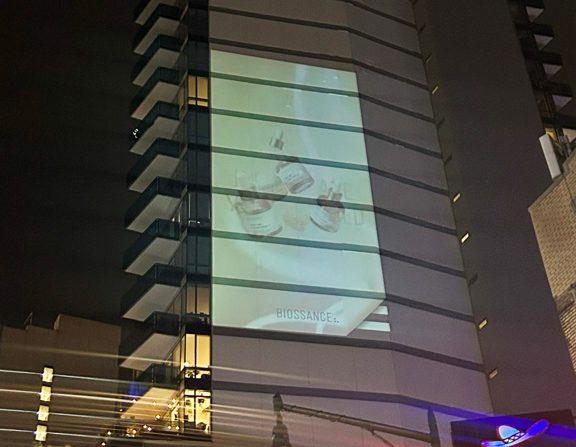
Raleigh campaigns follow the same structured operational sequence that has produced documented results for AGM clients including the US Marine Corps, Women’s March, Reproductive Freedom for All, Biossance, The Weeknd, and YouTube. Advance scouting — the foundational phase — deploys AGM’s national scouting team to Raleigh for both digital pre-analysis and physical on-the-ground surface evaluation. Every candidate surface receives a full technical assessment: reflectivity, flatness, window interruption, beam path clearance from the proposed projector position, pedestrian traffic volume and movement patterns, permitting considerations, and equipment staging logistics. Scouting costs approximately Contact us for a custom quote. for the Raleigh market and produces a ranked location shortlist with full GPS documentation, photography, and technical parameters for every evaluated surface.
Creative development is calibrated to the specific surface and audience the scouting phase confirms. Warehouse District campaigns — large blank walls, growing but not dense audience, strong visual dominance in a relatively dark environment — reward bold, high-contrast content that owns the visual field at distances up to 200 feet. Glenwood South campaigns — smaller effective surface areas in a higher-ambient-light environment — require content that performs at closer viewing distances with slightly brighter ambient competition. Boylan Heights and Five Points campaigns, targeting smaller and more engaged audiences, support more conceptually detailed content because the audience engagement mode in arts neighborhoods involves genuine visual attention rather than the fast passing-pedestrian impression that corridor locations produce.
Execution brings AGM’s own direct technical crew to the confirmed Raleigh location with the complete operational package. The 20,000-lumen commercial projection system, generator and self-contained power solution, full electronics bundle, and mobility unit are staged and confirmed before the dusk start window. Campaigns run four to six hours with continuous crew presence. Multi-night Raleigh campaigns — a Warehouse District run across Thursday, Friday, and Saturday, for instance, or a Glenwood South campaign aligned to three consecutive nights of peak nightlife traffic — compound impression totals while keeping the scouting and creative investment fixed. Post-campaign, AGM delivers GPS-verified location records, on-site photography and video, and full structured reporting for every Raleigh engagement.
Raleigh Projection Advertising Pricing
Building projection advertising across Raleigh markets runs at contact us for a quote. — the standard AGM rate for all North Carolina markets. This nightly rate covers the complete operational package with no additional line items: the 20,000-lumen commercial projection system, generator and power solution, electronics bundle, mobility unit, and a two-person technical crew handling setup, continuous overnight operation, and full breakdown. The rate is the total cost of execution on the street — no equipment rental charges on top, no crew labor billed separately.
Advance location scouting for the Raleigh market costs approximately Contact us for a custom quote. covering digital and physical surface evaluation across the Warehouse District, Glenwood South, Five Points, Boylan Heights, and Transfer Co. area. Private-property building owner agreements — for campaigns requiring access to specific surfaces on privately owned warehouse buildings or commercial properties — add location rights costs structured on a per-location, per-night basis, typically ranging from Contact us for a custom quote. to Contact us for a custom quote. or more depending on property terms and market conditions.
For multi-night Raleigh campaigns, the scouting investment and creative development costs are fixed regardless of execution length. A Thursday-Friday-Saturday Warehouse District run costs three times the nightly equipment rate plus the fixed scouting investment — there are no incremental logistics fees for additional nights at the same confirmed location. This structure makes multi-night campaigns significantly more economical per impression than successive one-night standalone activations, and AGM consistently advises clients with Raleigh impression targets above a certain threshold to run consecutive nights rather than single-night executions.
Raleigh's Projection Advertising Client Mix
The range of organizations running building projection campaigns in Raleigh reflects the city’s position at the intersection of capital city governance and innovation economy growth. Tech companies completing funding rounds use Warehouse District projections to signal market arrival to the local startup and investor community that populates Raleigh’s professional social scene. Government agencies and defense organizations use Raleigh’s central-North Carolina reach and its specific capital-city demographic for recruitment and brand presence campaigns. Advocacy organizations targeting the state legislature use Raleigh projection during legislative sessions to reach both policymakers and the media that covers state government in the city’s civic corridors.
Consumer brands in food and beverage, lifestyle, entertainment, and personal technology have found Raleigh’s Glenwood South and Transfer Co. corridors productive for new-product launch campaigns targeting the Triangle’s young professional demographic. Entertainment properties and music platforms use Raleigh’s NC State-adjacent corridors and Warehouse District creative scene to reach the 18–32 demographic in their most socially active environment. The city’s extraordinary pace of population growth means the fraction of Raleigh’s audience that has been conditioned by long-term exposure to the city’s existing outdoor advertising landscape is proportionally smaller every year — projection advertising’s novelty advantage compounds in a rapidly growing city in a way it does not in more static markets.
AGM is a Best of Brooklyn award-winning operation whose national client roster spans Biossance, The Weeknd, the US Marine Corps, Women’s March, Reproductive Freedom for All, and YouTube. Our direct technical crew — AGM’s own operators on every job, never subcontracted — ensures consistent quality control across every Raleigh execution night. The GPS-documented post-campaign reporting that every AGM engagement delivers gives Raleigh clients a level of campaign accountability and post-execution evidence that traditional outdoor advertising formats do not provide at any price point.
AGM’s projection client roster includes Netflix, Disney, Coca-Cola, FanDuel, Live Nation, iHeartRadio, and the US Marine Corps. A confirmed case study: the US Marine Corps × CMA Fest Nashville — multi-night projections onto architectural surfaces throughout the festival footprint, reaching 80,000+ attendees across the campaign window. Projection advertising scales across every brand category; what our campaigns share is scale, precision, and a physical presence digital cannot replicate.
Coverage & Estimated Impressions
| Zone / Area | Peak Hours | Foot Traffic | Est. Nightly Impressions | Best For |
|---|---|---|---|---|
| Warehouse District | 9PM–2AM | Very High | 25,000–120,000 | Product Launch |
| Glenwood South Entertainment Corridor | 9PM–2AM | Very High | 25,000–120,000 | Event Promotion |
| Boylan Heights Arts Zone | 9PM–2AM | Very High | 25,000–120,000 | Brand Awareness |
| Five Points Arts Corridor | 9PM–2AM | Very High | 25,000–120,000 | Political |
| Transfer Co. Food Hall Area | 9PM–2AM | Very High | 25,000–120,000 | Sports |
Frequently Asked Questions
The Warehouse District outperforms every other Raleigh neighborhood on projection surface quality by a significant margin. The district’s former industrial warehouse buildings were constructed with large, flat, painted exterior wall faces — in some cases running an entire city block without window interruption — that reflect a 20,000-lumen system at peak efficiency and deliver sharp, color-accurate projections at distances up to 200 feet. No other Raleigh neighborhood has comparable blank wall inventory at this scale and surface quality. Glenwood South, Five Points, and Transfer Co. area buildings all offer viable projection surfaces, but the maximum achievable image size, brightness, and visual dominance in those corridors does not match what the Warehouse District’s best building faces produce.
NC State home football and basketball events generate substantial pedestrian movement through specific Raleigh corridors — particularly the routes between campus, downtown, and the entertainment districts that fans move through before and after games at Carter-Finley Stadium and PNC Arena. The specific projection locations best suited to capturing NC State event-night foot traffic depend on the venue and the pedestrian routing from that venue into Raleigh’s entertainment geography. AGM’s scouting team maps game-night pedestrian flow patterns from both venues as part of event-aligned campaign planning, identifying the building faces that intercept the highest volume of event crowd movement in the hours bracketing game time.
Glenwood South’s nightlife traffic follows a weekly pattern with a pronounced Thursday-through-Sunday peak that reflects the social behavior of Raleigh’s young professional, university-adjacent, and hospitality-industry demographic. Monday through Wednesday evenings, while not empty, carry pedestrian volumes that are significantly lower than the peak-day baseline, reducing the per-night impression count for any projection operating in the corridor. Thursday typically marks the opening of the peak window as after-work social gatherings extend into late evenings. Friday and Saturday peak at the highest density of the week. Sunday carries meaningful traffic around dining-out behavior but begins to taper. AGM’s campaign timing recommendations for Glenwood South consistently prioritize the Thursday-Saturday window for any campaign where impression count per execution night is a primary success metric.
Boylan Heights is a deliberately different audience environment from Glenwood South or the Warehouse District. It does not deliver the same raw impression volumes per night — the neighborhood’s pedestrian density is lower, the street geometry is smaller, and the audience moves in smaller, more dispersed groups. What Boylan Heights offers instead is audience depth: the people who live in and frequent Boylan Heights are arts-community participants, civically engaged, and highly connected within their social networks. A projection in Boylan Heights reaches fewer people total but engages a higher fraction of them at a deeper level — they stop, discuss the campaign, photograph it, and share it within networks that are specifically relevant to advocacy and creative brand campaigns. For organizations whose campaign success metric is community engagement and social amplification rather than raw impression count, Boylan Heights consistently over-delivers relative to its pedestrian volume.
The commercial buildings adjacent to Transfer Co. Food Hall include several structures with smooth painted exterior faces visible from the food hall’s surrounding parking areas and access roads — surfaces that provide viable projection opportunities when throw distance from the adjacent street and parking areas achieves adequate clearance of the food hall’s own structure and signage. Equipment staging for Transfer Co. area campaigns typically uses the parking areas and access roads immediately east of the food hall footprint, which offer good line-of-sight positioning to the adjacent commercial building faces without requiring placement in active traffic lanes. AGM’s advance scouting for Transfer Co. area campaigns evaluates both building face reflectivity and staging position geometry, identifying the specific projector location that maximizes image size and brightness on the confirmed target surface.
The Warehouse District is one of the primary after-work social destinations for Raleigh-based tech professionals who commute from Research Triangle Park — and for the significant portion of RTP’s workforce that lives in Raleigh and arrives at downtown venues directly after office hours. The RTP campus itself closes down after business hours without meaningful after-dark pedestrian activity, but the professional community it houses redistributes into Raleigh’s entertainment corridors — primarily the Warehouse District and Glenwood South — on Thursday and Friday evenings in particular. A Warehouse District projection on a Thursday or Friday night is as close to reaching the RTP tech professional audience in a social setting as any format in the Raleigh market achieves. The key campaign timing insight is that the heaviest RTP professional concentration in the Warehouse District occurs in the 5:00–10:00 PM window when the after-work to dinner-and-drinks transition is underway.
The Five Points intersection itself — where multiple streets converge — is generally not the ideal projector staging position or projection target because the intersection’s traffic signal infrastructure, overhead utility wires, and crossing vehicle traffic create multiple beam-path obstructions and staging complications. The side streets radiating from Five Points offer cleaner projection environments: narrower, lower-traffic, with less overhead utility congestion and more predictable pedestrian flow along the sidewalk facing the target building face. AGM scouts the specific cross streets adjacent to the Five Points commercial node — typically selecting a projector position on one side of a cross street with a clear line of sight to a flat, light-colored building face on the opposite side — to achieve clean beam-to-wall delivery without the intersection’s complications. The audience for a Five Points side-street projection is smaller than a main-intersection placement would theoretically reach, but the viewing conditions are significantly cleaner and the image quality correspondingly higher.
NC State’s football home schedule at Carter-Finley Stadium — which runs September through November — generates the largest single-event pedestrian density of the NC State athletic calendar, with fan audiences arriving in Raleigh for home game weekends and moving through entertainment corridors before kickoff and after final whistles. Basketball season at PNC Arena runs November through March and provides more frequent but smaller single-night audience windows. Of particular value for projection campaign planning are the home games against ACC rivals — Duke, UNC, and Clemson in particular — which pull the largest alumni and travel contingents and extend post-game fan movement deeper into Raleigh’s downtown and Glenwood South corridors. AGM incorporates the NC State athletics home schedule into Raleigh campaign timing recommendations for any brand campaign whose target demographic overlaps with the Wolfpack fan base.
Yes, and this is one of the most distinctive campaign opportunities available in the Raleigh market that no other North Carolina city offers. The state legislature is in regular session from January through June, with the spring session window typically running the highest legislative activity of the year. During active session periods, the capitol complex and surrounding government corridors have elevated foot traffic from legislators, lobbyists, advocacy professionals, journalists, and government affairs staff who fill Raleigh’s downtown restaurants and bars in the evenings after legislative proceedings. A projection campaign positioned in the corridors between the capitol building and downtown Raleigh’s entertainment core — on Blount Street, Morgan Street, or the New Bern Avenue corridor — reaches this concentration of policy-influencing professionals in the social environment where they’re most accessible. Advocacy campaigns targeting both the policy audience and the general public benefit from the dual-reach dynamic that Raleigh’s capital city geography uniquely provides.
Raleigh’s extraordinary pace of population growth means the city continuously replenishes its pool of residents who are encountering the local advertising landscape for the first time. A newcomer arriving in Raleigh — and tens of thousands do every year — has no prior exposure to the city’s existing outdoor media inventory, no conditioned filtering of its familiar placements, and no established mental map of which corridors carry advertising and which do not. For building projection advertising, which derives a significant fraction of its impact from novelty and unexpectedness in the physical environment, a rapidly growing city like Raleigh maintains an advantage over slower-growing markets where the same audience has been exposed to the same corridor for years. The Raleigh that exists today — with its Warehouse District transformation, its Glenwood South nightlife growth, its Transfer Co. foot traffic draw — is a genuinely different advertising environment from the Raleigh of five years ago, and brands that activate projection campaigns in the city’s current growth window are reaching audiences for whom the format is still genuinely surprising.
AGM’s post-campaign documentation package — GPS-verified location records, on-site photography and video from active projection hours, and structured reporting — is designed to support both internal campaign evaluation and earned media use. Raleigh projection campaigns in the Warehouse District and Glenwood South regularly generate organic social sharing from pedestrians, particularly from the city’s tech professional and university communities whose members are active content creators on visual platforms. Local Raleigh media — The News and Observer, WRAL, local arts and food blogs — have covered AGM-style projection activations in Triangle-area markets when the campaigns are visually distinctive and well-positioned. AGM recommends that Raleigh clients establish a social listening protocol for campaign-specific brand mentions and location tags during and following execution nights to capture the earned media conversation that projection campaigns in active Raleigh corridors produce.
More AGM Outdoor Advertising Services
Led Billboard Trucks
Mobile LED displays that bring your brand to any location, any event.

Fly Posting
Street-level poster saturation across walls, construction sites, and corridors.

Sidewalk Decals
Ground-level branded decals at pedestrian hotspots and event entrances.

Sidewalk Stencils
Creative stencil campaigns that put your brand in the path of pedestrians.