American Guerrilla Marketing
Nationwide Service
Media planning, media buying, billboard advertising, & guerrilla marketing
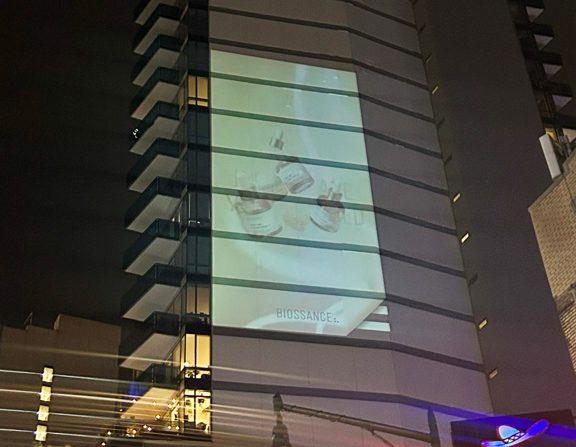
Guerrilla Projections in Spokane, WA
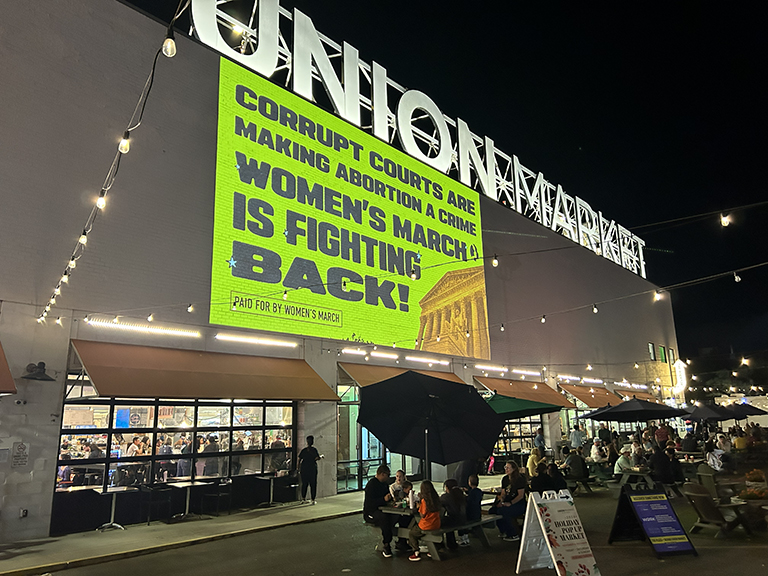
Spokane’s revitalized arts corridors, clear skies, and accessible wall inventory make it one of the Pacific Northwest’s most productive mid-market environments for building projection advertising campaigns.
Spokane as a Projection Advertising Market
Eastern Washington’s largest city occupies a distinctive position in the regional projection advertising landscape. Spokane is not a secondary market in any diminished sense — it is a strategically underutilized market where production-quality campaigns face less competition for wall inventory, less permit density, and an audience that encounters outdoor projection as a genuinely novel experience rather than one more layer of an already saturated visual environment. That novelty premium translates directly into higher engagement rates per pedestrian encounter and stronger organic documentation behavior from an audience seeing large-format building projection for the first time.
Past AGM projection clients include Coca-Cola, Live Nation, and iHeartRadio, with multi-night campaigns that generated earned media coverage and massive organic social sharing.
The city’s downtown revitalization — concentrated along Monroe Street, in the Garland District, and throughout Browne’s Addition — has created a nighttime economy anchored by restaurants, bars, live entertainment venues, and arts institutions whose patrons are exactly the kind of engaged, social-media-active audience that projection advertising converts into organic reach. Spokane’s Hoopfest, Bloomsday, and other major civic events bring tens of thousands of out-of-region visitors into the downtown corridor annually, creating event-aligned campaign windows that multiply effective audience reach beyond the city’s resident base.
The physical environment in Spokane consistently rewards projection campaigns in ways that larger, more developed markets sometimes cannot. The commercial building stock along the Monroe Street corridor includes structures with substantial blank wall sections above the street-level retail layer — older commercial facades built before the window-to-wall ratio escalated in mid-century construction. The West Central neighborhood’s arts district adds a layer of creative pedestrian culture that amplifies campaign reception for brands and causes whose messages align with an independent, arts-engaged community.
AGM’s approach to Spokane campaigns applies the same full-production standard that the agency deploys in Seattle or New York: 20,000-lumen commercial projection system, direct technical crew, advance physical scouting, and comprehensive post-campaign documentation. The market may be smaller, but the campaign infrastructure is identical, and the wall-to-audience ratio often produces higher per-impression quality than can be achieved in more densely competitive major markets. For brands looking to establish presence in Eastern Washington or test campaign concepts before scaling to larger cities, Spokane delivers both operational reliability and strategic value.
Spokane’s position as the commercial and healthcare hub for a broad inland region — serving communities across Eastern Washington, Northern Idaho, and parts of Montana and Oregon — also gives projection campaigns in the city a regional reach that extends well beyond the metro’s own population. Visitors to Spokane from surrounding smaller markets are often the highest-engagement observers of projection campaigns, documenting and sharing footage that carries the campaign’s visual footprint back to communities that no traditional outdoor advertising placement would ever reach.
Activate Spokane's Best Walls
Monroe Street, Garland, Browne's Addition — AGM deploys 20,000-lumen projection campaigns across Spokane's most impactful arts and entertainment corridors. Let's build your Eastern Washington activation.
The Districts That Drive Spokane Projection Campaigns
Spokane’s projection inventory is not evenly distributed across the metro. The city’s most productive campaign zones are concentrated in a handful of distinct corridors where the combination of building stock, nighttime foot traffic, and audience profile converges to support effective outdoor projection advertising. The districts below represent AGM’s assessment of Spokane’s highest-value projection locations based on surface quality, pedestrian dynamics, and campaign accessibility.
Monroe Street Arts Corridor
Monroe Street runs north through Spokane’s near-downtown neighborhoods and has emerged as the city’s most reliable commercial arts corridor, hosting independent restaurants, boutiques, bars, and entertainment venues in a built environment that skews toward older commercial construction with ample blank wall territory. The buildings along Monroe Street’s active blocks present a mix of painted brick facades and concrete commercial fronts with large sections above the ground-floor signage band that are effectively invisible except to a projection system that illuminates them at scale. Campaign deployments along Monroe Street benefit from consistent evening foot traffic and an audience profile that leans toward creative-class and arts-engaged demographics — a strong fit for entertainment, cultural, and cause-driven campaigns.
West Central Neighborhood Arts District
West Central has undergone a gradual transformation from an underinvested residential neighborhood into one of Spokane’s most creatively active community zones, anchored by artist studios, gallery spaces, community organizations, and small independent businesses whose owners and patrons are highly engaged with public art and outdoor visual culture. The building stock in West Central is primarily residential and small commercial — structures with lower wall heights than the downtown corridor — but the neighborhood’s pedestrian culture and receptive audience profile make it a productive location for campaigns whose content benefits from intimate-scale projection in a community context rather than monumental-scale projection in a commercial district.
Garland District Entertainment Zone
The Garland District is Spokane’s historical entertainment corridor, centered on the Garland Theater and surrounded by a cluster of bars, restaurants, and small venues that generate concentrated nighttime foot traffic in a neighborhood slightly removed from downtown’s center. The district’s older commercial buildings — many dating to the 1920s and 1930s — present brick and plaster facades with substantial blank wall sections on upper floors and side elevations. Garland’s audience is locally rooted and entertainment-oriented, making the district particularly well-suited for campaigns tied to film releases, music events, streaming platform launches, and cultural activations whose message resonates with a neighborhood crowd rather than a transient commuter audience.
Browne’s Addition Arts Area
Browne’s Addition is one of Spokane’s oldest and most architecturally distinctive residential and mixed-use neighborhoods, located immediately west of downtown and characterized by late-19th-century brick apartment buildings, small commercial nodes, and arts-oriented businesses. The neighborhood’s building surfaces — primarily plaster-finished brick and smooth concrete — respond well to projection campaigns, and the residential character of the area means that campaign visibility extends into the evening hours when residents are active on sidewalks and in adjacent commercial spaces. Browne’s Addition campaigns work particularly well for brands whose aesthetic profile aligns with the neighborhood’s character: independent, culturally aware, locally grounded.
University District Near WSU Medical Campus
Spokane’s University District has expanded around the Washington State University medical school campus, drawing students, faculty, healthcare professionals, and the businesses that serve them into a concentrated daytime and evening pedestrian zone. The district’s relatively new institutional construction creates mixed surface conditions — much of the campus architecture uses glass and cladding systems unsuitable for projection — but the surrounding commercial corridors include older structures with viable blank wall faces that can serve as projection surfaces. Evening campaigns in the University District target an educated, media-engaged audience segment, and proximity to the medical campus creates natural alignment for healthcare, pharmaceutical, and public health campaign categories.
How To Read Spokane's Wall Inventory
Spokane’s building stock rewards projection campaigns differently than Seattle’s does, and understanding those differences is essential to effective campaign scoping. Where Seattle’s SoDo corridor offers monumental industrial walls at maximum scale, Spokane’s downtown and near-neighborhood corridors offer a more granular inventory of medium-scale commercial facades — three- and four-story buildings with blank wall sections that are well-suited to projection at 25–50 feet of image height, a scale that is highly legible at typical urban pedestrian distances without requiring the extended throw distances that very large walls demand.
The advantage of Spokane’s medium-scale wall inventory is flexibility. Projection positioning can often be established from street level at distances of 40–80 feet, reducing the logistical complexity of setup in a narrower urban streetscape. The trade-off is that Spokane walls typically present less visual spectacle from long distances than the massive SoDo-type surfaces available in larger industrial corridors, making pedestrian proximity and audience density more important factors in location selection. In Spokane’s most productive corridors — Monroe Street, the Garland District, Browne’s Addition — that pedestrian proximity is built into the neighborhood character, making medium-scale projection campaigns consistently effective.
Surface texture in Spokane skews toward brick and plaster rather than the poured concrete that delivers the highest projection reflectivity. AGM’s 20,000-lumen system compensates effectively for the light absorption of brick surfaces, but campaigns on painted or plastered surfaces will show noticeably better color saturation than campaigns on unpainted brick. Scouting specifically for painted or plaster-finished surfaces within Spokane’s target districts — and there are many — significantly improves campaign output quality.
Clear line of sight from projector to wall is a Spokane-specific logistical consideration in neighborhoods where mature street trees, utility lines, and older streetscape infrastructure create obstruction patterns that require careful positioning. AGM’s physical scouting process identifies and addresses these obstructions before they become campaign-night surprises.
Plan Your Guerrilla Projection Campaign in Spokane, WA
Tell us about your campaign goals, target audience, and preferred locations. Our team will help you plan a high-impact guerrilla projection campaign tailored to your needs.
Award Winning Personalized Service
You will get thoughtful, devoted, and individualized attention from our experienced, qualified, and professional personnel. Being one of the most illustrious agencies in Brooklyn, New York, American Guerrilla Marketing has been awarded the Best of Brooklyn title.
Nationwide
Industry City, Brooklyn, New York 11232
American Guerrilla Marketing
Hours
Mon - Fri: 9 AM - 5 PM
Sat & Sun: Closed
Automate your campaign with AGM’s Request for Proposal Builder.
Automate your campaign with AGM’s Request for Proposal Builder. Simply answer a few quick questions about your campaign goals, markets, and timeline, and the system will generate a tailored presentation with recommended strategies, quantities, and pricing. Click the RFP Builder to instantly receive your customized proposal.
Content and Creative Strategy for Spokane Audiences
Entertainment Release Campaigns
When The Weeknd and YouTube partnered on a countdown projection campaign for an entertainment release, the campaign demonstrated a format that translates powerfully to mid-market audiences who have never encountered large-scale building projection firsthand. Spokane’s entertainment-engaged downtown audience responds to release-tied projections with exactly the documentation and sharing behavior that makes the format valuable — and the novelty premium in a market this size amplifies that response significantly above what the same campaign would achieve in a saturated major market.
Regional Brand Awareness
Brands building presence in Eastern Washington use Spokane projection campaigns to establish recognition in the regional commercial hub that serves as a cultural anchor for a broad inland territory. A single projection campaign in Spokane reaches not just the city’s residents but the regional visitors, healthcare travelers, and event attendees who cycle through the market from surrounding communities — extending the campaign’s effective reach well beyond what the metro population alone would suggest.
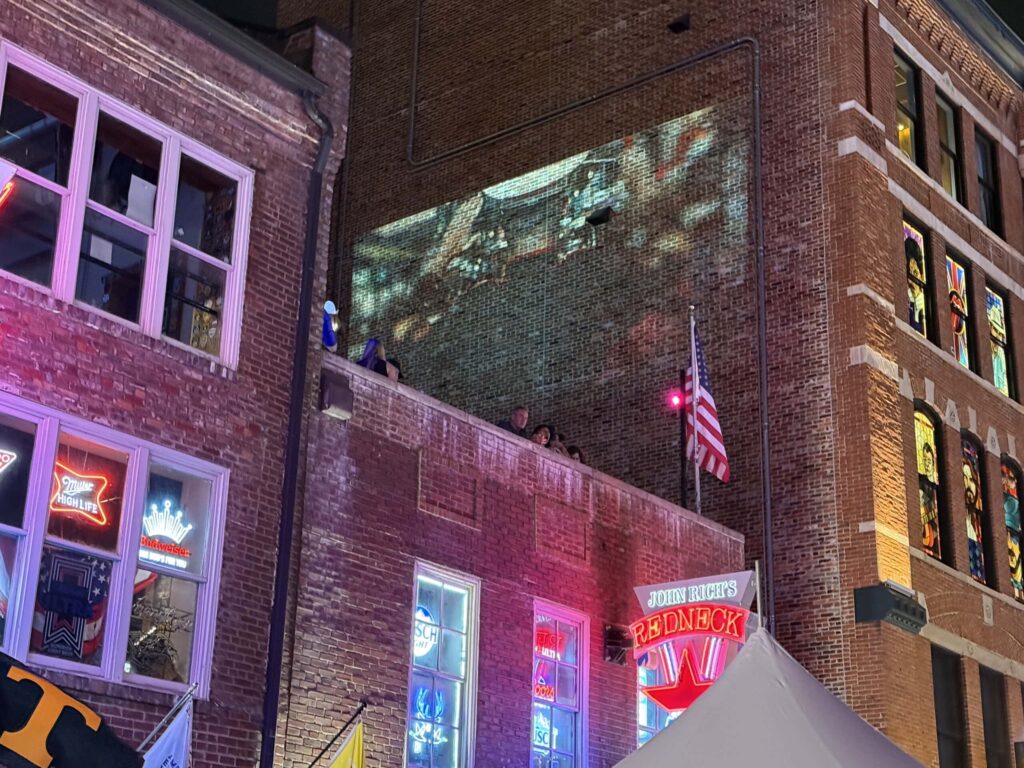
AGM’s projection client roster includes Netflix, Disney, Coca-Cola, FanDuel, Live Nation, iHeartRadio, and the US Marine Corps. A confirmed case study: the US Marine Corps × CMA Fest Nashville — multi-night projections onto architectural surfaces throughout the festival footprint, reaching 80,000+ attendees across the campaign window. Projection advertising scales across every brand category; what our campaigns share is scale, precision, and a physical presence digital cannot replicate.
Community and Civic Campaigns
Spokane’s active civic culture and its community organizations make it a productive market for cause-driven campaigns aligned with local and regional issues. The city’s arts districts — particularly West Central and the Garland area — host audiences that respond strongly to messages grounded in community identity, cultural pride, and collective values. Civic and advocacy campaigns in Spokane benefit from audiences who view public space as a legitimate venue for meaningful communication, not just advertising.
Healthcare and Institutional Campaigns
Spokane’s emergence as a major inland regional healthcare hub — anchored by Providence, MultiCare, and the WSU medical campus — creates a distinct campaign category that most Pacific Northwest cities don’t offer. Healthcare organizations, pharmaceutical brands, and public health initiatives find in Spokane an audience with above-average healthcare sector engagement, making the city’s University District and adjacent commercial corridors productive targets for campaigns in these categories.
Executing A Spokane Projection Campaign
Spokane campaigns follow the same pre-campaign scouting protocol that AGM applies across all markets: physical site visits to every candidate wall location, surface dimension assessment, reflectivity and texture evaluation, projector positioning analysis, and a review of any permit or property owner requirements before campaign planning is finalized. For Spokane, physical scouting typically requires two to three weeks of advance lead time to complete the site assessment and content production phases before the planned run date.
Because Spokane’s campaign environment is less logistically complex than major metro markets — fewer competing events, more accessible street positioning, shorter advance permit queues — AGM can often move from campaign booking to execution more quickly in Spokane than in Seattle or other high-demand markets. Brands that need to mobilize quickly for event-aligned campaigns or time-sensitive releases find that Spokane’s operational flexibility is an asset rather than a constraint.
On the campaign night, the two-person technical crew deploys the full 20K-lumen projection package from the pre-scouted position. Spokane’s consistently low ambient light in its residential-adjacent arts districts — an advantage of a mid-size city without the light pollution density of a major metro — means that projection campaigns achieve excellent image contrast even on nights when a thin cloud layer is present. Clear eastern Washington nights deliver optimal projection conditions that Seattle’s marine climate cannot match as reliably.
Documentation captures both the visual output — photo and video of the projected image on the building surface — and the campaign environment: the street context, audience reactions, and the overall physical footprint of the activation. Post-campaign reports are delivered within five business days and include all raw media assets for client distribution, alongside operational notes and audience observation context from the crew.
Spokane Campaign Pricing
Guerrilla projection advertising in Spokane is priced at contact us for a quote. , inclusive of the 20,000-lumen projection system, generator and power solution, electronics bundle, mobility unit, and a two-person direct AGM technical crew for all phases of the campaign night. Campaigns begin at dusk and typically run four to six continuous hours.
Advance location scouting for the Spokane market is available at approximately contact us for a quote. applies as a credit toward the campaign total for confirmed activations. Multi-night Spokane campaigns are priced at the same per-night rate, with crew and equipment remaining in market across consecutive nights. For brands running a Spokane campaign in conjunction with a Seattle or Tacoma activation across the same week, AGM can structure multi-market logistics to minimize travel costs and crew repositioning time between markets.
Who Uses Projection Advertising In Spokane
Spokane’s projection advertising market serves a distinct mix of clients reflecting the city’s dual character as both a regional commercial hub and an arts-oriented urban community. Entertainment brands and streaming platforms use Spokane campaigns to extend entertainment release reach into Eastern Washington’s engaged consumer base, with the market’s novelty premium delivering stronger per-impression engagement than comparable West Coast metro campaigns. Regional healthcare and institutional organizations use the University District and downtown corridors for public awareness and employer brand campaigns targeting the city’s large and growing healthcare workforce. Consumer brands entering the Pacific Northwest market include Spokane in multi-city campaign rollouts alongside Seattle and Tacoma to demonstrate regional commitment rather than just major-market presence. Civic and advocacy organizations use Spokane’s arts districts for cause-driven projections that resonate with the city’s active community culture.
AGM’s GPS-documented location analysis and post-campaign reporting provide every Spokane client with a clear evidence base for campaign effectiveness, supporting both internal marketing attribution and earned media follow-up by the client’s communications team. The agency’s national scouting infrastructure — with both digital and physical on-the-ground assessment — ensures that Spokane campaigns receive the same pre-campaign rigor that AGM applies to activations in New York, Los Angeles, and Chicago.
Coverage & Estimated Impressions
| Zone / Area | Peak Hours | Foot Traffic | Est. Nightly Impressions | Best For |
|---|---|---|---|---|
| Monroe Street Arts Corridor | 8PM–1AM | High | 8,000–35,000 | Product Launch |
| West Central Neighborhood Arts District | 8PM–1AM | High | 8,000–35,000 | Event Promotion |
| Garland District Entertainment Zone | 8PM–1AM | High | 8,000–35,000 | Brand Awareness |
| Browne’s Addition Arts Area | 8PM–1AM | High | 8,000–35,000 | Political |
| University District Near WSU Medical Campus | 8PM–1AM | High | 8,000–35,000 | Sports |
Frequently Asked Questions
Absolutely. Spokane is one of the Pacific Northwest’s most productive mid-market environments for outdoor projection advertising. The city’s revitalized arts districts, accessible wall inventory, and regional visitor base create campaign conditions that deliver strong engagement and organic documentation. Brands that write off Spokane as too small are typically underestimating both the city’s nighttime pedestrian economy and the novelty premium that building projection commands in a market that hasn’t been saturated with the format.
AGM’s highest-priority Spokane corridors are Monroe Street for its commercial arts density and evening foot traffic, the Garland District for its entertainment-oriented audience and older building stock, and Browne’s Addition for its residential arts character. West Central and the University District are secondary targets for campaigns with specific community or institutional audience objectives. Each location is evaluated individually based on campaign-specific surface and audience requirements.
In mid-size markets like Spokane, building projection delivers a novelty premium that major metro campaigns typically don’t enjoy — audiences are encountering the format for the first time, which drives higher documentation rates and stronger social sharing than the same content would generate in a more projection-saturated environment. The fundamental mechanics are identical to major-market campaigns: 20K-lumen system, direct crew, advance scouting, comprehensive documentation. The experience for pedestrians is fresher and the organic amplification accordingly stronger.
Yes. Spokane functions as the cultural and commercial hub for a broad inland region, and campaigns in the city reach not just Spokane residents but regular visitors from Eastern Washington communities, Northern Idaho, and portions of Montana and Oregon. The regional visitor and event attendee base that cycles through Spokane’s downtown and entertainment districts extends effective campaign reach well beyond what the metro population alone would suggest.
Spokane’s wall inventory skews toward medium-scale commercial facades — three- and four-story buildings with blank wall sections suitable for 25–50-foot image projection — rather than the monumental industrial walls available in Seattle’s SoDo corridor. That medium scale is well-suited to Spokane’s pedestrian distances and street geometry, and it offers operational flexibility that very large walls sometimes don’t. Seattle has a broader range of surface sizes; Spokane has a more consistently accessible medium-scale inventory with less permit complexity.
AGM recommends three to four weeks of advance lead time for most Spokane campaigns, covering the physical scouting phase, permit and property owner outreach if required, and creative content production and review. For campaigns tied to specific events — Hoopfest, Bloomsday, or other major Spokane civic events — four to six weeks of lead time is advisable to secure locations before event-adjacent demand increases.
Eastern Washington’s climate generally benefits projection campaigns. Spokane’s clear, dry summer and fall nights — a stark contrast to Seattle’s marine weather patterns — deliver optimal projection conditions with minimal ambient moisture on lenses and high atmospheric clarity that maximizes image sharpness. Winter campaigns are viable but require standard cold-weather equipment precautions. Spokane’s low nighttime light pollution in residential-adjacent districts also means that projection image contrast is often higher than in denser metro environments.
Bold, high-contrast graphic content with clear messaging performs best on Spokane’s predominantly brick and plaster surfaces. Entertainment countdowns, motion loops, and typographic campaigns with strong color contrast to the wall surface all translate well. Content that references regional identity — Eastern Washington, Inland Northwest, Spokane-specific imagery — consistently generates above-average documentation rates as local audiences claim ownership of the campaign through their social sharing behavior.
Yes, and event-aligned campaigns in Spokane often deliver the highest engagement rates in the market. Hoopfest draws tens of thousands of participants and spectators into downtown Spokane over a June weekend, and Bloomsday brings more than 50,000 runners through the city each May. Projection campaigns deployed in the days immediately preceding or concurrent with these events reach both the resident audience and a large visitor population that is already in an engaged, active outdoor mode. AGM advises early booking for event-window campaigns given elevated location demand during these periods.
The WSU medical campus and the broader University District serve as a target zone for campaigns oriented toward healthcare, education, and institutional audiences. Evening foot traffic in the district is driven by students, faculty, and healthcare professionals moving between the campus, residential areas, and adjacent commercial blocks — a distinct demographic segment from the arts-district audiences in Monroe Street and Garland. Healthcare organizations, pharmaceutical brands, and public health campaigns find the University District particularly valuable for reaching an audience with professional medical engagement.
The minimum Spokane campaign is a single projector for a single night, priced at Contact us for a custom quote. inclusive of equipment and crew. Most Spokane clients run one to two projectors over one to three nights, depending on campaign objectives and budget. AGM recommends at least a two-night run for campaigns relying heavily on organic social amplification, as the second night typically captures the audience awareness built by the first night’s organic reach.
AGM’s national scouting team conducts physical, on-the-ground assessments in all markets where campaigns are planned, including Spokane. Rather than relying on a local contractor network, AGM dispatches its own scouting personnel to Spokane ahead of campaign planning to physically walk candidate districts and evaluate surfaces firsthand. That direct assessment — rather than remote digital review or third-party reporting — is how AGM ensures that scouted locations match the surface quality and operational parameters that each campaign requires.
More AGM Outdoor Advertising Services
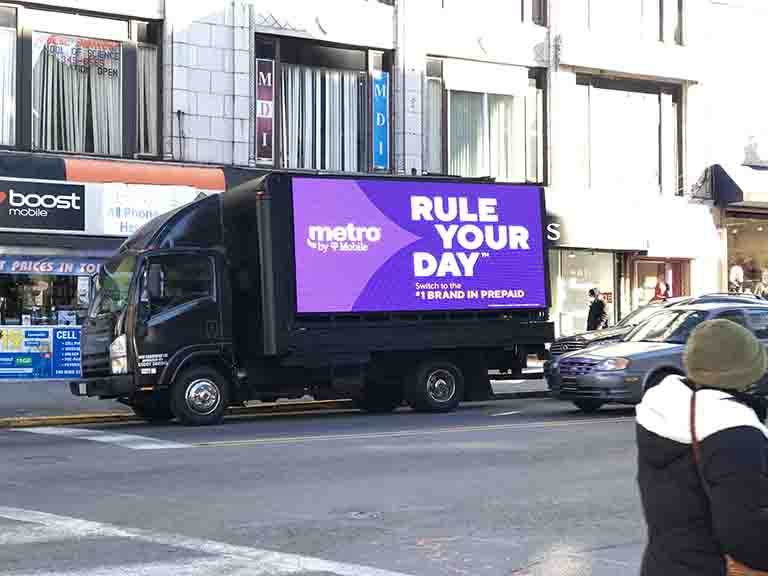
Led Billboard Trucks
Mobile LED displays that bring your brand to any location, any event.
Fly Posting
Street-level poster saturation across walls, construction sites, and corridors.

Sidewalk Decals
Ground-level branded decals at pedestrian hotspots and event entrances.

Sidewalk Stencils
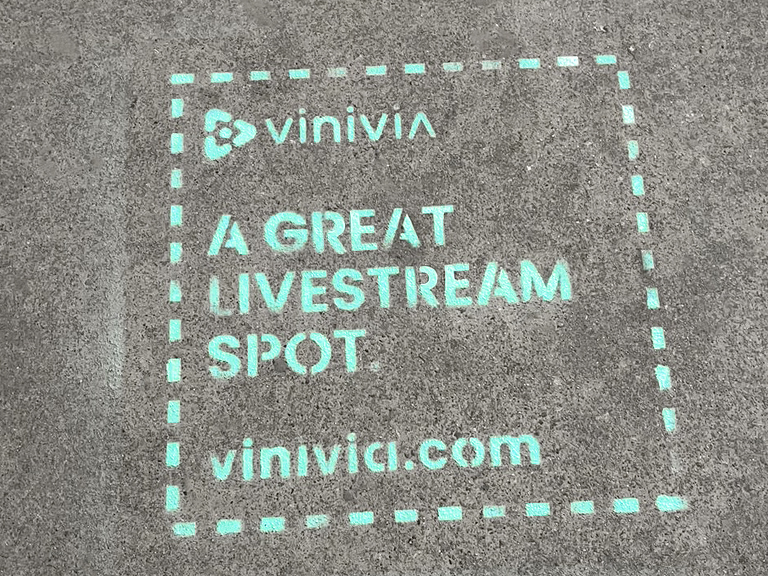
Creative stencil campaigns that put your brand in the path of pedestrians.