American Guerrilla Marketing
Nationwide Service
Media planning, media buying, billboard advertising, & guerrilla marketing
Guerrilla Projections in Providence, RI
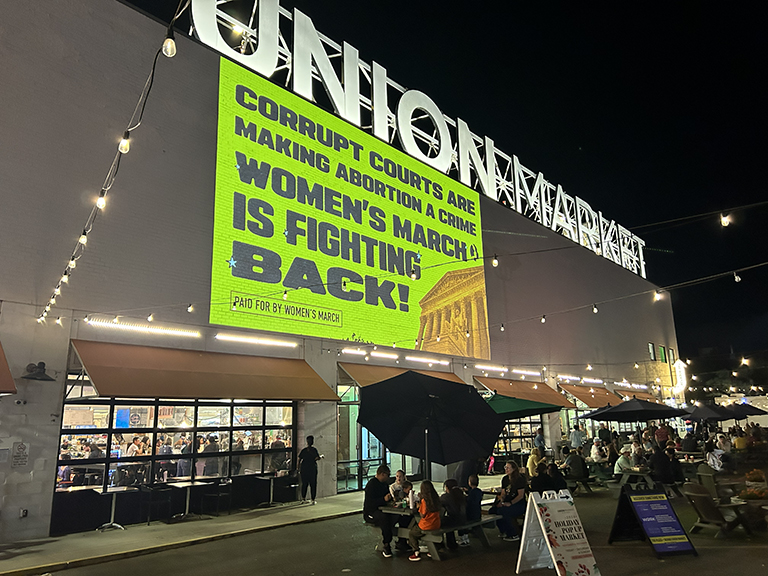
The Jewelry District’s former industrial granite and brick. Federal Hill’s restaurant corridor. Westminster Street’s creative community. Providence is Rhode Island’s cultural capital and its strongest guerrilla projection market — a city where a 20,000-lumen projection on a Jewelry District building wall becomes the evening’s defining visual moment.
Providence is a city that takes its arts identity seriously in a way that translates directly into guerrilla projection advertising value. The presence of the Rhode Island School of Design — one of the most influential arts and design institutions in the country — and its relationship with Brown University on College Hill creates an intellectual and creative culture that permeates the entire city’s social fabric. That culture shows up in the Providence nighttime economy: in the Jewelry District’s converted former industrial buildings now housing design studios, restaurants, and arts organizations; in Federal Hill’s restaurant-driven entertainment corridor where food culture and social gathering are community institutions; in Westminster Street’s creative commercial zone where independent retailers, arts venues, and nightlife establishments attract a densely interconnected community of cultural producers and consumers. The people who animate Providence’s evenings are, by demographic profile and by cultural habit, exactly the audience that makes building projection advertising work as an earned media engine — they photograph, they share, they talk about what they see, and their social networks have reach that extends well beyond Providence’s population.
AGM has executed guerrilla projection campaigns for brands including Netflix, Disney, and FanDuel — deploying high-impact visual activations onto architectural surfaces in major markets nationwide.
Providence also benefits from a dense institutional network — RISD, Brown, Johnson & Wales, Providence College, Rhode Island College — that adds tens of thousands of students and faculty to the downtown and near-downtown pedestrian zones throughout the academic year. This institutional population skews young, digitally active, and culturally engaged, and it concentrates heavily in the Jewelry District and College Hill zones adjacent to the entertainment corridors where building projection campaigns deploy most effectively. On any given Friday or Saturday evening during the academic year, the Providence projection audience is denser, younger, and more socially active than the city’s permanent resident population alone would produce.
Providence Walls. RISD Eyes. Your Brand.
The Jewelry District. Federal Hill. Westminster Street. The West End. Providence's projection zones bring industrial-heritage surfaces together with the most culturally connected arts community in New England. Contact AGM to plan your Providence guerrilla projection campaign.
Browse Cities in Rhode Island
Select a city to explore Guerrilla Projections opportunities.
Providence's Arts Identity And Its Projection Dividend
RISD’s influence on Providence extends well beyond the College Hill campus. RISD graduates, faculty, and affiliated creatives live and work across the Jewelry District, the West End, Federal Hill, and the Valley neighborhood — the city’s creative population is not concentrated in a single zone but distributed across the neighborhoods that comprise Providence’s arts and entertainment geography. That distribution means that a building projection in the Jewelry District is not just reaching the Jewelry District’s evening foot traffic — it is reaching the social networks of a creative community whose members cross the city and whose digital connections extend across New England and nationally.
This creative density has a specific effect on projection campaign documentation. RISD-affiliated photographers, designers, and artists who encounter a building projection in the Jewelry District or near Federal Hill are not casual social media users — they are visual media professionals with active platforms, engaged followers, and a professional orientation toward documenting striking visual experiences in their built environment. Their documentation of a campaign projection is qualitatively different from that of a general urban audience: it tends to be more carefully composed, more widely shared, and more likely to surface on platforms and in networks where it generates secondary distribution beyond the initial post. For brands and campaigns that want their Providence projection to generate high-quality organic documentation alongside its direct viewership, the RISD creative community’s presence in the city’s projection zones is a structural advantage that no other Rhode Island market can match.
Finding The Right Surface In Providence — District By District
The Jewelry District — Former Industrial Heritage, Arts Community Present
Providence’s Jewelry District takes its name from the city’s history as the center of America’s jewelry and silverware manufacturing industry — an industry that operated from the late eighteenth century through the mid-twentieth century in a dense collection of brick and granite factory buildings in the blocks between downtown and the Providence River. Those buildings have been substantially converted over the past two decades to house design studios, technology companies, restaurants, bars, and arts organizations, while their exterior wall faces retain the characterful brick and granite masonry of their manufacturing heritage. The Jewelry District’s building facades provide the most consistently high-quality projection surfaces in Providence: former industrial scale, multi-story masonry walls with relatively minimal fenestration on the non-street-entry elevations, and the kind of authentic industrial character that makes projection campaign photography distinctive and visually compelling on social platforms. AGM’s Jewelry District scouting focuses on the blank-wall elevations of former manufacturing buildings on the district’s side streets and alley-accessed facades, where clear projector sight lines and large unobstructed wall planes combine to produce the best projection geometry available in the Providence market.
Downtown Westminster Street Entertainment Corridor
Westminster Street connects the Jewelry District to the Federal Hill gateway through a mixed-use commercial corridor of independent retailers, arts venues, bars, restaurants, and performance spaces that collectively define Providence’s most walkable and most diverse nighttime entertainment zone. The corridor’s building stock spans the full range of Providence’s commercial history — from mid-nineteenth century brick commercial construction to early-twentieth century mixed retail buildings to mid-century commercial additions — with exterior surfaces of varying quality and scale. Projection-viable walls on Westminster Street tend to be the blank upper-floor and side-wall sections of corner commercial buildings, which carry larger and less interrupted surface areas than the street-fronting facades of the individual storefronts. Westminster Street’s consistent foot traffic — strong on Friday and Saturday evenings and moderate to strong on Thursday evenings driven by arts programming — makes it one of Providence’s most reliable campaign environments for audiences outside the specific arts-community demographic that the Jewelry District and West End attract most strongly.
Federal Hill Restaurant and Entertainment District
Federal Hill is Providence’s historic Italian-American neighborhood and the city’s premier restaurant district — a commercial corridor of dense dining and nightlife establishments centered on Atwells Avenue and the surrounding blocks, with a neighborhood identity rooted in community traditions and a contemporary reputation as one of New England’s best dining destinations. The district draws a cross-demographic audience of neighborhood residents, city-wide restaurant destination diners, tourists, and social groups whose evening activity concentrates heavily in the four-to-eleven PM window on weekends and the six-to-ten PM window on weekdays. Building facades along Atwells Avenue and the Federal Hill grid include former commercial buildings with brick exteriors and, on some mid-block and corner structures, blank side walls of sufficient size for projection placement. Federal Hill projections reach a broadly accessible, high-spending audience that differs demographically from the arts-community concentration of the Jewelry District — making the two zones complementary targets for campaigns with different audience objectives within the Providence market.
West End Arts Corridor and Valley Neighborhood
The West End arts corridor and the Valley neighborhood along Charles Street provide community-oriented projection contexts on Providence’s west side, where a mix of arts organizations, independent restaurants, and neighborhood-facing businesses serve a more locally rooted and less tourist-oriented community than the Jewelry District or Federal Hill. These neighborhoods are home to a significant portion of Providence’s working artists and arts educators, and their social connectivity to the RISD and Brown communities extends their organic documentation reach well beyond their immediate residential population. Projection surfaces in the West End and Valley zones include former commercial and light-industrial buildings adjacent to the arts corridor, typically at smaller scale than the Jewelry District mill heritage buildings but with the community character that gives projection campaigns in these neighborhoods a site-specific resonance particularly well-suited to arts-sector and advocacy campaign objectives.
Plan Your Guerrilla Projection Campaign in Providence, RI
Tell us about your campaign goals, target audience, and preferred locations. Our team will help you plan a high-impact guerrilla projection campaign tailored to your needs.
Award Winning Personalized Service
You will get thoughtful, devoted, and individualized attention from our experienced, qualified, and professional personnel. Being one of the most illustrious agencies in Brooklyn, New York, American Guerrilla Marketing has been awarded the Best of Brooklyn title.
Nationwide
Industry City, Brooklyn, New York 11232
American Guerrilla Marketing
Hours
Mon - Fri: 9 AM - 5 PM
Sat & Sun: Closed
Automate your campaign with AGM’s Request for Proposal Builder.
Automate your campaign with AGM’s Request for Proposal Builder. Simply answer a few quick questions about your campaign goals, markets, and timeline, and the system will generate a tailored presentation with recommended strategies, quantities, and pricing. Click the RFP Builder to instantly receive your customized proposal.
Creative Campaign Types Suited to the Providence Market
Design and Arts Brand Launches
Brands in the design, fashion, personal care, and creative lifestyle categories use Providence Jewelry District projections to establish credibility with the RISD-affiliated creative community that defines the city’s cultural authority. A projection on a Jewelry District former manufacturing building reaches the exact audience whose approval and organic distribution most effectively positions a design-forward brand in the New England market.
Food, Restaurant, and Hospitality Campaigns
Federal Hill’s restaurant and nightlife concentration makes it one of New England’s most food-engaged projection environments. New restaurant openings, food and beverage brand launches, and hospitality campaigns that deploy on Federal Hill or adjacent Westminster Street corridors reach a dining-engaged audience whose social documentation of food and hospitality experiences is already culturally normalized and whose platforms reach an active regional dining community.
Entertainment and Cultural Release Campaigns
Music, film, and entertainment releases targeting New England’s creative and university-affiliated young adult audience use Providence Jewelry District projections to generate organic social documentation from the most influential creative community in the region. A projection near College Hill or in the Jewelry District on a major release night reaches the social distribution nodes — the RISD and Brown students, the arts community professionals — whose shares carry the most weight in the New England creative media ecosystem.
Institutional and Advocacy Campaigns
RISD, Brown, and Providence’s network of arts and civic institutions use building projections in their home districts for programming awareness, community engagement, and fundraising campaigns that connect with the community in its own neighborhood context. Advocacy organizations use the West End and Valley neighborhood for civic projection campaigns reaching Providence’s engaged community activist population in its home territory rather than in the more tourist-oriented downtown corridors.
How A Providence Guerrilla Projection Is Planned And Executed
Providence Scouting and Surface Confirmation
AGM’s Providence scouting process draws on existing knowledge of the Jewelry District, Federal Hill, and Westminster Street building inventories while conducting fresh verification of surface conditions, access, and sight-line geometry for each campaign. Providence’s urban environment changes continuously — new construction, street furniture additions, vegetation growth, and business signage changes affect walls that were viable in previous campaign cycles. The scouting verification ensures current accuracy before each campaign commitment. For West End and Valley neighborhood deployments, fresh physical scouting covers the less-frequently activated building inventory in those zones. Scouting for the Providence market adds approximately Contact us for a custom quote. for markets where AGM does not hold current confirmed wall specifications.
Creative Template and Asset Calibration
The Jewelry District’s granite and brick building surfaces have a warm, characterful visual texture that shapes the creative experience. Projection onto a granite-faced former jewelry manufacturing building in the Jewelry District produces an image with a distinct surface quality — the stone’s crystalline texture visible beneath the projected colors — that differs from projection on a smooth painted stucco wall. AGM’s technical team provides surface-specific creative guidance for Providence Jewelry District campaigns, recommending design treatments that acknowledge and work with the surface texture rather than competing with it. For Federal Hill deployments on conventional brick commercial buildings, standard creative specifications apply with color and contrast optimization for the specific wall tone.
Campaign Night and Post-Campaign Output
The two-person AGM crew positions and activates the 20,000-lumen system before dusk at the confirmed Providence projector position, running the campaign through the peak pedestrian window for the target district. Post-campaign documentation — GPS records, timing logs, and multi-angle still photography — is formatted for press distribution and social content use and delivered to the client within forty-eight hours. For Providence Jewelry District projections, the photography quality tends to be particularly strong given the architectural character of the building surfaces and the visual interest of the industrial district setting as a campaign documentation backdrop.
Retail Launch Projection — What the Biossance × Sephora Campaign Proves
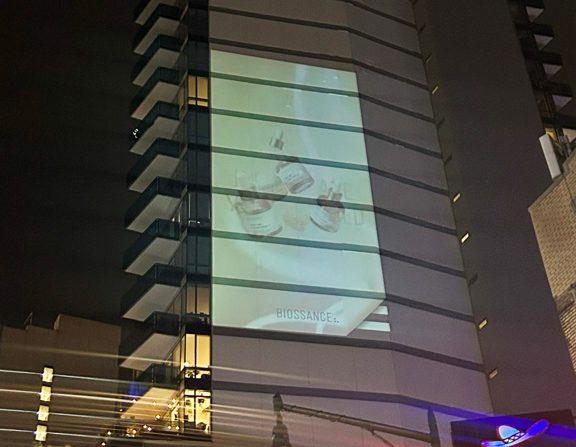
The Biossance product launch at Sephora Union Square in New York City gives brands considering a Providence projection campaign a direct template for measuring expected outcomes. The campaign placed a large-scale image on a building face adjacent to the physical retail location, in a high-density pedestrian zone during peak shopping and dining hours. The projection’s scale — visible from a full city block in multiple directions — combined with the organic documentation it generated from the pedestrian audience produced an earned media moment whose reach substantially exceeded the campaign’s direct viewership. The campaign’s press coverage, social distribution, and brand-in-place cultural positioning all extended the campaign’s value well beyond the night of the projection itself, delivering long-tail returns that no conventional media format in the same market would have generated at the same investment level.
The Providence application of this model is particularly strong for retail brands seeking to establish presence with the RISD and Brown creative community. A consumer brand that projects in the Jewelry District is positioning itself directly within the visual field of designers, artists, and creative professionals whose endorsement and organic distribution carry disproportionate weight with the broader New England creative consumer market. The physical scale of a Jewelry District projection — large enough to be visible from multiple city blocks — ensures that the brand impression lands at a scale that conventional retail advertising in Providence cannot match, and the social documentation it generates from the RISD-affiliated community ensures that the campaign’s reach extends well beyond the pedestrians who see it directly on the night of the projection.
Providence Building Projection — Investment And Scope
Guerrilla projection campaigns in Providence are priced at contact us for a quote. covering AGM’s full deployment system: the 20,000-lumen commercial projection unit, generator and power solution, electronics bundle, mobility unit, and the two-person technical crew for setup, full operation, and breakdown. For Jewelry District, Federal Hill, and Westminster Street campaigns where AGM holds current scouting records, campaigns can often proceed without an additional scouting fee. For West End and Valley neighborhood campaigns or for situations where Providence scouting records require updating, the scouting phase adds approximately contact us for pricing.
Multi-night Providence campaigns are priced at the per-night unit rate and may span multiple districts — Jewelry District one evening, Federal Hill the next — to reach distinct audience segments across a single campaign run. The close proximity of all Providence projection zones to each other means that multi-district campaigns can be managed by a single crew without repositioning overhead that would apply in a geographically larger city.
Who Deploys Projection Campaigns in Providence
Providence’s projection advertising client profile is shaped by the city’s cultural and institutional identity. Consumer design brands and personal care companies target the RISD community with Jewelry District projections that position the brand within the city’s creative heritage. Food, beverage, and hospitality brands use Federal Hill for launch campaigns reaching Providence’s most food-engaged audience segment. Entertainment companies — music labels, streaming platforms, gaming companies — use Jewelry District and Westminster Street projections for release activations targeting the university and arts community demographics. RISD, Brown, and affiliated cultural institutions use the West End and College Hill adjacencies for programming awareness and community engagement campaigns. Advocacy organizations use Federal Hill, the West End, and the Valley neighborhood for civic projection moments reaching the city’s engaged community population. The consistent driver is the recognition that Providence’s arts and academic community represents one of the most valuable earned media amplification networks per capita of any New England market.
AGM’s projection client roster includes Netflix, Disney, Coca-Cola, FanDuel, Live Nation, iHeartRadio, and the US Marine Corps. A confirmed case study: the US Marine Corps × CMA Fest Nashville — multi-night projections onto architectural surfaces throughout the festival footprint, reaching 80,000+ attendees across the campaign window. Projection advertising scales across every brand category; what our campaigns share is scale, precision, and a physical presence digital cannot replicate.
Frequently Asked Questions
The Jewelry District offers the combination of former industrial building scale — multi-story granite and brick factory buildings with large exterior wall planes — and contemporary arts and creative community density that makes it Providence’s strongest projection environment. The building surfaces are large enough for monumental projection images, the creative professional population is predisposed to document and share striking visual experiences, and the district’s RISD and design community adjacency means that documentation from Jewelry District projections distributes through platforms with significant influence on the broader New England creative consumer market.
Federal Hill delivers a cross-demographic dining and nightlife audience that differs usefully from the Jewelry District’s arts-forward creative community. The corridor’s concentration of restaurant-going households, food-culture enthusiasts, and social dining groups provides a high-engagement consumer audience with strong spending power and significant social media activity around the food and hospitality categories. For consumer brands in food, beverage, and hospitality, Federal Hill’s audience profile is more directly aligned with purchasing behavior than the arts-community audience of the Jewelry District. For brands that want both, a two-night Providence campaign — Jewelry District for arts credibility, Federal Hill for consumer volume — covers both audience segments within a single campaign run.
Yes. Westminster Street’s mixed commercial character and broad demographic foot traffic make it a versatile projection location for consumer brands that want to reach a general Providence entertainment audience rather than a specific arts or dining niche. The corridor’s Friday and Saturday evening foot traffic includes arts community members, nightlife patrons, restaurant diners, and general Providence residents in a mix that is broadly representative of the city’s 21-to-45 demographic. The surface options on Westminster Street vary in quality — AGM scouting identifies the strongest specific walls within the corridor — but the right placement provides strong foot-traffic exposure and workable projection geometry.
The Jewelry District’s former manufacturing buildings present two primary surface types. Granite-faced structures — the quarried stone used extensively in nineteenth-century New England industrial construction — carry a crystalline surface texture that reflects projection with a distinctive visual quality: colors appear slightly warmer and the surface texture is visible beneath the projected image, giving the projection a unique aesthetic character. Brick-faced structures — the fired clay masonry also common in New England mill construction — carry a finer, more even texture that reflects projection somewhat more conventionally. Both surface types are projection-viable; AGM’s creative guidance for Jewelry District campaigns addresses which design approaches work best on each surface type.
The West End serves a more community-oriented, locally rooted audience than the Jewelry District’s more institutional arts community. West End projections are better suited to community-facing advocacy campaigns, neighborhood-level brand awareness, and arts sector outreach targeting Providence’s working artist population rather than the university-affiliated and design-professional community that the Jewelry District reaches most directly. The building surfaces in the West End are generally smaller in scale than the Jewelry District’s former manufacturing buildings, which limits projection image size but also reduces access complexity and sometimes improves the pedestrian proximity of the audience to the projected image.
Yes. The Valley neighborhood’s arts and residential character provides a community-context projection environment suitable for advocacy, arts-sector, and community-facing campaign objectives. Charles Street and adjacent blocks carry former commercial and light-industrial buildings with exterior wall sections accessible for projection from the adjacent street infrastructure. The Valley neighborhood’s arts community connection to the broader Providence creative scene means that Valley projections generate social distribution that reaches beyond the neighborhood’s immediate residential population through the shared social networks of the city’s artistic community.
Jewelry District projection image sizes depend on the specific wall confirmed during scouting and the projector-to-wall distance available at the confirmed positioning. Typical Jewelry District projections span two to four stories in height and thirty to sixty feet in width on the former manufacturing buildings that comprise the district’s projection inventory. The granite-faced buildings with multi-story wall planes offer the largest dimensions; converted commercial buildings on the district’s peripheral streets tend to offer smaller but still substantial wall sections in the twenty-to-forty-foot width range. The scouting phase confirms the precise achievable dimensions for each wall before creative development begins.
The RISD community’s effect on Providence projection documentation is substantial and qualitatively distinctive. RISD students, faculty, and graduates are visual media professionals with active digital platforms, strong aesthetic sensibilities, and a professional practice of documenting striking visual work in their environment. Their documentation of a building projection in the Jewelry District or near the College Hill campus tends to be more carefully composed, more widely distributed on higher-reach platforms, and more likely to generate secondary distribution through the national and international networks of the RISD alumni community — a network that has significant influence on design, fashion, brand, and creative culture media across multiple countries.
Consumer brands in personal care, fashion, and lifestyle — categories with strong university-demographic alignment — have used building projections in college-heavy Northeast cities to generate organic social content from early-adopter audiences whose distribution reach exceeds their raw numbers. Entertainment companies targeting the university-affiliated market use projections for release activations that generate documentation from the platforms most active in the 18-to-24 demographic. Technology companies recruiting from Northeast university communities have used projections near campuses to generate brand awareness with the engineering and design students they seek to attract. The shared rationale is the university audience’s role as a social distribution amplifier: their organic sharing behavior generates reach multiples that justify projection advertising over conventional campus and digital media.
The Jewelry District’s nineteenth-century granite and brick construction creates two practical projection surface considerations that differ from more conventional commercial building contexts. First, granite surfaces have a crystal structure that scatters light more than painted stucco or smooth concrete, slightly reducing the apparent sharpness of fine typographic details at long viewing distances — a consideration that AGM’s creative guidance addresses by recommending bolder, less detail-dependent creative approaches for granite-surface deployments. Second, the district’s buildings often have ornamental masonry details — cornices, window surrounds, pilasters — that interrupt the projection surface in ways that smooth commercial facades do not. Scouting identifies wall sections that minimize the impact of these interruptions on the effective projection area.
Providence and Boston carry the same per-projector, per-night rate of Contact us for a custom quote. under AGM’s national pricing structure. What differs is the market context, the audience profile, and the earned media return on the same investment. Providence’s RISD and Brown communities are smaller than Boston’s university population but arguably more concentrated in their cultural influence and social media reach within the New England design and arts ecosystem. For brands specifically targeting the New England creative professional and arts-adjacent consumer market, Providence’s creative community offers a higher per-campaign influence return than Boston’s larger but more diffuse university demographic.
Providence’s peak pedestrian density in the Jewelry District and Westminster Street corridor typically occurs between 8:00 and 11:00 PM on Friday and Saturday evenings, with a secondary peak from 6:00 to 8:00 PM driven by early-evening dining activity that transitions to bar and social activity as the evening progresses. Federal Hill peaks somewhat earlier — 6:30 to 9:30 PM — driven by the dining-primary character of the district’s commercial mix. AGM calibrates projection activation timing to the specific target district’s foot-traffic pattern, ensuring that the projection is live and optimally calibrated before the peak window rather than requiring on-night adjustments during high-audience periods.
More AGM Outdoor Advertising Services
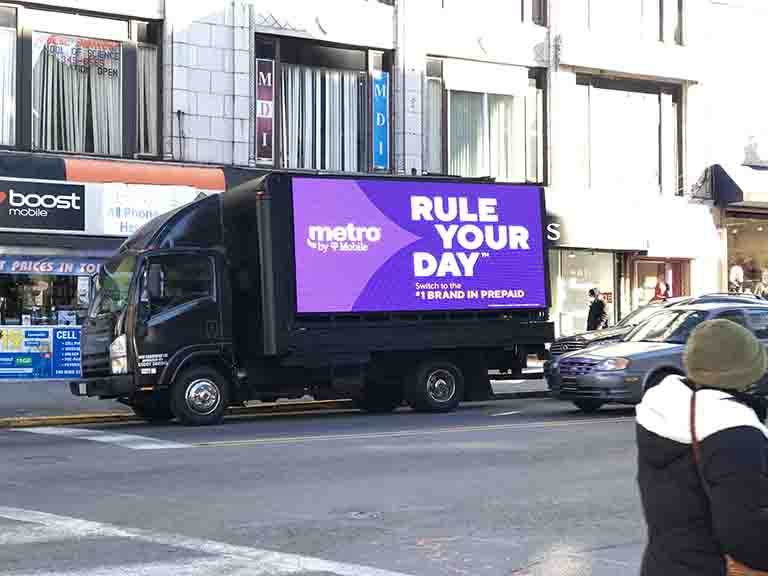
Led Billboard Trucks
Mobile LED displays that bring your brand to any location, any event.
Fly Posting
Street-level poster saturation across walls, construction sites, and corridors.

Sidewalk Decals
Ground-level branded decals at pedestrian hotspots and event entrances.

Sidewalk Stencils
Creative stencil campaigns that put your brand in the path of pedestrians.