American Guerrilla Marketing
Nationwide Service
Media planning, media buying, billboard advertising, & guerrilla marketing
Guerrilla Projections in Philadelphia, PA
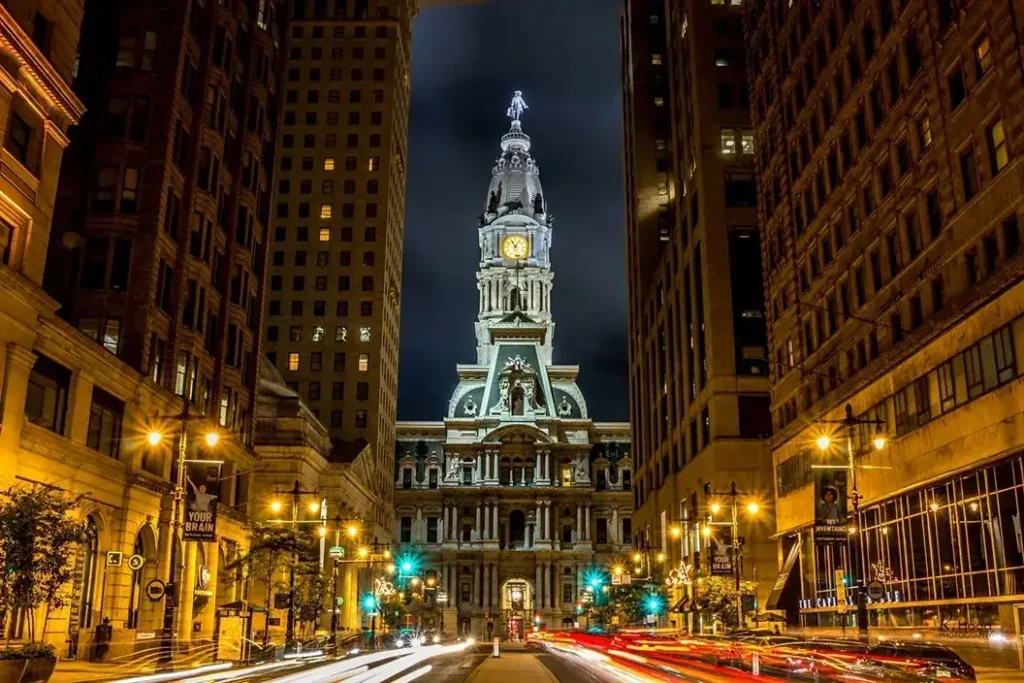
Fishtown’s warehouse walls. Old City’s weekend corridor. The Navy Yard’s industrial facades. Northern Liberties’ blank brick lofts. Philadelphia has more projection-ready building surfaces per square mile than any other city on the East Coast outside New York — and AGM knows exactly where each one is.
Philadelphia is one of the few American cities where the conditions for guerrilla projection advertising align so completely that the only real question is which neighborhood fits the specific campaign best. The city has the pedestrian density — over 1.5 million residents in the city proper, millions more in the surrounding metro, and a nighttime dining and entertainment culture that routinely keeps people outdoors until 1:00 and 2:00 AM. It has the building stock — a city built on manufacturing, warehousing, and light industry, which left behind an extraordinary inventory of former industrial buildings with large, flat, blank exterior walls that are ideal projection canvases. It has the social and cultural connectivity — Philadelphia’s young professional and creative class is among the most socially engaged in the country, with high rates of visual content documentation and platform sharing that translate directly into earned media reach. And it has the neighborhood character — Fishtown, Northern Liberties, Old City, and East Passyunk are neighborhoods where cultural discovery is a core part of the identity, where an unexpected building projection is not just noticed but actively celebrated.
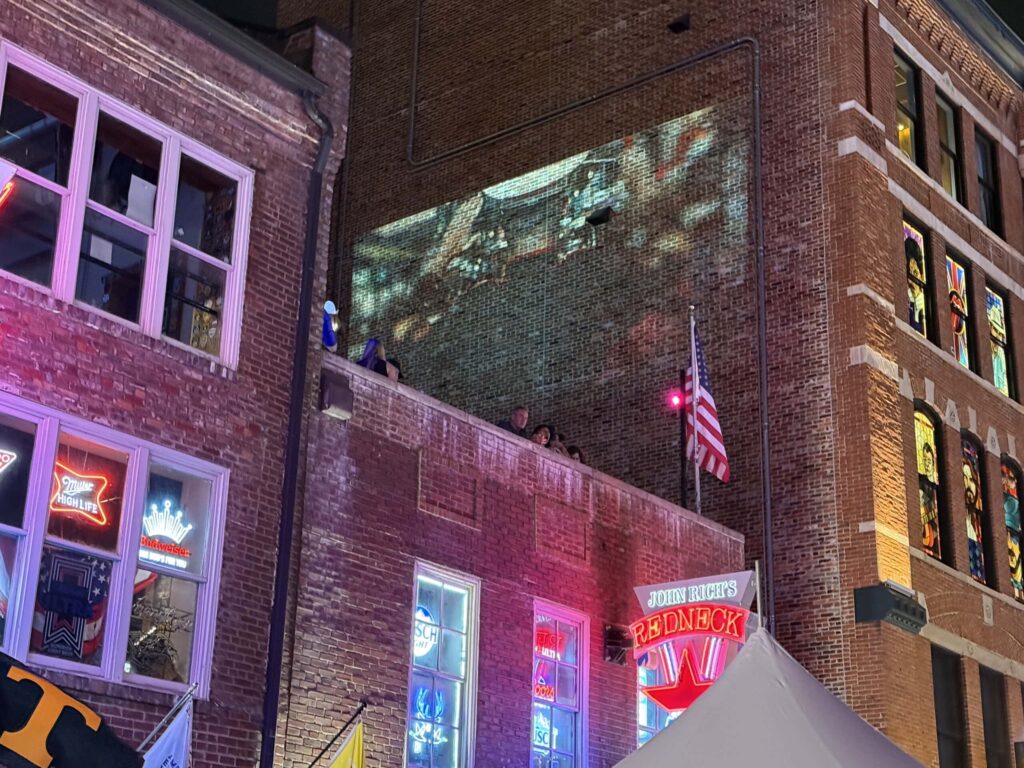
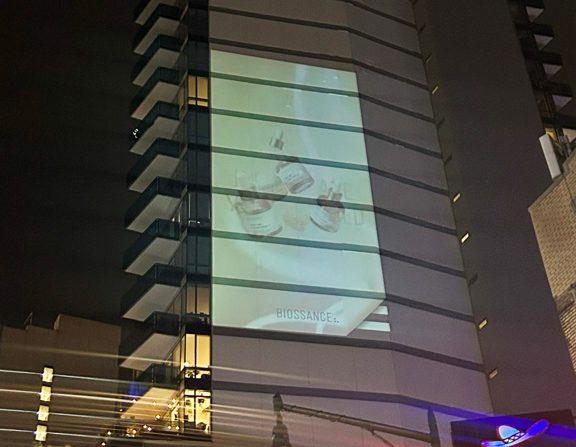
Past AGM projection clients include Coca-Cola, Live Nation, and iHeartRadio, with multi-night campaigns that generated earned media coverage and massive organic social sharing.
AGM has deployed building projection campaigns across Philadelphia’s major entertainment and arts corridors. The city’s wall inventory is one of the most thoroughly scouted in the national network, which means that campaign planning timelines in Philadelphia are often shorter than in other major markets — in many cases, the wall is already confirmed before the first client meeting concludes. That scouting depth is a function of demand: Philadelphia is one of AGM’s busiest projection markets, which means the team’s knowledge of the city’s streets, sightlines, surface qualities, and pedestrian patterns is continuously updated and refined by active campaign experience.
Put Your Brand on Allentown's Walls
Hamilton Street. The PPL Center district. Arts Walk. Lehigh Landing. Allentown's projection zones are ready — AGM's team knows exactly where to deploy. Contact AGM to start planning your Lehigh Valley building projection campaign.
Browse Cities in Pennsylvania
Select a city to explore Guerrilla Projections opportunities.
The Philadelphia Advantage — Why Fishtown Changes The Campaign Calculus
Fishtown is the variable that makes Philadelphia distinct from every other East Coast projection market outside of New York. The neighborhood’s physical characteristics — former warehouses and industrial buildings converted to bars, restaurants, recording studios, and creative offices, the whole corridor still carrying the blank brick and plastered exterior walls of its working past — would be compelling enough on their own. What makes Fishtown exceptional is the community it has built around those physical characteristics. This is a neighborhood that defines itself by cultural discovery. The people who live and spend evenings in Fishtown are precisely the people who will stop walking when they see a projection on a warehouse wall, who will take the photograph, who will share it immediately, and who will remember the brand or campaign associated with that moment in a way that a conventional advertising impression simply cannot produce.
The commercial density of Fishtown — the concentration of bars, restaurants, galleries, and music venues within a walkable few blocks — means that the audience for a Fishtown projection is not just physically present but actively engaged, moving between destinations in a social mode that makes them maximally receptive to an unexpected visual experience. A projection that activates at 9:30 PM on a Fishtown warehouse wall doesn’t interrupt anything. It becomes the evening’s conversation piece, the thing people bring up at the next bar, the image that circulates through friend groups across the city by morning. That social transmission is what makes Fishtown projection campaigns disproportionately valuable relative to what a raw impression count would suggest.
Philadelphia's Projection Neighborhoods — Surface Inventory By District
Fishtown Arts District — The Marquee Projection Zone
Fishtown’s projection inventory centers on the former warehouse and industrial buildings along Frankford Avenue, Girard Avenue, and the cross streets that connect them. These are multi-story structures — typically three to six floors — with large, uninterrupted wall planes facing the street or alley that runs adjacent to the pedestrian zone. Surface finishes in Fishtown range from raw red brick to painted stucco and plastered exterior walls, with the lighter-painted surfaces in the neighborhood producing the most vivid projection results with AGM’s 20,000-lumen system. The neighborhood’s street grid provides multiple projector positioning options — many Fishtown walls have clear sightlines from the opposite side of the street or from a parking position in an adjacent alley — giving the scouting process more geometry options to work with than tighter urban blocks in other parts of the city. Projections in Fishtown have documented audience viewing distances of up to a full city block, with documented photography from pedestrians on both sides of the street.
Old City Entertainment Zone
Old City is Philadelphia’s historic entertainment district, bounded roughly by the Delaware River waterfront, Vine Street, and Broad Street. The neighborhood’s combination of colonial-era masonry buildings, converted warehouse loft structures, and the pedestrian traffic generated by its dense concentration of bars, restaurants, and gallery spaces makes it a strong secondary projection zone. Old City’s audience skews somewhat older than Fishtown — late-twenties to mid-forties professionals and tourists — with strong spending power and high documentation propensity. Surface options in Old City include the blank side walls of converted warehouse buildings, the rear facades of historic masonry structures visible from parking areas, and the exterior walls of former commercial buildings in the blocks adjacent to the major bar and restaurant cluster on Market and Chestnut Streets.
Northern Liberties Arts Corridor
Northern Liberties, directly north of Fishtown along Second Street and surrounding blocks, has developed its own arts and entertainment identity built on a similar physical foundation: former industrial and manufacturing buildings converted to creative and commercial uses, with the exterior walls largely intact. The neighborhood’s loft buildings and former factory structures carry some of the largest available projection surfaces in Philadelphia proper — multi-story blank wall faces visible from the commercial street and accessible from multiple projector positions. Northern Liberties’ audience shares Fishtown’s cultural and social profile, with a slightly calmer nighttime energy that makes the neighborhood a strong choice for campaigns that want arts-district authenticity with a somewhat less dense pedestrian context.
South Philadelphia Italian Market Area
The South Philadelphia Italian Market — running along Ninth Street and surrounding blocks — is one of the city’s most distinctive pedestrian commercial zones, with a community identity rooted in the neighborhood’s Italian immigrant heritage and a contemporary commercial scene that spans the original open-air food market, restaurants, specialty retailers, and bars. The Italian Market area draws a mix of neighborhood residents, city-wide destination visitors, and tourists, making it a cross-demographic projection context that works well for consumer brand campaigns with broad audience targets. Building facades along the market corridor include the blank wall faces of row commercial buildings, former warehouse structures, and the rear walls of market-facing buildings accessible from the surrounding street grid.
The Navy Yard Warehouse District
The Philadelphia Navy Yard’s former industrial precinct, repurposed into a campus of creative offices, manufacturing facilities, and commercial tenants, contains some of the largest available projection surfaces in the Philadelphia metro area. Former ship maintenance buildings, warehouse structures, and industrial facilities in the Navy Yard campus carry exterior wall faces that span five to eight stories and extend hundreds of feet in width — the kind of truly monumental projection canvas that produces images visible from extraordinary distances. For campaigns requiring maximum physical scale — large-format brand identities, bold typographic statements, high-impact advocacy images — the Navy Yard’s industrial building stock provides a projection environment that no other Philadelphia zone can match in terms of raw surface scale. Access and deployment logistics in the Navy Yard are more complex than in standard neighborhood contexts and require advance coordination during the campaign planning phase.
Plan Your Guerrilla Projection Campaign in Philadelphia, PA
Tell us about your campaign goals, target audience, and preferred locations. Our team will help you plan a high-impact guerrilla projection campaign tailored to your needs.
Award Winning Personalized Service
You will get thoughtful, devoted, and individualized attention from our experienced, qualified, and professional personnel. Being one of the most illustrious agencies in Brooklyn, New York, American Guerrilla Marketing has been awarded the Best of Brooklyn title.
Nationwide
Industry City, Brooklyn, New York 11232
American Guerrilla Marketing
Hours
Mon - Fri: 9 AM - 5 PM
Sat & Sun: Closed
Automate your campaign with AGM’s Request for Proposal Builder.
Automate your campaign with AGM’s Request for Proposal Builder. Simply answer a few quick questions about your campaign goals, markets, and timeline, and the system will generate a tailored presentation with recommended strategies, quantities, and pricing. Click the RFP Builder to instantly receive your customized proposal.
Campaign Types That Perform in Philadelphia
Consumer Brand and Product Launches
Consumer brands launching in the Philadelphia market use Fishtown and Northern Liberties projections to generate retail-floor credibility and arts-district social documentation. A projection in Fishtown positions a brand within an earned, culturally authentic context that the neighborhood’s audience recognizes and respects — producing the kind of brand placement that paid media cannot manufacture regardless of budget scale.
Entertainment and Release Activations
Philadelphia’s dense 21-to-35 entertainment audience makes it a priority market for film, music, streaming, and gaming release campaigns. A building projection in Fishtown on the night of a major album drop or streaming premiere generates organic social documentation from exactly the demographic most engaged with the release, creating a self-propagating earned media moment that outperforms equivalent paid media at the same investment level.
Advocacy and Political Campaigns
Philadelphia’s role as a major civic mobilization hub — for both local and national political campaigns — makes it one of the most strategically valuable advocacy projection markets in the country. Building projections in Old City and Fishtown during election cycles, civic events, and advocacy campaign windows reach concentrated, politically engaged audiences at the exact moment of maximum receptivity to a civic or political message.
Large-Format Institutional Campaigns
The Navy Yard’s monumental industrial building faces make Philadelphia uniquely suited to campaigns requiring true architectural-scale projection. Institutional clients, government agencies, and brands seeking maximum visual impact at exceptional scale use the Navy Yard’s building stock for projection campaigns that would simply not be achievable at the same dimensions in any other Philadelphia neighborhood.
The Technical Reality Of A Philadelphia Projection Deployment
Surface Selection and Scouting
Philadelphia’s scouting process draws on AGM’s existing wall inventory for the city’s major projection zones while conducting fresh physical verification for each campaign to confirm current surface conditions, access, and sight-line geometry. Urban environments change — construction projects, new street furniture, and vegetation growth can affect walls that were viable in previous seasons. AGM’s scouting team physically verifies each confirmed Philadelphia wall before the campaign night to ensure that nothing in the projector’s sight path has changed since the wall was last evaluated. For campaigns targeting neighborhood zones not in AGM’s existing inventory — the Kensington arts corridor, the East Passyunk entertainment zone — fresh scouting is conducted as a dedicated phase.
Equipment and Crew
AGM’s Philadelphia deployments use the same 20,000-lumen commercial projection system as all national markets: the projection unit, generator, power solution, electronics bundle, and mobility unit, operated by a two-person technical crew. Philadelphia’s density and parking dynamics sometimes require more creative projector positioning than markets with more accessible street geometry, which the scouting process accounts for in advance. The crew arrives before dusk to position and test the system, ensuring the projection is aligned and calibrated before the peak foot-traffic window begins in the target neighborhood. Documentation — photography, GPS records, timing logs — is captured throughout the campaign evening and compiled for client delivery within forty-eight hours of campaign completion.
Multi-Night and Multi-Neighborhood Deployments
Philadelphia’s neighborhood-by-neighborhood diversity makes it well-suited to multi-night campaigns that rotate through different districts — Fishtown one night, Old City the next, Northern Liberties on the third — reaching distinct audience segments within the broader Philadelphia market while building cumulative social and press coverage across the full campaign run. AGM coordinates multi-night logistics from a single campaign management engagement, with crew and equipment repositioned between nights according to the confirmed neighborhood schedule.
Civic Moments and Projection Power — The Women's March
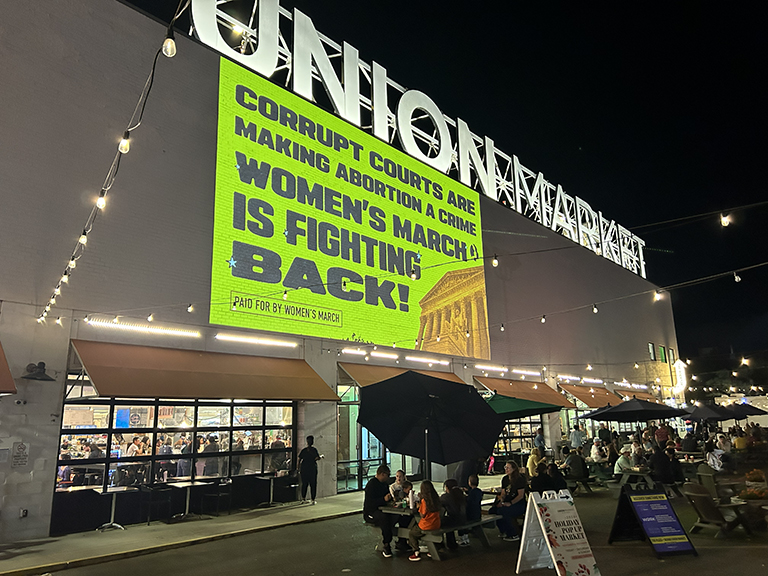
The Women’s March projection campaign that AGM executed in Washington, DC offers a direct framework for understanding what guerrilla projection advertising achieves when it aligns with a concentrated civic moment in a major city. The projection appeared on a high-visibility building facade in the path of what became one of the largest single-day demonstrations in American history — hundreds of thousands of people moving through the capital, cameras raised, already emotionally engaged with the moment and the message. The image distributed across social platforms with extraordinary velocity, generating earned media reach that extended far beyond the physical audience of the projection and creating a campaign artifact — the photograph of the projection, the building, the city night — that outlasted the projection itself by weeks and months.
Philadelphia is one of the most natural American cities for this model. The city’s civic and political culture is intense, organized, and deeply connected to national movements. Major marches, mobilizations, and civic events regularly concentrate enormous crowds in the downtown and adjacent neighborhoods, creating precisely the audience conditions that made the Women’s March projection so powerful. A building projection in Fishtown or Old City timed to a major Philadelphia civic moment reaches an audience that is already engaged, already emotionally receptive, and already equipped to document and distribute what they see. AGM’s knowledge of Philadelphia’s streets and walls means the right surface is already identified — the campaign moment is the remaining variable.
Philadelphia Projection Advertising — What The Investment Covers
Guerrilla projection campaigns in Philadelphia are priced at contact us for a quote. That rate covers the complete AGM campaign infrastructure: the 20,000-lumen commercial projection unit, generator, power solution, electronics bundle, mobility unit, and the two-person technical crew for full setup, operation, and breakdown. Philadelphia campaigns in AGM’s existing wall inventory can often proceed without an additional scouting fee, as the major Fishtown, Old City, and Northern Liberties walls are thoroughly documented with current dimensional and surface specifications. Campaigns requiring fresh scouting — Kensington, East Passyunk, Navy Yard, or other less-frequently activated zones — add approximately Contact us for a custom quote. for the scouting phase.
Private-property or permitted Philadelphia wall access, when required for a specific campaign objective, is subject to additional costs in the range of Contact us for a custom quote. per night based on the building owner, the location, and the specific campaign parameters. Multi-night Philadelphia campaigns and multi-neighborhood deployments are priced at the same per-night unit rate with logistics managed through a single campaign engagement.
The Philadelphia Projection Client Profile
Philadelphia’s building projection clients span the full range of the format’s use cases. Consumer brands — fashion, food and beverage, personal care, technology — use Fishtown and Northern Liberties for product launches and retail market entry campaigns where arts-district cultural positioning matters to the target consumer. Entertainment companies — music labels, streaming platforms, film distributors — deploy projections for release activations targeting Philadelphia’s dense young-adult entertainment audience. Political campaigns and advocacy organizations use Old City and Center City adjacencies for civic projection moments timed to elections, ballot initiatives, and legislative campaigns where Philadelphia’s voter concentration is strategically critical. Institutional clients — universities, museums, cultural organizations — use the format for awareness campaigns connected to major programming moments, capital campaigns, and civic anniversaries. What unites all of these clients is the recognition that Philadelphia’s audience doesn’t just tolerate bold visual media — it actively rewards it with the documentation and social distribution that makes projection advertising self-amplifying in a way that conventional formats are not.
AGM’s projection client roster includes Netflix, Disney, Coca-Cola, FanDuel, Live Nation, iHeartRadio, and the US Marine Corps. A confirmed case study: the US Marine Corps × CMA Fest Nashville — multi-night projections onto architectural surfaces throughout the festival footprint, reaching 80,000+ attendees across the campaign window. Projection advertising scales across every brand category; what our campaigns share is scale, precision, and a physical presence digital cannot replicate.
Frequently Asked Questions
Fishtown’s projection value comes from the combination of three things that rarely align this completely: a dense inventory of large, blank, projection-friendly building walls; a pedestrian population that is highly receptive to and active in documenting unexpected visual media; and a neighborhood identity built around cultural discovery that makes a building projection feel like an extension of the neighborhood’s character rather than an intrusion into it. The result is organic documentation rates and social distribution speeds that consistently outperform equivalent campaigns in less culturally aligned neighborhoods, even when the raw foot-traffic numbers are similar.
Yes, with advance coordination. The Navy Yard operates as a campus with a mix of private tenants and managed common areas, which means projection campaigns in the Navy Yard require advance access coordination with the relevant property managers or tenants. AGM handles this coordination as part of the campaign planning process. The Navy Yard’s building scale — multi-story former industrial structures with massive blank wall faces — justifies the additional coordination for campaigns that require true large-format projection at architectural scale.
Kensington is a developing arts corridor with genuine building projection potential, but the neighborhood’s character — an arts community in a neighborhood still navigating significant economic and social challenges — means that commercial brand projections should be selected carefully for tonal and contextual appropriateness. Brands and organizations whose campaign content connects authentically with the Kensington community and the corridor’s arts-district character tend to perform well; campaigns that read as purely commercial without any community resonance may generate negative attention. AGM advises on creative appropriateness during the planning phase for any Kensington campaign.
East Passyunk’s entertainment corridor draws a somewhat older and more established audience than Fishtown — late-twenties to late-thirties professionals and neighborhood residents with strong spending power and a deep relationship with the corridor’s restaurant culture. Social documentation rates in East Passyunk are slightly lower than Fishtown’s on a per-pedestrian basis, but the audience’s purchasing power and the corridor’s press profile make East Passyunk campaigns valuable for consumer brands targeting established professional demographics rather than the younger early-adopter segment that Fishtown captures most effectively.
Property owners interested in participating in guerrilla projection campaigns as a paid host can be coordinated through AGM’s campaign planning process. AGM identifies projection-suitable walls in its scouting work and in some cases approaches property owners directly when a specific building is the highest-performing option for a confirmed campaign. Property owner compensation for private-wall access varies based on the building, the neighborhood, and the campaign duration, and is handled directly between the property owner and AGM’s campaign management team.
Northern Liberties typically generates somewhat lower per-block pedestrian density than Old City on Friday and Saturday evenings, but the foot traffic it does draw is more concentrated around the neighborhood’s primary bar and restaurant cluster near Second Street and Liberties Walk. Old City draws broader tourist and destination traffic in addition to neighborhood regulars, producing higher raw pedestrian numbers but a more diffuse audience distribution. For campaigns targeting culturally specific audiences — arts consumers, creative professionals, early-adopter brand enthusiasts — Northern Liberties’ more homogeneous audience profile can be more valuable than Old City’s larger but more varied footfall.
Yes. AGM’s post-campaign documentation package — still photography captured by the technical crew during the campaign night, GPS location records, and timing logs — is formatted specifically to support press release distribution, earned media pitches, and social distribution by the client’s communications team. The photographs are high-resolution, multi-angle, and captured during the peak foot-traffic window for maximum visual impact. AGM can advise on which documentation angles are most effective for specific press target audiences during the campaign planning phase.
Fishtown’s street grid — with blocks ranging from approximately 60 to 90 feet in width — provides projector-to-wall distances that typically fall in the 60-to-100-foot range when projecting across a standard street width. This distance range is well within the optimal operating zone for AGM’s 20,000-lumen system and allows projection images that span the full multi-story height and width of a standard Fishtown warehouse building face. Alley-positioned projectors can achieve somewhat different geometry — sometimes accessing walls that are not projectable from the public street — which the scouting process evaluates as an alternative approach for specific buildings.
The Italian Market provides a very different projection context from Fishtown: a daytime-oriented neighborhood market that transitions to a restaurant and bar district in the evening, with a more cross-demographic audience that spans long-term neighborhood residents, destination visitors, and city-wide diners. The building facades along the market corridor are lower-profile than Fishtown’s warehouse district — primarily row commercial structures of three to four stories rather than the six-story warehouse lofts — but they offer ample projection surface area for standard campaign formats. The Italian Market context works well for consumer food and beverage brands, restaurant campaigns, and community-oriented advocacy messaging that resonates with the neighborhood’s character.
For campaigns that require formal permits — such as those in locations where a temporary structure or specific access arrangement is needed — AGM manages the permit application process as part of campaign planning, coordinating with the relevant Philadelphia city agencies. For standard mobile-unit projections from public rights-of-way in typical neighborhood contexts, the regulatory framework often does not require a dedicated projection-specific permit, and AGM navigates the applicable rules for each specific deployment location. The scouting phase identifies permit requirements for each confirmed wall before the campaign is scheduled.
Friday and Saturday evenings generate the highest pedestrian density in Fishtown, Old City, East Passyunk, and the Italian Market — making them the strongest campaign nights for consumer and entertainment projection campaigns targeting maximum direct viewership and organic social documentation. Thursday evenings have emerged as a strong secondary window in Fishtown and Northern Liberties, driven by the neighborhood’s bar and restaurant culture extending into mid-week. Campaigns timed to specific civic events or sports events should align with the event calendar regardless of day of week, as event-night concentration often exceeds standard weekend foot-traffic levels in the immediate event-adjacent zone.
Billboard advertising in Philadelphia delivers passive impressions to a diffuse audience across an extended campaign period, with no organic amplification mechanism and no differentiation from other billboard content in the viewer’s visual field. A guerrilla projection in Fishtown or Northern Liberties is a singular media event — one image, one wall, one night — that generates active documentation, social sharing, and earned press coverage that continues to deliver value after the projection has ended. The two formats are not directly comparable on an impression-per-dollar basis because they operate in fundamentally different modes: one delivers reach at volume over time, the other delivers intensity in a concentrated moment that triggers a cultural response the billboard format cannot produce.
More AGM Outdoor Advertising Services
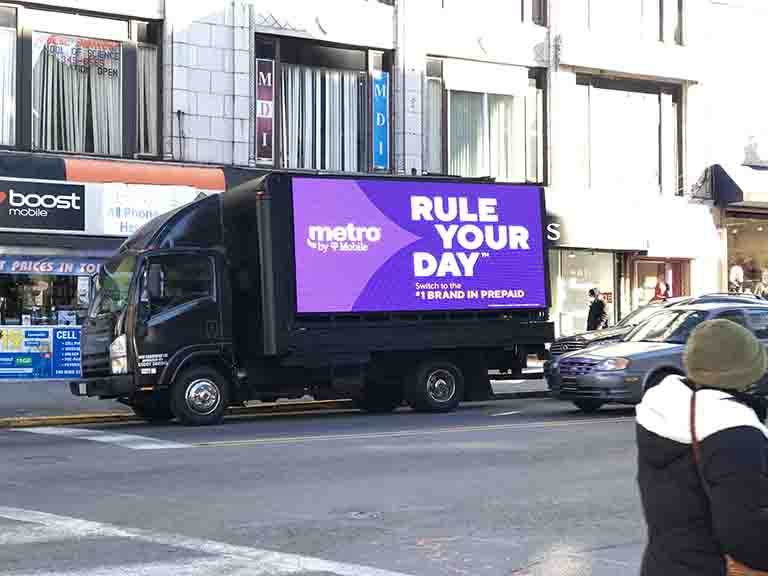
Led Billboard Trucks
Mobile LED displays that bring your brand to any location, any event.
Fly Posting
Street-level poster saturation across walls, construction sites, and corridors.

Sidewalk Decals
Ground-level branded decals at pedestrian hotspots and event entrances.

Sidewalk Stencils
Creative stencil campaigns that put your brand in the path of pedestrians.