American Guerrilla Marketing
Nationwide Service
Media planning, media buying, billboard advertising, & guerrilla marketing
Guerrilla Projections in Columbus, GA

Columbus packs a riverfront arts district, a historic warehouse zone, and a military-adjacent professional audience into a compact downtown geography that makes projection advertising campaigns here efficient, targeted, and visually distinctive against the Chattahoochee’s natural backdrop.
Columbus, Georgia as a Projection Advertising Market
Columbus operates as western Georgia’s primary commercial and cultural center, with an economic identity shaped by three major institutional anchors: Fort Moore (formerly Fort Benning), one of the Army’s largest training installations and home to the Maneuver Center of Excellence; Columbus State University, which brings an academic community to the city’s arts and cultural life; and the Chattahoochee Riverwalk, a fourteen-mile pedestrian trail along the Georgia-Alabama border that has catalyzed arts and entertainment development in the adjacent Uptown corridor. These three anchors create a layered market — military families and professionals, university students and faculty, and the creative and civic community that has developed around the riverwalk infrastructure — that gives Columbus projection advertising campaigns a demographic range unusual for a city of its size.
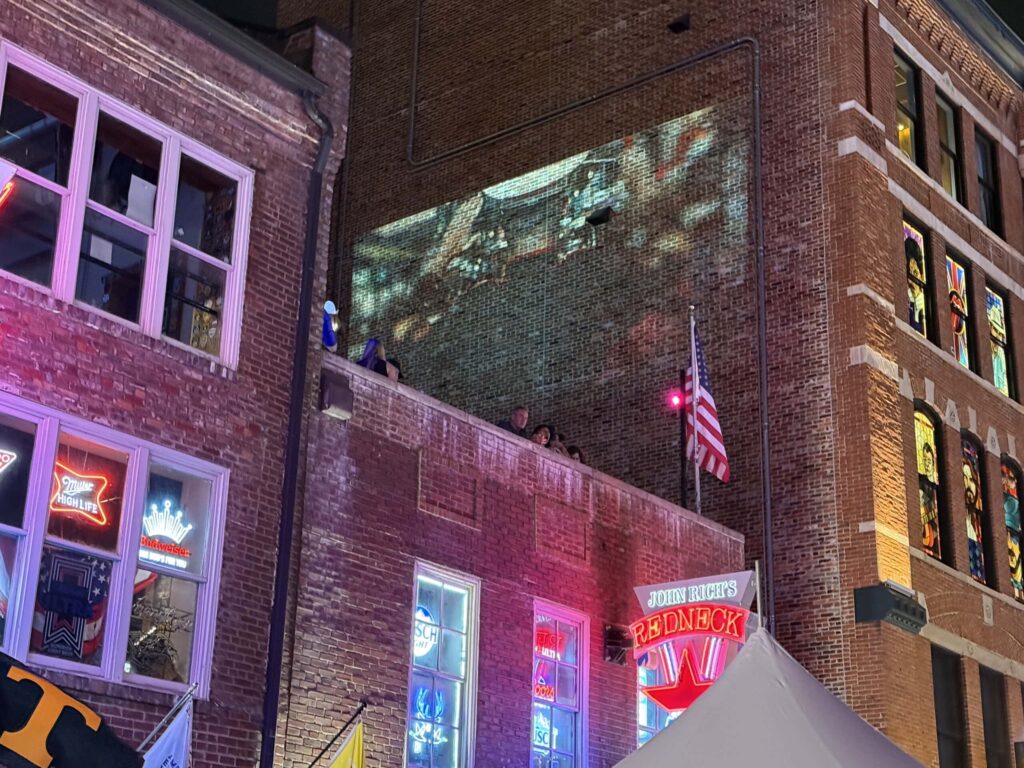
The US Marine Corps selected AGM for a guerrilla projection campaign during CMA Fest in Nashville, projecting onto high-traffic surfaces during peak festival activity and reaching 80,000+ attendees.
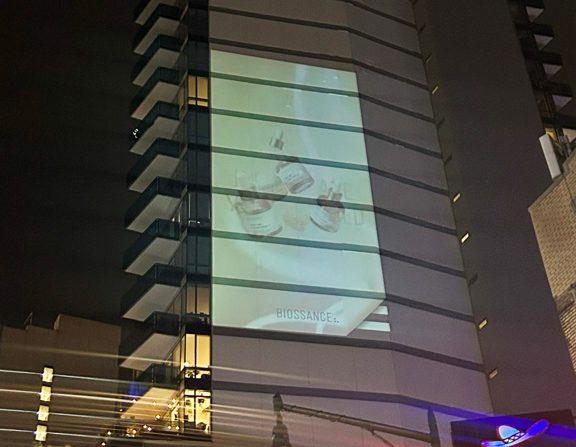
AGM’s projection client roster includes Netflix, Disney, Coca-Cola, FanDuel, Live Nation, iHeartRadio, and the US Marine Corps. A confirmed case study: the US Marine Corps × CMA Fest Nashville — multi-night projections onto architectural surfaces throughout the festival footprint, reaching 80,000+ attendees across the campaign window. Projection advertising scales across every brand category; what our campaigns share is scale, precision, and a physical presence digital cannot replicate.
The RiverCenter for the Performing Arts anchors Columbus’s arts district with programming that ranges from Broadway touring productions to symphony performances, drawing audiences from across the CSRA (Columbus Statistical Area) that includes adjacent Phenix City, Alabama. The concentration of performing arts audiences in the RiverCenter district creates natural projection campaign windows that brands and organizations targeting arts-engaged, higher-income consumers can align their campaigns to precisely. The building scale and waterfront setting of the RiverCenter corridor provide projection surfaces with visual authority that Columbus’s compact downtown concentrates into a small but highly capable geographic footprint.
Broadway Columbus — the city’s primary commercial entertainment street — runs parallel to the Chattahoochee, connecting the arts district to Uptown Columbus’s historic warehouse and commercial buildings. The combination of the performing arts infrastructure along the river and the nightlife and dining concentration along Broadway creates an evening pedestrian circuit that moves audiences between two distinct zones, generating multiple impression opportunities per campaign night for projections positioned at points visible from both the Broadway corridor and the approach paths between Broadway and the riverfront.
American Guerrilla Marketing’s scouting team has documented Columbus’s projection-ready surfaces across the RiverCenter district, Broadway’s commercial corridor, and the Uptown warehouse zone. The industrial-era buildings in Uptown Columbus present some of the most technically capable projection surfaces in western Georgia — masonry and concrete structures at the scale of a working industrial city, with large, flat facades that allow projected images to reach the architectural scale that creates the visual authority projection advertising is designed to deliver.
Fort Moore’s proximity to Columbus’s downtown entertainment district creates a consistent military and veteran audience presence in the commercial corridors that serve the installation’s active-duty personnel, civilian employees, and the veteran community that has settled in the surrounding area. For brands and organizations targeting service members and veterans — as well as for advocacy campaigns relevant to the military community’s concerns — Columbus’s downtown projection zones provide access to this specific demographic in the social environments they use outside of work hours.
Project in Columbus's River District
RiverCenter's performing arts corridor, Broadway's entertainment spine, and Uptown's industrial warehouse facades are all scouted and ready. AGM brings the 20,000-lumen system and the crew — you bring the message.
Columbus's Three Projection Zones
RiverCenter Arts and Entertainment District
The RiverCenter district occupies the most dramatically positioned section of Columbus’s Chattahoochee Riverfront — where the performing arts center, the National Infantry Museum connector, and the surrounding entertainment and hospitality infrastructure create a concentrated arts-and-tourism audience zone. Buildings in and adjacent to the RiverCenter district include structures whose exterior walls face the river approach roads and the pedestrian infrastructure connecting the arts district to Broadway’s commercial corridor. Programming nights at the RiverCenter produce concentrated pre- and post-show audiences in the corridors immediately surrounding the venue — audiences in a specifically elevated, culturally receptive state that makes the per-impression quality of projection advertising in this zone particularly high.
Broadway Columbus Entertainment Corridor
Broadway’s historic commercial corridor serves as Columbus’s primary entertainment spine, running parallel to the Chattahoochee and hosting the concentration of restaurants, bars, and entertainment venues that serve the combined military, university, and general resident population of the Columbus metro. Commercial buildings along Broadway include historic structures dating to the late 19th and early 20th centuries — brick masonry facades with upper floors at scales appropriate for projection advertising in an intimate urban commercial context. The corridor’s consistent evening foot traffic from a demographically diverse population creates broad impression coverage across multiple audience segments within a single campaign run window.
Historic Uptown Columbus Warehouse District
Uptown Columbus’s historic warehouse buildings represent the city’s most technically capable projection surfaces. Former textile and manufacturing facilities in the area present masonry facades at the industrial scale — four to seven stories, large continuous wall sections, minimal window interruption — that allow for projected images reaching fifty to seventy feet in height at standard throw distances. The warehouse district’s lower ambient light relative to Broadway’s commercial corridor translates to higher projected image contrast and apparent brightness, which improves documentation quality for campaigns producing social media and earned media assets. The district’s industrial architectural character adds visual authenticity to projection campaigns in a way that more recently constructed commercial environments cannot match.
Creative Formats For Columbus's Market
Military and Veteran Campaigns
Fort Moore’s proximity to Columbus’s entertainment district creates direct access to active-duty Army personnel, civilians, and veteran families in the social environments they use for dining and entertainment. AGM’s experience with military brand campaigns — including work for the United States Marine Corps — provides specific knowledge of how to design projection campaigns that communicate effectively with this demographic audience in commercial entertainment contexts.
Performing Arts and Cultural Programming
The RiverCenter’s performing arts programming creates natural audience windows for cultural institution and event projection campaigns in the arts district. Theater companies, presenting organizations, and cultural institutions use building projection in the RiverCenter corridor to announce programming and build institutional awareness among the performing arts audience concentrated in this zone during programming evenings.
Consumer and Retail Campaigns
Columbus’s diverse consumer audience — spanning military families with significant purchasing power, Columbus State students and faculty, and the general civic and professional population — creates broad demographic coverage for retail and consumer brand campaigns running along the Broadway corridor. The corridor’s consistent evening foot traffic delivers impression volume across a demographically mixed audience appropriate for broad consumer awareness campaigns.
Advocacy and Civic Messaging
Columbus’s civic community — active in local and state political issues, informed by Columbus State’s academic presence and Fort Moore’s institutional perspective — creates a productive audience for civic and advocacy campaigns running in the Broadway and RiverCenter zones. Building projection here reaches a diverse civic audience with community investment across multiple institutional sectors simultaneously.
Plan Your Guerrilla Projection Campaign in Columbus, GA
Tell us about your campaign goals, target audience, and preferred locations. Our team will help you plan a high-impact guerrilla projection campaign tailored to your needs.
Award Winning Personalized Service
You will get thoughtful, devoted, and individualized attention from our experienced, qualified, and professional personnel. Being one of the most illustrious agencies in Brooklyn, New York, American Guerrilla Marketing has been awarded the Best of Brooklyn title.
Nationwide
Industry City, Brooklyn, New York 11232
American Guerrilla Marketing
Hours
Mon - Fri: 9 AM - 5 PM
Sat & Sun: Closed
Automate your campaign with AGM’s Request for Proposal Builder.
Automate your campaign with AGM’s Request for Proposal Builder. Simply answer a few quick questions about your campaign goals, markets, and timeline, and the system will generate a tailored presentation with recommended strategies, quantities, and pricing. Click the RFP Builder to instantly receive your customized proposal.
Execution and Pricing for Columbus Campaigns
Location Scouting
AGM’s Columbus scouting evaluates the RiverCenter district, Broadway corridor, and Uptown warehouse zone against technical performance criteria and strategic audience value. Physical reconnaissance captures surface conditions, ambient light levels, standoff positions, and pedestrian timing patterns specific to each zone. Advance scouting adds approximately contact us for a quote.
Campaign Night Operations
AGM’s own technical crew manages every Columbus campaign night with the 20,000-lumen system and self-contained generator. Setup takes one to two hours; projection runs from dusk for four to six hours; complete breakdown is handled by end of run. GPS-documented location records and professional photography are delivered post-campaign.
Pricing
Columbus projection campaigns are priced at contact us for a quote. covering the complete production package. Private-property campaigns with building owner authorization add Contact us for a custom quote. per night. Columbus campaigns can be combined with Augusta or Atlanta in multi-city Georgia tours at standard per-night rates.
Case Study: Women's March — Building-scale Civic Presence
The Women’s March used AGM’s building projection advertising to create civic messaging at architectural scale on landmark facades in Washington, DC — projecting images dozens of feet tall in high-pedestrian corridors, generating earned media coverage and organic social documentation that extended the campaign’s reach far beyond the physical projection nights. The campaign demonstrated how advocacy organizations can create institutional visual presence through projection advertising that matches the scale and significance of the issues they’re working to advance.
For Columbus — a city with a significant military community, an active civic engagement culture shaped by its institutional anchors, and a compact downtown geography that concentrates diverse audiences in a small number of high-value corridors — this advocacy model provides a directly applicable template. Campaigns that create civic-scale presence on Columbus’s Broadway corridor or in the RiverCenter district reach the military professional, academic, and civic activist communities in the same physical spaces they share for dining and entertainment, creating a cross-demographic impact that few other advocacy formats can achieve in a market of Columbus’s specific community structure.
Coverage & Estimated Impressions
| Zone / Area | Peak Hours | Foot Traffic | Est. Nightly Impressions | Best For |
|---|---|---|---|---|
| RiverCenter Arts and Entertainment District | 9PM–2AM | Very High | 25,000–120,000 | Product Launch |
| Broadway Columbus Entertainment Corridor | 9PM–2AM | Very High | 25,000–120,000 | Event Promotion |
| Historic Uptown Columbus Warehouse District | 9PM–2AM | Very High | 25,000–120,000 | Brand Awareness |
Frequently Asked Questions: Guerrilla Projections in Columbus, GA
The Chattahoochee Riverwalk’s fourteen-mile pedestrian trail and the entertainment development that has clustered around it create both audience infrastructure and physical positioning opportunities for projection campaigns targeting the riverfront corridor. Buildings visible from the Riverwalk approach and from the river-adjacent pedestrian infrastructure benefit from the trail’s consistent user base — walkers, cyclists, and outdoor recreation users who traverse the corridor in daylight and evening hours. Projection campaigns on Uptown warehouse buildings adjacent to the Riverwalk can reach trail users at specific positions where sightlines from the trail to the building facade create natural viewing angles.
The RiverCenter concentrates a specifically valuable audience — performing arts patrons with above-average income, education, and cultural engagement — in a compact geographic zone on programming evenings. These audiences are in a particularly receptive state for projection advertising: they’ve self-selected for a cultural experience, they’re moving between the performance venue and the surrounding dining and bar infrastructure, and they’re explicitly in a visual, experiential mindset rather than a task-focused one. Per-impression quality for projection campaigns timed to RiverCenter programming nights consistently exceeds what the same locations deliver on non-performance evenings.
Broadway Columbus operates at a more intimate scale than Atlanta’s Edgewood Avenue or Savannah’s River Street, but the demographic diversity of its audience — military families, university students, civic and professional residents — creates a cross-sectional impression pool that more demographically homogeneous corridors can’t match. For campaigns with broad consumer awareness objectives that span multiple demographic segments, Broadway Columbus’s mixed audience is an asset rather than a limitation. The corridor’s building scale — two-to-four-story historic commercial structures — supports projection at neighborhood commercial dimensions appropriate to the intimate urban context.
Yes. Active-duty Army personnel, civilian employees, contractors, and veteran families associated with Fort Moore use Columbus’s downtown Broadway and RiverCenter corridors for dining and entertainment on evenings and weekends. Projection campaigns running in these zones on weekend evenings reach this military-adjacent audience in their social environment rather than in a work or institutional context, which changes both the quality of attention they bring to the campaign and the emotional register in which the messaging lands. For military and veteran service campaigns, this social-context reach is often the most productive format available in the Columbus market.
Uptown Columbus’s warehouse buildings present predominantly brick masonry exteriors — a mix of painted and unpainted surfaces at industrial scale. Painted brick and concrete block surfaces in this district outperform raw unpainted brick on reflectivity metrics, supporting brighter and more color-saturated projected images under 20,000-lumen output. Several warehouse structures in the Uptown zone have EIFS or stucco exterior finishes on upper portions of their facades, which perform at the top of Columbus’s reflectivity range. The district’s open lot geometry and wide alley accesses create standoff distances that allow for large-format image scales on the zone’s tallest warehouse facades.
River-adjacent walls create specific projection positioning challenges — the riverside may face open water rather than a public street or lot, limiting available projector standoff positions to the building’s street-side approach rather than the river frontage. AGM’s scouting process identifies the positioning angles that create effective projected image coverage on river-adjacent facades while working within the logistical constraints of available vehicle circulation and equipment positioning areas. For buildings where river-facing facades are the primary surface of interest, the scouting evaluates whether boat-based or river-access projector positioning is feasible and appropriate for the campaign’s objectives and budget parameters.
Columbus’s institutional diversity — military, academic, civic professional — means that advocacy campaigns with themes that resonate across these distinct communities perform best in the city’s primary entertainment corridors. Veterans’ issues, healthcare access, community development, and economic opportunity all draw consistent engagement across Columbus’s demographic cross-section. Issue-specific campaigns with narrower audience targeting benefit from district-specific placement — military-focused messaging in Broadway corridor zones frequented by Fort Moore personnel, academic and arts community campaigns in the RiverCenter and Columbus State-adjacent zones — rather than the broad Broadway placement that general awareness campaigns favor.
Phenix City, Alabama sits directly across the Chattahoochee River from Columbus, connected by multiple bridges whose residents use Columbus’s commercial infrastructure for dining, entertainment, shopping, and cultural programming. Columbus’s downtown entertainment district effectively serves a bi-state market, with Phenix City residents comprising a meaningful share of the Broadway and RiverCenter corridor’s evening pedestrian audience. Projection campaigns in Columbus reach this bi-state audience without requiring separate Alabama market deployment — the geographic integration of the two communities means a Columbus campaign’s impression reach includes Phenix City organically.
The minimum throw distance required to fill a specific Uptown warehouse facade depends on the wall’s dimensions and the projector lens configuration. For typical Uptown warehouse buildings running four to six stories in height, a throw distance of 60 to 100 feet is generally required to achieve full-facade image coverage at the aspect ratio appropriate to the wall’s geometry. AGM’s technical team confirms achievable throw distances and corresponding image dimensions at each confirmed location during the scouting phase, and uses this information to select the appropriate projection lens configuration and to format creative content to the actual achievable image dimensions.
Fort Moore’s proximity creates a projection advertising audience profile in Columbus that’s unique among Georgia’s cities. Active-duty Army personnel, civilian Department of Defense employees, contractors, and the veteran and military family community that has settled in the surrounding area collectively represent a substantial share of Columbus’s consumer market — with spending patterns, brand relationships, and values that differ meaningfully from purely civilian urban markets. For brands and organizations that want to specifically reach or include military audiences in their campaign geography, Columbus’s downtown entertainment districts provide one of the most accessible and productive military-adjacent projection advertising venues in the Southeast.
More AGM Outdoor Advertising Services
Led Billboard Trucks
Mobile LED displays that bring your brand to any location, any event.

Fly Posting
Street-level poster saturation across walls, construction sites, and corridors.

Sidewalk Decals
Ground-level branded decals at pedestrian hotspots and event entrances.

Sidewalk Stencils
Creative stencil campaigns that put your brand in the path of pedestrians.