American Guerrilla Marketing
Nationwide Service
Media planning, media buying, billboard advertising, & guerrilla marketing
Guerrilla Projections in Seattle, WA

Seattle’s politically engaged pedestrian districts, dense nightlife corridors, and warehouse-lined industrial zones create an ideal environment for building facade projection campaigns that stop foot traffic and drive organic documentation.
Seattle’s Projection Advertising Environment
Few American cities combine the activist civic energy, nighttime pedestrian density, and raw wall inventory that Seattle delivers for outdoor projection advertising. Capitol Hill alone — the city’s arts and entertainment nucleus — generates more organic foot traffic per block between 9 PM and 1 AM than most mid-size markets achieve across their entire downtown at peak hours. That concentration of engaged, visually literate pedestrians is precisely what transforms a building projection from a spectacle into a shareable event.
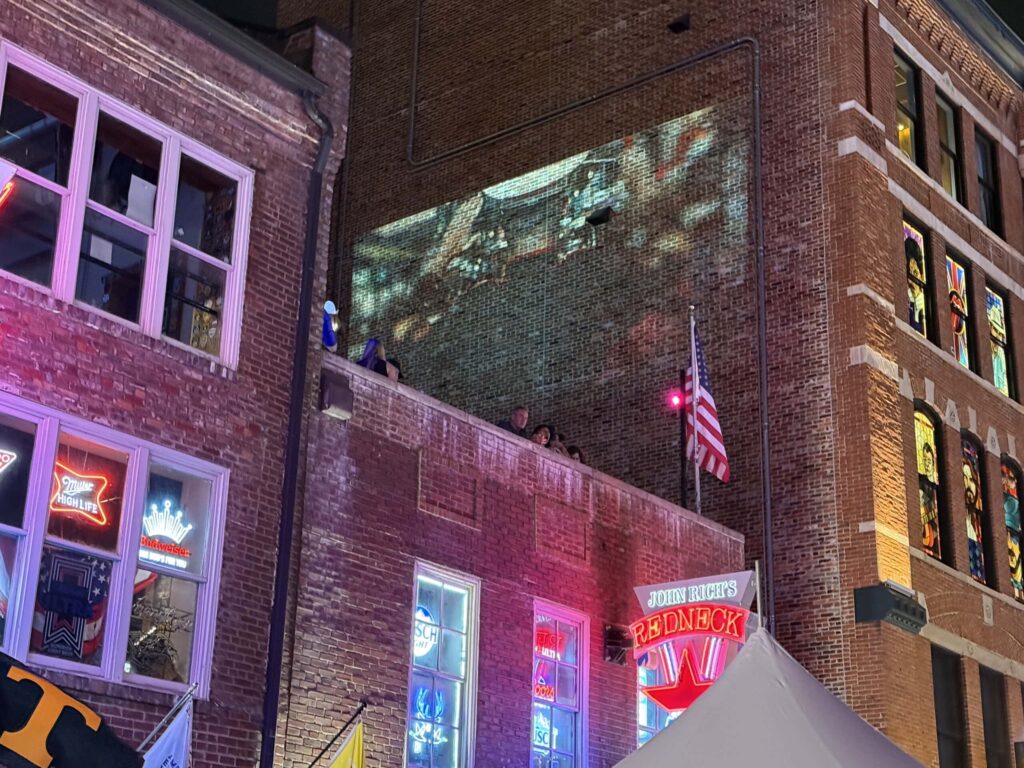
The US Marine Corps selected AGM for a guerrilla projection campaign during CMA Fest in Nashville, projecting onto high-traffic surfaces during peak festival activity and reaching 80,000+ attendees.
AGM’s projection client roster includes Netflix, Disney, Coca-Cola, FanDuel, Live Nation, iHeartRadio, and the US Marine Corps. A confirmed case study: the US Marine Corps × CMA Fest Nashville — multi-night projections onto architectural surfaces throughout the festival footprint, reaching 80,000+ attendees across the campaign window. Projection advertising scales across every brand category; what our campaigns share is scale, precision, and a physical presence digital cannot replicate.
Seattle’s identity as a city — progressive, creative, tech-forward, musically connected — shapes which campaign types resonate most powerfully in its street-level environment. Advocacy campaigns find a receptive audience in neighborhoods where political engagement is part of daily public life. Entertainment releases tap into a music and streaming culture that runs deep in the local consumer identity. Technology product launches find their native audience in the South Lake Union corridor, where major employers have concentrated tens of thousands of innovation-sector workers within walking distance of evening entertainment zones.
The physical architecture of Seattle’s neighborhoods adds another layer of projection viability. Pioneer Square’s century-old masonry buildings, the SoDo corridor’s sprawling former industrial facilities, and the Fremont arts district’s eclectic mix of converted warehouse spaces all offer the kind of large-format blank wall surfaces that projection advertising requires. The variety across districts means that campaigns can be tailored not just to audience profiles but to surface aesthetics — choosing historic patina for a cultural campaign, clean concrete for a tech activation, or raw industrial brick for an advocacy message that wants to read as urgent and unmediated.
AGM brings its full national projection infrastructure to Seattle campaigns: 20,000-lumen commercial projection system, integrated generator and power solution, electronics bundle, mobility unit, and a two-person direct technical crew. The scouting process that precedes every Seattle campaign includes physical site visits in every target district, not just satellite review, because the difference between a viable projection surface and a problematic one often comes down to variables that no mapping tool captures — a streetlamp at the wrong angle, a recently installed awning, a chain-link fence that wasn’t visible from the aerial image.
Seattle’s year-round outdoor culture, even in the gray Pacific Northwest winter, means that projection campaigns can operate during most months without the seasonal blackout periods that constrain campaigns in colder climates. Rainy nights typically dampen neither pedestrian activity nor projection operations, since Seattle residents are accustomed to outdoor activity in wet conditions and AGM’s equipment is configured for outdoor deployment in variable weather.
Project on Seattle's Best Walls
Capitol Hill, Pioneer Square, SoDo — AGM scouts and executes building projection campaigns across Seattle's most impactful districts. Let's scope your activation.
Where Building Projections Find Their Best Surfaces In Seattle
Seattle’s wall inventory is extensive but uneven. Selecting the right surface is the single most impactful pre-campaign decision, and it requires understanding both the physical characteristics of each district’s buildings and the pedestrian dynamics that determine whether audiences actually encounter the projection at scale. The location blocks below reflect AGM’s assessment of Seattle’s highest-value projection corridors based on surface quality, audience density, and campaign accessibility.
Capitol Hill Arts and Entertainment District
Capitol Hill is Seattle’s projection advertising epicenter. The neighborhood’s density of bars, restaurants, live music venues, and arts spaces generates concentrated nighttime foot traffic across a compact grid of streets where pedestrians are already primed for visual engagement. Building walls along Broadway and Pike Street include a mix of painted concrete faces and older brick facades with large blank sections above the commercial ground-floor level — surfaces that projection campaigns can activate with minimal setup and maximum visibility to the streams of people moving between venues throughout the evening. The neighborhood’s politically active resident population also makes Capitol Hill the preferred landing zone for advocacy campaigns whose messages benefit from an audience that is already engaged with cause-oriented content in daily life.
South Lake Union Tech and Entertainment Corridor
South Lake Union has undergone a complete transformation over the past two decades, shifting from a light-industrial and underused commercial zone into one of Seattle’s densest concentrations of technology employment and residential density. The corridor’s mix of new construction and converted older buildings creates a projection surface environment that requires careful surface selection — much of the new construction uses glass curtain-wall architecture that is unsuitable for projection. However, the remaining converted industrial buildings along Westlake Avenue and adjacent blocks present painted concrete and masonry surfaces that work well, and the neighborhood’s evening foot traffic from tech workers transitioning from office to restaurant and entertainment venues creates a high-value audience window between 6 PM and 10 PM on weeknights.
Pioneer Square Arts District
Pioneer Square is Seattle’s most historically significant arts district and one of its most architecturally distinctive projection environments. The neighborhood’s late-19th-century masonry construction creates blocks of building faces with substantial blank sections — particularly on the upper floors of structures whose ground-level retail storefronts give way to smooth brick or sandstone upper walls. Pioneer Square’s gallery row and bar scene generate solid nighttime foot traffic, and the neighborhood’s architectural character makes it particularly valuable for campaigns whose visual identity benefits from a backdrop of historical texture rather than anonymous concrete. The trade-off is light absorption: Pioneer Square brick surfaces require the full 20K-lumen output to achieve vivid saturation, and image sharpness is somewhat reduced compared to smooth painted surfaces. For the right campaign and the right creative, that trade-off is worth it.
Belltown Entertainment Zone
Belltown sits north of downtown Seattle and has historically served as the city’s densest nightlife corridor, hosting a concentration of bars, clubs, and restaurants that draw both locals and visitors through most evenings of the week. The neighborhood’s building stock — largely mid-century commercial construction — includes numerous large blank wall sections, particularly on the sides of taller buildings that face alleyways or secondary streets. Projection campaigns in Belltown benefit from the district’s high foot traffic density and its position as a transit corridor for people moving between downtown and Capitol Hill, meaning that a wall projection in Belltown is often visible to audiences passing through rather than rooted in a specific venue. That transit audience tends to generate higher documentation rates than seated venue audiences because they encounter the projection at walking pace with phones already in hand.
SoDo Warehouse District
The South of Downtown corridor — SoDo — is Seattle’s premier surface inventory zone for large-format projection advertising. The district’s concentration of former industrial and warehousing facilities produces building walls that are simply unavailable in most other Seattle neighborhoods: three- and four-story end-walls of poured concrete or painted CMU block, uninterrupted by windows or architectural features, oriented toward streets with clear projector positioning options. SoDo’s nighttime foot traffic is lower than Capitol Hill or Belltown outside of event nights at T-Mobile Park or Climate Pledge Arena, but event-adjacent campaigns that deploy during major concerts, sporting events, or public gatherings can capture event-bound audience streams moving through the district. For campaigns that prioritize visual scale and production quality over continuous foot-traffic volume, SoDo delivers walls that no other Seattle district can match.
What To Project: Creative Formats For Seattle Audiences
Advocacy Campaigns
Seattle’s activist pedestrian culture makes advocacy projection campaigns particularly effective. When Reproductive Freedom for All deployed a building projection campaign in Washington, DC to generate maximum public visibility and organic media coverage, the campaign demonstrated exactly the formula that works in Seattle — a politically engaged audience, a blank wall in a high-traffic corridor, and a message that the neighborhood’s residents are already primed to amplify through their own networks. Seattle’s Capitol Hill and Central District deliver that formula with exceptional reliability.
Music and Entertainment Releases
Seattle’s deep connection to national and independent music scenes makes it a natural target for album drop campaigns, streaming platform activations, and entertainment release events. A building projection in Capitol Hill during a release weekend reaches the exact consumer profile — music-engaged, 21–40, social-media-active — that entertainment brands most want to reach through out-of-home media. The organic documentation rates for entertainment campaigns in Capitol Hill consistently outperform Seattle’s other districts.
Technology Product Activations
South Lake Union’s technology employment concentration makes it a primary target for product launch and brand awareness campaigns from tech companies and their adjacent vendor and partner organizations. Evening deployments along Westlake Avenue during the post-workday window capture an audience profile that is difficult to reach through traditional outdoor advertising but highly accessible via building projection campaigns positioned along their commute-to-dinner routes.
Brand Awareness Campaigns
Consumer brands entering the Seattle market or building awareness among the city’s influential early-adopter population use building projection campaigns to create physical presence in neighborhoods where static signage is constrained by permit requirements and design review processes. A single-night projection in Capitol Hill generates more organic social documentation than most month-long static placements in the same corridor — and at a fraction of the cost of premium billboard positions in the neighborhood.
Plan Your Guerrilla Projection Campaign in Seattle, WA
Tell us about your campaign goals, target audience, and preferred locations. Our team will help you plan a high-impact guerrilla projection campaign tailored to your needs.
Award Winning Personalized Service
You will get thoughtful, devoted, and individualized attention from our experienced, qualified, and professional personnel. Being one of the most illustrious agencies in Brooklyn, New York, American Guerrilla Marketing has been awarded the Best of Brooklyn title.
Nationwide
Industry City, Brooklyn, New York 11232
American Guerrilla Marketing
Hours
Mon - Fri: 9 AM - 5 PM
Sat & Sun: Closed
Automate your campaign with AGM’s Request for Proposal Builder.
Automate your campaign with AGM’s Request for Proposal Builder. Simply answer a few quick questions about your campaign goals, markets, and timeline, and the system will generate a tailored presentation with recommended strategies, quantities, and pricing. Click the RFP Builder to instantly receive your customized proposal.
Running a Projection Campaign in Seattle: The Full Process
Every Seattle campaign begins three to four weeks before the projected run date, with AGM’s scouting team conducting physical site assessments in the target district. That assessment produces a ranked list of candidate walls with surface dimensions, reflectivity estimates, projector positioning options, and preliminary notes on any permit or property owner considerations. The client reviews the candidate list and selects primary and backup surfaces before the creative production phase begins.
Creative production for a Seattle projection campaign means adapting existing brand assets or developing new content specifically formatted for the confirmed surface dimensions. Projection content requires aspect ratios and resolution settings calibrated to the physical dimensions of the target wall and the throw distance from projector to surface — variables that don’t apply to print or digital placements and that require production-side expertise to handle correctly. AGM’s team reviews all content before the campaign night to catch formatting issues before they become operational problems at 11 PM in front of an audience.
On the campaign night, the two-person technical crew arrives at the deployment location typically 90 minutes before the planned projection start. Equipment setup — projector, generator, electronics, mobility unit — takes 45–75 minutes depending on site conditions. Projection operations begin at dusk and run continuously for four to six hours per night. The crew manages content playback, monitors equipment performance, and captures photo and video documentation throughout the operating window. At the conclusion of each night’s operation, the crew completes a full breakdown and documents the end state of the location for permit and property record purposes.
Advocacy campaigns like those run by Reproductive Freedom for All demonstrate the power of building projection in urban pedestrian environments where the message and the audience are aligned. A projection campaign in Seattle’s Capitol Hill district targeting a cause-oriented message reaches an audience that is not only receptive but actively inclined to document and share — converting a single-night activation into organic social reach that extends far beyond the physical footprint of the campaign itself.
Post-campaign, AGM delivers a comprehensive documentation package within five business days: high-resolution photo and video assets from the campaign nights, a summary of operating conditions, audience observation notes, and any relevant logistical context for the client’s campaign records. That documentation supports both internal campaign reporting and social media content distribution by the client’s marketing team.
Seattle Projection Campaign Investment
Building projection advertising in Seattle is priced at contact us for a quote. . Included in that rate: the 20,000-lumen commercial projection system, generator and integrated power solution, electronics bundle, mobility unit, and a two-person AGM technical crew who handle all setup, operation, and breakdown. Campaigns begin at dusk and run four to six hours per night.
Advance location scouting for Seattle campaigns is available at approximately Contact us for a custom quote. for the Seattle market and is credited against the total campaign cost for confirmed activations. Private-property or permitted location arrangements — when specific high-value walls require owner coordination or city permit applications — typically range from Contact us for a custom quote. per night depending on the building and the nature of the arrangement.
Multi-night Seattle campaigns carry the same per-night rate across all nights of the engagement, with the crew and equipment remaining in market between nights. Clients running two- and three-night activations in Seattle frequently deploy a second projector to expand district coverage — for example, running one unit in Capitol Hill while a second activates simultaneously in Pioneer Square, doubling the organic documentation footprint within a single operating window.
The Brands and Organizations That Activate in Seattle
Seattle’s projection advertising market attracts a consistent mix of entertainment brands, advocacy organizations, technology companies, and consumer goods launches. Entertainment campaigns dominate Capitol Hill and Belltown, where the audience profile and the venue density create natural alignment. Advocacy organizations — from local causes to national coalitions — use Capitol Hill and the Central District for campaigns that need both visual scale and audience receptivity. Technology brands and their agencies target South Lake Union for product launches and employer brand campaigns. Retail and consumer brands arriving in the Seattle market use Pioneer Square and Fremont as launch-moment statement placements that generate earned media and social amplification alongside the physical outdoor impression.
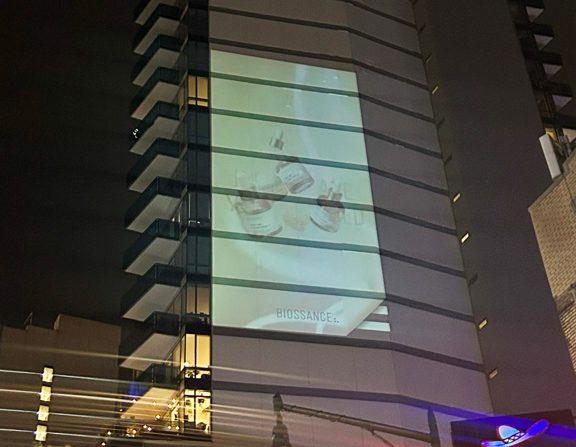
AGM’s experience across all these campaign categories — demonstrated through work with clients including Biossance, The Weeknd, the Women’s March, and Reproductive Freedom for All — informs every Seattle campaign brief. Understanding which district works for which campaign type, which wall surfaces perform under real nighttime conditions, and which content formats generate the most organic documentation is knowledge that comes from repeated execution in the market, not from a database of theoretical placements.
Coverage & Estimated Impressions
| Zone / Area | Peak Hours | Foot Traffic | Est. Nightly Impressions | Best For |
|---|---|---|---|---|
| Capitol Hill Arts and Entertainment District | 9PM–2AM | Very High | 25,000–120,000 | Product Launch |
| South Lake Union Tech and Entertainment Corridor | 9PM–2AM | Very High | 25,000–120,000 | Event Promotion |
| Pioneer Square Arts District | 9PM–2AM | Very High | 25,000–120,000 | Brand Awareness |
| Belltown Entertainment Zone | 9PM–2AM | Very High | 25,000–120,000 | Political |
| SoDo Warehouse District | 9PM–2AM | Very High | 25,000–120,000 | Sports |
Frequently Asked Questions
Capitol Hill is the highest-demand location in Seattle for guerrilla projections, offering the best combination of nighttime foot traffic, audience receptivity, and wall inventory. Pioneer Square works well for campaigns that benefit from a historic arts-district backdrop. The SoDo warehouse corridor delivers the largest blank wall surfaces in the city. South Lake Union targets tech-sector audiences. Fremont and Belltown round out the market for brands seeking specific neighborhood aesthetic and demographic profiles.
AGM manages all permit research, city outreach, and property owner coordination as part of the pre-campaign scouting phase. Some Seattle locations require temporary use agreements with the City of Seattle; others require written permission from building owners for private-property access. The specific requirements depend on the target location and the nature of the campaign setup. AGM presents clients with a scouted list of viable locations along with a clear picture of the permit or access requirements for each one before any commitment is made.
Yes. Entertainment release campaigns are one of the most common and highest-performing formats for Seattle projection advertising. The city’s music-engaged consumer base and Capitol Hill’s overnight pedestrian density create ideal conditions for release-aligned campaigns. AGM can typically mobilize a Seattle campaign within two to three weeks of booking confirmation, which accommodates most entertainment release calendar windows.
The AGM crew typically arrives 90 minutes before the planned projection start to allow for equipment deployment, positioning, and test-image calibration. Physical equipment setup — projector, generator, electronics, mobility unit — runs 45–75 minutes depending on site-specific conditions. First image on the wall typically occurs within 90 minutes of crew arrival at the deployment position.
Image size is determined by the throw distance between projector and wall and the physical dimensions of the target surface. On SoDo warehouse walls at maximum throw distance, AGM’s 20K-lumen system can produce images exceeding 60 feet in height. On Capitol Hill’s more constrained building faces, images typically run 20–40 feet in height. AGM specifies image dimensions for each confirmed surface during the pre-campaign scouting phase.
Pioneer Square is a historic district, and some buildings may have preservation restrictions on exterior modifications. Projection campaigns — which leave no physical mark on building surfaces — are generally compatible with historic district guidelines, but AGM confirms applicable restrictions during the scouting and permit phase for each Pioneer Square location. The district’s brick surfaces also require the full 20K-lumen output for maximum image saturation, which AGM’s system delivers by default.
Capitol Hill’s nighttime pedestrian density is one of its primary campaign assets. High foot traffic means that a projection running for four hours on a Capitol Hill wall will be encountered by a large cumulative audience — and that a meaningful fraction of that audience will document the projection with smartphones and share the footage organically. AGM’s campaign experience consistently shows that Capitol Hill activations generate higher organic documentation rates per projector-hour than any other Seattle district.
Multi-night Seattle campaigns are priced at contact us for a quote. across all nights of the engagement. A two-night, one-projector campaign runs Contact us for a custom quote. total for projection operations; a two-night, two-projector campaign runs contact us for pricing. Scouting, permitted location costs, and production fees are separate line items. AGM provides a full cost summary before any campaign commitment is finalized.
Yes. AGM’s documentation team captures shareable photo and video assets during every campaign night, and clients receive that content for social distribution. Campaigns can also be designed with social amplification in mind — building specific hashtags, account tags, or QR-adjacent design elements into the projected content to drive online engagement among pedestrians who encounter the installation. AGM advises on content design strategies that support social integration during the pre-campaign creative review.
AGM captures high-resolution photo and video documentation from multiple positions — ground level, elevated perspectives, and wide-angle captures that show the projection in context with the surrounding street environment — during every campaign night. All documentation is compiled into a post-campaign report delivered within five business days of the final campaign night. The report includes operational notes, audience observation context, and all raw media assets for client use.
AGM identifies and pre-qualifies backup wall options for every Seattle campaign during the advance scouting phase. If the primary surface becomes unavailable — due to a last-minute permit issue, unexpected construction, or other site change — the crew pivots to the backup location without requiring client intervention. Backup surfaces are scouted to the same standard as primary selections and are capable of delivering comparable campaign performance.
Many SoDo warehouse walls are available for projection campaigns, though availability depends on property ownership and any active building or tenant restrictions on exterior use. AGM’s scouting process identifies which SoDo surfaces are accessible for public-facing campaigns from the street right-of-way and which require property owner coordination. The district’s blank concrete and CMU surfaces are among the highest-performance projection surfaces in the Seattle market when correctly positioned.
More AGM Outdoor Advertising Services
Led Billboard Trucks
Mobile LED displays that bring your brand to any location, any event.

Fly Posting
Street-level poster saturation across walls, construction sites, and corridors.

Sidewalk Decals
Ground-level branded decals at pedestrian hotspots and event entrances.

Sidewalk Stencils
Creative stencil campaigns that put your brand in the path of pedestrians.