American Guerrilla Marketing
Nationwide Service
Media planning, media buying, billboard advertising, & guerrilla marketing
Guerrilla Projections in Wisconsin
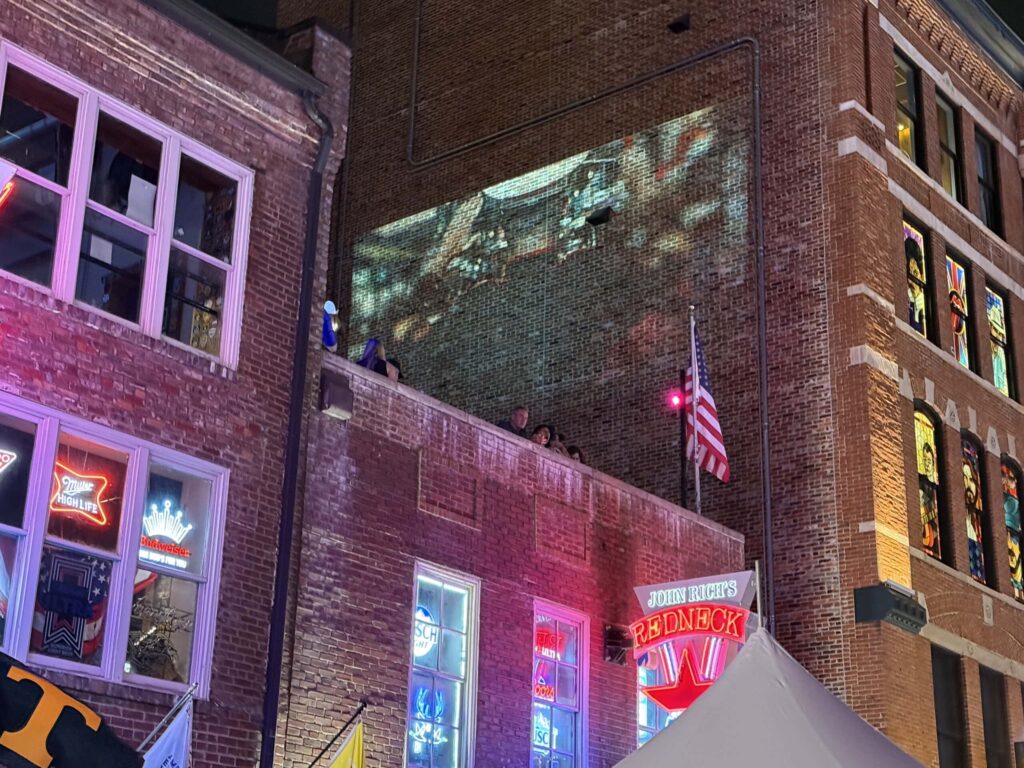
20,000-lumen building projection campaigns across Milwaukee, Madison, Green Bay, and Kenosha. Street-level brand impact that no billboard, banner, or digital ad can replicate.
Wisconsin is a state built for large-scale visual advertising. Its warehouse districts hold multi-story flat facades painted in light tones. Its stadium corridors pack tens of thousands of pedestrians into a half-mile radius on event nights. Its university town features a walkable corridor that connects two of the state’s most significant civic landmarks and draws a dense, socially active foot-traffic pattern seven days a week. These aren’t convenient coincidences — they’re the structural conditions that make guerrilla projection advertising work here at a level that most markets can’t match.
American Guerrilla Marketing deploys 20,000-lumen commercial projection systems on building facades across Wisconsin. AGM’s national scouting team identifies locations using both digital research and physical on-the-ground scouting — evaluating surface quality, pedestrian flow, sightlines, and power access before committing to any site. Every campaign is executed by AGM’s own two-person technical crew. There are no subcontractors in the field. The people operating the equipment are the same people who scouted the location and planned the deployment. That continuity shows in the result.
Wisconsin clients come from a broad range of sectors: sports and entertainment brands activating around Lambeau Field, consumer product companies launching in Milwaukee’s walkable arts districts, advocacy organizations targeting Madison’s civic audience, and entertainment labels targeting the college demographic that fills State Street on any given Friday night. What they share is an understanding that the right projection at the right location on the right surface produces a kind of brand impact that paid digital and static outdoor simply cannot replicate — because it surprises people in public space, and surprised people document what they see.
AGM’s Wisconsin projection capabilities cover the four major markets detailed below. Each market has its own geography, its own building stock, and its own audience profile. Each also has distinct seasonal patterns that affect when and where campaigns are most effective. The following overview covers the major markets, the physical conditions that make them work for projection advertising, and the strategic considerations that separate a strong campaign from a forgettable one.
Put Your Brand on Wisconsin's Best Building Walls
20,000-lumen projection campaigns from contact us for pricing. AGM's own crew. Real locations. Real audiences in Milwaukee, Madison, Green Bay, and Kenosha.
Wisconsin's Four Major Projection Markets
AGM’s national scouting team has evaluated all four of Wisconsin’s primary markets for projection suitability. Each delivers a different kind of audience and a different physical environment. Here’s how they break down.
Milwaukee — Warehouse Districts and Urban Nightlife Corridors
Milwaukee’s Historic Third Ward and Walker’s Point neighborhoods are the core of AGM’s Wisconsin projection operations. Both districts are former industrial zones whose conversion to arts, dining, and nightlife has left behind an inventory of multi-story warehouse facades — large, flat, light-painted, and minimally interrupted by windows above street level. These surfaces reflect a 20,000-lumen system with exceptional fidelity at distances of 80 to 150 feet, and they sit directly alongside some of the city’s highest foot-traffic pedestrian zones. Walker’s Point specifically anchors Milwaukee’s arts and LGBTQ+ nightlife community, producing a socially active audience that tends to document and share what they encounter in public space. For product launches, entertainment releases, and brand activations, Milwaukee’s warehouse stock and nightlife corridors represent the strongest projection environment in the state.
Madison — State Street and the Capitol Corridor
Madison’s State Street runs between the Wisconsin State Capitol and the University of Wisconsin–Madison campus — a half-mile strip flanked by outdoor dining, independent retail, advocacy organizations, and nightlife venues. Building walls throughout the corridor include smooth painted masonry and EIFS-clad commercial structures well-suited to outdoor projection. The corridor’s pedestrian density during peak evening hours is among the highest of any street in the Midwest outside Chicago, and the audience mix — students, state workers, faculty, residents, and visitors — spans an unusually wide demographic range. For campaigns with advocacy or civic messaging, the proximity to the Capitol gives projection advertising a contextual resonance that amplifies the content. For entertainment and consumer brands, the sheer density of the evening crowd makes State Street one of the most cost-efficient audience-per-impression environments in Wisconsin.
Green Bay — Lambeau Field Perimeter and Sports Market
Green Bay’s projection market is defined by Lambeau Field and its gravitational effect on foot traffic. On game days and major event nights, the streets and parking zones surrounding the stadium carry tens of thousands of people moving on foot — a concentrated, emotionally activated audience moving through a defined geographic zone over a predictable multi-hour window. The Titletown District development west of the stadium has added restaurants, bars, and entertainment venues that extend the pedestrian zone and create a commercial corridor specifically designed to capture pre- and post-game traffic. Downtown Green Bay’s Broadway arts district offers a secondary projection environment with a smaller but consistent evening foot traffic pattern tied to the city’s arts and restaurant community. For sports brands, consumer products, and entertainment campaigns targeting a passionate Midwest audience, Green Bay produces a concentration of qualified impressions within a tight footprint.
Kenosha — Lake Michigan Lakefront and Regional Crossroads
Kenosha’s geographic position between Chicago and Milwaukee gives its lakefront zone a draw that extends well beyond the city’s own population base. The lakefront entertainment area along Lake Michigan attracts visitors from both metro areas, particularly during summer evenings when outdoor activity peaks. The city’s downtown arts corridor along 52nd Street and the area surrounding the Kenosha Art Association provide additional projection environments with solid building stock and a growing evening foot traffic pattern tied to the city’s arts community. Kenosha’s commercial buildings along the lakefront and downtown include painted brick and smooth-surface masonry structures well-suited to projection at moderate throw distances. For regional brands and campaigns targeting a dual-metro audience without the logistics cost of Milwaukee or Chicago, Kenosha provides genuine visibility at a price point that fits activation budgets more tightly than the larger markets.
Surface Selection And Wall Evaluation Across Wisconsin
The quality of a guerrilla projection campaign depends as much on where the image lands as on what the image shows. AGM’s national scouting team evaluates every candidate surface before a campaign is confirmed — looking at a specific set of physical characteristics that determine whether a wall will hold a clean, brilliant image or absorb lumens and scatter light.
Surface color is the first filter. Light-colored walls — white, off-white, light grey, or pale painted concrete — reflect a 20,000-lumen projection system efficiently, producing vivid color and strong contrast. Dark brick, unfinished stone, and unpainted masonry absorb significant percentages of that light output, resulting in a washed-out image that loses impact at viewing distance. Milwaukee’s painted warehouse facades and Madison’s EIFS-clad commercial buildings represent the highest-quality surface types in the Wisconsin market. Smooth, flat surface texture is the second factor: rough brick scatters light and softens edge definition in the projected image, while smooth concrete, plaster, and stucco produce clean, sharp images at large sizes.
Window density and architectural interruption are evaluated on each surface because windows — both transparent and reflective — interrupt the projected field. The ideal surfaces for large-format projection are those with expansive uninterrupted face area: end walls of warehouse buildings, blank side elevations of commercial structures, and parking garage end-walls. Wisconsin’s industrial building stock in Milwaukee’s warehouse districts and Kenosha’s downtown commercial zone provides exactly this kind of surface. Madison’s State Street buildings tend toward narrower façades but include multi-story walls with minimal window interruption in the upper sections.
Projector-to-wall geometry determines image size and brightness. AGM’s 20,000-lumen systems are positioned between 50 and 200 feet from the target surface — at 100 feet, the projection can fill a two-to-three-story building face with a bright, sharp image. The scouting team evaluates each site for available projection positions: accessible ground locations, power access, and clear sightlines between projector and wall without obstructions. Every confirmed location in Wisconsin has been assessed for all three of these geometry factors before the campaign date.
Plan Your Guerrilla Projection Campaign in Wisconsin
Tell us about your campaign goals, target audience, and preferred locations. Our team will help you plan a high-impact guerrilla projection campaign tailored to your needs.
Award Winning Personalized Service
You will get thoughtful, devoted, and individualized attention from our experienced, qualified, and professional personnel. Being one of the most illustrious agencies in Brooklyn, New York, American Guerrilla Marketing has been awarded the Best of Brooklyn title.
Nationwide
Industry City, Brooklyn, New York 11232
American Guerrilla Marketing
Hours
Mon - Fri: 9 AM - 5 PM
Sat & Sun: Closed
Automate your campaign with AGM’s Request for Proposal Builder.
Automate your campaign with AGM’s Request for Proposal Builder. Simply answer a few quick questions about your campaign goals, markets, and timeline, and the system will generate a tailored presentation with recommended strategies, quantities, and pricing. Click the RFP Builder to instantly receive your customized proposal.
Campaign Formats That Work in Wisconsin Markets
Static Brand Campaign
A single bold image — logo, product visual, campaign headline, or brand graphic — projected and held on the wall for the full campaign run. Maximum legibility from distance, maximum simplicity of production, and maximum clarity of message. Works well in high-traffic zones where brevity and impact matter more than narrative. Milwaukee’s warehouse walls and Green Bay’s stadium perimeter are natural fits for static campaigns.
Looping Motion Campaign
A short animated sequence — typically 10 to 30 seconds — projected on repeat throughout the campaign night. Motion attracts peripheral vision at greater distances than still images, pulling people’s attention toward the wall from further down the block. Ideal for entertainment releases, product reveals with motion components, and brand narratives that benefit from sequence. Madison’s pedestrian corridor and Milwaukee’s nightlife zones support this format well.
Event-Adjacent Activation
Projection campaigns timed around a specific event — a Packers game, a concert, a festival night, a political gathering — that provides the foot traffic while the projection provides the branded moment. The event elevates the emotional state of the audience; the projection intercepts that energy with a brand message. Green Bay’s game-day pedestrian environment and Madison’s recurring Capitol Square events both support this format at high volume.
Multi-Market Statewide Rollout
Simultaneous or consecutive deployments across multiple Wisconsin markets — Milwaukee and Madison on the same night, or a rolling campaign that moves through Green Bay, Milwaukee, Madison, and Kenosha across four evenings. Each market uses its own dedicated projector, crew, and scouted location. AGM coordinates logistics across all markets. Statewide rollouts suit advocacy campaigns with geographic reach requirements, entertainment releases targeting multiple demographic segments, and brand launches timed to a specific moment.
Case Studies: Proven Formats In Comparable Markets
AGM’s projection portfolio includes work across sports, entertainment, advocacy, and consumer products. Two campaigns offer particularly clear templates for the Wisconsin market.
Mizzou × Cotton Bowl — Arlington, TX
When University of Missouri athletics needed to build awareness and energy around its Cotton Bowl appearance, AGM deployed building projection advertising in the stadium perimeter zone surrounding the game venue. The campaign targeted the dense pedestrian traffic pattern that forms in the hours surrounding a major bowl game — tens of thousands of fans moving on foot through a defined geographic area, already emotionally activated by the event. The projection intercepted that traffic and delivered a branded impression within the peak energy window of the event. The Cotton Bowl deployment is a direct precursor to what AGM can execute around Lambeau Field in Green Bay — the same pedestrian density pattern, the same geographic concentration, the same window of elevated audience engagement. Wisconsin sports brands and event sponsors have a proven format to draw from.
The Weeknd × YouTube — New York City
For a music release countdown campaign tied to The Weeknd and YouTube, AGM used building projection to transform a city block into a branded entertainment moment. The projection drove organic audience documentation — passersby photographing and videoing the image and sharing it across social platforms — extending the campaign’s reach far beyond the immediate physical audience. The campaign is a template for how entertainment and media brands can use projection to generate earned-media reach in markets where a walkable, smartphone-active evening audience already exists. Milwaukee’s Walker’s Point and Madison’s State Street carry exactly this audience profile on peak evenings, making both markets viable for the same format that powered the Weeknd campaign’s street-level reach.
Projection Campaign Investment in Wisconsin
Guerrilla projection campaigns across Wisconsin are priced at contact us for a quote. . That investment covers the 20,000-lumen commercial projector, generator and complete power solution, electronics bundle, mobility unit, and AGM’s own two-person technical crew for setup, full-duration operation, and breakdown. No subcontractors. No surprise add-ons for crew or power. The campaign runs from dusk through a typical four-to-six-hour window, and multi-night deployments are available in all Wisconsin markets.
Location scouting — advance physical scouting by AGM’s national team in a specific Wisconsin market — is available at approximately contact us for a quote. Campaigns requiring permitted locations or private-property building agreements carry location fees of Contact us for a custom quote. per night, depending on the specific property and market. AGM’s GPS-documented reporting system records precise deployment data, timestamps, and site documentation for every campaign — delivered post-campaign for client review and internal reporting purposes.
Who Runs Guerrilla Projection Campaigns in Wisconsin
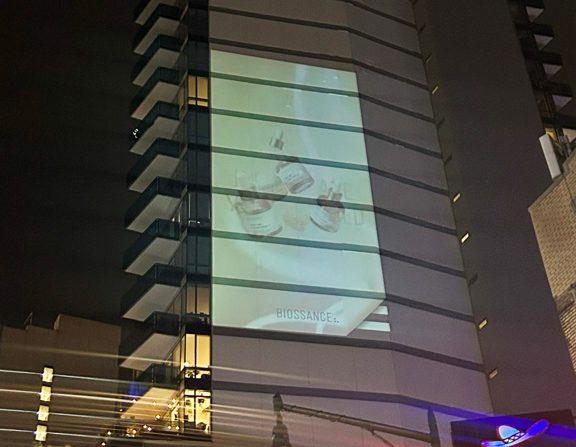
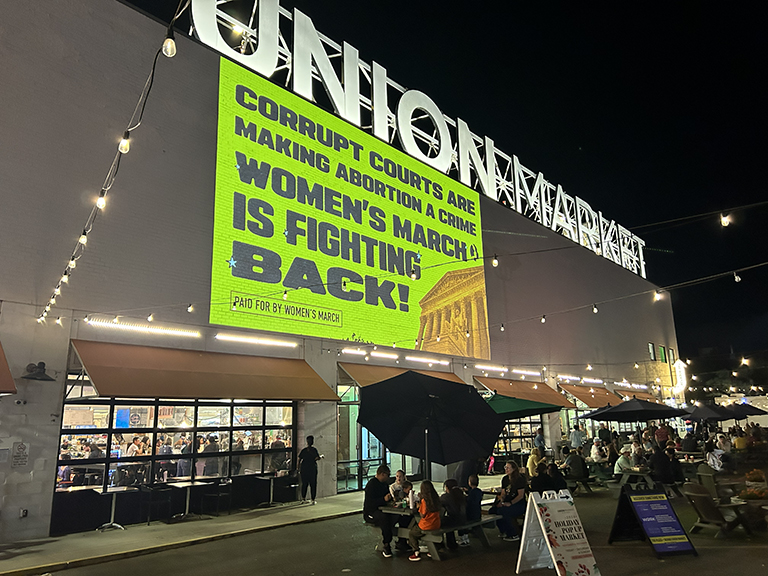
Wisconsin projection advertising clients represent a cross-section of industries that benefit from high-visibility street-level moments. Sports brands and event sponsors activate around Lambeau Field and stadium-adjacent zones in Green Bay. Entertainment labels and streaming platforms target Madison’s college demographic and Milwaukee’s arts-active nightlife audience. Consumer brands use Milwaukee’s warehouse district for product launch visibility in a market that responds to visual novelty. Advocacy organizations — reproductive rights groups, environmental campaigns, civic causes — use Madison’s State Street for messaging at the intersection of student, civic, and political audiences. Hospitality, food and beverage, and retail clients activate around grand openings and seasonal campaigns in markets where building space and foot traffic align. AGM has served clients including Biossance, The Weeknd, YouTube, the US Marine Corps, the Women’s March, and Reproductive Freedom for All — and that same strategic infrastructure serves Wisconsin campaigns at every scale.
AGM’s projection client roster includes Netflix, Disney, Coca-Cola, FanDuel, Live Nation, iHeartRadio, and the US Marine Corps. A confirmed case study: the US Marine Corps × CMA Fest Nashville — multi-night projections onto architectural surfaces throughout the festival footprint, reaching 80,000+ attendees across the campaign window. Projection advertising scales across every brand category; what our campaigns share is scale, precision, and a physical presence digital cannot replicate.
Coverage & Estimated Impressions
| Zone / Area | Peak Hours | Foot Traffic | Est. Nightly Impressions | Best For |
|---|---|---|---|---|
| Milwaukee | 8PM–12AM | Moderate | 2,500–12,000 | Product Launch |
| Madison | 8PM–12AM | Moderate | 2,500–12,000 | Event Promotion |
| Green Bay | 8PM–12AM | Moderate | 2,500–12,000 | Brand Awareness |
| Kenosha | 8PM–12AM | Moderate | 2,500–12,000 | Political |
Frequently Asked Questions
Wisconsin projection clients span sports brands, entertainment labels, consumer product companies, advocacy organizations, hospitality brands, and local businesses running grand-opening or seasonal campaigns. The state’s mix of sports culture (centered on Green Bay), college markets (Madison), and walkable arts districts (Milwaukee) makes it accessible for a wide range of campaign types and audience objectives. AGM’s client history — including The Weeknd, YouTube, Biossance, the US Marine Corps, the Women’s March, and Reproductive Freedom for All — demonstrates the range of use cases the projection format supports.
Outdoor pedestrian activity peaks in Wisconsin during summer months — June through August — when festivals, lakefront activity, and outdoor dining drive evening foot traffic across all four major markets. Green Bay has a distinct fall spike tied directly to the NFL regular season, when Lambeau-adjacent pedestrian density on game nights can exceed summer baseline numbers. Madison’s State Street maintains strong year-round foot traffic anchored to the UW academic calendar, with the heaviest activity running from September through May. Winter campaigns are viable in sheltered or indoor-adjacent environments in all markets. AGM advises clients on the optimal seasonal timing for each market based on campaign objectives and target audience profiles.
Permitting requirements vary by municipality and by specific location within each city. AGM’s team navigates these requirements as part of campaign planning. Some campaigns are deployed in guerrilla public-space configurations that do not require advance permitting. Others — particularly campaigns on private property or in locations where the local municipality requires approval — involve direct engagement with property owners and local authorities. Permitted or private-property location fees range from Contact us for a custom quote. per night, depending on the building and market. AGM’s national scouting team identifies the most practical approach for each campaign’s specific objectives.
Yes. AGM coordinates multi-market Wisconsin deployments — Milwaukee and Madison simultaneously, or a three-city campaign covering Milwaukee, Madison, and Green Bay on consecutive evenings. Each market requires its own projection unit, technical crew, and scouted location, and each is priced at contact us for a quote. Multi-market deployments suit advocacy campaigns with statewide geographic reach objectives, entertainment releases targeting more than one demographic segment, and brand activations timed to a specific statewide cultural or political moment.
For event-adjacent campaigns tied to Packers games, major concerts, or festival dates, AGM recommends four to six weeks of lead time to accommodate location scouting, any necessary permitting, and logistics coordination. For standard market campaigns without a specific event anchor, two to four weeks of lead time is typically sufficient. Advance scouting — when purchased — is conducted in the weeks preceding the campaign date. Earlier booking gives AGM’s scouting team more time to evaluate candidate surfaces and identify the strongest location for your specific campaign objective.
AGM’s 20,000-lumen commercial projectors deliver broadcast-grade image quality with high resolution, full color saturation, and consistent brightness across a large building face. At 100 feet of throw distance, the projection can cover a two-to-three-story facade. Image quality is also surface-dependent: a smooth, light-colored wall will reflect significantly more of the projected light than a rough or dark surface. AGM’s scouting team selects surfaces specifically to maximize visual output from the 20,000-lumen system — ensuring the image reads cleanly from pedestrian viewing distances of 25 to 100 feet or more.
Light rain generally does not halt a campaign — AGM’s equipment is designed for outdoor deployment and the crew is trained to operate in variable weather conditions. Heavy rain, sustained high winds, or severe weather will prompt a safety suspension of operations. Wisconsin’s spring and fall weather can be unpredictable, and AGM’s crew makes real-time decisions based on conditions at the deployment site. Campaigns significantly impacted by weather are documented, and AGM works with clients on rescheduling or makeup options when conditions prevent a full campaign run.
Before a campaign runs, AGM’s scouting team evaluates each candidate location using GPS coordinates, site photography, and analysis of foot traffic patterns, surface quality, sightlines, and power access. This documentation travels with the campaign and becomes part of the post-campaign report delivered to the client. GPS-documented reporting gives clients a precise record of where the campaign ran, for how long, and under what site conditions — serving as proof-of-placement documentation for internal performance review, press materials, and client reporting.
Static billboard advertising in Wisconsin builds frequency over extended periods at fixed locations. Guerrilla projection advertising creates concentrated impact — a single high-energy moment at a specific location during a specific window. Projection campaigns generate organic social media documentation at rates that static outdoor rarely approaches, because the visual surprise of a large building projection creates an impulse to photograph and share. The two formats serve different objectives: billboards build awareness over time through repetition; projections generate moments. Many Wisconsin clients use both formats — billboards for sustained frequency, projection for a launch spike or event-adjacent moment of maximum energy.
AGM’s post-campaign report includes GPS-documented location data, deployment timestamps, crew deployment records, and photography or video documentation from the campaign run. Multi-market campaigns receive per-market breakdowns within a single consolidated report. The report is delivered digitally and formatted for internal presentation, agency reporting, and press use. Some clients incorporate campaign documentation directly into earned-media pitches or social media content — the visual evidence of a large projection on a major building face is itself a content asset.
AGM’s primary scope covers physical deployment: scouting, logistics, equipment, and on-site technical crew. Clients typically supply finished creative assets formatted for projection at the correct resolution and aspect ratio. AGM’s team advises on what creative formats perform best at specific locations and on specific surface types — wide-format horizontal graphics read differently than tall portrait images, and animated content requires different pacing considerations than static campaigns. AGM can connect clients with trusted creative partners when content development is needed. Final assets must be delivered before the campaign date in the correct format.
More AGM Outdoor Advertising Services
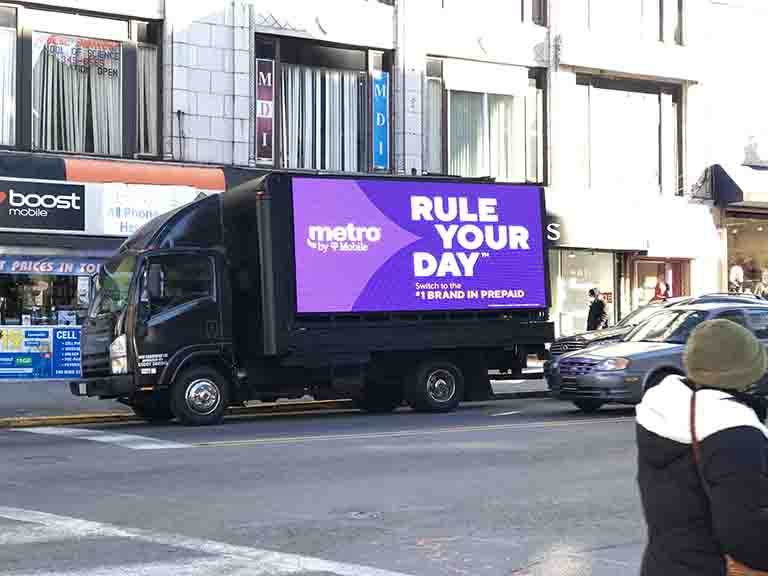
Led Billboard Trucks
Mobile LED displays that bring your brand to any location, any event.
Fly Posting
Street-level poster saturation across walls, construction sites, and corridors.

Sidewalk Decals
Ground-level branded decals at pedestrian hotspots and event entrances.

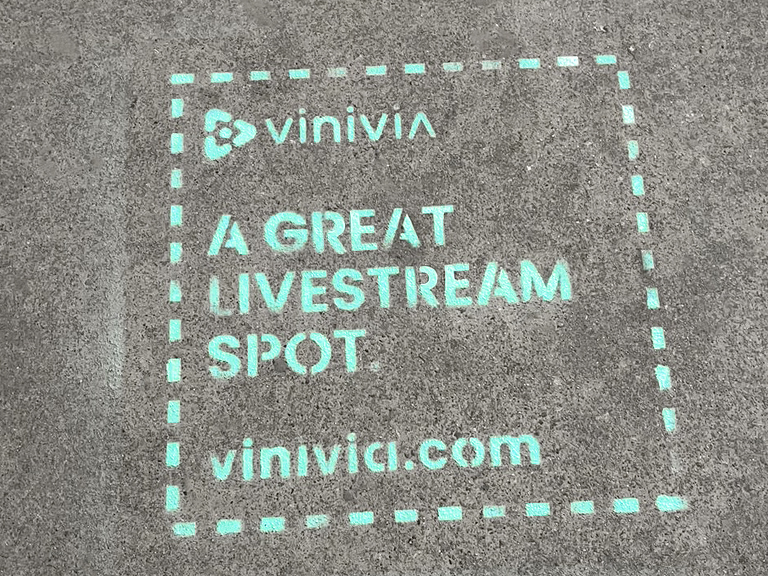
Sidewalk Stencils
Creative stencil campaigns that put your brand in the path of pedestrians.