American Guerrilla Marketing
Nationwide Service
Media planning, media buying, billboard advertising, & guerrilla marketing
Guerrilla Projections in West Virginia
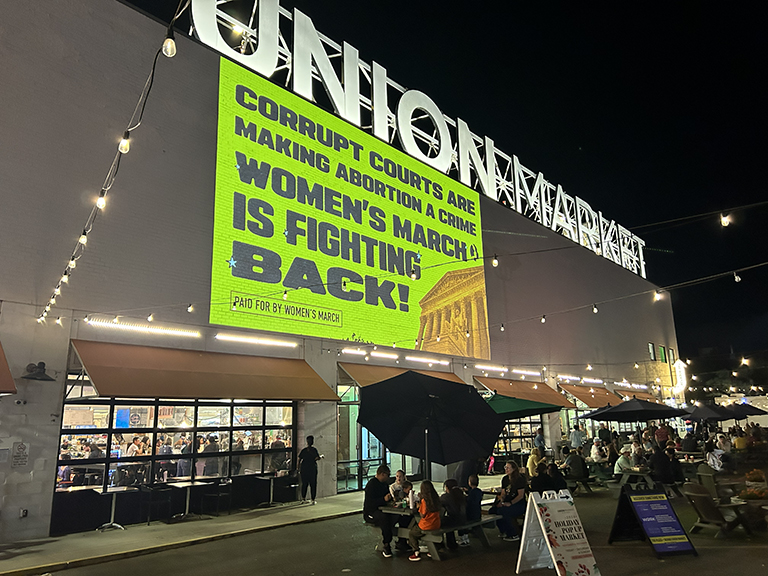
West Virginia’s state capital, university corridors, river city downtown cores, and post-industrial building landscape create a compelling environment for building projection campaigns that reach engaged audiences across the Mountain State.
West Virginia’s Projection Advertising Markets
West Virginia is one of the most strategically underutilized states for guerrilla projection advertising in the eastern United States. The state’s four primary urban markets — Charleston, Huntington, Morgantown, and Parkersburg — each contain the combination of blank building surfaces, nighttime pedestrian corridors, and engaged audiences that projection campaigns require, yet none of these markets has yet been saturated with the format. That novelty gap represents a significant strategic opportunity for brands, advocacy organizations, and entertainment campaigns willing to be among the first to deploy large-scale building projection in these markets.
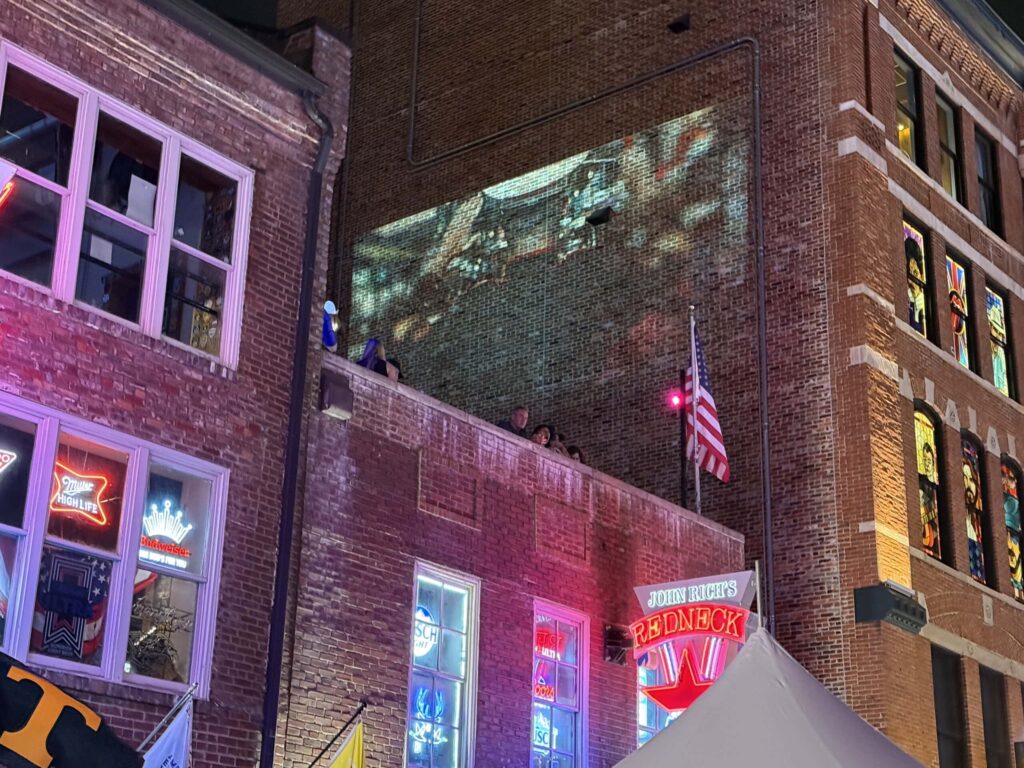
AGM’s projection client roster includes Netflix, Disney, Coca-Cola, FanDuel, Live Nation, iHeartRadio, and the US Marine Corps. A confirmed case study: the US Marine Corps × CMA Fest Nashville — multi-night projections onto architectural surfaces throughout the festival footprint, reaching 80,000+ attendees across the campaign window. Projection advertising scales across every brand category; what our campaigns share is scale, precision, and a physical presence digital cannot replicate.
Past AGM projection clients include Coca-Cola, Live Nation, and iHeartRadio, with multi-night campaigns that generated earned media coverage and massive organic social sharing.
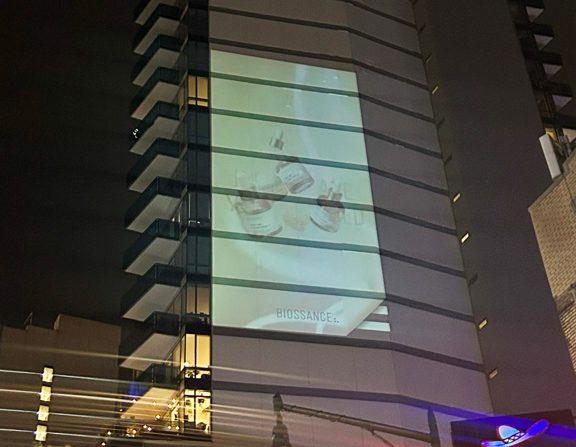
West Virginia’s physical character — shaped by generations of industrial development along its rivers and valleys — has left a built environment rich in exactly the kinds of building surfaces that projection advertising maximizes. Former manufacturing facilities, river-city commercial warehouses, and mid-century downtown commercial buildings across the state present flat, large-format wall faces that a 20,000-lumen commercial projection system can activate with vivid, high-impact imagery. The state’s post-industrial landscape, often discussed in terms of economic transition, translates directly into projection advertising opportunity: building stock that was built for industrial scale, not commercial visual complexity, produces the blank wall inventory that smaller commercial building formats cannot match.
The Women’s March campaign in Washington, DC showed the power of building projection to mobilize public attention and generate national media coverage for an advocacy cause — a model that translates directly to West Virginia’s political geography. Charleston, as the state capital, sits at the intersection of policy advocacy and public audience in ways that few cities outside of Washington can match. A projection on Capitol Street during a legislative session reaches an audience of lawmakers, lobbyists, journalists, and politically engaged citizens in a single concentrated deployment that no traditional media placement can replicate at the same cost-per-impact ratio.
Morgantown’s West Virginia University campus population brings more than 28,000 students into the city’s downtown corridor — a concentrated, socially active, documentation-prone audience that transforms a High Street projection campaign into an organic social media event before the crew has completed its first operating hour. Huntington’s Pullman Square pedestrian zone delivers concentrated outdoor dining and entertainment audiences in a compact, well-lit public space that generates high per-pedestrian engagement for campaigns positioned along its building perimeter. Parkersburg’s Mid-Ohio Valley location and its river city heritage provide a market anchor for the western edge of the state whose commercial building stock is rich with projection-viable surfaces in the downtown corridor.
American Guerrilla Marketing brings its full national projection infrastructure to West Virginia campaigns — 20,000-lumen commercial projection system, direct two-person technical crew, physical advance scouting, and GPS-documented location analysis and post-campaign reporting. The agency’s track record with national advocacy clients, entertainment brands, and consumer goods campaigns provides every West Virginia client with strategic context that purely local operators cannot offer.
Activate West Virginia's Most Impactful Walls
From Charleston's Capitol Street to Morgantown's High Street, AGM deploys 20,000-lumen projection campaigns across West Virginia's highest-value urban corridors. Let's build your Mountain State campaign.
Browse Cities in West Virginia
Select a city to explore Guerrilla Projections opportunities.
Charleston, Huntington, Morgantown, And Parkersburg
Each of West Virginia’s four primary projection markets offers a distinct strategic position that shapes which campaign types perform best in each city.
Charleston is West Virginia’s capital city and its most politically significant projection advertising market. The combination of Capitol Street’s state government adjacency and the East End arts district’s cultural engagement creates two distinct campaign environments within a single metro — one oriented toward civic and advocacy messaging that reaches the policy audience concentrated in the capital corridor, and one oriented toward cultural and entertainment campaigns that reach the arts and nightlife community of the East End. Charleston’s Clay Center for the Arts and Sciences anchors a broader cultural campus whose evening audience is a natural target for cultural and institutional projection campaigns.
Huntington is a riverfront city anchored by Marshall University and the Tri-State regional economy, and its projection advertising environment is shaped by the interplay between the university community and the downtown entertainment district. Pullman Square’s outdoor pedestrian zone — a rare genuinely car-free public space in West Virginia’s urban landscape — delivers the kind of concentrated, accessible audience that projection advertising converts into organic social reach most efficiently. The 4th Avenue arts corridor and the blocks adjacent to Marshall’s campus extend the market’s viable campaign zones beyond the immediate Pullman Square footprint.
Morgantown is West Virginia’s most dynamically active projection advertising market, driven by the WVU population’s combination of density, youth, social media engagement, and concentration in the High Street corridor. A projection campaign running on High Street during an active semester week encounters an audience of thousands of pedestrians within its operating window — an audience with smartphones in hand, social networks active, and a cultural appetite for visually engaging public experiences. The Metropolitan Theatre area and the McQuain Amphitheatre zone extend the market beyond High Street into arts-engaged and outdoor-gathering-oriented audience segments.
Parkersburg anchors West Virginia’s mid-Ohio Valley and serves as the commercial hub for a regional economy that includes portions of southeast Ohio as well as West Virginia’s western counties. The city’s downtown corridor along Market Street, Henderson Hall, and the Grand Central area presents older commercial building stock with substantial blank wall inventory that projection campaigns can activate with minimal permit complexity. The city’s river heritage and its position as a regional commercial center make it a natural market for brands building presence in the mid-Ohio Valley.
The Appalachian Building Landscape And Projection Surface Opportunity
West Virginia’s built environment reflects the architectural patterns of Appalachian industrial development: river-city commercial districts built dense and vertical to maximize frontage along natural trade corridors, surrounded by industrial and warehousing infrastructure that served the extractive economy of the 19th and early 20th centuries. That historical pattern left a physical legacy of building types that are exactly what projection advertising requires — large-footprint structures built for practical use rather than architectural expression, with exterior walls that are flat, minimal in fenestration, and frequently blank across substantial surface areas.
The specific surface characteristics across West Virginia’s four markets vary by district and by the building era represented in each zone. Downtown Charleston’s Capitol Street area includes both early-20th-century commercial masonry and mid-century government-adjacent office construction, presenting a range of surface textures from painted brick to smooth concrete. Huntington’s Pullman Square and 4th Avenue offer commercial building faces that have been maintained through the corridor’s ongoing revitalization, with surface conditions that include painted masonry and newer stucco finishes on renovated facades. Morgantown’s High Street presents a dense mixed inventory of commercial building types serving the retail and entertainment economy of a major university town — brick, concrete, and painted CMU block in various states of surface finish. Parkersburg’s downtown corridor offers older commercial masonry with substantial blank sections that have not been covered by later signage installations.
In every West Virginia market, AGM’s physical scouting process prioritizes surfaces with painted or plaster finishes over unpainted brick, flat planar walls over curved or angled surfaces, and clear projector positioning options over locations where trees, utility lines, or other urban infrastructure create throw-path obstructions. The 20K-lumen system handles West Virginia’s urban surface conditions effectively, but starting from the highest-quality available surface in each district maximizes campaign output quality and organic documentation value.
Plan Your Guerrilla Projection Campaign in West Virginia
Tell us about your campaign goals, target audience, and preferred locations. Our team will help you plan a high-impact guerrilla projection campaign tailored to your needs.
Award Winning Personalized Service
You will get thoughtful, devoted, and individualized attention from our experienced, qualified, and professional personnel. Being one of the most illustrious agencies in Brooklyn, New York, American Guerrilla Marketing has been awarded the Best of Brooklyn title.
Nationwide
Industry City, Brooklyn, New York 11232
American Guerrilla Marketing
Hours
Mon - Fri: 9 AM - 5 PM
Sat & Sun: Closed
Automate your campaign with AGM’s Request for Proposal Builder.
Automate your campaign with AGM’s Request for Proposal Builder. Simply answer a few quick questions about your campaign goals, markets, and timeline, and the system will generate a tailored presentation with recommended strategies, quantities, and pricing. Click the RFP Builder to instantly receive your customized proposal.
Creative Opportunities Across West Virginia
Advocacy and Policy Campaigns
West Virginia’s capital city location makes Charleston the most powerful advocacy campaign platform in the state. When the Women’s March in Washington, DC used building projection to generate maximum public visibility for a national cause, the campaign demonstrated a model that Charleston’s Capitol Street replicates at the state legislative level. Campaigns targeting state legislators, their staff, and the political press corps concentrated in Charleston during session windows achieve impact at the policy audience level that no conventional media buy can match.
University and Student-Oriented Campaigns
Morgantown’s WVU population creates a consistently high-value target for entertainment brands, consumer goods campaigns, health awareness initiatives, and civic engagement efforts whose audience centers on the 18–24 demographic. High Street’s pedestrian density during the academic year makes it one of the most concentrated and documentation-active nighttime audiences in the entire eastern United States for its market size.
Entertainment and Cultural Releases
West Virginia’s entertainment market is underserved by large-scale out-of-home advertising, creating strong novelty premium for building projection campaigns tied to album drops, streaming platform activations, film releases, and cultural institution programming announcements. Entertainment campaigns in Morgantown and Huntington reach audiences whose social networks extend beyond the state’s borders through university connections, amplifying geographic reach well beyond West Virginia’s resident base.
Healthcare and Public Awareness Campaigns
West Virginia’s outsized public health challenges — substance use, cardiovascular disease, mental health access, and others — create a consistent demand for public awareness projection campaigns from healthcare organizations, state agencies, and nonprofit groups whose audiences are concentrated in the state’s urban corridors. The format’s visual scale and organic reach make it particularly effective for public health messages that need to break through media fatigue in communities accustomed to ignoring traditional advertising.
Running A Projection Campaign In West Virginia
West Virginia campaigns begin with the same pre-campaign scouting protocol AGM applies nationally: physical site visits to candidate locations in each target city, surface quality and dimension assessment, projector positioning analysis, and a review of permit and property requirements before any campaign is committed. For West Virginia’s four primary markets, physical scouting typically covers the highest-priority campaign zones in each city in a single scouting trip, given the manageable distances between Charleston, Huntington, and Parkersburg along the I-64 and US-35 corridors.
Permit requirements in West Virginia’s urban markets are generally less complex than in major coastal metros. Charleston’s city government, Morgantown’s permit office, and Huntington’s administration have all processed outdoor event and installation requests that create a usable precedent framework for projection campaign permits. AGM handles all permit research and outreach as part of the pre-campaign process, and in cases where private-property access to a specific building delivers superior surface quality or positioning, AGM manages property owner coordination as well.
Campaign night operations deploy the full 20K-lumen projection package — projector, generator, electronics bundle, mobility unit — from the pre-scouted position. Setup requires 45–75 minutes from crew arrival. West Virginia’s generally low urban ambient light in its river-city and arts-district corridors creates favorable projection contrast conditions, and the state’s four-season climate delivers strong summer and fall projection windows when evening temperatures and clear skies combine for optimal operating conditions. Documentation runs throughout each operating window, capturing projection imagery from multiple angles for post-campaign reporting.
Campaign Costs in West Virginia
Guerrilla projection campaigns in West Virginia are priced at contact us for a quote. . That rate includes the 20,000-lumen commercial projection system, generator and integrated power solution, electronics bundle, mobility unit, and a two-person AGM technical crew managing all phases of the campaign from setup through breakdown. Campaigns begin at dusk and run four to six continuous hours per night.
Advance location scouting for West Virginia markets is available at approximately Contact us for a custom quote. credited toward the campaign total for confirmed activations. Multi-city West Virginia campaigns — for example, a Charleston activation followed by a Morgantown deployment on consecutive nights — can share pre-campaign logistics to reduce overall scouting costs. Private-property or permitted location arrangements run Contact us for a custom quote. per night depending on the specific building and market.
Organizations That Activate In West Virginia
West Virginia’s projection advertising market draws advocacy organizations, healthcare institutions, university-affiliated campaigns, consumer brands, and entertainment campaigns that want to reach audiences in a state where large-scale building projection is genuinely novel. Advocacy groups targeting state legislative action use Charleston’s Capitol Street corridor to reach the political audience concentrated in the capital. Healthcare organizations and state agencies use Huntington and Morgantown’s pedestrian corridors for public awareness campaigns whose impact depends on visual scale and organic documentation reach. Entertainment labels and streaming platforms find in Morgantown’s WVU student population exactly the music- and media-engaged consumer demographic that makes entertainment projection campaigns generate their highest organic amplification rates. Consumer brands building regional presence in the mid-Ohio Valley use Parkersburg and Huntington campaigns to establish market visibility in a region whose residents are underserved by major-market advertising investment. AGM’s experience with national clients including Women’s March, WakeUp Coalition, and others informs every West Virginia campaign brief with strategic context drawn from national projection practice.
Coverage & Estimated Impressions
| Zone / Area | Peak Hours | Foot Traffic | Est. Nightly Impressions | Best For |
|---|---|---|---|---|
| Advocacy and Policy Campaigns | 8PM–12AM | Moderate | 2,500–12,000 | Product Launch |
| University and Student-Oriented Campaigns | 8PM–12AM | Moderate | 2,500–12,000 | Event Promotion |
| Entertainment and Cultural Releases | 8PM–12AM | Moderate | 2,500–12,000 | Brand Awareness |
| Healthcare and Public Awareness Campaigns | 8PM–12AM | Moderate | 2,500–12,000 | Political |
Frequently Asked Questions — Guerrilla Projections in West Virginia
All four of West Virginia’s primary urban markets offer viable projection advertising environments with distinct strategic profiles. Charleston is the state capital and the strongest market for advocacy and policy campaigns. Morgantown delivers the highest audience density and documentation rates, driven by the WVU student population on High Street. Huntington’s Pullman Square pedestrian zone offers exceptional pedestrian concentration for entertainment and consumer brand campaigns. Parkersburg serves the mid-Ohio Valley market with solid commercial building stock and accessible wall inventory.
Charleston’s position as West Virginia’s state capital concentrates a unique audience — legislators, lobbyists, state agency staff, political journalists, and advocacy organizations — in a compact downtown corridor during legislative session windows. Campaigns deployed on Capitol Street during session periods reach a policy audience that is effectively impossible to reach through conventional media at comparable cost-per-impact ratios. Advocacy organizations and issue campaigns find Charleston’s capital adjacency to be among their most valuable campaign variables in the state.
West Virginia’s projection market serves advocacy organizations, healthcare institutions, entertainment brands, university-affiliated campaigns, and consumer goods companies building regional presence. The state’s public health challenges create consistent demand from healthcare-sector clients; its capital city creates advocacy campaign demand; its university population creates entertainment and consumer brand demand; and its underserved outdoor advertising market creates brand awareness demand from regional and national companies seeking efficient reach in the mid-Appalachian consumer market.
West Virginia’s Appalachian geography has concentrated urban development in river valleys and along natural transportation corridors, producing compact urban cores with high building density along a limited footprint. That pattern creates river-city commercial districts — Charleston along the Kanawha, Huntington along the Ohio, Parkersburg at the confluence of the Ohio and Little Kanawha — where the building stock is tall relative to the street width and frequently presents blank side-wall and end-wall faces that serve projection campaigns well. The vertical character of West Virginia’s river-city building stock is a projection advertising asset.
Yes, significantly. None of West Virginia’s four primary urban markets has experienced saturation with large-scale building projection advertising, which means the novelty premium — the elevated organic documentation and social amplification that comes from audiences encountering the format for the first time — is available to brands and organizations willing to be among the first to deploy it. That novelty premium translates directly to higher per-campaign reach efficiency and stronger earned media follow-through than comparable campaigns in more projection-familiar markets.
West Virginia campaigns are priced at contact us for a quote. inclusive of the 20K-lumen projection system, generator, electronics bundle, mobility unit, and a two-person AGM technical crew. Advance location scouting is available for approximately contact us for a quote. Multi-city campaigns that combine Charleston, Huntington, Morgantown, or Parkersburg can share pre-campaign logistics to reduce total scouting costs across the engagement.
AGM’s national scouting team conducts physical, on-the-ground assessments in every West Virginia market where campaigns are planned. Team members physically walk target districts — Capitol Street in Charleston, High Street in Morgantown, Pullman Square and 4th Avenue in Huntington, Market Street and Henderson Hall in Parkersburg — to assess surface dimensions, texture, reflectivity, obstructions, and projector positioning options. Digital satellite and street-level review supplements but never replaces the physical site assessment.
Yes, with appropriate surface scouting. Smaller West Virginia communities along the major highway and river corridors — Beckley, Clarksburg, Martinsburg, Wheeling — have downtown commercial cores with older building stock that can support projection campaigns. The audience density is lower than in the four primary markets, but the novelty premium is even higher in communities with no previous exposure to building-scale projection advertising. AGM evaluates smaller-market viability on a campaign-by-campaign basis during the initial scouting phase.
West Virginia University’s enrollment of more than 28,000 students makes Morgantown’s High Street corridor one of the highest-density projection campaign environments in the state on a per-block-foot basis. The student population’s combination of social media engagement, nighttime activity in the High Street entertainment district, and geographic diversity — students from across West Virginia and neighboring states carry campaign documentation home to their own social networks — means that a Morgantown projection campaign’s organic reach extends well beyond the city itself.
West Virginia’s most productive projection windows are spring (March–May), early fall (September–October), and the pre-holiday window in November. Summer dusk arrives late, compressing the operating window, though June and July evenings still provide four to five hours of viable projection time. Winter campaigns are viable but require cold-weather equipment precautions. Morgantown campaigns benefit from the academic year calendar — scheduling activations when the WVU student population is on campus (September through April, excluding breaks) maximizes audience density in the High Street corridor.
Yes. West Virginia’s political environment means that some advocacy campaign topics — particularly those related to energy policy, labor, and reproductive rights — generate elevated local media interest when deployed publicly in the capital. That elevated interest is a strategic asset for campaigns that want earned media follow-through beyond their organic social documentation. AGM advises advocacy clients on the specific timing, location, and content variables that maximize both public visibility and earned media coverage for West Virginia advocacy projection campaigns.
Standard West Virginia campaigns operate four to six hours per night, beginning at dusk. Morgantown’s High Street campaigns often run toward the longer end of that window because the student-dominated nightlife audience remains active later than typical commercial district foot traffic. Charleston Capitol Street campaigns may be optimized for the earlier portion of the evening window when the policy audience is still present in downtown rather than the late-night entertainment demographic.
More AGM Outdoor Advertising Services
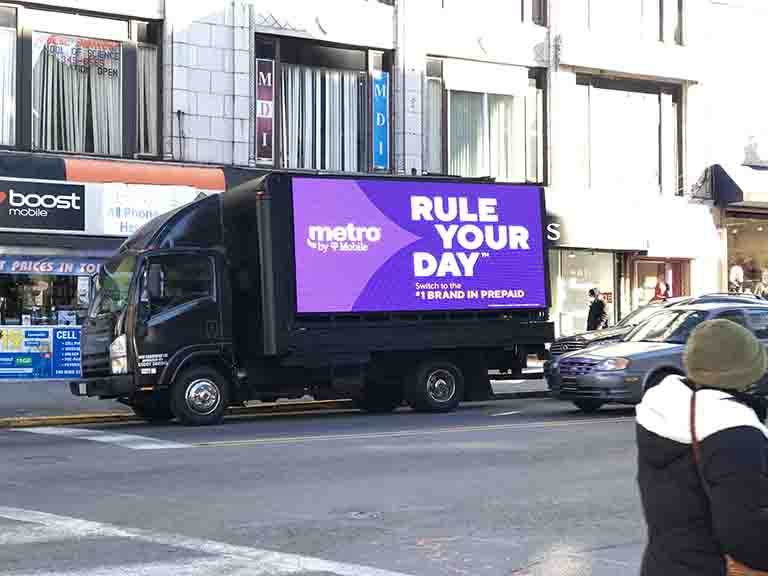
Led Billboard Trucks
Mobile LED displays that bring your brand to any location, any event.
Fly Posting
Street-level poster saturation across walls, construction sites, and corridors.

Sidewalk Decals
Ground-level branded decals at pedestrian hotspots and event entrances.

Sidewalk Stencils
Creative stencil campaigns that put your brand in the path of pedestrians.