
November 22, 2026
Mobile Projection Advertising Setup: A Field Guide
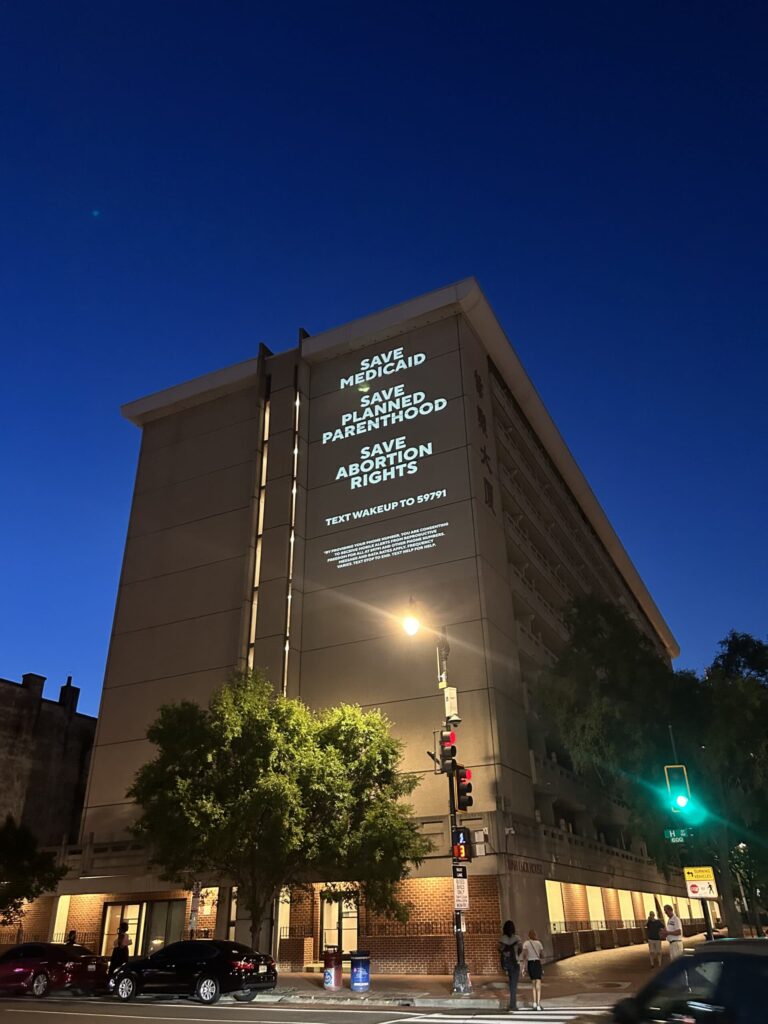
Most people who call us about mobile projection have already watched a video of a logo forty feet tall on the side of a building and decided they want that. Fair enough. It is a good-looking format.
What they have not seen is the ninety minutes before the image appeared, or the three site visits before that, or the conversation where somebody had to decide whether a loading dock door counted as part of the wall.
Mobile projection is a setup discipline. The projector is the least interesting part. The interesting part is throw distance, power, sightlines, surface colour, who owns the wall, and what the wind is doing at 11pm.
I have spent a lot of nights standing in a parking lot with a laser rangefinder, arguing with myself about whether to move the rig six feet. This page is the version of that argument written down.
If you are buying a mobile projection campaign, this will tell you what your crew is actually doing with your money and your night. If you are planning one yourself, it will tell you where it goes wrong.
I am going to skip the marketing framing entirely. No impressions talk. Just setup.
What “mobile” actually means in projection
There are three things people call mobile projection and they are not the same job.
The first is a vehicle-mounted rig. A projector lives in a van or box truck, aimed out of a side door or a cut panel, running off an inverter or a generator. The vehicle parks, projects, and leaves. This is the one that gets filmed.
The second is a portable ground rig. Projector on a stand or road case, power from a building feed or a quiet generator, crew standing with it. It is mobile in the sense that it packs into a vehicle, but it does not project from the vehicle.
The third is a walking or backpack rig. Small projector, battery, operator on foot. Low output, short throw, works on alley walls and under awnings at close range. People oversell this one badly.
Most of what AGM runs is the second type with the first type as the transport and backup. The ground rig gives you placement freedom. You can put the projector where the geometry works instead of where a legal parking space happens to be.
That distinction drives everything else in this guide. A vehicle rig is constrained by parking. A ground rig is constrained by permission and power. You pick based on which constraint you can solve on that block.
The site survey is the job
We do not book a projection night without seeing the site in the dark. Daytime surveys lie. A wall that looks perfect at 2pm can be washed out by a streetlight you did not notice, or by the spill from a parking garage across the road.
A survey walk covers six things.
Surface. We want flat, light-coloured, matte, and large. Painted concrete and smooth brick are the friends here. Glass is a non-starter. Dark brick eats output. Heavy mortar lines chop detail. Corrugated metal turns type into a barcode. Anything glossy will throw a hot spot back at the viewer and look cheap.
Obstructions. Fire escapes, downspouts, signage, ivy, security cameras, awnings, and the single ugliest enemy of projection, the window. A wall with six windows in it is a wall with six black holes in your artwork. Sometimes you can design around them. Usually you move.
Ambient light. This is the one clients underestimate. Sodium and LED streetlights sitting close to the wall will flatten your contrast before the projector even warms up. We note the fixtures, the angle they hit the surface, and whether anything is on a timer.
Throw geometry. Where can the projector physically sit, how far is that from the wall, and what lens does that distance require. Measured, not guessed. A rangefinder and a tape, every time.
Power. Building feed, generator, or battery. Each has a different noise, permission and run-time profile.
Sightline. Where does the audience stand. A beautiful projection with no pedestrian position in front of it is a photo, not a campaign.
We write all six down, with photos, and we photograph the surface with a phone exposure locked so we can compare walls honestly.
Throw distance, lens choice and the geometry you cannot cheat
Projected image size is a function of throw distance and lens. That is it. You do not get a bigger image by turning the brightness up.
Short throw lenses let you sit close and go big, which sounds like a win until you understand the cost. Short throw makes keystone and focus harder across a large surface, and it puts the rig right in the pedestrian flow where it gets bumped, blocked and questioned.
Long throw lenses let you sit back, often across a street or in a lot, which keeps the crew out of the way and keeps the beam above head height. The trade is that anything crossing that long beam path interrupts the image. Box trucks, buses, and the one delivery van that parks exactly in the middle of your throw for forty minutes.
Our default is to sit as far back as the site allows while keeping the beam clear of traffic lanes at vehicle height. Diagonal throws across a plaza usually beat straight-on throws across a road.
Keystone correction is a last resort, not a plan. Every degree of digital keystone you dial in throws away pixels and softens edges. We would rather physically raise the rig on a stand or a case stack and shoot closer to perpendicular. Optical lens shift costs you nothing in sharpness. Digital correction always costs something.
Height matters more than people expect. Projecting from ground level into a tall wall means a steep upward angle and a heavy trapezoid. Getting the lens up even four or five feet, onto cases or a truck bed, straightens the image considerably.
Power, noise and the generator argument
Projection runs on a steady supply or it does not run.
Building power is best when you can get it. A dedicated circuit from a cooperating property gives you silence, stability and an easy load-in. It also means somebody with keys has agreed to the campaign, which solves your permission question at the same time.
Generators work and we use them, but they are the noisiest part of the kit and the part most likely to draw attention you did not ask for. Inverter generators are quieter and cleaner, which matters because projector lamps and laser drivers do not love dirty power. We run them downwind of the audience position and as far from residential windows as the cable lets us.
Battery power is viable now for smaller rigs and short runs. It is silent, which is a real operational advantage in residential or mixed-use blocks. It is also finite, and nothing makes a crew look worse than an image that dies at the exact moment a crowd forms.
Cable discipline is a safety and credibility issue. Taped runs, cable ramps at any crossing point, nothing stretched across a sidewalk at ankle height. If your cables look sloppy, the first person in a uniform who walks past will treat the whole operation as sloppy, and that conversation goes differently.
Crew, timeline and what the night actually looks like
A standard mobile projection night for us is two to four people.
One operator owns the rig: projector, media playback, focus, alignment, content cueing. One crew lead owns the site: permission contact, pedestrian flow, police or security conversations, and the call to move. A third person handles power, cable, and load. On bigger nights, a fourth runs documentation, meaning stills and video, because unphotographed projection may as well not have happened.
The timeline on a single-site night usually runs like this.
Load-out from the shop in the late afternoon. Arrive on site before dark, typically ninety minutes ahead of first projection. Park, stage, walk the site again, and confirm nothing changed since survey. Set the rig while there is still light.
First power-up and rough alignment at dusk. The image will look terrible. That is normal, ambient light is still winning.
Full alignment and focus once true darkness lands. This is the fiddly part, usually twenty to forty minutes of micro-adjustment, masking the edges, and checking the image from three or four pedestrian positions rather than from behind the lens.
Run window. For most urban sites the useful window is from full dark to somewhere between 11pm and 1am, depending on foot traffic. After that you are projecting at empty pavement.
Strike. Twenty to thirty minutes, cables first, optics last.
Multi-site nights change the shape completely. Moving a rig between two sites in the same city costs you forty-five to seventy-five minutes of darkness, every time, including the re-alignment. Clients routinely ask for five sites in one night. We usually talk them down to two, sometimes three if the sites are close and pre-surveyed. Three good projections beat five rushed ones that all look slightly crooked.
Surface and weather truth
Projection does not stick to anything, which people assume makes weather irrelevant. It does not.
Rain is the big one. Light drizzle is survivable with proper rain covers on the rig and a shooting position under cover. Steady rain ends the night. Not because the projector cannot handle it, but because wet asphalt and wet air scatter the beam, the wall surface goes reflective and blotchy, and nobody is standing outside looking at your wall anyway.
Fog and mist are complicated. A little atmospheric haze makes the beam visible, which some clients love and some hate. Heavy fog destroys contrast on the wall.
Wind matters for the rig, not the image. Projectors on stands in gusting wind produce a visible shimmer in the projected image, and the taller the stand the worse it gets. Sandbags on every leg, every time. On exposed waterfront sites we drop the rig low and accept the keystone.
Cold is a lamp and battery problem. Batteries lose run time fast below freezing. Optics can fog on the temperature swing when a cold rig comes out of a warm vehicle, so we open cases early and let the kit equalise.
Heat is a shutdown risk. Projectors throttle or cut out when intake air is hot and recirculating. In a closed vehicle in summer, that happens faster than people expect, which is one reason we prefer ground rigs with open airflow.
Surface colour and texture behave predictably once you have seen enough walls. Light grey painted concrete is the best common surface in American downtowns. Clean limestone is excellent. Red brick is workable but mutes everything, so high-contrast artwork only. Dark modern cladding is a waste of a night.
Permission, ordinance and the grey area
Here is where I have to be careful and honest at the same time.
Projection Advertising sits in a grey area in most American cities. Rules were mostly written for physical signage, and a beam of light that leaves no residue does not fit the old categories cleanly. Some municipalities have since written sign code language that captures projected images. Others have not. Enforcement is inconsistent, and it varies between a downtown core and a quieter commercial block in the same city.
What is not grey is surface ownership. Projecting onto a building you do not have permission to use is somebody else’s property question, whatever the sign code says. The same goes for occupying a sidewalk or a traffic lane with equipment and crew, which is a separate permission issue from the image itself.
So our approach is to reduce the number of people who can object.
We get written permission from the property owner or manager of the receiving surface wherever that surface is private. We identify the owner through public records rather than guessing from the signage on the door.
We prefer private parking lots and private plazas for the rig position, with the property’s agreement, over public right of way.
We notify building security and, where appropriate, the local precinct before the night rather than after. A short heads-up conversation prevents nearly every bad outcome we have had to manage.
We carry insurance documentation and the permission paperwork on site, in a folder, physically. Pulling a PDF up on a phone at midnight with poor signal is a bad look.
We do not project onto residences, places of worship, schools, hospitals, government buildings or active construction without explicit permission, and usually not even then.
We never advise clients on whether something is lawful in their city. That is a question for their counsel and the municipality. What we do is build the campaign so there is somebody with authority over the surface who has said yes.
Removal, for the record, is trivial. This is the one real advantage of projection over every pasted or applied format. When the rig powers down, the surface is exactly as we found it. No residue, no scraping, no next-day crew. That genuinely changes how property owners respond when you ask.
What goes wrong, and when we push back
Most failures are predictable. Here are the ones we see.
The client picked the wall from a photograph. A daylight photo from an unflattering angle, usually sourced from a map service, with no information about streetlights, window count or ownership. We re-survey every client-selected wall, and we have declined walls that were chosen this way.
Too much copy. Projection is read in motion, by people walking, from varying distances, with ambient light fighting the contrast. A logo, four to six words, and maybe a URL. Paragraphs do not survive. Thin typefaces do not survive. Light type on dark backgrounds works because projectors add light, they cannot add darkness. Clients send us dark-background artwork with a thin white serif and are surprised when it looks weak.
Animation that nobody can follow. A thirty second loop with a narrative arc assumes somebody stands there for thirty seconds. Most do not. We build loops that read at any entry point.
Site count ambition. Covered above. We talk clients out of five-site nights constantly.
Expecting the vehicle rig to solve a parking problem. If there is no legal, safe place to put a vehicle at the correct throw distance, the vehicle rig does not work at that site, and no amount of enthusiasm changes the geometry.
Thinking brightness fixes contrast. A brighter projector on a wall lit by a streetlight is still a washed-out image. The fix is a darker wall position or a different wall.
Booking a full moon summer night at a beachfront site and expecting the same image quality as a November alley. Darkness is a resource and it is not evenly distributed across the year.
And the one we flag most often: projection as the only format in a campaign. Projection is loud for a few hours and then it is gone. It photographs beautifully and it generates social content, which is often the real point. But it leaves nothing behind.
That is why we usually recommend pairing projection nights with a Wheatpasting & Poster Campaigns run in the same neighbourhoods. The projection gives you the moment and the imagery. The posters give you the two to four weeks of residual presence on the same streets, so the people who saw the photo online encounter the brand again on the walk to work. The two formats cover each other’s weaknesses, and sequencing the paste run a few days ahead of the projection night means the audience arrives already primed.
Documentation, because the night is the deliverable
Projection leaves no artifact. If you do not photograph it well, you bought nothing you can show anyone.
We shoot from the pedestrian sightline, not from behind the projector. We shoot wide enough to include recognisable street context, because a logo on an anonymous grey rectangle could be anywhere. We shoot with people in frame where we can, since scale is invisible otherwise. We shoot video in short, steady, tripod-mounted takes rather than long handheld pans.
We also shoot the failures, quietly, for internal review. Every crooked mask and hot spot gets looked at afterwards.
Documentation is a crew role on any night that matters, not a thing the operator does between focus adjustments.
Frequently asked questions
How far in advance should a mobile projection night be booked?
Three to four weeks is comfortable for a single city. That allows a night-time site survey, property owner outreach for the receiving surface, artwork revision after we see the wall, and a weather buffer night. Faster is possible on sites we have surveyed before. Anything under a week means projecting onto a wall we have only evaluated in daylight, which we try to avoid.
What surfaces work best for outdoor projection advertising?
Flat, matte, light-coloured and large. Painted concrete and smooth light brick are the most reliable surfaces in American downtowns, and clean limestone is excellent. Avoid glass, polished metal, dark cladding, heavy corrugation and walls with multiple windows. Window openings read as black holes in the artwork, and glossy surfaces throw hot spots back toward viewers.
Can you project while the vehicle is moving?
In practice, no, not usefully. A moving vehicle cannot hold focus, alignment or throw distance, so the image smears and distorts continuously. Vehicle rigs project while parked. The vehicle is transport, power housing and weather protection. Anyone promising a sharp branded image from a vehicle in motion is describing something different from what will actually appear on the wall.
How long does a projection setup take on site?
Plan ninety minutes from arrival to a finished, aligned image. Staging and rough setup happen before dark, then full alignment and focus need twenty to forty minutes of true darkness. Strike runs twenty to thirty minutes. Moving between sites in one night costs forty-five to seventy-five minutes each time, which is why we cap most nights at two or three locations.
Does rain cancel a projection campaign?
Light drizzle is workable with rain covers on the rig and a protected shooting position. Steady rain ends the night, because wet air scatters the beam, wet surfaces go blotchy and reflective, and foot traffic disappears. We build a backup night into every booking for this reason, and we make the call in the late afternoon rather than on arrival.
Is projection advertising allowed in my city?
It is a grey area that varies by municipality, and enforcement is inconsistent. Many sign codes predate projected advertising and do not address it clearly. We cannot give legal advice. What we do is secure written permission from the owner of the receiving surface, stage equipment on private property where possible, notify security and local law enforcement ahead of time, and carry documentation on site.
Work with a crew that surveys the wall first
If you have a wall in mind, send us the address and we will go look at it after dark before anyone quotes anything. If you do not have a wall, tell us the neighbourhood and the audience and we will find candidates and photograph them properly.
We will tell you honestly if the surface is wrong, if the ambient light kills it, or if the site count you want does not fit in one night. That conversation costs you nothing and saves a lot of disappointment later.
Request a campaign quote and we will come back with a site plan, a crew plan and a realistic night schedule.

Ready to Run Your Campaign?
Call us or email us. We’ll tell you exactly what we can do in your market and what it costs.
Related Service
Explore similar advertising solutions offered by American Guerrilla Marketing.
American Guerrilla Marketing — Los Angeles
Street-level campaigns in Los Angeles and nationwide. Wheatpasting, LED trucks, street teams, and more.
(646) 776-2770
Related Articles
-
Billposting: Where It Works and Where It Fails
November 22, 2026
-
Lumens Needed for Outdoor Projection: A Field Guide
November 22, 2026
-
Laser Projection Advertising: A Field Guide From the Crew
November 22, 2026
-
Projection Mapping for Brand Campaigns Explained
November 22, 2026
-
Projection Content Length and Loop Structure
November 22, 2026