American Guerrilla Marketing
Nationwide Service
Media planning, media buying, billboard advertising, & guerrilla marketing
Guerrilla Projections in Durham, NC
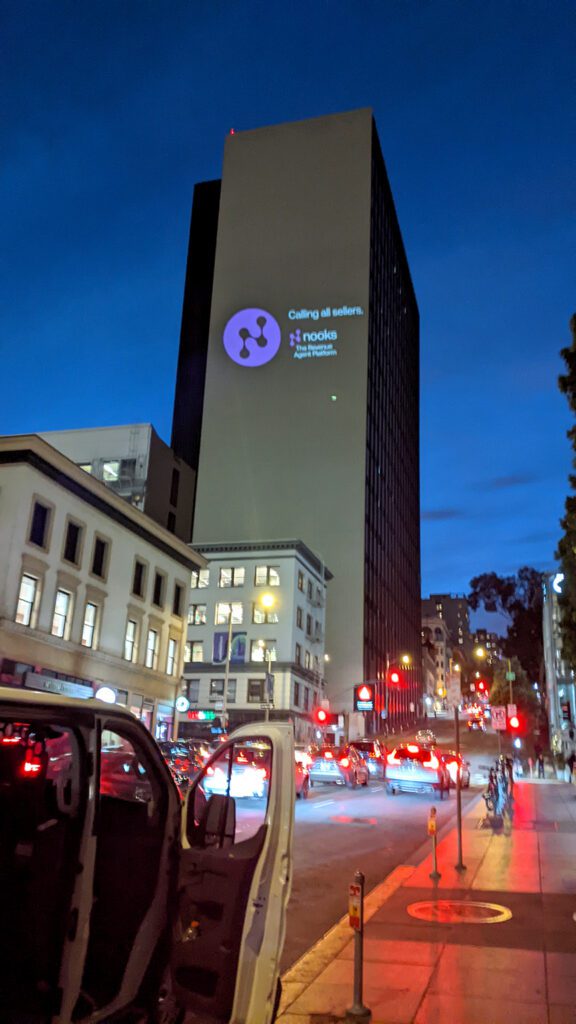
The Bull City’s former tobacco factory walls are among the Southeast’s finest projection canvases — enormous, flat, and built for scale. AGM puts 20,000-lumen campaigns on Durham’s industrial facades for the innovation economy’s most ambitious brands.
Durham is one of the most architecturally interesting advertising markets in the American South, and not for reasons most brands immediately recognize. The city’s twentieth-century identity was built around tobacco manufacturing on an enormous scale — massive factory complexes that required equally massive building footprints, thick exterior walls designed for industrial function rather than architectural expression, and long, uninterrupted facade runs that stretch across entire city blocks without a window, a doorway, or an architectural interruption. Those same physical characteristics that made Durham’s factory buildings ideal for tobacco production now make them among the most technically superior outdoor projection surfaces in the Southeast. The tobacco industry built Durham its walls. The innovation economy fills them at night with exactly the kind of after-dark pedestrian audience that guerrilla projection advertising needs to work.
The transformation from tobacco manufacturing to technology and creative economy has been dramatic, and the pace of that transformation is what makes Durham’s projection advertising market so distinctive right now. American Tobacco Campus, the former cigarette factory complex, has become a mixed-use destination with offices, restaurants, event venues, and arts spaces — but the building walls themselves haven’t changed. They remain exactly as the tobacco manufacturers built them: multi-story, flat, smooth-plastered, and blank across face dimensions that can exceed 10,000 square feet of uninterrupted surface. A 20,000-lumen projection on those walls doesn’t just fill a surface — it commands the visual field of every person in the courtyard, on the approach roads, and in the surrounding blocks. There is simply no outdoor advertising format that operates at that scale in Durham’s built environment at any comparable cost.
Duke University’s proximity to downtown Durham adds a persistent audience layer that operates independently of Durham’s dining and entertainment calendar. The university’s student population, faculty community, and affiliated research hospital employees collectively represent hundreds of thousands of people moving through the urban core adjacent to Durham’s projection-ready corridors throughout the academic year. Duke’s calendar creates distinct projection windows — home basketball games at Cameron Indoor Stadium, semester openings, graduation weekend, and homecoming — that concentrate especially large and socially engaged audiences in the corridors between the university and downtown. Brands and organizations that want to reach the Duke-affiliated demographic in an environment where they’re social and receptive — rather than behind a desk or on a commuter route — will find Durham’s evening entertainment corridors highly productive.
Durham's Walls Are Ready. Your Campaign Should Be Too.
American Tobacco Campus. The Warehouse District. Brightleaf. Durham's former factory walls are the Southeast's finest projection canvases — and AGM's 20,000-lumen system does them justice. contact us for a quote. complete crew and equipment included.
Our Campaign Locations
Browse Cities in North Carolina
Select a city to explore Guerrilla Projections opportunities.
How Military Campaign Logic Applies To Durham's Innovation Audience
The United States Marine Corps partnered with American Guerrilla Marketing during CMA Fest in Nashville — one of country music’s most heavily attended annual events — deploying building projection across Lower Broadway’s entertainment district to reach young festival attendees at night rather than through conventional media channels. The strategic logic of that campaign is directly transferable to Durham’s context: instead of competing for attention through digital formats where an audience is distracted, fragmented, and actively filtering advertising, the USMC placed a building-scale visual statement in the physical environment where young people were already gathered, already socially engaged, and already looking at the world around them. The entertainment district projection didn’t interrupt the experience — it became part of it.
Military branch campaigns succeed with guerrilla projection specifically because of the format’s relationship to entertainment-event crowds. When thousands of people are concentrated in a corridor for an evening — at a festival, a concert, a gallery opening, a food and beverage event — the normal decision hierarchy of advertising breaks down. People are not in task-completion mode. They are in experience-receptivity mode: open to stimulation, looking for things to engage with and share, not defending against intrusion. A 20,000-lumen projection in that environment isn’t an ad they have to decide to watch. It’s a physical event in the space they’re already occupying, at a scale that the human visual system registers automatically regardless of intent.
Durham’s innovation economy produces a particular variant of that crowd type with remarkable regularity. Product launches, startup demo events, tech community meetups, and university-sponsored public programming all create concentrated evening pedestrian audiences in and around Durham’s entertainment corridors without requiring any additional event infrastructure. The Durham tech community is both socially active and highly networked — social sharing rates among Durham’s startup and university communities are among the highest of any comparable market, meaning a projection campaign that lands with ten people who post about it reaches hundreds more before morning. AGM’s GPS-documented location analysis identifies the Durham corridors where this audience concentration is most consistent and most accessible to projection advertising placement.
Durham's Finest Projection Surfaces
Durham’s tobacco industry legacy has left the city with a remarkable inheritance of projection-ready wall surfaces. The four locations below represent the highest-value projection environments in the Bull City, each evaluated for wall quality, pedestrian access, nighttime audience density, and the logistical requirements of deploying a 20,000-lumen projection system with full generator and crew support. AGM scouts each proposed Durham surface individually — the summaries below describe the corridor-level characteristics that make each area valuable, but the specific surface selected for a given campaign is determined by detailed on-site evaluation.
American Tobacco Campus
There is no projection surface in Durham — and very few in the entire Southeast — that competes with the exterior walls of American Tobacco Campus in terms of sheer technical quality. The former cigarette factory’s conversion to a mixed-use destination preserved the industrial building shells intact, which means that the long, multi-story blank brick and plaster exterior walls facing the main courtyard and primary approach roads remain exactly as the tobacco manufacturers finished them: enormous, flat, and unbroken by window grids or architectural ornamentation. Wall surfaces facing the internal courtyard offer the added advantage of a contained viewing environment — the courtyard’s geometry naturally focuses the attention of everyone present toward the projection surface, creating an audience that is physically arranged to receive the campaign rather than moving past it at variable angles. American Tobacco Campus’s consistent evening and weekend foot traffic — drawn by restaurants, event venues, and office workers extending their day into the surrounding hospitality offerings — delivers a sizable organic audience on any given night of operation without requiring event activation to generate crowd density.
Durham Warehouse District
The former warehouse cluster east of Main Street represents Durham’s most logistically straightforward projection environment. The flat painted masonry walls characteristic of Durham’s warehouse district offer good to excellent reflectivity depending on the specific building’s exterior finish, and the ground-level vehicle access throughout the district makes equipment staging — projector, generator, mobility unit, crew support vehicle — practical without the spatial constraints that some denser urban environments impose. The Warehouse District’s dining scene has expanded steadily over the past decade, and the concentration of restaurants and bars in the area means consistent after-dark pedestrian traffic on weekday and weekend evenings without requiring event alignment to produce an audience. Walls on the district’s less-trafficked cross streets often offer the cleanest projection geometry: clear line-of-sight distance, minimal competing ambient illumination, and building faces oriented toward natural pedestrian approaches from the Main Street dining corridor.
Main Street Arts Corridor
The stretch of Durham’s Main Street between Five Points and Durham Bulls Athletic Park anchors the city’s most linear pedestrian entertainment environment. Dining establishments, bars, and galleries concentrated along this corridor create a built-in audience that moves slowly, stops frequently, and occupies outdoor seating areas facing the building facades across the street — exactly the viewing position that makes building projection advertising most effective. The building faces along this corridor tend toward mid-scale commercial structures — two to four stories, flat facades, varied surface finishes from painted masonry to stucco — that accommodate projection well when throw distance from across the street or from a parking area is adequate. Durham Bulls Athletic Park’s home game schedule adds event-aligned density windows on top of the Main Street corridor’s baseline evening traffic, creating nights when the pedestrian concentration is significantly higher than the weeknight average.
Brightleaf at the Park
The historic tobacco warehouse complex redeveloped as Brightleaf at the Park offers a different surface character than American Tobacco Campus’s blank plaster walls — the Brightleaf buildings retain more of their original brick exterior, which creates a warmer aesthetic context for projection but also a lower baseline reflectivity than smooth plaster or painted concrete. AGM’s scouting evaluates Brightleaf surfaces on a case-by-case basis, identifying the wall sections with the most favorable surface finish for the projection system’s output. The complex’s retail and entertainment tenants generate consistent evening foot traffic, and the relatively contained site geometry means that audiences moving through the Brightleaf area are naturally proximate to the exterior walls where projection would be deployed. For campaigns with aesthetics that benefit from a brick-and-history backdrop rather than a clean industrial surface, Brightleaf offers a distinct visual context unavailable elsewhere in Durham’s projection inventory.
Plan Your Guerrilla Projection Campaign in Durham, NC
Tell us about your campaign goals, target audience, and preferred locations. Our team will help you plan a high-impact guerrilla projection campaign tailored to your needs.
Award Winning Personalized Service
You will get thoughtful, devoted, and individualized attention from our experienced, qualified, and professional personnel. Being one of the most illustrious agencies in Brooklyn, New York, American Guerrilla Marketing has been awarded the Best of Brooklyn title.
Nationwide
Industry City, Brooklyn, New York 11232
American Guerrilla Marketing
Hours
Mon - Fri: 9 AM - 5 PM
Sat & Sun: Closed
Automate your campaign with AGM’s Request for Proposal Builder.
Automate your campaign with AGM’s Request for Proposal Builder. Simply answer a few quick questions about your campaign goals, markets, and timeline, and the system will generate a tailored presentation with recommended strategies, quantities, and pricing. Click the RFP Builder to instantly receive your customized proposal.
What Durham Projection Campaigns Are Made Of
Startup & Innovation Launches
Durham’s startup community is dense, networked, and highly attuned to brand signal — a building-scale projection campaign on American Tobacco Campus or in the Warehouse District during or after a product launch event reaches the exact audience most likely to amplify the announcement through professional and social networks. Projection at this scale communicates investment and ambition in a way that press releases and digital advertising cannot replicate in the physical city.
Biotech & Life Sciences Branding
Durham’s proximity to Research Triangle Park’s life sciences cluster — some of the highest concentrations of biotech and pharmaceutical research employees in the country — creates a specialized market for projection campaigns targeting this professional demographic in the after-work social environments where they congregate in Durham’s downtown. Industry conferences, lab community events, and corporate brand presence campaigns all find Durham’s evening corridors productive for reaching this audience.
University & Academic Campaigns
Duke University’s nationally recognized brand and large community of students, alumni, graduate researchers, and affiliated hospital staff creates an audience segment in Durham’s entertainment corridors that responds to university-adjacent messaging, alumni-targeted campaigns, and education-sector brand advertising in a way that few markets of comparable size can match. Academic calendar windows — semester openings, basketball season, spring recruiting weekends — align projection campaigns with peak audience concentrations.
Military & Defense Brand Campaigns
The USMC’s entertainment-event projection model — reaching young civilians in festival and nightlife environments rather than through traditional media — translates directly to Durham’s social geography. The Triangle region’s strong military-adjacent demographics and the regular concentration of young professionals in Durham’s Main Street and Warehouse District corridors make building projection an effective format for branch recruiting and military brand campaigns timed to evening entertainment windows.
Entertainment & Streaming Releases
Music platforms, streaming services, and entertainment brands targeting the 21–38 demographic find Durham’s arts-forward audience — concentrated most heavily in the Warehouse District and around American Tobacco Campus — to be one of the Triangle’s most receptive markets for entertainment-forward projection content. Release campaigns, tour announcements, and platform launches all benefit from the format’s capacity to generate organic social sharing among Durham’s highly connected creative class.
Food, Beverage & Lifestyle Brands
Durham’s nationally recognized food scene draws a disproportionately food-literate and brand-conscious dining audience to the Main Street corridor and surrounding blocks on any given evening. Consumer brands in craft beverage, specialty food, and lifestyle categories that want to reach an audience with high purchasing power and strong product discernment will find Durham’s restaurant-district pedestrian traffic a natural fit for projection advertising campaigns timed to peak dining hours.
Understanding Durham's Projection Surface Landscape
Evaluating a Durham building wall for projection advertising requires the same technical framework that AGM applies in every market, adapted to the specific architectural characteristics of the Bull City’s built environment. Durham’s tobacco-era industrial buildings are exceptional by national standards, but not every building in the city’s entertainment corridors hits the technical ideal — and the gap between a good Durham projection surface and a marginal one matters significantly in terms of campaign impact.
The most important distinction in Durham’s surface inventory is between smooth plaster and painted masonry surfaces — which reflect 20,000 lumens with high efficiency and color fidelity — and rough or natural-finish brick, which scatters light at the surface texture level and produces a noticeably lower effective brightness and image sharpness. American Tobacco Campus’s main exterior walls, which feature whitewashed and plaster-finished faces on their primary building faces, represent the high end of this spectrum. Brightleaf’s exposed brick represents the other end — still viable for projection, but with realistic expectations about brightness relative to a plaster surface. AGM’s scouting documentation captures the specific surface finish of every proposed Durham wall and advises clients on expected visual output before any campaign commitment is made.
Throw distance is the second critical variable in Durham’s specific building environment. American Tobacco Campus’s campus geometry — courtyard-enclosed buildings with defined approach roads — creates naturally bounded viewing environments where the distance from projector to wall and the audience’s viewing position can be precisely calculated. The Warehouse District’s street grid provides vehicular staging access and cross-street throw positions that work well with the 100-to-200-foot operating range of AGM’s projection system. The Main Street corridor requires more careful geometry assessment because the street width, parked vehicle obstructions, and ambient illumination from restaurant and bar frontage all interact with the beam path in ways that vary block by block. AGM’s advance scouting phase maps throw geometry for every proposed Durham surface as part of the standard location analysis deliverable.
Pedestrian movement patterns around each Durham location determine when a projection campaign is most productive and where the projector should be positioned relative to the wall to maximize the percentage of the passing audience who receives the full image. Around American Tobacco Campus, audiences tend to dwell in the courtyard and around outdoor seating rather than moving past quickly — this stationary or slow-moving audience character means dwell time per impression is higher than in a corridor where people are walking purposefully toward a destination. The Main Street corridor produces more directional pedestrian movement, with people moving between destinations along the street, meaning the projection’s impact is concentrated into shorter engagement windows but with a higher total volume of impressions per hour. AGM scouts both patterns and advises on content design — simpler, bolder imagery for the moving corridor audience, more detailed content for the dwelling courtyard audience — to match creative to audience behavior.
The AGM Campaign Process for Bull City Engagements
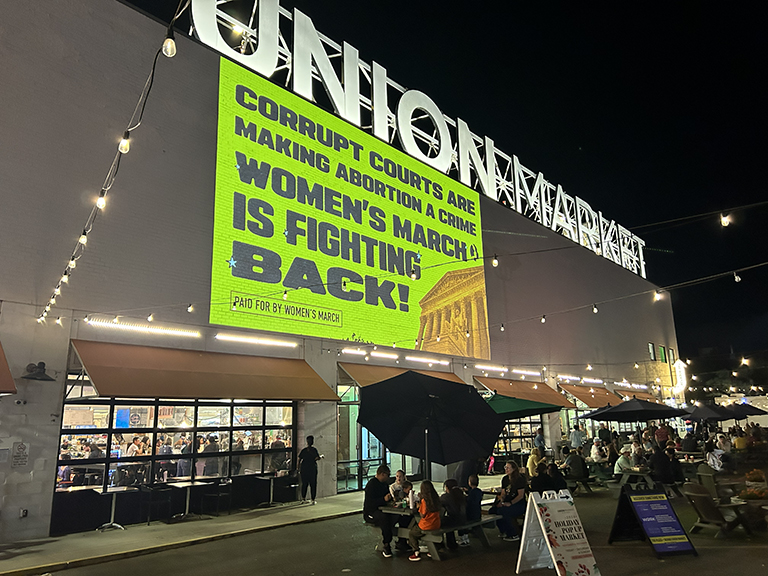
Durham campaigns follow the same structured operational sequence that AGM has deployed for national clients including the US Marine Corps, Women’s March, Reproductive Freedom for All, and YouTube. Advance scouting comes first: AGM’s national scouting team — operating with both digital analysis tools and physical on-the-ground Durham evaluation — documents every candidate surface in the target corridors. Each surface receives a full technical assessment covering reflectivity, flatness, beam path obstructions, available throw distance, pedestrian traffic volume and movement patterns, and any permitting or property access considerations specific to the location. Scouting costs approximately Contact us for a custom quote. for the Durham market and delivers a ranked location shortlist with full GPS records, photography, and technical notes.
Creative development follows the scouting findings. AGM works with clients to develop projection content calibrated specifically for the surface and audience profile confirmed by the scouting report. American Tobacco Campus’s courtyard walls, which are viewed by a dwelling audience at relatively close range, reward more compositionally detailed content than the Main Street corridor’s building faces, which are viewed from across a moving street at higher speed. Both require the same fundamental projection content principles — bold typography, high contrast, strong color — but the compositional emphasis differs based on viewing distance, audience dwell time, and the ambient visual environment of the specific location.
Execution night deploys AGM’s own direct technical crew — not subcontractors, which matters for quality control, professional conduct in a public environment, and liability management — to the confirmed Durham location with the complete operational package. Setup begins before dark. The 20,000-lumen commercial projection system, generator and power solution, and full electronics bundle are staged and confirmed before the dusk start window. Campaigns run for four to six hours with continuous technical crew presence. Multi-night Durham campaigns — an American Tobacco Campus activation running across Thursday, Friday, and Saturday, for instance — compound impression counts dramatically while amortizing the scouting and creative investment across multiple execution nights.
Pricing For Durham Projection Campaigns
Durham projection advertising runs at contact us for a quote. — the standard AGM rate for all North Carolina markets outside New York City. The nightly rate covers everything required to put a campaign on the street: the 20,000-lumen commercial projection system, generator and self-contained power solution, full electronics bundle, mobility unit, and a two-person technical crew for setup, full-night operation, and breakdown. No separate equipment fees, no additional labor charges, and no unanticipated add-ons at the invoice stage.
Advance location scouting for Durham runs approximately Contact us for a custom quote. covering physical and digital surface evaluation, pedestrian traffic analysis, GPS documentation, permitting research, and the location shortlist delivered before any campaign commitment. Private-property arrangements — formal building owner agreements for projecting onto American Tobacco Campus or Brightleaf building faces, for example — add location rights costs that typically range from Contact us for a custom quote. per night depending on the property management’s terms and the specific access requested.
For Durham campaigns aimed at startup or innovation economy audiences, AGM also advises on the earned media dimension of campaign budgeting: a well-positioned projection at American Tobacco Campus generates organic social sharing from Durham’s tech community that extends campaign reach beyond the direct pedestrian impression count. When that earned media potential is factored into total campaign value, the cost-per-engaged-impression for a Durham projection campaign is highly competitive against any digital format targeting the same demographic at the same engagement depth.
Who Runs Projection Campaigns in the Bull City
Durham’s projection advertising client base reflects the city’s distinctive economic character. Research Triangle startups completing funding rounds use American Tobacco Campus or Warehouse District projections to signal market arrival to the local tech and investor community in a format that generates conversation and social media amplification. Biotech and life sciences firms running recruiting campaigns use Durham’s Main Street corridor to reach the graduate-level scientific talent that Duke University and nearby research institutions produce. Entertainment brands and music platforms targeting Durham’s arts-forward young professional demographic use Brightleaf and Main Street projections during album release and tour announcement windows.
Advocacy organizations working on public health, environmental policy, and social justice issues find Durham’s politically engaged university-adjacent community one of the most receptive audiences in the Carolinas for projection-based messaging during key campaign moments. Defense and military organizations with recruiting objectives in the Triangle’s 21–28 demographic use Durham’s entertainment corridors for the same reason the USMC chose Nashville’s festival strip — the audience is present, social, and receiving in a way that digital recruiting platforms cannot replicate in the physical environment.
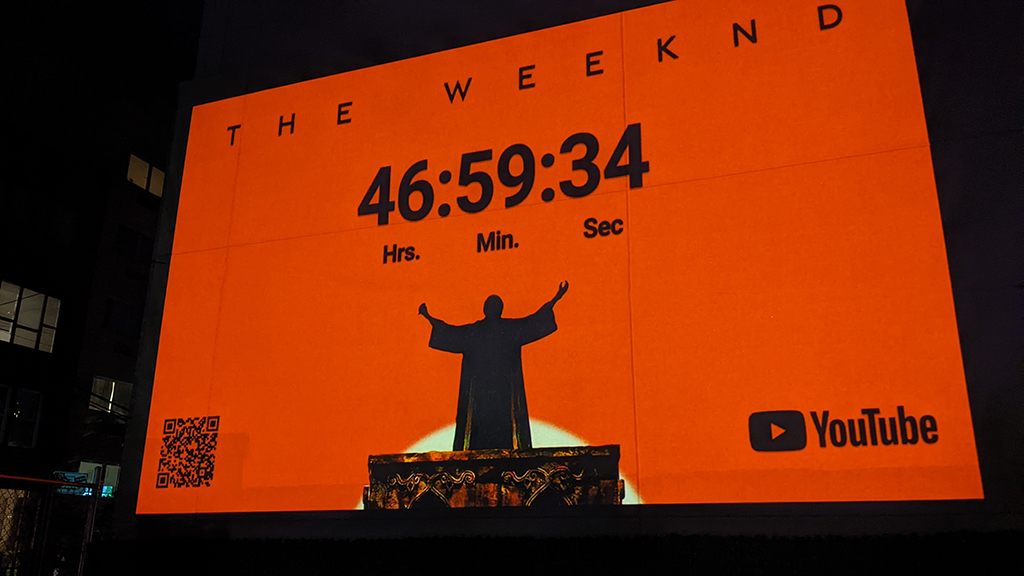
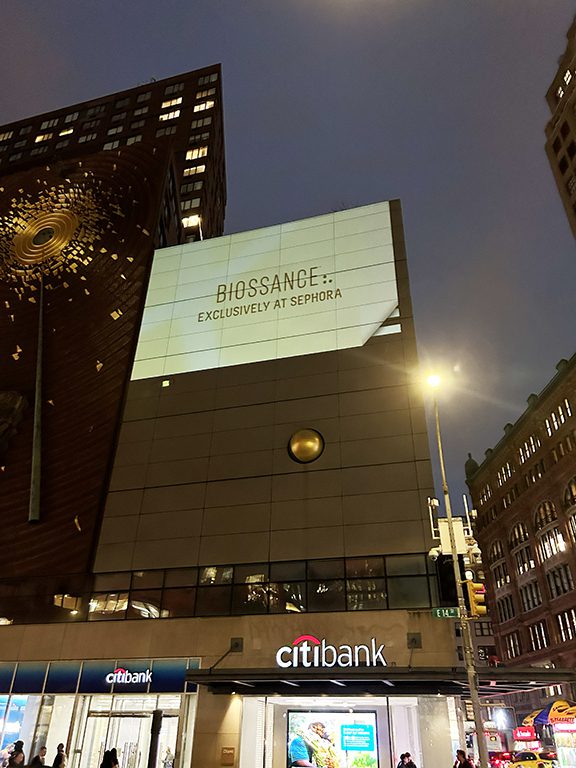
AGM is a Best of Brooklyn award-winning operation with a national client roster that includes Biossance, The Weeknd, the US Marine Corps, Women’s March, Reproductive Freedom for All, and YouTube. Our direct technical crew model ensures that the standards applied to our highest-profile national campaigns are present on every Durham execution night. GPS-documented location analysis and structured post-campaign reporting give every Bull City client a clear accountability record — evidence of what was executed, where, and when — that traditional outdoor advertising formats do not provide.
AGM’s projection client roster includes Netflix, Disney, Coca-Cola, FanDuel, Live Nation, iHeartRadio, and the US Marine Corps. A confirmed case study: the US Marine Corps × CMA Fest Nashville — multi-night projections onto architectural surfaces throughout the festival footprint, reaching 80,000+ attendees across the campaign window. Projection advertising scales across every brand category; what our campaigns share is scale, precision, and a physical presence digital cannot replicate.
Coverage & Estimated Impressions
| Zone / Area | Peak Hours | Foot Traffic | Est. Nightly Impressions | Best For |
|---|---|---|---|---|
| American Tobacco Campus | 8PM–1AM | High | 8,000–35,000 | Product Launch |
| Durham Warehouse District | 8PM–1AM | High | 8,000–35,000 | Event Promotion |
| Main Street Arts Corridor | 8PM–1AM | High | 8,000–35,000 | Brand Awareness |
| Brightleaf at the Park | 8PM–1AM | High | 8,000–35,000 | Political |
Frequently Asked Questions
American Tobacco Campus is privately managed mixed-use real estate, which means projecting onto its building faces requires a formal agreement with the property management team. AGM’s advance scouting phase includes outreach to American Tobacco Campus management as part of permitting and access research. The additional location rights cost — typically Contact us for a custom quote. per night — is generally justified by the surface quality: there is simply no other projection canvas in Durham with the scale, flatness, and reflectivity of American Tobacco Campus’s primary courtyard walls. For brands that need maximum projection impact in Durham, the surface quality premium is worth the access cost.
The former tobacco factory buildings were constructed for industrial manufacturing function, which produced exterior walls with characteristics that happen to be ideal for large-format projection: massive unbroken surface areas, flat planar geometry without architectural ornamentation, and finished plaster or whitewashed masonry surfaces that reflect a 20,000-lumen projection system with high efficiency and color fidelity. There are no regular window grids interrupting the image, no curved facades distorting the projection geometry, and no ornamental surface features creating dead zones in the projected content. Combined with the buildings’ sheer wall dimensions — some exterior faces exceed 10,000 square feet of unbroken surface — these characteristics create projection canvases that would be essentially impossible to find in newer construction.
Duke University’s academic calendar generates several high-density projection windows annually in the corridors between campus and downtown Durham. Semester openings — particularly the fall semester — bring a large influx of students, new faculty, and family visitors into Durham’s entertainment and dining scene. Duke home basketball games at Cameron Indoor Stadium draw sold-out audiences who frequently extend their evenings into downtown corridors before and after games. Spring graduation weekend concentrates thousands of alumni, parents, and visitors in the downtown area over a multi-day period. Each of these windows represents a meaningful pedestrian density spike in Durham’s projection corridors, and AGM’s scouting team tracks the Duke academic and athletics calendar when advising on campaign timing for Durham engagements.
The Durham Warehouse District is one of the primary after-work social gathering destinations for the Triangle’s startup and biotech professional class. The concentration of restaurants and bars in the district draws tech workers, researchers, and creative economy professionals from downtown Durham, Duke Medical Center, and Research Triangle Park’s eastern edge throughout the week. A Warehouse District projection on a Wednesday or Thursday evening captures this demographic in the social environment where they’re most receptive to brand discovery and most likely to discuss and share what they see. The ground-level vehicle access in the warehouse district also makes equipment staging straightforward for AGM’s technical crew.
Durham Bulls home games at the ballpark adjacent to the Main Street corridor create consistent pedestrian density spikes on game nights throughout the baseball season, with fans arriving before first pitch and dispersing into the Main Street restaurant district before and after games. This event-aligned audience concentration supplements the baseline pedestrian traffic on the Main Street corridor on game nights, making Bulls game evenings among the highest-value projection windows for Main Street-area building faces. AGM’s scouting incorporates the Bulls home schedule into campaign timing recommendations for Durham’s Main Street corridor.
American Tobacco Campus’s primary projection-facing surfaces are finished in smooth plaster or whitewashed masonry, which reflect 20,000 lumens at high efficiency — delivering the maximum image brightness and color saturation the projection system is capable of. Brightleaf at the Park retains more of its original exposed brick exterior, which has a rougher surface texture that scatters light and produces a lower effective brightness and image sharpness compared to smooth plaster. Both are viable projection environments, but AGM advises clients that Brightleaf campaigns should be evaluated with realistic brightness expectations relative to the American Tobacco Campus standard, and content designed for Brightleaf should lean toward bolder, more contrast-heavy imagery to compensate for the reduced reflectivity of the brick surface.
Building projection campaigns are an exceptionally effective format for startup launch announcements specifically because of the earned media dynamic they produce in innovation economy communities. Durham’s startup and tech professional demographic is highly connected on social media platforms where visual content from unusual or striking outdoor experiences circulates rapidly. A 20,000-lumen projection announcing a company name, product, or funding milestone on an American Tobacco Campus or Warehouse District wall will be photographed and shared by dozens of passersby on any given night, reaching thousands of followers in the Durham tech community within hours. The projection itself operates as a trigger for a broader earned media conversation that extends campaign reach well beyond the direct pedestrian impression count.
Durham’s Main Street corridor between Five Points and the Durham Bulls Athletic Park consistently delivers higher weeknight pedestrian volumes than Brightleaf at the Park, which draws its foot traffic more heavily from daytime retail and weekend evening dining activity. Main Street’s higher density of bar and restaurant tenants generates a stronger late-evening pedestrian presence on Tuesday through Saturday, making it the more productive weeknight projection environment of the two. Brightleaf is stronger on weekend evenings and during special events hosted on the campus. AGM’s scouting documentation captures pedestrian traffic patterns at the time-of-day level for both locations to inform timing recommendations for each Durham campaign.
Durham’s creative class audience — concentrated most heavily around American Tobacco Campus, the Warehouse District, and NoDa-adjacent arts pockets — tends toward arts, design, food, and cultural sector professionals with strong aesthetic sensibilities and high organic sharing rates on visual platforms. Content that rewards visual engagement — bold composition, unexpected imagery, strong design sensibility — performs especially well with this audience. Raleigh’s tech professional audience, concentrated most heavily in the Warehouse District and Glenwood South, skews more heavily toward software, enterprise technology, and research sectors, and responds strongly to signals of innovation and market momentum. Campaigns targeting both audiences in the same window can run simultaneous projections in Durham and Raleigh for a Triangle-wide footprint, with content calibrated to each city’s audience character.
Yes. Duke home basketball games generate significant pedestrian movement from Cameron Indoor Stadium toward downtown Durham’s restaurant and bar district, and the post-game window — roughly two hours after final buzzer — represents one of the highest-density spontaneous pedestrian moments in Durham’s downtown corridor. AGM’s campaign planning incorporates the Duke basketball home schedule when advising on Durham projection timing, and the Main Street corridor’s building faces are positioned to capture post-game pedestrian flow from the campus-to-downtown route. Given Duke basketball’s season length and the consistent crowd volumes at Cameron Indoor, game-night timing can provide five to fifteen additional high-value projection windows annually for a Durham campaign that’s planned around the athletics calendar.
American Tobacco Campus’s internal courtyard and approach road geometry provides natural staging zones for AGM’s mobility unit at distances typically ranging from 80 to 150 feet from the primary projection surfaces. The campus’s enclosed courtyard character is an advantage for certain campaign configurations: the audience inside the courtyard is essentially surrounded by the projection environment, with the building face filling the forward visual field. Approach roads and parking areas adjacent to the campus can extend throw distance for campaigns targeting the larger exterior walls facing the surrounding street grid. AGM’s advance scouting for American Tobacco Campus evaluates multiple projector position options and provides throw distance calculations and image size projections for each candidate position as part of the scouting deliverable.
Our Campaign Locations
Browse All States
Explore Guerrilla Projections opportunities across the United States.
49 States • 192 Cities
More AGM Outdoor Advertising Services
Led Billboard Trucks
Mobile LED displays that bring your brand to any location, any event.

Fly Posting
Street-level poster saturation across walls, construction sites, and corridors.

Sidewalk Decals
Ground-level branded decals at pedestrian hotspots and event entrances.

Sidewalk Stencils
Creative stencil campaigns that put your brand in the path of pedestrians.