American Guerrilla Marketing
Nationwide Service
Media planning, media buying, billboard advertising, & guerrilla marketing
Guerrilla Projections in Buffalo, NY

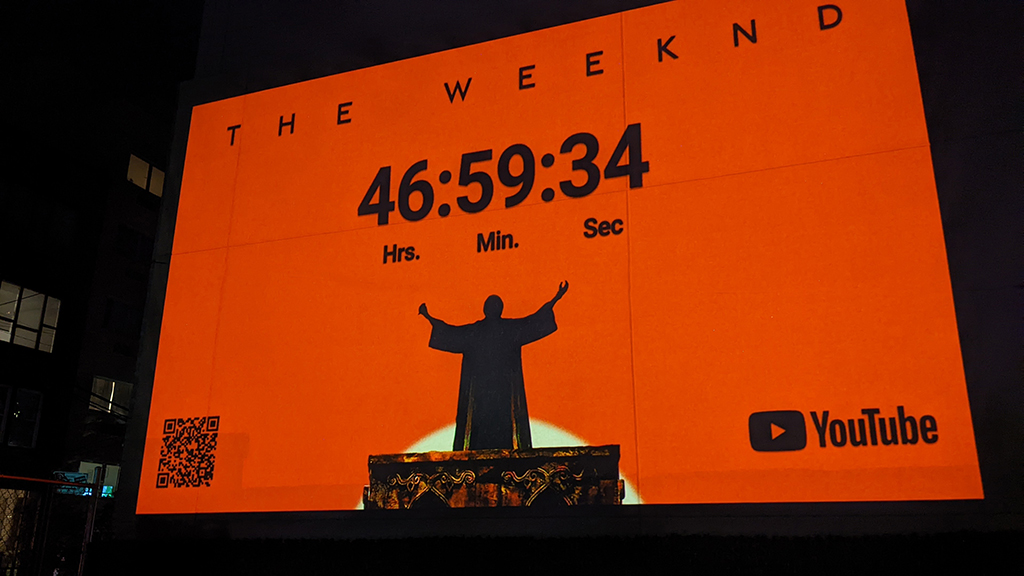
Victorian brick walls in Allentown, warehouse-scale masonry in the Larkin District, event-night crowds at KeyBank Center — AGM deploys 20,000-lumen building projection campaigns across western New York’s arts capital.
Buffalo’s Post-Industrial Arts Landscape and Why Projection Advertising Thrives Here
Buffalo’s Allentown Arts District occupies a neighborhood of late-Victorian commercial and residential buildings on the western edge of downtown — a geography defined by Allen Street’s gallery and nightlife corridor, the surrounding blocks of early 20th-century rowhouses and multi-story mixed-use buildings, and the specific character of a neighborhood that has housed Buffalo’s arts and creative community for generations. The Victorian building stock in Allentown carries exterior walls of brick and painted masonry with the solid, thick-wall construction of its era — not as smooth as modern stucco, but flat, absorptive of projected light, and distinctive in the photography that documents projection campaigns on these surfaces. Allen Street between Elmwood Avenue and Delaware Avenue concentrates arts gallery visitors, bar patrons, restaurant diners, and arts community regulars at pedestrian densities that hold their own against much larger American arts districts.
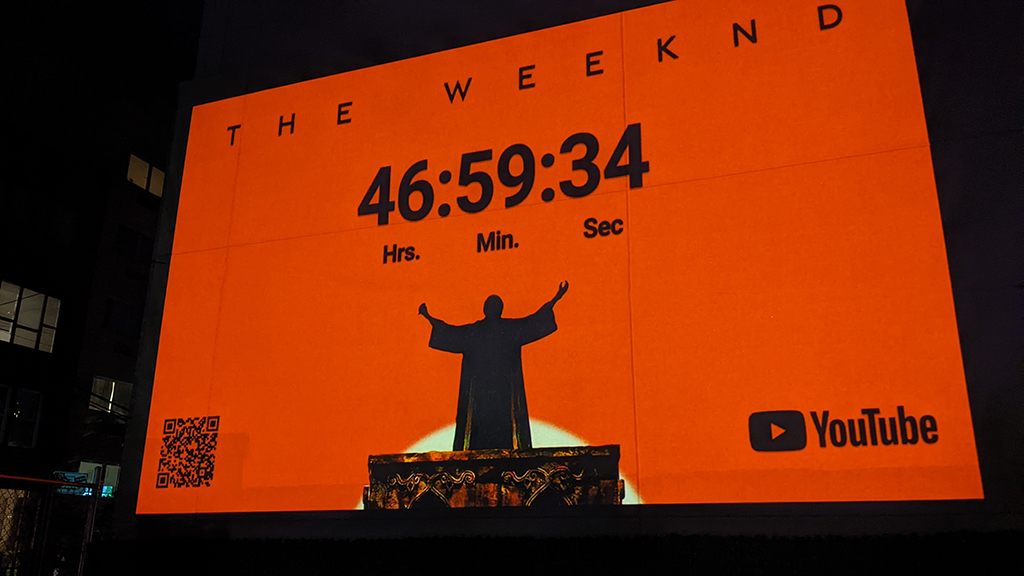
The US Marine Corps selected AGM for a guerrilla projection campaign during CMA Fest in Nashville, projecting onto high-traffic surfaces during peak festival activity and reaching 80,000+ attendees.
AGM’s projection client roster includes Netflix, Disney, Coca-Cola, FanDuel, Live Nation, iHeartRadio, and the US Marine Corps. A confirmed case study: the US Marine Corps × CMA Fest Nashville — multi-night projections onto architectural surfaces throughout the festival footprint, reaching 80,000+ attendees across the campaign window. Projection advertising scales across every brand category; what our campaigns share is scale, precision, and a physical presence digital cannot replicate.
The Larkin District, south of downtown near Larkin Square, operates on a scale that Allentown cannot match. The Larkin Soap Company’s former campus and the surrounding warehouse complex feature exterior masonry wall faces that span dimensions measured in thousands of square feet on the largest building fronts. These surfaces were engineered for manufacturing function, not aesthetics — maximally flat, minimally windowed on the upper stories, oriented toward the street with clear sightlines from the surrounding industrial and commercial blocks. At 20,000 lumens from 80 to 120 feet of throw distance, the full wall face of a Larkin District building becomes one of the largest single-building projection canvases in western New York, with an image footprint that dominates the visual environment of the entire block.
KeyBank Center sits in Buffalo’s Cobblestone District on the harbor, anchoring the city’s sports and entertainment economy with Sabres NHL games, Bills-adjacent events, major concerts, and community gatherings throughout the year. The arena generates several event nights per week during hockey and concert seasons, each one producing a concentrated, high-energy audience assembly that moves through the Cobblestone District’s approach corridors on arrival and departure. These audience flows — predictable in timing, enormous in scale relative to standard nighttime foot traffic — represent the most impactful event-adjacent projection campaign windows available in Buffalo.
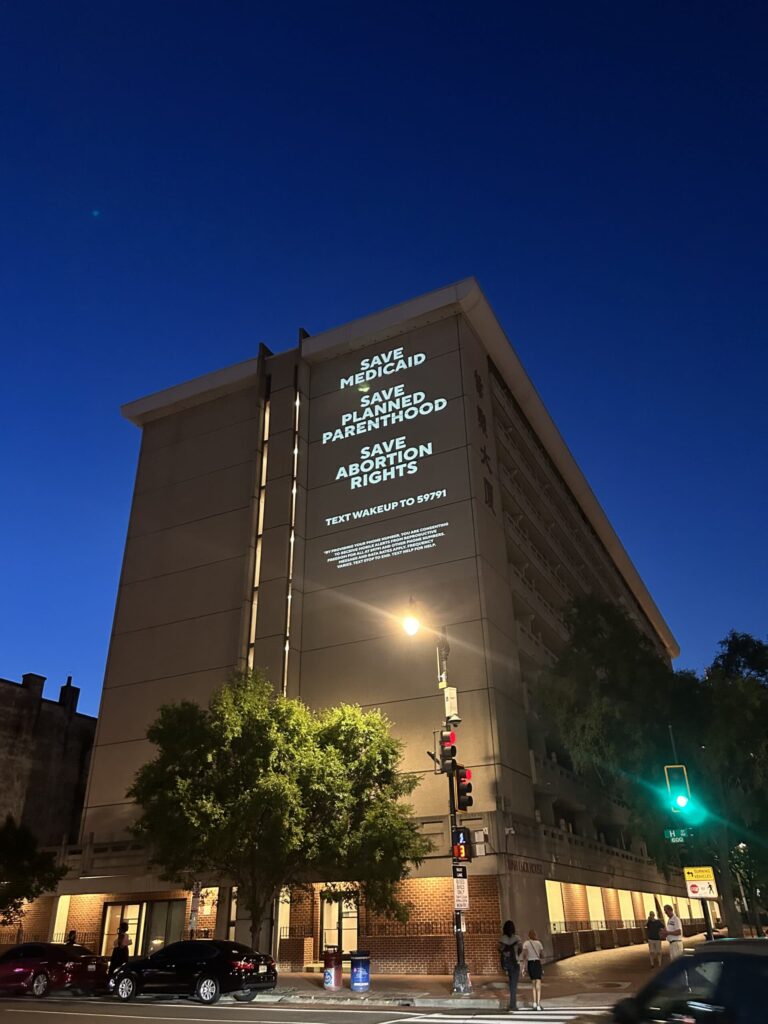
The WakeUp Coalition’s advocacy projection campaign in Austin achieved its impact by concentrating campaign presence precisely in the pedestrian corridors where the highest-density audience was assembled and attentive. Buffalo’s Allentown Arts District provides the equivalent structural condition: a walkable nighttime corridor where the arts and nightlife audience assembles predictably from Thursday through Saturday, where the building faces fronting the street are appropriate for projection, and where the audience’s arts-district orientation primes them for engagement with unexpected visual content in the urban environment. The campaign approach that drove results in Austin’s Sixth Street arts corridor maps directly to Allen Street.
Project in Buffalo — From Allentown to the Larkin District
AGM executes 20,000-lumen building projection campaigns across Buffalo's Allentown Arts District, Cobblestone District, Elmwood Village, and the Larkin warehouse zone. Full-service from scouting through post-campaign documentation.
Our Campaign Locations
Browse Cities in New York
Select a city to explore Guerrilla Projections opportunities.
Five Projection Zones In Buffalo Worth Targeting
Allentown Arts District — Buffalo’s Nightlife and Gallery Corridor (Ideal)
Allen Street through Allentown packs the highest concentration of galleries, bars, live music venues, and arts organizations of any neighborhood in western New York. Two- to three-story Victorian commercial buildings along Allen Street present brick and painted masonry upper-story exterior faces above the street-level retail zone — surfaces where projection images can be placed above the ambient signage and awning clutter, giving projected content visual space to register clearly from the opposite sidewalk and from the length of the block. The Allentown audience on a weekend evening draws arts community regulars, young nightlife patrons, gallery visitors from across the Buffalo metro, and the broader creative professional community that treats the neighborhood as its primary after-dark destination. The demographic breadth of this audience — spanning college-age through established arts professional — gives a single projection campaign here demographic reach that no single-venue event in the city can match in a comparable geographic footprint.
Cobblestone District near KeyBank Center
The Cobblestone District occupies the blocks around KeyBank Center along Michigan Avenue and the harbor-adjacent streets, with historic brick and stone commercial buildings that date to Buffalo’s 19th-century commercial boom repurposed for hospitality, sports-adjacent dining, and entertainment. Building faces in the Cobblestone zone include the exterior masonry walls of mid-19th and early 20th century warehouse and commercial structures — thick-wall brick construction with relatively flat primary facades and upper-story wall faces that, on the better sidestreet positions, present limited window coverage. Event nights at KeyBank Center generate audience flows through the district’s approach corridors that are predictable, high-volume, and temporally concentrated — the largest single-night audience assemblies accessible through any projection location in Buffalo during hockey and concert seasons. Pre-game approach traffic on the primary entry corridors represents a captive audience moving at foot-travel pace, with dwell time elevated by the crowd density that builds on event evenings.
Elmwood Village Arts and Entertainment Corridor
Elmwood Village runs north of Allen Street along Elmwood Avenue through a neighborhood with a distinct character from Allentown — coffee shops, independent bookstores, a wider range of independent retailers, and music and performance venues alongside the galleries and nightlife anchors of the arts district. Building stock along Elmwood includes turn-of-the-century brick commercial buildings with the characteristic broad painted masonry faces of that era, as well as some mid-20th-century commercial construction with smoother painted concrete block surfaces. The smoother mid-century surfaces offer superior projection image quality — higher saturation and crisper edge definition — while the brick faces provide more textural character that can enhance the documentary quality of campaign photography. Elmwood Village’s foot traffic demographic skews slightly more toward everyday neighborhood residents and neighborhood-regular patrons than Allentown’s event-oriented gallery-hop crowd, giving campaigns here a complementary audience profile that broadens total reach when combined with an Allentown execution in the same campaign week.
Hydraulics / Electric Avenue Warehouse Buildings
The Hydraulics neighborhood around Electric Avenue on Buffalo’s east side has evolved into an emerging arts and events zone, with former industrial and warehouse buildings converted to music venues, artists’ studios, event spaces, and arts programming facilities. The industrial building stock in this zone offers some of the largest flat exterior wall faces in the Buffalo metro — brick and painted masonry warehouse facades with the scale and surface geometry that allow 20,000-lumen projection systems to achieve image dimensions significantly larger than what Allentown’s commercial building stock allows. The district is less continuously active than Allentown’s nightly economy, but generates substantial audience concentration on event nights when its large warehouse venue spaces host concerts, arts events, and community programming. Event-adjacent projections in the Hydraulics zone reach the assembled event audience during the specific high-density window when they are arriving and lingering before the main event begins.
Larkin District Warehouse Zone
The Larkin District represents the industrial-scale end of Buffalo’s projection inventory. The Larkin Soap Company campus and surrounding warehouse buildings feature exterior masonry faces — painted concrete, brick, and rough-cast masonry — that run substantially wider and taller than anything available in Allentown or Elmwood Village. Larkin Square’s activation as a public gathering and cultural events space has added a consistent foot traffic anchor to the district, with outdoor movie screenings, food truck festivals, and community programming that bring audiences into the warehouse zone on evenings when the surrounding industrial buildings serve as the visual backdrop for the entire event environment. A projection on a Larkin District warehouse wall during a Larkin Square event reaches the assembled outdoor audience from multiple viewing angles simultaneously, at image dimensions that register as the dominant visual element in the surrounding space. Outside event programming, the district’s mixed industrial and commercial character sustains lower but meaningful ambient foot traffic.
The After-dark Crowd Buffalo's Arts Districts Attract
Buffalo’s arts district evening audience has changed significantly over the past two decades, and understanding that change matters for projection campaign targeting. The Allentown Arts District has historically been the gathering point for the city’s arts community — gallery professionals, working artists, arts educators, and the creative industry workforce that clusters around the city’s gallery and performance infrastructure. That core audience remains active, but the past decade has added a substantial young professional demographic drawn by the quality of Allentown’s food and bar programming, alongside college students from the Buffalo-area institutions who populate the corridor particularly on Thursday evenings. The Elmwood Village crowd is somewhat older on average, with more established residents and families mixed into the late-afternoon and early evening hours before the nightlife contingent takes over. The Cobblestone District on event nights draws the sports and entertainment audience — demographically broader than the Allentown arts community, skewing toward the 25-to-45 age range and generating the largest single-evening audience volume of any zone in Buffalo. Campaigns across multiple Buffalo districts in the same week access all of these audience segments across a single campaign investment.
Plan Your Guerrilla Projection Campaign in Buffalo, NY
Tell us about your campaign goals, target audience, and preferred locations. Our team will help you plan a high-impact guerrilla projection campaign tailored to your needs.
Award Winning Personalized Service
You will get thoughtful, devoted, and individualized attention from our experienced, qualified, and professional personnel. Being one of the most illustrious agencies in Brooklyn, New York, American Guerrilla Marketing has been awarded the Best of Brooklyn title.
Nationwide
Industry City, Brooklyn, New York 11232
American Guerrilla Marketing
Hours
Mon - Fri: 9 AM - 5 PM
Sat & Sun: Closed
Automate your campaign with AGM’s Request for Proposal Builder.
Automate your campaign with AGM’s Request for Proposal Builder. Simply answer a few quick questions about your campaign goals, markets, and timeline, and the system will generate a tailored presentation with recommended strategies, quantities, and pricing. Click the RFP Builder to instantly receive your customized proposal.
What Campaign Formats Work in Buffalo
Advocacy and Political Campaigns
Buffalo’s politically engaged urban population and competitive western New York electoral geography make the Allentown and downtown corridors strong advocacy projection targets. Political campaigns in state legislative and congressional districts anchored in Buffalo’s urban core find building projection advertising reaches concentrated registered voter populations during evening hours. The city’s progressive arts community and civically active neighborhoods — Allentown, Elmwood Village — are particularly receptive to advocacy campaigns that use the public visual environment as a political statement.
Arts and Entertainment Marketing
Buffalo’s live music culture — anchored by the Iron Works, Town Ballroom, Mohawk Place, and the broader club circuit — and its active gallery programming calendar create natural alignment for entertainment release campaigns and arts institution marketing. The Allentown audience is music-engaged and culturally active; album releases, streaming premieres, film openings, and gallery events all find receptive audiences along Allen Street and through the Elmwood corridor.
Sports and Event-Adjacent Campaigns
Buffalo’s Bills and Sabres fandom is among the most intense in American sports, and event-adjacent projection campaigns timed to game nights or playoff runs reach a highly engaged, deeply identified sports audience moving through the Cobblestone District’s approach corridors. Campaign creative that references Buffalo’s sports identity connects with the city’s civic self-image in ways that generic brand advertising cannot achieve.
Consumer Brand Activations
Buffalo’s growing professional class — concentrated in the medical, biotech, and financial services sectors — and the arts-literate urban resident base of Allentown and Elmwood Village represent a viable consumer brand target for lifestyle, food and beverage, fashion, and technology campaigns. Consumer brands entering the western New York market or building presence with the urban professional demographic find building projection advertising in the arts district corridors a higher-visibility alternative to conventional outdoor placements in the market.
Corporate and Institutional Awareness
Buffalo’s expanding economy — driven by the medical corridor at the Buffalo Niagara Medical Campus, technology sector growth, and the manufacturing industry’s ongoing transformation — creates demand for corporate awareness campaigns targeting professional and civic audiences. Building projection campaigns in the Larkin District and Cobblestone zones reach this professional audience in a physical environment that communicates the city’s industrial heritage and contemporary economic ambition simultaneously.
From Scout To Execution: The Buffalo Campaign Process
Wall Identification and District Scouting
AGM’s Buffalo scouting process evaluates Allen Street and the Allentown surrounding blocks, the Cobblestone District approach corridors, Elmwood Avenue’s commercial strip, the Electric Avenue warehouse zone, and the Larkin District campus for wall surface quality, building face dimensions, projector positioning options from public right-of-way, ambient lighting levels during the execution window, and pedestrian volume on target evenings. Buffalo’s arts district geography is compact enough that a single physical scouting visit can cover all five primary candidate zones. Event calendar review at the scouting phase identifies KeyBank Center programming, Larkin Square events, and Allentown gallery opening schedules that can be used to align campaign timing with peak audience windows.
Technical Configuration for the Buffalo Market
Buffalo’s Victorian brick building stock introduces surface texture considerations that differ from the smooth stucco and EIFS common to newer markets. Brick surfaces scatter projected light across the mortar lines and variable brick face textures, which reduces image sharpness compared to painted concrete or plaster. AGM’s image configuration for Buffalo Allentown walls compensates by selecting images with broad color masses rather than fine detail, and by targeting the smoothest painted-masonry wall faces in each district for the highest-impact image placement. For Larkin District and warehouse zone walls, surface conditions are evaluated individually — many warehouse buildings in the district have painted masonry or smooth-cast exterior finishes that approach the quality of the best stucco surfaces for projection purposes.
Campaign Night Operations in Buffalo
Buffalo projection campaigns launch at dusk, with AGM’s two-person crew managing all equipment setup, calibration, and operation from arrival through breakdown. Setup and calibration from crew arrival to projection launch runs approximately 60 to 90 minutes. Campaign windows typically extend four to six hours through the peak pedestrian period — 8 PM through 1 AM on Friday and Saturday evenings in Allentown, or aligned to event-arrival and post-event dispersal windows in the Cobblestone District on event nights. The mobile projection unit allows repositioning between Allentown and Elmwood within a single execution evening when the campaign scope calls for multi-district coverage.
Post-Campaign Documentation and Delivery
Every Buffalo campaign includes professional photography and video documentation throughout the projection run. Documentation captures the projection at full brightness against the night environment, with the distinctive Victorian brick and stone building character of Allentown or the industrial masonry scale of the Larkin District visible in the surrounding context — imagery that is identifiably Buffalo in ways that distinguish the campaign documentation from generic street projection content. Post-campaign deliverables include GPS-verified location confirmation, image quality documentation, and audience environment footage. All assets are packaged for brand use across social media, earned media pitching, and internal marketing reporting.
Buffalo Projection Advertising: Cost Structure and Coverage
Guerrilla projection campaigns in Buffalo are priced at contact us for a quote. . That rate covers a 20,000-lumen commercial projection system, generator and complete power solution, electronics bundle, mobility unit, two-person AGM technical crew, and all setup, operation, and breakdown labor. Multi-night Buffalo campaigns — running two to four consecutive evenings across Allentown, Elmwood, and the Cobblestone or Larkin zones — are available with scope-based pricing.
Event-adjacent campaigns timed to KeyBank Center events or Larkin Square programming benefit from predictable high-audience windows without requiring advance coordination with venue operators. Advance location scouting for Buffalo is approximately . Permitted or private-property locations in Buffalo — particularly Larkin Square venues and Larkin District property owners — are priced at Contact us for a custom quote. per night depending on building access and site conditions. Campaign windows run four to six hours from dusk through the peak pedestrian period.
Campaign Precedent That Maps To The Buffalo Market
The WakeUp Coalition’s Austin advocacy campaign achieved campaign visibility by concentrating projection presence in the precise corridors where the highest-density arts district audience was assembled, present, and actively sharing their environment on social media. The approach — guerrilla building facades as campaign infrastructure in a walkable arts-and-nightlife corridor — generated both organic audience documentation and earned media coverage that extended reach far beyond the physical execution nights. Buffalo’s Allentown Arts District provides exactly the same structural conditions: predictable evening audience assembly, building walls appropriate for projection, and an audience whose arts-district orientation and social documentation habits produce organic amplification of well-executed campaigns.
The United States Marine Corps × CMA Fest campaign in Nashville demonstrated a different projection approach: using building facade campaigns as brand infrastructure adjacent to a major entertainment event, reaching a concentrated event audience with brand imagery that registered in the physical environment of the entertainment corridor before, during, and after event activities. The approach maps directly to Buffalo’s event-adjacent projection opportunities around KeyBank Center — where the NHL or concert audience moving through the Cobblestone District provides a defined, high-volume target for building projection campaigns on the approach and departure corridors.
Who Uses Building Projection Advertising in Buffalo
- Political campaigns targeting western New York’s competitive state and federal electoral districts
- Advocacy organizations building public presence around Erie County and New York State issues
- Entertainment companies promoting releases to Buffalo’s music- and arts-engaged population
- Sports teams and venue operators running event-adjacent campaigns in the Cobblestone District
- Consumer brands entering the western New York market or targeting the urban professional demographic
- Arts institutions promoting the Allentown Art Festival, gallery openings, and cultural programming
- Corporate brands building awareness in Buffalo’s expanding professional economy
Coverage & Estimated Impressions
| Zone / Area | Peak Hours | Foot Traffic | Est. Nightly Impressions | Best For |
|---|---|---|---|---|
| Allentown Arts District | 8PM–1AM | High | 8,000–35,000 | Product Launch |
| Cobblestone District near KeyBank Center | 8PM–1AM | High | 8,000–35,000 | Event Promotion |
| Elmwood Village Arts and Entertainment Corridor | 8PM–1AM | High | 8,000–35,000 | Brand Awareness |
| Hydraulics / Electric Avenue Warehouse Buildings | 8PM–1AM | High | 8,000–35,000 | Political |
| Larkin District Warehouse Zone | 8PM–1AM | High | 8,000–35,000 | Sports |
Frequently Asked Questions
Allentown’s combination of sustained evening foot traffic, arts-literate audience composition, walkable corridor geometry that maximizes dwell time, and Victorian building faces that provide projection candidates throughout the district makes it the most campaign-efficient location in western New York. No other Buffalo neighborhood assembles the same combination of audience volume, demographic quality, and building wall availability in a single walkable corridor. The district’s predictable Thursday-through-Saturday audience pattern allows campaign timing to be planned with confidence around peak attendance windows.
KeyBank Center generates predictable high-density audience flows through the Cobblestone District several nights per week during hockey and concert seasons. Event-adjacent projection campaigns positioned on building faces along the primary approach corridors from downtown parking and transit points can intercept this audience during the 30-to-45-minute pre-event arrival window, when crowd density peaks and movement slows as fans converge on the arena. Post-event dispersal creates a second audience flow window lasting 20-to-30 minutes after the final whistle or curtain call. Both windows are viable projection campaign targets, with pre-event typically delivering higher dwell time and post-event delivering higher social documentation activity.
Yes — the Allentown and Elmwood Village districts specifically produce audience overlap between the college-age demographic and the young professional population in the 25-to-40 range that characterizes Buffalo’s arts-district nightlife audience. Allentown’s Thursday evenings see higher college-age representation from University at Buffalo and Buffalo State students, while Friday and Saturday evenings pull more heavily from the working professional demographic. A Thursday-through-Saturday campaign run in Allentown reaches both audience segments across the three nights, with documentation capturing the demographic variety of the full campaign audience.
Allentown’s Victorian commercial buildings typically feature exterior facades of red brick with stone or cast-iron ornamental details at the cornice and window surrounds, and painted masonry on some of the 20th-century infill and converted residential buildings. Painted brick and painted masonry are the most favorable projection surfaces in the district — they provide a more uniform base color than raw brick and reduce the contrast variations introduced by mortar lines and brick face texture. Raw red brick is workable for 20,000-lumen projection but introduces some texture scatter that affects image sharpness at the fine-detail level. AGM’s wall selection in Allentown prioritizes painted masonry and smooth upper-story wall faces over raw brick wherever available.
Elmwood Village’s entertainment calendar includes gallery opening nights, live music events, and restaurant programming throughout the week, with Thursday through Saturday evenings generating the strongest foot traffic. The neighborhood’s film and performance venue programming — Cinema 1, 2, 3 and Shea’s PAC in the adjacent downtown — create event-adjacent audience flows on programming evenings that complement the standard nightlife traffic on Elmwood itself. Campaign timing that aligns with Elmwood Art Festival weekend (typically held in late summer) reaches one of the neighborhood’s peak audience events, when the corridor is activated with festival programming that draws significantly larger crowds than standard weekend evenings.
Yes. Sabres home games at KeyBank Center run throughout the hockey season and are the most consistent event-adjacent opportunity for the Cobblestone District. Buffalo Bills home games at Highmark Stadium are not adjacent to the downtown arts districts, but the pre-game and post-game activity they generate in downtown bars and restaurants creates elevated general evening foot traffic throughout the broader downtown and Allentown zone on home game Sundays and the occasional Monday or Thursday night. For maximum event-adjacent impact, Sabres game nights at KeyBank Center are the most operationally practical option, with game timing predictable, approach corridors well-defined, and the venue directly adjacent to the Cobblestone District projection zone.
Buffalo’s civic identity has undergone a significant transformation over the past two decades — from a post-industrial city in decline to a city actively reclaiming its industrial heritage as an asset and a source of genuine pride. Creative campaigns that acknowledge Buffalo’s character directly — the city’s resilience narrative, its sports fandom identity, its architectural legacy — connect with residents in ways that generic brand content does not. Projection campaigns that engage with the visual character of the building they project on (using the Larkin District’s industrial architecture as intentional campaign context, for example, rather than treating it as a neutral backdrop) often perform better in earned media and organic social documentation than campaigns that ignore the physical environment their imagery occupies.
The Larkin District’s largest warehouse building faces span widths of 60 to 100+ feet with heights exceeding 30 to 40 feet on the primary industrial structures. At 20,000 lumens from throw distances of 80 to 150 feet, AGM’s projection system can cover these wall faces with image widths approaching the full building face width and heights of 25 to 35+ feet — image areas measured in thousands of square feet. Precise dimensions are confirmed during the physical scouting phase for each specific wall, as building orientation, available projector positioning, and sightline clearance vary by location within the Larkin complex. The Larkin District consistently offers the largest achievable projection image dimensions of any Buffalo location in AGM’s campaign portfolio.
The Cobblestone District’s pedestrian activity on non-event nights is meaningfully lower than on KeyBank Center event evenings — the district’s restaurant and bar programming maintains some ambient foot traffic, but the neighborhood does not generate the kind of sustained walkable arts-district audience that Allentown holds on non-event nights. Cobblestone District projections on non-event nights reach primarily the dining and nightlife audience of the harbor-adjacent restaurant zone — a smaller but still meaningful audience for campaigns that require the Cobblestone’s specific geographic position or building character. For campaigns optimized for maximum impression volume, Cobblestone event-night execution is strongly preferred over non-event nights; for campaigns with flexible timing, pairing Allentown non-event evenings with Cobblestone event nights in the same campaign week maximizes total impression volume.
Buffalo projection campaigns are staged from AGM’s Brooklyn office, with crew and equipment traveling to Buffalo via I-90 West — a roughly six-hour drive that allows for same-day arrival in Buffalo from Brooklyn for a dusk-launch campaign. For multi-night Buffalo campaigns, crew accommodations in Buffalo are arranged as part of the campaign logistics package, with the team staging from a Buffalo base for consecutive execution nights. Equipment travels in AGM’s dedicated campaign transport, which carries the complete technical package — projection system, generator, electronics, mobility unit — configured for immediate deployment at the Buffalo execution sites. Pre-campaign scouting visits confirm all site-specific logistics before crew deployment for the execution nights.
Our Campaign Locations
Browse All States
Explore Guerrilla Projections opportunities across the United States.
49 States • 192 Cities
More AGM Outdoor Advertising Services
Led Billboard Trucks
Mobile LED displays that bring your brand to any location, any event.

Fly Posting
Street-level poster saturation across walls, construction sites, and corridors.

Sidewalk Decals
Ground-level branded decals at pedestrian hotspots and event entrances.

Sidewalk Stencils
Creative stencil campaigns that put your brand in the path of pedestrians.