American Guerrilla Marketing
Nationwide Service
Media planning, media buying, billboard advertising, & guerrilla marketing
Sidewalk Stencil Advertising in Madison, Wisconsin

Turn Madison’s most-walked corridors into high-visibility brand touchpoints. From State Street to Capitol Square, Sidewalk Stencils™ by AGM put your message exactly where pedestrians look — underfoot, unavoidable, and impossible to scroll past.
Madison is one of America’s most walkable capital cities, and its walkability is not incidental — it is structural. The city wraps around two lakes, concentrates its commercial and civic life along a mile-long pedestrian corridor between a world-class university and a working state capitol, and sustains a year-round population of politically engaged, culturally active, highly educated residents and students who have made walking a central part of daily life. That environment is precisely what Sidewalk Stencils™ are designed for.
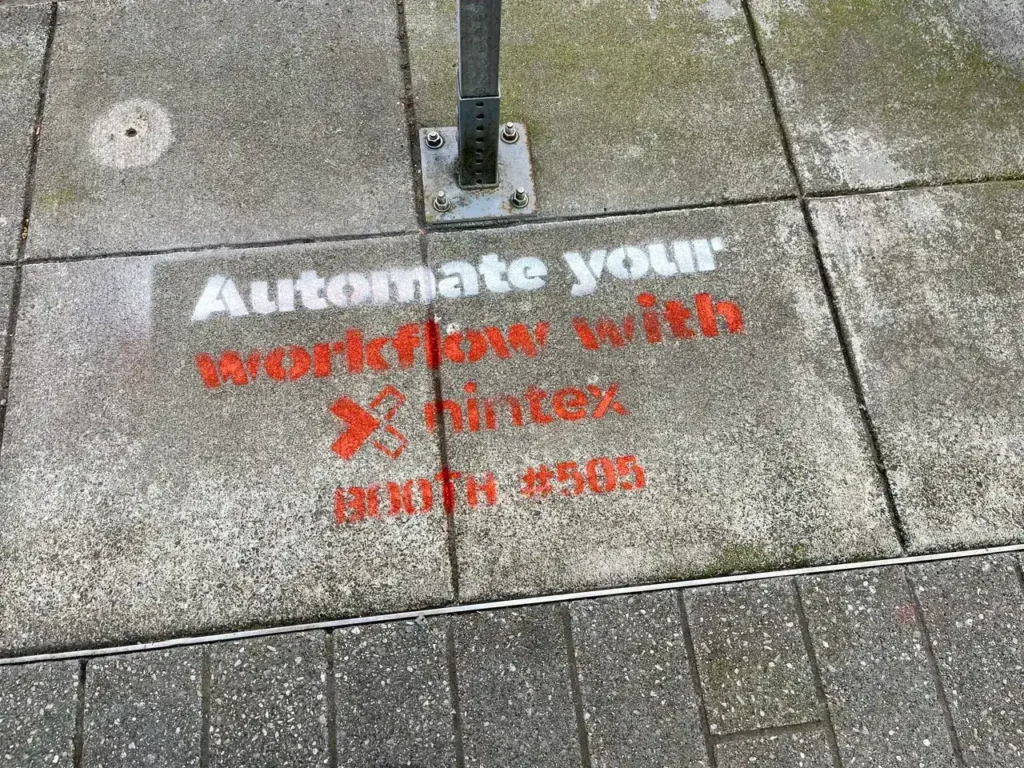
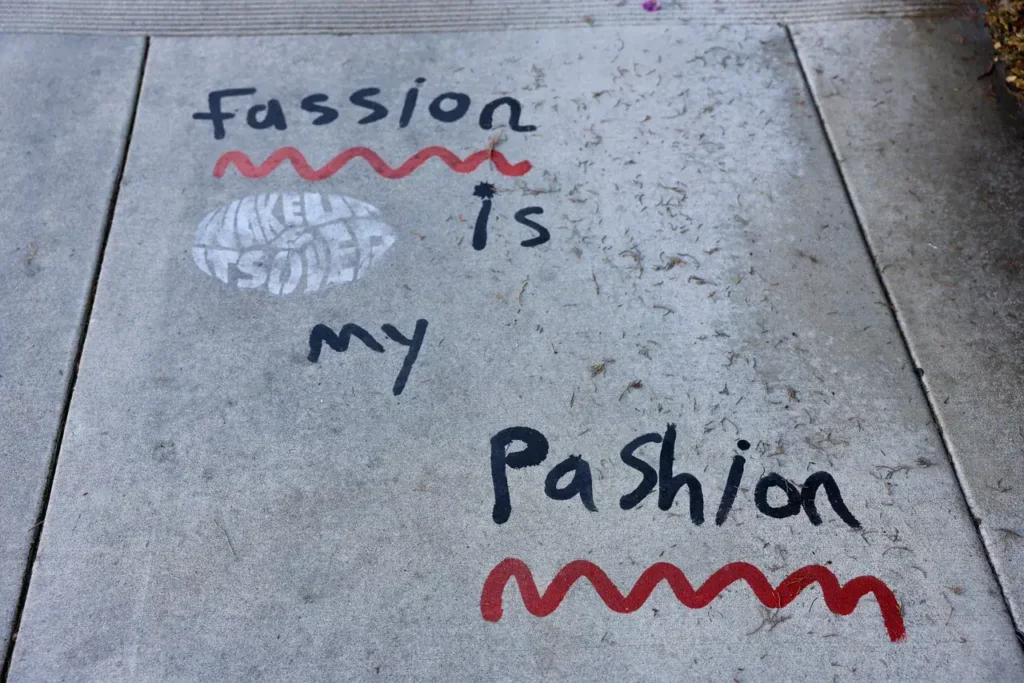
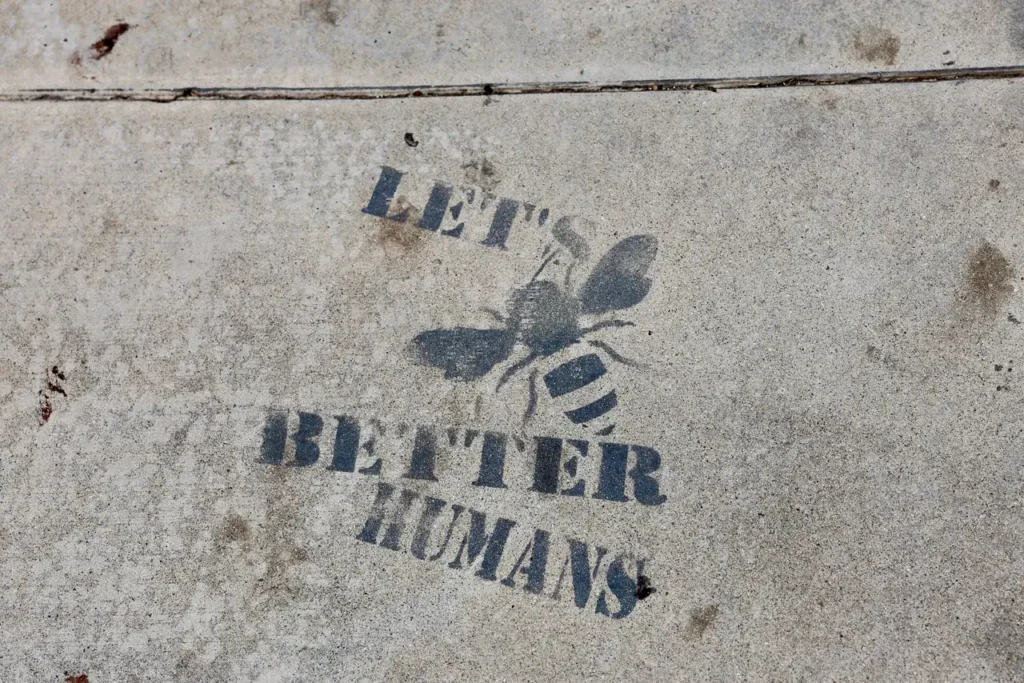
A Sidewalk Stencil™ is a brand impression applied directly to the pavement — the sidewalk, plaza, crosswalk, or any high-foot-traffic surface. Unlike a billboard that commands attention upward, a stencil intercepts attention naturally. It occupies the same visual field as the street itself. Pedestrians encounter it without anticipating it, which produces the kind of genuine, unguarded moment of brand engagement that most digital and traditional formats can no longer deliver in a city where consumers are already oversaturated with screens.
American Guerrilla Marketing has executed Sidewalk Stencil™ campaigns across the country for brands including Nike, Wrangler, and EA Sports. The process is precise: we scout your preferred Madison locations, identify surfaces with the right foot traffic and texture, determine the appropriate stencil method, and deploy on schedule. Every campaign is documented with photos and GPS-tagged placement reports so your team can verify coverage without leaving the office.
Madison’s population of roughly 70,000 UW-Madison students, plus a state government workforce and a thriving tech and startup sector, creates exceptional demographic density within a compact, walkable geography. The isthmus — the narrow land bridge between Lakes Mendota and Monona that contains downtown Madison — concentrates pedestrian traffic in ways that few cities of comparable size can match. A stencil placed on State Street or Capitol Square is physically encountered by a significant percentage of Madison’s entire daytime population within a matter of days.
Whether you are a local Madison brand announcing a new location, a national company entering the Wisconsin capital market, a UW-Madison department building event awareness, or a campaign organization mobilizing a political audience, Sidewalk Stencils™ give you a format that Madison’s isthmus geography naturally amplifies. The pavement is the medium. Madison’s foot traffic is the audience. We connect the two.
Ready to Own Madison's Sidewalks?
From State Street to Capitol Square to the Memorial Union Terrace, AGM puts your brand exactly where Madison walks. Let's build your campaign.
Why Madison Is Built For Sidewalk Stencil Campaigns
Madison’s isthmus geography is the defining fact of its advertising landscape. The narrow strip of land between Lake Mendota to the north and Lake Monona to the south forces pedestrian traffic into high-density corridors in ways that sprawling cities cannot replicate at any scale. State Street alone — a pedestrian mall running from the UW-Madison campus to the State Capitol — concentrates thousands of pedestrians into a car-free, stencil-friendly corridor every single day of the year.
State Street — Pedestrian Mall
State Street is Madison’s most iconic pedestrian artery, an eight-block car-free corridor running from the Library Mall at UW-Madison’s western edge to the Capitol Square roundabout. The street is lined with independent restaurants, bars, coffee shops, boutique retailers, and music venues on both sides, and it carries some of the highest pedestrian density in Wisconsin at virtually every hour of the day. Students walk State Street between campus and the Capitol multiple times daily; tourists explore it as the heart of downtown Madison; state workers traverse it for lunch and after-work stops. A stencil campaign on State Street provides the closest thing Madison advertising has to a guaranteed impression — if you are active in Madison, you walk State Street.
Capitol Square & East Washington Avenue
The Wisconsin State Capitol sits at the center of Madison’s isthmus, ringed by Capitol Square — a one-way street loop framing a plaza that hosts the Dane County Farmers’ Market (one of the largest producers-only farmers’ markets in the United States), Saturday concerts, political rallies, and year-round civic events. The foot traffic on Capitol Square and the radiating corridors along East Washington Avenue, West Washington Avenue, and Mifflin Street is consistent and demographically diverse — government workers, tourists, market shoppers, and downtown residents all circulate through the square on a daily basis. Stencils placed on Capitol Square during Farmers’ Market season (April through November) intercept one of the broadest audience cross-sections in Dane County.
UW-Madison Campus — Library Mall & Bascom Hill
Library Mall, the open pedestrian plaza at the eastern end of UW-Madison’s campus where State Street meets University Avenue, is one of the highest-concentration pedestrian nodes in Madison. Tens of thousands of students, faculty, and staff pass through Library Mall daily during the academic year, moving between State Street retail and dining, the main library, the humanities buildings on Bascom Hill, and the lakefront Memorial Union Terrace. Stencil placements at Library Mall and along the Bascom Hill approach from University Avenue reach the university’s full population at its most transit-dense point. The Memorial Union Terrace on Lake Mendota’s shore — a Madison institution for outdoor seating, live music, and sunset viewing — generates additional high-dwell-time foot traffic in the warm-weather months.
Williamson Street (Willy Street) & Atwood Avenue
Williamson Street — universally known in Madison as Willy Street — and the adjacent Atwood Avenue corridor on Madison’s near-East Side form the city’s most independent, community-oriented commercial district. The Williamson Street neighborhood hosts the Willy Street Co-op, independent bars, vintage shops, bakeries, and a dense residential population of progressive young professionals and longtime Madison residents. Foot traffic on Willy Street is consistent throughout the day and into the evening, particularly around the major cross-streets at Few Street, Jenifer Street, and Brearly Street. Stencil placements on Willy Street reach a highly engaged consumer who actively seeks out independent businesses and is deeply receptive to brands that demonstrate authentic community connection.
Monroe Street & Regent Street — Near West Side
Monroe Street from Regent Street to Edgewood Avenue forms Madison’s premier near-West Side commercial corridor, lined with restaurants, boutiques, wine bars, and specialty retailers that attract a more established, professional demographic than State Street. The neighborhood sits adjacent to the UW Arboretum and draws residents from the surrounding Nakoma, Vilas, and Dudgeon-Monroe neighborhoods — some of Madison’s most affluent zip codes. Regent Street, which runs along the south edge of the UW-Madison campus between downtown and the Monroe Street area, carries strong foot traffic from UW sports fans heading to Camp Randall Stadium, students commuting from West Campus housing, and neighborhood residents. Stencil campaigns along this corridor perform well for premium food and beverage, financial services, and lifestyle brands.
Overture Center District & Breese Stevens Field
The Overture Center for the Arts on East Mifflin Street is Madison’s flagship performing arts venue, drawing hundreds of thousands of annual visitors to its concert halls, galleries, and performance spaces. The surrounding blocks — particularly East Mifflin Street, East Washington Avenue, and the approach from State Street — concentrate audiences before and after performances in a defined pedestrian zone. Breese Stevens Field on East Washington Avenue hosts concerts, FC Madison soccer matches, and community events that regularly draw thousands of attendees to the near-East Side. Chalk stencils placed along the pedestrian approaches to both venues on event days intercept audiences in the elevated, experience-oriented mindset where brand impressions register most durably.
Stencil Types Available In Madison
Every Madison location has different pavement conditions, brand requirements, and campaign duration goals. AGM offers four distinct stencil methods, and we help you select the right one based on your specific surface, timeline, and objective.
Chalk Stencil
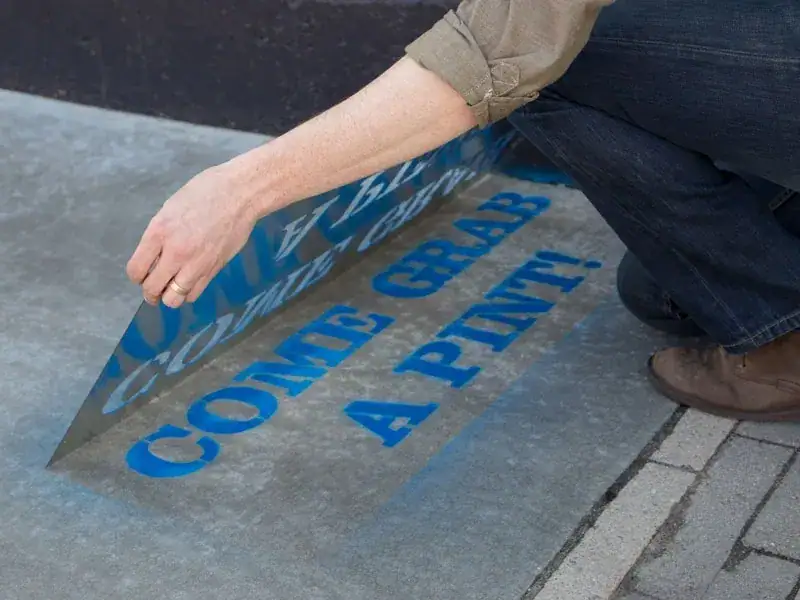
Chalk stencils use water-soluble chalk-based media applied through a precision stencil to produce bright, high-contrast impressions. They are fully temporary — lasting from several hours to a few days depending on weather and surface — which makes them ideal for event-driven campaigns in Madison. A chalk stencil campaign for a UW-Madison game day, a Dane County Farmers’ Market Saturday, or a Breese Stevens concert can be deployed that morning and will dissipate naturally without cleanup. Because chalk is non-damaging and water-soluble, it is broadly welcomed in Madison’s public spaces and is the most accessible option for navigating the city’s activation requirements for the first time.
Reverse Graffiti (Clean Graffiti)
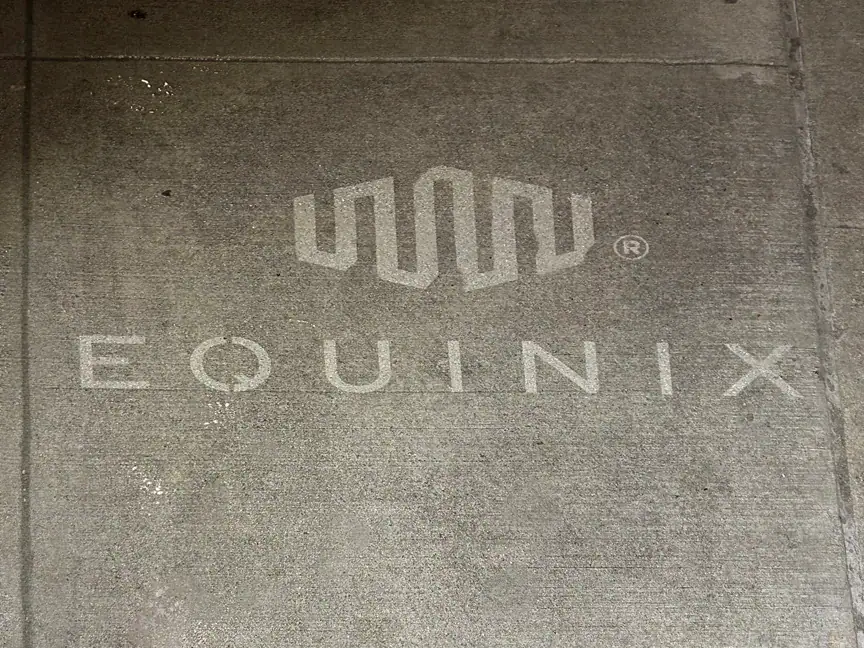
Reverse graffiti — also called clean graffiti — uses high-pressure water to selectively clean a brand pattern into an existing layer of grime or surface discoloration. The result is a photographic-quality impression in the contrast between clean and dirty pavement. Madison’s older downtown sidewalks, particularly along State Street’s western blocks and the East Washington Avenue corridor, have the surface conditions that make reverse graffiti especially striking. The technique generates strong organic social media attention and is particularly effective for sustainability-forward brands — Madison’s progressive consumer base responds to the concept of advertising that cleans rather than marks.
Paint Stencil
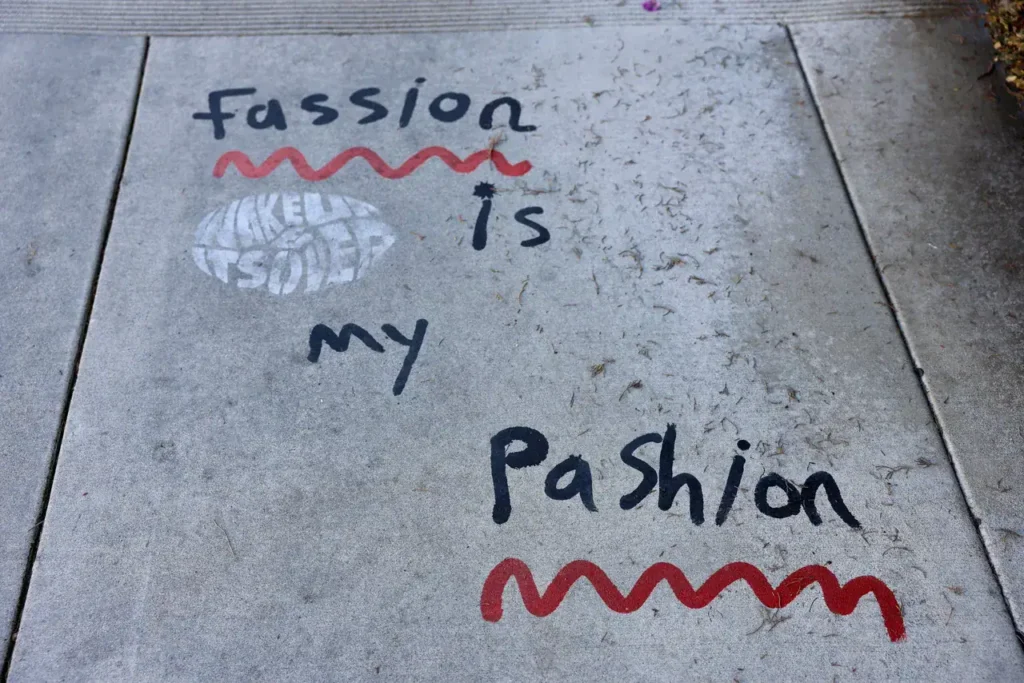
Paint stencils are the most durable format AGM deploys. Using water-based or specialty paints applied through precision-cut stencil templates, paint stencils produce sharp, lasting impressions suited for longer-duration campaigns or private property placements. For a brand anchoring a Monroe Street retail presence, a UW-adjacent business running a semester-long campaign, or a Capitol Square venue with ongoing activation needs, a paint stencil delivers consistent impressions across weeks or months. Private property authorization is always confirmed before deployment.
Water Stencil (Pressure Wash)
Water stencils use targeted pressure washing on concrete or pavement with a natural patina to create clean brand impressions. The technique is closely related to reverse graffiti but is tuned for surfaces where the contrast between cleaned and uncleaned areas produces a particularly sharp result. For Madison campaigns targeting older Capitol Square sidewalks or high-traffic pedestrian plazas near Library Mall, water stencils can produce striking results at street scale. Like reverse graffiti, this method leaves no residue and requires no paint or chemical application — an important quality for campaigns adjacent to Madison’s lakes and environmental corridors.
Get A Free Sidewalk Stencil Advertising Quote
Ready to make your brand stand out with sidewalk stencil advertising? Contact American Guerrilla Marketing to plan your campaign. Tell us your target locations, campaign goals, and timeline, and our team will help you create a customized sidewalk stencil advertising strategy that fits your needs and budget.
Award Winning Personalized Service
You will get thoughtful, devoted, and individualized attention from our experienced, qualified, and professional personnel. Being one of the most illustrious agencies in Brooklyn, New York, American Guerrilla Marketing has been awarded the Best of Brooklyn title.
Nationwide
Industry City, Brooklyn, New York 11232
American Guerrilla Marketing
Hours
Mon - Fri: 9 AM - 5 PM
Sat & Sun: Closed
Automate your campaign with AGM’s Request for Proposal Builder.
Automate your campaign with AGM’s Request for Proposal Builder. Simply answer a few quick questions about your campaign goals, markets, and timeline, and the system will generate a tailored presentation with recommended strategies, quantities, and pricing. Click the RFP Builder to instantly receive your customized proposal.
Madison Placement Strategy: Where to Put Your Stencils
Choosing the right Madison location is the single most important variable in a stencil campaign’s performance. Traffic count matters, but so does traffic composition — the right 500 people seeing your brand is worth more than 5,000 disengaged eyes. Here is how we think about placement across Madison’s key corridors.
State Street (Full Length): As a car-free pedestrian mall, State Street provides the cleanest stencil canvas of any corridor in Madison. There is no vehicle traffic to wear impressions faster, and pedestrians occupy the full width of the street rather than a narrow sidewalk strip. A campaign running the length of State Street — eight blocks from Library Mall to Capitol Square — can be structured so that pedestrians encounter multiple stencils during a single transit, building brand familiarity through repetition in a single walk.
Johnson Street & Gorham Street (Campus Approach Corridors): East Johnson Street and East Gorham Street are the primary east-west arteries that carry UW-Madison students from campus into the near-East Side neighborhoods. Stencils placed along these corridors at the intersection with North Blair Street, North Few Street, and North Ingersoll Street catch students mid-commute — in motion, ambient attention available, and not yet in the destination-focused mindset that reduces receptivity to new brand information.
University Avenue (West Campus Gateway): University Avenue between North Park Street and North Randall Avenue runs along the northern edge of the main UW-Madison campus, connecting the engineering and science buildings to the west with Library Mall and State Street to the east. It carries a large volume of student bicycle and pedestrian traffic, plus bus riders moving between the Kohl Center, Camp Randall area, and the campus core. Stencil placements along University Avenue are effective for brands targeting STEM students, engineering, and research-adjacent demographics.
East Washington Avenue (Capitol to Breese Stevens): East Washington Avenue is Madison’s primary entry corridor from the east, running from the Capitol toward I-90 and carrying heavy pedestrian and transit traffic between downtown, the Marquette neighborhood, and the growing near-East Side commercial and residential zones. Stencils placed along East Washington Avenue reach a commuter-heavy audience during peak morning and evening transit hours, plus the concert and event crowd that flows toward Breese Stevens Field on event nights.
Langdon Street (UW Fraternity/Sorority Row): Langdon Street along the south shore of Lake Mendota carries significant student foot traffic between Greek organizations, lake-facing bars and restaurants, and the adjacent campus buildings. On football Saturdays and spring weekend evenings, Langdon Street pedestrian traffic spikes dramatically. Stencil placements here reach UW-Madison’s greek-life and athletics-adjacent demographic — a highly social, brand-aware audience with strong peer-influence dynamics.
Sidewalk Stencil Pricing In Madison
Every Madison campaign is priced by stencil count. Pricing includes creative development, permitting support, professional installation, and post-campaign photo documentation. All prices are all-in — no hidden deployment or travel fees for Wisconsin markets.
Not sure which tier is right for your Madison campaign? Our team will map your target corridors, estimate pedestrian coverage by tier, and recommend the configuration that delivers the best impression density for your budget. Contact us for a no-obligation scoping call.
Available Stencil Sizes
AGM’s Sidewalk Stencils™ are produced in four standard sizes, each suited to different surface contexts and brand objectives. Smaller formats work well at doorways, crosswalk approaches, and tightly spaced pedestrian corridors. Larger formats command State Street’s open pedestrian mall, wide Capitol Square sidewalks, and the plaza spaces at Library Mall. Every Madison location assessment includes a size recommendation based on surface width, pedestrian flow direction, and visual sight lines.
- 11″ × 14″Precision placement at doorways, crosswalk corners, tight urban corridors
- 48″ × 12″Horizontal banner format for curb edges, storefronts, and directional runs
- 36″ × 18″Versatile mid-scale format for main sidewalk panels and plaza approaches
- 24″ × 24″Square format for logos, icons, and visuals built around symmetrical brand marks
How A Madison Sidewalk Stencil Campaign Works
Step 1 — Brief & Strategy: We start with your objectives, target demographic, and preferred Madison zones. If you have specific streets or events in mind, we incorporate them. If you need a recommendation, we map the corridors that match your audience profile and campaign timeline — whether that is a State Street saturation play for a UW launch or a Capitol Square activation around a legislative session.
Step 2 — Location Scouting: Our team scouts your selected Madison locations, assessing surface condition, foot traffic patterns, municipal placement requirements, and sight-line performance. We photograph and GPS-tag every approved placement point before any stenciling begins.
Step 3 — Permitting & Coordination: AGM handles coordination with Madison city contacts, the University of Wisconsin for campus-adjacent placements, property managers for private-surface deployments, and event organizers for activations tied to Capitol Square programming. We confirm every placement is cleared before deployment day.
Step 4 — Stencil Production: Your creative is translated into precision-cut stencil templates sized and configured for your chosen format. We produce exact templates for every unique placement — no one-size-fits-all shortcuts.
Step 5 — Deployment: Our trained installation crews deploy your campaign across Madison on schedule, working quickly and cleanly. Chalk and reverse graffiti campaigns can be completed overnight for a morning reveal. Paint campaigns are deployed during lower-traffic hours to ensure clean results.
Step 6 — Documentation & Reporting: Every stencil is photographed after installation, GPS-tagged, and compiled into a post-campaign report delivered to your team. You get exact placement confirmation with visual evidence for every location in the campaign.
Brands That Have Used AGM Sidewalk Stencils™
American Guerrilla Marketing’s Sidewalk Stencils™ program has been trusted by some of the most recognizable consumer brands in the world. Nike has used our pavement campaigns to drive awareness around product launches, activating street-level attention in the hours and days before major retail moments. Wrangler partnered with AGM to bring its denim brand identity into urban streetscapes in a format that felt authentic to an outdoor, working-class American aesthetic. EA Sports has leveraged stencil campaigns around game launch dates to intercept gaming audiences in high-density pedestrian environments near retail and entertainment destinations.
These campaigns demonstrate that sidewalk stenciling is not a niche tactic — it is a format that scales from local brand builders to global consumer giants. What these brands recognized is that the sidewalk is one of the last genuinely uncluttered advertising surfaces in the urban environment. There are no algorithms curating who sees it. There is no scroll that takes it away. There is no ad blocker that hides it. A person walks by, they see it, and they react.
For Madison brands, the same logic applies with particular force. In a city where the population walks constantly — to class, to the capitol, to the farmers’ market, to concerts at the Overture Center — a stencil is not an interruption. It is part of the environment. A UW-adjacent business can own the Library Mall approach. A State Street restaurant can guide foot traffic from the Capitol Square end of the corridor. A tech startup in the University Research Park can announce itself to the campus community with a morning stencil that thousands of students step over on their way to the first lecture of the day. The format is native to Madison in a way it simply is not in cities built around the car.
Frequently Asked Questions
State Street’s car-free status actually makes it one of the most favorable stencil environments AGM works with anywhere in the country. Without vehicle traffic wearing the surface, chalk stencils on State Street maintain their clarity and contrast significantly longer than on standard vehicle-adjacent sidewalks. The full eight-block length of State Street from Library Mall to Capitol Square is available for stencil campaigns subject to the City of Madison’s standard public right-of-way protocols, which AGM manages as part of every campaign. Because pedestrians occupy the full width of the mall rather than a narrow sidewalk strip, stencils can be placed in high-visibility center-corridor positions that a vehicle-traffic street would not allow.
The Dane County Farmers’ Market, held on Capitol Square every Saturday morning from April through November, is the largest producers-only farmers’ market in the United States, routinely drawing 15,000 to 20,000 visitors to the Capitol Square loop in a single morning. The market creates a slow-moving, socially engaged pedestrian flow around the entire square, with attendees spending 45 minutes to two hours browsing — an unusually long dwell time for a street-level stencil impression. Chalk stencils placed on Capitol Square the Friday evening before a Farmers’ Market Saturday are fresh and vivid when the first market visitors arrive at dawn, and they remain visible throughout the full market run. This is one of the single highest-reach stencil deployment windows available anywhere in Wisconsin.
UW-Madison is one of the largest universities in the United States, with approximately 47,000 enrolled students, and its campus generates extraordinary pedestrian density along Library Mall, the Bascom Hill approach, and the surrounding academic corridors. Campus stencil placements require coordination with UW-Madison facilities management for surfaces that fall within university jurisdiction — a process AGM handles directly. The most productive on-campus and campus-adjacent placement nodes include the Library Mall crossings where State Street meets University Avenue, the pedestrian paths around the student union, and the Langdon Street approach from the lake-facing dormitory corridor. Combined with State Street placements, a campus-plus-State-Street campaign provides essentially full coverage of UW-Madison’s mobile student population.
Willy Street is among AGM’s strongest placements in Madison for brands whose identity aligns with independent, community-oriented, sustainability-conscious values. The corridor’s consumer base is deeply loyal to businesses that share its values and highly skeptical of brands that feel corporate or inauthentic. A stencil campaign on Willy Street works best when the creative feels native to the neighborhood — direct, smart, and not over-produced. Reverse graffiti is particularly strong here: the concept of cleaning rather than marking resonates with the environmental sensibility of Willy Street’s consumer base, and the organic social media documentation it generates from community members extends the campaign’s reach into Madison’s progressive social networks at no additional cost.
Camp Randall Stadium on the UW-Madison campus is one of the largest stadiums in college football, with a capacity exceeding 80,000. Home game Saturdays produce extraordinary pedestrian density along Regent Street, Breese Terrace, and the surrounding blocks as fans move from tailgate zones, campus parking, and nearby bars to the stadium gates. The pedestrian flow is predictable and consistent, moving toward the stadium in the hours before kickoff and dispersing along the same routes after the game. Chalk stencils placed along the main pedestrian approaches the morning of a home game intercept one of the largest single-day concentrations of pedestrian foot traffic in Wisconsin. This is one of the most compelling single-day activation opportunities in the state for sports, food and beverage, and consumer brands.
Madison hosts an exceptionally dense summer festival calendar, including Orton Park Festival, the Willy Street Fair, the Marquette Neighborhood Association’s various events, and numerous Capitol Square concerts and outdoor programming. Each of these events concentrates a defined neighborhood audience into a walkable zone for a day or weekend, creating a stencil opportunity that combines the organic reach of a neighborhood event with the impression efficiency of a defined geographic deployment. AGM can plan stencil campaigns around any of these events, customizing placement zones to match the specific pedestrian flows each festival generates in its surrounding blocks.
Monroe Street is AGM’s preferred Madison placement for brands targeting professional adults aged 30–55, families with higher household incomes, and consumers who favor premium and independent retail over mass-market alternatives. The corridor’s proximity to the Nakoma, Vilas, and Dudgeon-Monroe neighborhoods — some of the highest median-income zip codes in Dane County — means the Monroe Street foot traffic skews toward a demographic that is actively spending and relatively brand-loyal. Stencils on Monroe Street maintain visibility significantly longer than State Street placements because the pedestrian volume is lower and there is less surface wear from foot traffic, meaning a campaign in this corridor can generate extended impressions at a given stencil count.
Madison’s isthmus is the single most important geographic factor in campaign structuring. Because the downtown isthmus is a narrow east-west strip bounded by two lakes, there are only a limited number of north-south corridors that connect the neighborhoods on either side — which means pedestrian traffic naturally funnels through predictable chokepoints. A stencil campaign that targets the major north-south crossing points on the isthmus — Park Street, Blair Street, Pinckney Street, and the State Street pedestrian mall itself — achieves coverage of virtually the entire isthmus pedestrian population with relatively few stencils. This geographic compression makes Madison uniquely efficient for stencil campaigns compared to sprawling cities where coverage requires far more placements to achieve comparable reach.
AGM manages all permitting coordination for every Madison campaign. This includes coordination with the City of Madison Department of Public Works for public right-of-way placements, UW-Madison facilities management for campus-adjacent surfaces, and individual property owners for private surface deployments. Madison has a well-defined permitting framework for temporary public space activations, and our team has navigated it for campaigns in comparable markets. All permitting work is included in the campaign scope — clients do not manage city contacts or research local code requirements themselves.
Standard Madison campaign lead time is two to three weeks from brief confirmation to deployment, covering location scouting, permitting coordination, stencil production, and crew scheduling. For campaigns tied to UW-Madison home football games, the Farmers’ Market season opener, or other high-demand calendar events, we recommend initiating the process four weeks in advance to ensure all placement clearances are secured. Rush chalk stencil activations for last-minute event opportunities can occasionally be accommodated, but standard lead times allow us to deliver a campaign that performs at the level Madison’s pedestrian environment makes possible.
Our Campaign Locations
Browse All States
Explore Sidewalk Stencil Advertising opportunities across the United States.
49 States • 201 Cities