American Guerrilla Marketing
Nationwide Service
Media planning, media buying, billboard advertising, & guerrilla marketing
Sidewalk Stencil Advertising in Tacoma, Washington

Turn Tacoma’s most-walked corridors into high-visibility brand touchpoints. From the 6th Avenue independent district to UWT’s downtown campus blocks, Sidewalk Stencils™ by AGM put your message exactly where pedestrians look — underfoot, unavoidable, and impossible to scroll past.
Tacoma has spent the past two decades rewriting its own narrative, and the rewrite is working. The City of Destiny — once overshadowed by its neighbor to the north — has developed a legitimate urban identity built on a thriving arts scene, a nationally recognized Museum District, a growing University of Washington campus, and a collection of neighborhood commercial corridors that now rival any in the Puget Sound region. That development has created something invaluable for advertisers: dense, walkable zones where consumers move at a human pace, take in their surroundings, and make decisions. Sidewalk Stencils™ are built for exactly that environment.
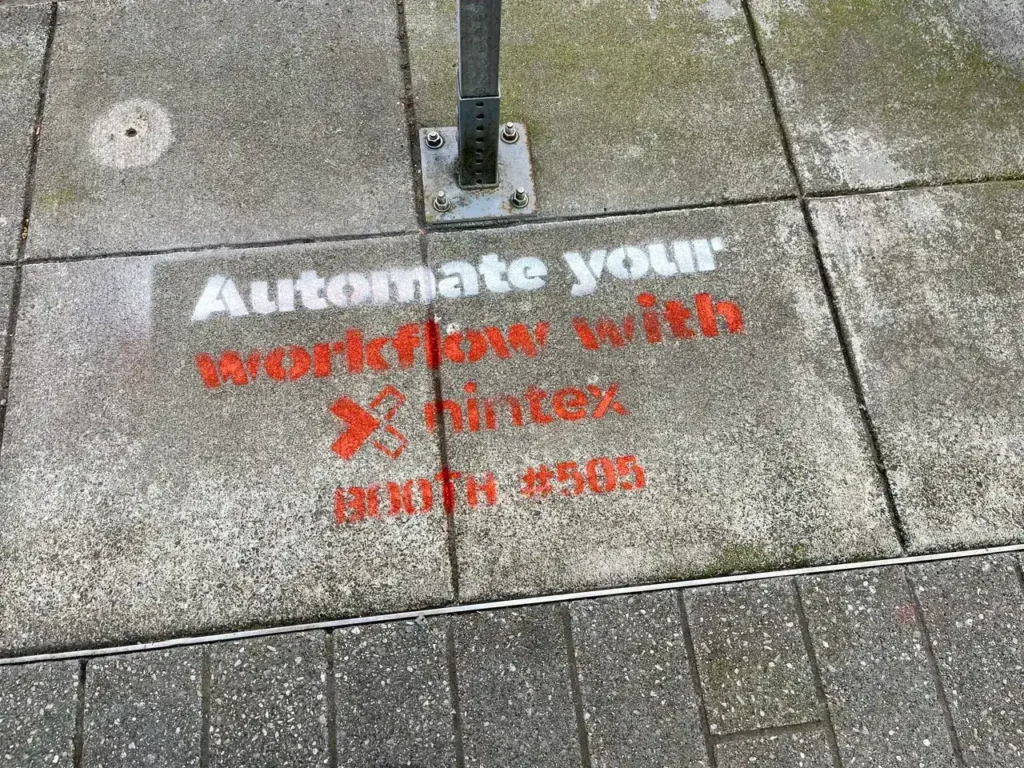
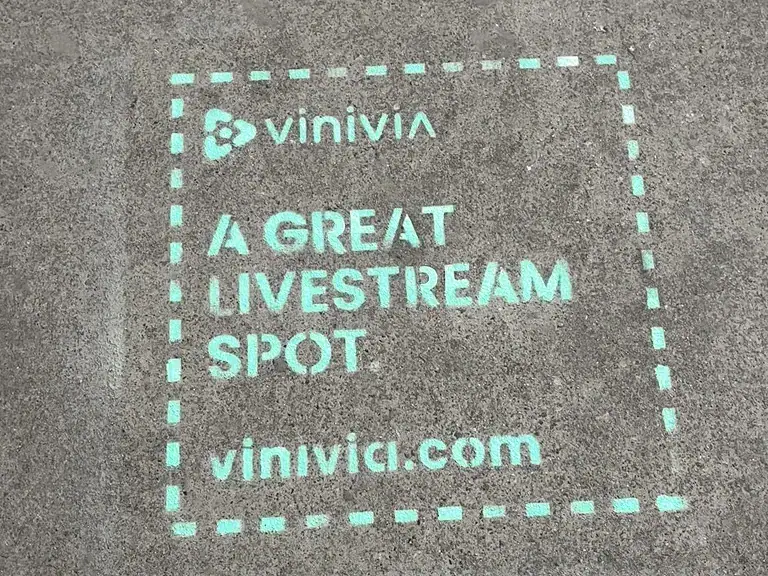
A Sidewalk Stencil™ is a brand impression applied directly to the pavement — the sidewalk, plaza, crosswalk, or any high-foot-traffic surface. Unlike a billboard mounted above the street or a digital ad that interrupts a feed, a stencil intercepts attention naturally at the ground level where pedestrians already direct their gaze. Tacoma residents and visitors encounter it without anticipating it, producing the kind of genuine, unguarded moment of brand engagement that most advertising formats struggle to replicate in a market this size.
American Guerrilla Marketing has executed Sidewalk Stencil™ campaigns across the country for brands including Nike, Wrangler, and EA Sports. The process is precise: we scout your preferred Tacoma locations, identify surfaces with the right foot traffic and texture, determine the appropriate stencil method, and deploy on schedule. Every campaign is documented with photos and GPS-tagged placement reports so your team can verify coverage without leaving the office.
Tacoma’s advertising landscape has a distinctive characteristic: it is not saturated. Unlike Seattle, where every surface and sightline competes for attention, Tacoma’s walkable corridors remain genuinely open for street-level brand presence. That means the novelty premium is intact — a well-executed stencil on 6th Avenue or in the Theater District stands out rather than blending into a cluttered visual environment. Advertisers who recognize this early capture that first-mover advantage at a fraction of the cost of equivalent exposure in larger Pacific Northwest markets.
Whether you are a local Tacoma business looking to expand your block presence, a regional brand building recognition across Pierce County, or a national company entering the South Sound market for the first time, Sidewalk Stencils™ give you a format that the city cannot ignore. The pavement is the medium. Tacoma’s foot traffic is the audience. We connect the two.
Ready to Own Tacoma's Sidewalks?
From 6th Avenue to the Museum District, AGM puts your brand exactly where Tacoma walks. Let's build your campaign.
Why Tacoma Is Built For Sidewalk Stencil Campaigns
Tacoma’s walkable zones are more concentrated and more varied than the city’s overall footprint suggests. The 6th Avenue commercial strip, the downtown Theater District and Pacific Avenue corridor, the Proctor District, the Museum District along the Foss Waterway, and the University of Washington Tacoma campus each function as distinct pedestrian ecosystems with their own traffic patterns and consumer demographics. A well-planned stencil campaign here does not require covering the whole city — it means deploying with precision inside the corridors where Tacoma’s most active consumers already choose to spend their time.
6th Avenue — South Fife Street to South Orchard Street
6th Avenue is Tacoma’s most celebrated independent neighborhood commercial strip. The stretch between South Fife Street and South Orchard Street concentrates craft breweries, independent restaurants, coffee roasters, vintage shops, and live music venues into a walkable corridor that draws foot traffic from across the South Sound region. The street’s character — independent, local, slightly irreverent — makes it an ideal environment for street-level advertising that feels native to the neighborhood rather than imposed on it. An evening on 6th Avenue sees bar-goers, diners, and couples walking between venues, moving slowly and taking in their surroundings in exactly the way that produces maximum stencil engagement. A chalk stencil at the corner of 6th and Sprague, or along the bar corridor approaching Ferdinand’s, is encountered by virtually every visitor to the district over the course of a weekend evening.
Downtown Theater District — Broadway & Pacific Avenue
Tacoma’s Theater District anchors the city’s downtown cultural identity. The Pantages Theater, the Rialto Theater, the Tacoma Art Museum, and the Washington State History Museum cluster along Broadway between 7th and 11th Streets, creating a pedestrian zone that draws audiences for performances, museum visits, and the surrounding restaurants and bars that serve the pre- and post-show crowd. Pacific Avenue runs parallel as a primary pedestrian artery through downtown, connecting the Theater District to the UWT campus and the Foss Waterway to the south. On performance nights at the Pantages or the Rialto, the theater district sidewalks see the highest-concentration foot traffic in downtown Tacoma — and that audience is in an elevated, experiential mindset that makes brand impressions especially effective.
UWT Campus — Commerce Street & Pacific Avenue
The University of Washington Tacoma campus has grown from a single building into a sprawling urban campus that occupies a significant section of downtown Tacoma’s historic warehouse district. Commerce Street and Pacific Avenue serve as the primary pedestrian arteries connecting UWT’s academic buildings, student services, and the surrounding coffee shops, lunch spots, and convenience retailers. The campus generates a continuous flow of student, faculty, and staff foot traffic throughout the academic day. UWT’s enrollment of roughly 5,000 students creates a dense, young demographic within a compact downtown footprint — and unlike a traditional suburban campus, UWT students move through the same sidewalks as downtown commuters, museum visitors, and residents, which means stencil placements here reach multiple audience segments simultaneously.
Museum District — Foss Waterway & Pacific Avenue South
Tacoma’s Museum District along the Foss Waterway is one of the most distinctive cultural destinations in the Pacific Northwest. The Museum of Glass — with its iconic hot shop cone visible from the highway — the Washington State History Museum, and the Tacoma Art Museum draw hundreds of thousands of visitors annually to a relatively compact walkable zone. The pedestrian bridge over the Foss Waterway connecting the museums to the downtown core creates a natural corridor where visitors slow down, look around, and absorb their environment — exactly the kind of pedestrian behavior that maximizes stencil engagement. A brand impression placed on the bridge approach or on the Pacific Avenue South museum frontage reaches an audience that is actively in discovery mode.
Proctor District — North 26th Street & Proctor Avenue
The Proctor District is Tacoma’s most established neighborhood commercial corridor — a stretch of North 26th Street and Proctor Avenue that has served the North End’s residential community for generations. The neighborhood’s mix of independent coffee shops, bookstores, specialty food retailers, and local restaurants draws a loyal base of Tacoma residents who prioritize neighborhood shopping and dining over chain alternatives. The Proctor Farmers Market, held weekly in the district’s parking area, concentrates the North End’s consumer community into a defined pedestrian zone on market days — creating a dwell-rich activation opportunity for brands that align with the neighborhood’s locally-invested values. This is Tacoma’s version of a high-trust neighborhood audience, and stencil placements here carry the credibility of the neighborhood itself.
Tacoma Dome & Event Corridor — East D Street Approach
The Tacoma Dome is one of the largest events venues in the Pacific Northwest, hosting concerts, sporting events, trade shows, and conventions that draw audiences from throughout Pierce County and the broader South Sound region. The East D Street corridor and the surrounding pedestrian approaches from the Light Rail station and the adjacent parking structures channel arriving audiences into a compact network of sidewalks before each major event. For large-scale concerts or Tacoma Rainiers baseball playoff activations, these approach corridors concentrate thousands of fans within a short distance of a stencil placement — delivering the kind of compressed, high-energy audience exposure that most out-of-home formats cannot match at equivalent cost.
Stencil Types Available In Tacoma
Every Tacoma location has different pavement conditions, brand requirements, and campaign duration goals. AGM offers four distinct stencil methods, and we help you select the right one based on your specific surface, timeline, and objective.
Chalk Stencil
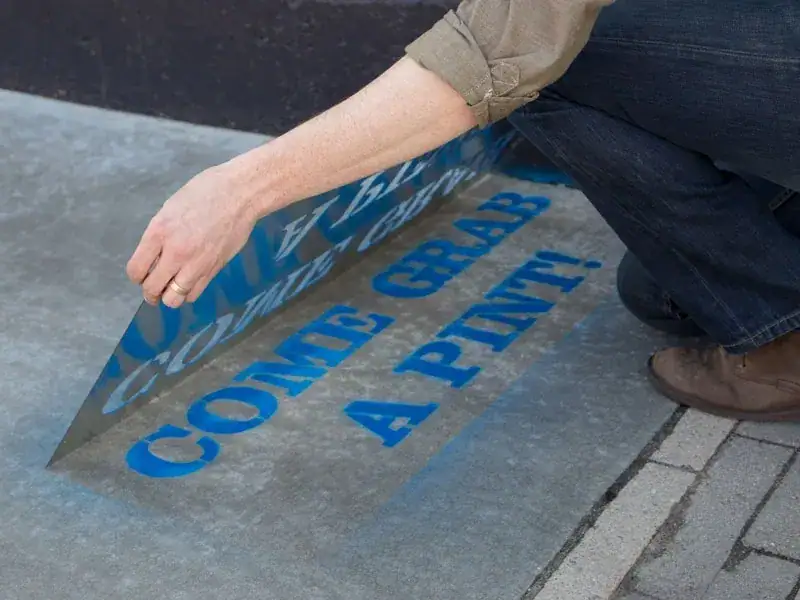
Chalk stencils use water-soluble chalk-based media applied through a precision stencil to produce bright, high-contrast impressions. They are fully temporary — lasting anywhere from several hours to a few days depending on weather and surface — which makes them ideal for event-driven campaigns in Tacoma. A chalk stencil campaign timed to a Tacoma Art Museum opening night, a Pantages Theater performance weekend, or a Tacoma Rainiers home playoff series can be deployed the morning of the event and dissipate naturally without any cleanup effort. Because chalk is non-damaging and water-soluble, it is broadly welcomed in city-approved public spaces and is the most accessible option for brands navigating Tacoma’s permitting landscape for the first time.
Reverse Graffiti (Clean Graffiti)
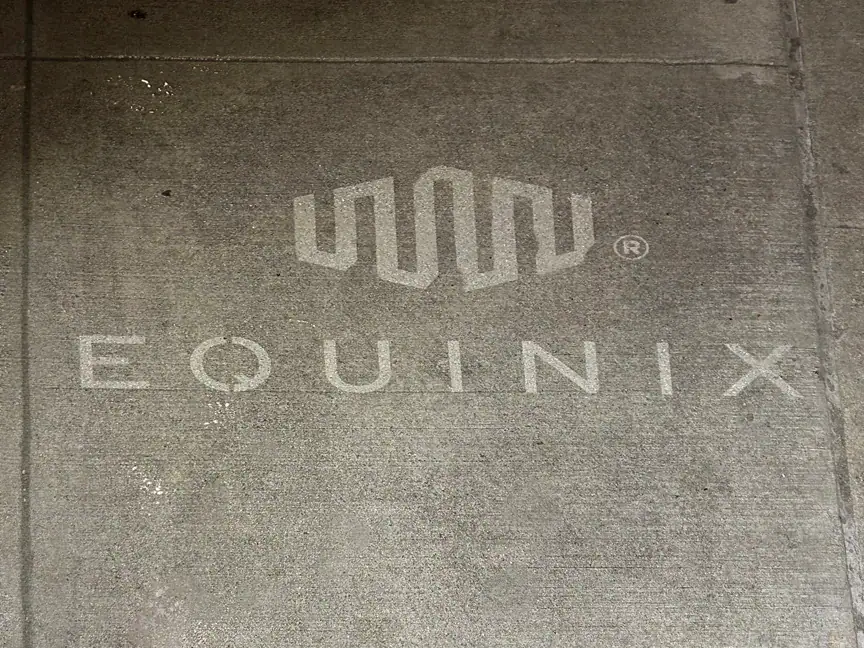
Reverse graffiti — also called clean graffiti — does not apply anything to a surface. Instead, it uses high-pressure water to selectively clean a brand pattern into an existing layer of grime, exhaust residue, or surface discoloration. The result is a photographic-quality impression in the contrast between clean and dirty pavement. Tacoma’s historic downtown sidewalks — particularly along Broadway, Pacific Avenue, and the older industrial-heritage surfaces of the Foss Waterway corridor — have exactly the kind of accumulated surface patina that makes reverse graffiti visually striking. The technique also generates organic social media documentation, which is particularly valuable in a market like Tacoma where novel street-level advertising can generate earned media attention that amplifies the campaign far beyond its immediate pedestrian audience.
Paint Stencil
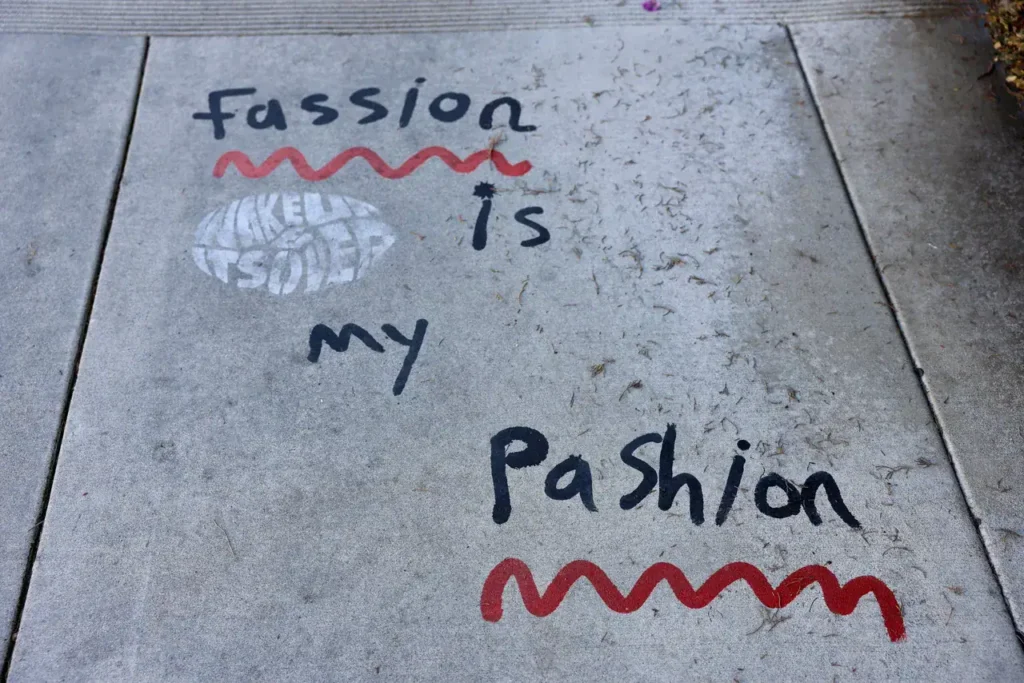
Paint stencils are the most durable format AGM deploys. Using water-based or specialty paints applied through precision-cut stencil templates, paint stencils produce sharp, lasting impressions suited for longer-duration campaigns or placements on private property. For a brand anchoring a presence on 6th Avenue through an entire season, a retail business marking its block in the Proctor District, or a venue that wants consistent brand presence on surrounding sidewalks through a full performance schedule, a paint stencil on private-property surfaces delivers reliable impressions across weeks or months. The format supports complex brand marks, full logos, and multi-color designs at any of our available sizes.
Water Stencil (Pressure Wash)
Water stencils use targeted pressure washing on specific surface types — typically concrete or pavement with a natural patina — to create clean brand impressions. For Tacoma campaigns targeting the warehouse-era concrete and brick sidewalks through the Museum District and the UWT campus zone, water stencils can produce gallery-quality results at street scale. The technique is particularly effective on Tacoma’s older downtown surfaces, where years of high foot traffic and Pacific Northwest moisture have produced the kind of surface texture that responds dramatically to selective pressure washing. Like reverse graffiti, this method leaves no residue and requires no paint or chemical application.
Get A Free Sidewalk Stencil Advertising Quote
Ready to make your brand stand out with sidewalk stencil advertising? Contact American Guerrilla Marketing to plan your campaign. Tell us your target locations, campaign goals, and timeline, and our team will help you create a customized sidewalk stencil advertising strategy that fits your needs and budget.
Award Winning Personalized Service
You will get thoughtful, devoted, and individualized attention from our experienced, qualified, and professional personnel. Being one of the most illustrious agencies in Brooklyn, New York, American Guerrilla Marketing has been awarded the Best of Brooklyn title.
Nationwide
Industry City, Brooklyn, New York 11232
American Guerrilla Marketing
Hours
Mon - Fri: 9 AM - 5 PM
Sat & Sun: Closed
Automate your campaign with AGM’s Request for Proposal Builder.
Automate your campaign with AGM’s Request for Proposal Builder. Simply answer a few quick questions about your campaign goals, markets, and timeline, and the system will generate a tailored presentation with recommended strategies, quantities, and pricing. Click the RFP Builder to instantly receive your customized proposal.
Tacoma Placement Strategy: Where to Put Your Stencils
Choosing the right Tacoma location is the single most important variable in a stencil campaign’s performance. Traffic count matters, but so does traffic composition — the right 500 people seeing your brand is worth more than 5,000 disengaged eyes. Here is how we think about placement across Tacoma’s key corridors.
6th Avenue at South Fife Street (District Entry): The informal entry point to 6th Avenue’s commercial core at South Fife Street is where foot traffic from the Stadium District and Hilltop neighborhoods begins to concentrate before dispersing along the commercial strip. A stencil placed at this intersection intercepts virtually every 6th Avenue visitor before they reach their destination — the highest-value position in the district’s pedestrian flow.
Broadway between 9th and 11th Streets (Theater District Core): The two-block stretch of Broadway between 9th and 11th Streets concentrates the Theater District’s cultural anchors — the Pantages, the Rialto, and the Tacoma Art Museum — into a tight pedestrian zone. On performance nights, this corridor sees slow, social foot traffic with long dwell times as theatergoers arrive early, linger after the curtain, and compare notes on the sidewalk outside venues. A stencil placed along this stretch gets multiple reads from the same pedestrian over the course of a single evening visit.
Pacific Avenue (Downtown Spine): Pacific Avenue is Tacoma’s primary downtown artery, connecting the Theater District to the north, the UWT campus in the middle, and the Foss Waterway museum cluster to the south in a single continuous pedestrian corridor. A campaign placed along Pacific Avenue reaches the broadest cross-section of Tacoma’s downtown population — students, museum visitors, theatergoers, downtown workers, and Transit Center commuters — in a single deployment.
Tacoma Link Light Rail Stops (Commerce & Pacific): Tacoma’s Link Light Rail connects the Tacoma Dome station with the downtown core at Commerce Street and Pacific Avenue, delivering a continuous stream of commuters, students, and event-goers to multiple stops within the pedestrian district. Light rail stops create natural dwell zones where waiting riders are stationary, phone-free moments occur, and ambient attention is highest. A stencil placed at the Commerce Street or Stadium District stops reaches these moments of captured attention repeatedly throughout the day.
Proctor Street at North 27th (Farmers Market Hub): The Proctor Farmers Market site creates a weekly concentration of Tacoma’s most locally-invested consumers in the North End. On market days, the surrounding sidewalks see a slow, browsing foot traffic pattern with high dwell times and strong community social engagement. A stencil placed at the market perimeter on a Saturday morning reaches this audience during its most relaxed and receptive moment — far more effectively than any digital format that competes for the same consumer’s divided screen attention.
Sidewalk Stencil Pricing In Tacoma
Every Tacoma campaign is priced by stencil count. Pricing includes creative development, permitting support, professional installation, and post-campaign photo documentation. All prices are all-in — no hidden deployment or travel fees for Washington State markets.
Not sure which tier is right for your Tacoma campaign? Our team will map your target corridors, estimate pedestrian coverage by tier, and recommend the configuration that delivers the best impression density for your budget. Contact us for a no-obligation scoping call.
Available Stencil Sizes
AGM’s Sidewalk Stencils™ are produced in four standard sizes, each suited to different surface contexts and brand objectives. Smaller formats work well at doorways, crosswalk approaches, and tightly spaced pedestrian corridors like 6th Avenue’s bar strip. Larger formats command the open plaza environments of the Museum District waterfront, the wide sidewalks along Broadway in the Theater District, and the high-clearance zones around the Tacoma Dome approaches. Every Tacoma location assessment includes a size recommendation based on surface width, pedestrian flow direction, and visual sight lines.
- 11″ × 14″Precision placement at doorways, crosswalk corners, tight urban corridors
- 48″ × 12″Horizontal banner format for curb edges, storefronts, and directional runs
- 36″ × 18″Versatile mid-scale format for main sidewalk panels and plaza approaches
- 24″ × 24″Square format for logos, icons, and visuals built around symmetrical brand marks
How A Tacoma Sidewalk Stencil Campaign Works
Step 1 — Brief & Strategy: We start with your objectives, target demographic, and preferred Tacoma zones. If you have specific streets or events in mind, we incorporate them. If you need a recommendation, we map the corridors that match your audience profile and campaign timeline.
Step 2 — Location Scouting: Our team scouts your selected Tacoma locations, assessing surface condition, foot traffic patterns, municipal placement requirements, and sight-line performance. We photograph and GPS-tag every approved placement point before any stenciling begins.
Step 3 — Permitting & Coordination: AGM handles coordination with City of Tacoma contacts, property managers for private-surface placements, and event organizers for performance-adjacent activations at Pantages Theater, Tacoma Art Museum openings, or Tacoma Dome events. We confirm every placement point is cleared before deployment day.
Step 4 — Stencil Production: Your creative is translated into precision-cut stencil templates sized and configured for your chosen format. We produce exact templates for every unique placement — no one-size-fits-all shortcuts.
Step 5 — Deployment: Our trained installation crews deploy your campaign across Tacoma on schedule, working quickly and cleanly. Chalk and reverse graffiti campaigns can be completed overnight for a morning reveal. Paint campaigns are deployed during lower-traffic hours to ensure clean results.
Step 6 — Documentation & Reporting: Every stencil is photographed after installation, GPS-tagged, and compiled into a post-campaign report delivered to your team. You get exact placement confirmation with visual evidence for every location in the campaign.
Brands That Have Used AGM Sidewalk Stencils™
American Guerrilla Marketing’s Sidewalk Stencils™ program has been trusted by some of the most recognizable consumer brands in the world. Nike has used our pavement campaigns to drive awareness around product launches, activating street-level attention in the hours and days before major retail moments. Wrangler partnered with AGM to bring its denim brand identity into urban streetscapes in a format that felt authentic to an outdoor, working-class American aesthetic. EA Sports has leveraged stencil campaigns around game launch dates to intercept gaming audiences in high-density pedestrian environments near retail and entertainment destinations.
These campaigns demonstrate that sidewalk stenciling is not a niche tactic — it is a format that scales from local brand builders to global consumer giants. What these brands recognized is that the sidewalk is one of the last genuinely uncluttered advertising surfaces in the urban environment. There are no algorithms curating who sees it. There is no scroll that takes it away. There is no ad blocker that hides it. A person walks by, they see it, and they react.
For Tacoma brands, the calculus is compelling. The city’s consumer base is growing, increasingly sophisticated, and deeply loyal to brands that show up authentically in its neighborhoods. A business that deploys a well-crafted stencil on 6th Avenue or in the Proctor District is not just placing an advertisement — it is participating in the neighborhood’s visual culture in a way that earns credibility alongside attention. That combination of awareness and affinity is exactly what the best Sidewalk Stencil™ campaigns produce, and it is why the format continues to attract brands at every scale from local Tacoma restaurants to national consumer companies entering the South Sound for the first time.
Frequently Asked Questions
6th Avenue is AGM’s strongest Tacoma placement for campaigns targeting the 21–35 demographic. The strip’s concentration of independent bars, restaurants, and entertainment venues draws Tacoma’s most socially active young adult population on evenings and weekends. The foot traffic is slow and social — people are walking between venues, not commuting through — which means dwell time per stencil impression is significantly longer than on a typical downtown sidewalk. A chalk stencil placed at the informal district entry near South Fife Street, or at the high-traffic intersection near Masa or Dirty Oscar’s Annex, is encountered by virtually every 6th Avenue visitor during the campaign window. For brands targeting Tacoma’s millennial and Gen Z consumer, 6th Avenue delivers the right audience in the right mindset.
Theater district activations are among the most effective single-event stencil deployments AGM executes in Tacoma. The Pantages Theater and the Rialto Theater draw audiences that arrive early, linger after shows, and move slowly through the surrounding sidewalks — producing dwell times that rival the best static placements in any format. AGM deploys chalk stencils the day of a major performance on Broadway between 9th and 11th Streets and on the Pacific Avenue approach from the Transit Center. For weekend runs of multi-night performances, a campaign can cover Friday and Saturday evenings with a single deployment, capturing both nights’ audiences before the first significant rain event resets the surface. We coordinate with theater management to ensure placement approval and timing alignment with the performance schedule.
UWT’s downtown campus is one of AGM’s most distinctive Tacoma placements because it delivers a college-aged audience inside an urban mixed-use environment rather than a traditional suburban campus. Students on Commerce Street and Pacific Avenue are moving through the same sidewalks as downtown workers, museum visitors, and Transit Center commuters — which means a stencil placed on these corridors captures multiple demographics simultaneously. For brands targeting college students specifically, the highest-density windows are the midday period between class sessions and the transition from the academic day to the evening, when students move from campus toward 6th Avenue, the downtown bars, or the Transit Center for their commute home.
The Tacoma Museum District — the Museum of Glass, the Washington State History Museum, and the Tacoma Art Museum clustered along the Foss Waterway and Pacific Avenue South — draws visitors who are in an active discovery mindset. People who walk the museum district are looking at things, paying attention to their surroundings, and open to new visual inputs in a way that a commuter or a purposeful errand-runner is not. That heightened visual engagement translates directly into stronger stencil noticeability. The pedestrian bridge over the Foss Waterway is a particularly powerful placement — visitors slow down on the bridge, take in the view, and look at their surroundings from a stationary position for several seconds. A stencil on the bridge deck or at either approach is seen in the most attentive way possible.
The Tacoma Dome is one of the Pacific Northwest’s largest event venues, and its surrounding pedestrian approaches create significant activation opportunities for major concerts, trade shows, and sporting events. The Light Rail connection from the Tacoma Dome station into downtown means a substantial portion of any event’s audience arrives on foot, moving through the East D Street corridor and the surrounding sidewalks from the station to the venue entrance. A chalk stencil campaign deployed the morning of a major Dome event intercepts this audience at peak concentration in its pre-event mode — the highest-energy and most brand-receptive moment of the day. We coordinate event-day timing with Dome event schedules to ensure maximum freshness at peak foot traffic windows.
Tacoma’s historic downtown sidewalks are among the best reverse graffiti surfaces in the South Sound region. The older concrete along Broadway, the warehouse-era brick pavement in portions of the Foss Waterway corridor, and the high-use surfaces on Pacific Avenue have all developed the kind of accumulated surface patina that produces striking contrast when selectively cleaned. A reverse graffiti campaign in Tacoma’s Theater District or Museum District generates immediate visual attention and strong organic social media documentation — particularly valuable in a market where a novel street-level activation can generate local press coverage and social sharing that extends the campaign’s reach well beyond its immediate pedestrian audience.
The Proctor District’s consumer profile — North End Tacoma residents who prioritize local businesses, independent retail, and quality over convenience — makes it an ideal placement for food and beverage brands, independent retail concepts, lifestyle brands, and any product with a “local first” or artisan positioning. It is less effective for mass-market consumer products that do not align with the neighborhood’s independent ethos. The Proctor Farmers Market window is particularly strong for organic, food, health, and wellness brands — the weekly market draws Tacoma’s most health-conscious and locally-invested consumer demographic to a single location for several hours each Saturday. A stencil present for that window earns credibility simply by showing up in the right place.
AGM manages all permitting coordination for every Tacoma campaign. City of Tacoma requirements vary based on stencil method and placement location — chalk stencils on public sidewalks operates under different parameters than paint on private surfaces — and our team navigates those requirements as part of the campaign planning process. Clients never manage city contacts or research local code requirements themselves. For event-adjacent placements near Tacoma Dome shows or Theater District performances, we coordinate directly with venue and event management as part of standard campaign preparation. All permitting work is included in the campaign scope.
A neighborhood-scale stencil campaign is one of the most cost-effective grand opening awareness tools available to a new Tacoma business. A restaurant opening on 6th Avenue can place chalk stencils along the approach sidewalks and at the district entry points the week before opening — building curiosity and foot traffic before the first service. A business opening in the Proctor District can use a focused 20–30 stencil campaign to ensure that every regular visitor to the neighborhood sees the new name multiple times before opening day. The format works at this scale because it targets the exact geographic community that a neighborhood business needs to convert into regulars. No other advertising format can achieve the same geographic precision at a comparable cost.
Standard Tacoma campaign lead time is two to three weeks from brief confirmation to deployment, covering location scouting, permitting coordination, stencil production, and crew scheduling. For event-driven campaigns tied to Tacoma Dome shows, Theater District opening nights, or seasonal market activations in the Proctor District, we recommend initiating the process four weeks in advance to ensure placement clearances are fully secured before deployment day and the most impactful locations are available.
Our Campaign Locations
Browse All States
Explore Sidewalk Stencil Advertising opportunities across the United States.
49 States • 201 Cities