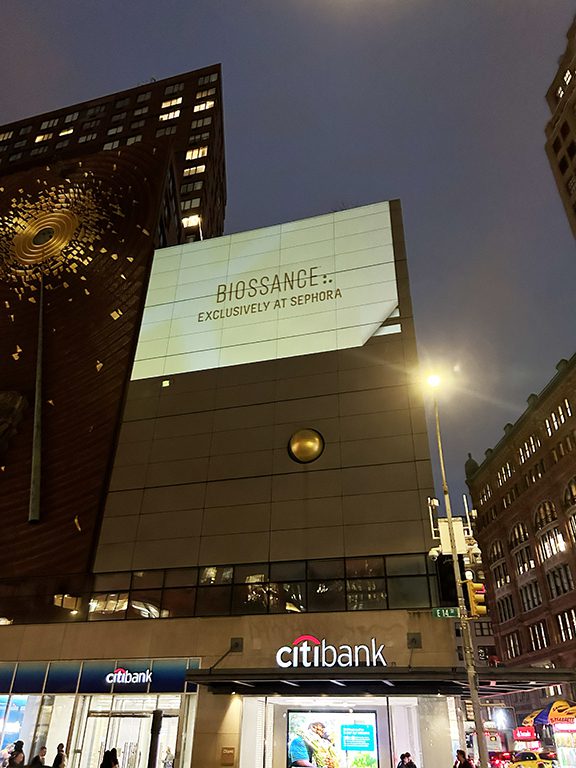
New York is where we cut our teeth. We have run projection advertising campaigns across SoHo, the Lower East Side, Williamsburg, and the Meatpacking District. This is what the NYC market actually requires and how we deliver it.
New York City is the most demanding projection advertising market in the United States. The density is unmatched. The ambient light competition from commercial signage, streetlights, and illuminated storefronts is intense. The streets are narrow by comparison to other American cities, which creates throw distance challenges in some neighborhoods. And the competition for cultural attention from an audience that is exposed to more advertising than almost any other American urban population means that a projection campaign that would generate significant attention in a smaller market has to work harder in New York to achieve the same impact.
It is also the most valuable projection advertising market in the country. The density that creates operational challenges also concentrates more of the target audience for most brand campaigns into a smaller geographic area than any other American city. The neighborhoods that matter most for cultural brand campaigns, SoHo, the Lower East Side, Williamsburg, the Meatpacking District, and others, have some of the highest social media documentation activity of any neighborhoods anywhere. A projection in SoHo on a Thursday or Friday night at the right location will be photographed by hundreds of people and shared across platforms by a disproportionate number of people with large, brand-relevant social media audiences.
We are based in New York. This is our home market. We know every relevant building, every neighborhood’s ambient light profile at operating hours, every logistical wrinkle that can affect a projection campaign in Manhattan, Brooklyn, or Queens. This guide covers what makes projection advertising work in New York City specifically, which neighborhoods perform best for which campaign types, how we plan and execute campaigns in the market, and what the cost of a NYC projection campaign looks like.
New York’s physical environment creates specific conditions for projection advertising that differ from every other US market. Understanding these conditions is the foundation of planning a campaign that performs at the level the city makes possible.
Ambient Light
New York City, particularly Manhattan, has some of the highest ambient light levels of any urban environment in the world. Commercial signage, streetlights, building lobbies, and restaurant and bar frontage all contribute to a nighttime light environment that is significantly brighter than comparable neighborhoods in Los Angeles, Chicago, or other major cities. This higher ambient light level means that projection advertising in New York requires higher lumen output projectors than comparable surface sizes would require in less lit markets. Our standard 20,000-lumen setup handles the majority of New York City locations, but for high-ambient-light corridors like certain blocks in Midtown, the Meatpacking District on busy nights, or locations adjacent to large commercial signage, we scale to higher output equipment based on what the site survey confirms.
Street Width and Throw Distance
Manhattan’s historic street grid was designed before automobiles, and many blocks have effective street widths significantly narrower than those in Los Angeles or other car-centric cities. Narrower streets mean shorter available throw distances from across-the-street projector positions. Shorter throw distances mean smaller projected image sizes at a given projector position unless a wider-angle lens is used, which reduces image brightness. We work with these constraints rather than around them by selecting buildings where the block geometry allows adequate throw distance, and by using lens configurations optimized for the available throw in each confirmed location.
Building Stock
New York has an exceptionally varied building stock that ranges from nineteenth-century cast-iron facades in SoHo to mid-century concrete towers in Midtown to modern glass curtain-wall construction in Hudson Yards. The cast-iron facades of SoHo, while architecturally iconic, have significant window ratios that interrupt projection surfaces. The painted brick buildings of the Lower East Side, Williamsburg, and Bushwick have surfaces that work very well with adequate projector output. The concrete buildings of the warehouse districts and certain Chelsea and Meatpacking blocks are excellent projection surfaces. We survey each location individually rather than making assumptions about building surface quality from neighborhood or building type alone.
Key Neighborhoods for Projection Advertising in New York City
Neighborhood
Borough
Best For
Peak Nights
SoHo
Manhattan
Fashion, luxury, culture, art, retail
Thursday through Sunday
Lower East Side
Manhattan
Music, streetwear, nightlife, youth culture
Friday and Saturday
Meatpacking District
Manhattan
Fashion, nightlife, entertainment, hospitality
Thursday through Saturday
Williamsburg
Brooklyn
Music, creative, food and beverage, independent brands
Friday and Saturday
Dumbo
Brooklyn
Tech, creative, arts, architecture-forward brands
Friday and Saturday
Bushwick
Brooklyn
Art, music, creative industries, streetwear
Friday and Saturday
Astoria / Long Island City
Queens
Broader audience reach, arts, food and beverage
Friday and Saturday
What Makes NYC Projection Advertising Campaigns Succeed
We have run enough projection campaigns in New York to know what consistently separates the ones that generate significant organic documentation and brand impact from the ones that simply run without building much secondary reach. The factors are consistent and apply regardless of brand category or campaign type.
Location Precision
In New York, being on the right block matters more than it does in less dense markets. A projection on Crosby Street in SoHo operates in a completely different audience environment than a projection two blocks away on Broadway, even though both are technically in SoHo. The foot traffic patterns, the social media activity of the people in those specific locations at night, and the cultural associations of specific sub-blocks all differ substantially. We site-survey at the block level, not the neighborhood level, and the location precision that comes from that approach makes a measurable difference in campaign documentation and social reach.
Timing Relative to Neighborhood Peak Hours
Neighborhoods in New York have specific peak hours that differ by day of week and by the type of activity that drives foot traffic. A campaign targeting the nightlife audience in the Lower East Side should be running at its peak during the 10pm to 2am window on weekends. A campaign targeting the retail and cultural audience in SoHo on a Thursday evening has a different peak window that starts earlier. We confirm peak traffic hours for the specific location and ensure the projection is running at full brightness during those hours, not just during the technical opening of the campaign window.
Content Quality
New York has the most visually sophisticated street audience of any American city. Content that feels generic or underdeveloped will not generate the organic documentation response that makes projection campaigns multiply beyond their live audience. Content designed specifically for the projection format, with bold graphics, high contrast, and motion where appropriate, consistently outperforms content that was produced for other formats and repurposed. We push back on content that we assess as underperforming for the format and the city, because the entire investment in a NYC projection campaign is contingent on the content being strong enough to earn documentation from the street audience.
AGM Field Note: The best documentation response we have seen from NYC projection campaigns comes from campaigns where three things aligned simultaneously: the content was visually strong and clearly purposeful, the location was in a neighborhood with high social media activity among a brand-relevant audience, and the brand’s own social channels published coordinated content during the projection window. When all three align, the campaign’s total social reach is often ten to twenty times the live street audience count. When only one or two align, the multiplier is substantially lower.
NYC Projection Advertising Pricing
Projection advertising in New York City is priced at $6,500 per projector per night. This is our NYC-specific rate, reflecting the operational complexity and higher equipment requirements of the New York market. Each campaign package includes a 20,000-lumen laser projector, generator, full electronics bundle, mobility unit, and two technicians for setup, operation throughout the campaign window, and breakdown at the session close.
Projections start at dusk and typically run four to six hours per night. Multi-night campaigns are available at the same per-night rate. We identify primary and backup locations for every projector unit as standard practice. Pre-scouted locked placements, where a specific building wall is confirmed before the campaign date, and guerrilla-style flexible placements are both available depending on campaign requirements.
For brands running simultaneous campaigns in New York and Los Angeles, the New York rate is $6,500 per projector per night and the Los Angeles rate is $7,500 per projector per night. We coordinate both market operations from our central team and deliver unified campaign documentation covering both cities. For multi-city campaigns involving New York, Los Angeles, Chicago, Miami, and other markets, we provide fully itemized proposals for the complete scope before any commitment is made.
Projection advertising in New York is most effective as the high-impact centerpiece of a coordinated campaign that uses additional formats to build neighborhood presence before and around the projection nights. Street-level poster campaigns installed in the projection neighborhood in the two to three weeks before the projection date build visual familiarity with the campaign creative in the community. Street teams deployed on projection nights drive live audience engagement and generate additional social media documentation in real time. LED truck routes on projection night extend brand visibility to the adjacent neighborhoods and transit corridors surrounding the projection location.
New York also offers advertising formats that work particularly well as complements to projection campaigns. Subway advertising in the stations nearest to the projection neighborhood reaches the audience that commutes to and from the area before and after the projection event. Transit shelter advertising on the blocks around the projection location creates a visual frame for the campaign at street level that the projection then anchors from building height. Each format operates in a different plane of the audience’s visual environment: below street level in subway stations, at eye level on sidewalks, and above at building scale with the projection.
Campaign Planning Timeline for NYC
We recommend a minimum of four to six weeks of lead time for New York City projection campaigns. The site survey, equipment configuration, content specification, content production, pre-campaign review, crew coordination, and weather monitoring all need to complete in sequence. New York’s density creates additional logistical coordination requirements in some neighborhoods that are less present in other markets, which is a further argument for early engagement.
Initial brief and objective alignment with AGM: 4 to 6 weeks before campaign date
Site survey in target neighborhood at operating hours: 3 to 4 weeks before campaign date
Content specifications delivered to client content team: immediately after site survey
Content production completed and files delivered to AGM: 1 week before campaign date
Content review and pre-campaign testing if applicable: 3 to 5 days before campaign date
Crew and equipment confirmation: 1 week before campaign date
Weather monitoring and contingency date confirmation: 48 to 72 hours before campaign date
Campaign execution and field documentation
Post-campaign documentation delivery to client
AGM Field Note: New York City documentation from projection advertising campaigns travels further through social networks than documentation from any other US market we work in. The city’s concentration of media, culture, and entertainment professionals means that a single post from someone with industry connections can cascade into press coverage, talent sharing, and brand conversation that reaches audiences the campaign itself never targeted. We account for this amplification potential in how we plan the documentation and social coordination elements of every New York projection campaign, because the secondary reach from NYC organic documentation is a meaningful part of the campaign’s total value.
NYC-Specific Campaign Contexts for Projection Advertising
New York City has a calendar of cultural events, industry gatherings, and seasonal moments that create particularly strong contexts for projection advertising. Understanding these contexts and timing campaigns to take advantage of them is part of what separates campaigns that feel timely and culturally resonant from those that feel disconnected from the moment in which they run.
New York Fashion Week
New York Fashion Week concentrates the global fashion industry’s press corps, buyers, influencers, and creative community in Manhattan for a compressed window twice a year. The neighborhoods adjacent to major venue clusters, historically SoHo, the Meatpacking District, and increasingly various Brooklyn neighborhoods, see dramatically elevated foot traffic from a fashion-industry audience during Fashion Week. Projection advertising during Fashion Week in these neighborhoods reaches an audience with outsized cultural influence at a moment when they are actively looking for and engaging with brand presence in the physical environment. Fashion Week projection campaigns require early booking, as demand for all guerrilla formats in New York surges during Fashion Week, and the best locations are confirmed weeks in advance.
Album Release Weeks
New York is the primary market for album release campaigns in the US, with the city’s music media concentration, fan base density, and cultural audience making it the most important single city for music marketing. Projecting album artwork in Brooklyn, the Lower East Side, or other neighborhoods with strong music audience concentrations during a release week aligns the physical campaign with the social and digital campaign in the market that matters most for the release’s cultural trajectory. We have run more album release projection campaigns in New York than in any other single market, and the format’s effectiveness for this specific campaign type in this specific market is consistently strong.
Art Basel New York and Cultural Events
New York’s major cultural events, including Frieze New York, various gallery opening seasons, and the Armory Show, draw concentrated creative and collector audiences to specific neighborhoods for defined event windows. Projection advertising during these events in adjacent neighborhoods reaches the creative and collector audience at a moment when they are highly receptive to brand presence in the physical environment and actively sharing what they encounter in the city. The combination of a culturally active audience, elevated social media activity in the neighborhood, and a brand presence that fits the artistic character of the event creates strong conditions for organic documentation and social amplification.
How We Execute Projection Advertising in New York City
Our execution process for New York City projection advertising campaigns reflects the specific operational requirements of running high-production campaigns in one of the world’s densest and most operationally complex urban environments. Every step of the process is the same as in other markets in structure, but the NYC-specific context adds layers of detail and coordination that brands coming from smaller markets should understand before planning a New York campaign.
Equipment arrives at the site two to three hours before the projection window opens. In Manhattan and dense Brooklyn neighborhoods, equipment transport and positioning require navigation of parking restrictions, loading zone availability, pedestrian traffic around the setup area, and the general density of street-level activity that characterizes busy New York evenings. Our crew is trained to set up efficiently under these conditions, but efficient setup in New York still requires more time and more coordination than setup in a less dense market. We factor this into the campaign timeline from the beginning rather than assuming New York logistics will be as straightforward as they would be in another market.
During the campaign window, we monitor not just the projection equipment but the broader street environment around the setup. New York’s street environment is dynamic, and conditions that were favorable at the start of the campaign window can change during it: delivery activity, event crowds from nearby venues, or changes in ambient light from adjacent businesses all affect the campaign environment. Our crew is equipped to adapt to these changes and does so throughout the campaign window without interrupting the projection unless a specific technical intervention requires it.
Frequently Asked Questions About Projection Advertising in NYC
Frequently Asked Questions
How much does projection advertising in NYC cost?
Projection advertising in New York City runs $6,500 per projector per night. The package includes a 20,000-lumen projector, generator, electronics bundle, mobility unit, and two technicians for setup, operation throughout the campaign window, and breakdown. Multi-night campaigns are available at the same per-night rate.
What neighborhoods in NYC work best for projection advertising?
SoHo, the Lower East Side, the Meatpacking District, Williamsburg, Dumbo, and Bushwick are the most consistently strong neighborhoods for projection advertising in New York City. Each has a different character and audience profile that makes it more or less appropriate for specific campaign types. We discuss neighborhood selection in the context of the specific campaign objective at the start of every project.
How does NYC’s density affect projection advertising?
Manhattan’s narrower streets limit available throw distance in some locations, requiring careful projector positioning. Higher ambient light levels from dense commercial signage require higher lumen output than comparable setups in lower-density markets. We assess and plan for both variables in the site survey, which is always conducted at campaign operating hours to capture actual nighttime conditions.
Can projection advertising in NYC be combined with a simultaneous LA campaign?
Yes. We coordinate simultaneous New York and Los Angeles campaigns with field teams in each market. Bi-coastal projection on the same night is a common structure for major national launch campaigns where physical presence in both markets on a specific date is a priority. The NYC rate is $6,500 per projector per night and the LA rate is $7,500 per projector per night.
What types of brands run projection advertising in New York City?
Music labels, streaming platforms, film studios, fashion and streetwear brands, tech companies, and consumer goods brands are all active users of projection advertising in New York City. The city’s cultural density and global visibility make it the primary market for projection campaigns requiring national and international visibility.
How long does a projection advertising campaign in NYC run?
NYC projection campaigns typically run four to six hours per night starting at dusk. Multi-night campaigns are available at the same per-night rate. Setup requires two to three hours before the projection window opens, and breakdown follows at the session close.
Does AGM provide location scouting for NYC projection campaigns?
Yes. We conduct site surveys at campaign operating hours in the target neighborhood, evaluating building surface quality, available throw distance, ambient light at night, equipment positioning options, and foot traffic patterns. We confirm both primary and backup locations before the campaign date as standard practice.
How do I book projection advertising in New York City with AGM?
Call (646) 776-2770 or email [email protected] with your campaign brief, target neighborhood, and preferred campaign dates. We will confirm location options, equipment configuration, and deliver a detailed itemized proposal within a few business days of our initial conversation.