
September 12, 2026
Projection Billboard Los Angeles | Building Projection Advertising 2025
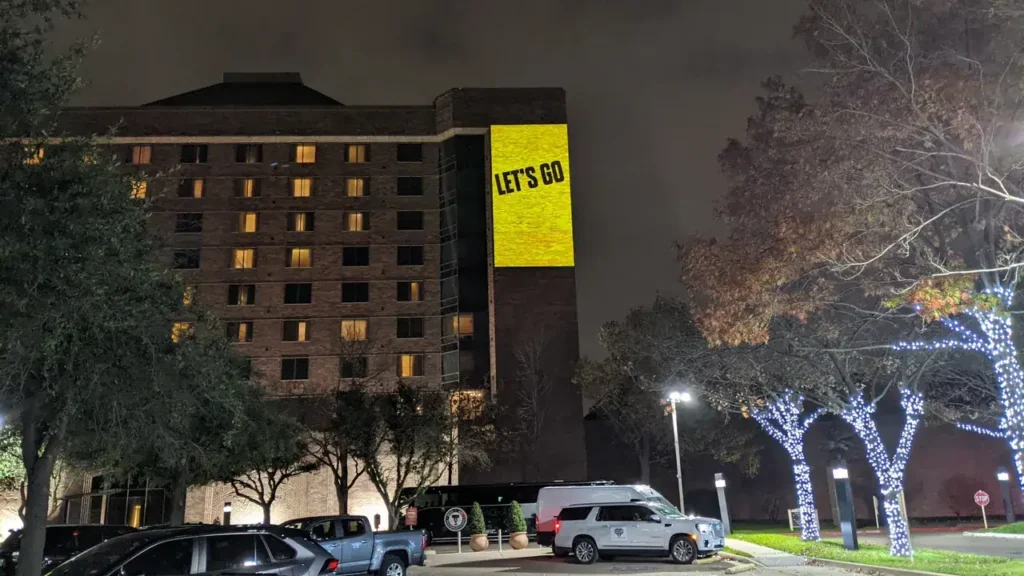
A projection billboard turns any building facade into a canvas. In Los Angeles, where the architecture, the nightlife, and the camera culture align, it is one of the most visually impactful outdoor formats available.
Projection advertising — projecting brand imagery onto the exterior of a building using high-powered projectors — is not a new format. It has been used in various forms for decades. But it has become significantly more viable and visually compelling as projector technology has improved, and in markets like Los Angeles, where the combination of pedestrian nightlife, photography culture, and entertainment industry attention make visually striking outdoor moments particularly valuable, it is an increasingly relevant tool.
The core appeal of projection billboard advertising is its temporary nature combined with its visual scale. You can project a brand image the size of a ten-story building onto a facade without any permanent installation, any physical modification to the surface, or any long-term commitment to the location. The projection appears, creates a visual event, is documented, and disappears. That temporariness is part of the value proposition.
This guide covers how projection billboard campaigns work in Los Angeles, which neighborhoods and surfaces work best, the technical and logistical requirements, and what to expect from a well-run campaign.
How Projection Billboards Work
The mechanics are straightforward in concept: high-powered projectors are positioned at a distance from a target building surface, aimed at the facade, and connected to a media playback system that feeds the creative content. The projector converts the digital content into a light beam that renders the image on the building surface at large scale.
The complexity is in the execution. The projector needs to be positioned correctly relative to the surface — too close and the image is truncated; too far and the lumens are insufficient for a visible image. The surface needs to be suitable — flat, pale or neutral-colored, without too many architectural interruptions that break up the image. The ambient light conditions need to be dark enough for the projected image to read clearly. And the logistics of positioning equipment, powering the setup, and managing the site during the projection period all require coordination.
Equipment
Large-format building projection requires projectors in the range of 20,000 to 50,000+ lumens depending on the scale of the surface and the ambient light conditions. These are not consumer or prosumer projectors — they are professional-grade units that require trained operators. A typical building projection setup uses multiple projectors blended to cover the full surface, synchronized to create a seamless image across the entire facade.
The projectors are typically truck-mounted or positioned on scaffolding across from the target building. The projection distance determines the image size — at 200 feet of throw distance, you can cover a building face of roughly 100 by 60 feet with a single high-powered unit.
Projection Surfaces in Los Angeles
Not every building in Los Angeles is a good projection surface. The best surfaces share several characteristics:
- Pale or light-colored facade. White, cream, light gray, or light-colored stone are ideal. Dark surfaces absorb the projected light rather than reflecting it, significantly reducing the visible brightness of the image.
- Flat or planar surface. Curved surfaces create distortion in the projected image. Surfaces with significant relief elements — columns, projecting cornices, deep window reveals — create shadow patterns that interrupt the image.
- Sufficient scale. A 10-foot by 15-foot wall is not worth the projection setup. Building faces of 40 feet or more in height produce projections that are visible from meaningful distance and that photograph and film well.
- Clear sightline from the projector position. Trees, parked vehicles, or other buildings blocking the projection throw will interrupt the image at the surface.
- Appropriate surrounding context. A projection on a building in a dark, quiet block will not have an audience. The best projection surfaces are in or adjacent to areas with evening foot traffic, nearby venues, or visual prominence that means people are already looking toward the building.
Los Angeles Neighborhoods for Projection Billboard Campaigns
Los Angeles is a large, dispersed city, and not all of it is equally suited to projection billboard work. The neighborhoods that work best combine evening foot traffic, photogenic architecture, and cultural relevance.
Hollywood Boulevard and Hollywood
Hollywood Boulevard is one of the most photographed streets in Los Angeles. The combination of tourists, entertainment industry activity, and the street’s inherent visual culture makes it a strong location for projection campaigns tied to entertainment releases, music launches, and culturally significant brand moments. The architecture varies — some surfaces work better than others — but the audience density in the evening is consistently high.
Sunset Strip (West Hollywood)
The Sunset Strip in West Hollywood has been an advertising destination for decades. The existing concentration of large-format outdoor advertising on the Strip means that audiences are accustomed to looking at the buildings and are receptive to visual novelty. Projection campaigns on Strip buildings work particularly well for music, fashion, and entertainment brands that fit the cultural identity of this corridor.
Downtown Los Angeles
DTLA has undergone significant development over the past decade and now has genuine evening foot traffic in areas like the Arts District, around the Staples Center (now Crypto.com Arena), and along Broadway. The mix of older commercial architecture with flat, lightly colored facades makes DTLA a strong market for projection work. The Arts District in particular has both the architecture and the culturally engaged audience that benefits most from outdoor artistic and advertising installations.
Venice Beach
Venice has a distinct cultural identity and a strong evening pedestrian culture, particularly along Abbot Kinney and in the beach and boardwalk area. Buildings suitable for projection are more limited here than in DTLA or Hollywood, but the audience quality — creative, photographically active, culturally engaged — makes successful placements particularly valuable.
Melrose Avenue and Silver Lake
Both neighborhoods have the combination of evening commercial activity, pedestrian density, and culturally engaged demographics that make projection work effective. The streetscape architecture varies in suitability, but both areas have buildings that work well as projection surfaces.
AGM Field Note: In Los Angeles, the documentation value of a projection billboard campaign often equals or exceeds the live audience value. A striking projection on a Hollywood or West Hollywood building will be photographed by dozens or hundreds of people during its operating window. That social documentation is part of the campaign’s deliverable, not a bonus. Build the projection to be photographed.
Technical Requirements for LA Projection Campaigns
Power Supply
High-powered projectors require significant electrical power — a single 30,000-lumen unit draws roughly 3,000 watts, and a multi-projector setup can draw 10,000 to 20,000 watts or more. Most street locations in Los Angeles do not have accessible power at this scale. Projection campaigns typically require a generator, which adds to the equipment footprint and requires appropriate placement away from the projection operation.
Crew and Operator Requirements
A professional projection billboard campaign requires a trained projection crew to set up, calibrate, and operate the equipment during the projection window. Calibration — aligning the projectors to cover the target surface correctly — can take one to two hours and must be done before the projection window begins. During operation, the crew monitors the setup and adjusts if anything shifts. At the end of the evening, the equipment is struck and packed.
Weather and Visibility
Los Angeles has an advantage here compared to most markets: the climate is dry and clear most of the year. Rain, fog, and high humidity all reduce the effectiveness of projection by scattering the projected light before it reaches the surface. Los Angeles’s low humidity and generally clear skies make projection viable most nights of the year. Summer nights are ideal; late winter can occasionally bring marine layer fog that affects visibility.
Content Preparation
Projection content needs to be prepared for the specific surface dimensions and the specific projector setup. A content file that looks correct on a monitor may not map correctly to the target building if the building’s aspect ratio or surface irregularities are not accounted for in the file preparation. Working with the projection crew on content specifications before final creative delivery prevents calibration problems on the night of the projection.
Projection Billboard vs. Digital Billboard: When to Use Each
| Factor | Projection Billboard | Digital Billboard |
|---|---|---|
| Operation hours | Nighttime only | 24 hours |
| Location flexibility | Any suitable building surface | Fixed infrastructure locations only |
| Visual scale | Building-sized, very large | Fixed panel size |
| Content type | Video, animation, still | Video, animation, still |
| Documentation potential | Very high (dramatic visual) | Medium (standard infrastructure) |
| Setup and teardown | Required each session | Not required |
| Permit requirements | Often required in LA | Built into media buy |
| Best for | Events, launches, cultural moments | Ongoing brand awareness, promotions |
Planning a Projection Billboard Campaign in Los Angeles
Site Selection and Surface Scouting
Site selection is the first and most critical step. The projector crew and the client’s marketing team should scout the target area together, evaluating potential surfaces against the technical criteria (color, flatness, size, sightline) and the audience criteria (foot traffic, cultural context, photographic potential). In Los Angeles, building ownership and access for the projector positioning also need to be evaluated — some of the best surfaces are on buildings where access for the projector setup requires negotiation.
Logistics and Coordination
In Los Angeles, projection billboard campaigns in public-facing locations typically require advance coordination with the city and, where applicable, with the property owner of the building being used as a projection surface. The specific requirements vary by neighborhood and exact location. Working with a vendor who has run projection campaigns in LA before — and who knows the specific considerations for the areas you are targeting — reduces friction significantly.
Duration and Operating Windows
A single-night projection creates a dramatic moment and generates documentation content. Multi-night campaigns over a weekend or a week build more cumulative audience reach as different people encounter the projection on different nights. Event-tied campaigns — a film premiere, a product launch party, a concert — run for the evening of the event to coincide with the concentrated audience moment.
Content Strategy for Los Angeles Projection Campaigns
Projection content in Los Angeles needs to work in a visual environment that is already competitive. The city is saturated with entertainment and brand imagery. A projection campaign that reads as a standard advertisement in a larger format will not generate the response a distinctive, visually compelling piece will.
The content that works best in projection campaigns tends to have movement, strong visual contrast, and a single dominant element — a face, a product, a environment — that is compelling at scale. Animation that takes advantage of the projection medium’s ability to simulate three-dimensional effects on a flat surface can create visually arresting moments that still imagery cannot.
In LA’s entertainment culture, the association between the brand and a specific artistic moment can be as valuable as the reach of the campaign itself. A projection that people discuss and share because it was genuinely interesting to look at produces a different quality of cultural resonance than one that simply put a logo on a building.
The Technical Evolution of Projection Billboard Advertising
Projection technology for outdoor advertising has evolved dramatically over the past decade. First-generation large-format projection systems required extremely powerful (and expensive) projectors, limited creative quality at large scale, and were vulnerable to even modest ambient light conditions. Contemporary systems use significantly more capable projectors that can produce visible, high-quality imagery at much larger scales and in conditions that would have defeated earlier equipment.
Current professional projection systems used in outdoor advertising campaigns in Los Angeles and other major markets operate in the range of 20,000 to 100,000+ lumens, with high-resolution native outputs and improved brightness-to-size ratios compared to systems available a decade ago. These improvements have made large building projection viable in more urban environments and during longer daily operating windows, expanding the practical applications of the format significantly.
Projection Mapping vs. Standard Projection
Projection mapping is a more technically sophisticated variant of building projection that uses software to account for the three-dimensional geometry of the projection surface. Rather than projecting a flat image onto a flat wall (standard projection), projection mapping allows the projected image to follow the contours, edges, and relief features of complex architectural surfaces, creating an illusion of three-dimensionality or transforming the apparent shape of the building.
For outdoor advertising applications, projection mapping is typically reserved for campaigns with significant creative budgets and technically skilled production teams. Standard projection (flat image on flat or near-flat surface) is more commonly used for commercial outdoor advertising because it is simpler to produce and execute. Both approaches can produce striking visual results in the right context, and the choice between them should be driven by the creative concept and the specific surface being used rather than by a general preference for technical complexity.
Los Angeles Permitting and Coordination for Projection Campaigns
Los Angeles has a complex regulatory environment for outdoor advertising generally, and projection billboard campaigns specifically require coordination with multiple decision-makers and community members. The specific requirements depend on the location, the scale of the projection, and the duration of the campaign.
For projection campaigns on private building facades, coordination with the property owner is typically sufficient for the use of the building surface itself. However, if the projector setup requires placement on the public sidewalk or street, additional coordination with the City of Los Angeles Bureau of Engineering or Bureau of Street Services may be required for temporary use permits. Large-scale projections that require lane closures or significant public space use require more extensive permitting.
The Los Angeles Department of Building and Safety (LADBS) and the Bureau of Street Lighting may also have input on projection campaigns that involve significant power draw from public infrastructure. Working with a production company that has experience navigating Los Angeles city departments for projection campaigns is strongly recommended — the permitting environment is navigable, but it requires knowledge of which departments have jurisdiction over which aspects of the campaign.
Specific Venue Considerations
Several of the strongest projection billboard locations in Los Angeles require specific coordination beyond standard permitting. The Sunset Strip in West Hollywood is within the City of West Hollywood’s jurisdiction, which has its own approval processes separate from the City of Los Angeles. Hollywood Boulevard has both City of Los Angeles jurisdiction and the influence of the Hollywood Property Owners Alliance. The Arts District in DTLA involves the Los Angeles County Museum of Art’s neighborhood and the LA Downtown Center Business Improvement District.
Each of these jurisdictions and business improvement districts has its own priorities, timelines, and points of contact. Production companies with established relationships in these specific areas can navigate these decision-makers and community members far more efficiently than those starting from scratch. The operational advantage of working with an experienced local production team is most visible in exactly this kind of multi-decision-maker coordination.
Creative Strategy for Los Angeles Projection Campaigns
Los Angeles is a city with an unusually sophisticated visual culture. It is the home of the film and television production industry, the center of a global entertainment media network, and a city where art, design, and visual culture are embedded in the daily life of a significant portion of the population. Projection billboard campaigns in Los Angeles are being evaluated not just by general consumers but by a community with professional expertise in visual production and storytelling.
This raises the creative bar for projection campaigns in LA in a way that is genuinely meaningful. Generic motion graphics or straightforward animated versions of static brand creative will be recognized as such by a sophisticated audience. The campaigns that perform best in the Los Angeles market — and generate the social documentation and earned media coverage that deliver maximum campaign value — are the ones where the creative is genuinely worth watching, not just worth glancing at.
Narrative and Story Structure
The best projection billboard creative in Los Angeles tends to have narrative structure — a beginning, development, and resolution that rewards watching the full loop. Even in a 15 to 30 second loop, a projection that tells a story (however abstract) is more engaging than one that simply animates static brand elements. The film industry’s influence on the city’s visual culture means that narrative is a language that resonates deeply with Los Angeles audiences in a way that may not be equally true in other markets.
Music and Audio
Projection campaigns in outdoor environments are typically silent — the projector does not project sound, and outdoor audio requires separate speaker systems and permits. However, for certain event-tied or venue-adjacent projection campaigns where an audio component is feasible, pairing strong audio with the projection dramatically increases the impact and memorability of the experience. A projection campaign run during an event at a venue with an outdoor space can use the venue’s audio infrastructure to accompany the visual with sound, creating a combined experience that is significantly more immersive than vision alone.
Case for Projection Billboards in LA’s Event Economy
Los Angeles has one of the most active event economies of any city in North America. Award shows, film premieres, music events, product launches, fashion shows, and cultural openings happen continuously throughout the year. The entertainment industry’s presence means that events are not just consumer moments — they are media moments, with press coverage, social media activity, and industry attention that extends the reach of any well-executed brand presence far beyond the physical attendees.
For brands with a natural connection to entertainment (technology, fashion, food and beverage, luxury goods), projection billboard campaigns timed to coincide with relevant events can achieve outsized media value. A brand with a striking projection on a building near the Dolby Theatre during awards season, or near Crypto.com Arena during a major concert or playoff series, is appearing in the visual context of entertainment events that are themselves generating enormous media coverage. The brand association with that moment — the physical co-presence in the news photographs, the social media frames — is worth more than the face value of the projection campaign alone.
Projection Advertising and the Social Media Amplification Cycle
The single most important factor in determining whether a projection billboard campaign in Los Angeles delivers exceptional results is whether it generates organic social media documentation from the audience. A successful projection campaign is one where people who did not plan to attend the projection location go out of their way to get there because they heard about it from other people, photograph it when they arrive, and share those photographs with their networks.
This amplification cycle begins with the initial projection audience, who document and share the event in real time. Their network sees the content and either shares it further or travels to see the projection in person and document their own visit. Press and design publications that monitor social media for interesting visual content may pick up the story and publish features that extend the campaign’s reach to audiences who would never encounter it through standard media channels.
Building this cycle requires that the projection itself be worth documenting. The question to ask at every stage of the creative development process is: “Would I photograph this if I walked past it?” If the honest answer is no, the creative needs to be reconsidered before investing in the production and logistics of a building projection.
Finding the Right Projection Surface in Los Angeles
Los Angeles has hundreds of buildings that are theoretically suitable for projection. Finding the right one for a specific campaign requires balancing technical suitability (surface color, flatness, scale, sightline for the projector) with audience suitability (the right neighborhood, the right evening foot traffic, the right cultural context) and practical suitability (owner access, projector positioning, power availability).
The most photogenic projection surfaces in Los Angeles tend to be in the older commercial neighborhoods with large, relatively flat masonry facades: the Arts District in DTLA, parts of Hollywood, and the vintage commercial strips in neighborhoods like Culver City and West Adams. These surfaces have the texture and character that make building projections look cinematic in photographs rather than like a screen awkwardly placed on a building.
For brands that want the projection to look as spectacular as possible in documentation — rather than just technically correct — the surface selection decision is as much an aesthetic decision as a technical one. A projection on a building with interesting architectural character, with the right surrounding visual context, will generate better documentation than the same projection on a blank warehouse wall with no visual interest beyond the brand’s creative.
Post-Campaign: Maximizing the Projection Documentation
A projection billboard campaign in Los Angeles should produce a significant archive of documentation: photographs from the professional documentation team, video of the projection in operation, crowd photography if the projection draws an audience, and any organic social content generated by attendees. This documentation archive is a campaign asset that should be actively used after the projection period ends.
Post-campaign use of projection documentation includes: social media content for the brand’s own channels (the best photographs from the projection make strong visual content with high engagement rates); pitch material for media coverage (technology publications, design publications, and entertainment industry media regularly feature outstanding projection campaigns); digital advertising creative (projection photography makes powerful visual content for social ads targeting the same audience that would have attended in person); and case study material for the brand’s marketing documentation and agency pitches. The production investment in the projection creates content value that extends far beyond the few evenings when the projection was actually running.
Planning a Los Angeles Projection Campaign with AGM
American Guerrilla Marketing coordinates projection billboard campaigns in Los Angeles through our West Coast production network. We handle the full campaign process: site scouting, projection surface evaluation, logistics and permitting coordination, creative content preparation review, field coordination during projection nights, and post-campaign documentation delivery.
Frequently Asked Questions
What is a projection billboard in Los Angeles?
A projection billboard in Los Angeles uses high-powered projectors to display brand imagery, video, or animation onto building facades at night. The projection creates a large-format visual presence without permanent installation — the image appears on the building’s surface using projected light.
When do projection billboard campaigns run?
Projection campaigns run after dark, typically from dusk until midnight or 2 AM depending on the location and the client’s objectives. In Los Angeles, this typically means 8 PM or 9 PM through late night. Daytime projection is generally not effective because ambient sunlight overwhelms the projected image.
What neighborhoods in Los Angeles work best for projection billboards?
Hollywood Boulevard, the Sunset Strip in West Hollywood, Downtown LA (particularly around LA Live and the Arts District), Venice Beach, and Melrose Avenue are the strongest locations for projection billboard campaigns because of their evening foot traffic and the photogenic quality of the architecture in those areas.
How much lead time does a projection billboard campaign in LA require?
A projection billboard campaign requires two to four weeks of lead time for site scouting, projection surface evaluation, equipment sourcing, creative preparation, and logistics coordination. Event-tied campaigns that need to run on a specific date should start planning six to eight weeks out to allow contingency time.
Can projection billboard content include video or animation?
For more on this, explore our wheatpasting los angeles. For more on this, explore our street teams activations. Yes. High-powered projectors can display video, animation, and still imagery. Video and animated content performs particularly well in projection campaigns because the movement draws attention in ways that static imagery does not. The content file format and resolution requirements depend on the specific projector setup.

Ready to Run Your Campaign?
Call us or email us. We’ll tell you exactly what we can do in your market and what it costs.
Related Services
Explore similar advertising solutions offered by American Guerrilla Marketing.
American Guerrilla Marketing — Los Angeles
Street-level campaigns in Los Angeles and nationwide. Wheatpasting, LED trucks, street teams, and more.
(646) 776-2770
Related Articles
-
Street Poster Advertising Ottawa: A Complete Campaign Guide
September 17, 2026
-
Activation Marketing: How Brands Win at Street Level
September 13, 2026
-
Experiential Marketing Firms Chicago | American Guerrilla Marketing
September 12, 2026
-
Pop Up Experiential
September 12, 2026
-
Mobile Pop Up
September 12, 2026