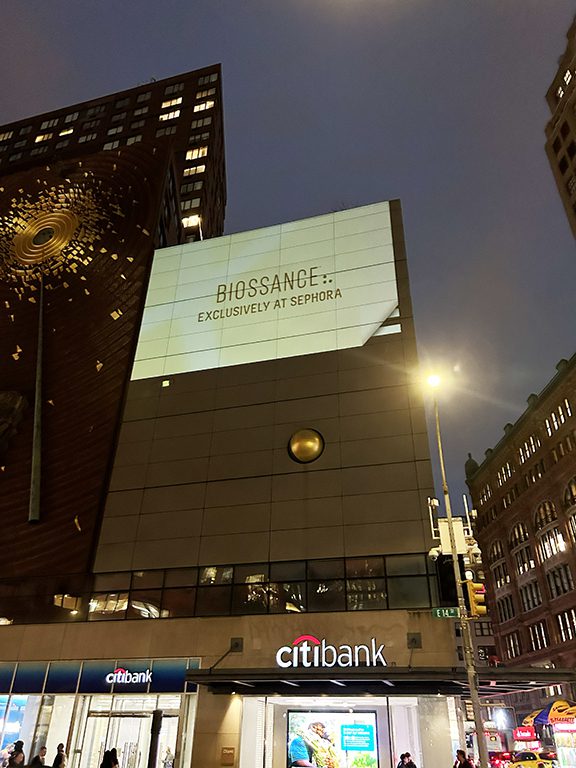
The trade show floor is a crowded advertising environment. The convention zone outside the hall in the evening hours is not. When the floor closes and thousands of trade show attendees move into the outdoor district between the convention center and the evening venues, the advertising environment shifts entirely. The competition for attention disappears. The visual field opens. And a brand with a building-scale projection on the convention center wall occupies that field alone.
What Makes Projection Advertising Unique at Trade Shows
Every other outside-the-hall advertising format at a trade show operates at human scale. A wheatpasted poster is wall-height. A sidewalk stencil is foot-level. An LED truck is vehicle-scale. A building projection operates at architectural scale. It fills an entire wall of a convention center. It is visible from a block away in daylight conditions and from several blocks away after dark. It is unmissable in a way that no other format can claim.
This scale creates an impression category that is qualitatively different from other formats. Attendees do not scan a building projection the way they scan a poster. They stop. They look. They photograph. A well-executed convention projection consistently generates organic social media content from the attendees who witness it, extending the campaign reach beyond the physical audience in the convention zone.
The after-hours context amplifies the format’s impact further. After a full day of exhibitor booths, product demos, and show floor stimulation, trade show attendees are in a different state in the evening. They are social, relaxed, and visually open in a way they are not on the show floor. A building projection encountered in this state creates a different quality of impression than any show floor encounter, because the attendee is present and receptive rather than in active evaluation mode.
Target Surfaces for Trade Show Projection
The ideal trade show projection surface is a large, light-colored exterior wall that faces the primary pedestrian zone in the convention district, accessible to projection equipment placement at the appropriate throw distance. Convention center buildings themselves are often the best surfaces, offering large, high, flat exterior walls that face the outdoor gathering zones where attendees concentrate in the evening.
We assess potential projection surfaces in the convention district during the site evaluation phase of every campaign. Our evaluation criteria include surface color and reflectivity, the available throw distance for equipment placement, ambient light levels in the evening deployment window, and the foot traffic volume and pattern in front of the surface during target deployment hours.
Convention hotels in the immediate venue vicinity are also strong projection surfaces. A hotel wall facing the pedestrian transit zone between the convention center and the hotel district offers both a large display surface and maximum exposure to the hotel-bound attendee traffic flow that concentrates in the early evening.
Technical Execution: Equipment and Content
Projection Equipment
We use high-lumen professional projectors in the 20,000 to 60,000 lumen range for convention projection campaigns, selected based on the surface size, throw distance, and ambient light conditions of each specific deployment. Equipment is sourced from professional rental inventory and operated by trained field crews who manage positioning, calibration, and runtime throughout each deployment session.
For large convention center facades, high-lumen equipment in the 40,000 to 60,000 lumen range produces the brightest, most visible images in mixed ambient light environments. For smaller surfaces or darker environments, lower-lumen configurations are appropriate. Our team specifies equipment for each campaign based on the site assessment data rather than defaulting to a fixed configuration.
Content Production
Projection content for trade shows is designed specifically for the outdoor environment: high contrast, bold typography, animated elements that draw the eye from a distance, and a clear brand message that communicates in the three to five seconds a moving pedestrian spends in direct view of the projection surface.
We advise on content specifications based on the projection surface characteristics and environment, and can produce projection-ready content in-house or work with client creative teams to adapt existing assets to the technical requirements of high-lumen outdoor projection. Content is tested in the pre-deployment setup phase to confirm image quality, color accuracy, and legibility before the evening deployment audience arrives.
site-approval planning and Property Authorization
Every trade show projection campaign requires property owner authorization for the projection surface and may require city site approvals depending on the specific location and local site rules. We initiate the site-approval planning and authorization process as early as possible in the campaign planning timeline, typically eight to twelve weeks before the show, to ensure all required approvals are in place before deployment.
In major convention markets where we operate regularly, we maintain relationships with venue operators and property managers that facilitate the authorization process. For new venues or markets, we manage the outreach and negotiation as part of campaign planning, with the client informed at each stage of the authorization process.
Documentation and Performance Reporting
Every trade show projection campaign we run is documented with a structured field report that includes setup photos showing equipment positioning and throw configuration, mid-deployment photos from multiple viewing distances showing the projection as attendees see it, and any notable observations from our field crews about attendee response, social media documentation behavior, and environmental conditions during the deployment.
Post-campaign, we compile a performance summary that includes total runtime hours, estimated impression counts based on foot traffic data for the deployment location and time window, and the photo documentation package. For clients who integrate social media monitoring into their trade show campaigns, we can coordinate with their social teams to track organic sharing behavior during projection deployments.
Projection Advertising as a Social Media Event at Trade Shows
Building projections at trade shows generate disproportionate social media documentation relative to their deployment cost. Trade show attendees are active on social media during events, documenting what they see and sharing it with their professional networks. A 40-foot building projection at a major industry trade show is the kind of visual spectacle that earns photographs and social shares because it stands out so distinctly from the standard convention zone advertising environment.
This social amplification effect extends the reach of the projection beyond the physical audience in the convention zone. Each organic share from an attendee’s social post reaches their professional network, which typically overlaps significantly with the trade show’s professional audience. A single well-executed trade show projection campaign can generate social reach that exceeds the official show attendance through organic amplification alone.
We help clients build social amplification into their projection advertising strategy by designing projection content that is specifically optimized for photograph sharing: strong visual composition that looks impressive in a smartphone photo, readable brand name at the scale and distance from which attendees typically photograph buildings, and any visual elements that make the photograph worth sharing beyond just documentation of the projection itself.
Trade Show Projection Advertising: Investment and Return
Convention building projection is a premium advertising format with corresponding investment requirements: high-lumen equipment, trained operators, property permissions, and content production. For brands that are already investing significantly in trade show booth presence, outside-the-hall outdoor campaign elements, and ambassador programs, projection advertising as an evening element adds the highest-impact single brand moment of the full convention week at an incremental cost that is typically a fraction of the total trade show marketing investment.
The return calculation for trade show projection advertising is best understood through the lens of impression quality rather than impression volume. The exposures made by a building projection in the evening convention zone are qualitatively different from any other format in the program: they are at building scale, they are in the leisure and social context of the evening, and they are consistently accompanied by the organic social documentation that no other format dependably generates.
Trade Show Building Projection Examples
A cybersecurity platform company runs a building projection on the exterior west wall of the convention center during the evening hours of the last two days of a major technology conference in San Francisco. The projection runs from 7:00 PM to 11:00 PM on both evenings, displaying a sequence of animated graphics featuring the company’s brand mark, a bold product claim relevant to the enterprise security audience at the show, and the booth number.
Field crew documentation from both evenings captures photographs showing the projection from multiple viewing distances and angles, confirming image quality and legibility from the pedestrian zone in front of the convention center. Social media monitoring identifies 28 organic posts sharing photographs of the projection during the two deployment evenings, reaching an estimated professional network audience of 14,000 based on average follower counts of the sharing accounts. The client’s booth team reports several visitors on the final show day who specifically reference seeing the building projection the evening before as what prompted them to make a point of visiting the booth before the show closed.
This pattern, where evening projection creates booth visit intentions that convert to actual visits on subsequent show days, is consistent across multiple trade show projection campaigns we have executed. The projection creates a brand moment of sufficient impact that it generates specific next-day behavioral intent, not just ambient exposures. This is the characteristic that distinguishes building projection from other outdoor advertising formats at trade shows.
Integrating Projection Advertising into a Trade Show Campaign
Projection advertising at trade shows produces the strongest results as the premium element in a multi-format outside-the-hall program. During show hours, the day-format tactics, including wheatpasted posters, sidewalk stencils, LED billboard trucks, and brand ambassador programs, build brand recognition across the full attendee population in the pedestrian environment. In the evening, the projection campaign converts that recognition into a spectacular brand moment that the full attendee population encounters simultaneously as they move through the convention zone.
An attendee who has seen the poster at the hotel entrance, the stencil at the crosswalk, the LED truck on the approach route, and the building projection in the evening has encountered the same brand through four different formats at four different scales across the full convention day. That multi-format exposure creates a brand presence that any single format, regardless of budget, cannot replicate.
For guerrilla marketing at trade shows, the combination of day-format persistent presence and evening projection creates the most memorable outside-the-hall campaign available in any convention market.
Planning Your Trade Show Projection Campaign
Building projection campaigns at trade shows require eight to twelve weeks of advance planning in markets where we have established property relationships and ten to fourteen weeks in new markets. Property permission is the first and longest lead item in the planning timeline. We initiate property outreach as soon as the campaign is confirmed and parallelize the site-approval planning and equipment booking processes to compress the overall lead time.
Content production for trade show projection typically requires two to three weeks from creative approval to final rendered files optimized for outdoor projection. We build this production timeline into the overall campaign schedule and establish content approval checkpoints early enough that production can complete before the pre-show equipment test date.
What is projection advertising at trade shows?
Projection advertising at trade shows is the projection of large-scale branded visuals onto convention center facades, hotel walls, and large surfaces in the trade show district during evening hours. It creates high-impact brand moments visible to the full trade show attendee population in the outdoor convention zone after the show floor closes.
How is projection advertising different from other trade show outdoor formats?
Projection advertising operates at building scale, creating visual exposures visible from a block away that no printed format can match. It occupies its own visual category in the trade show district and consistently generates organic social media sharing from attendees who photograph it.
What equipment does AGM use for trade show projection advertising?
We use high-lumen professional projection equipment in the 20,000 to 60,000 lumen range depending on surface size, ambient light, and throw distance. Equipment is operated by trained field crews who manage setup, calibration, content deployment, and runtime throughout each deployment session.
How are trade show projection deployments documented?
Every deployment is documented with setup photos, runtime photos from multiple viewing angles, and a post-campaign report with estimated impression counts and field crew observations about attendee engagement and social sharing behavior.
What is the lead time for a trade show projection campaign?
Eight to twelve weeks for a full campaign including surface identification, property permission, site-approval planning, content production, and equipment logistics. Contact us to discuss feasibility for a specific show and timeline.
Can projection advertising be combined with other trade show outdoor tactics?
Yes. Projection works as the premium evening element in a multi-format outside-the-hall campaign including wheatpasted posters, sidewalk stencils, LED billboard trucks, and brand ambassador teams during show hours. Each format contributes a different dimension of the overall campaign.
How do I get started with trade show projection advertising?
Campaign Architect – American Guerrilla Marketing
Frequently Asked Questions
What is projection advertising at trade shows?
Projection advertising at trade shows is the projection of large-scale branded visuals onto convention center facades, hotel walls, and large surfaces in the trade show district during evening hours. It creates high-impact brand moments visible to the full trade show attendee population in the outdoor convention zone after the show floor closes.
How is projection advertising different from other trade show outdoor formats?
Projection advertising operates at building scale, creating visual exposures visible from a block away that no printed format can match. It occupies its own visual category in the trade show district and consistently generates organic social media sharing from attendees who photograph it.
What equipment does AGM use for trade show projection advertising?
We use high-lumen professional projection equipment in the 20,000 to 60,000 lumen range depending on surface size, ambient light, and throw distance. Equipment is operated by trained field crews who manage setup, calibration, content deployment, and runtime throughout each deployment session.
How are trade show projection deployments documented?
Every deployment is documented with setup photos, runtime photos from multiple viewing angles, and a post-campaign report with estimated impression counts and field crew observations about attendee engagement and social sharing behavior.
What is the lead time for a trade show projection campaign?
Eight to twelve weeks for a full campaign including surface identification, property permission, site-approval planning, content production, and equipment logistics. Contact us to discuss feasibility for a specific show and timeline.
Can projection advertising be combined with other trade show outdoor tactics?
Yes. Projection works as the premium evening element in a multi-format outside-the-hall campaign including wheatpasted posters, sidewalk stencils, LED billboard trucks, and brand ambassador teams during show hours. Each format contributes a different dimension of the overall campaign.
How do I get started with trade show projection advertising?
Contact us at [email protected] or call (646) 776-2770. Share the trade show name, venue, dates, and your campaign objectives and we will assess projection opportunities and build a proposal within 48 hours.
How early should a brand start planning?
For most campaigns, the smart move is to start planning at least two to four weeks before the launch window so production, routing, staffing, and reporting are all lined up.
What makes one market perform better than another?
Market fit depends on audience density, neighborhood behavior, route efficiency, and whether the creative belongs in that setting. The busiest city is not always the best city.
Can AGM bundle this with other services?
Yes. AGM often combines this work with supporting formats so the campaign has stronger repetition and cleaner reporting across the whole run.
How does AGM quote pages like this?
We quote from official rate cards where they apply, then scope the remaining production, staffing, and routing details to the actual job.