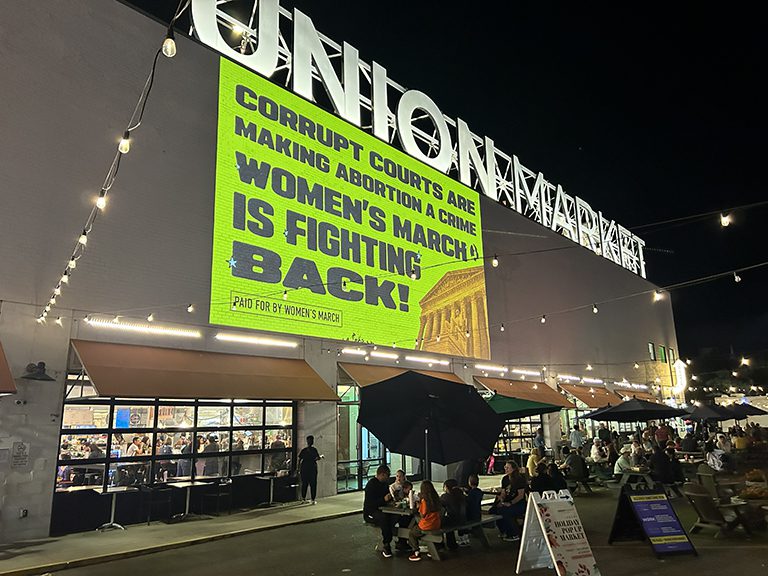
When the convention show floor closes at 5:00 PM or 6:00 PM, every attendee in that building becomes a pedestrian in the outdoor convention zone. They are moving between the convention center and hotels, heading to evening dinners and networking events, standing in rideshare queues, and walking in groups through the commercial district surrounding the venue. The show floor is dark. The outdoor environment is live with the full attendee population.
Why the Evening Convention Zone Is the Premium Advertising Window
During show hours, the attendee audience is distributed across a large show floor competing for attention from hundreds of exhibitor booths. In the evening, the same audience is concentrated in a much smaller outdoor area, in a social state, looking up and around rather than down at floor maps and phone screens.
A large-format projection on the wall of a convention center building or a major hotel in the convention district in this evening window reaches the full attendee population in their most socially active and visually receptive state of the day. The scale of a building projection makes it visible from a block away. The motion of animated projection content attracts attention from attendees who are not actively looking for advertising.
The novelty of the format also creates social media sharing behavior that extends the reach of the projection beyond the immediate audience. Convention attendees photograph and share building projections far more consistently than they share any standard advertising format. A single well-executed convention projection becomes the source of dozens of organic social media posts that reach the same professional network the exhibitor is trying to connect with through the convention itself.
How We Execute Convention Building Projections
Site Assessment and Surface Selection
The first step in planning a convention projection campaign is assessing the available projection surfaces in the convention district. We evaluate surfaces based on four criteria: the surface area available, the base color (lighter surfaces produce brighter, more visible projections), the throw distance available for projection equipment placement, and the foot traffic volume in front of the surface during the target deployment window.
Convention centers, major convention hotels, and commercial buildings in the convention district are the typical projection surfaces. We identify the two to three surfaces in each convention district that offer the best combination of these criteria for each specific campaign and develop placement options for client review and selection.
Property Permission and site-approval planning
Building projection on private property requires the property owner’s permission, which we secure before any campaign planning proceeds beyond the surface selection phase. For convention centers and convention hotels, we have established relationships in the major convention markets where we operate regularly. For new venues or markets, we manage the permission process as part of campaign planning.
City site-approval planning requirements for projection advertising vary by market. We manage all site approval applications and coordinate with property owners to ensure all required approvals are in place before the projection equipment is deployed.
Equipment Selection and Content Production
Convention projection advertising uses high-lumen projectors in the 20,000 to 60,000 lumen range, depending on the surface size, ambient light levels, and throw distance. Equipment selection is made based on the specific surface and environment of each deployment. We use professional rental equipment from trusted projection technology sources and deploy with trained operators who manage the equipment and content throughout each deployment session.
Projection content for convention advertising is designed for the outdoor environment: high contrast, bold graphic elements, and motion that draws the eye from a distance. We advise on content specifications based on the surface and environment and can produce projection-ready content in-house or work with client creative teams to adapt existing assets.
Deployment and Documentation
Convention projection deployments are executed by our field teams with equipment transported, positioned, and calibrated on-site. Deployment documentation includes setup photos showing equipment position and throw configuration, runtime photos from multiple positions showing the projection as attendees see it from the pedestrian zone, and any notable observations about attendee response and engagement.
Post-campaign documentation includes a full projection report with all deployment photos, runtime hours, estimated impression counts based on foot traffic data for the deployment location and time window, and any organic social media content our team observed being created during the deployment.
The Social Media Amplification Effect of Convention Projection
Building projections at conventions generate substantial organic social media content from attendees who photograph and share what they see. Convention attendees are active on social media during events, and a large-format building projection is the kind of visual moment worth documenting and sharing. The scale, the motion, and the spectacle of a well-executed convention projection consistently earns photographs from dozens of attendees during each deployment evening.
Each social share reaches the photographer’s professional network, which typically overlaps significantly with the convention’s professional audience. A technology industry convention projection photographed and shared by a hundred attendees reaches potentially tens of thousands of their industry peers through organic social amplification. This secondary reach is not guaranteed and varies by campaign and audience, but it is a consistent feature of convention projection advertising that no static outdoor format dependably produces.
We advise clients on how to build social amplification into the projection strategy: designing content that photographs well from the distances at which attendees typically capture it, coordinating with the client’s social media team to monitor and engage with organic sharing during the deployment, and incorporating shareable visual elements that give the attendee a reason to post beyond simple documentation of the projection itself.
Convention Projection Advertising Technical Execution
High-quality convention projection advertising requires professional-grade equipment operated by trained crews. We use projection systems in the 20,000 to 60,000 lumen range for convention building projections, selected based on surface size, ambient light levels at the deployment location and time, and throw distance from the equipment position to the projection surface.
Each projection deployment begins with a site assessment in daylight to confirm surface dimensions, identify equipment placement positions, and assess ambient light conditions at the expected deployment time. We conduct a pre-show calibration setup to confirm image quality, color accuracy, and legibility before the first audience encounters the projection during deployment hours.
Content production for convention projections is designed specifically for the outdoor environment. High-contrast visuals that hold their quality under ambient light conditions, motion elements calibrated to be visible without distortion at typical deployment viewing distances, and typography sized for legibility from the full range of pedestrian viewing positions are the production requirements. We advise on these requirements during the creative briefing process and review client-provided content assets for outdoor suitability before approving them for production.
Field crews manage all aspects of deployment evening operations: equipment transport and rigging, calibration at location, content management throughout the deployment window, and equipment breakdown at the end of the deployment. We do not subcontract this operational layer; it is managed by our trained teams who understand the specific requirements of each deployment environment.
Convention Projection as Part of a Multi-Format Campaign
Projection advertising at conventions works best as the high-impact evening element in a multi-format outside-the-hall campaign. During the day, wheatpasted posters and sidewalk stencils build persistent brand presence in the pedestrian zone. Brand ambassadors create first-contact exposures in the hotel zone. LED billboard trucks run approach route circuits during morning arrival.
In the evening, the projection campaign takes over, creating the day’s most visually spectacular brand moment and reinforcing the exposures built through the day’s other formats. An attendee who has seen the poster on the wall, the stencil at the crosswalk, and the LED truck in the morning sees the same brand projected on the convention center wall in the evening. Each encounter is a different format and a different scale, but together they create a day-long brand narrative that no single format can build alone.
For clients investing in a multi-day convention outside-the-hall campaign, projection advertising in the evening hours is the format that creates the most memorable and most socially amplified impression of the full program.
Projection Advertising Planning Timeline for Conventions
Convention building projection campaigns require more advance planning than most other outside-the-hall formats because of the combination of property permission, site-approval planning, equipment logistics, and content production that must all align before the first deployment evening. We recommend a planning timeline of eight to twelve weeks for convention projection campaigns in markets where we have established relationships and ten to fourteen weeks in markets where we need to develop new property relationships.
The property permission process is typically the longest lead item. Convention center operators and hotel brands have their own internal approval processes for building projection requests, and these processes can take several weeks from initial contact to signed permission. We initiate property permission outreach as the first step in campaign planning, often before the creative brief is even final, to preserve the timeline for all subsequent steps.
City site-approval planning follows the property permission step in most markets. Some cities require site approvals for projection advertising that points into public spaces; others do not. Our team evaluates the site-approval planning requirements for each specific location and city before committing to a placement and builds the site-approval planning timeline into the campaign schedule.
Equipment booking for peak convention season requires advance reservation, particularly for the highest-lumen systems needed for large building facades. We recommend booking projection equipment at the same time property permission outreach begins, with cancellation flexibility built into the booking, to avoid equipment availability constraints during peak convention calendar periods.
Convention Projection Advertising Examples and Results
A major technology company runs evening building projections at a Las Vegas technology convention on the exterior south wall of the Las Vegas Convention Center’s West Hall, facing Paradise Road. The projection runs for three consecutive evenings from 7:30 PM to midnight during the official show week. Projector equipment at 40,000 lumens produces a 60-foot wide image visible from the full length of the Paradise Road pedestrian approach from the Westgate Las Vegas to the LVCC entrance plaza.
Field documentation from the three deployment evenings captures the projection from six distinct viewing positions ranging from 50 to 250 feet, confirming legibility of the brand name and product claim at all distances. Social media monitoring during the three evenings identifies 47 organic posts from convention attendees sharing photographs of the projection, with an estimated total organic reach of 22,000 professional network exposures. The client’s booth team reports 12 specific visitor references to the projection during the subsequent show days, each representing a booth visit that was explicitly motivated by seeing the building display the previous evening.
At a healthcare convention at the Walter E. Washington Convention Center, a health data analytics company projects on the Mount Vernon Place exterior wall of the convention center building for two consecutive evenings. The 35-foot projection displays an animated data visualization graphic, the company’s brand mark, and a booth number. Evening foot traffic at the Mount Vernon Place pedestrian area is documented at approximately 600 to 800 convention attendees per hour during the deployment window, producing an estimated 3,000 to 4,000 unique impression encounters across the two evenings. Post-show, the client attributes three new enterprise prospect conversations at the booth to the evening projection exposure.
At IAAPA Expo in Orlando, an attractions technology company projects on the exterior facade of the OCCC South Concourse building facing Convention Way, the primary pedestrian route from the International Drive hotel corridor to the convention center. The projection runs for two evenings during the five-day show. The client uses the projection to announce a morning event at their booth on the following show day, combining a brand awareness impression with a direct event promotion message. Attendance at the morning booth event is 40% higher than the previous year’s equivalent event, which had no projection advertising component.
Convention Projection Advertising in Major Markets
Convention Projection Advertising in Major Markets
We execute convention projection advertising in the major convention markets where the most significant industry shows are held: Las Vegas, Chicago, Orlando, San Francisco, New York, Boston, Atlanta, and other cities with active convention calendars. Each market has its own site-approval planning requirements, venue relationships, and operational logistics that our team manages based on direct field experience in those markets.
Las Vegas convention districts, with their open commercial streetscapes and strong visual advertising culture, are particularly well-suited to large-scale convention projection. The LVCC campus, the Sands Expo district, and the Mandalay Bay convention area all offer projection opportunities with large surfaces and high foot traffic volumes during evening convention hours.
Chicago’s McCormick Place and the surrounding South Loop convention district offer large building surfaces with concentrated pedestrian evening traffic. Orlando’s OCCC district and the International Drive corridor provide both large surface opportunities and dense hotel-to-convention foot traffic that an evening projection captures at its highest-volume window.
What is projection advertising at conventions?
Projection advertising at conventions is the display of high-lumen branded visuals on convention center buildings, hotel facades, or large surfaces in the convention district during evening hours. The projections create large-scale brand moments when attendees are moving through the outdoor convention zone after the show floor has closed.
When does convention projection advertising run?
Convention projection advertising runs in the evening hours after the show floor closes, typically from 6:00 PM through midnight or later. This is the window when attendees are moving between the convention center, hotels, restaurants, and evening events in the outdoor convention zone.
What surfaces can projection advertising use at conventions?
Convention building projection uses large, light-colored exterior walls of convention centers, hotels, and commercial buildings in the convention district with property owner permission. The surface needs to be large enough for the image scale, light in color for maximum brightness, and accessible to projection equipment placement at the appropriate throw distance.
Does projection advertising at conventions require site approvals?
Yes. Building projection on private property requires property owner permission. Projection into public spaces may require city site approvals depending on the specific location and local site rules. Our team handles all site-approval planning and property coordination for every projection campaign.
What content works best for convention projection advertising?
High-contrast animated graphics, bold brand marks, product visuals, and short motion sequences work best. Content must be visible from a distance and communicate the brand impression quickly since viewers encounter it while moving through the convention zone.
How large are convention building projections?
Convention projections typically range from 20 to 50 feet wide depending on the surface dimensions, equipment used, and throw distance available. Larger projections are possible with high-lumen equipment and adequate throw distance. We size each projection to the specific surface and environment.
How do I get started with projection advertising at conventions?
How We Plan and Execute Convention Projection Advertising
The planning process for a convention building projection campaign starts with a site evaluation at the target convention venue, typically conducted several weeks before the show during the site-approval planning and property approval phase. The site evaluation confirms surface dimensions, assesses ambient light conditions at the target deployment time, identifies the optimal projector placement position relative to the surface, and maps the pedestrian zone in front of the surface to confirm the foot traffic patterns that will determine impression volume during deployment.
Based on the site evaluation data, we specify the projection equipment configuration, content production requirements, and crew staffing plan. Equipment is booked and confirmed for the specific deployment window. Content production begins in parallel with site-approval planning, with approval checkpoints at the brief, concept, and final production stages to ensure the client has reviewed and approved the projection content before it is rendered in the format required for outdoor projection equipment.
On deployment evenings, our crew arrives at the location two hours before the scheduled start of the projection to position equipment, complete calibration, and conduct a pre-show quality check with the client if they wish to attend. The projection begins at the scheduled time and runs until the scheduled close, managed by our operators throughout. Field documentation happens in real time: crew members photograph the projection from multiple viewing positions and distances throughout the deployment, building the photo documentation record that the client receives in the post-campaign report.
For multi-evening convention projection campaigns, the daily debrief between our team and the client allows for content adjustments or creative updates for subsequent evenings if the first deployment reveals any image quality or content performance issues. This iterative approach to multi-evening projection programs ensures that the quality improves with each successive deployment rather than repeating the same configuration regardless of what the first evening revealed.
Projection Advertising at Conventions: The Final Word
Building projection advertising at conventions is the format that occupies a category of its own in the outside-the-hall marketing toolkit. No other format operates at the same visual scale, creates the same social media documentation behavior from the audience, or produces the same quality of brand moment in the evening convention zone when the show floor is closed and the full attendee population is outside and moving through the public district around the venue.
For brands that are already investing significantly in convention exhibition and outside-the-hall outdoor advertising, projection advertising as an evening element adds the highest single-impression-quality brand moment of the full convention campaign at an incremental cost that is typically a modest fraction of the total convention marketing investment. The social amplification from organic attendee documentation of a well-executed building projection consistently extends the impression count well beyond the direct physical audience in the convention zone.
American Guerrilla Marketing executes convention building projection campaigns with the same operational rigor we bring to every outside-the-hall format: advance site assessment, property permission and site-approval planning, professional-grade equipment, trained crew management, and full field documentation from every deployment evening. Every projection campaign delivers a documented performance record the client can use to evaluate the investment and plan the next one.
The projection advertising format at conventions earns its place in the marketing mix through a combination of scale, novelty, social amplification, and timing that no other format can replicate. It is the highest-impact single brand moment available in the convention marketing toolkit, and it operates exclusively in the evening window when the full attendee population is outside and available in the public convention zone. For brands committed to maximum impact from their convention marketing investment, building projection advertising into the evening convention zone program is the highest-return incremental investment available.
Campaign Architect – American Guerrilla Marketing
Frequently Asked Questions
What is projection advertising at conventions?
Projection advertising at conventions is the display of high-lumen branded visuals on convention center buildings, hotel facades, or large surfaces in the convention district during evening hours. The projections create large-scale brand moments when attendees are moving through the outdoor convention zone after the show floor has closed.
When does convention projection advertising run?
Convention projection advertising runs in the evening hours after the show floor closes, typically from 6:00 PM through midnight or later. This is the window when attendees are moving between the convention center, hotels, restaurants, and evening events in the outdoor convention zone.
What surfaces can projection advertising use at conventions?
Convention building projection uses large, light-colored exterior walls of convention centers, hotels, and commercial buildings in the convention district with property owner permission. The surface needs to be large enough for the image scale, light in color for maximum brightness, and accessible to projection equipment placement at the appropriate throw distance.
Does projection advertising at conventions require site approvals?
Yes. Building projection on private property requires property owner permission. Projection into public spaces may require city site approvals depending on the specific location and local site rules. Our team handles all site-approval planning and property coordination for every projection campaign.
What content works best for convention projection advertising?
High-contrast animated graphics, bold brand marks, product visuals, and short motion sequences work best. Content must be visible from a distance and communicate the brand impression quickly since viewers encounter it while moving through the convention zone.
How large are convention building projections?
Convention projections typically range from 20 to 50 feet wide depending on the surface dimensions, equipment used, and throw distance available. Larger projections are possible with high-lumen equipment and adequate throw distance. We size each projection to the specific surface and environment.
How do I get started with projection advertising at conventions?
Contact us at [email protected] or call (646) 776-2770. Share the convention name, venue, dates, and your campaign objectives and our team will assess projection opportunities in the specific convention district and build a proposal.