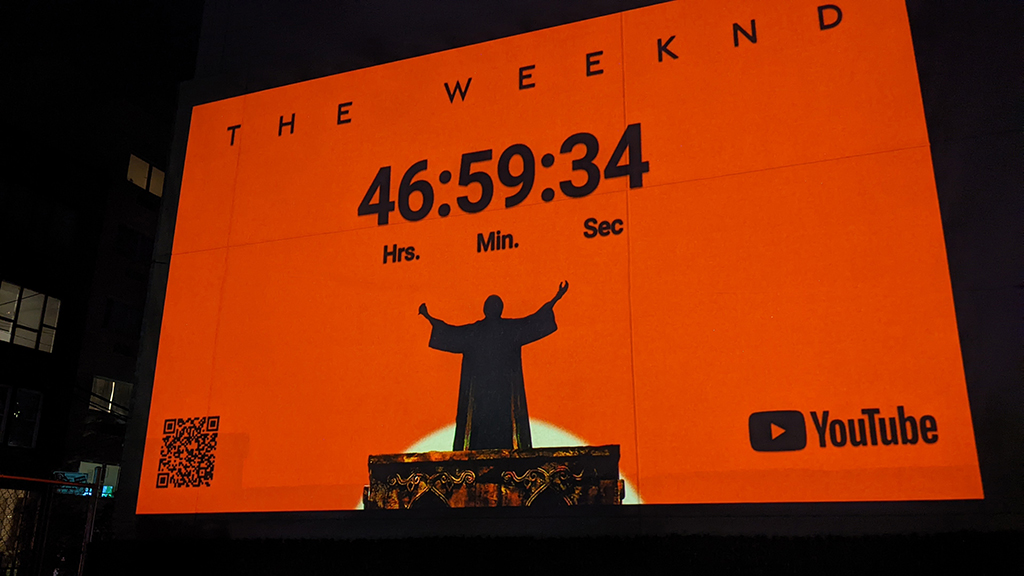
Projection Advertising Los Angeles: A Field Guide from AGM
Los Angeles is one of the best projection advertising markets in the country. Wide streets, warehouse districts, and culture-dense neighborhoods give brands real options for where to land. Here is how we approach projection campaigns in LA.
Los Angeles occupies a unique position in the projection advertising environment. The city has everything projection campaigns need: a density of culturally significant neighborhoods, buildings with large light-colored surfaces ideal for projection, streets wide enough to provide adequate throw distance from most projector positions, and an active street culture at night in the areas that matter most for brand campaigns. It is also one of the world’s most photographed cities, which means that a well-executed projection in a visible LA neighborhood generates social media documentation that travels far beyond the local audience.
We have run projection advertising campaigns across Los Angeles in neighborhoods from the Arts District to Fairfax to Silver Lake to the Sunset Strip. Each of those neighborhoods has a different character, a different nighttime audience, and different physical conditions for projection. The Arts District has large warehouse walls and lower ambient light levels. Fairfax has dense foot traffic and a culturally engaged streetwear audience. The Sunset Strip has the visual competition of some of the most expensive outdoor advertising in the country but also a massive vehicle and foot audience on Friday and Saturday nights. Understanding these differences is what separates a strategically placed projection from a technically functional but strategically misplaced one.
This guide covers projection advertising in Los Angeles specifically: the neighborhoods that work best, the technical conditions in each, how to plan a campaign that serves the brand’s objectives in the LA market, and what distinguishes projection advertising in Los Angeles from the same format in other markets.
Several structural characteristics of Los Angeles make it an exceptionally strong market for projection advertising campaigns.
Building Stock and Surface Quality
Los Angeles has a significant inventory of projection-suitable building surfaces compared to many American cities. The warehouse districts in the Arts District and East LA have large, flat, light-colored concrete and stucco walls that are ideal projection surfaces. The commercial corridors of Melrose, Fairfax, and Sunset have a mix of painted brick and stucco facades that work well with adequate projector output. The newer construction in areas like Koreatown and West Hollywood often features the smooth concrete and glass combinations that require higher output projectors but produce striking projection results when the equipment is sized correctly.
Street Width and Throw Distance
Compared to Manhattan’s narrow grid, Los Angeles has significantly wider streets in most neighborhoods. Wider streets mean greater throw distances are naturally available from across-the-street projector positions, which allows for larger projected images without requiring rooftop positioning. The combination of large building surfaces and adequate throw distance available from street level makes equipment logistics substantially simpler in most LA locations than in comparable New York settings.
Nighttime Culture and Foot Traffic
Los Angeles has a strong nighttime street culture in specific neighborhoods that sustains high foot traffic through late evening hours. The entertainment corridors, nightlife districts, and cultural neighborhoods generate the kind of street activity that gives a building projection a substantial live audience without requiring an event to draw people to the location. Friday and Saturday nights in Fairfax, the Sunset Strip, Silver Lake, and the Arts District can generate street audiences equivalent to major New York neighborhoods at comparable hours.
Entertainment Industry Concentration
Los Angeles is home to the largest concentration of entertainment industry decision-makers and talent of any American city. Music labels, streaming platforms, film studios, and entertainment agencies are all headquartered or have major operations in LA. This concentration means that a projection campaign in a well-chosen LA neighborhood has a high probability of being encountered by exactly the kind of industry decision-makers who influence the brands and projects that use guerrilla projection as a format. The city’s entertainment industry also means that the audience for projection campaigns in LA is typically more sophisticated about brand presence than audiences in other markets, which raises the bar for creative quality but also raises the potential reward for campaigns that meet that bar.
AGM Field Note: In our LA campaigns, the Arts District consistently produces the strongest documentation-to-live-audience ratio of any neighborhood in the city. The combination of large, projectable warehouse walls, a creative and socially active street community, and the visual identity of the neighborhood as a destination for creative professionals means that a well-executed projection in the Arts District generates organic social documentation from people whose networks are disproportionately composed of exactly the audience entertainment and fashion brands are trying to reach.
Key Neighborhoods for Projection Advertising in Los Angeles
Neighborhood
Best For
Surface Notes
Nighttime Traffic
Arts District
Creative brands, fashion, music, streetwear
Large warehouse walls, ideal concrete surfaces
Strong Thursday through Saturday
Fairfax District
Streetwear drops, youth culture, music
Mixed commercial facades, painted stucco
Strong Thursday through Sunday
Silver Lake
Music, independent brands, creative industries
Mixed residential and commercial, varied quality
Strong Friday and Saturday
Sunset Strip
Entertainment, nightlife, film, tech
Competitive ambient light, requires high output
Very Strong Friday and Saturday
Melrose
Fashion, lifestyle, hospitality
Good painted facade stock, walkable blocks
Moderate to Strong evenings
Koreatown
Food and beverage, entertainment, diverse audience
Mixed commercial stock, some newer construction
Strong nightly, peak Friday and Saturday
How Projection Advertising Works Differently in Los Angeles
Brands that have run projection advertising campaigns in New York will find Los Angeles to be operationally different in ways that affect both the logistics of execution and the strategic character of the campaign.
Ambient Light Conditions
Most Los Angeles neighborhoods outside of the densest commercial corridors have lower ambient light levels at night than comparable New York neighborhoods. Lower ambient light means projected content achieves higher contrast relative to the surrounding environment, which translates to stronger visual presence at a given projector output level. A 20,000-lumen projector in the Arts District at 10pm will typically produce a brighter, higher-contrast projection than the same unit in SoHo at the same hour, because the Arts District has less competing ambient light from dense commercial signage and street lighting.
In high-ambient-light locations like the Sunset Strip or Hollywood Boulevard, this dynamic reverses. These corridors compete with some of the most aggressively lit outdoor advertising environments in the country, and projectors with higher output are required to achieve adequate projection brightness relative to the surrounding visual environment. We factor ambient light into equipment selection as a primary variable alongside throw distance and surface quality.
Vehicle vs. Foot Audience
Los Angeles has a higher ratio of vehicle audience to foot audience than New York for most outdoor advertising formats. For projection advertising, this matters because projected content on a building is most effectively engaged with by people who are at street level and stationary or slow-moving, not by people in vehicles. We weight our location selection in LA toward blocks with higher foot traffic and natural stopping points, such as restaurant clusters, retail destinations, and entertainment venue entrances, rather than purely high-traffic vehicle corridors.
Photography Conditions
Los Angeles ambient air quality and the lower building density in most neighborhoods typically produce better projection photography conditions than New York. The wider perspective available from LA streets, the lower surrounding light pollution in warehouse and residential neighborhoods, and the cleaner sightlines available to photography positions all contribute to higher-quality campaign documentation photography in most LA markets. For campaigns where documentation photography quality is a priority, this is a genuine advantage of the LA market.
Campaign Planning for Los Angeles Projection Advertising
Planning a projection advertising campaign in Los Angeles follows the same general structure as any projection campaign, with LA-specific considerations at each stage.
Lead Time
We recommend a minimum of four to six weeks of lead time for LA projection campaigns, the same as our standard recommendation for any market. Site scouting, equipment confirmation, content production, and crew coordination all need to complete in sequence, and compressing the timeline increases risk at every stage. For campaigns that involve a specific location type, such as a pre-scouted locked placement at a particular building, additional lead time may be needed to confirm the location and complete any necessary coordination.
Content Preparation
Content for LA campaigns requires the same technical preparation as content for any market: confirmation of the surface aspect ratio before production finalizes, high-contrast graphic approach, and correct file format and resolution for the confirmed equipment. The LA-specific content consideration is audience sophistication. Los Angeles is a city of high visual literacy, particularly in the creative and entertainment neighborhoods where projection campaigns typically run. Content that would be compelling in other markets may read as generic or underdeveloped to an LA creative and entertainment audience. The bar for visual quality is higher in LA, and brands should allocate content production resources accordingly.
AGM Field Note: For campaigns that run simultaneously in New York and Los Angeles, we frequently recommend developing content with LA’s visual environment in mind and then testing it in New York conditions as well. LA’s wider streets and lower ambient light often allow content with slightly more tonal complexity than New York’s higher-ambient conditions. Content that works well in LA almost always works well in New York, while content optimized purely for New York conditions sometimes loses some of its intended visual character in the different LA environment. Starting with the more demanding creative standard and confirming compatibility across markets is the safer approach.
Projection Advertising Los Angeles Pricing
Projection advertising campaigns in Los Angeles run at $7,500 per projector per night. This rate applies to all markets outside of New York City. Each package includes a 20,000-lumen laser projector, generator, full electronics bundle, mobility unit, and two technicians covering setup, operation throughout the campaign window, and breakdown. Projections begin at dusk and typically run four to six hours. Multi-night campaigns are available at the same per-night rate.
For clients running simultaneous campaigns in Los Angeles and New York City, the per-market rates apply for each city: $6,500 per projector per night in New York City and $7,500 per projector per night in Los Angeles. We coordinate both operations from our central team and deliver a unified proposal and campaign documentation package covering both markets.
Location types available in Los Angeles include pre-scouted locked placements, where a specific building and wall are confirmed before the campaign date, and guerrilla-style flexible placements. We recommend identifying a primary location and a backup for each projector unit, as standard practice for all markets.
Combining Projection Advertising with Other LA Formats
Projection advertising in Los Angeles is most effective when it operates alongside other guerrilla formats that build presence in the target neighborhood before, during, and after the projection nights. Street-level posters installed in the projection neighborhood in the two to four weeks before the projection create visual familiarity with the campaign creative. Street teams deployed in the neighborhood on projection night engage the live street audience and document the projection for social media. LED truck routes on projection night extend the campaign’s visual presence to adjacent neighborhoods and transit corridors.
Los Angeles also offers opportunities that are specific to the market. Mural advertising in the Arts District, Fairfax, and Silver Lake creates durable visual presence that can run for months surrounding a projection campaign night, giving the brand a sustained neighborhood presence that the projection event then punctuates. The combination of a long-running mural and a projection event in the same neighborhood creates a layered campaign that builds audience familiarity over time and delivers a high-impact moment at the campaign’s peak.
LA-Specific Campaign Opportunities for Projection Advertising
Los Angeles offers specific campaign contexts and cultural moments that are either unique to the city or particularly strong in the LA market. Brands planning projection advertising in Los Angeles should be aware of these contexts and consider timing their campaigns to take advantage of them.
Award Season Activations
Award season in Los Angeles, the period running from late fall through spring that includes the Golden Globes, Grammy Awards, Academy Awards, and other major entertainment industry ceremonies, concentrates an extraordinary density of entertainment industry professionals, press, and culturally engaged public in specific Hollywood and West Hollywood neighborhoods. Projection advertising during award season in the corridors and neighborhoods adjacent to ceremony venues and industry gathering spots reaches an audience that has outsized influence on cultural conversation, press coverage, and social media reach. The timing of award season campaigns requires early planning, as demand for guerrilla marketing services during this period is high and the best locations book out well in advance of the events themselves.
Music Festival Season
Southern California’s music festival season, anchored by events in the desert and drawing tens of thousands of music and culture-oriented consumers to the region, creates strong projection advertising opportunities in the days before and after major festivals when audiences are concentrated in Los Angeles. Brands that want to reach this audience in an LA urban context should consider projections in the Arts District, Fairfax, and Silver Lake during the week of major festival events, when the festival-going audience is moving through those neighborhoods in concentrated numbers.
Film Release Campaigns
Los Angeles is the primary market for film release campaigns, and projection advertising in LA during opening weekend of a major release reaches the entertainment industry audience that shapes media coverage and industry conversation about the film’s launch. A projection in West Hollywood or near major entertainment industry gathering spots during opening weekend positions the film brand directly in front of the people whose opinions and social media activity carry the most weight in the industry conversation about the release.
How We Run Projection Advertising Campaigns in Los Angeles
Our operational process for projection advertising campaigns in Los Angeles follows the same structure as our other markets, with LA-specific considerations at each stage that reflect the unique physical and cultural characteristics of the city.
Site surveys in Los Angeles are conducted at campaign operating hours in the target neighborhood. We evaluate building surface quality from the street, confirm available throw distance from potential projector positions, assess ambient light levels at the operating hour in that specific location, and map foot traffic patterns to confirm the campaign will run during the neighborhood’s peak activity window. In Los Angeles, we also evaluate vehicle traffic patterns in neighborhoods where the primary audience is mobile rather than pedestrian, because the relationship between vehicle and foot audiences varies considerably across LA’s neighborhoods and affects how we position equipment and orient the projection for optimal visibility.
Content in Los Angeles is reviewed with the same standards as in all markets: high contrast, correct aspect ratio for the confirmed surface, and motion where the creative supports it. For LA-specific campaigns, we additionally consider the visual sophistication of the target neighborhood’s audience. The Arts District, Fairfax, and Silver Lake audiences have high visual literacy and strong brand awareness that makes generic creative underperform relative to campaigns with strong, original visual concepts. We push for creative ambition in LA because the audience rewards it with stronger documentation and engagement than they give to campaigns that feel familiar or derivative.
Frequently Asked Questions About Projection Advertising in Los Angeles
What neighborhoods in Los Angeles work best for projection advertising?
The Arts District, Fairfax District, Silver Lake, West Hollywood and the Sunset Strip, Melrose, and Koreatown are the most consistently strong neighborhoods for projection advertising in Los Angeles. Each has a different character, audience profile, and physical environment that makes it suitable for different brand campaign objectives.
How much does projection advertising in Los Angeles cost?
Projection advertising in Los Angeles runs $7,500 per projector per night. This is our standard rate for all markets outside New York City. The package includes a 20,000-lumen projector, generator, electronics bundle, mobility unit, and two technicians for setup, operation throughout the campaign window, and breakdown.
How is Los Angeles different from New York for projection advertising?
Los Angeles generally has wider streets and lower building density in key neighborhoods, allowing for longer throw distances and larger projected surfaces from street-level positions. Lower ambient light levels in warehouse and residential areas often produce brighter projections at comparable equipment specs. The audience profile in LA leans more toward entertainment industry and creative professional communities than Manhattan’s mixed commercial and residential density.
Can projection advertising in LA run simultaneously with a New York campaign?
Yes. We coordinate simultaneous multi-city campaigns with field teams in each market. A simultaneous New York and Los Angeles campaign on the same night is a common structure for national brand launches where bi-coastal physical presence on a specific date is a priority. The combined social media documentation from both markets amplifies the campaign’s total reach significantly.
What types of brands run projection advertising campaigns in Los Angeles?
Music labels and artists, film studios and streaming platforms, streetwear and fashion brands, tech companies, and entertainment brands are the most active users of projection advertising in Los Angeles. The city’s entertainment industry concentration makes it a natural market for launch and event-driven projection campaigns, and the culturally engaged creative audience in key neighborhoods produces strong organic documentation from every well-executed campaign.
How does AGM handle location scouting in Los Angeles?
We conduct on-site surveys in the target neighborhood at campaign operating hours. We evaluate building surface quality, available throw distance, ambient light conditions at night, equipment positioning options, and foot traffic patterns before confirming a location. We identify both a primary and backup location for every projector unit as part of standard campaign planning.
Can a projection advertising campaign in LA be combined with other guerrilla formats?
Yes. We frequently combine projection advertising with street-level poster campaigns, mural advertising, LED truck routes, and street team activations in the same neighborhood. The projection serves as the high-impact anchor event while supporting formats build ambient presence before and after the projection nights.
How do I book a projection advertising campaign in Los Angeles with AGM?
Email [email protected] or call (646) 776-2770 with your campaign brief, target neighborhood in LA, and preferred campaign dates. We will confirm location options, equipment configuration, and deliver a detailed itemized proposal within a few business days.