American Guerrilla Marketing

Nationwide serivce

Media planning, media buying, billboard advertising, & guerrilla marketing

College Campus Reconnaissance

University campuses have their own geography, their own pedestrian logic, and their own advertising rules. Our field operators map it all before a single dollar goes into production.

College Campus Reconnaissance

Why University Environments Need Their Own Scouting Approach

Our field team visits every campus we scout in person, walking dormitory corridors, student union adjacencies, and off-campus routes during the academic day to confirm where your audience concentrates. College campuses are not just dense pedestrian environments. They are structured social territories with predictable flow patterns, semi-permeable perimeters, defined gathering zones, and a distinct audience that moves differently from commuters, shoppers, or event crowds. The scouting methodology that works in a downtown retail corridor does not map cleanly onto a 300-acre research university campus.

AGM’s nationwide field network supports College Campus Reconnaissance engagements in every major US market. Our College Campus Reconnaissance methodology is consistent everywhere: operators walk campuses on foot during the academic day, document dormitory adjacencies and student union foot traffic, and GPS-confirm viable surfaces before any College Campus Reconnaissance location enters a client report. Contact AGM to start your College Campus Reconnaissance brief.


Student Movement Data Changes Campus Campaign Outcomes

Campaign performance lives and dies on location selection. Campus location selection is driven by actual student movement data — observed foot traffic, class-change corridors, and high-dwell outdoor zones determine every recommendation.

How We Do It

Our college campus reconnaissance process works in four phases. First, we map the campus pedestrian flow grid: the class-change corridors, the dining hall approach routes, the library-to-dorm pathways that repeat multiple times daily. Second, we document the specific zones within that flow grid where dwell time is highest — seating areas, crosswalk wait points, covered walkway clusters. Third, we assess on-campus placement options: kiosks, bulletin boards, chalked surfaces, and permissioned exterior walls. Fourth, we document the off-campus commercial zone immediately adjacent to campus, which often outperforms on-campus placements for certain campaign types because permit complexity is lower and wall inventory is higher.

This service type is led by AGM field operators Rachel Odom and Jake Schuler, who between them have completed college campus reconnaissance for brands across more than 95 universities in 38 states. Every recommendation in their briefs comes from an operator who physically walked the location. That’s the only standard they work to.

Effective College Campus Reconnaissance requires specialists who understand campus pedestrian dynamics at a technical level. AGM’s College Campus Reconnaissance operators know how student movement patterns shift by hour, day, and academic calendar, which campus zones generate the highest dwell time, and what the physical and regulatory requirements are for placement at the specific institutions in the target market.

At USC, the pedestrian spine between Trousdale Parkway and the Village runs at different densities depending on the hour and the day of the week. At Ohio State, the zone from High Street through South Oval behaves one way on a football Saturday and a completely different way on a Tuesday at noon. At NYU, the boundaries between campus and city barely exist, which creates an entirely different set of placement opportunities and complications than a residential campus with defined gates.

Our field operators approach each university as a specific territory requiring a specific map. They walk the pedestrian corridors, note the transition zones between on-campus and off-campus foot traffic, identify the off-campus neighborhoods where students actually spend their leisure time, and document where brands have and have not appeared before in the activation landscape.

For College Campus Reconnaissance campaigns, AGM brings boots-on-the-ground field intelligence from a nationwide operator network covering all 50 states. The College Campus Reconnaissance data behind every report is built from real field visits — operators walking campuses on foot, not pulling filtered databases. Get in touch to access our existing College Campus Reconnaissance field documentation.
We’ve run guerrilla marketing campaigns nationwide for over a decade. AGM’s field operators have boots-on-the-ground experience across every major US media market, and our portfolio of firsthand location intelligence is updated through active field visits — not aggregated data. Contact AGM to access that intelligence for your campaign.

What We Scout on a University Campus

Pedestrian Corridors Between Buildings

The paths students take between academic buildings are the highest-concentration pedestrian zones on most campuses, and they run on class-change schedules that are completely predictable. Between 9:50 and 10:05 on a Tuesday morning, the walkway between the science quad and the humanities buildings at Boston University pushes thousands of students past a fixed point. Our operators document these corridors with directional counts during actual class-change windows to give you real numbers, not estimates.

Corridor scouting covers: surface type and condition on adjacent walls and pavement, approved bulletin board and kiosk locations, sightline lengths that determine effective poster format sizes, and the physical obstacles (trees, benches, bike racks) that affect activation footprint at each choke point.

Dining Hall Approach Zones

Dining halls draw the most predictable foot traffic on campus, running three peak windows per day with consistent volume across the week. The approach zones, the 50 to 200 feet of sidewalk and plaza leading to each dining facility, are prime real estate for sidewalk stencils, decals, and hand-to-hand distribution. At the University of Texas at Austin, the approach to Jester Center dining pulls students from four directions through a plaza that works as a natural gathering point before the 6 p.m. dinner rush.

Student Union Zones

Student unions serve as the central social hubs on most residential campuses, combining food, study space, event facilities, and student organization offices. The exterior plaza areas surrounding student unions are often among the few on-campus spaces where temporary brand activations are possible with proper permits. Our operators document the permit application process for each union’s exterior activation space and photograph all adjacent surface opportunities.

Greek Row and Residential Corridors

Greek row streets and the blocks surrounding dormitory clusters serve a different audience segment than academic corridors: students in residential mode rather than academic mode. These zones see peak traffic during evening hours and on weekends, and the adjacent street walls frequently fall outside campus jurisdiction, making them more accessible for wheatpaste campaigns and snipe advertising than on-campus walls. At the University of Michigan, the blocks along South State Street running toward the Hill neighborhood carry significant student foot traffic that extends well past 11 p.m. on weekends.

Off-Campus Bars and Coffee Shops

The bars, coffee shops, and restaurants in the two or three blocks immediately surrounding every major campus are frequently the most effective targeting environments for brands trying to reach students. These venues are outside campus jurisdiction, have established relationships with local advertisers, and attract the specific student demographic in a social context where advertising encounters feel less institutional. At UCLA, the Westwood Village corridor along Broxton Avenue pulls undergraduates seven days a week. At Boston University, the Commonwealth Avenue corridor between Kenmore Square and the BU Bridge is dense with both student venues and student-appropriate wall surfaces.

Sports Facility Approach Corridors

For campaigns with sports or lifestyle brand relevance, the routes from student residential areas to athletic facilities are high-value scouting targets. These corridors see concentrated traffic from a self-selected fitness and sports-interested audience during morning and early evening hours. Our operators document surface inventory, lighting conditions, and the pedestrian direction of travel on these routes at peak hours.

Approved Posting Zones on Campus

Most universities maintain designated posting zones: specific kiosk boards, columns, or bulletin surfaces where outside advertising is permitted with an approved permit. Our scouting identifies every approved posting surface on campus, documents the permit application process and required lead times, and photographs current occupancy to assess competition levels in the space.

Universities We Have Scouted And Know Well

Our operator network has conducted field reconnaissance at dozens of university campuses across the country. A partial list of campuses where we have active field knowledge includes:

  • USC (University of Southern California), Los Angeles: Trousdale Parkway spine, Village retail corridor at Jefferson and Hoover, off-campus bar cluster on Figueroa Street
  • UCLA, Westwood: Bruin Walk corridor, Westwood Village off-campus retail and bar zone, residential corridor on Gayley Avenue
  • University of Michigan, Ann Arbor: State Street corridor, South University Avenue bar strip, Hill neighborhood residential blocks, Michigan Stadium approach on game days
  • Ohio State University, Columbus: High Street corridor from campus to Short North, South Oval pedestrian spine, Lane Avenue bar district
  • NYU, New York City: Washington Square Park perimeter, Broadway corridor through NoHo, bleecker Street coffee shop cluster, campus-adjacent subway exits at 8th Street and West 4th
  • Boston University, Boston: Commonwealth Avenue corridor, Kenmore Square adjacency, Bay State Road residential stretch, Comm Ave bar strip
  • University of Texas at Austin, Austin: Guadalupe Street “Drag” retail corridor, 6th Street bar district approach from campus, Jester Center plaza, West Campus residential density
  • University of Illinois Urbana-Champaign: Green Street retail and bar corridor, Campustown commercial zone, dormitory cluster at PAR and Allen Hall
  • Penn State, State College: College Avenue downtown, Allen Street bar cluster, East Halls residential approach
  • University of Georgia, Athens: College Avenue downtown, Five Points neighborhood, Milledge Avenue Greek row
  • Columbia University, New York City: Broadway corridor along Morningside Heights, Amsterdam Avenue retail block, Riverside Park adjacent path
  • University of North Carolina at Chapel Hill: Franklin Street retail and bar corridor, Henderson Street pedestrian spine, Carrboro neighborhood spill zone
  • University of Florida, Gainesville: University Avenue corridor, Midtown district bar and restaurant cluster, Southwest 13th Street approach
  • Georgetown University, Washington D.C.: M Street commercial corridor in Georgetown, Wisconsin Avenue approach, Prospect Street off-campus residential

Certified placement experts with licensed field credentials manage the college campus reconnaissance inventory — every recommended surface assessed firsthand before entering the active placement record.

Every surface in the college campus reconnaissance placement inventory was assessed by a certified field expert — licensed professional operators who confirm access, evaluate conditions, and document what they find.

Targeting Students At A Specific University?

    Award Winning Personalized Service

    You will get thoughtful, devoted, and individualized attention from our experienced, qualified, and professional personnel. Being one of the most illustrious agencies in Brooklyn, New York, American Guerrilla Marketing has been awarded the Best of Brooklyn title.

    Nationwide

    Industry City, Brooklyn, New York 11232

    American Guerrilla Marketing

    +1 (646) 776-2770

    [email protected]

    Telegram: @americanguerillamarketing

    Hours

    Mon - Fri: 9 AM - 5 PM

    Sat & Sun: Closed

    Automate your campaign with AGM’s Request for Proposal Builder.

    Automate your campaign with AGM’s Request for Proposal Builder. Simply answer a few quick questions about your campaign goals, markets, and timeline, and the system will generate a tailored presentation with recommended strategies, quantities, and pricing. Click the RFP Builder to instantly receive your customized proposal.

    Campus Activation Formats That Work

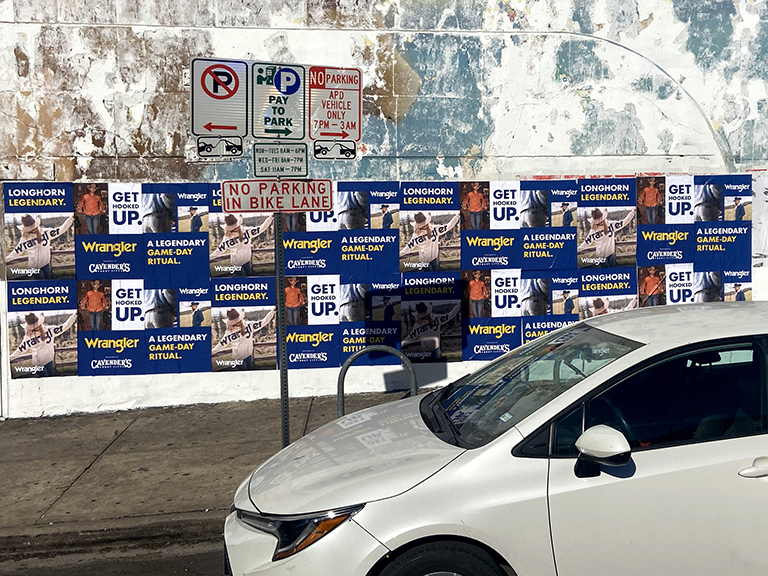
    Wheatpaste on Off-Campus Walls

    The blocks immediately surrounding most major university campuses have established posting traditions. Building owners in high-student-traffic areas are often familiar with wheatpaste campaigns and have existing relationships with advertisers. Our campus scouting specifically documents off-campus wall inventory within a three-block radius of the main campus perimeter, and identifies surfaces with documented posting history that signals a receptive environment. Learn more about wheatpaste poster campaigns.

    Street Teams at Campus Entry Points

    The gates, transit stops, and natural pedestrian entry points to major campuses are hand-to-hand distribution gold. At peak commute and class-change windows, single operators can reach thousands of students per hour at the right campus gate. Our scouting documents the exact entry point hierarchy: which gates carry the most foot traffic, at what hours, and where engagement space allows a team member to actually stop and interact rather than just hand something off in passing. See how brand ambassador programs work at campus scale.

    Snipe Advertising on Routes from Campus to Housing

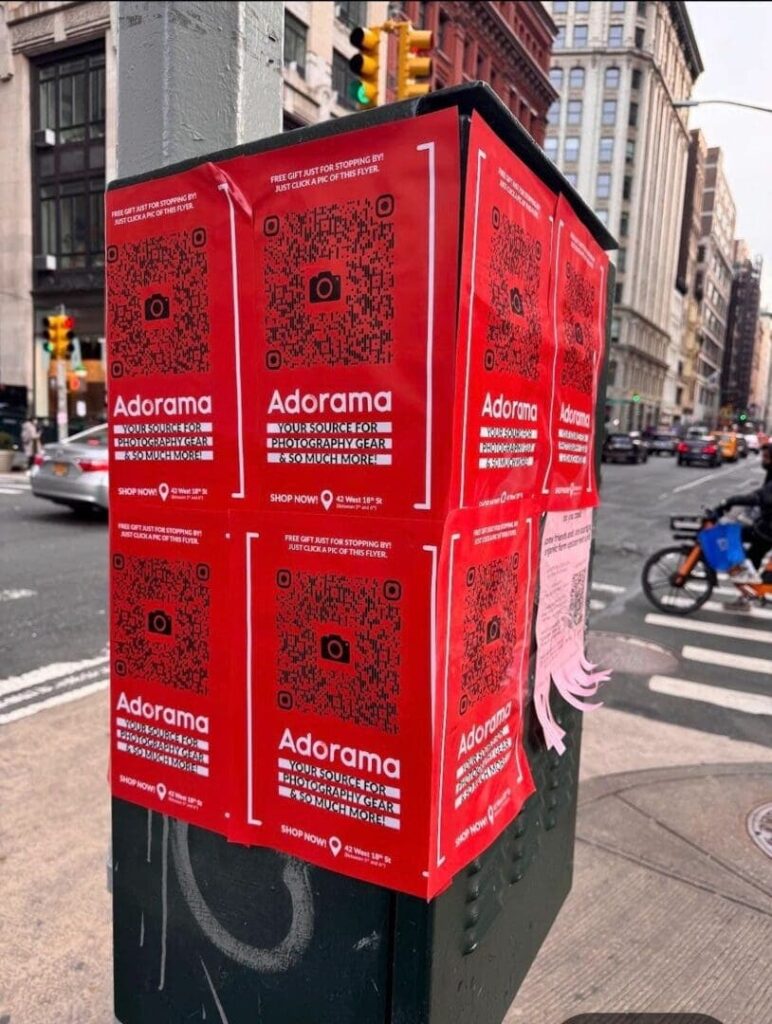
    The utility poles, traffic control boxes, and fixed surfaces on the blocks connecting campus to off-campus student housing clusters are consistently high-visibility for the student audience. Students walk these routes multiple times per day. Snipe placements on these corridors accumulate repeated impressions from the same individuals over a campaign window. Our operators map the exact pole inventory on priority student commute routes and document surface condition and hardware compatibility for snipe advertising formats.

    Sidewalk Stencils at Dining Hall Entrances

    Dining hall entrances produce predictable foot traffic concentration at specific hours. The pavement in front of dining facilities is frequently high-quality concrete with minimal surface contamination, making it one of the better environments for sidewalk stencil placements. Our operators document pavement material, condition, and the exact approach geometry at each dining facility.

    Bar Takeovers Near Campus

    For brands where bar environments fit the audience and the product, a venue takeover at a campus-adjacent bar reaches the student demographic in their social context rather than their academic context. The difference in receptivity is significant. Our guerrilla marketing services team has executed bar takeovers at venues serving students near campuses across the country. Campus scouting identifies the right venue: the one with the student demographic mix, the ownership structure that is open to brand partnerships, and the interior footprint that supports an activation.

    Deliverables: What the Campus Reconnaissance Report Includes

    The college campus reconnaissance report is structured differently from a standard urban scouting report because the decision environment is different. Permit requirements are layered (university policy plus municipal code). Property ownership switches from campus to private within a single block. And the audience moves on a schedule that is unique to the academic calendar.

    Campus Pedestrian Flow Map

    A documented map of primary pedestrian corridors, secondary paths, and key gathering nodes with directional flow notes and time-of-day volume observations. This is hand-documented by a field operator walking the campus, not pulled from a data platform.

    Approved Posting Zone Inventory

    A complete list of every approved bulletin, kiosk, and posting surface on campus, with the permit application pathway for each, current occupancy photographs, and format dimension specifications for production planning.

    Off-Campus Surface and Venue Inventory

    A block-by-block inventory of the three-to-five-block radius surrounding campus, covering wall surfaces accessible for wheatpaste or mural formats, bar and venue shortlist with ownership identification, pole and fixture inventory for snipe formats, and pavement surface assessment for decal and stencil formats.

    Activation Timing Windows

    A documented schedule of peak traffic windows at priority locations, cross-referenced with the academic calendar for the target semester. Class-change windows, meal rush times, event nights, and weekend behavior are all documented separately because they represent different audience volumes and different audience states.

    Property Owner Contact Status

    For surfaces requiring owner permission, the report documents the property owner identity, initial contact status, and any preliminary response to the inquiry. We do not leave this unresolved in the deliverable.

    Bar and Venue Scouting

    Bar and Venue Scouting

    The right venue reaches your audience when they are relaxed, social, and receptive. Finding that venue requires field research, not a Yelp search. We identify and vet the bars, restaurants, and nightlife spots that match your brand and your target audience.

    Learn More
    Building Projection Scouting

    Building Projection Scouting

    Projection media is technically demanding before it is creatively demanding. The geometry has to work. The ambient light has to cooperate. The wall has to take the image. We scout all of it before you book the equipment.

    Learn More

    All Scouting Services

    College Campus Reconnaissance

    College Campus Reconnaissance

    University campuses have their own geography, their own pedestrian logic, and their own advertising rules. Our field operators map it all before a single dollar goes into production.

    Learn More
    Corporate Campus Reconnaissance

    Corporate Campus Reconnaissance

    AGM scouts corporate campuses, office parks, and business districts to identify the pedestrian zones, commuter corridors, parking approaches, and surface inventory where guerrilla marketing campaigns reach employees, contractors, and visitors at their daily access points.

    Learn More
    Event and Festival Scouting

    Event and Festival Scouting

    The best opportunity to reach a defined audience in a concentrated geographic zone happens in the hours before and after a major event. We map the entire perimeter, document every approach route, and rank every activation zone before the crowd arrives.

    Learn More
    Guerrilla Activation Scouting

    Guerrilla Activation Scouting

    A brand stunt in the wrong plaza is a brand stunt nobody sees. We find the exact intersection, courtyard, or public space where your target audience concentrates, document the logistics, research the permits, and hand you a site that works.

    Learn More
    Mobile Billboard Route Scouting

    Mobile Billboard Route Scouting

    A billboard truck running the wrong corridor delivers impressions to an audience that was never the target. We map the routes that put your LED or static display in front of the specific people you need to reach, at the times they are actually there.

    Learn More
    Mural Location Scouting

    Mural Location Scouting

    A mural is a permanent statement. The wall you choose determines whether it gets seen by thousands daily or disappears behind a dumpster. We find the right wall before your production team touches a brush.

    Learn More
    Neighborhood Distribution Scouting

    Neighborhood Distribution Scouting

    Distribution campaigns fail when the neighborhood data is wrong. A door hanger campaign in the wrong building type, the wrong demographic zone, or a neighborhood with access barriers the crew was not briefed on burns print and labor on zero-return addresses. We fix that before the crew goes out.

    Learn More
    Pop-Up Location Scouting

    Pop-Up Location Scouting

    Actually, A mobile boutique parked in the wrong block is invisible to the audience you paid to reach. We find the locations where your pop-up will attract the people it needs, and document everything from loading access to permit requirements before you commit to a date.

    Learn More
    Street Advertising Location Scouting

    Street Advertising Location Scouting

    Snipe placements, sidewalk decals, and stencil campaigns all depend on knowing the specific poles, pavement, and intersections that your audience actually passes. We map that territory before your crew hits the street.

    Learn More
    Street Team Location Scouting

    Street Team Location Scouting

    Brand ambassadors are only as effective as the zone they are deployed in. We identify the intersections, transit stops, and venue approaches where your exact target demographic concentrates, count the traffic, and confirm the deployment makes sense before your team hits the street.

    Learn More
    Transit Adjacency Scouting

    Transit Adjacency Scouting

    Subway exits, bus stops, and train stations concentrate thousands of people at defined physical points on a predictable daily schedule. We map those points, document the surface inventory within reach, and profile the commuter audience by line, exit, and time window.

    Learn More
    Wheatpaste Location Scouting

    Wheatpaste Location Scouting

    A wheatpaste campaign lives or dies on wall selection. The wrong surface peels in 48 hours. The wrong neighborhood tears posters down before the paste dries. We find the walls that work, in the neighborhoods where posting belongs.

    Learn More

    What Brands Use AGM College Campus Reconnaissance For

    Consumer Tech and App Launches

    Consumer apps, fintech products, and software brands use campus scouting to identify the specific quads, dining corridors, and transit stops where the 18-24 demographic concentrates before deploying street team and wheatpaste posting campaigns around product launches.

    Food, Beverage, and CPG Brands

    Consumer packaged goods brands targeting the college demographic use campus reconnaissance to map the off-campus bars, coffee shops, and convenience corridors where students spend most of their non-classroom time — the placement zones that deliver the highest frequency contact with the target audience.

    Recruiting and Graduate Programs

    MBA programs, graduate schools, and employers targeting specific university talent pools use campus scouting to identify the highest-exposure placement surfaces near relevant academic departments, career center corridors, and the commuter routes that graduating seniors use daily.

    Music and Entertainment Brands

    Labels, streaming platforms, and tour promoters targeting the college audience brief us around academic calendar windows — first weeks of fall semester, spring concert season, and graduation weekends — to ensure placements land when campus foot traffic peaks.

    Frequently Asked Questions About College Campus Reconnaissance

    Most universities permit some forms of advertising on campus property through a permit or sponsorship process administered by the student affairs or events office. The permitted formats typically include approved bulletin boards, kiosk surfaces, and event tables in designated locations. On-campus wheatpaste or unauthorized posting is generally not permitted and carries removal risk. Our scouting distinguishes clearly between permitted on-campus surfaces and off-campus opportunities that fall under municipal rather than university jurisdiction.

    Standard campus reconnaissance covers the campus perimeter plus a three-to-five-block radius in the surrounding off-campus neighborhood. The exact radius depends on the campus geography and the student residential pattern. For campuses where students live further afield, such as many urban university settings, we extend the off-campus scope to cover the documented student residential and social corridors rather than applying a fixed geographic radius.

    Yes. If your campaign targets a specific student segment, such as graduate students versus undergraduates, athletes, Greek-affiliated students, or students in specific academic departments, we adjust the scouting scope to prioritize the zones where that specific segment concentrates. Graduate student housing areas, athletic facility approaches, Greek row, and department-specific building corridors all serve distinct sub-populations within the broader campus audience.

    The academic calendar drives everything. Fall semester back-to-school windows, typically late August through September, and spring semester re-entry, typically late January, are peak awareness moments when students are actively forming habits and routines. Campaign timing tied to these windows benefits from higher-than-average student engagement with their environment. We advise against launching campus campaigns during finals periods, winter break, and spring break, when campus populations drop sharply.

    Campus scouting requires an understanding of the academic schedule, campus-specific permit systems, the distinction between campus and municipal jurisdiction on a block-by-block basis, and the specific social geography of university life, including Greek row social patterns, athletic event schedules, and off-campus social corridors. Our operators who conduct campus work are familiar with these layers and know to document the permit pathway for each surface rather than treating all outdoor surfaces as equivalent opportunities.

    Yes. Bar and venue identification for campus-adjacent nightlife is a standard component of college campus reconnaissance. We document venue type, estimated capacity, ownership contact, current brand partnership history where visible, and interior footprint notes from a walk-through assessment. This feeds directly into a bar takeover or venue activation planning process. For a deeper dive on this format, see our dedicated bar and venue scouting service.

    We scout any educational institution where the target audience warrants the investment. Community colleges often have more permeable perimeters and more off-campus student concentration than residential universities, which changes the scouting approach. Technical schools, trade programs, and professional graduate campuses each have their own foot traffic logic that we document specifically rather than applying a one-size template.

    Yes. Many clients commission a single campus reconnaissance report that covers multiple format types: wheatpaste wall inventory, snipe pole inventory, street team deployment zones, venue shortlist, and on-campus posting surface inventory all in one document. This is more cost-effective than commissioning separate reports for each format and gives the creative and planning team a unified view of the full campus media environment.

    Urban embedded campuses, NYU in Greenwich Village, Columbia in Morningside Heights, Drexel and Penn in West Philadelphia, require a different spatial approach than residential campuses. Rather than mapping from a defined perimeter, we identify the key zones where student foot traffic is concentrated and map outward from those nodes. Transit exit scouting often becomes central to urban campus work because students move from the subway into the campus environment rather than from a parking lot or campus gate.

    Standard delivery is 7 to 10 business days from confirmed brief receipt. For time-sensitive launches tied to semester start dates or specific campus events, we can assess rush availability depending on field operator schedules in the target market. Brief us as early as possible before a semester launch window to ensure adequate lead time for scouting, report delivery, permit applications, and production.

    AGM Scouting Coverage: All 50 States and D.C.

    AGM operates a national network of field operators. We have scouted campaigns in every U.S. state and the District of Columbia. Whether your campaign targets a dense urban core or a suburban retail corridor, we have operators who know the territory.

    No locations found

    American Guerrilla Marketing Blog Posts